Talks will focus on the €1 billion daily deficit and rare earth export restrictions.
Published On 7 Oct 20267 Oct 2026
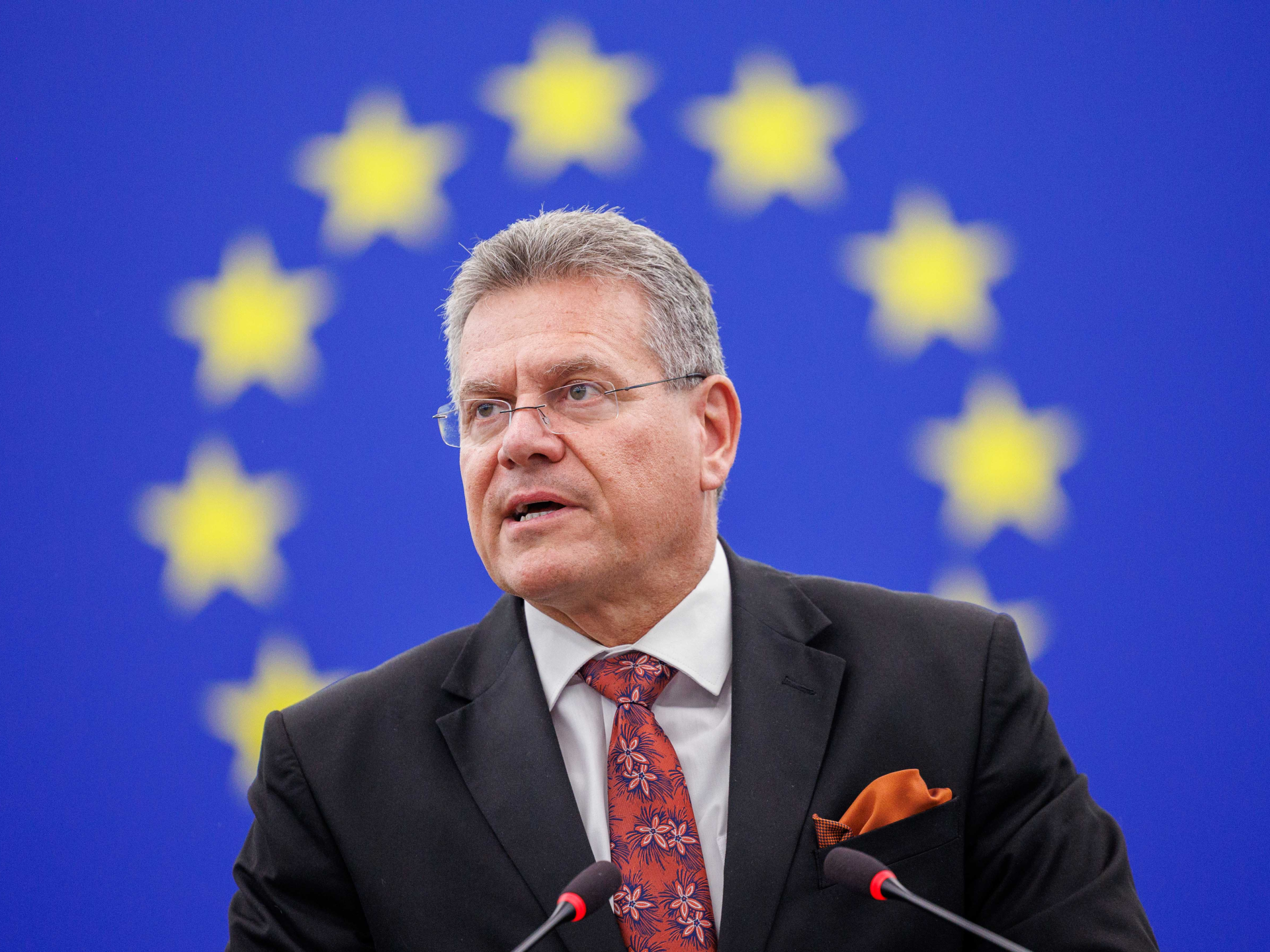
European Trade Commissioner Maros Sefcovic has arrived in Beijing for talks on the European Union’s (EU) growing trade deficit with China.
Sefcovic will meet Chinese Commerce Minister Wang Wentao on Thursday and Friday after months of discussions over the EU’s trade deficit of more than €1bn ($1.12bn) daily, as well as Chinese curbs on exports of rare earths and other critical minerals.
Recommended Stories
list of 3 itemsend of list
Meanwhile, Chinese companies are increasingly challenging Europe’s top car brands. China rejected the EU request for voluntary curbs on Chinese hybrid car exports as the two sides enter negotiations, the Financial Times reported on Wednesday. The European Commission now hopes to get Beijing to accept a unilateral EU measure to cap hybrid imports instead, the outlet said, citing two diplomats briefed on the plan.
The two days of discussions come just as a majority of EU lawmakers called for a more assertive trade policy towards Beijing in a non-binding resolution on Wednesday. China vowed a “resolute response” to safeguard its industries if the European Union goes ahead with restrictions against Chinese companies or products, according to its commerce ministry.
Germany and France propose rapid EU measure
French President Emmanuel Macron and German Chancellor Friedrich Merz, leaders of the bloc’s two biggest powers, on Tuesday urged the EU to prepare a “credible instrument” that could be quickly activated to strike back against countries that harm the bloc economically.
The new measure would not target any specific country. German officials said the EU needed a tool as powerful as the Section 301 tariffs imposed by the United States or China’s restrictions on critical-mineral exports.
The proposed weapon – to be discussed at an EU leaders’ summit next week – would give the European Commission the power to respond to a trade aggression within days.
China responded to the letter by urging Paris and Berlin to steer clear of “protectionist” measures.
“We hope that France and Germany, as major economies in the world, will uphold openness, cooperation and free trade,” the commerce ministry said in a statement.
“They should avoid going down the wrong path in the wrong way, only to ultimately suffer the consequences themselves.”
G20 finance leaders, except China’s, agreed in September to act against “non-market” distortions that exacerbate imbalances. Beijing says that hyping up issues such as economic imbalances and overcapacity is a form of protectionism designed to exert pressure on and restrict China.
Ongoing trade talks
EU and Chinese officials have been discussing trade imbalances since June. Sefcovic said he wanted “tangible results by October” as well as some form of commitment that can be put to EU leaders meeting in Brussels.
Trade relations with China top the summit’s agenda next week, as ballooning debt has prompted auditors to warn about the next seven-year EU budget and has spurred protests in France.
European Commission President Ursula von der Leyen told the European Parliament last month that the trade imbalance had reached a tipping point and that Europe would use every tool at its disposal to rebalance the relationship.
Carney declared the pipeline a project of national interest, smoothening its way to a single federal regulatory review process.
Published On 1 Oct 20261 Oct 2026
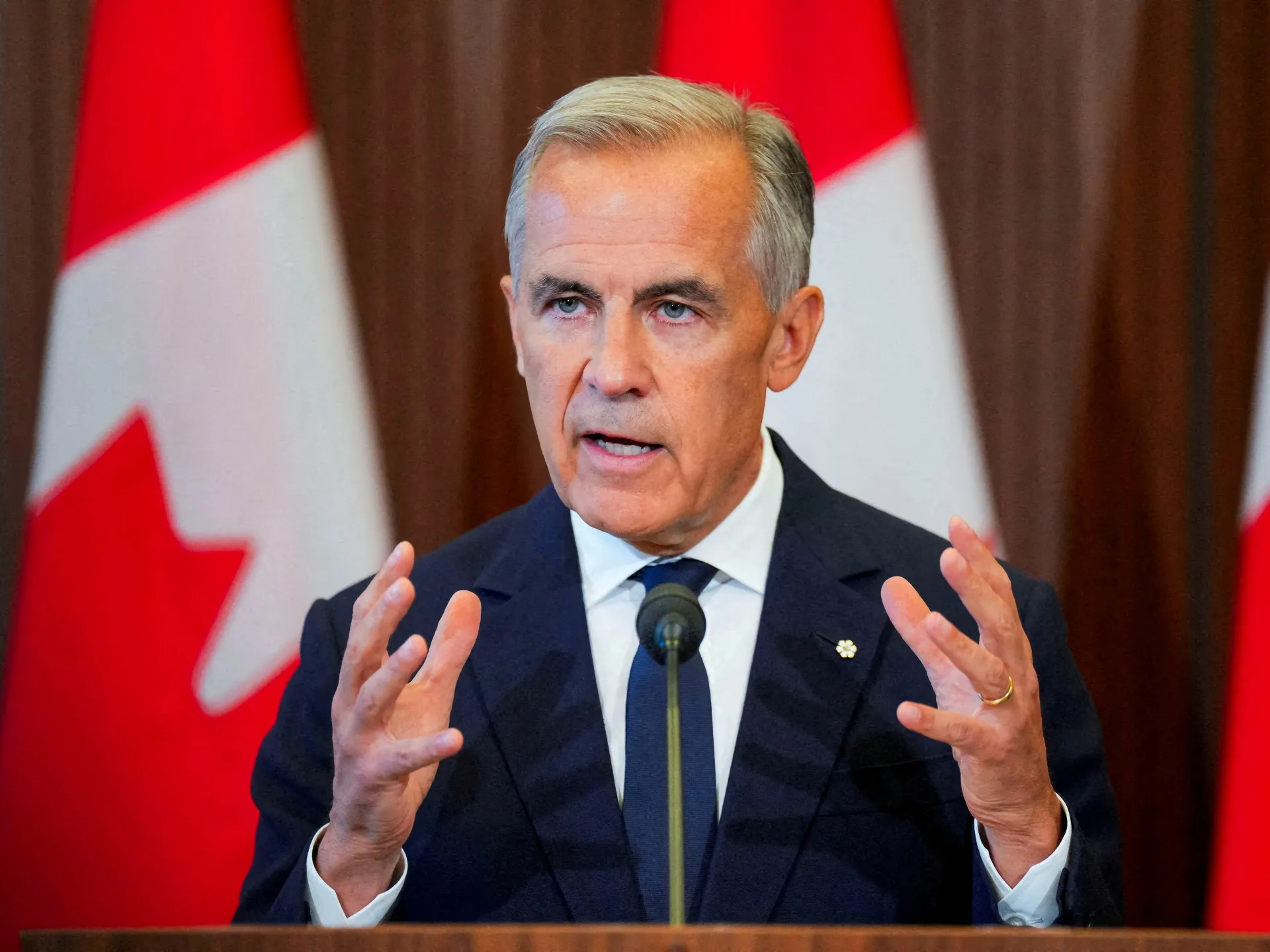
Canada will fast track the approval process for a new proposed crude oil export pipeline to its west coast that could generate billions in revenue and boost economic growth, Prime Minister Mark Carney has said.
Carney made the announcement on Thursday to fast-track the pipeline, which is a crucial part of his bid to diversify the economy away from the United States and help lessen the effect of US President Donald Trump’s tariffs.
Recommended Stories
list of 4 itemsend of list
Carney said Ottawa is officially listing the Pacific Link pipeline, which had been announced in July, as a project of national interest. That will ensure it proceeds through a single federal regulatory review process. He said Ottawa aimed to complete the process by September 1, 2027.
“A pipeline to the west coast is part of our mission to transform our economy, to double our non-US exports over the next decade … [and] to unlock our full potential as a global energy superpower,” he told reporters in Fort McMurray, hub of Alberta’s tar sands industry.
Ottawa says the 1 million barrel a day project would create 140,000 jobs and generate more than 20 billion Canadian dollars ($14bn) in gross domestic product (GDP) per year and 100 billion Canadian dollars ($70bn) in government revenue by 2060.
Canada currently has just one east-west oil export pipeline in Canada, the 890,000-barrel-per-day Trans Mountain pipeline. An expansion of that pipeline was completed in 2024, but it is already running at capacity.
For years, Canada has sent more than 90 percent of its crude oil exports to the US via pipeline. A new oil export pipeline could make Canada a major global energy supplier, as Asia’s top importers seek oil from outside the Middle East in the wake of the Iran conflict.
Filling the pipeline, however, would require new tar sands expansions of the type no company has undertaken in more than a decade.
The pipeline will be built by government-owned Trans Mountain Corp in coordination with Pembina Pipeline Corp. Alberta estimates it could cost between 35.2 billion Canadian dollars and 43.7 billion Canadian dollars ($24.7bn – $30.7bn).
The majority owners will be the federal government and the government of Alberta. Indigenous communities will be offered a minimum of 10 percent ownership interest.
Previous oil pipeline projects in Canada have faced strong opposition from environmentalists and Indigenous groups, resulting in the cancellation of some projects and leading to cost overruns and construction delays with others.
Alberta separatism
Carney made the announcement alongside Alberta Premier Danielle Smith in Fort McMurray in the heart of Canada’s tar sands, a move meant to mend relations with oil-rich Alberta as separatists push for a referendum on leaving Canada.
Alberta is holding a public vote on October 19 on whether to hold a referendum on leaving Canada. Smith has long complained that Carney’s predecessor, Justin Trudeau, hindered Alberta’s energy industry and fuelled separatist sentiment.
Smith said she would vote to keep Alberta in Canada and called the roughly 22 percent support for separation in a recent poll “still too high for my liking”.
“I don’t like the fact that many of our fellow citizens have given up on Canada,” Smith said, adding that the pipeline was an example of how “cooperative federalism can work in action”.
Asked what message Albertans considering separation should take from the announcement, Carney said it demonstrated that “Canada is working” and showed what the country could achieve by acting together.
New Delhi, India — Speaking at an event in New York this week, India’s Foreign Affairs Minister S Jaishankar offered a blunt assessment of Washington: It has been an insensitive partner to India’s concerns over “terrorism”; has warmed to its arch-rival Pakistan; and has pursued “self-centered” trade policies that have disproportionately hurt the Global South.
That tone marks a new edge in how New Delhi is dealing with US President Donald Trump’s administration in Washington, analysts say, on the back of rising bilateral tensions between the capitals.
For decades, India has dealt with divisive issues with otherwise friendly nations quietly behind the scenes, away from spectacle. That has especially been New Delhi’s approach with Washington, where the relationship has broadly enjoyed wide bipartisan support.
However, after months of tensions, New Delhi is adopting a more openly critical tone towards Washington to address the volatility and uncertainty that Trump brings to the White House.
The changing tune in New Delhi also comes at a critical time for Prime Minister Narendra Modi, who faces mounting domestic pressure and criticism from the opposition for allegedly bowing down to US pressure, time and again. On Wednesday, Modi held a telephone call with Trump, which the Indian PM called “productive” — a cold and formal depiction far removed from his description of the US president as a “good friend” in previous years.
Chietigj Bajpaee, a senior research fellow for South Asia at the Chatham House think tank, said that Jaishankar’s remarks “offer a frank assessment” on the current state of the India-US relationship. “Clearly, the shine has come off the bilateral relationship after India was initially among the most optimistic about a second Trump term,” he said.
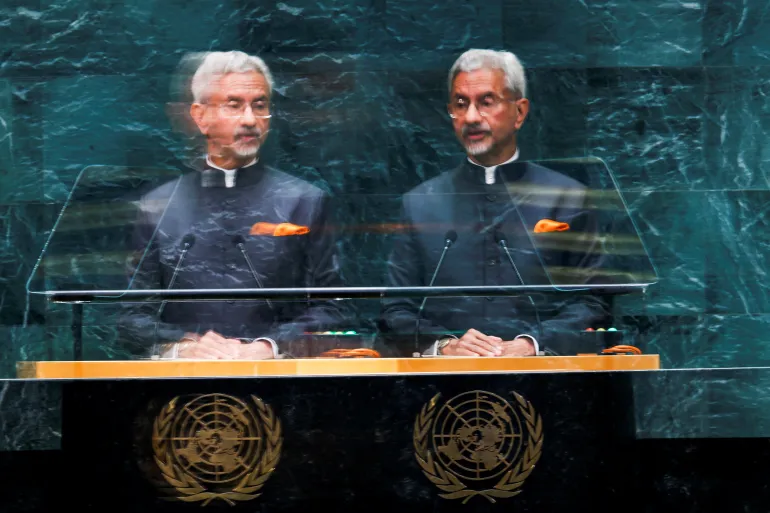
Indian Minister of External Affairs Subrahmanyam Jaishankar addresses the 81st United Nations General Assembly at UN headquarters in New York City, US, September 26, 2026 [Eduardo Munoz/Reuters]
India’s pain points
Jaishankar addressed frictions between India and the US while speaking at an Asia Society event after the UN General Assembly in New York ended on Monday.
“If I stand back and look at the [India-US] relationship, I note that much of the world has had a more difficult relationship with the US,” he said. “I mean that may not be a consolation, but that’s a reality.”
Trade
Trade has been one of the flashpoints. Washington is India’s largest trading partner, with bilateral goods trade reaching $149.1 billion in 2025; but the relationship remains tilted towards India with a $58.4 billion goods surplus.
Jaishankar started by noting: “Countries should not be so self-centred that you’re in your own world and take your decision and say, ‘Well, it was not my intention to make your life difficult’.”
The minister was partly referring to the economic spillover of the wars in Iran and Ukraine, urging that “sound common sense” should ensure that the basic needs of countries were not neglected.
But then, he referred to the trade negotiations between India and the US, that have so far yielded a roadmap to a deal — but not a deal itself. “Apart from the per capita gap between India and the United States, the nature of production and the nature of society is very different,” he noted.
The agricultural sector has been among the most contested points between the two, where India has kept its market largely closed for decades to safeguard its farmers. “The expectation that it could rapidly move forward was tested against the ground reality, which was much more complex,” he said, adding that “there is more or less an understanding on the trade agreement.”
At one point, India was among the countries facing the worst tariff rates imposed by Trump. After the US Supreme Court struck down Trump’s sweeping tariffs in February, his administration swiftly turned to other tools, including a new 10 percent global tariff. Earlier this month, Trump signed a law under which the US can impose up to 100 percent tariffs on countries like India that purchase Russian oil.
Jaishankar pointed to these changes, noting that the negotiations created “bumps last year for the relationship,” and added that once the deal is closed, it “would contribute to a better relationship.”
Ajay Bisaria, a retired diplomat who served as high commissioner to Canada and Pakistan, and as ambassador to Poland, told Al Jazeera that with Washington, in particular, “India has decided to be more public because there has been a lot of public criticism and a sentiment that the US is bullying India and India has been silent.”
The new 100 percent tariff on India, due to come into effect in less than a month, “is sort of a deal breaker in the relationship right now,” said Bisaria. “If that becomes reality, then all Indian efforts [to reach out to the US] would come under scrutiny.”
‘Terrorism’
But trade isn’t the only challenge in the relationship. A major rupture emerged in May last year, when New Delhi engaged in a four-day war with its bitter neighbour, Pakistan, after an attack by armed fighters in Indian-administered Kashmir killed 26 civilians.
New Delhi was upstaged as President Trump announced a ceasefire, claiming that he threatened both countries with economic damage if they didn’t stop fighting. For India, any question on Kashmir is strictly bilateral with Pakistan, with no room for so-called third-party intervention.
Nevertheless, Trump has gone on to claim dozens of times that he brokered the crucial ceasefire — as recently as at the UNGA in New York — that halted the war between two nuclear-armed neighbours. India took offence to these claims.
On the other hand, Pakistan’s leaders cozied up to Trump, showered high praise, and nominated him for a Nobel Peace Prize. Since then, the relationship between Islamabad and Washington has bloomed, to New Delhi’s obvious irk.
For India, Jaishankar said, “particularly important is the issue of terrorism.”
“As a country, perhaps there are very few countries which have been subjected to the kind of terrorism that we have from a neighbour as part of a deliberate, conscious policy over many, many decades,” Jaishankar said, referring to Pakistan.
“Now, if something which matters so deeply to us, there isn’t enough understanding or appreciation or empathy of that, I think that creates a problem too,” he said, adding that India’s primary concerns are “not fully appreciated” by its partner, the US.
New Delhi’s changing tone while addressing Washington “is a lesson learnt from its experiences,” said Bisaria, the former diplomat. “After the ceasefire issue, the moods changed — and it all became worse.”
Harsh Pant, vice president of the Observer Research Foundation, a New Delhi-based think tank, said that “the obsession with Pakistan in the Trump administration without taking India’s sensitivities into account contributed to the sense that, look, we need to start articulating it.”
“When at the top level, you don’t see reciprocity, then calculations change and decisions are taken to bring differences out in the open,” Pant told Al Jazeera, referring to Jaishankar’s comments.
India’s Prime Minister Narendra Modi offers a hand to US President Donald Trump during a family photo before a cultural performance and concert during the G7 summit, in Evian-les-Bains, France, June 16, 2026 [Evelyn Hockstein/Reuters]
Domestic Pressure
Indians have been the biggest beneficiaries of the US’s H1B programme which allows hiring of foreign workers with training in specialty fields. But that has come under fire from Trump, under whose watch Washington has raised barriers and fees for applicants, amid growing criticism of the scheme from supporters of his MAGA movement.
“For many years, mobility was seen as an economic gain. Today the economics of mobility and the politics of mobility are at odds with each other, at least in some quarters,” Jaishankar said, referring to Trump’s anti-immigration politics.
“That certainly in public perception is an issue,” the minister said.
Domestic pressure appears to be finally catching up in New Delhi. “Modi is feeling domestic pressure, with key state elections coming up next year, especially amid some anti-incumbency,” said Bisaria. “It dictates that the government’s posture should not be one of taking bullying from the US.”
Pant said issues like migration impact the general public in India, with the world’s largest population. For years, such connections made the US “an attractive partner for a large mass of Indians.” But today, he said, ”the same issues are becoming a negative drag on the relationship.”
“The public mood in India is also changing perceptibly towards the US. And I think the government is articulating that negative sentiment now publicly,” Pant said.
President Donald Trump and India’s Prime Minister Narendra Modi shake hands during a news conference in the East Room of the White House, Thursday, February 13, 2025, in Washington. (Alex Brandon/AP Photo)
‘Waiting out Trump’
When Trump returned to the White House for his second presidential run, many in New Delhi’s strategic community were optimistic about bilateral relations, because of the US president’s warm personal relations with PM Modi during his first term.
But things unravelled in the coming months.
Still, Chatham House’s Bajpaee said that despite widening divisions between the US and India, “both have not given up on reviving their relationship”.
He pointed to Jaishankar’s remarks that India isn’t singled out in having a difficult relationship with the US. “Rather, the downturn in India-US relations is a reflection of the Trump administration’s transactional and often unpredictable or erratic foreign policy,” he told Al Jazeera.
“This offers a potential off-ramp for an eventual reset in relations. The conclusion of a bilateral trade agreement is a key watchpoint for this,” Bajpaee added.
For New Delhi, Pant said, “it is now just the question of waiting Mr. Trump out.” Though he added, with a laugh, that India is not alone in that queue.
“Everyone is waiting him out. President Trump has little respect for conventions and norms of inter-state behaviour. How do you just deal with that individual?” Pant said.
As Iran and the United States work with mediators to end seven months of hostilities, the reality in the Strait of Hormuz is shifting in ways that could prove to be a game-changer in ongoing negotiations.
According to the latest data from tanker-tracker websites, traffic through the key waterway has been steadily increasing, with some estimates putting oil and petroleum flow through the Strait of Hormuz at nearly 80 percent of what it was before the US-Israeli war on Iran began on February 28.
Recommended Stories
list of 3 itemsend of list
This could dent Iran’s leverage in reaching a favourable deal for itself in its attempts to end the fighting, which has seriously hampered its already heavily sanctioned economy, amid the US blockade of Iranian ships and ports.
Despite that, experts believe it would be a mistake to think normality in the Strait of Hormuz is imminent, or that Iran will fold easily despite growing economic hardship.
“The fact that oil is getting through the Strait of Hormuz is encouraging, but flows are not yet regarded as completely secure or guaranteed, particularly while the wider conflict remains unresolved,” Susannah Streeter, chief investment strategist at Wealth Club, told Al Jazeera.
Moreover, oil prices remain high globally, including in the US, where President Donald Trump faces a crucial midterm election that could see his party swept away in both houses of Congress.
Tanker insurance costs also remain elevated and energy flows through Hormuz are still far from secure, suggesting Iran’s leverage may be weakening rather than disappearing.
Oil flows through Hormuz recovering
The latest data from commodity analytics firm Kpler points to a significant recovery in oil exports from the Middle East.
Crude exports reached an estimated 16.328 million barrels per day (bpd) in September – their highest level since the war began in late February, the firm reported this week.
Flows through the Strait of Hormuz itself were expected to reach about 9.719 million bpd during the month. Saudi Arabia has driven much of the increase, with its exports rebounding from 2.446 million bpd in August to about 5.4 million bpd in September.
Kpler said Middle East crude exports have recovered to just under 80 percent of their pre-war level. But the figures remain about 3.2 million bpd below the 19.513 million bpd exported in February.
The data also does not include ships crossing Hormuz with their tracking systems switched off, meaning actual traffic could be higher.
Prior to the war, an estimated 120-140 vessels crossed through the waterway daily, roughly half of them oil tankers moving approximately 20 million barrels per day. At the height of the fighting, traffic through the waterway collapsed to as few as two tankers a day after Iran in effect closed the strait in retaliation for US-Israeli attacks.
Is Iran losing leverage?
The rebound in oil flow presents a challenge for Tehran. Iran has sought to use its ability to disrupt the Strait of Hormuz – one of the world’s most important energy chokepoints – as leverage against Washington’s military and economic pressure.
But if large volumes of oil can continue moving through the strait while Iran itself remains under a US naval blockade, Tehran’s bargaining power could diminish.
Iran, however, rejects any assessment that its control over the strait is slipping.
Islamic Revolutionary Guard Corps spokesperson Hossein Mohebbi on Tuesday said the ability of vessels to transit the waterway with US assistance did not mean Hormuz had returned to normal.
Oil prices are another indication that Iran has not lost all of its leverage.
Villagers stand near plastic containers at a fuel station to fill their water pumps, as India faces rising oil prices, in Halvad, Gujarat, India [File: Amit Dave/Reuters]
Brent crude fell 2.6 percent to $102.59 a barrel on Tuesday as traders focused on recovering Middle East exports. But it was still heading for a roughly 13 percent gain in September.
Chris Beauchamp, an analyst at IG, said markets were beginning to incorporate evidence of recovering flows but remained wary about how durable that recovery would be.
“It takes time for evidence to filter through to markets,” Beauchamp said. “Oil prices came off yesterday as the narrative began to take hold, and should continue to fall.”
But he said concerns persisted over whether the US protection system could withstand a renewed barrage of Iranian missiles and drones.
Streeter of Wealth Club said the market still had a geopolitical risk premium built into crude prices, despite the improving flows.
“Insurance costs for tankers also remain elevated because of the perceived risks of operating in the region, adding to the cost of transporting crude even as more ships make it through the waterway,” she said.
Moreover, Streeter warned that crude figures tell only part of the story. Flows of refined fuels, particularly diesel and gasoline, remain constrained, while damage to infrastructure has placed additional pressure on energy supply chains, she added.
There is another vulnerability, the investment strategist pointed out. Countries including the US have relied heavily on strategic oil reserves to cushion the impact of the disruption and help contain prices.
“With those stockpiles now significantly depleted, there is a thinner buffer if there is another disruption, which is helping to keep a floor under crude prices,” Streeter added.
‘Economic war’ on Iran
There is little doubt that economic pressure on Iran is intensifying, potentially increasing Tehran’s incentive to reach an agreement.
Official data from the Statistical Center of Iran earlier this month showed gross domestic product (GDP) contracting 10.1 percent year on year between March 21 and June 20, while the crucial oil and gas sector shrank 26.4 percent.
Iran has also been battling high inflation and a plunging currency as the US blockade constrains oil exports and foreign currency earnings.
Twelve-month average inflation reached 69.9 percent earlier in September, while the rial had fallen beyond 2.2 million to the US dollar in early September.
People shop at Tajrish Bazaar in northern Tehran, Iran [File: Abedin Taherkenareh/EPA]
In August, the US announced a fresh economic pressure campaign against Iran, promising to target Tehran’s financial interests across the world.
Mohammad Eslami, a research fellow at the University of Tehran, told Al Jazeera that Iran was facing an “economic war” alongside the military conflict.
“There is a US blockade of the Strait of Hormuz, which affects Iran’s revenues from oil exports and other products such as petrochemicals, which are important to Iran’s economy,” Eslami said. “As a result, Iran’s dollar revenues have been affected by the blockade.”
But he cautioned against judging Iran’s economy solely through the value of its currency.
“The exchange rate is a very important indicator, but it is not the only measure for explaining what is happening or the difficulties and challenges facing Iran’s economy,” Eslami said, adding that Iran has faced US economic pressure for “five decades”.
Can a deal be reached?
Despite the military and economic pressure, negotiations have not collapsed.
At the United Nations General Assembly last week, Tehran and Washington engaged in three hours of indirect talks, as US special envoys Steve Witkoff and Jared Kushner met with Iranian Foreign Minister Abbas Araghchi.
President Trump later described the encounter as “very good” and “very productive.”
Iran also proposed a seven-day roadmap under which the Strait of Hormuz could be reopened and normal maritime traffic restored if Washington meets Tehran’s conditions, a plan Trump categorically rejected.
Those conditions included ending the naval blockade on Iran, easing sanctions and releasing frozen Iranian funds.
However, on Wednesday, Reuters news agency reported that Araghchi had received US feedback on the proposal through Qatari mediators.
An official briefed on the talks said the main disagreement now centred on the sequencing of measures rather than the components of the plan.
Trump retaliated against Canada’s counter-tariffs on $20bn worth of US imports by banning $1bn of Canadian goods.
Published On 29 Sep 202629 Sep 2026
The United States is implementing a ban on nearly $1bn in imports from Canada, including alcoholic beverages, dairy products and motorcycles.
The ban took effect early Tuesday and is likely to further strain already-tense relations between the two neighbours.
Recommended Stories
list of 4 itemsend of list
Ottawa and Washington DC have long been allies and trade partners, with approximately $880bn worth of annual two-way trade. That relationship has been upended during US President Donald Trump’s second term as he unleashed tariffs on most trading partners, including Canada, and referred to the northern neighbour as the 51st state of the US.
Most recently, the US slapped 50 percent levies on Canadian goods worth $20bn, including dairy and motorcycles, on August 22 after trade negotiations failed. Canadian Prime Minister Mark Carney retaliated, saying Ottawa will match US tariffs “dollar for dollar in order to protect Canadian workers, farmers, families and businesses”. Canada levied tariffs of 15 percent, 25 percent and 50 percent on US exports of a similar value.
Tuesday’s ban was Trump’s punishment for Canada’s retaliatory tariffs.
“The impact of such a ban will be minor, it is only $1bn while we trade hundreds of billions with Canada,” Professor Gary Shields at Wayne State University’s School of Business told Al Jazeera. “It is, however, rather astonishing how President Trump treats our allies in Canada and Europe, while rolling out the red carpet for China’s dictator when he visited the US last week”.
“It is a tit-for-tat. It will not reduce people’s taxes and won’t put money in their pockets. It is kind of personal and a way of showing off toughness,” Shields added.
Canada’s economy grew by an estimated 0.2 percent in August after remaining unchanged in July, according to Statistics Canada. But the new US-Canada tariffs, tighter financial conditions and a shrinking population should further weaken growth in late 2026 and early 2027, Michael Davenport, senior Canada economist at Oxford Economics, said in a note provided to Al Jazeera.
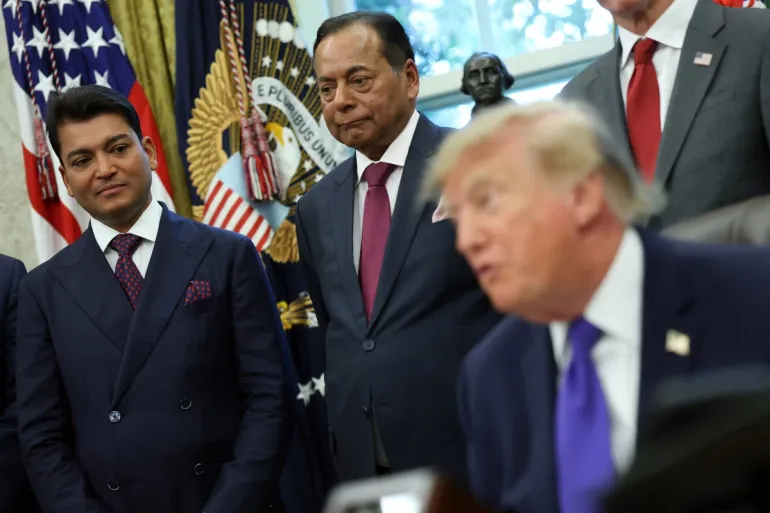
As US President Donald Trump announced a $15bn steel megaplant while seated at his Oval Office desk on Monday, he had a lineup of mostly US politicians standing behind him – from cabinet members to elected representatives from Iowa, where the mill is to be built. There was one exception: an Indian man with a receding hairline and a lilac pocket handkerchief, standing behind the US president’s right shoulder.
Ravi Ruia is a cofounder of the Essar Group, which owns Mesabi Metallics, the Minnesota-based firm that’s building the steel mill, which is expected to be the United States’s largest once it is complete. A decade earlier, in October 2016, his brother Shashi was in the photo frame with a different president during the signing of another major deal: Russian leader Vladimir Putin.
Steel and metallics aren’t Essar’s only association with minerals and natural resources. The conglomerate had been involved for years with oil, before it sold one of India’s largest private oil refineries to a Russian-led consortium in 2016 for nearly $13bn. Essar Oil was rebranded as Nayara Energy.
Today, Nayara Energy is half-owned by Russian gas major Rosneft, which is under heavy US and European sanctions over Moscow’s war on Ukraine. Nayara has also emerged as a supplier of petroleum products to Russia at a time when the country is facing a fuel crisis following multiple Ukrainian attacks on its oil and gas depots.
And as part of a 99-year deal, Nayara is continuing to use Essar’s branding in India, where the company runs thousands of petrol stations. Nayara is under European Union sanctions.
The White House is touting the Iowa steel project, unveiled just before the US midterm elections, as a major economic win for Americans, promising hundreds of jobs and billions of dollars in revenue. And there is no evidence that the steel project is in violation of any Russia-specific US sanctions.
But Trump’s announcement of a mega project with an Indian firm closely tied to Russian investments under Western sanctions underscores how the US has struggled to isolate Moscow economically despite an unprecedented economic pressure campaign.
And the timing of the steel mill announcement raises questions, because it comes days after Trump signed a law that empowers him to punish countries that buy Russian oil with up to 100 percent tariffs. India is Russia’s second-largest oil buyer. But the legacy Indian conglomerate that best epitomises the country’s links to Russian energy is now also behind the US’s biggest steel factory.
Rewant Ruia, left, chairman of Mesabi Metallics, and Ravi Ruia, centre, board member of Mesabi Metallics and director of Essar Capital, listen as US President Donald Trump delivers remarks in the Oval Office at the White House on September 28, 2026, in Washington, DC [Kevin Dietsch/Getty Images]
What’s the steel factory project about?
The new project would integrate its iron ore mining operations in Minnesota’s Mesabi Iron Range with the upcoming steel complex in Iowa.
The White House and the company’s announcements said that the Iowa steel plant is expected to create at least 1,750 permanent jobs – “while continuing to work with suppliers and businesses throughout Iowa and the Midwest” – and support up to 6,000 construction jobs.
Washington also noted that the mill will produce 7.5 million tonnes of steel per year in its first phase, expected to rise to 10 million tonnes. First steel production is expected in 2030.
The first phase of the project is expected to generate $95bn in total economic impact during construction and its first 10 years of operation, according to the White House.
Trump’s commerce secretary, Howard Lutnick, told the reporters that “these are your 232 tariffs, the steel tariffs at work.” He added: “Without those tariffs, this mine and steel plant doesn’t get built.”
Trump chipped in, too. “Soon after my inauguration, I imposed powerful 50 percent tariffs on all foreign steel, and now our steel industry is roaring back to life,” Trump said. “Everyone’s building their plant here because they don’t want to pay tariffs.”
But the steel project is also evidence of how countries and companies have skirted US economic pressure – and how it gives them leverage to continue to do so.
An Essar petrol station with pumps showing no fuel in Stanley, County Durham, UK, September 27, 2021 [Lee Smith/Reuters]
What are Essar’s ties to Russia?
Essar Oil, the group’s energy arm, began refining crude in 2008 at its refinery in Vadinar on the coast of the western Indian state of Gujarat.
But by 2016, the company was in deep debt, listed as a defaulter by the Reserve Bank of India, the country’s central bank, and desperately looking for a buyer who would take over its oil operations. The timing was opportune. President Putin in Russia was at the time trying to get Rosneft, his country’s energy giant, to offload some stakes in exchange for foreign capital.
Indian Prime Minister Narendra Modi played matchmaker, helping stitch together a series of deals between 2014 and 2016 that helped Rosneft and Essar. First, Indian public sector oil majors bought stakes in Rosneft, giving it the cash it needed. Rosneft, in turn, joined hands with other investors to buy the Vadinar refinery, freeing Essar from its debts.
Essar Oil became Nayara Energy – a company in which Rosneft owns a 49 percent stake, and United Capital Partners, a Russian asset management company, owns another 49 percent. The buyers paid Essar $12.9bn for the deal. As part of the agreement, Nayara got to use Essar’s branding – including on thousands of petrol stations across India – for 99 years.
Logo of Nayara is seen at its fuel station on the outskirts of Ahmedabad, India, November 16, 2022 [Amit Dave/Reuters]
Is Nayara under Western sanctions?
Yes. The European Union imposed sanctions on Nayara in July last year as part of the broader 18th package of sanctions against Russian oil.
The sanctions banned the import of petroleum products processed using Russian crude oil and restricted the refinery’s access to EU shipping insurance, as well as financial and other services.
Nayara’s Vadinar refinery in western India has been processing only Russian oil since other suppliers backed out following the sanctions. Since then, Nayara has relied on international traders to import crude and export refined fuels.
In July this year, Nayara Energy sold petroleum to Russia as Ukrainian attacks targeted oil refineries across the country, triggering a fuel crisis.
In recent months, Ukrainian forces have targeted Russian oil facilities, setting them ablaze and causing long lines for fuel across the country, including in the capital, Moscow. The fuel crisis, unprecedented for Russia, a country that is one of the world’s biggest energy producers, has led to rationing in many regions.
These Russian links have brought Nayara Energy under wider scrutiny, prompting companies, including SAP, to suspend services to the refiner, citing sanctions and obligations under EU law.
Nayara challenged the move in the Delhi High Court, which ordered SAP India to restore its services earlier this month.
Are Essar or the steel plant violating any sanctions?
While Nayara is under EU sanctions, Essar does not face any US or EU sanctions.
In October 2016, after Essar struck its deal with Rosneft and United Capital Partners to sell the Vadinar refinery, the US – at the time under the Barack Obama administration – said that the agreement was not in violation of any sanctions.
“I don’t think we see any violation of any US-EU sanctions stemming from this deal,” State Department spokesperson Mark Toner said at the time. Essar also said that the deal was compliant with US sanctions.
There is no evidence of any sanctions breach in Essar’s investment in Mesabi, or in the planned investment to set up the steel factory in Iowa.
But Essar’s relations with Russia have nevertheless attracted scrutiny, including in the United Kingdom, where the Ruia brothers have long had major investments.
At the time of the sale of the Vadinar refinery to Russian buyers, the Russian bank VTB also gave Essar a $3.9bn loan for debt reconstruction.
The bank was hit by major US and EU sanctions in February 2022, right after Russia’s full-fledged invasion of Ukraine. Essar, reporting published in April 2026 by The Guardian and investigative journalism platform SourceMaterial, showed, moved the VTB loan to Mauritius, a tax haven, allegedly to avoid the sanctions. Essar owns the Stanlow oil refinery in the UK.
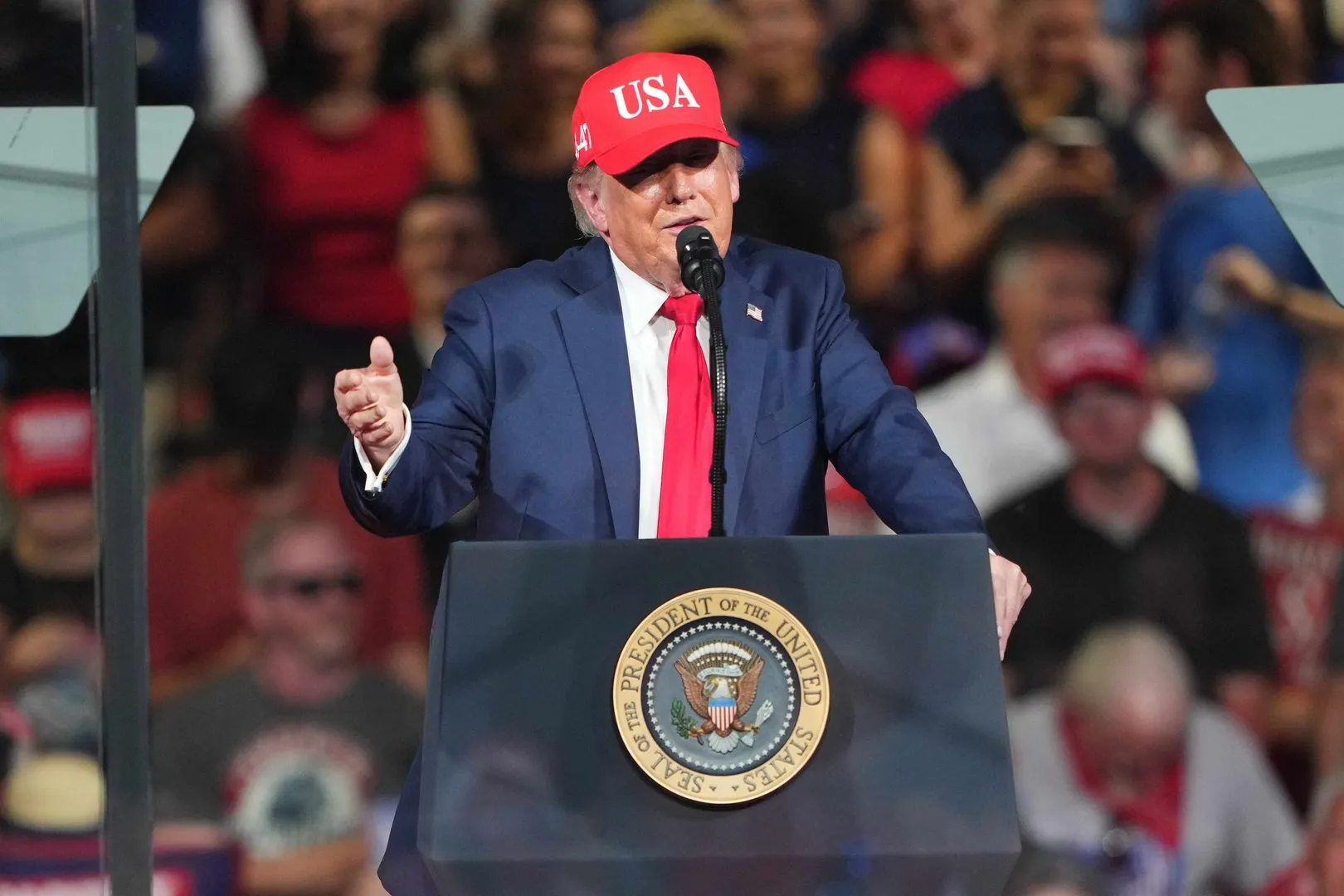
US President Donald Trump waves as he walks to board Marine One as he departs from the South Lawn of the White House in Washington, DC, on September 26, 2026 [AFP]
Why is the timing of the steel plant announcement significant?
Trump’s Republican Party is heading for crucial midterm congressional elections in November, while his approval rating has been plumbing all-time lows in the face of voter concerns about inflation, the cost of living, and the war on Iran.
In his second term, Trump has made tariffs and a revival of US manufacturing a cornerstone of his economic vision, claiming that higher barriers to imports will drive investment back to the US.
Moreover, Washington introduced legislation that would allow the president to impose tariffs of up to 100 percent on imports from countries that continue economic engagement with Russia or Iran, aiming to put pressure on countries that continue buying Russian energy.
New Delhi is particularly exposed since it became one of the largest buyers of discounted Russian crude after the invasion of Ukraine in 2022. Trump imposed an additional 25 percent tariff on Indian imports in 2025 over the issue, before removing it in February 2026 after India committed to stop buying Russian crude.
Russia has remained India’s largest source of crude, although purchases have declined as the threat of US penalties has grown. The news agency Reuters reported that India imported approximately 2.1 million barrels per day of Russian crude in August.
There is also a recent parallel to underscore the incentives for investment in Trump’s US. In May this year, Washington moved to dismiss the criminal fraud and bribery charges against Indian billionaire Gautam Adani, while his lawyers had told the Justice Department that Adani was prepared to invest $10bn in the United States. A federal judge subsequently dismissed the criminal case in August.
Amid tight Iowa midterm races, President Trump emphasises steel industry revival with project announcement.
Published On 28 Sep 202628 Sep 2026
Just weeks before the midterm elections, United States President Donald Trump has announced that a Minnesota-based steel manufacturer intends to build a $15bn steel mill project in Iowa, as the White House tries to highlight its focus on domestic manufacturing.
On Monday, joined by executives from Mesabi Metallics, which recently opened Minnesota’s first new iron ore mine in 50 years, Trump announced the project. It is expected to begin production in 2030 and could bring more than 1,700 jobs to the region, with an initial production capacity of 7.5 million tonnes per year.
Recommended Stories
list of 4 itemsend of list
The first phase of construction for the project will generate 5,000–6,000 construction jobs, a White House official told Al Jazeera.
The plant in Iowa will use iron ore from the Mesabi Iron Range in nearby Minnesota. Mesabi, which is owned by Indian conglomerate Essar Group, invested more than $2.5bn to build the mine in Minnesota.
“President Trump is delivering on his promise to rebuild American industry, re-shore manufacturing, and create new jobs. Today’s announcement underscores the president’s historic efforts to revitalize the US steel industry—supporting local communities, strengthening supply chains, and protecting our national security,” White House Spokeswoman Taylor Rogers said in a statement to Al Jazeera.
The steel industry has loomed over the first half of Trump’s second term in office. The president imposed 50 percent tariffs on steel and aluminium imports last year in an effort to boost domestic production, but also threatened to increase prices of products that use those materials, from soda cans to washing machines to cars.
“These are your 232 tariffs, the steel tariffs at work. Without those tariffs, this mine does not get built, and this steel plant does not get built”, US Commerce Secretary Howard Lutnick said in the Oval Office on Monday.
Trump also solidified the US government’s stake in US Steel, which was acquired by Japan’s Nippon Steel in June 2025. As part of the deal, the US government received a so-called “golden share”, which gives the president the authority to appoint a board member to weigh in on decisions that would impact domestic steel production.
Midterm stakes
The announcement comes a little more than a month ahead of the US midterm elections, and the economy is top of mind for US voters.
Among Republicans, Trump is losing steam on his handling of economic issues, with a new September 21 Ipsos poll finding that 56 percent approve of his handling of the economy, down from 80 percent.
Iowa is in play as a seat Democrats could flip in the midterm elections, with Republican Ashley Hinson facing Democrat Josh Turek in November and with polls suggesting a tight race.
Hinson joined the president in the Oval Office for the announcement.
A poll conducted by the Republican-aligned pollster the Trafalgar Group showed Hinson with a two-point lead, while an InsiderAdvantage poll, which is considered more nonpartisan, found Turek leading by two points.
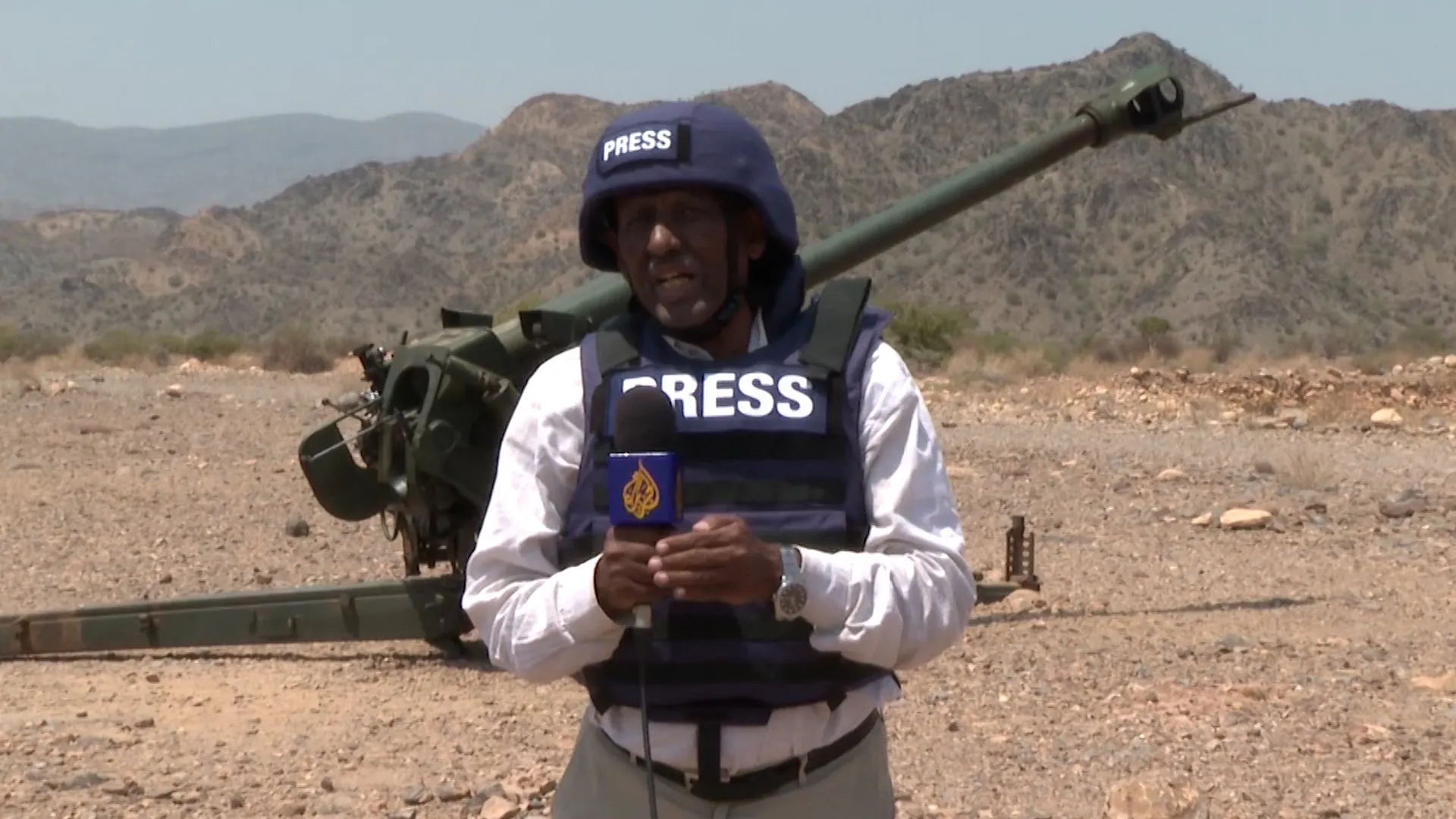
Al Jazeera’s Mohamed Tawakul is near a front line in Ethiopia’s Afar region, where fighting has spread after rebel groups formed an alliance to try to oust the government of Prime Minister Abiy Ahmed.
WASHINGTON — President Trump’s trade war with Canada could intensify the headwinds Republicans are navigating ahead of the November midterms, with its effects poised to reverberate in northern battleground states with crucial Senate races.
The escalating beef with Canada — Trump attacked the country anew on social media Wednesday — stands to heighten voters’ economic worries and add to the GOP’s political challenge in dead-heat races, analysts said.
“It doesn’t make things easier. It’s not helping,” said Rusty Hills, a University of Michigan public policy professor and onetime chair of the Michigan Republican Party.
The president’s unpopular policies on the war in Iran, the economy and data centers have already handed Republican candidates the tough task of appearing responsive to Americans’ frustration with cost-of-living issues without alienating Trump and his voter base.
The trade war, said Lance Dutson, a Maine Republican media strategist, puts “another log on the fire” of the affordability issue.
The tariffs have appeared unpopular in recent polling, including among a majority of independent voters. Though they are not expected to dramatically increase consumer prices, they could affect voters’ perception of the economy — and even small economic impacts on certain industries, such as auto manufacturing in Michigan, could have an effect in very close midterm races, experts said.
Trump’s new import bans on some Canadian goods are set to begin next week, a response to retaliatory tariffs Canada levied earlier this month. Trump argues that Canada has “been ripping off” the United States and that tariffs will help domestic manufacturers.
On Wednesday, the president inaccurately claimed on Truth Social that Canada is allowing “millions and millions” of immigrants into its country.
“It is a Liberal takeover that will end very badly. Already showing up in their numbers. Big unemployment. ‘Oh Canada!” the president wrote on social media Wednesday morning.
Five of the nine states most likely to decide Senate control border Canada — Alaska, Ohio, Michigan, New Hampshire and Maine. Two more, Texas and Iowa, also do substantial trade with Canada.
Democrats must retain their Senate seats including New Hampshire and Michigan and flip four of the other states to win a majority, a tall task. As the landscape worsens for Republicans, however, some aretesting how much they can distance themselves from Trump.
“It’s a tightrope, there’s no question,” Hills said. “[Candidates] are looking for some wiggle room on some of these issues like the war and prices and Canada tariffs, because they need every independent and swing voter they can get.”
A majority of Americans oppose raising tariffs on Canadian goods, including 64% of independents, anEconomist/YouGov poll found. Only 14% of independents said they supported additional U.S. tariffs on Canada in a late AugustIpsos poll.
And in Michigan, 68% of independent voters disapprove of the tariffs, a poll this month from the Washington Post and Schar School found.
“The more we put tariffs on stuff, the more they put tariffs on stuff … prices are just ultimately going to go up for all of us,” said one Michigan swing voter in a Sept. 9 focus group conducted by the firm Engagious, in which 11 of 13 participants said the trade war was bad for the state.
The highest costs of the tariffs will be concentrated within a few industries, including auto and other manufacturing, dairy, and alcohol and spirits, said Alex Durante, a senior economist at the Tax Foundation. The tariffs likely won’t create a major change for consumers, but the general impression that tariffs can contribute to higher prices might turn off voters who are already worried about inflation, he said.
Counter-tariffs imposed by Canada in response to U.S tariffs last year resulted in a 6% increase in the prices of affected goods, researchers found in paper published by the Journal of Monetary Economics.
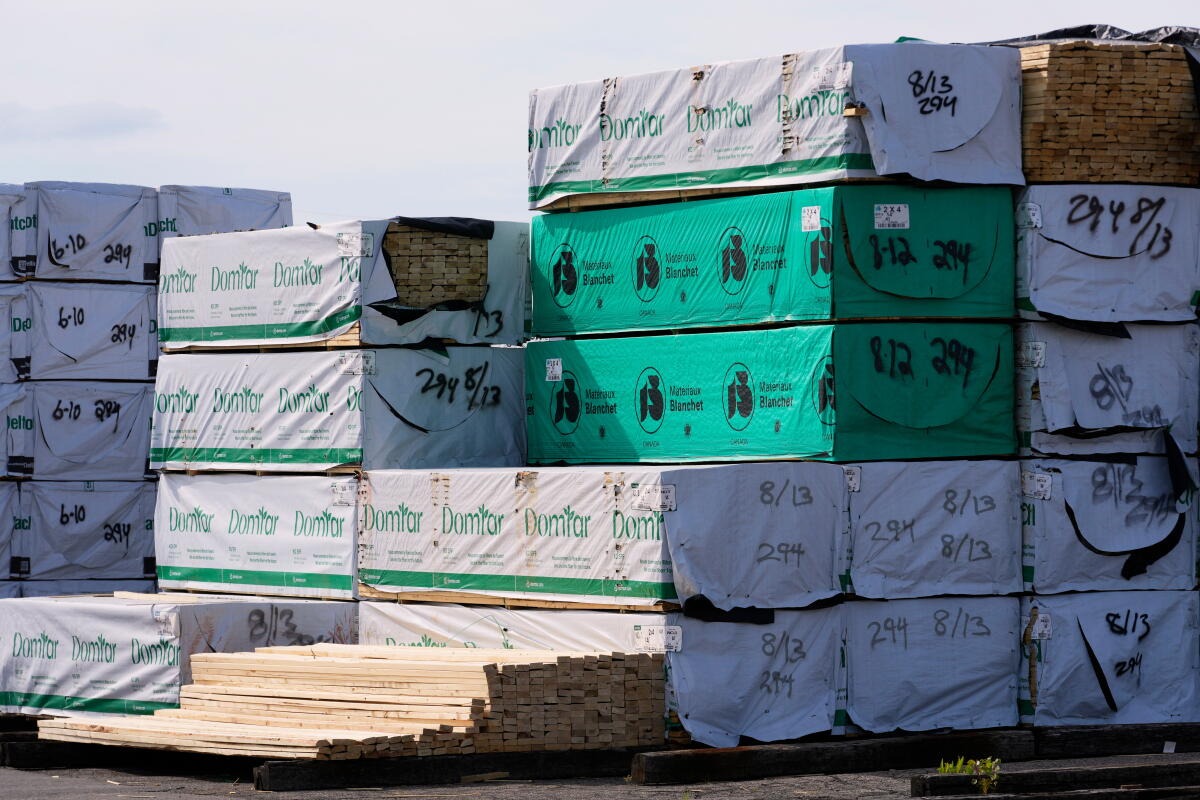
Canadian lumber products at Gutherie Lumber in Livonia, Mich., in August.
(Paul Sancya / Associated Press)
“This trade war is certainly not helping the president and his party in the midterms,” Durante said. “What’s weighing on the top of people’s minds is this general affordability crisis … and they realize that tariffs are another factor that is impacting affordability.”
The latest escalation of the trade dispute began in July, when Trump threatened new 50% tariffs on some Canadian goods, reinvigorating a conflict that began with tariffs the president imposed in 2025.
The two countries began trade talks, but the negotiations fell apart in late August, and Trump imposed tariffs on about $20-billion worth of Canadian goods. Canada retaliated with tariffs on about $20-billion worth of American goods that took effect Sept. 8. Trump then announced import bans on some Canadian goods, including certain alcohol and dairy products, which go into effect next week.
Construction and farm equipment in Illinois, aluminum and pipe products in New York, and iron and steel products in Ohio are among the goods targeted by Canada’s counter-tariffs, the Canadian Broadcasting Corp. reported. In California, about 10.5% of the state’s Canadian imports are exposed to the counter-tariffs imposed by Canada.
Democrats have seized on the issue as another way to tie Republican candidates to Trump’s policies, something that analysts said may have varying degrees of success in different swing states.
Maine Republican Sen. Susan Collins campaigns in August in Kittery, Maine.
(CJ Gunther / Getty Images)
In Maine and New Hampshire, where the Republican Senate nominees have criticized Trump’s move, the tariff issue may be less likely to stick. Efforts to tie Republicans to Trump have historically been less successful in the region because of its independent streak, said Jim Merrill, a veteran Republican strategist in New Hampshire.
Maine Republican Sen. Susan Collins warned the White House against imposing tariffs and successfully pushed for the administration to exempt road salt and cement this month. She told Politico that the Trump administration had “very much underestimated” the effect of the tariffs on Maine residents.
Republican John Sununu, a former senator who is running to retake the seat in New Hampshire, has also criticized the tariffs, saying a trade war with Canada “doesn’t make any sense.” He indicated he would support legislation in Congress to restrain the president’s tariff powers.
Elsewhere, Senate nominees have walked a careful line on tariffs. In Alaska, Sen. Dan Sullivan has largely avoided the issue, even as Democrats there have used it to ramp up attacks on his record in recent days. In Ohio, former Sen. Jon Husted told the National Review in August that the public “would like to understand the strategy behind what the president’s trying to do.”
Former Rep. Mike Rogers of Michigan, the Republican Senate nominee, told reporters over the weekend that he was in favor of “good” tariffs that would help Michigan and opposed to “bad” tariffs that would hurt the state.
Focusing on issues other than tariffs may be the right strategy on the campaign trail, Hills said.
“He’d much rather be talking about the Republican plan for affordability,” Hills suggested. “There’s interesting things we need to be talking about in order to win this election, and this isn’t one of them.”
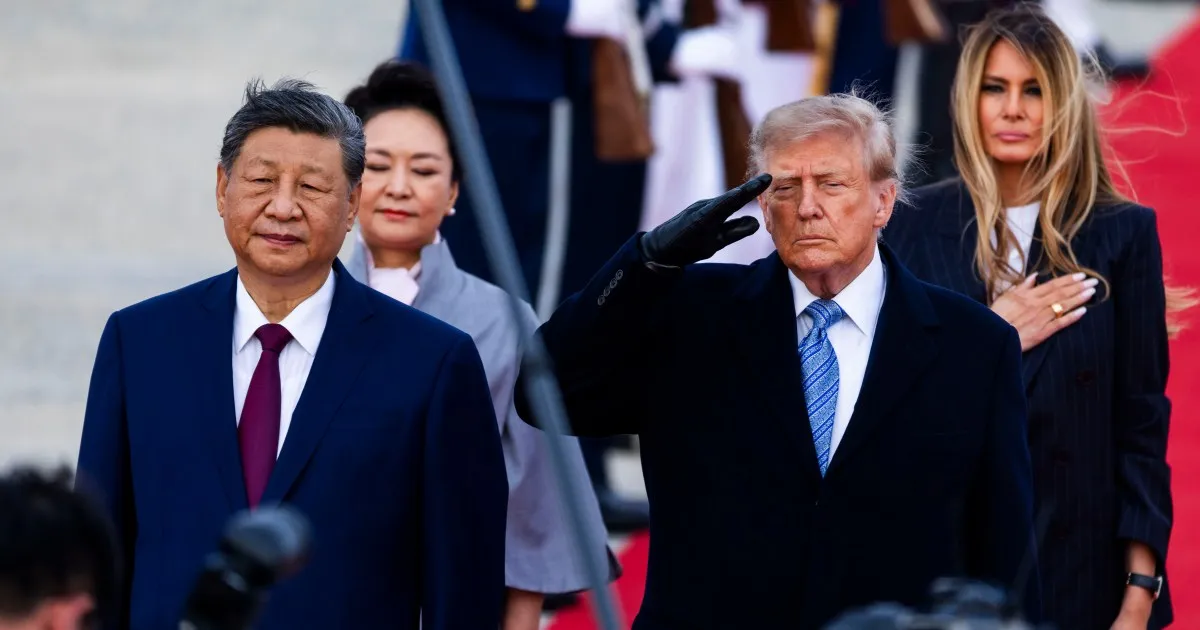
The red carpet was rolled out, and a trade truce was extended. Yet, beneath the pomp and pageantry of Chinese President Xi Jinping’s state visit with US leader Donald Trump on Thursday, Washington and Beijing remain locked in a much deeper strategic rivalry.
Xi arrived in Washington, DC on Wednesday evening for talks on Thursday, and Trump was there to meet him personally on the tarmac.
Recommended Stories
list of 4 itemsend of list
The meeting was the first state visit by a Chinese leader to the US in 11 years. But it is also the third time in less than a year that the two men have met face to face, as the two powers remain uneasily gridlocked in competition over AI, rare-earth metals, the question of Taiwan, and the Iran war.
Overhanging it all is the paused, but simmering, trade war between their two nations.
Almost as soon as Trump began his second term in the White House in January 2025, up went tariffs on Chinese goods as he accused China of facilitating the flow of fentanyl, a deadly drug, to the US. Beijing responded with its own levies, then restricted exports of valuable rare-earth metals which are crucial for the development and manufacture of everything high-tech, from smartphones to fighter jets. At one point, tariffs were heading towards 150 percent before being paused to allow time for talks.
Finally, the two leaders called a truce on the sidelines of the Asia-Pacific Economic Cooperation (APEC) summit in South Korea on October 30, and they met once more, in May, when Trump travelled to Beijing.
As Xi landed in Washington on Wednesday this week, the Trump administration announced that the two countries had agreed to extend an October 2025 truce which had offered some respite from the punishing tariffs, produced an agreement from China to buy more soyabeans from the US and delayed the ban on rare-earth exports from China until January 10. The prospect of a much-longed-for trade deal appeared to be in the air when US Treasury Secretary Scott Bessent told Fox News he had met Chinese Vice Premier He Lifeng before Xi’s visit to “see if we could do a bigger deal as opposed to just a series of smaller things”.
But analysts have, for the most part, shot down such hopes. Beyond tariffs, they say, the simmering conflict between the two powers now encompasses new US sanctions on buyers of Russian oil – namely China – and sweeping investment and research restrictions, never mind the intensifying race for dominance in artificial intelligence.
“The two-month extension isn’t a bridge to a grand bargain – it’s a temporary sandbag holding back a structural flood,” Beijing-based Einar Tangen, a senior fellow at the Center for International Governance Innovation, told Al Jazeera.
Theatrics or continued thaw in tensions?
In fact, the truce is little more than “transactional theatre” – an attempt at good optics before the upcoming US midterm elections – Tangen said.
Trump’s deeply unpopular war on Iran has already inflicted severe damage to his chances in that vote. Democrats are leading in the polls amid concerns about the rising cost of energy, triggered by the war which the US started. Trump ultimately needs wins on other issues.
The current truce with China serves a purpose, therefore, but is fragile enough to be undone the moment political utility shifts for Trump, Tangen said.
“Success in January won’t be measured by what is solved, but by whether the knot is left tight enough to hold, but not kill,” said Tangen.
Phillippe Le Corre, professor of international relations and Asian studies at France’s ESSEC Business School, said the length of the truce extension indicates clearly that a more permanent deal remains out of grasp.
“The extensions are getting shorter and shorter, which means they haven’t found a common ground on many issues,” Le Corre told Al Jazeera.
“The two-month extension is a terrible outcome for the US. Nothing is resolved, and many Damocles’ swords are still hanging over Washington’s head,” he added.
Trump’s entire China policy, Le Corre argued, is in fact short-sighted. “That is bringing the world a lot of uncertainty,” he said.
Some analysts are more hopeful, but not much. Sun Chenghao, a fellow at the Center for International Security and Strategy at Tsinghua University in Beijing, described the extension of the trade truce as a “useful interim step”. It shows that both sides want to preserve the recent easing of tensions, which is meaningful progress, he said.
“From China’s perspective, a sustainable agreement needs reciprocal benefits and greater policy predictability,” Sun told Al Jazeera. “Additional purchases cannot indefinitely compensate for uncertainty over tariffs, technology restrictions and market access.”
The extension’s value, however, will depend on whether it produces “concrete commitments” from Beijing and Washington, Sun added.
A game of ‘economic chicken’
There is motivation to get a deal done, analysts say. Any escalation in the US-China trade war will be costly for both sides.
But there is some way to go. A Congressional Research Service report in July 2026 noted that Chinese goods exported to the US still face tariffs of 36.5 percent, while US goods entering China are taxed at 31 percent.
Any higher, and they will raise import and manufacturing costs in the US, squeeze margins and increase pressure on consumer prices, said Sun. They would also hurt US farmers and industrial exporters, he added, just as the US faces pressure from the rising costs of its war on Iran, which have pushed it into a record national debt of $40 trillion two years earlier than expected.
“Washington is playing a high-stakes game of economic chicken with a $40 trillion debt load, an inflationary sword of Damocles, zero fiscal cushion to absorb a truce collapse and a dependence [on] Chinese industrial and manufacturing inputs,” Tangen said.
US consumers and the economy in general will find it tough to survive yet another inflationary shock from renewed tariffs “at a time when the federal budget already operates like a high-wire Ponzi scheme”.
Then there is the AI race, which no one can afford to lose. According to Jon Bateman, a senior fellow at the Carnegie Endowment for International Peace, a partial “decoupling” of US and Chinese technology ecosystems is under way. US policymakers have pushed to become less dependent on Chinese tech and “to secure America’s technological future in the context of a rising China”, Bateman writes.
But that will not help if there is a collapse in valuations of companies in the AI sector, which currently drive global stock markets. An AI valuation collapse, Tangen warned, “could trigger a financial tsunami that makes 2008 look tame – making technological decoupling meaningless as the world is plunged into a depression”.
Despite the trade war and Trump’s tariffs, China’s trade with other countries has risen sharply, with the country registering a $1.2 trillion global trade surplus last year. But an escalation of the trade war with the US would nevertheless spell increased pressure on export orders, employment in exposed industries and business confidence, said Sun.
Beijing does hold one crucial ace card – it is sitting on 60 percent of the world’s known deposits of rare-earth minerals, said Le Corre. It processes 90 percent of them, too. These are the metals that all countries need supplies of for semiconductors, technological components and the manufacture of weapons, to name but a few. Last year, China began to make use of that leverage by restricting exports of five of the 12 rare-earth metals it mines in April. Then, in October, it prepared to restrict seven more – until the trade truce happened. Plans for the export restrictions are not shelved, however, merely on hold.
“[China] understood this over the past year and they are certainly not going to give up on this,” said Le Corre.
“Washington is hostile, but it is hooked,” Tangen said. “You cannot threaten China with secondary sanctions on energy while desperately needing its rare-earths to fuel your military-industrial base.”
A drawn-out path to durability
The path to a lasting US-China trade deal will be long and rocky. First, any new tariff reductions will need more coverage and duration, said Sun.
For a deal to last, it would also require “more predictable licensing and actual deliveries of rare earths and critical minerals; restraint in expanding technology restrictions; and market access reflected in regulatory approvals and completed transactions”, he said.
A durable agreement also needs regular consultations and a process for resolving complaints. If all this can be hammered out then, just maybe, there might be a chance, Sun said.
Tangen and Le Corre were less optimistic, however. “The US view of China as an existential threat has to change before there can be solutions,” said Tangen.
Le Corre, meanwhile, said that while China is a long-term planner, “durable is a word that can hardly be associated with Trump.”
The existing trade truce also risks breaking down if there are new unilateral tariffs, broader technology or mineral restrictions, or disputes over whether commitments have been fulfilled, said Sun.
Tensions over Taiwan, which China claims as its own territory, but for which the US approved an $11.1bn arms sale in December last year, could also trigger a breakdown in trade relations, the analysts said.
“Taiwan remains the ultimate low-probability, catastrophic-impact tail risk – where a single round of arms sales can snap a multibillion-dollar trade truce in an instant,” Tangen noted.
Scott Bessent and He Lifeng meet in New York for US-China talks ahead of the Trump-Xi meeting later this week.
Published On 20 Sep 202620 Sep 2026
Top economic officials from China and the United States have begun talks in New York City aimed at clearing the way for possible agreements on trade, artificial intelligence and critical minerals ahead of a meeting between US President Donald Trump and Chinese President Xi Jinping later this week.
US Treasury Secretary Scott Bessent and Chinese Vice Premier He Lifeng began talks at JPMorgan Chase’s Manhattan headquarters on Sunday morning, with US Trade Representative Jamieson Greer also taking part.
Recommended Stories
list of 4 itemsend of list
The talks come four days before Trump is due to host Xi at the White House, with both sides looking to ease tensions between the world’s two largest economies.
“I’m looking forward to having focused, fulsome and constructive talks today that will set the stage for our leaders’ meeting,” Bessent told reporters as he arrived.
At the top of the agenda is a fragile US-China trade truce due to expire on November 10.
The agreement, reached in Busan, South Korea, last November, capped US tariffs on Chinese goods at about 20 percent after a tit-for-tat trade fight briefly pushed tariffs into the triple digits.
Washington is also pressuring Beijing over its supply of rare-earth magnets and other critical minerals, crucial to industries ranging from cars to advanced semiconductors.
China promised to restore the flow of critical minerals under last year’s truce, but a senior US official said on Friday that Beijing’s performance had “not been up to par”.
AI enters the talks
Artificial intelligence (AI) is also expected to feature prominently, adding a relatively new issue to negotiations long dominated by trade.
Bessent has said the countries could discuss AI “guardrails” aimed at addressing shared risks, including preventing powerful models from falling into the hands of malign non-state actors.
The talks are expected to cover both open- and closed-weight AI models. Chinese open-weight models have increasingly attracted US companies, in part because they can be cheaper than closed systems developed by US firms such as OpenAI and Anthropic.
“The United States remains the leader in AI,” Bessent said. “And we are open to discussions on avoiding shared risks and avoiding bifurcation of our two systems.”
Another potential point of friction is Iran. China remains one of Tehran’s most important economic partners and buys much of its oil, making Beijing an important target of Washington’s efforts to increase economic pressure on Iran as the US-Israel war on Iran enters its seventh month.
Expectations remain low
Despite the packed agenda, analysts are not expecting a sweeping breakthrough.
“I think there will be some show of deliverables because of the fact that it’s a presidential summit coming, but I don’t feel like we’re on the verge of some sort of breakthrough,” Anna Ashton, a China trade analyst and founder of Ashton Intelligence, told Reuters.
“I think status quo is probably both sides’ general best expectation.”
Former US Deputy Secretary of State Kurt Campbell similarly said the immediate goal may simply be keeping tensions contained.
“One of the only things we can hope for in the short term is a truce, and that this will likely continue through the remainder of this year,” Campbell said.
Sunday’s negotiations are part of a series of meetings between Bessent, He and Greer over the past 16 months aimed at hammering out areas of agreement before Trump and Xi meet face to face.
Abbotsford, British Columbia – Every second day, 28,000 litres of raw milk leave Casey Pruim’s farm in Abbotsford in western Canada, entering a distribution system built on the assumption that the milk and the products made from it will have somewhere to go.
While most is consumed in Canada, some had been sold across the border to the United States.
Those sales have largely come to a standstill since US President Donald Trump’s 50 percent tariff on $20bn in Canadian goods, including dairy products, came into effect on August 22.
Pruim, who is also chair of the British Columbia Dairy Association representing about 400 dairy farmers across the province, told Al Jazeera that Canadian farmers do not individually decide which products are exported.
Instead, producers such as Pruim – whose farm has 330 cows milked three times a day – sell into the provincial milk-marketing system, which distributes milk to processors according to demand, including for products exported to the US.
If a processor loses US demand, it may require less milk, with the impact then spread across the provincial pool.
Dylan Kruger, director of public affairs at BC Dairy, told Al Jazeera “there is still considerable uncertainty around the impact of the US tariffs”.
He said it was too early to know how the industry would be impacted or whether milk no longer sold to the US could be sold elsewhere, mitigating financial losses.
But the tariffs and wider trade tensions have already introduced uncertainty and instability for businesses.
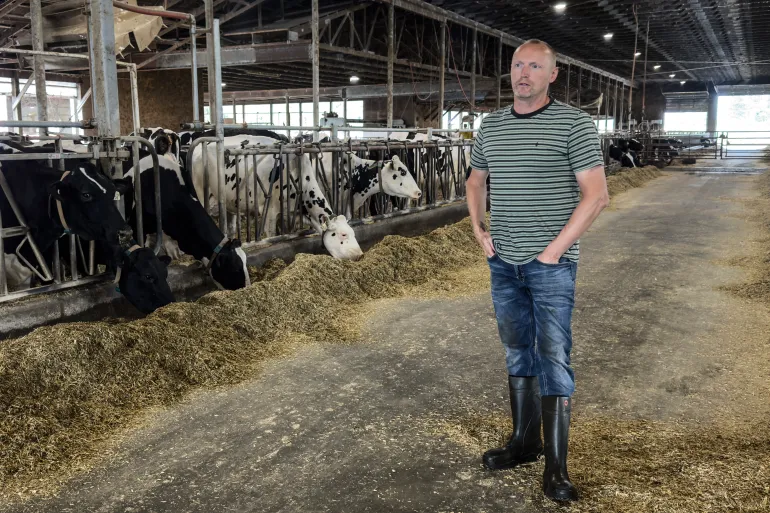
Casey Pruim, owner of Prime Acres Ltd dairy farm in Abbotsford, British Columbia, heads the BC Milk Producers Association in Canada’s western province [File: Ali Mustafa/Al Jazeera]
“If the processor who’s exporting some of his product to the United States can no longer sell into that market because he’s now priced out of the market with a 50 percent tariff, that’s how it would impact the dairy farm,” Pruim said.
Pruim said if processor demand is squeezed, farmers would be forced to dump the milk. In the worst-case scenario, the herd has to be cut.
“Cows aren’t like a tap; you can’t just turn them on or off,” he said.
His warning captures dairy’s particular vulnerability in a tariff war: Milk is highly perishable, collected on a tight schedule and dependent on processors whose demand can change much faster than farmers can adjust production.
“These tariffs are completely unwarranted,” David Wiens, president of the Dairy Farmers of Canada, told Canada’s CBC News, adding that they would affect “the supply chain, not only in Canada but in the US as well”.
Supply-management system
Dairy trade between Canada and the US has largely operated under a free trade agreement between the US, Mexico and Canada, known as CUSMA in Canada.
Canada manages the supply of dairy, poultry and eggs through a national agricultural policy known as supply management. The system uses production quotas and import controls, including tariffs, to provide farmers with more stable and predictable prices while maintaining domestic supply.
Critics describe the system as protectionist and as a government-backed cartel.
Washington argues that Canada’s supply-management system restricts US dairy exports. Trump posted on Truth Social that “Canada had been ripping off the United States of America for years” and accused it of imposing “ridiculously high tariffs” that made life impossible for US farmers.
Canadian producers reject that argument, saying the existing trade agreement already gives US imports substantial tariff-free access that is not fully utilised.
Canada’s dairy trade deficit with the US has grown significantly since CUSMA came into force on July 1, 2020, according to the Dairy Processors Association of Canada.
In 2020, Canada exported 241.3 million Canadian dollars ($173m) in dairy products to the US and imported 647.4 million Canadian dollars ($462.7m) worth of dairy and dairy products. In 2025, Canadian dairy exports had risen to 308.7 million Canadian dollars ($220.7m) while dairy imports from the US had more than doubled to 1.355 billion Canadian dollars ($968.5m), accounting for 13.8 percent of total value of US dairy exports, according to the association.
Nearly 14,000 litres of milk are stored daily in the refrigeration unit at Casey Pruim’s farm in Abbotsford, British Columbia, at a temperature of 2.8’C [File: Ali Mustafa/Al Jazeera]
Bryan Yu, chief economist at Central 1 credit union, said the immediate shock of losing a major market could be difficult for Canadian producers to absorb because replacement buyers cannot be found quickly.
“There is going to be pain in the near term for a lot of our producers,” Yu told Al Jazeera.
“You really can’t quickly adjust to a 50 percent tariff, because it’s uncharted waters for a lot of industries … and ultimately it shuts [Canadian producers] out, because a lot of them don’t have the margins that they can play with,” he said.
Yu said Canadian consumers might absorb some of the additional supply while exporters search for new markets and higher-value products, but neither adjustment is instantaneous.
“There are global markets as well, especially when you talk about chilled, chilled beef, chilled products and really it’s a question of whether … other types of markets that could be available.”
Canada has also imposed retaliatory tariffs, which came into effect on September 8 and cover $20bn worth of US products.
Dairy products are among the targeted goods. The list includes a 50 percent tariff on milk, cream and whey products and a 25 percent tariff on many cheeses imported from the US.
Casey Pruim has a herd of 330 cows at his dairy farm in Abbotsford, British Columbia [File: Ali Mustafa/Al Jazeera]
Canadian Prime Minister Mark Carney has framed Ottawa’s response as both retaliation and an attempt to build greater economic resilience.
Announcing the collapse of the latest negotiations, he said Canada would match Washington’s new tariffs “dollar for dollar” to protect workers, farmers, families and businesses.
But retaliatory measures carry risks of their own.
“Canada’s new retaliatory tariffs will help some industries but hurt most and weaken economic growth across the country by raising costs for producers and consumers,” Oxford Economics said in a report.
For now, geography remains important for perishable goods like dairy products that once moved quickly across the US border and cannot be redirected overnight to a distant market without new buyers, logistics and regulatory approvals.
Ottawa’s Trade Commissioner Service is advising affected companies to check their CUSMA compliance, explore available relief and contact trade commissioners about potential new markets.
Yu predicted that the US and Canada could reach a tariff deal in the following months but said the interim period could bring “higher prices, weaker economic activity and deeper mistrust”.
For Pruim, the uncertainty is as destabilising as the tariff threat itself.
“I think, like [for] any Canadian, it’s disappointing to have these trade talks collapse again and just the uncertainty around it.”
The European Commission stepped up pressure on China on Thursday, calling for tangible results with Beijing following a one-hour video call between Trade Commissioner Maroš Šefčovič and his Chinese counterpart, Wang Wentao.
ADVERTISEMENT
ADVERTISEMENT
The EU executive hopes to secure commitments from Beijing to rebalance the trade relationship, as the bloc’s trade deficit with China has been widening by €1 billion a day.
However, Beijing wants to secure access to the EU’s market of 450 million consumers, resisting calls from the Europeans to reduce its exports.
“While genuine engagement remains a priority, it is equally important that first concrete outcomes are delivered at the second session of the Trade and Investment Council in Beijing in October, which the Commissioner will co-chair – a signal that we are moving from rhetoric to results,” the Commission said in a statement after the call.
“That outcome needs to be credible,” the statement added.
The EU-China Trade and Investment Council was launched in June as a dialogue between the two sides, with the Commission setting October as a deadline to reach tangible results.
During the call on Thursday, Šefčovič and Wentao discussed market access on both sides and Chinese export controls on rare earths.
China has a near-monopoly over the production and processing of these strategic materials, which are essential to the EU’s green technology, defence and automotive industries, giving Beijing significant leverage in the negotiations.
The EU is seeking assurances that China will not halt its exports of rare earths again, a year after blocking them amid a trade war with the US. Securing the necessary export licences is essential for EU businesses.
EU leaders expect results
The coming weeks will be crucial for the negotiations, with EU officials expected to make another trip to China for technical discussions before Šefčovič himself travels to Beijing on 8–9 October.
In her State of the Union address to MEPs on Wednesday, European Commission President Ursula von der Leyen also pushed for concrete results in the EU-China talks.
“Words are good. But deeds are better,” she said, making clear that the EU was ready to use all its trade defence instruments to rebalance the trade relationship.
China is also expected to feature prominently on the agenda when EU leaders meet in October. They have tasked the Commission with securing tangible results from its dialogue with Beijing.
In an interview with Euronews, Šefčovič also made clear that, without a “deliverable” to present to EU leaders,“the political interest would be to look for the solution through other instruments.”
The EU has several trade defence instruments such as anti-dumping duties or tariffs against unfair subsidies.
A diversification tool is also in the pipeline, aimed at reducing EU firms’ reliance on Chinese critical minerals for strategic technologies by helping them diversify their sources of supply.
Such a move would come as relations between Beijing and Brussels remain strained, following the Commission’s introduction of several legislative proposals aimed at protecting the EU market. One of them would introduce a European preference for products made in Europe, prompting China to threaten retaliatory measures.
Last summer, China also urged its companies to stop cooperating with the Commission in antitrust investigations, after the EU executive opened a probe in May into e-commerce giant JD.com over concerns about subsidies.
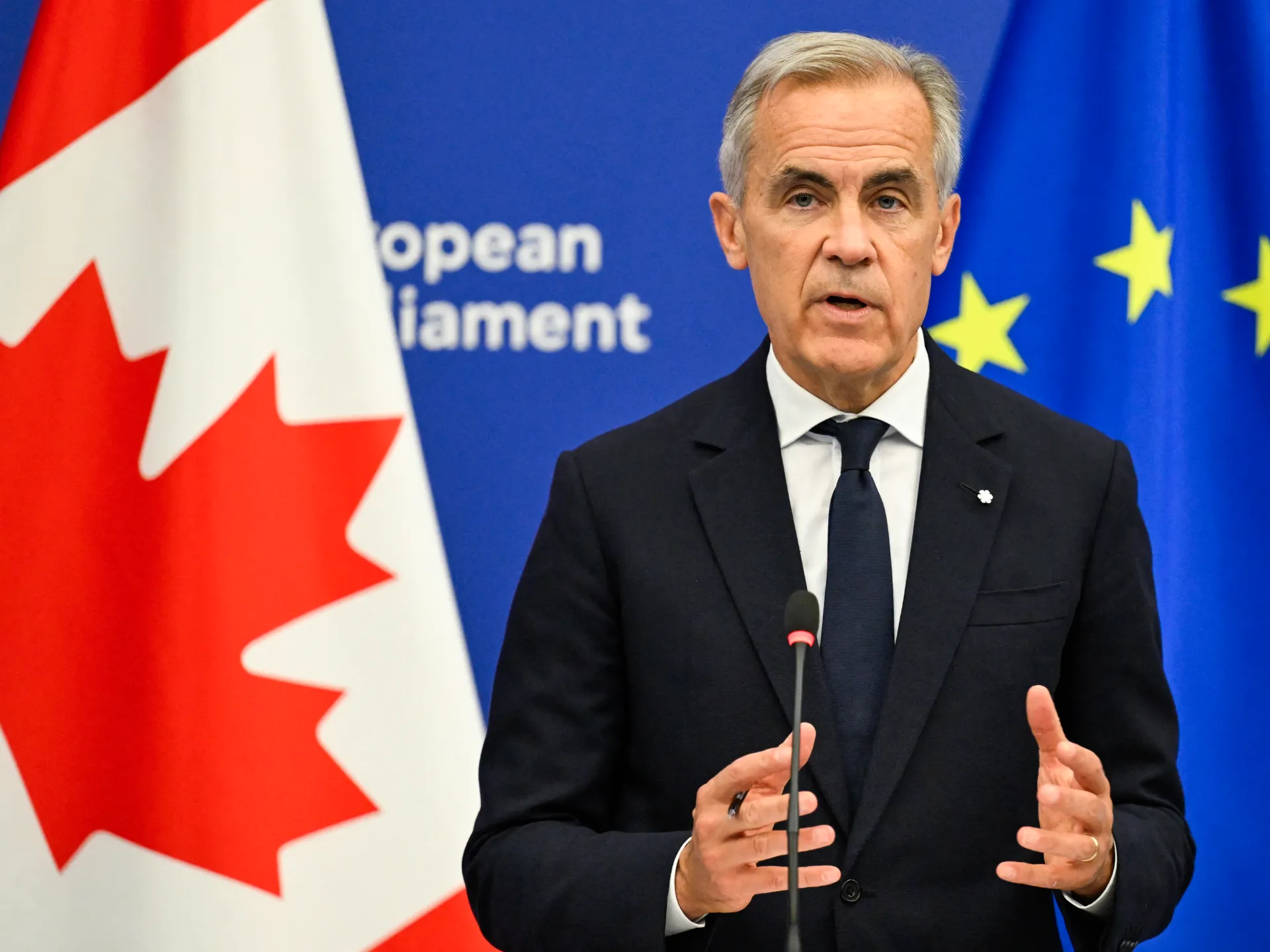
In address to European parliament, Canadian Prime Minister Mark Carney listed areas where he wants to boost cooperation.
Published On 17 Sep 202617 Sep 2026
Canadian Prime Minister Mark Carney has welcomed the prospect of his country becoming the European Union’s first associate member, saying such an alliance is aimed to be a “beacon for democracies” and not to “dominate others”.
Speaking in the European Parliament in Strasbourg, Carney said Canada “welcomes” von der Leyen’s ambition to make the country an associate member.
Recommended Stories
list of 3 itemsend of list
“We are not fair-weather allies. We do not pursue zero-sum deals. We hold common values for which we have always fought, and in whose defence we must always remain vigilant,” Carney said to applause from European lawmakers.
“Canada and Europe are each strong. Europe and Canada are stronger together.”
“I am not proposing a third bloc in order to become a great-power rival – only with better manners,” he continued. “We do not seek power to dominate others. On the contrary, we are pursuing resilience so that no one can control our open markets, impair our sovereignty, threaten our territorial integrity, or undermine our freedoms, our democracies, our rule of law.”
Carney listed a slew of areas where he wanted to ramp up cooperation.
“Canada and Europe should secure our strategic autonomy through deep cooperation in the full range of strategic capabilities, including critical minerals, defence industrial capacity, AI and compute, energy security, space and payments.”
He also said the EU and Canada should move towards “seamless digital trade” and allow young people from both sides to work and study on either side of the Atlantic.
The EU and Canada have been facing stiff rivalry and pressure from Trump’s administration on trade, among other matters, and from an increasingly assertive China.
Trump threatened late on Wednesday to take action against the EU if it moves forward with von der Leyen’s proposal of associate membership for Canada.
“If they do that, if I think it’s at all a hostile act, I will put very serious tariffs or stop trading with Europe on many things,” Trump told reporters, calling the proposal “laughable”.
“If it’s a good intention, that’s fine. If it’s a bad intention, we’ll put very heavy tariffs on Europe,” he added.
The European Commission (EC) said von der Leyen’s proposal – which is yet to be fleshed out and will need to be approved by EU member states to go forward – was not a hostile act.
“As our President (von der Leyen) made clear yesterday, the proposed strengthening of our partnership with Canada is not against anyone else, but for our common strength,” said Olof Gill, an EC spokesperson.
US President Donald Trump had tried to pressure the Fed to lower rates, but it voted unanimously to raise them instead. In response, Trump is now threatening to end trade with countries the US has a trade deficit with – namely Canada, Mexico and the European Union.







![US President Donald Trump waves as he walks to board Marine One as he departs from the South Lawn of the White House in Washington, DC, on September 26, 2026 [AFP]](https://i0.wp.com/occasionaldigest.com/wp-content/uploads/2026/09/1790693783_407_afp_6ab7d4f7ee67-1790432503.jpg?w=640&ssl=1)


![Casey Pruim, owner of Prime Acres Ltd. dairy farm in Abbotsford, British Columbia heads the BC Milk Producers Association in Canada's western province [Ali Mustafa/Al Jazeera]](https://i0.wp.com/www.aljazeera.com/wp-content/uploads/2026/09/PRUIM7-1789051532.jpg?w=640&ssl=1)
![Each day almost 14,000 litres of milk produced by cows is stored in the refrigeration unit at Casey Pruim's Prime Acres Ltd. dairy farm in Abbotsford, British Columbia at a temperature of 2.8'C [Ali Mustafa/Al Jazeera]](https://i0.wp.com/www.aljazeera.com/wp-content/uploads/2026/09/DSLR_PRUIM25-1789051502.jpg?w=640&ssl=1)
![Casey Pruim, owner of Prime Acres Ltd. has a herd of 330 cows at his dairy farm in Abbotsford, British Columbia [Ali Mustafa/Al Jazeera]](https://i0.wp.com/www.aljazeera.com/wp-content/uploads/2026/09/DSC01443-1789051497.jpg?w=640&ssl=1)