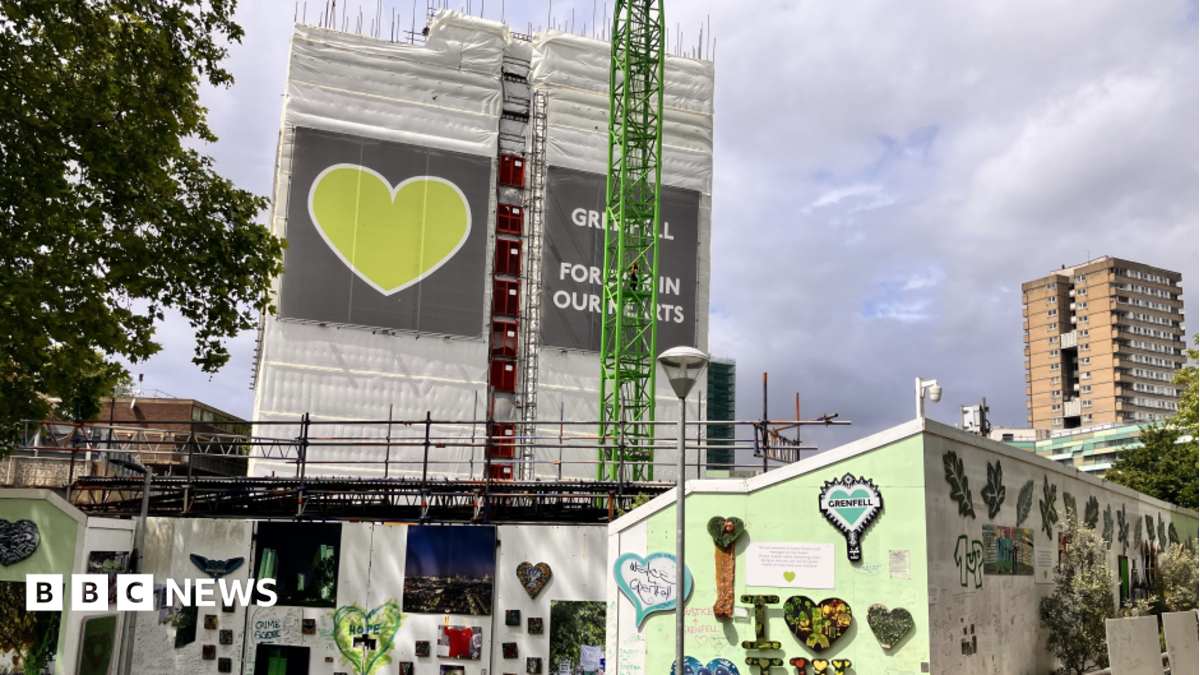
Deputy assistant commissioner Kevin Southworth said a team of 220 investigators had worked hard on the case but he appreciates “it has taken nine years to get to this point”.
“As we have said before, this is one of the most complex investigations ever undertaken by any UK law enforcement agency – the scale is truly enormous.
“While we know this has had a significant impact on those waiting for answers, it has necessarily taken this long to ensure our investigation is meticulous and presents the very best possible evidence to the CPS for charging decisions,” he added.
The CPS will decide whether there is a realistic prospect of conviction, as well as considering whether bringing charges is in the public interest.
In anticipation of possible criminal proceedings, the Met has said it is building a £2m replica of a section of the tower, which is being dismantled, to help future jurors understand its layout.
Frank Ferguson, head of the CPS special crime and counter terrorism division, said it marked “an important step”.
“We recognise that the journey to this point has been long and difficult.
“Charging decisions will be made independently by CPS prosecutors following a thorough and careful review of all the evidence gathered by the Metropolitan Police Service,” he added.
AN ICONIC London tower is being carved into a £1billion “Swiss Cheese” hotel as plans are unveiled for major refurbishment.
New terraces, restaurants, office spaces and panoramic views of the city are all part of the plans.
An iconic London tower is set to undergo a major revamp as its current tenants lease expiresCredit: Kiasm/Canary Wharf Press OFficePlans for the HSBC tower include restaurants, office spaces and cutaway terraces – likening the design to Swiss cheeseCredit: KFPA large glass box called “The Cloud” will also be part of the new plans with panoramic views of the cityCredit: KPF
The HSBC Tower, located in London’s Canary Wharf, is set to undergo a major refurbishment next year, as its current occupants relocate to the city.
Plans for the refurbishment of the 45-storey tower have been submitted to Tower Hamlets Council by Qatar Investment Authority (QIA) and Canary Wharf Group (CWG).
Sign up for the Travel newsletter
Thank you!
The revamp will be led by architects Kohn Pedersen Fox (KPF) and reports indicate it is set to cost between £800,000,000 and £1,000,000,000.
Proposals for the building will see sections of the tower’s higher floors cut away to create a series of terraces, creating the appearance of holes which have landed the building with the Swiss cheese comparison.
Designs for the tower will also see it move from a single-occupant space, instead paving the way for multiple uses throughout the building.
Starting from the bottom, the lower and ground floors will be transformed into an 181-room hotel and leisure facilities.
It will also see the addition of a brand new public walkway that crosses through the ground floor to link the Elizabeth Line Station with nearby Canada Square Park.
Middle floors will be reserved for office spaces, designed to house multiple corporate tenants, with asset management company BlackRock reportedly eyeing the space, according to The Banker.
Staggered terraces will be a main feature of the top floor, as well as a huge glass box called “The Cloud”, functioning as an entertainment space with restaurants and bars and boasting panoramic views of the city.
In a statement posted to the CWG website, CEO Shobi Khan said: “We look forward to working with QIA on 8 Canada Square to deliver a building of outstanding design, engineering and sustainability standards.
“This redevelopment is another step in Canary Wharf’s evolution into a vibrant mixed-use neighbourhood offering workspace, retail, homes, leisure and amenities all in one location – a true 15-minute city.”
Elie Gamburg from Kohn Pedersen Fox said: “We are extremely excited to collaborate with QIA and CWG to reimagine the single-use office building as a blueprint for the highly sustainable, mixed-use building of the future.
“This transformation embodies the ethos behind much of our work, we see it as an integral part of the evolution of today’s single-use neighbourhoods into vibrant mixed-use neighbourhoods of tomorrow – an evolution of which CWG is already leading the way.”
ONE of the most iconic buildings in the capital’s skyline is set to become a 400-room hotel.
The Grade-II BT Tower in London is being transformed into a hotel, with rooms in the tower itself.
The BT Tower in London is set to reopen as a hotelCredit: OrmsIt will feature bedrooms in the tower itselfCredit: Orms
Levels seven to 23 of the Tower will all have accommodation, with each floor featuring four curved rooms around the central structure.
As for the lower floors, a new building will be developed at the bottom of the Tower, with a rooftop poolon level six, outdoor seating areas and wildflower roof gardens.
Sign up for the Travel newsletter
Thank you!
The lower ground floor will then feature events spaces and restaurants, and the ground floor will have a wine bar as well as other Class E businesses which could include a gym, shops and cafes.
Hotel rooms will then start on the first floor as well as another events space with the same for levels two to six, with some outdoor terraces, too.
At the top of the Tower (level 34) – which used to be home to a revolving restaurant and viewing platform – there will be a 360-degree visitor attraction including a ‘revolving floor’, with suggestions it could be a restaurant again.
There will then be another events space on level 35 with an outdoor terrace and level 36 will have two more events spaces and two lobbies.
Levels 31 to 33 will also have events spaces.
Levels 24 to 28 and 37 to 40 will all be used for storage and building maintenance.
There will also be a rooftop pool on level sixCredit: OrmsThe hotel is expected to open in 2033Credit: Alamy
Outside the base of the Tower, a new public square will be constructed too.
The park will feature curved timber benches, large pebble seating areas and bronze metal artwork.
Construction is expected to start in 2029 and the hotel is then due to open in 2033.
The BT Tower first opened in 1964 as the Post Office Tower and was the capital’s tallest building until the NatWest Tower opened in 1980.
The Tower then closed to the public in 1981 – though, there will be some private events.
The hotel was then purchased by MCR, an American hotel chain, in 2024 for £270million.
Ten years ago, Walt Disney Imagineering announced what was widely perceived by the public as a risky — and ill-advised — project: Disney California Adventure’s Twilight Zone Tower of Terror would be remade into a ride featuring Marvel’s “Guardians of the Galaxy.” And it would open in just a few months, ahead of the 2017 summer tourist season.
Fans, to say the least, were not happy. They saw the makeover as a marketing move, done solely because a new movie in the franchise was being released. They were also skeptical of the tight timeline.
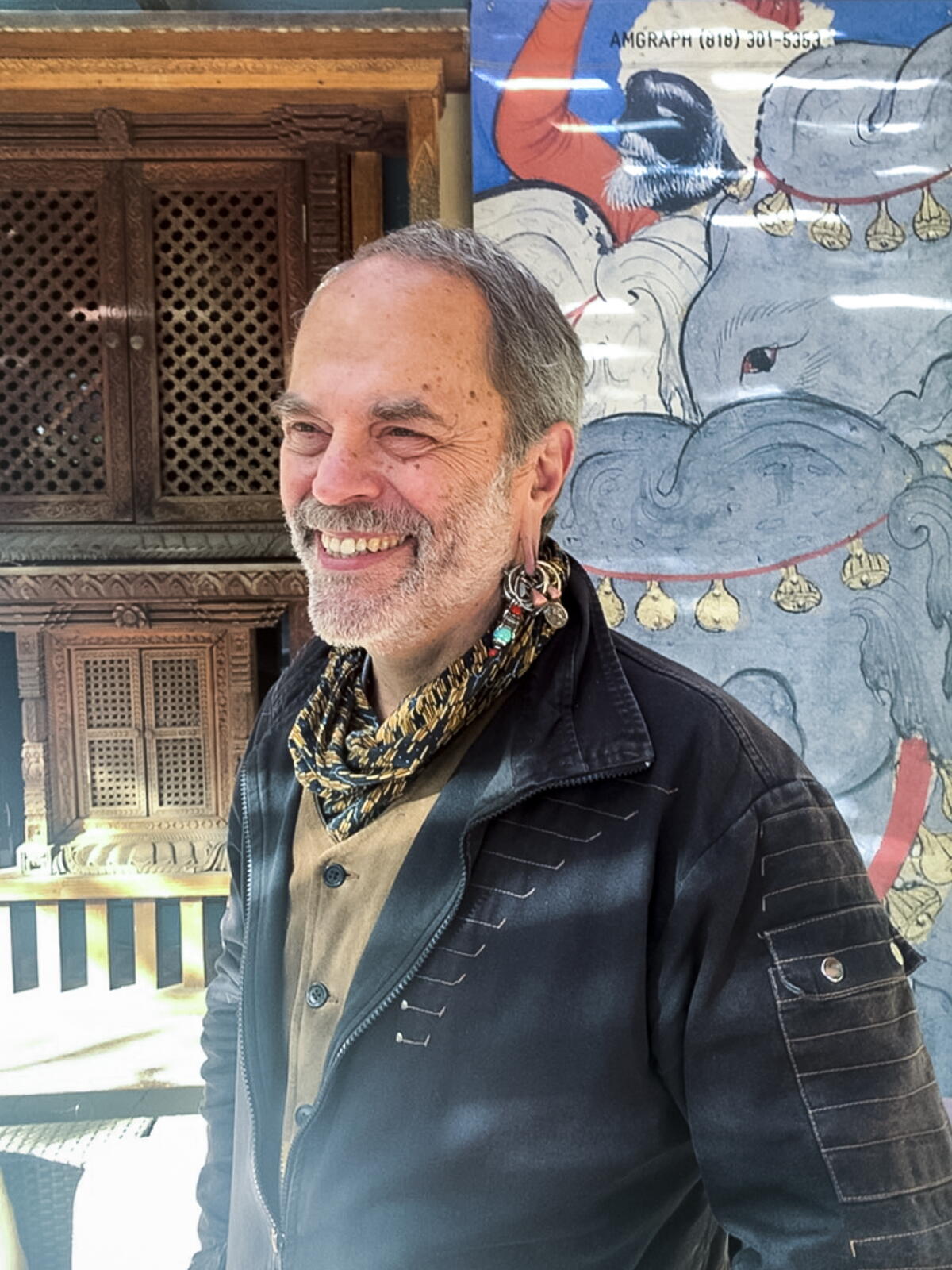
Retired Imagineer Joe Rohde, who led the project, heard the complaints.
Sign up for Mr. Todd’s Wild Ride
An insider guide to the ever-changing world of theme parks, coming to you straight from SoCal — the theme park capital of the world.
By continuing, you agree to our Terms of Service, which include arbitration and a class action waiver. You agree that we and our third-party vendors may collect and use your information, including through cookies, pixels and similar technologies, for the purposes set forth in our Privacy Policy such as personalizing your experience and ads.
“They look at the schedule and go, ‘You can’t do anything in that amount of time. There’s nothing you can do that is worth doing in this short amount of time, so we think this is going to be bad,’ ” says Rohde, whom I chatted with at the recent Disney fan convention D23.
Rohde‘s new book, “Floating Mountains: The Art of Imagining the Impossible,” is out this week and in it, he demystifies the creative process, heavily touching on his four-decade career at Imagineering as a jumping-off point on how to stay inspired and find art in the everyday. In a revealing chapter on what became Guardians of the Galaxy — Mission: Breakout!, Rohde writes about creating art out of a series of limitations.
Famed retired Disney Imagineer Joe Rohde, whose book “Floating Mountains: The Art of Imagining the Impossible” demystifies the creative process.
(Jay L. Clendenin / Los Angeles Times)
He notes that the new “Guardians of the Galaxy” film was not the reason for changing the drop tower ride — rather, the motivating factor was giving the Disneyland Resort something new to promote for 2017 and to begin to bring Marvel into the parks.
When assigned the project, Rohde initially pitched a Dr. Strange-inspired attraction, believing the hotel facade of Tower of Terror could quickly and easily translate to a mysterious sanctum. Execs, however, rejected the concept, arguing Dr. Strange wasn’t popular enough. They told Rohde and the team to focus on Spider-Man.
Now it was Rohde’s turn to say no. “Spider-Man needs room to swing,” Rohde writes in his book. “We only go up and down. There’s nowhere for Spider-Man to be!”
Bringing Marvel superheroes into a theme park, Rohde tells me, is something of a challenge.
“Marvel is a character brand,” Rohde says. “When we watch these movies or read the comics, our primary investment is in the psychology of the character. Spider-Man is a great example of this. Spider-Man’s life is a constant emotional crisis of one kind or another. It’s almost more of a soap opera format.
Guardians of the Galaxy — Mission: Breakout! is today the dominating structure of Avengers Campus at Disney California Adventure.
(Allen J. Schaben / Los Angeles Times)
“So, you have an art form — the Marvel Cinematic Universe and the Marvel Comic Universe — in which settings are disposable and are disposed of in order to drive character development. That works great in a film, but when it comes to place-making, it is difficult to lock yourself on the experiences of places, which is part of what makes theme parks theme parks. All through your day in a theme park the primary actor you engage with is the architecture and the landscape.”
With Spider-Man out, “Guardians of the Galaxy” was the compromise everyone could agree on. Only now the clock was ticking. Rohde notes that the team had to stop viewing the Tower of Terror as a hotel, and instead look at it as something of a blank page — an empty canvas that just happened to be in the shape of a blocky silhouette that jolts guests 190 feet in the air. Remove the hotel signage, and suddenly the mass resembled many things: “a grain silo, a fortress, a bank, a storage facility, possibly a prison,” Rohde writes.
Arguably, the facade for Mission Breakout! represents a bit of each of those. In “Floating Mountains,” Rohde says he began reimagining the building by taking inspiration from Marvel comic artist Jack Kirby, but he has also spoken of finding influence in architect Renzo Piano, who worked on France’s Centre Pompidou. The end result is a retro sci-fi building with high-tech-like pipes drawing one’s attention.
The chapter documents a frantic race against time. The star of the ride is an audio-animatronic of the Rocket Raccoon character, but it wasn’t always clear the figure could be finished by the deadline. And instead of using just one ride profile like the Tower of Terror, Mission Breakout! aimed for four, but Rohde writes the team had two as a fall-back plan (ultimately, they prevailed with their original intent).
Rohde notes that to get it done, a concession was made: limited reviews but a fixed, unchangeable budget with a strict deadline. And the team had to make a decision and commit. Little tinkering.
Guardians of the Galaxy — Mission: Breakout! is now considered one of the most popular attractions at Disneyland.
(Jason Armond / Los Angeles Times)
“You have to allocate a certain percentage of time and energy to prepare for a review, and that can be two weeks of energy,” Rohde says. “In this case, the most crucial thing about this project was its opening day. If you back out of that opening day just with production time, it becomes clear there’s no time to change. There’s no time to ask someone if they like it or don’t like it. So we have to decide we’re going to do it, and we’re going to do it for this much money, and you can look at it once before we start, and once before we build.”
Guardians of the Galaxy — Mission Breakout! opened on time, and with enough budget left over to create an “after dark” version during the Halloween season, which is currently running. And those fans who initially viewed the project with skepticism? Many were quiet after opening day, as Mission Breakout! is considered one of the Disneyland Resort’s most popular attractions.
Aside from replacing the former tension with chaotic elevator maneuvering, the makeover was a success because it’s not a rehash of a scene from the film. Rather than rely heavily on plot, it focuses on one frantic moment — a prison breakout — to create a zany, screwball comedy feel. In short, it’s a singular work of art, one that stands apart from its cinematic counterparts.
And that’s key to the appeal of “Floating Mountains,” as throughout Rohde makes the case that theme parks — often derided as commercial entities — are indeed vital spaces. He speaks of art as living on a spectrum. On one end, “art for art’s sake,” and on the other, “utterly commercial enterprises with no purpose other than to harvest value out of an intellectual property.”
“Theme parks,” says Rohde, “rocket somewhere in the middle of this.”
“I do believe that their social impact alone should argue for the fact that, no matter what you think of high art, of low art, something is going on here that people find very affecting,” he says of theme parks. “I think it is an art form.”
This week in SoCal theme parks
Inside Kingswell skate shop is a wall documenting the building’s history as the first L.A. outpost of what would become the Walt Disney Co.
(Todd Martens / Los Angeles Times)
A Disney history celebration. Walt Disney launched his animation career in Kansas City, Mo., in 1920. But when his Laugh-O-gram Studio failed after only about two years, he decided to move west. Here in Los Angeles, Walt and his brother Roy would in 1923 rent a small studio space on Kingswell Avenue in Los Feliz, near where he was staying with his uncle. They called their operation the Disney Bros. Studio, and it was officially the formation of what would become the Walt Disney Co. In September 2024, a small strip on the corner of Kingswell and Vermont avenues was designated the Disney Bros. Cartoon Studio Square. This Sunday, the space will host a mini-block party from noon to 5 p.m., with photo ops, events and skating demonstrations courtesy of the Kingswell skate shop,
Welcome the Lucas Museum. The long-awaited Lucas Museum of Narrative Art has arrived in L.A. and is welcoming members for previews. The space officially opens Sept. 22, and its emphasis on pop culture and “Star Wars” likely means there’s many an overlap with the Disney fan community. The Times has a bevy of coverage, including an architecture review as well as an analysis of its collection and how it deviates from typical art gallery fare.
Meow Wolf taps dozens of L.A. artists for new venue. Meow Wolf is getting closer to unveiling its Los Angeles locale. When doors open — the company is targeting late 2026 — expect a walk-around, floor-to-ceiling experience that pays homage to the art of cinema with a sci-fi, psychedelic-like bent. And to bring that vision to life, the Santa Fe, N.M.-based experiential art collective will be working with nearly 40 L.A. artists across multiple mediums. Meow Wolf last week unveiled its roster of artists with ties to the L.A. region.
A new Magic Mountain coaster is on the way. Six Flags Magic Mountain, garnering headlines tied to the safety of its X2 coaster, is looking ahead to 2027 and teasing a Thursday announcement for its next big thrill ride. The park last week posted a video to social media hinting at more info to come this week on what is expected to be a glider coaster with bike-like seating.
Ride report
An actor performing as Ozzy Osbourne during a haunted house at Universal Studios Hollywood’s Halloween Horror Nights.
(Scott Strazzante / For The Times)
This week’s ride report is actually a haunted house report. Of the eight spooky mazes at Universal Studios Hollywood this year, there were two clear standouts for me: the “Sinners” maze, which I documented last week, and Ozzy Osbourne: Prince of Darkness. This walk-through attraction, which Halloween Horror Nights mastermind John Murdy has described as something of a passion project, is a filled with cartoonishly sinister imagery in an homage to the recently deceased heavy metal legend.
Murdy says he didn’t have any hesitation about crating a haunted house based on Osbourne’s solo career so soon after he died last summer. “It hit everybody really hard,” the lifelong Osbourne fan says of the artist’s death. “It hit his fan community really hard. We needed to do something for the fans to celebrate this guy’s legacy.”
A giant animatronic bat in a haunted house inspired by the music of Ozzy Osbourne.
(Scott Strazzante / For The Times)
In an unique twist, nearly every scare actor is performing as some embodiment of Osbourne. The attraction is also filled with little nods to Osbourne’s life and legacy, including pictures donated from the family and a toy cow as a nod to an early job of Osbourne’s in a slaughterhouse. Murdy estimates the house features about 20 songs from Osbourne’s solo career, bookended by “Crazy Train” and “See You on the Other Side.” A train, of course, figures heavily into the maze, and an early ride scene appears to take us straight to hell.
It gets demented, but in a silly way that feels all-in-good-fun rather than anything frightening. Case in point: A centerpiece of the attraction is a giant animatronic bat, which is holding the severed head of Osbourne, only here the musician is depicted as a werewolf. Osbourne, says Murdy, was also heavily religious, so the walk-through culminates with the artist on a church-like throne. But it’s no ordinary cathedral, as jetting our from under Osbourne’s chair is a blue dragon, a nod to the tattoo the singer had on his chest.
It’s a love letter to Osbourne, and Murdy’s appreciation of the artist runs deep. He notes that as a seventh- or eight-grader in the early ‘80s, he wrote a term paper defending the artist. “I didn’t like the fact that people were condemning things when they hadn’t even bothered to read the lyrics and know what they are about,” Murdy says. “Take ‘Crazy Train.’ It’s about the Cold War. It’s about a fear that society is going off the rails. At an early age I was already going, ‘Don’t trust things that you hear at face value.’ ”
Tell us your stories. Ask us your questions.
Have a theme park tale to share? Whether it was a good day or less-than-perfect day, I would love to hear about it. Have a question? A tip? A fun photo from the parks to share? Email me at todd.martens@latimes.com. I may feature your note in an upcoming newsletter.
Ride on,
Todd Martens
P.S.
I can admit when I was largely wrong. Last week I expressed concerns about the way Halloween Horror Nights was adding the character of Nikki from “Obsession,” worrying a hyped incognito approach could open up the actor — or regular paying guests — to being uncomfortably approached by attendees. But while Nikki is not easy to find, she’s far from anonymous, all bloodied up and holding a brick. Plus, she’s accompanied by multiple handlers who keep folks from crowding the performer’s space.
There is a game-like aspect to this. Those who speak a password, released via social media, receive a fake business card, which does mean many a guest is standing there shouting a password at the actor. This is slightly awkward, and where I still have some reservations.
An actor as Nikki from “Obsession” interacting with guests during Halloween Horror Nights at Universal Studios Hollywood.
(Scott Strazzante / For The Times)
But many who find Nikki may discover it’s a highlight of the night. I’m not someone who seeks out characters at theme parks, largely because they’re there more for photos than to completely interact. Nikki is different. Nikki is in full immersive theater mode, responding entirely in character and pushing guests to talk about their devotion — to her, to another, to anything. In my minute with the actor, she aggressively quizzed me on my nonexistent love life, forcefully walking toward me so I had to gently stumble backward, which she lightly mocked.
Despite the unnerving tone of the actor’s questions, I was charmed. More of this type of interacting and play is always welcome. Now, I just wonder why she was so consumed with the health and age of my cat.
The Eiffel Tower was temporarily closed on Monday after workers went on strike to protest the sidelining of female staff during a private visit by a Hindu religious group.
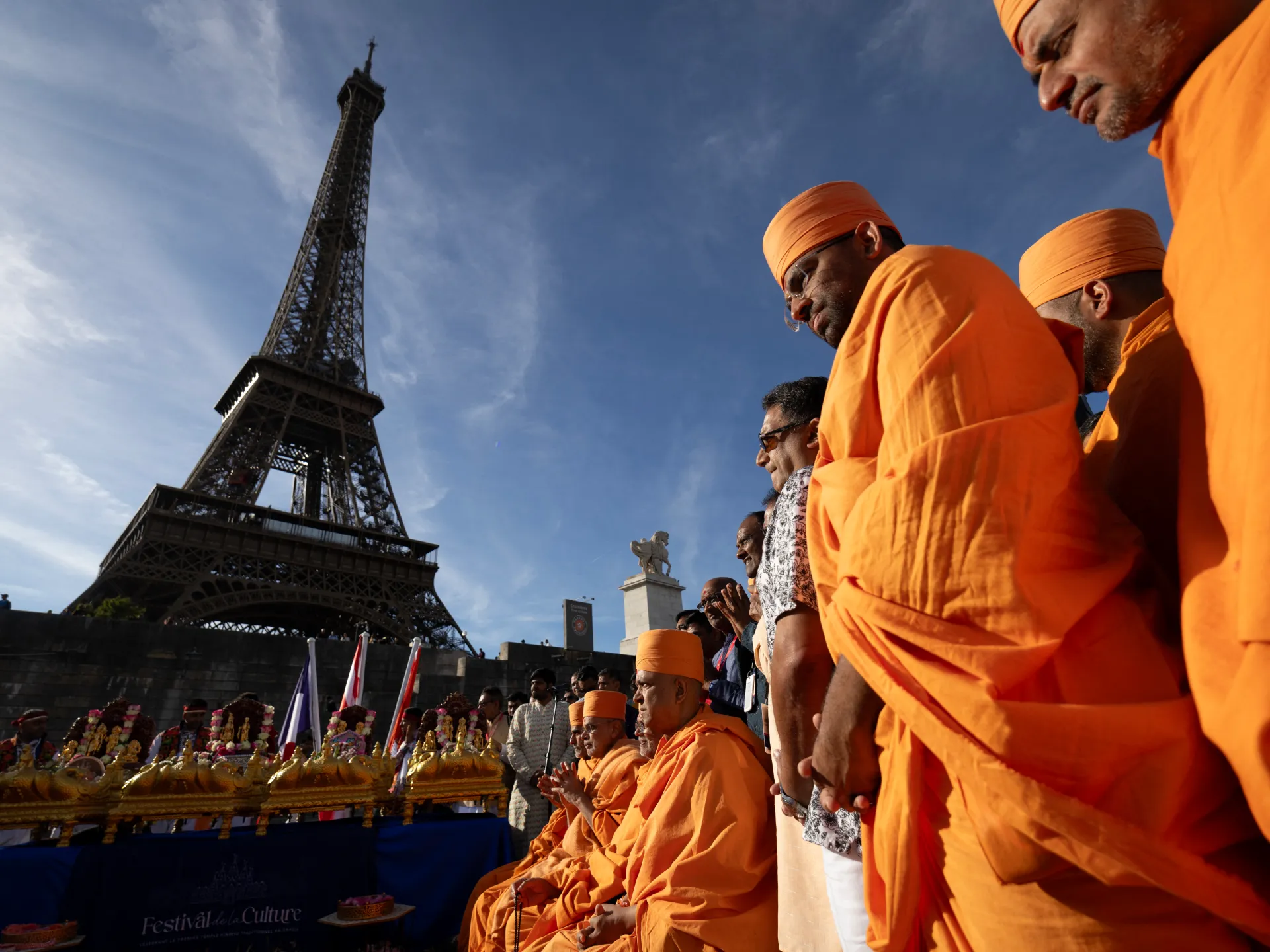
The tower, which has since reopened, shut after members of Bochasanwasi Akshar Purushottam Swaminarayan Sanstha (BAPS), a global socio‑spiritual Hindu denomination, visited the site. Female staff were reportedly asked to give way to male staff for the group’s tour, prompting protests from the workers’ union, outrage from French politicians and an apology from the Hindu group.
Here is more about BAPS and how the controversy unfolded.
What’s the controversy about?
The Eiffel Tower closed after staff walked out over the removal of women staff during a weekend visit by BAPS.
The Societe d’Exploitation de la Tour Eiffel, or SETE, which runs the Paris landmark, acknowledged that the group had requested the Saturday visit be organised in a way that limited “interactions with women”, and said “these conditions should not have been accepted”.
The BAPS monks, or sadhus, practise strict celibacy, which requires them to avoid physical contact with women and being alone in their company, and to minimise personal interaction or attention towards the opposite sex.
Wider community members of BAPS are not bound by these celibacy rules. According to news reports, the BAPS delegation visiting the Eiffel Tower comprised both monks and community members.
Eiffel Tower staff said in a statement that they condemned “professional instructions that led to female employees being sidelined, replaced and made invisible because of their sex” during the visit by the delegation.
“Some were asked to leave their posts and withdraw to other areas. In some posts they were replaced by men. And all female employees were instructed not to go through or cross certain areas while the delegation was present,” the staff union said, adding they were shocked to have been put in such a situation.
Paris Mayor Emmanuel Gregoire said an investigation would be launched “as soon as possible”. In a post on social media, he said he was aware of the employees’ anger and agreed their dissatisfaction was legitimate.
What is BAPS and how have they responded?
BAPS was founded in India in 1907 and began expanding internationally from the 1960s. It is a spiritual organisation which works on community building, constructing temples, helping with disaster relief and running medical camps, environmental drives and educational programmes.
It now also runs an extensive network of temples and cultural centres across the world, including more than 100 in the United States and more than 1,000 worldwide, including across Europe, Africa and Asia. BAPS also runs a temple in Paris.
On Tuesday, the BAPS Paris account posted a statement on X responding to the controversy.
“To our knowledge, at no time was access to the Eiffel Tower denied to anyone,” the account wrote, originally in French.
“Nevertheless, we wish to offer our sincere apologies to anyone who may have been hurt or inconvenienced by this situation,” it added.
How has the response in France been?
Leaders within France expressed outrage over reports of women being removed from the premises.
Aurore Berge, the minister delegate for gender equality and fight against discrimination in France, wrote in an X post on Monday: “In France, we do not ask women to step aside. No dogma, no religion is superior to the laws of the Republic.”
Yael Braun-Pivet, president of the National Assembly, wrote in a post on social media: “Welcoming others never means giving up our values. In France, women are fully present in public life. No one tells them to become invisible.”
Former French President Francois Hollande, now an MP, wrote on X on Tuesday: “We do not ask women to step aside to satisfy religious demands.”
He expressed support for the Eiffel Tower staff who walked out.
“Equality between women and men is a fundamental achievement of our Republic. It applies everywhere, to all women and all men, without exception,” Hollande wrote.
Parliamentarian and former PM Michel Barnier wrote on X: “It is therefore utterly unacceptable that an order aimed at making women disappear from this space could have been issued.”
Barnier added that “women are not hidden. They are not erased. They are respected, and their freedom is defended”, demanding an explanation from the SETE.
Jordan Bardella, the president of the far-right National Rally, wrote on X on Tuesday: “This degrading demand should never have been met. In a free country like France, gender equality is respected, and no religious reason can override women’s dignity.”
Prominent far-right MP and leader of the National Rally (RN), Marine Le Pen wrote in an X post: “In France, we will never accept that the presence of women be ‘limited.’”
Is BAPS linked to the Modi government?
BAPS is not officially part of a political party in India, and has long insisted that it is apolitical.
But researchers have long pointed to a close, cooperative relationship with Prime Minister Narendra Modi and his Bharatiya Janata Party (BJP) government.
In fact, the Eiffel Tower closure came just a day after Modi virtually inaugurated the BAPS temple in Paris.
Modi also attended the physical inauguration of the BAPS temple in the United Arab Emirates (UAE) in 2024.
Has BAPS faced other controversies in the past?
BAPS has faced a series of high-profile controversies in the past.
During a landmark legal battle in 1966, BAPS leaders argued in court that their sect was not part of Hinduism but a distinct religion. They did so in an attempt to avoid the Bombay Harijan Temple Entry Act, which required Hindu temples to open their doors to Dalits, a historically marginalised caste group. The Indian Supreme Court rejected the appeal made by BAPS.
In 2013, two former BAPS monks filed a complaint accusing senior BAPS leaders of sexual assault dating back to the 1970s. BAPS leaders denied the allegations. The complaint did not result in any publicly reported criminal charges.
In 2021, a US federal class‑action lawsuit accused BAPS of exploiting low‑caste labourers from India to work on its temples. The case, brought on behalf of about 200 Indian workers, alleged they were lured from India, coerced into employment agreements, and forced to work more than 12 hours a day with only five days off a year at a temple in Robbinsville Township, New Jersey.
The suit says they were paid as little as $1.20 an hour, far below the US federal minimum wage of $7.25 and New Jersey’s $12 statewide minimum.
A US federal investigation into labour trafficking at the Robbinsville temple has since been closed without criminal charges, but the civil class‑action lawsuit brought by the workers continues.
The Eiffel Tower was shut on Monday after staff went on strike claiming women were asked to step out of sight during a visit by a Hindu group. Around 100 people from the BAPS Hindu movement were among the delegation as France inaugurated its first major Hindu temple.