Democratic Senate control has moved from a reach to a toss-up
Today we discuss political forecasting, death and taxes.
Goodness! We’re just 65 days from election day.
Time flies when you’re watching American democracy teeter.
Still think Republicans will lose the House?
Your friendly political columnist makes no predictions. It’s hard to know the future, seeing as how it hasn’t happened yet. But our best guide — historical trends — suggest Democrats are exceedingly likely to seize control on Nov. 3.
They need only flip three seats and, going back well over half a century, the average midterm gain for a party out of the White House is more than two dozen. Even with the advantage the GOP engineered through aggressive gerrymandering, the deadweight of a deeply unpopular president threatens to drag down a number of Republicans in competitive and some otherwise-not-so-competitive races.
Right now, the biggest question seems to be whether November brings a blue wave, a big blue wave or merely a ripple.
What about the fight for control of the Senate?
That’s where things have gotten interesting.
Oh?
At the start of this election cycle, it looked like winning control was all but out of Democratic reach.
There are 35 contests on the ballot in November. Of those, nearly two dozen are effectively over before they’ve even started, given the advantage one party holds over the other. Of the remainder, most are being held in states Trump won in 2024, which makes them, broadly speaking, much friendlier terrain for Republicans.
Democrats need to flip four Senate seats and until fairly recently that inhospitable political map made it seem like an all-but insurmountable challenge.
And now?
Now smart handicappers, like the folks at the nonpartisan Cook Political Report, say control of the Senate is a toss-up.
“Republicans still retain a structural advantage given the partisan challenges of the map, and Democrats still need almost every key race to break their way,” Jessica Taylor, who tracks Senate races for the Cook Report, wrote in a recent analysis. But, she went on, “in a wave election akin to 2006” — when Democrats gained six Senate seats — “even states that President Donald Trump won by double digits could move within Democrats’ reach.”
That’s exactly what’s happened as inflation festers, the war with Iran drags on and Trump’s political standing steadily deteriorates.
Democratic jubilee!
Not so fast. A toss-up means it’s just as likely Republicans will retain their Senate majority.
Understood. So break it down.
Let’s start with those things Democrats have going for them, with the usual caveats …
… There are no certainties but death and taxes. Got it. Go on.
At one time, Georgia looked to be a toss-up as Democrat Jon Ossoff sought reelection in one of those battleground states Trump carried. But Ossoff has raised a boatload of money and drawn a less-than-world-beating opponent in Republican Rep. Mike Collins. Lately, the buzz around Ossoff has been focused more on a potential 2028 run for president than his November reelection.
Meantime, in North Carolina, where former Democratic Gov. Roy Cooper is running against former national GOP Chairman Michael Whatley, a Cooper victory seems much more likely than not. A win there would give Democrats one of the four seats they need to flip.
Then there’s a handful of red-state seats that Republicans are fighting to hang on to, in Alaska, Iowa, Ohio and Texas.
Do tell.
In Alaska, former Rep. Mary Portola managed to win nearly 50% of the vote in the Aug. 18 primary, which is noteworthy given she ran on the same ballot as the GOP incumbent, Dan Sullivan, who finished second. (Another Dan Sullivan also appeared on the ballot; under Alaska’s top-four system both Sullivans will advance to a November runoff, along with Portola. The fourth slot is pending.
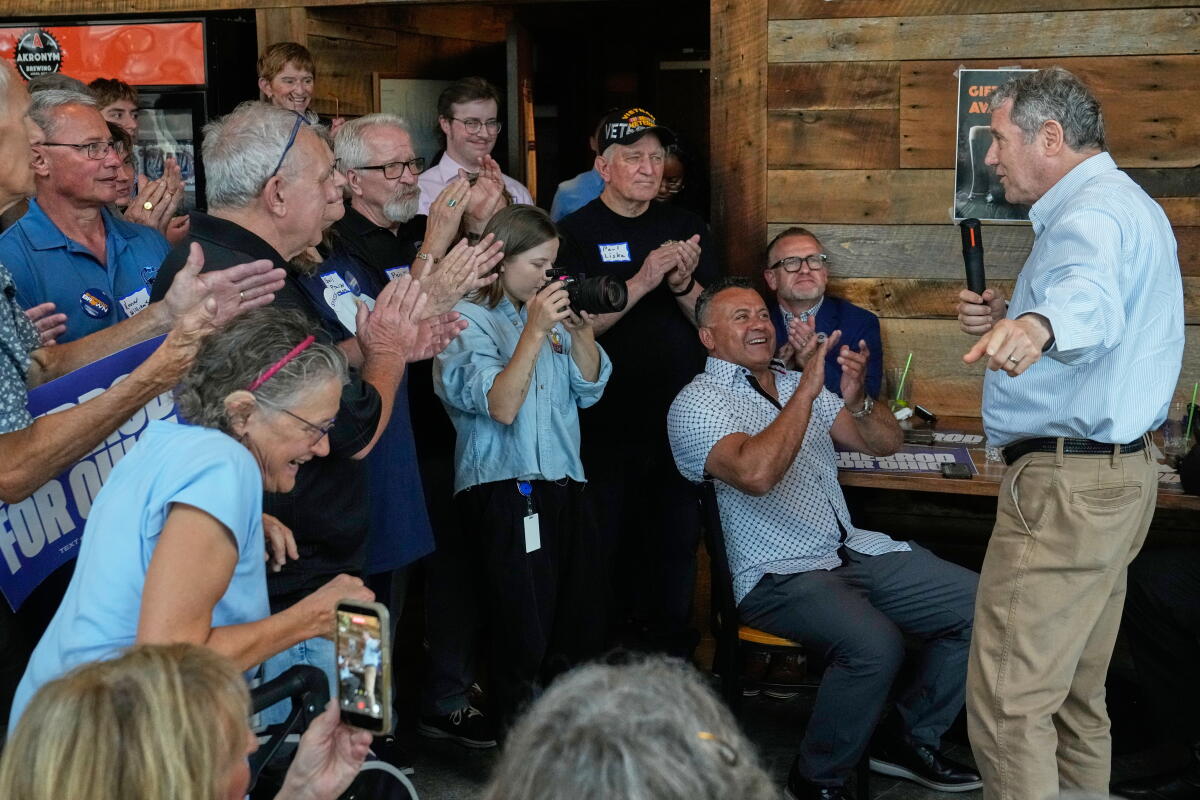
In Ohio, former Sen. Sherrod Brown, who was elected three times before losing his 2024 reelection bid amid a Trump landslide, faces Republican Jon Husted, who was appointed to fill the seat vacated when JD Vance became vice president. Husted has proved a less-than sure-footed candidate while Brown is waging a strong comeback campaign.

Supporters applaud as Democratic Ohio Senate candidate Sherrod Brown speaks at a campaign event in Akron
(Sue Ogrocki / Associated Press)
In Iowa, Rep. Ashley Hinson (a USC grad and former KABC-TV intern!) is running against state Rep. Josh Turek in a state that’s been hammered by Trump’s tariffs and the surging price of gas — especially the diesel fuel that sustains Iowa’s all-important agricultural economy. Turek could also benefit from the strong campaign being waged by gubernatorial front-runner Rob Sand, who tops the Democratic ticket.
Then there’s Texas.
The land of dashed Democratic dreams!
Obviously, you know your political history.
Democrats haven’t won a statewide contest in Texas since 1994, despite no end of hype and hope. This time, they’re pinning their dreams on state Rep. James Talarico, a seminarian and viral sensation. But what’s made the race highly competitive is the singularly defective GOP nominee, Ken Paxton, whose splotchy resume includes indictment, impeachment and alleged adultery. On top of all that, he’s been a pretty lousy fundraiser and has yet to bind the wounds left by a savage GOP primary.
So everything is coming up Democratic roses?
Not necessarily.
Two states they’re counting on to flip the Senate, Maine and Michigan, have grown problematic.
Maine once looked to be Democrats’ best pickup opportunity. Incumbent Susan Collins is the lone Republican running in a state Kamala Harris carried in 2024. Then came Graham Platner, along with his inflammatory social media postings, Nazi tattoo and allegations of sexual assault. He stepped aside in July and was replaced by Troy Jackson, a former logger and state Senate president, who has considerable ground to make up after his late start.
Collins, who’s been reelected four times, has a history of winning tough races. The Platner debacle certainly hasn’t helped Jackson or Democrats.
Meanwhile, in Michigan, the progressive Abdul El-Sayed inched past a more centrist alternative to win the Democratic nomination. The question is whether he’s too far left (and, frankly, whether there’s too much anti-Muslim sentiment) for El-Sayed to prevail in that purple state. The Republican nominee, former Rep. Mike Rogers, ran two years ago and lost by less than half a percentage point.
Good to know. A lot can happen in the next 65 days.
Exactly.
Which is why we stick to columnizing. If you want predictions, ask a mystic or consult your Magic 8 Ball.