tops

Dow tops 50,000 as most blue-chip stocks post gains

Feb. 6 (UPI) — The Dow Jones Industrial Average surpassed 50,000 points for the first time in its history as most blue-chip stocks gained during trading Friday.

The Dow set a new record of 50,115.67 after posting an average gain of 1,207 points and 2.4%, while 28 of 30 blue-chip stocks rose in value during the day’s trading.

The Dow’s record day caused it to post a 2.5% gain for the week.

NVIDIA led the charge with a 7.87% gain while closing at 185.41 after rising 13.53 in value, and Caterpillar posted a 7.04% gain after rising 47.74 in value and closing 726.2.

Investors credited the nation’s economy and significant corporate earnings with spurring the day’s gains after overcoming an emotionally driven selloff earlier in the week, The Wall Street Journal reported.

“Emotional deleveraging selloffs, such as this week, are unnerving,” Mark Hackett, chief market strategist at Nationwide, told the news outlet.

Despite the earlier selloff, Hackett said the “macro and earnings environment remain encouraging.”

In addition to the Dow gains on Friday, investors spurred a 1.97% gain for the S&P 500, which rose 133.90 points and closed at 6,932.30.

The Nasdaq Composite also posted a significant gain by rising 2.18% and 490.63 points to close at 23,031.21 for the day.

Despite the gains on Friday, the S&P 500 was down a slight 0.1% and the Nasdaq 1.8% for the week.

Investments by tech firms in artificial intelligence generally fueled the day’s gains.

“We’re in a gold rush right now with AI,” Falcon Wealth Planning founder Gabriel Shahin told CNBC.

“You have the investment that Google is making, Nvidia is making, that Meta is making [and] that Amazon is making,” Shanin said. “There is money that will be deployed.”

He said investors are moving away from growth stocks and favoring those that provide value amid a “great recalibration.”

Source link

Naver tops $9.1B in revenue, bets on AI agents and fintech monetization

Naver CEO Choi Soo-yeon speaks during a plenary session of the Artificial Intelligence (AI) Action Summit at the Grand Palais in Paris, France, 11 February 2025. The summit takes place from 10 to 11 February. File. Photo by MOHAMMED BADRA / EPA

Feb. 6 (Asia Today) — South Korean internet giant Naver said Thursday it has entered the era of 12 trillion won ($9.1 billion) in annual revenue, driven by strong growth in commerce and fintech and a renewed push to monetize artificial intelligence services.

Naver reported 2025 revenue of 12.35 trillion won ($9.15 billion) and operating profit of 2.21 trillion won ($1.64 billion), up 12.1% and 11.6%, respectively, from a year earlier, during its fourth-quarter earnings call. Fourth-quarter revenue rose 10.7% to 3.20 trillion won ($2.37 billion), while operating profit increased 12.7% to 610.6 billion won ($453 million), lifting the operating margin to 19.1%.

Commerce and fintech led the gains. Fourth-quarter commerce revenue surged 36% year-on-year to 1.05 trillion won ($780 million), while annual transaction volume on Naver’s Smart Store platform grew 10%. The company said revamped membership benefits and guaranteed delivery services helped strengthen user retention, while AI-driven personalized recommendations boosted conversion rates and advertising and commission revenue.

Fintech revenue also climbed sharply. Fourth-quarter payment volume rose 19% to 23 trillion won ($17.0 billion), bringing full-year fintech revenue to 1.69 trillion won ($1.25 billion). Chief Executive Choi Soo-yeon said platform trust and ecosystem-building efforts drove growth in transactions and new memberships.

During the call, Naver declared 2026 the first year of full-scale AI monetization. Choi said AI accounted for about 55% of advertising revenue growth last year, highlighting what she called tangible returns from the company’s AI investments.

Naver plans to roll out hyper-personalized AI agents across its services, beginning with a shopping agent for Naver Plus Store later this month following an internal beta test. Vertical AI agents covering restaurants, locations, travel and finance are set to follow later this year. In the second quarter, Naver will add an “AI tab” to its search results, while a unified intelligent assistant, dubbed “Agent N,” is scheduled for launch this summer.

The company also plans to begin monetization tests, including advertising within its AI briefing service, in the second half of the year. Choi said longer user engagement times could lift both ad pricing and effectiveness.

Beyond AI, Naver is advancing structural changes to secure future growth. Its financial unit is proceeding with the previously announced plan to bring crypto exchange operator Dunamu under full ownership, fueling market expectations of a won-based stablecoin and expanded use of Naver Pay’s 34 million-user ecosystem.

Naver is also expanding its cloud business, citing steady demand for GPU services, and plans to conduct outdoor proof-of-concept trials for robot delivery this year, drawing on experience gained in Japan and Saudi Arabia.

Addressing regulatory issues, Choi said government-led foundation model initiatives are unlikely to materially affect Naver’s sovereign AI strategy or business-to-business revenue.

The company also strengthened its shareholder return policy. Naver said it plans to return 25% to 35% of average consolidated free cash flow over a three-year period from 2025 to 2027. For the 2025 fiscal year, it will propose dividends totaling 393.6 billion won ($291 million), or 2,630 won per share, subject to board approval. Beginning this quarter, Naver will reorganize its revenue disclosure into platform, financial and global challenge segments to improve transparency.

— Reported by Asia Today; translated by UPI

© Asia Today. Unauthorized reproduction or redistribution prohibited.

Original Korean report: https://www.asiatoday.co.kr/kn/view.php?key=20260206010002456

Source link

Online shopping tops $188B as Korea’s retail divide widens

People crowd an indoor shopping mall in South Korea on 25 January 2026. Photo by YONHAP / EPA

Feb. 2 (Asia Today) — South Korea’s online shopping market surpassed 270 trillion won (about $188 billion) in 2025, hitting a record high and underscoring a growing divide between fast-growing digital platforms and stagnant offline retailers.

According to the “December 2025 and Annual Online Shopping Trends” released Monday by the National Data Service, online shopping transactions reached 272.3 trillion won (about $188 billion), up 4.9% from a year earlier. Mobile shopping accounted for 211.1 trillion won (about $145 billion), a 6.5% increase. Both figures were the highest since data collection began.

Online shopping growth has been fueled by the rapid expansion of mobile consumption and logistics innovations such as early-morning and same-day delivery. Transaction volumes rose from 94.1 trillion won (about $64.9 billion) in 2017 to more than 100 trillion won (about $68.9 billion) the following year, exceeded 200 trillion won (about $137.7 billion) in 2022 and continued climbing steadily into the 270-trillion-won range (about $188 billion) last year.

The strongest growth came from automobiles and auto-related products, which posted annual transactions of 7.5 trillion won (about $5.22 billion), up 30.5% year-on-year. The increase was driven largely by online sales of electric vehicles, particularly from Tesla, which operates a direct online ordering system. Tesla’s domestic sales reached 59,916 units in 2025, more than double the previous year’s total.

Food-related categories also expanded sharply. Online food service transactions rose 12.2% to 41.4 trillion won (about $28.6 billion), while online food and beverage purchases increased 9.5% to 37.8 trillion won (about $26.0 billion), reflecting consumers’ growing reliance on delivery platforms.

By contrast, offline retail channels showed little momentum. Data from the Ministry of Trade, Industry and Energy showed that sales at 26 major retailers rose 6.8% in 2025, but growth was heavily skewed toward online platforms. Online retail sales jumped 11.8%, while offline sales edged up just 0.4%.

Large supermarkets saw sales fall 4.2% from a year earlier, while convenience store sales grew only 0.1%, effectively stagnating. These sectors, closely tied to everyday household consumption, were hit hardest as shoppers shifted spending online.

Industry analysts attribute the decline to the rapid spread of mobile shopping and fast delivery services, which have reduced foot traffic and average transaction values at brick-and-mortar stores. The traditional “one-stop shopping” advantage of large supermarkets has weakened, while convenience stores have lost their proximity edge to quick-commerce and delivery platforms.

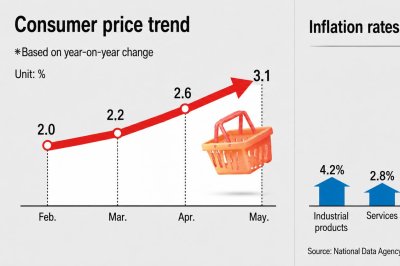
Rising fixed costs, including rent, labor and electricity, combined with weaker consumer demand amid high interest rates and inflation, are further eroding profitability. As a result, the gap between online and offline retail is increasingly seen as a structural shift rather than a temporary trend.

— Reported by Asia Today; translated by UPI

© Asia Today. Unauthorized reproduction or redistribution prohibited.

Original Korean report: https://www.asiatoday.co.kr/kn/view.php?key=20260202010000592

Source link

Gold tops $5,500, silver rises while Powell downplays metal rally

Federal Reserve Chair Jerome Powell pushed back against political pressure on the US central bank on Wednesday and defended its independence, urging the next chair to “stay out of elected politics”. Markets, however, appeared unconvinced, accelerating a sell-off in the dollar as gold and silver hit fresh record highs.

“Don’t get pulled into elected politics. Don’t do it,” Powell told reporters.

The reaction followed the Federal Reserve’s latest decision to leave interest rates unchanged in a range between 3.5% and 3.75%.

Asked whether the Fed was drawing any macroeconomic signal from the explosive rally in precious metals, Powell played down its significance.

“We don’t take much message macroeconomically,” Powell said. “The argument that we are losing credibility is simply not the case. If you look at where inflation expectations are, our credibility is right where it needs to be.”

He highlighted that the Fed does not “get spun up over particular asset price changes”, although it continues to monitor markets closely.

Markets react

The market reaction sharply contradicted Powell’s message.

Gold jumped to $5,500 per ounce, setting a new all-time high, while silver climbed above $117 per ounce.

Gold is now up over 20% this month, on track for its strongest monthly performance since January 1980.

Silver’s gains have been even more dramatic, with prices already up around 55% this month — the strongest monthly rise on record.

Meanwhile, the US dollar index, which tracks the greenback against a basket of major currencies, fell to levels last seen four years ago.

“The next couple of days will show whether investors have concluded that the dollar needs to go lower and that today’s bounce is a selling opportunity,” said James Knightley, chief economist at ING.

The dollar is now more than 10% below its 2025 highs, weighed down by persistent macro headwinds, including global central bank diversification away from US assets, widening fiscal deficits, recurring questions over Fed independence, and expectations of further policy easing.

‘Is gold the new bitcoin?’

Veteran Wall Street economist Ed Yardeni linked the rally to politics, suggesting its sustained popularity could make “gold the new bitcoin”.

Yardeni argued that US President Donald Trump, a vocal supporter of cryptocurrencies, appears to be inadvertently fuelling the rise in gold prices.

On Tuesday, Trump said “the dollar is doing great” when asked whether the currency had fallen too much, signalling he is comfortable with a weaker greenback.

“A weaker dollar may put upward pressure on US inflation, which would also boost the price of gold,” Yardeni said.

Commodities surge beyond gold and silver

The rally has spread across the broader commodities market.

Platinum climbed above $2,900 per ounce for the first time on record this week and is already up 33% this month. Palladium, which benefits from stronger industrial demand, rose to a four-year high and is up more than 22% year to date.

Copper also surged, hitting a record $6.30 per pound on Thursday.

Across commodity markets, investors are increasingly positioning for prolonged dollar weakness, amid perceptions that US institutions are willing to tolerate — or quietly accept — the shift.

Euro stronger, equities mixed

In Europe, the euro traded near $1.1950, edging lower after briefly breaking above $1.20 earlier in the week following Trump’s comments.

The single currency has now risen for three consecutive months against the dollar and is up around 15% year on year.

European equities were mixed. France’s CAC 40 and Italy’s FTSE MIB gained around 0.5%, while Germany’s DAX fell over 1%.

Frankfurt’s losses were led by SAP, which slid 16% — its biggest one-day drop since October 2020 — after weaker-than-expected cloud sales and a cut to 2026 revenue guidance outweighed in-line fourth-quarter results.

Source link