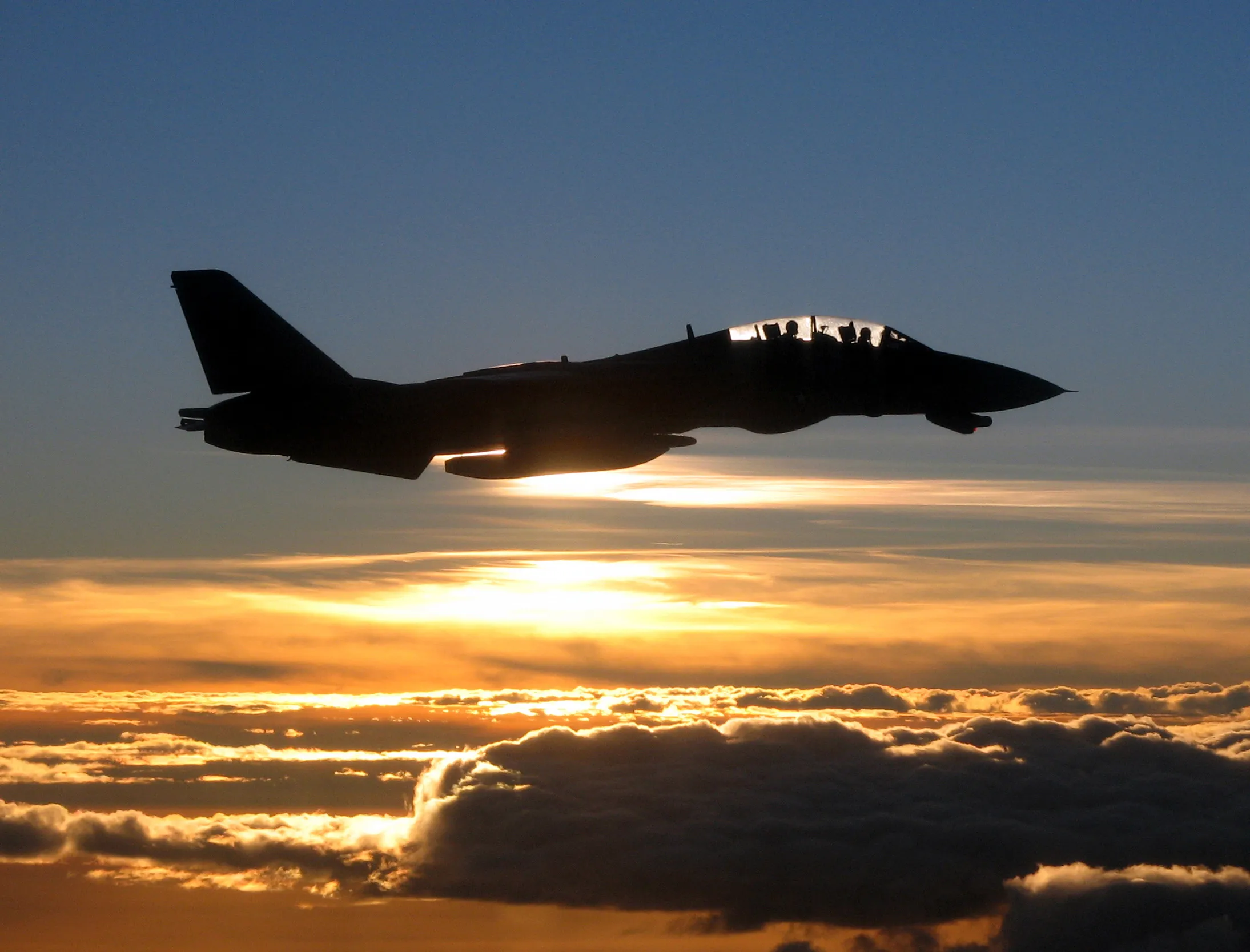
My God… The F-14 Tomcat May Actually Fly Again Over The United States
The dream of getting an F-14 Tomcat back up in American skies, discussed as a fantasy for the past two decades since the Navy retired the type, may actually become a reality.
Legislation making its way through Congress would allow the Navy to gift three retired F-14Ds to the U.S. Space & Rocket Center museum in Huntsville, Alabama, and open the door to one of the iconic jets potentially being returned to flight status. Companion bills in the Senate and House are both dubbed the “Maverick Act,” a clear reference to the Top Gun film franchise and the fictional Navy Capt. Pete “Maverick” Mitchell, played by star Tom Cruise.
Senator Tim Sheehy, a Montana Republican, introduced the Senate’s version of the Maverick Act on March 23. Senator Mark Kelly, an Arizona Democrat, co-sponsored that bill. Sheehy is a U.S. Naval Academy graduate and former Navy SEAL. Kelly is also a retired naval aviator, who flew A-6 Intruders, and astronaut. In the House, Representative Abe Hamadeh, a Republican from Arizona and U.S. Army veteran, introduced the companion legislation with the same title on April 16. There are nine co-sponsors to Hamadeh’s bill, including one Democrat. The legislation cleared the Senate by unanimous consent on April 28, and the matter is now in the hands of the House.

The last Navy F-14 was officially retired in September 2006 after 32 years of service to the fleet. Despite its retirement in the United States, the Tomcat has remained under extremely tight export controls due to its continued service in Iran, the only other country to ever operate the type.
The three Tomcats now earmarked for potential transfer are identified by their Navy serial numbers, or Bureau Numbers: 164341, 164602, and 159437. These are the only three F-14Ds currently in storage at the famed boneyard at Davis-Monthan Air Force Base in Arizona, per U.S. Air Force records. Three A variants and a pair of B models are also currently stored there. The current condition of any of these aircraft is unclear.

Sticking with the text of the Senate version at the time of writing for simplicity, the bill says the transfer of the F-14s to the U.S. Space & Rocket Center, an air and space museum established by the government of Alabama in 1970, would be made at no cost to the government. “Any costs associated with such conveyance, costs of determining compliance with terms of the conveyance, and costs of operation and maintenance of the aircraft conveyed shall be borne by the Commission,” per the proposed legislation.
The bill explicitly states that the aircraft will “not have any capability for use as a platform for launching or releasing munitions or any other combat capability that it was designed to have.” It also lays out a series of conditions for the transfer, noting that the Secretary of the Navy would not be obligated to restore, repair, or otherwise modify the Tomcats before handing them over, but would provide accompanying maintenance and operations manuals along with any excess spare parts available.

The matter of excess spare parts leads us to the most eye-catching section of the bill:
“The Secretary [of the Navy] shall provide excess spare parts to make one of the F-14D aircraft flyable or able to complete a static display, provided that any part transferred is from existing Navy stock, with no items being procured on behalf of the Commission.”
“The Secretary will not be responsible for transferring any additional parts or providing any additional support beyond what is stated in this section, during or after the conveyance of the aircraft,” the proposed legislation adds. As such, the Secretary of the Navy would allow the Commission to enter into agreements with relevant nonprofit organizations to help with restoring and operating the aircraft “for public display, airshows, and commemorative events to preserve naval aviation heritage.”
The transfer would also be made under the “condition that the Commission shall operate and maintain the aircraft in compliance with all applicable limitations and maintenance requirements imposed by the Administrator of the Federal Aviation Administration,” the bill notes. “The Commission shall not convey any ownership interest in, or transfer possession of, the aircraft to another party without the prior approval of the Secretary.”
The Navy would reserve the right to immediately repossess the aircraft if either of the above terms were breached.

“The Maverick Act of 2026 creates a narrow exception to the post-retirement restrictions that have destroyed nearly all F-14s, ensuring that its legacy is preserved,” according to a press release that Abe Hamadeh’s office put out on May 1. “The Maverick Act allows three of the world’s final Tomcats to be demilitarized and transferred for public display and education under strict national security safeguards. It does not restore combat capability or reopen foreign transfer.”
“I want to thank Senator Sheehy and his colleagues for passing this legislation aimed at preserving for history one of the most iconic aircraft ever flown,” Hamadeh said in an accompanying statement. “As a former U.S. Army officer, I know that many of the men and women I served with felt the same way. That is why I proudly introduced this legislation.”
It is worth noting that retired F-14s are on public display at various military bases and museums in the United States, but none are in flyable condition. Around it’s retirement, there had been unsuccessful pushes in the past to try to get a Tomcat back into the air in private hands, including by the late Dale “Snort” Snodgrass, a legendary naval aviator and F-14 pilot, who performed official Navy Tomcat demos at airshows for many years.
The prospect of getting a ‘warbird’ Tomcat flying has remained a persistent topic of popular discussion, but has long seemed largely impossible due to bureaucratic red tape, as well as the cost and complexity of doing so. TWZ stressed these points when it emerged that a non-flying F-14 would feature in the sequel to 1986’s Top Gun, Top Gun: Maverick, which hit theaters in 2022. The U.S. military was heavily involved in the production of both movies. The original film cemented the place of the F-14 and the Navy’s TOPGUN program in popular culture.

TOP GUN | Official Trailer | Paramount Movies

Top Gun: Maverick – Official Trailer (2022) – Paramount Pictures
A key factor in all of this has been that the story of the Tomcat is inseparably linked to Iran, which received a fleet of F-14As before the fall of the Shah in 1979. The Islamic Republic that emerged afterward continued to operate the jets despite the U.S. government cutting off support. American authorities also moved to impose very tight controls on access to retired F-14 airframes and spare parts, and many of the aircraft were destroyed outright as they left Navy service because of this.
Intriguingly, the prospect of having an F-14 flying again in the United States may have become more likely as a result of the latest conflict with Iran. As TWZ has previously reported, joint U.S. and Israeli strikes between February and April may well have finally put an end to the Islamic Republic of Iran Air Force’s (IRIAF) Tomcat operations for good.

Even before the conflict, Iran likely only had a handful of serviceable Tomcats. For example, only one example appeared at the Kish Air Show in 2024, as you can read about here.

Still, even if the Maverick bill is passed and signed into law, there would be many more hurdles before an F-14 could return to the air. After many years spent in the desert boneyard, the Tomcat would require deep inspections to ensure its structure and critical subsystems were fully functional and compliant with the Federal Aviation Administration’s certification requirements.

Just getting the F-14 back to flight status would be massively labor-intensive and very expensive. Keeping the jet in the air would also require considerable funds, with the Tomcat being notoriously maintenance-heavy. Flying the jet regularly would impose high costs, including fuel. The F-14 holds roughly 2,280 gallons of fuel internally. So filling up the jet with a single tank of gas would run around $14,500 at today’s jet fuel prices. This jumps up considerably with external fuel tanks, which add another 534 gallons to the price tag. It can burn this fuel load very fast, especially during high-performance airshow routines.
Complex, supersonic swing-wing jets have periodically appeared at U.S. airshows, specifically the Soviet-era MiG-23 Flogger. In 2023, a privately owned MiG-23UB crashed at the Thunder Over Michigan airshow in Ypsilanti, Michigan, highlighting the challenges of operating these kinds of jets in private hands.
Meanwhile, a Tornado F2, another Cold War-era swing-wing jet, is now being returned to flight status by Jared Isaacman. Now the administrator of NASA, Isaacman is also the founder and former CEO of the ‘red air’ adversary support provider Draken International, as well as a tech billionaire, astronaut, and the operator of a pristine MiG-29 Fulcrum personal jet.
Whether or not the Maverick Act becomes law, or if the U.S. Space & Rocket Center returns an F-14 to U.S. skies, the legislation is a notable new development in the Tomcat’s story. It could have broader impacts, as well. On several occasions in the past, members of Congress have proposed legislation to curtail private operators from flying former advanced U.S. military aircraft, in general.
When it comes to the possibility of a Tomcat back in the air, while it is certain to be a big challenge, it is fair to say that no other single aircraft has more of a draw in popular culture and more pull in the public consciousness. There are likely to be many people with a lot of money who would be eager to get behind an initiative to get one of the jets back in the air if the opportunity presents itself.
Overall, turning the idea of a ‘warbird’ Tomcat from fantasy into reality would be extremely welcome among Top Gun movie lovers, loyal fans of the F-14, Naval Aviation veterans and aficionados, and the aviation heritage community at large.
Author’s note: Special thanks to @Osinttechnical on X for bringing this to our attention.
Contact the author: thomas@thewarzne.com