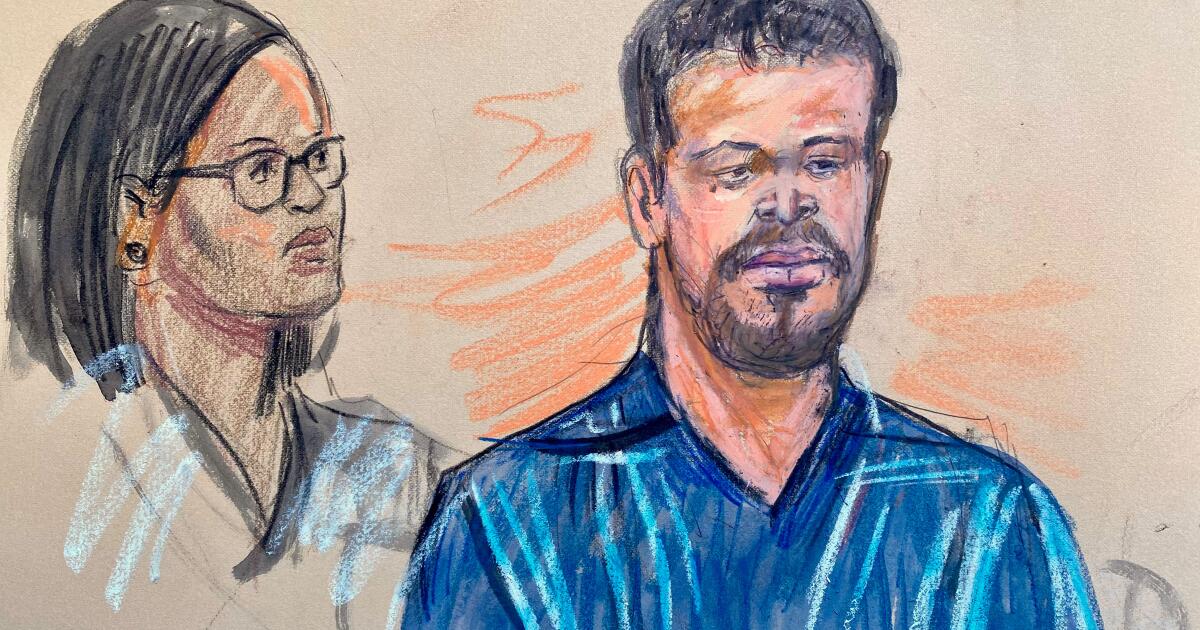
Tomas

Cole Tomas Allen, Torrance man accused of trying to kill Trump at press gala, to remain jailed

Cole Tomas Allen, the 31-year-old Torrance man charged with trying to kill President Trump at last weekend’s White House Correspondents’ Assn. dinner, will remain in federal jail pending trial.

Allen agreed to his ongoing detention during a brief hearing in federal court in Washington, D.C., on Thursday. “He’s conceding detention at this time,” one of his federal public defenders, Tezira Abe, told Magistrate Judge Moxila Upadhyaya, according to CNBC.

He did not enter a plea during the hearing, according to the Associated Press.

Abe and Allen’s other public defender, Eugene Ohm, had argued in a filing Wednesday for Allen’s pre-trial release, citing his lack of a criminal record, family support and ties to his church, as well as inconsistencies and weaknesses they allege exist in the government’s case against him.

Abe and Ohm did not respond to a request for comment following the hearing.

In addition to trying to kill Trump, a terrorism-related charge that carries a potential life sentence, Allen faces two firearms charges related to his allegedly transporting two guns across state lines as he traveled from California to Washington by Amtrak train, and allegedly discharging one of those firearms — a shotgun — during the incident.

In arguing for Allen’s release in their Wednesday filing, his attorneys not only insisted he was no danger to the community, but questioned the government’s reasoning and evidence for the charges against him.

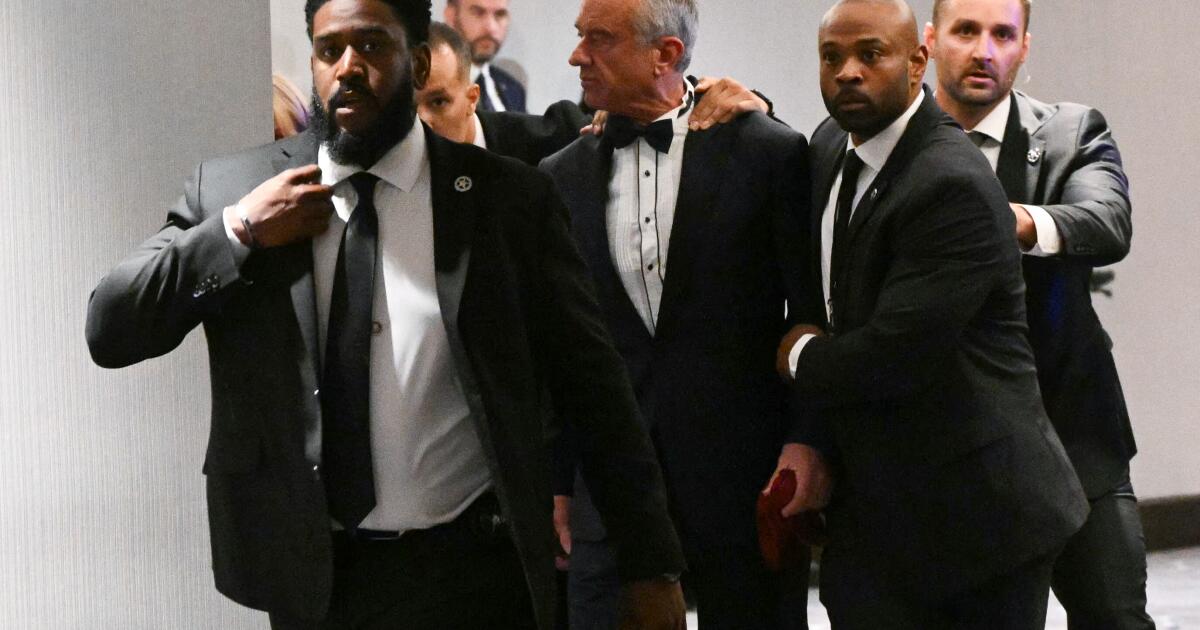
Allen was captured on a hotel video camera sprinting past U.S. Secret Service agents and into the secured event space a floor above the dinner while armed, according to prosecutors, with the shotgun, a pistol, and various knives. He then fell to the ground and was detained, according to prosecutors.

Trump administration officials who were at the dinner, including Acting Atty. Gen. Todd Blanche and Jeanine Pirro, the U.S. attorney for D.C., charged him swiftly — leaning heavily on an email Allen had sent to family just as he was breaching event security, which Trump and others referred to as a “manifesto” but which was titled an “Apology and Explanation.”

In that document, Allen allegedly wrote that he was targeting top Trump administration officials, with the highest ranking among them receiving top priority. He allegedly wrote that he would “go through” others at the event to get to those officials, but that he was not targeting guests or hotel staff and had chosen buck shot rather than slugs to “minimize casualties” in the room.

The charge of attempting to kill the president hung largely on that document, according to charging documents.

Blanche and Pirro also alleged that Allen had fired a shot during the encounter with Secret Service agents, in which they said a Secret Service agent was shot in the ballistic vest. Prosecutors also alleged in court that Allen had fired his shotgun, noting their recovery of one spent casing, but made no mention of a Secret Service officer being shot in the vest.

That alleged shot served as the basis for the one count of discharging a firearm.

In their filing arguing for Allen’s release, his attorneys questioned the legitimacy of both arguments.

They wrote that the government’s “sole proffered evidence” of Allen’s intent to kill Trump — the “Apology and Explanation” letter — was “far from clear” and never actually mentioned Trump by name.

“The government’s evidence of the charged offense — the attempted assassination of the president — is thus built entirely upon speculation, even under the most generous reading of its theory,” Allen’s attorneys wrote. “While the government may be able to say that the letter expresses an intent to target administration officials, it falls well short of narrowing those officials to President Trump.”

Regarding the one count of discharging a firearm, Allen’s attorneys wrote that the government “has not asserted that Mr. Allen ever fired any of the recovered weapons.” They wrote that the government, “after essentially asserting that Mr. Allen shot a Secret Service Officer in the criminal complaint, has apparently retreated from the theory by not mentioning the alleged officer at all” in its filing arguing for Allen’s ongoing detention.

In the latter document, prosecutors wrote only that an officer had seen Allen fire his shotgun “in the direction of the stairs leading down to the ballroom.” However, they provided little evidence to support that claim, other than that the shotgun held a spent cartridge in its barrel.

“In sum,” Allen’s attorneys wrote, “the government’s entire argument about the nature and circumstances of the offense is based upon inferences drawn about Mr. Allen’s intent that raise more questions than answers.”

Prosecutors, in a separate filing in the case related to evidence gathering, rejected the defense claims.

“The preliminary analysis of the crime scene is consistent with the government’s evidence that your client fired at least one shot from the 12-gauge pump action shotgun in the direction of Officer V.G., and that Officer V.G. fired his service weapon five times,” they wrote. “The government is aware of no evidence thus far collected and analyzed that is inconsistent with the above.”

They wrote that evidence suggests Allen fired his Mossberg 12-gauge pump-action shotgun “at least one time as he ran past the magnetometers on the Terrace Level of the Washington Hilton.”

They wrote that investigators recovered one spent cartridge from the chamber of the shotgun, that the “government’s preliminary ballistics and video analyses show that your client fired his shotgun in the direction of” the Secret Service officer identified only as “V.G.,” and that “at least one fragment was recovered from the crime scene that was physically consistent with a single buckshot pellet.”
Source link

Cole Tomas Allen case reveals Secret Service failures at D.C. gala

According to Acting Atty. Gen. Todd Blanche and other top administration officials, the U.S. Secret Service did a fine job protecting President Trump and Cabinet members from the gunman who breached the White House Correspondents’ Assn. dinner Saturday.

“That horrible act was stopped because of the courage and professionalism of law enforcement — the officers who responded without hesitation and did their jobs as they were trained to do,” Blanche said Monday.

However, according to a detailed accounting filed Wednesday by federal prosecutors in the criminal case against suspect Cole Tomas Allen, the performance of the nation’s preeminent protection agency was marred by inattentiveness and misfires and saved by “extraordinary good fortune” and the gunman falling to the ground.

“The defendant, armed with a 12-gauge shotgun, a .38 caliber pistol, two knives, four daggers, and enough ammunition to take dozens of lives, was apprehended by [Secret Service] officers mere feet away from the ballroom where his primary target was located, along with other members of the Cabinet,” prosecutors wrote Wednesday, in a filing arguing for Allen to be held in detention pending trial on one charge of trying to kill the president and two firearms charges.

Contradicting a prior claim by Blanche that officers had “promptly tackled and detained” Allen, prosecutors wrote that the 31-year-old tutor from Torrance simply “fell to the ground” after blowing past a team of agents just two open flights of stairs from the ballroom.

They wrote that one officer fired at Allen five times, but never hit him.

The same officer saw Allen fire his shotgun “in the direction of the stairs leading down to the ballroom,” prosecutors wrote, and officers later discovered “one spent cartridge in the barrel and eight unfired cartridges in the magazine tube.”

Prosecutors said nothing about the Secret Service officer who Blanche said was shot in his ballistic vest during the incident — adding to speculation that the officer may have been shot not by Allen, but by a fellow officer, or not at all.

Agency critiqued before

In all, the court filing brought further into focus a chaotic Secret Service response that appeared flawed from the start, including in a video Trump posted shortly after the incident in which agents appeared to be idling around an unobstructed entrance when Allen ran past them.

It added to concerns that law enforcement, security experts and members of Congress had raised about the performance of an agency that has been repeatedly called on to improve after previous attempts on Trump’s life. At a 2024 campaign rally in Butler, Pa., a gunman fired a bullet that grazed Trump’s ear, and that same year, another assailant prepared to shoot him from the unsecured perimeter of a Florida golf course.

Robert D’Amico, a former FBI deputy chief of operations for hostage rescue teams who is now a security consultant, said the security failures he saw in the Secret Service’s preparation for Saturday’s dinner — including its failure to set up basic barriers to prevent people from sprinting into the secured area — were stunning, especially given the past threats and the fact the nation is at war with Iran.

“It’s for a person like Trump, who’s had two assassination attempts before and is at war with Iran, which has terrorist training and proxies up, and you still don’t have the basics?” D’Amico said. “It’s unfathomable.”

Other concerns have been voiced by members of Congress, including Republicans.

The House Oversight Committee has requested a briefing from the Secret Service, and Sen. Josh Hawley (R-Mo.) has called for a hearing before the Senate Homeland Security and Governmental Affairs Committee, which also investigated the Butler incident.

In a letter urging the hearing, Hawley said the latest incident “raises questions about presidential security arrangements, potential resource needs, and the degree to which reforms previously proposed by Congress have been adopted.”

House Speaker Mike Johnson (R-La.) told Fox News that from “a layman’s perspective,” event security “looked a little lax in terms of getting into the building,” and that it “doesn’t sound like it was sufficient.”

Sean M. Curran, director of the Secret Service, has been on Capitol Hill in recent days briefing lawmakers.

He told CBS News that agents did a “great job,” but also that the incident remains under review. White House Press Secretary Karoline Leavitt has said that White House Chief of Staff Susie Wiles would be leading discussions on potential updates to Secret Service plans for securing the president.

Fear of graver threats

Blanche has argued that proof of the Secret Service’s effectiveness at the press gala was in the result: Allen was stopped, Trump and other officials were unharmed and no one was killed, despite Allen’s alleged intent.

However, the concerns being raised have to do with the vulnerabilities that were exposed as much as those that were exploited.

Because the dinner was not designated a major “national special security event” — such as a political convention — there were no trained counterassault agents on standby to prevent a breach or to take down a person with a weapon, officials have said.

Law enforcement experts said that was clearly a mistake given so many top officials — Trump, Johnson, Vice President JD Vance, Secretary of State Marco Rubio, Treasury Secretary Scott Bessent and Defense Secretary Pete Hegseth, among others — were in the room.

Such a gathering could have been targeted by foreign adversaries or others with far more experience, less regard for human life and much greater firepower than Allen, experts said.

“Most of my military friends are all saying the same thing,” said D’Amico, who is also a former infantry platoon commander in the U.S. Marines. “If you had had a team of three or four [gunmen], they would have gotten to [Trump].’”

In the initial criminal complaint against Allen, prosecutors included the text of an email Allen sent to family just as he was preparing to rush the security perimeter, in which he allegedly wrote that he had chosen to use buckshot in order to “minimize casualties” and prevent bystanders from being wounded by more powerful bullets penetrating walls.

He also allegedly wrote that he was willing to “go through most everyone” at the event to get to top administration officials, but that guests and hotel staff were “not targets at all.”

In Wednesday’s filing, prosecutors describe Allen’s actions as “premeditated, violent, and calculated to cause death,” and say he was “laden with weapons” as he breached security. But none of those weapons included assault-style rifles that can fire multiple bullets rapidly and have been used to kill civilians in mass shootings across the country for years.

The filing described Allen — a Caltech graduate and high school tutor — not as some trained tactical expert, but as an ideologue who spent part of his Amtrak journey from California to Washington waxing poetic about the landscape around him, describing Pennsylvania’s woods as “vast fairy lands filled with tiny trickling creeks in spring.”

Could have been worse

D’Amico said he and other Marines learned early on in Iraq that entrances to secured locations have to be designed in a “serpentine” fashion, forcing anyone approaching to move more slowly through the area and giving security officers more time to assess their intentions. And at an event the size of the correspondents’ dinner, with so many top officials gathered in a public hotel, you would want to make entrances “even more difficult.”

And yet no barriers seemed to be in place at the event, he said — something anyone trained more than Allen could have capitalized on.

“If they just had come through in a team of three or four who were coordinated and trained, there absolutely would have been penetration into the ballroom,” D’Amico said. “It would have been a gunfight.”

Allen himself questioned the security at the event, according to court records, allegedly writing that he had walked into the Washington Hilton with multiple weapons and no one considered “the possibility that I could be a threat.”

He wrote that if he “was an Iranian agent, instead of an American citizen,” he “could have brought a damn Ma Deuce in here and no one would have noticed” — referring to a powerful machine gun.

“It is fortunate he was only armed with what he had,” said Ed Obayashi, a California law enforcement expert on use of force.

Source link