Tomahawk

Japan Has Officially Joined The Tomahawk Cruise Missile Club

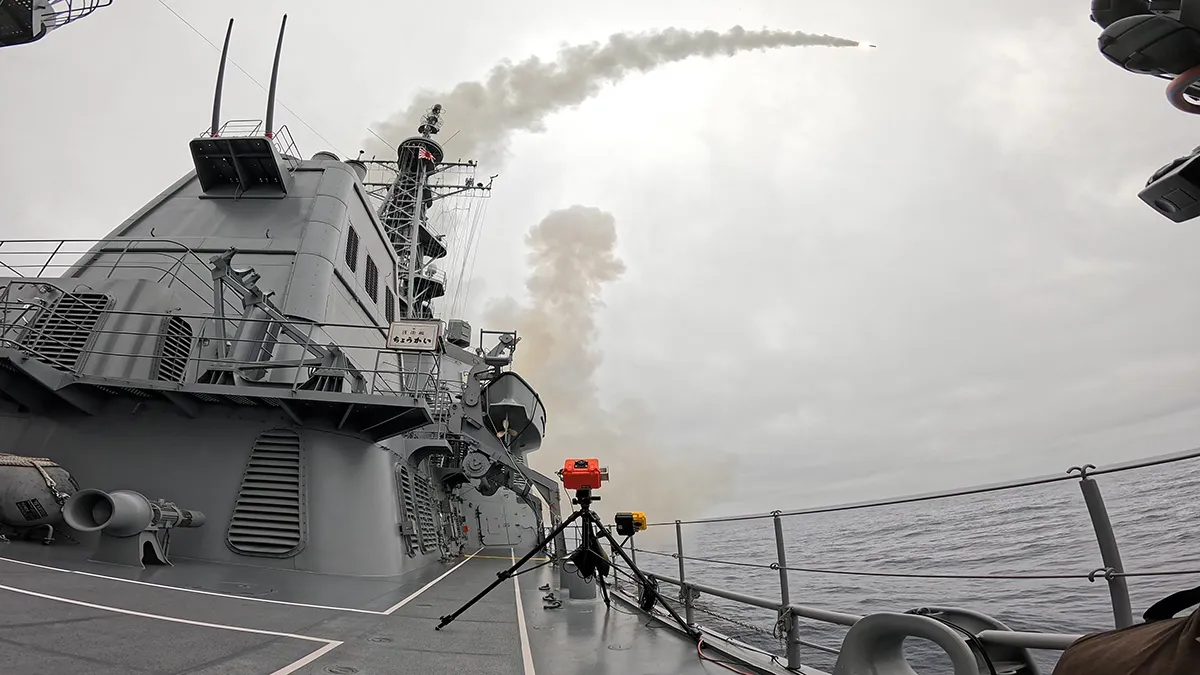
The Japan Maritime Self-Defense Force (JMSDF) has fired a Tomahawk land-attack cruise missile from one of its warships for the first time, marking a significant development in Tokyo’s efforts to field a long-range conventional strike capability at sea. The launch, conducted by the Kongō class Aegis destroyer Chōkai in the Pacific Ocean with support from the U.S. Navy, is the result of years of work to integrate the U.S.-made cruise missile into Japan’s surface fleet and significantly expands the country’s standoff attack options.

Japan becomes the third country outside the United States to fire a Tomahawk from a surface combatant, with Australia and the Netherlands having previously done so. The other operator of the missile, the United Kingdom, has only fired Tomahawks from submarines.

Launch of the first Tomahawk missile from Chōkai at an undisclosed location in the Pacific. Japan Ministry of Defense

Japan’s Ministry of Defense announced that Chōkai, which has been deployed to the United States since late last year for modifications and crew training, carried out the live-fire event on July 29 Japan Standard Time (July 28 Pacific Daylight Time). According to the ministry, the test confirmed not only the ship’s ability to launch the missile but also the proficiency of its crew in operating the weapon, clearing another major hurdle toward operational service.

The firing represents the culmination of a process that began in October 2025, when Chōkai arrived in the United States. In March, Japan announced that the destroyer had successfully completed the structural upgrades, software integration, and crew instruction required to employ the Tomahawk, making it the first Japanese warship capable of launching the missile. At the time, officials said a live-fire demonstration would follow before the capability entered operational service.

251020-N-NS989-1316 NAVAL BASE SAN DIEGO (Oct. 15, 2025) Kongo-class guided-missile destroyer in the Japan Maritime Self-Defense Force JS Chokai (DDG 176) arrives in Naval Base San Diego, October 15, 2025. Chokai is in San Diego conducting training. (U.S. Navy photo by Gunner's Mate 2nd Class Timothy Weber.)
The destroyer Chōkai arrives at Naval Base San Diego, October 15, 2025. U.S. Navy photo by Gunner’s Mate 2nd Class Timothy Weber Petty Officer 2nd Class Timothy Weber

“This live-fire test demonstrates steady progress in the Tomahawk project, and the Ministry of Defense will continue to work towards the early establishment of stand-off defense capabilities,” the ministry said in a statement.

Chōkai is expected to return to Japan around September 2026.

For decades, Japan’s Aegis destroyers have been optimized almost exclusively for fleet air defense and ballistic missile defense missions. Integrating the Tomahawk fundamentally changes this by giving the ships the ability to strike fixed targets hundreds of miles inland, and potentially other ships at sea over great distances, extending the reach of the JMSDF far beyond traditional maritime operations.

160728-N-SI773-2910 PACIFIC OCEAN (July 28, 2016) Japan Maritime Self-Defense Force guided missile destroyer JS Chokai (DDG 176) steams in close formation as one of 40 ships and submarines representing 13 international partner nations during Rim of the Pacific 2016. Twenty-six nations, more than 40 ships and submarines, more than 200 aircraft, and 25,000 personnel are participating in RIMPAC from June 30 to Aug. 4, in and around the Hawaiian Islands and Southern California. The world's largest international maritime exercise, RIMPAC provides a unique training opportunity that helps participants foster and sustain the cooperative relationships that are critical to ensuring the safety of sea lanes and security on the world's oceans. RIMPAC 2016 is the 25th exercise in the series that began in 1971. (U.S. Navy Combat Camera photo by Mass Communication Specialist 1st Class Ace Rheaume/Released)
The destroyer Chōkai steams during the Rim of the Pacific 2016 exercise. U.S. Navy Combat Camera photo by Mass Communication Specialist 1st Class Ace Rheaume/Released Senior Chief Petty Officer Ace Rheaume

The Tomahawk acquisition forms part of Japan’s broader effort to build what Tokyo describes as “standoff defense capabilities” in response to an increasingly challenging regional security environment. Under Japan’s revised National Security Strategy, the country has embraced a limited counterstrike capability intended to hold hostile missile launchers, command nodes, and other military targets at risk if Japan comes under attack. Officials have repeatedly stressed that these weapons remain consistent with Japan’s exclusively defense-oriented security policy and are intended to strengthen deterrence rather than enable offensive military operations.

Japan is purchasing up to 400 Tomahawk missiles from the United States, including both Block IV and newer Block V variants, at a cost of around $1 billion. The Block IV Tomahawk can hit targets nearly 1,000 miles away with a 1,000-pound unitary warhead. It is capable of rerouting mid-flight and can loiter over an area to hit targets as they emerge, featuring an imaging infrared seeker capability. The Block V variant is an improved version with survivability upgrades that can be used to also hit moving targets, especially in the long-range anti-ship missile role.

A Block V Tomahawk seen with its distinctive ‘chined’ nose cone. U.S. Navy

Tomahawk is seen as a bridge capability while indigenous long-range weapons — including Upgraded Type 12 anti-ship missiles and other domestically developed standoff systems — enter service. Tomahawk deliveries have already begun, and additional Aegis destroyers are expected to receive the modifications needed to employ the weapon over the coming years.

Japan’s four Kongō class destroyers already feature the Mk 41 vertical launching system (VLS) and an Aegis combat system closely aligned with U.S. Navy architecture, requiring modifications rather than wholesale redesign to operate Tomahawk. Future installations are expected across the remainder of Japan’s Aegis destroyer fleet, including the two Atago and two Maya class ships.

Tokyo has already allocated funds of close to $700 million for the appropriate modifications to four more Aegis destroyers: KirishimaHaguroMyoko, and Atago.

PHILIPPINE SEA (Nov. 27, 2021) -- Henry J. Kaiser-class replenishment oiler USNS Big Horn (T-AO198) conducts underway replenishments in the Philippine Sea with partners and allies, including JS Kirishima (DDG 174), a Kongō-class guided missile destroyer in the Japan Maritime Self-Defense Force (JMSDF), as part of Annual Exercise, Nov. 21-30. Naval forces from Australia, Canada, Germany, Japan and the United States took part in the multilateral, multinational exercise, led by the JMSDF. The exercise helps strengthen enduring relationships while sharpening naval proficiencies. (Photo by Juahn Gaskins)
The Kongō class destroyer Kirishima underway in the Philippine Sea. Tomahawk modification work on Kirishima began during fiscal year 2025. U.S. Navy/Photo by Juahn Gaskins Military Sealift Command Far Eas

Japan’s future Tomahawk fleet is likely to extend beyond its existing destroyers.

The country is constructing two massive Aegis System Equipped Vessels (ASEVs), due to enter service in fiscal years 2027 and 2028, respectively. Although the ships are being designed around the ballistic missile defense, or BMD, mission, Defense Ministry officials say that a Tomahawk capability will be added later.

Japan is also getting the highly- lexible Joint Strike Missile, which is air-launched and can hit land targets and vessels, as well, albeit over far shorter ranges than Tomahawk. The longer-range JASSM has also been cleared for sale to Japan, but that has not moved forward as far as we know. Beyond that, however, Japan plans to rely on domestically developed long-range missiles to ensure its standoff strike capability. As well as the aforementioned Upgraded Type 12 anti-ship missile, which adds a new land-attack capability, Japan is working on a ground-based Hyper Velocity Gliding Projectile (HVGP), a combination of ballistic missile and hypersonic glide vehicle, a project which you can read more about here.

The successful Tomahawk launch also underscores the deepening operational integration between the U.S. Navy and the JMSDF. Beyond the missile sale itself, the United States has supported the ship’s modernization, crew certification, and now its first live firing, highlighting the increasingly close cooperation between the two allies as they seek to deter their regional opponentsprimarily China and North Korea.

With the successful test now complete, Japan has taken another important step in establishing its new-look defense posture, transforming the JMSDF’s premier Aegis destroyers from platforms focused primarily on air and missile defense into warships capable of delivering precision strikes against land targets far beyond the horizon.

Contact the author: thomas@thewarzone.com

Thomas Newdick is a staff writer at TWZ, where he covers military aviation, defense technology, weapons systems, and international security. Based in Berlin, Germany, he reports on conflicts, military modernization efforts, and emerging aerospace technologies around the world, with a particular interest in airpower and its role in contemporary warfare. His reporting is informed by deep expertise in modern and historical airpower, particularly in Europe, with a focus on military aviation, air campaigns, and aerospace developments across the continent and beyond.


Source link

Germany To Buy Ground-Launched Tomahawk Missiles

Berlin says it has agreed a deal with the United States to buy U.S.-made Tomahawk cruise missiles, providing a significant boost to Germany’s long-range strike capabilities. The move comes after the United States appeared to renege on its plan to deploy a long-range fires battalion in Germany, and as NATO allies in Europe race to enhance their conventional standoff missile deterrent against Russia.

An agreement on the sale of Tomahawk missiles to Germany was reached with U.S. officials on the sidelines of the NATO Summit in Ankara this week, German Chancellor Friedrich Merz announced after his return from Turkey.

ANKARA, TURKIYE - JULY 7: US President Donald Trump and German Chancellor Friedrich Merz shake hands before the family photo with the summit participants during a reception at the Presidential Complex in honor of heads of state and government, along with their spouses, attending the 36th NATO Summit in Ankara, Turkiye on July 7, 2026. (Photo by Mehmet Ali Ozcan/Anadolu via Getty Images)
U.S. President Donald Trump and German Chancellor Friedrich Merz shake hands during the 36th NATO Summit in Ankara, Turkey, on July 7, 2026. Photo by Mehmet Ali Ozcan/Anadolu via Getty Images Anadolu

“This will close an important strategic gap in our defense, and at the same time, we will work to develop our own European systems and station them in Europe,” Merz told the Bundestag lower house of parliament in Berlin today.

Citing German government sources, Reuters reports that a letter of intent for the procurement was signed Tuesday.

Germany had previously sought to buy Tomahawks, but these efforts had been rebuffed by Washington.

Specifically, Berlin wanted to acquire the ground-launched version of the system, with up to 400 of the latest Tomahawk Block Vb missiles, valued at more than $1 billion, according to reports.

Block V Tomahawks seen with its distinctive ‘chined’ nose cone. U.S. Navy

All Block V Tomahawks are provided with a two-way datalink, allowing them to receive course correction and other targeting updates, as well as be entirely re-tasked, during flight. The Block Vb subvariant is fitted with a joint multi-effects warhead that makes it suitable for striking a wider variety of land targets.

The Tomahawk Block V has a range exceeding 1,000 miles depending on the exact configuration.

Currently, the longest-range indirect fires capability fielded by the German Army is the M270 Multiple Launch Rocket System (MLRS), known in German service as the Mittleres Artilleriraketensystem II (MARS II). The longest-range artillery rockets currently available for the system can hit targets out to around 43 miles. Germany has not received the far larger Army Tactical Missile System (ATACMS) short-range ballistic missiles that can engage threats out to 186 miles depending on the variant.

Ein mittleres Artillerieraketensystem II (MARS) des Artilleriebataillons 295 aus Stetten am kalten Markt unterstützt den Angriff eines gemischten Gefechtsverbandes im Rahmen der binationalen Übung Feldberg auf dem Truppenübungsplatz Bergen, am 06.12.2016. © Bundeswehr/Carl Schulze
An M270 of the German Army fires rockets during an exercise. Bundeswehr/Carl Schulze Carl Schulze

As well as the Tomahawk missiles, Germany will need to buy the Typhon launchers to deploy them. Reports in the German media suggest that a request for the launchers was already made in July 2025.

Germany had also been looking at the possibility of acquiring the naval version of the Tomahawk, to arm its planned Type 127 frigates, although these have since been canceled.

Regardless, acquisition of the Tomahawk would be a big deal for Germany.

Outside of the United States, only Australia, Japan, the Netherlands, and the United Kingdom currently use the Tomahawk. All of these export operators use the naval version of the missile, making the German development all the more significant.

Washington’s approval to sell the Tomahawk/Typhon combination to Berlin would seem to confirm that the United States won’t, after all, be sending a U.S. Army long-range fires battalion to Germany.

The US Army has reassigned primary responsibility of the Mid-Range Capability from the Rapid Capabilities and Critical Technologies Office to Program Executive Office Missiles and Space. The MRC provides a land-based, ground-launched system supporting multi-domain fires against specific threats.
A complete U.S. Army Typhon system. U.S. Army Darrell Ames

In May, amid something of a breakdown in relations between Berlin and Washington, triggered by German criticism of the U.S. war in Iran, the United States announced it would reduce its ⁠military presence in Germany by 5,000 soldiers.

At the same time, it was reported that the Pentagon had also decided to abandon plans to deploy the Army’s 2nd Multi-Domain Task Force (2MDTF) to Germany.

German officials moved to try to smooth things over, stating that there had been no “definitive cancellation” of the missile deployment by the United States.

First announced under the Biden administration, the 2MDTF was to start “episodic deployments” to Germany in 2026, followed by “longer-term stationing” of various types of long-range missiles in the same country. As well as Tomahawk, 2MDTF’s Typhon launchers can fire the SM-6 multi-purpose missile. In the future, they are also intended to be armed with “developmental hypersonic weapons,” like the Dark Eagle, and potentially others like the Operational Fires (OpFires) hypersonic missile and the Precision Strike Missile (PrSM) short-range ballistic missile.

Soldiers from the 3d Multi-Domain Task Force (3MDTF) conduct the first Typhon live-fire exercise outside of the continental United States, firing a Standard Missile-6 July 16, 2025, in the Northern Territory, Australia, during Exercise Talisman Sabre 25. The successful strike validated combined joint targeting and command-and-control interoperability between 3MDTF and combined-joint forces, highlighting the strength of the Australia-U.S. Alliance and the ability to deploy advanced, land-based maritime strike capabilities in support of regional security. (U.S. Army photo by Sgt. Perla Alfaro)
A Typhon system fires an SM-6 missile during a live-fire exercise in Australia. U.S. Army photo by Sgt. Perla Alfaro Sgt. Perla Alfaro

With that in mind, Germany’s Typhon launchers could potentially receive some of these missiles in the future, too.

For Germany, however, the Tomahawk procurement is seen as a temporary solution until domestically (or European) developed long-range weapons become available.

For the longer term, Germany is part of the European Long-Range Strike Approach (ELSA). The initiative, led by France and also involving Italy, Poland, Sweden, and the United Kingdom, aims to develop a new long-range strike capability, potentially in the form of a cruise missile, a ballistic missile, or a combination of both.

Earlier announcements indicated that ELSA is intended to deliver a missile with a range of 1,000 to 2,000 kilometers (621–1,243 miles), with entry into service planned for the 2030s.

Separately, Germany and the United Kingdom have also unveiled plans to jointly develop a deep precision-strike weapon with a range exceeding 2,000 kilometers. However, the project remains at an early stage, with no industrial framework yet agreed.

Together, these initiatives underscore the growing determination among European NATO members to develop long-range strike capabilities in response to the increasing Russian threat along the alliance’s eastern flank.

Germany’s planned procurement of ground-launched Tomahawk cruise missiles reflects a dramatically altered European security environment following the collapse of the Intermediate-Range Nuclear Forces (INF) Treaty. Signed in 1987 at the height of the Cold War, the accord prohibited the United States and the Soviet Union — and later Russia — from deploying ground-based ballistic and cruise missiles, whether nuclear or conventionally armed, with ranges between 500 and 5,500 kilometers (310 and 3,420 miles).

Ironically, one of the weapons outlawed by the INF Treaty was an earlier ground-launched version of the Tomahawk cruise missile, the U.S. Air Force BGM-109G Gryphon, which was also deployed in Germany, not without controversy.

1982 - A ground-launched cruise missile (GLCM) rises away from the Transporter-Erector-Launcher (TEL) during a test firing.. (Photo by: HUM Images/Universal Images Group via Getty Images)
A BGM-109G Gryphon Ground-Launched Cruise Missile (GLCM) rises from the transporter-erector-launcher (TEL) during a test firing. HUM Images/Universal Images Group via Getty Images HUM Images

The treaty effectively unraveled after the United States withdrew in 2019 during President Trump’s first term, citing Russia’s deployment of the prohibited 9M729 (SSC-8 Screwdriver) ground-launched cruise missile, an allegation Moscow has consistently denied. Russia formally suspended its own participation in the agreement in 2023, removing the last legal barriers to the deployment of intermediate-range land-based missiles in Europe.

MOSCOW, Jan. 23, 2019 -- The 9M729 missile container is demonstrated at the Patriot Congress and Exhibition Center, outside Moscow, Russia, on Jan. 23, 2019. The Russian 9M729 land-based cruise missile, contrary to the allegations of the United States, does not fall under the Intermediate-Range Nuclear Forces Treaty, according to senior Russian officials. (Xinhua/Bai Xueqi) (Xinhua/Bai Xueqi via Getty Images)
A 9M729 missile container at the Patriot Congress and Exhibition Center, outside Moscow, Russia, in 2019. Xinhua/Bai Xueqi via Getty Images Bai Xueqi

Since then, both Russia and NATO have moved to rebuild capabilities that had been absent from the continent for more than three decades. Even before its formal withdrawal, Moscow had signaled its intention to field new INF-range missiles in response to comparable U.S. deployments, while repeatedly using nuclear signaling — including high-profile exercises and explicit threats — in an effort to deter greater Western support for Ukraine.

Russia has also used the war in Ukraine to demonstrate and refine its expanding missile arsenal. In November 2024, it employed the new Oreshnik intermediate-range ballistic missile in combat for the first time. Although the version used against Ukraine carried conventional warheads, perhaps even inert ones, a nuclear-armed Oreshnik would be capable of striking most major Western European capitals and critical NATO military infrastructure.

At the same time, there are indications that Russia has employed the 9M729 operationally in Ukraine, while continuing work on additional intermediate-range strike systems, including a reported ground-launched hypersonic missile that could be based on the Zircon naval missile, or an enhanced Iskander-M ballistic missile. Russia has also reinforced its forward posture by deploying nuclear-capable Iskander missiles and  MiG-31 Foxhound aircraft armed with Kinzhal air-launched ballistic missiles to Kaliningrad in the Baltic, while transferring tactical nuclear weapons, or at least their delivery infrastructure, to neighboring Belarus.

Against this backdrop, Germany’s decision to acquire ground-launched Tomahawks is part of a broader effort to restore NATO’s long-range conventional deterrence and strike capabilities. The missiles are part of a wider European push to counter Russia’s growing inventory of intermediate-range weapons and reestablish a more credible balance of long-range conventional firepower on NATO’s eastern flank. This has become all the more important since the previous security guarantees provided to the continent by the United States are increasingly being questioned.

While we don’t yet know the numbers of Tomahawks involved, they will still likely be divorced from the reality of a high-intensity conflict. Ukraine is now striking Russia with long-range cruise missiles regularly. The numbers needed across NATO for a sustained engagement will be very high, so collectively Europe will likely only accelerate and broaden its long-range missile capabilities based on these lessons learned.

Germany’s Tomahawk procurement reflects a fundamental shift in NATO’s approach to deterrence in Europe, where long-range conventional strike capabilities are once again viewed as essential rather than escalatory. With Russia fielding new intermediate-range missiles, NATO’s relations with the United States under strain, and European allies launching their own development programs in this area, a new missile race is accompanying the changing security environment on the continent.

Contact the author: thomas@thewarzone.com

Thomas Newdick is a staff writer at TWZ, where he covers military aviation, defense technology, weapons systems, and international security. Based in Berlin, Germany, he reports on conflicts, military modernization efforts, and emerging aerospace technologies around the world, with a particular interest in airpower and its role in contemporary warfare. His reporting is informed by deep expertise in modern and historical airpower, particularly in Europe, with a focus on military aviation, air campaigns, and aerospace developments across the continent and beyond.


Source link