toll

Ebola death toll surpasses 4,000 as DR Congo struggles to suppress outbreak | Ebola News

Burning of a Ebola-hit transit camp sends 19,000 fleeing, illustrating the difficulties of controlling epidemic.

The Democratic Republic of Congo’s Ebola outbreak has now killed more than 4,000 people, according to government data, making it the worst epidemic in the country’s history.

Figures released on Friday showed that the death toll has risen to 4,018, and confirmed cases had ⁠reached 8,300 across seven provinces, as the government continues to struggle to contain the outbreak.

Recommended Stories

list of 4 itemsend of list

Weak infrastructure, the remoteness of the region in eastern DRC, and ongoing conflict with armed groups near the borders with South Sudan, Uganda, and Rwanda have hindered efforts to respond to cases quickly and effectively.

The United Nations reported on Friday that an Ebola-hit camp housing a transit centre for infected patients was burned by soldiers earlier this week as they were looking for weapons on the outskirts of Bunia, capital city of Ituri Province, which is at the epicentre of the outbreak.

The incident forced 19,000 people to flee the camp.

“The enormous challenge of halting the spread of Ebola in the Democratic Republic of the Congo (DRC) just became even harder after a key transit centre for patients requiring treatment burned down in Ituri province,” the UN said.

People’s mistrust and anger towards health workers and authorities have also contributed to the obstacles the government faces in its efforts to contain the outbreak.

A senior ‌member of DRC’s governing Union for Democracy and Social Progress (UDPS) party was beaten to death days ago after taking part ⁠in a radio programme to raise awareness about the epidemic.

The attack on Marie-Celestin Karondwa, a local official with UDPS, took place last Sunday at his home in Butembo, an Ebola hotspot in the eastern North Kivu province. His house was set on fire afterwards, and he died at hospital from his injuries.

The World Health Organization has warned that the epidemic is “far from over” and on track to surpass the regional 2014-2016 West Africa Ebola outbreak, which killed more than 11,000 people, primarily in Guinea, Liberia, and Sierra Leone.

Caused by the Bundibugyo strain of Ebola, the current epidemic became the largest and deadliest in the DRC after surpassing the 2018-2020 epidemic.

Several treatments and vaccines are being trialled against Bundibugyo, but currently, there is no approved vaccine or treatment.

The current outbreak, which is the DRC’s 17th, has spread rapidly since it was officially declared on May 15.

More than ⁠2,000 patients have recovered from the Ebola epidemic so far. The Africa Centres for Disease Control and Prevention said in its latest news conference that the number of confirmed cases is falling, although that could be attributed to insecurity and challenges in getting communities to cooperate in some of the hotspots.

Source link

DR Congo rolls out Ebola vaccine for health workers as death toll rises | Ebola News

50,000 frontline staff to receive a jab for a different Ebola strain, with 20,000 enrolled in a one-year clinical trial.

Health workers in parts of the Democratic Republic of the Congo (DRC) have begun to receive a vaccine that many hope will provide a level of protection against the Ebola virus.

The vaccine rollout started on Saturday in Bunia, the capital of Ituri province in the northeastern DRC. Ituri is the epicentre of the fastest-growing outbreak of Ebola in history.

Recommended Stories

list of 3 itemsend of list

The provincial governor, Major-General Gaby Kasongo Mulumba, said health workers there “are particularly exposed and deeply involved in the response”.

The operation, backed by the World Health Organization and Doctors Without Borders, known by its French initials MSF, will also target North Kivu, where cases have been rising sharply, health authorities said.

Some 50,000 health and other frontline workers will be injected with the Ervebo vaccine, which was developed for use against the more common Zaire strain.

Its effectiveness against the current Ebola strain caused by the Bundibugyo virus will be monitored in 20,000 recipients for up to one year.

Clinical trials are ongoing to find a licensed vaccine for the latest outbreak, which has no licensed vaccine or proven treatment.

“We don’t know to what degree it might be effective against the Bundibugyo strain,” Steve Ahuka, a Congolese official who is part of the health task force against the Ebola outbreak, said.

Dr Jeannot Elua said at a health facility in Bunia the vaccine was “beneficial”.

“We healthcare workers don’t really have a choice. We are going to receive it,” he told the Associated Press news agency. “Some people here had already received the previous vaccine. I received it myself, because it was mandatory.”

WHO experts have said that early data on the Ervebo vaccine, notably from animal trials, suggested it could offer some protection in the current outbreak.

The virus has killed at least 3,639 and infected some 7,541 people since May. Some 1,823 people have recovered, according to the latest figures from local authorities.

Workers at the Ceca-20 cemetery in Mongbwalu, Ituri province, Democratic Republic of the Congo, on July 14, 2026, as aid agencies intensify efforts to contain an Ebola outbreak caused by the Bundibugyo virus
Workers at the Ceca-20 cemetery in Mongbwalu, Ituri province, Democratic Republic of the Congo, on July 14, 2026, as aid agencies intensify efforts to contain an Ebola outbreak caused by the Bundibugyo virus [File: Gradel Muyisa Mumbere/Reuters]

The WHO said in August that 70,000 doses of Ervebo were approved for use in the DRC.

The vaccine is being used under a compassionate-use programme, which allows a medical product to be used in a serious disease situation even though it has not been specifically approved for that particular use.

While WHO officials have cited “encouraging signs” that transmission may be slowing, MSF warned on Friday that there is no clear evidence the epidemic is coming under control.

Source link

Arab News | First bodies of Philippines ferry fire victims land as toll hits 35

CORON, Philippines: The bodies of passengers killed in a ferry fire off the Philippines arrived at a port near the resort town of Coron, Palawan on Saturday morning, as the country’s coast guard warned the death toll of 35 would grow.

AFP watched tents being set up to accept 30 bodies brought from the M/V June Aster, which ran aground near the tourist hotspot after a fire erupted Wednesday evening and tore through the vessel “in seconds”.

Coast guard spokeswoman Noemie Cayabyab told a Saturday press conference the remains would be turned over to police forensic investigators for “proper disposition and identification” before allowing local authorities to inform family members.

“Currently, we are focused on the retrieval, and after that we will proceed with the investigation,” she said, confirming the bodies had been found in the ship’s economy accommodation area.

Police investigators were seen arriving at the port shortly after the press conference ended.

Asked how many bodies remained aboard the ship, she said authorities would provide an update later in the day.

Cayabyab told AFP on Friday evening that the first transfer had been capped at 30 bodies due to the capacity of the patrol vessel transporting them and that additional cadavers remained on the ferry.

Five others had been confirmed dead in the immediate wake of the fire.

Photos released by the coast guard showed rows of body bags being placed into a small ship alongside men in hazmat suits.

Thirty passengers and 13 crew have so far been rescued, while 54 people remain unaccounted for.

On Friday, Cayabyab had told a radio station the fire had begun in the cargo hold, then tore through the ship within seconds.

“From the time that they heard the loud explosion, the appearance of smoke, and then fire. It spread very quickly,” she said of survivors’ accounts.

“Everything happened in seconds,” she said, adding that those who made it off the ship had not even had time to put on life jackets.

‘Lost hope’

Myra Cabilan told AFP she had flown to Coron to find her missing brother, 40-year-old Rammel Gonzaga, who had taken the ferry from Manila on a business trip with his brother-in-law.

“His wife had just given birth a month ago. He was so happy he was given a daughter,” Cabilan said, fighting back tears.

“At dawn, I still believed he survived. But he’s still missing. I have lost hope.”

Hundreds of people desperate for news about the incident have taken to leaving comments on the Facebook page of a local mayor, searching for relatives, friends and even a dog.

The ferry’s manifest listed 134 crew and passengers, but two had not boarded, according to the coast guard. The ferry was also carrying goods, an electric vehicle, a pickup truck, and motorcycles.

The archipelago nation of 116 million has a long history of disasters involving the inter-island ferries that ply its seas.

Many rely on cheap and poorly regulated boats and ships for transport between the country’s more than 7,000 islands, despite regular accidents.

In January, a triple-decker ferry carrying more than 340 people sank off the southern Philippines, killing at least 52 people.

The M/V Trisha Kerstin 3 sank along nearly the same route where 31 people died in 2023 after a fire broke out aboard the Lady Mary Joy 3 ferry.

On Thursday, the company that owns the M/V June Aster, Atienza Interisland Ferries Inc, said it was fully cooperating with the investigation.


Source link

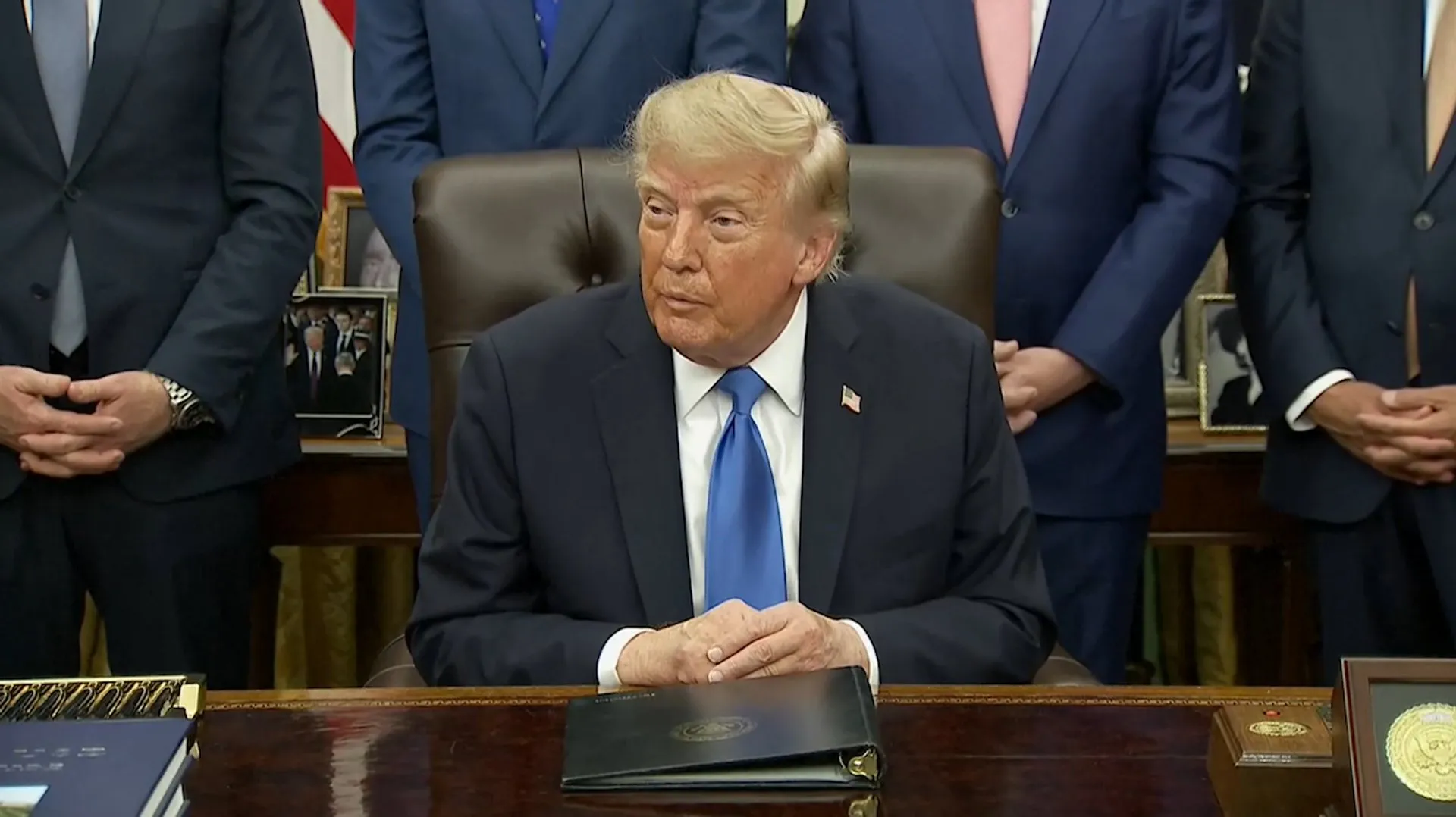
Trump threatens more strikes as death toll in Iran rises to 18 | News

United States President Donald Trump has threatened more attacks on Iran, warning that Washington could hit Iran “anytime we want”, as the death toll from the latest US strikes climbed to 18, with at least 108 others wounded.

Trump’s threat on Wednesday came after the US and Iran exchanged their biggest barrage since July. The US military struck cities and areas along Iran’s southern coast, near the blockaded Strait of Hormuz, including a wedding party in the city of Kuhestak.

Recommended Stories

list of 4 itemsend of list

Iran retaliated with attacks on US bases across the Middle East, including Bahrain, Iraq and Jordan.

Speaking to reporters at the White House, Trump said, “We hit them very hard last night” and that the strikes “took out all of the new equipment that they tried to build along the Strait of Hormuz”.

“It was a very heavy attack last night. And we’re prepared to do another one. And anytime we want,” he said.

Iranian officials said at least 18 people were killed in the US strikes.

The victims included two children, according to Mohammad-Reza Zafarghandi, Iran’s health minister. One of them was a four-year-old who was killed in the strike on the wedding party in Kuhestak in Sirik county.

At least four people were killed in that strike.

Esmaeil Baghaei, the spokesman for Iran’s Ministry of Foreign Affairs, described the Kuhestak attack as a “war crime” and hit back at US claims that it does not target civilians.

“The reality is so horrifying that even American propaganda has never dared make the claim [the US military] is making today. Sirik is not a story. The civilians are real. The victims are real”, Baghaei wrote on X.

Iranian media said the funeral for the four Kuhestak victims will be held on Thursday.

‘Uncomfortable strategic position’

The six-month war has led to a spike in oil prices, roiled the global economy and posed increasing political problems for Trump’s Republican Party ahead of November midterm elections in the US.

Only 31 percent of Americans approve of the war, while some 63 percent disapprove, according to a poll by the Reuters news agency and the Ipsos polling firm in August. Voters are particularly unhappy about high gas prices. Since the fighting resumed this weekend, the price of Brent crude oil, the international standard, has climbed to about $95, up more than 30 percent from the start of the war.

Trump’s approval rating has also fallen from 40 percent to 33 percent since the conflict began, according to Reuters/Ipsos polling.

On Wednesday, Trump said he did not think the renewed military campaign ⁠would last long. He also reiterated his position that the upcoming elections were not a factor in his Iran strategy.

“Number one, I’m not running. My party is running, and I’m going to help my party,” he told reporters in the Oval Office. “But I think my party respects the fact that we’re not allowing Iran to have a nuclear weapon.”

Iran has denied seeking a nuclear weapon.

Tariq Khan, a retired Pakistani lieutenant-general and former commander of the Pakistan Army’s Frontier Corps, said the US “now finds itself in an increasingly uncomfortable strategic position in the Iran war”.

“The US has not succeeded in restoring the maritime environment that existed before the war, and is now expending military resources to deal with a problem the war itself helped create,” he told Al Jazeera, referring to Iran’s closure of the Strait of Hormuz.

The strait was a free-flowing international waterway carrying roughly one-fifth of the world’s traded oil before the war. Tehran shut the waterway in response to the US and Israeli strikes on February 18 that began the war. Despite repeated US claims that the strait remains open, only a handful of vessels now pass through each day, and Iran continues to target ships attempting the crossing.

On Wednesday, Iran’s Islamic Revolutionary Guard Corps (IRGC) said two oil tankers had struck mines and were disabled while attempting an unauthorised transit. Separately, Saudi shipping firm Bahri reported that two Filipino sailors were killed in an attack on their vessel earlier in the week.

Iran’s Persian Gulf Strait Authority (PGSA), which Tehran set up to police the Strait of Hormuz, added 11 more ships to its blacklist for alleged “noncompliance” this week, on top of the 45 blacklisted last week. The PGSA said the vessels will face fines, seizures or confiscation unless they submit required documentation to Iran before attempting to cross the strait.

Strait of Hormuz

At the same time, the US has intensified an economic isolation campaign against Iran, threatening to slap countries that ‌trade with Tehran with massive sanctions, while also maintaining its own blockade in the Strait of Hormuz.

Trump on Wednesday continued to insist that Washington was in control of the strait, saying US forces were helping bring “lots of boats out every day with millions of barrels of oil”.

“We are, for the most part, doing it without trouble. Every once in a while they shoot a drone, and we knock it down. We have control, very strong control,” he said.

On Tuesday, he had claimed the US Navy was helping escort some 30 ships out of the strait every day. Before the war, some 130 ships transited the waterway daily.

Khan, the former Pakistani general, said Iran understands it cannot defeat the US conventionally and is seeking to make the war costly for Trump.

“If Trump escalates, Iran can portray America as being drawn deeper into another Middle Eastern war; if he restrains himself, Tehran can claim that American military superiority cannot compel Iran to surrender,” he said.

“Iran does not need a battlefield victory; it needs to remain standing, keep the economic disruption alive, and make the war politically costly for the US. Tehran has to make American victory increasingly unaffordable – militarily, economically and electorally.”

Source link