

A Ryanair passenger claims she was recently told it was “unlikely’ she’d be able to board a plane for an unexpected purpose. Aisling Finlay was left taken aback and has since issued an alert
11:00, 10 Jun 2026Updated 13:05, 10 Jun 2026
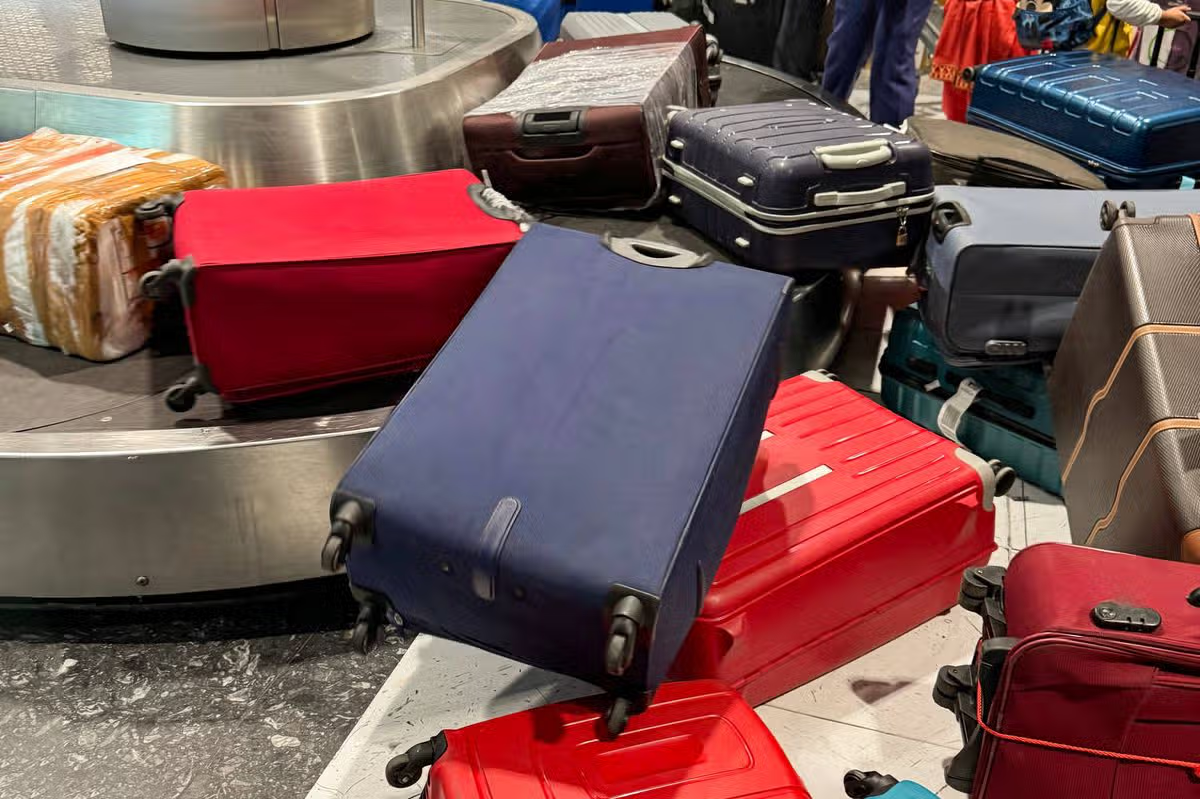
The Ryanair passenger has issued an alert (stock image)(Image: AFP via Getty Images)
A Ryanair passenger was left concerned after she was reportedly told she’d be “unlikely to board a plane”, and it’s not the first time someone has claimed they were denied a seat with the airline. Aisling Finlay recently opened up about her alleged travel issue, as she wanted to alert others to the fact that it could happen.
Aisling recently shared her story on TikTok, where she claimed she didn’t know something like this was possible when travelling with Ryanair. The clip has since gone viral as people couldn’t believe how events unfolded in the unlikely air travel tale that left many taken by surprise.
In the clip, she said: “There’s a high chance we’re not getting on this flight. So, a reminder to everyone to check-in way in advance, as they’re overbooking the planes.
“So, we’re flying to Spain at 11am. So, I checked in last night at about like 10pm, and weren’t able to like reserve a seat or allocate a seat, so I was like ‘strange’.
“And then our boarding card came up saying ‘seat allocated at the gate’, and then we arrived there, and they’re basically like ‘we’ve overbooked the flight by nine seats’.
“We’re number five and six to get on the plane. So she was like ‘it is unlikely you’ll get on the flight’. Brilliant.”
Content cannot be displayed without consent
The video has been viewed over 27,000 times since it was shared, and people were quick to comment too. Hundreds have since offered their thoughts on the matter.
One said: “In all my years travelling bumping has never happened to me, and I’ve never seen it happen. It must be a very new thing with Ryanair.”
Another added: “I had that once. Due to fly from Dublin to Bristol. They couldn’t get me on so they flew me to Birmingham and then paid for a taxi to Bristol, and a few weeks later I got £250 compensation. More than I paid for my whole trip.”
A third replied: “This is becoming so common. Happened two weeks ago. One member of our party didn’t get on, and was lucky to get a seat the next day. Check in as early as possible and book seats to make it safer.”
Meanwhile, a fourth also commented: “Most airlines do this!” One more also noted: “Every airline does this.”
What you need to know
When Ryanair was approached for comment, it stated as a policy the airline does not overbook flights. The airline also claimed the passenger travelled on the flight from Dublin to Palma de Mallorca on June 3.
However, some more information is available on its website. It states: “Ryanair, as a policy, does not overbook its flights. However, in the unlikely event that a seat is not available for a passenger with a confirmed reservation, we will seek volunteers to surrender their seats in exchange for benefits that we and the volunteer may agree upon before involuntarily denying boarding to other passengers.
“If there are insufficient volunteers, and we deny you boarding involuntarily, you are entitled to the rights set out below.” These rights are outlined on the website.
Travel companies have been contacting people with holidays booked after change made
Jet2 customers have been emailed about changes in the booking process and when they’ll get documents(Image: Getty)
Jet2 passengers have been told that a key change is now ‘in force’ after some got in touch worried that an email they received could be a fake. Holiday travel companies have also been getting in touch with customers to tell them of the change.
Thousands of travellers have received emails notifying them that their holiday documents will be arriving later than originally expected. This has raised alarm bells among some customers who fear it could be a scam – particularly as Jet2 has recently been warning about numerous fake social media accounts being created in an attempt to defraud passengers.
Previously Jet2 sent all documents to travellers 28 days in advance of the break – however in 2026 this has changed with great uncertainty about the situation this summer with the Middle East conflict still not resolved. In a recent post on Facebook travel company Holiday Getaway said: “Just a quick update for customers travelling with Jet2. Holiday documents will now be available 14 days before departure to ensure you have the most up-to-date information for your trip. No action needed. Online check-in is still available from 28 days before travel.”
One passenger wrote on X: “@jet2tweets Hi, I’ve just received this email apparently from Jet2 saying I will now get my holiday documents 14 days before my holiday departure instead of 28, is this true or is it still 28, I’ve a feeling this was a spam email though.”
Another passenger added: “I had the same email. Flying on 25 May with jet2,” A traveller added: “Ive just had the same email !”
The email says: “Just so you know, following a change to when we send out the documents for your holiday, you’ll now receive your documents 14 days before departure, rather than 28 days as stated on your original booking confirmation. You don’t need to contact us or take any action – you’ll receive your documents 14 days before you travel. Have a lovely holiday!”
Responding on X, Jet2 confirmed it was a genuine message and explained: “Hi there, thanks for reaching out. Yes we can confirm that you will receive your documents 14 days before departure. Should you require any further assistance, then please feel free to send us a DM. “
Jet2 advice says: “At 10 weeks before departure we will take any outstanding balance payment and send a confirmation that the balance has been paid. At 14 days before departure, we will send you a final confirmation with your travel documents attached, consisting of your booking confirmation; your flight voucher; your accommodation voucher, your cruise voucher (where applicable) and your transfer or car hire voucher. We will also provide you with your ATOL Certificate. Please remember to print off all your vouchers as well as your booking confirmation and your ATOL Certificate where applicable.”
Jet2 has also explained why some flight schedules may change, and has moved to remind passengers of an action they must take during a 48-hour period. The major airline states in the Frequently Asked Questions section of its website that it “always aims to operate our flights at the scheduled time of departure”. However, Jet2 added: “Sometimes we may need to make changes or provide alternative carriers or aircraft and cannot always notify you of this in advance. We may also alter or remove the planned schedules as shown on your booking confirmation.”
The guidance notes that Jet2 does not wish to cause inconvenience to passengers, yet “unfortunately sometimes changes to scheduled flight times may be required for operational or technical reasons outside our control”. Jet2 confirmed that in such circumstances, travellers would be given as much advance warning as possible.
Passengers flying with Jet2 are encouraged to keep a close eye on their email and text message inboxes, as these are typically the methods used to get in touch should any changes arise. Jet2 added: “Please contact us if you change your email address or mobile number so we can update your details.
“From the Manage My Booking section on our website you can see your booking summary, request a further email confirmation or select a different email address.” Jet2 is also reminding travellers that they are obligated to review their flight summary within a 48-hour window prior to departure.
Jet2 said: “Please be aware that it is one of our Terms and Conditions that you re-check your flight summary 72 to 24 hours before departure.” The airline also continues to urge passengers to consult the “latest travel information” on its website at least 12 hours before take-off to ensure they remain fully informed.” Additional advice reads: “Please check this section of the website at least 12 hours before your flight for the latest flight information.
“We recommend arriving at the airport at least 2 hours before your scheduled departure time. Please remember – check-in desks close 40 minutes before this.”
Airports at Brit holiday hotspots including Spain, France and Portugal have reported severe delays and long queues – some as long as three-and-a-half hours at peak times
11:27, 30 May 2026Updated 11:27, 30 May 2026
Recent airport delays appear linked to the new EES border control system(Image: ROBERT GHEMENT/EPA/Shutterstock)
British tourists are being advised to allow more time at airports across Europe before travelling home because of major delays caused by biometric checks.
Wizz Air boss Yvonne Moynihan warned holidaymakers returning home from an EU destination that they should arrive at the airport three hours before their flights are due to depart amid concerns about the new security procedures.
The EU entry-exit system (EES) has now replaced passport stamps with a digital registration, involving biometric checks carried out on entry and exit for all non-EU citizens.
The EES has been gradually introduced across Europe since October last year but came into full force last month. Since then, tourists have reported huge delays at border control,.
Just last week, French police temporarily lifted the EES checks at the Dover port to free thousands of tourists trapped in long delays in the scorching heat.
Ms Moynihan told the BBC: “Because there is another passport check … that’s where we see that people have, again, experienced longer waiting times than anticipated.”
She said that while usual advice is to arrive at the airport two hours before a flight, “in these circumstances, we are advising three hours”.
The new measures have been “fragmented across Europe”, she continued, with some EU countries recording “seamless travel” while in extremes, there have been long queues and delays at “usual hotspots such as Spain, Portugal, France”.
“When you land in the destination airport, there might be queues, so you should bring a portable charger or water,” Moynihan said her airline is advising in general to any British customers travelling from an EU destination.
For those with connecting flights, she advised planning for several hours.
Her comments come as the European airports association ACI Europe warned queues have been reaching an eye-watering three-and-a-half hours in peak traffic times, based on its survey conducted across 45 airports in 20 EU states on May 26.
“Airports which previously did not report excessive waiting times are now doing so despite the extensive use of partial suspension of EES,” it said in a statement to Travel Weekly.
However, the European Commission told the BBC that the EES was not the only factor that can cause delays at the border, stating information may only take around a minute to register.
Thousands of people are finding their holiday flights disrupted as a result of the conflict in the Middle East but the CAA say there is one time you should never choose a refund
There are rules for airlines when flights are cancelled(Image: Getty)
Scores of holidaymakers are facing an anxious wait ahead of their summer getaway as worries persist over the ongoing conflict in the Middle East. Thousands have already had their flights cancelled or disrupted, leaving them with the stressful task of replanning their trips or abandoning them entirely.
However, the Civil Aviation Authority, which oversees and regulates civil aviation in the UK, has issued summer guidance for passengers, outlining their rights should a flight be cancelled either before they depart or while they are already away. It has also reassured travellers that they are “well protected” when things go wrong.
It said: “You may have seen reports about possible disruption to flights this summer. As the summer travel season approaches, airlines, government and industry partners are working closely to support smooth journeys.”
It continued: “While there is a risk of some disruption as a result of the situation in the Middle East, travellers in the UK are well protected by some of the strongest passenger rights in the world, offering reassurance if disruption does occur.” Publishing the statement on its website, it went on to outline several key rules all passengers should be aware of if their flight is disrupted – including one scenario where you should not request a refund, reports the Liverpool Echo.
Cancellation of a flight departing from or travelling to the UK
If your cancelled flight was booked directly with the airline or via a third party your airline is required by law to offer you the following 3 options to choose from:
a refund
an alternative flight (referred to as “re-routing”) at the earliest opportunity
an alternative flight (referred to as “re-routing”) at a later date at your convenience, subject to availability.
It said: “You will be required by the airline to select one of these options. Once you have committed to one of these options with your airline you are unlikely to be able to change your mind. Ensure that you consider all options carefully before selecting the best choice for you.
A Refund
The CAA advised: “Do not choose a refund of your flight if you still wish to travel. If you choose a refund, you will not be entitled to re-routing or care.
“If you no longer wish to travel you can ask for a refund. If you chose this option, you will need to confirm this with your airline. The airline should provide you with a refund within 7 days. If you booked through a third party, your refund may take longer.
“Your right to a refund applies to all the parts of the ticket you have not used. For example, if you booked a return flight and did not depart, you are entitled to the full cost of the return ticket. If you are part way through your journey and your connecting flight is cancelled you are also entitled to a flight back to your original UK departure airport if you decide not to, or cannot, continue your journey.”
An alternative flight (re-routing) at the earliest opportunity
This requires the airline to find you a different flight to your destination as close as possible to the time of your original flight, explained the CAA. It said: “If there are lots of flights being cancelled, it may be challenging for your airline to find you alternative flight seats as other flights may already be full.
“Although we expect your airline to do all it can to offer you an alternative flight (which may mean flying on an alternative airline) and keep you updated while you wait, limited available seats may mean that your airline may not be able to get you to your destination as quickly as you or it would wish.
“If you are already at the airport when your flight is cancelled and you choose this option, your airline should also provide you with care in the form of meals, refreshments and hotel accommodation proportionate to the wait for your alternative flight. You are also entitled a means of communication e.g. two phone calls or emails.”
If your cancelled flight was a component of a package holiday
If your cancelled flight was a part of a package holiday, you benefit from the same rights as if you had booked directly with the airline. Refer to “If you booked a flight directly with the airline or via a third party” for details of these rights.
In addition, you may also benefit from additional rights under the Package Travel and Linked Travel Arrangements Regulations. Your package provider must offer a suitable alternative holiday if it can, or a refund for the full price of your package holiday.
Cancellation of a flight to the UK
These are similar to the rules for flights from the UK with some small expections, The CAA said if you booked a flight directly with the airline or via a third party and your return flight has been cancelled, you may be covered by UK passenger rights legislation, however this is dependent on which airline is operating your flight.
If it is a UK or EU air carrier you will be covered however if you are travelling with a non-UK or non-EU air carrier you will not be covered. It adds: “If UK passenger rights legislation does not apply, we encourage airlines to do all they can to minimise the overall impact to their passengers. You may also have some protection if you booked your flight with a credit card or via your travel insurance.”
However if your flight is covered by UK passenger rights legislation your airline is required by law to offer you the following 3 options to choose from:
a refund
an alternative flight (referred to as “re-routing”) at the earliest opportunity
an alternative flight (referred to as “re-routing”) at a later date at your convenience, subject to availability.
It added: “You will be required by the airline to select one of these options. Once you have committed to one of these options with your airline you are unlikely to be able to change your mind. Please ensure that you consider all options carefully before selecting the best choice for you. For most passengers, your choice will be a flight home.
A Refund
It said: “Do not choose a refund of your flight if you still wish to travel. If you choose a refund, you will not be entitled to re-routing or care. If you no longer wish to travel you can ask for a refund.
“If you chose this option, you will need to confirm this with your airline. The airline should provide you with a refund within 7 days. If you booked through a third party, your refund may take longer.
“Your right to a refund applies to all the parts of the ticket you have not used. For example, if you booked a return flight and did not depart, you are entitled to the full cost of the return ticket. If you are part way through your journey and your connecting flight is cancelled you are also entitled to a flight back to your original UK departure airport if you decide not to, or cannot, continue your journey.”
An alternative flight (re-routing) at the earliest opportunity
This option requires the airline to find you an alternative flight to the UK as close as possible to the time of your original flight. The CAA advised: “If there are lots of flights being cancelled, it may be challenging for your airline to find you alternative flight seats as other flights may already be full. Although we expect your airline to do all it can to offer you an alternative flight (which may mean flying on an alternative airline) and keep you updated while you wait, limited available seats may mean that your airline may not be able to get you to your destination as quickly as you or it would wish.
“If you are already at the airport when your flight is cancelled and you choose this option, your airline should also provide you with care in the form of meals, refreshments and hotel accommodation proportionate to the wait for your alternative flight. You are also entitled a means of communication e.g. two phone calls or emails.”
If your cancelled flight was a component of a package holiday
If your cancelled flight was a component of a package holiday, you benefit from the same rights as if you had booked directly with the airline, said the CAA. Refer to “If you booked a flight directly with the airline or via a third party” for details of these rights.
It added: “In addition, you may also benefit from additional rights under the Package Travel and Linked Travel Arrangements Regulations. Normally your tour operator will contact you in advance to re-arrange your flights back to you UK. However, if you are at the airport, you should contact your package travel organiser to talk through your options.”
Bradley Walsh is put in his place in the upcoming episode of Bradley & Barney Walsh: Breaking Dad
Bradley Walsh is hilariously told ‘do you know what you’re doing’ by an ITV show guest this Friday(Image: ITV)
Bradley Walsh is hilariously told ‘do you know what you’re doing’ by an ITV show guest this Friday.
Bradley, 65, and Barney, 28, are back on the road once in their hit series Breaking Dad as they head down under for a spectacular Australian adventure in the seventh season of their beloved ITV programme.
In this week’s episode, the boys’ Australian adventure continues and they are in the outback, where they meet a group of local farmers and help them muster their cattle.
The pair then make a pit stop at a local bar, where they end up taking part in a pub quiz. The next day it’s competition time as father and son go head to head in a race on lawnmowers.
Bradley and Barney’s trip then takes them back towards the coast and the beautiful Whitsundays, where a trip on a superyacht awaits them. However, in true show style, the boys won’t be doing any relaxing as they’re expected to work onboard.
In an exclusive first look clip of this Friday’s episode, it shows the moment the boys are thrown into a Below Deck style cocktail making challenge, where they have to make beverages for the superyacht’s passengers.
Bradley is tasked with making a margarita while Barney is asked to make a piña colada. However, Bradley’s cocktail making attempts don’t exactly go to plan as he pours Cointreau directly into the glass as opposed to the cocktail shaker. Noticing his blunder, he quips: “I should have done it in this but don’t worry!”
However, the superyacht’s guests are left apprehensive as one of the passengers squeals: “Does he know what he’s doing?” before another guest offers instructions, saying: “Do you need to put the Cointreau in there to shake it?”
To which Bradley insists: “I don’t really because it’s best if you have the Cointreau sitting at the bottom of the glass. That’s the way the pros do it!”
After mixing his drink, Bradley does a taste test as he exclaims: “Wow! I tell you what, you can run this boat on that!”
Meanwhile, Barney serves up the perfect piña colada to which a superyacht guest praises: “Oh my goodness Barney, you are amazing!”
Wanting feedback, Bradley asks: “Out of ten, would you say the piña colada?” to which the guest exclaims: “I give it 12 out of 10!”
A deflated Bradley then asks: “And the margarita?” with the other passengers admitting: “Three!” to which Barney jokes: “Unlucky!”
However, despite losing the cocktail making competition, Bradley soon gets stuck in as he grabs a piña colada to try himself and says: “Cheers to you all!”
The passengers who had the margaritas then put the drink back down on the bar with Barney joking: “Yeah, you best stay clear of that if I was you!”
Breaking Dad airs on Fridays at 7:30PM on ITV1, ITVX, STV and STV Player
The Centers for Disease Control and Prevention (CDC) in the US has banned entry from non-Americans who have been in the DR Congo, Uganda or South Sudan in the previous 21 days.
All DR Congo’s players are based outside the country and will not be affected by the restrictions now the training camp has been cancelled.
“If there are other people that are going to be coming in, they need to have a separate bubble from that team,” Giuliani said.
“If they end up coming, and any of those people end up symptomatic, they are risking the entire team being able to come and compete in this World Cup.”
On Friday the public health risk from the Ebola outbreak in the DR Congo was raised from “high” to “very high” by the World Health Organization (WHO).
WHO director-general Dr Tedros Adhanom Ghebreyesus said the risk in the wider region in Africa was “high” but that it remained “low” globally.
Dr Congo are due to play friendlies against Denmark on 3 June in Belgium and Chile on 9 June in Spain.
The World Cup runs from 11 June to 19 July, and DR Congo play Portugal in their opening game on 17 June.
WASHINGTON — Before being deployed to Los Angeles during anti-ICE protests last summer, U.S. Marines were given 12 rules for engaging with protesters, and Rule 1 was clear: Force “of any kind” was allowed only as a last resort.
If force were used, the rule stated, it “should be the minimum necessary to accomplish the mission.”
That detail is among 178 pages of federal documents released by the Marine Corps to the nonprofit watchdog group American Oversight through the Freedom of Information Act and shared exclusively with The Times.
The documents paint a thorough picture of how Marines prepared to deploy in Southern California, where they stood alongside National Guard members and agents with the Department of Homeland Security.
The documents also illuminate a glaring contrast between the training of Marines and that of immigration agents, who have been accused repeatedly of using unnecessary force against peaceful protesters, bystanders and immigrants during enforcement operations.
“Ironically, I would’ve felt much safer with Marine engagement than with DHS because of the depth of training,” said Ryan Schwank, a former instructor for Immigration and Customs Enforcement recruits at the ICE Academy within the Federal Law Enforcement Training Center in Georgia.
Schwank is a whistleblower who resigned in February after revealing that the Trump administration had slashed immigration officer training. After reviewing the documents obtained by American Oversight, he said the training given to Marines on crowd control was “significantly more in-depth and longer than training given to an ICE officer, even under the best of circumstances.”
An ICE agent walks through tear gas that was fired to push protesters back during a raid on Atlantic Boulevard in the city of Bell on June 20, 2025.
(Genaro Molina / Los Angeles Times)
The Department of Homeland Security did not respond to questions and instead pointed to a February news release that said training has not been cut back and that new hires receive additional training after leaving the academy.
“ICE law enforcement officers are trained to use the minimum amount of force necessary to resolve dangerous situations to prioritize the safety of the public and our officers,” said Lauren Bis, a department spokesperson. “Officers are highly trained in de-escalation tactics and regularly receive ongoing use of force training.”
Schwank noted that the Marines and ICE officers came to Southern California with different objectives: As protectors of people and property, the Marines had a more limited, reactive mission, while ICE officers were charged with making arrests, a confrontational role.
“We’re giving [ICE officers] less training on it and fewer refreshers than the Marines are getting and yet we’re putting them in a situation where they’re taking the more confrontational actions to where they’re more likely to have to make split-second decisions,” Schwank said.
For most of history, he added, ICE agents detained people who were already in the custody of another law enforcement agency. He said ICE was never meant to act as riot police.
“The real fundamental problem isn’t ICE agents using force,” Schwank said. “It’s ICE agents using force in an environment they are not trained for.”
The training of Marines, and the lead-up to their deployment, is outlined in the documents reviewed by The Times.
On June 6, a commanding general emailed other generals to say that “national-level leadership” had directed Marines to assume an “alert posture” and be ready to support the Los Angeles Police Department, Los Angeles County Sheriff’s Department and ICE officers who were already responding to civil unrest in downtown Los Angeles.
The Marines would safeguard federal facilities and thus “protect lives and property through the restoration of civil order,” the email said.
Marines push back anti-ICE protesters in front of the Federal Building during a “No Kings Day” in downtown Los Angeles last June.
(Carlin Stiehl / Los Angeles Times)
First, though, they needed to be trained.
The five-day course reviewed use-of-force policies, less-lethal weapons and handling of civil disturbances.
Overall, the 12 rules emphasized safety, urging Marines to be reasonable, to de-escalate tensions and to avoid confrontations with individuals who posed no threat.
Marines could use non-deadly force, if necessary, to control a situation or protect themselves or other federal personnel, and deadly force “only when all lesser means have failed.”
“Exercise due regard for the safety of innocent bystanders when using any type of force,” the rules state.
Schwank said there is no equivalent to the Marines course at Homeland Security. When he left the academy in February, he said, “there was no crowd control training, period.”
Crowd control was briefly added to the curriculum in 2021 for experienced law enforcement officers, he said, but it was later removed. ICE recruits may also have gotten lessons on crowd control after leaving the academy and joining their respective field offices, he said.
When Schwank left the agency, a six-hour class called “Public Order Public Safety” was in development for the 2026 curriculum, according to documents he provided to Congress. Homeland Security did not respond when asked if the class had started.
“I wouldn’t assume that any of the ICE officers on scene in L.A. had received any sort of actual crowd control class,” Schwank said. “They might have gotten a one-to-two-hour PowerPoint slideshow, but that would’ve been it.”
Marine Col. Beth R. Smith confirmed that the entire 2nd Battalion 7th Marines received academic and practical training before deploying to Los Angeles.
Managing civil disturbances has been an issue for Homeland Security since at least 2021, according to an audit conducted by the agency’s internal watchdog review of a 2020 deployment to Portland, Ore.
That year, President Trump mobilized federal power against the protests that spilled into Portland streets after the murder of George Floyd by a Minneapolis police officer. Trump sent 755 Homeland Security agents to defend federal property in what would come to be seen as a dry run for much larger operations of his second term.
A protester damages a Waymo vehicle at Los Angeles Street and Arcadia Street in L.A. on June 8, 2025.
(Robert Gauthier / Los Angeles Times)
Nested on rooftops, agents launched chemical weapons against protesters. Ground forces fired less-lethal rounds at point-blank range and forced participants into unmarked vans without explanation.
The audit by the Homeland Security inspector general found that only seven of 63 officers reviewed had received any level of riot and crowd control training. Some officers told investigators that they needed additional training, and many “questioned their involvement in the operation” due to the lack of preparation.
”Without the necessary policies, training, and equipment, DHS will continue to face challenges securing Federal facilities during periods of civil disturbance that could result in injury, death, and liability,” the audit concluded.
As of spring 2025, Homeland Security records show, the department had not corrected the training failures flagged in the audit years earlier.
Schwank agreed that the concerns raised in the inspector general’s report were never addressed.
Liz Hempowicz, deputy executive director of American Oversight, said the Marine Corps’ emphasis on de-escalation and on using force only as a last resort stands in stark contrast to what happened on the ground in Los Angeles with immigration agents.
The practices outlined in the documents “differ from positions taken by senior DHS leadership, whose separate internal communications revealed a mindset that appeared far more encouraging of violence,” she said.
Internal Homeland Security emails also obtained by American Oversight revealed that the agency’s lead attorney said federal agents in Los Angeles should have “just started hitting the rioters and arresting everyone that couldn’t get away.”
“These records underscore that the difference between disciplined restraint and unnecessary harm can come down to the tone set at the top — and when that tone shifts toward hostility, the human cost can be devastating,” Hempowicz said.
Jennifer Kavanagh, director of military analysis at Defense Priorities, a military research group, said that for Homeland Security, the issue is partly a training deficiency and partly a cultural shift against agent accountability.
“Trump talks about ‘the enemy within’ — this is what he’s talking about,” she said. “To some at DHS, the enemy within is all immigrants, it’s cartels — it’s also groups that are protesting the government.”
Conversely, the Marines’ documents emphasized personal liability and responsibility. For example, one page said that “if you either use more force than is necessary, or respond with DEADLY-force to a NON-deadly threat — You will likely lose your right to self-defense, and you will be viewed, under the law, as the ‘Aggressor.’”
Marines were told to immediately report anyone violating the 12 rules of engagement.
The high level of training for Marines shows that command considered the optics of military personnel harming or even killing civilians, Kavanagh said. But just because the deployment worked out last year doesn’t make it a good idea in the long run, she said.
Kavanagh, alongside Gov. Gavin Newsom, Mayor Karen Bass, and LAPD Chief Jim McDonnell, opposed the military deployments to Los Angeles last year, maintaining that Marines are trained for foreign combat, not domestic crowd control.
“I see these deployments as a recipe for disaster,” she said.
Schwank said ICE’s training touches on personal liability but not in as much depth. Last fall, Stephen Miller, Trump’s deputy chief of staff, said ICE officers “have federal immunity in the conduct of your duties, and anybody who lays a hand on you or tries to stop you or tries to obstruct you is committing a felony.”
On the ground in Los Angeles, ICE agents and other local law enforcement fired a range of less-lethal weapons at protesters, such as pepper balls, hard foam rounds or canisters delivering flash-bang grenades and tear gas.
At a June 12 protest, a federal agent shoved freelance journalist Anna Sophia Moltke to the ground, causing sprains on her left arm and leg and deep scrapes to her hip and knee that have since scarred. She was carrying a camera, she said, and wore clear press credentials and a helmet that said “PRESS.”
“I remember distinctly there being no violence at all until police and ICE showed up,” she said. “We saw them firing rubber bullets into the crowd. People started running away. I was halfway turned around when they started rushing the crowd, and a tall, 6-foot-4 masked man used both hands to push me onto the concrete.”
Moltke said she recalled a large group of protesters gathered near the Marines stationed at the northern end of the detention center, just before police and ICE swept through and forced her to the ground. To her knowledge, she said the Marines remained at their post and didn’t participate in street skirmishes.
This is especially important if you’re planning to go abroad
In 2020 the red passports were replaced with blue ones(Image: simonbradfield via Getty Images)
UK holidaymakers still carrying an old red passport have been issued a summer travel warning.
If you’re planning a getaway this year, it’s essential to examine your passport before jetting off due to strict entry requirements in place across various countries. Many nations enforce rules demanding that your passport remains valid for an extra six months prior to your departure for international travel. Known as the ‘six-month validity rule’, many travellers using pre-Brexit red passports may find their documents lack the necessary time left on them.
Countless other destinations, including all those within the Schengen zone, operate a three-month passport validity requirement. UK travellers can therefore only enter these nations if their passport has at least three months’ validity remaining.
If you’re still in possession of a red passport, checking its expiry date is absolutely vital. Following Brexit, your passport must be less than 10 years old on the day you arrive in the EU, and its expiry date needs to be at least three months beyond your planned departure date from the EU.
Most individuals, quite reasonably, assume that an adult passport is valid for 10 years, but if yours was issued before October 1, 2018, additional months may have been tacked onto its expiry date if the previous passport was renewed before it had completely expired.
To find out whether your passport will remain valid for your trip, head to GOV.UK, look up your destination country and select ‘entry requirements’. Bear in mind that you are only permitted to stay for a maximum of 90 days within any six-month period, reports Wales Online.
Among the countries that enforce a six-month passport validity rule are the USA, Australia, Thailand, China, the United Arab Emirates, and Indonesia. If your passport doesn’t have sufficient time remaining, you will be unable to travel as planned.
“Well…I’ve decided it’s TIME,” she wrote in the caption of an Instagram reel on Wednesday. “The AI revolution has begun, and I need to learn as much as I possibly can about AI and share it with all of you. Also, FYI: the jobs women hold are 3x more likely to be automated by AI, yet women are using AI at a rate 25% lower than men on average. We don’t want to be left behind. So…do you want to learn with me?”
In the video, which the star shared across social media platforms, Witherspoon said she was with 10 women at a book club this week. “I said to the 10 of them, ‘How many of you guys use AI?’ And only three of them used AI. And then I said, ‘How many of the three of you feel like you really know what you’re doing or using it the right way?’ And there was only one person,” she said.
“So, if three out of 10 women are the only ones using AI, that means 70% of that group is not keeping up. The thing I’ve learned about technology is if you don’t get a little bit of understanding from the very beginning, it just speeds past you. So you have to have little bits of learning just to keep up.”
The “Big Little Lies” star then seemingly put out a feeler for an A.I. learning course saying, “I think we should learn the basics together and learn some really good tools that are going to make our everyday lives easier and better. Do you want me to share what I’m learning with you?”
One group that was especially vocal in their opposition to A.I., was the literary community, and writers and authors across the country didn’t hold back when sharing their two cents.
Bestselling “Bad Feminist” author Roxane Gay chimed in on Threads, writing, “Oh Reese. Absolutely not.”
“This is obviously a scripted ad and it’s genuinely infuriating. Notice how AI’s biggest defenders are the ones cashing checks from it,” wrote screenwriter and director Charlene Bagcal on Threads. “AI isn’t inevitable. Technology follows society. If people stop using it, it dies. We still have agency.”
“Jagged Little Pill” author and literary agent Eric Smith weighed in, “As someone who champions authors and books the way you do, this is so disappointing.”
“AI plagiarized all my books. It seems unlikely that I’ll be ‘left behind’ if I don’t use it, given that it’s trained on work I did years ago,” wrote “Get Well Soon” author Jennifer Wright.
Writer and actor Rati Gupta said, “How am *I* the one being “left behind” by not using AI when *my* cognitive function will remain fully intact and uncompromised?”
And Sophia Benoit posted, “There’s something particularly insidious about seeing that women— the group you have built your brand on— have not adopted something and instead of assuming it’s out of wisdom, infantalizing them with ‘we’re falling behind.’”
In 2021, Witherspoon’s company, Hello Sunshine, partnered with World of Women (WoW), an NFT collective, and the actor similarly caught flak from followers for tweeting “In the (near) future, every person will have a parallel digital identity. Avatars, crypto wallets, digital goods will be the norm. Are you planning for this?”
Representatives for Witherspoon have not responded to the Times request for comment.