toe

‘Tip Toe’ review: Alan Cumming is phenomenal in this disturbing drama

“Tip Toe,” a fine new drama from Russell T Davies premiering Friday on Starz, begins at the end, with Leo Struther (Alan Cumming, phenomenally good), a gay Manchester bar owner, hanging dead from a streetlight outside his house, as a woman screams and his neighbor Clive Goss (David Morrissey) stands breathing heavily on his porch. Then, as so many series do nowadays, it goes back in time — 10 days here — to tell the tale that got them there.

And so you are prepared from the beginning for tragedy, though not everything that happens in its five episodes will be tragic — some of what we see will be sweet and even celebratory — and one might forget for a moment where this is all heading, and even believe that what we’ve already seen will turn out differently.

The series sets off in a comparatively light mood. Chasing a one-night stand who’s stolen his laptop, Leo finds he’s locked himself out of his house, and, dressed only in his underwear, goes next door to ask if he can borrow a phone to call his friend Stephanie (Elizabeth Berrington) to bring him a spare key; here we meet the Goss family, Clive, an out-of-work electrician; his wife, Marie (Pooky Quesnel), who doesn’t like Clive; 16-year-old son George (Jackson Connor), gay and closeted; and 25-year-old son Saul (Joseph Evans), an easygoing hunk who lives at home, secretly makes money on OnlyFans and accepts everyone for who they are. Leo and the Gosses have been living amicably at arm’s length for 14 years, though their lives are about to become closely entwined, with disastrous results.

In an act of something like willful, somewhat disturbing friendliness, or a desire not to have to deal with Leo the next time he’s locked out, Clive makes a copy of Leo’s key and installs a lock box by his door. (By the Chekov’s gun rule, a key copied in Episode 1 is bound to be turned in a lock in whatever later act Davies deems advantageous.) Then, Leo gives Clive work at his bar.

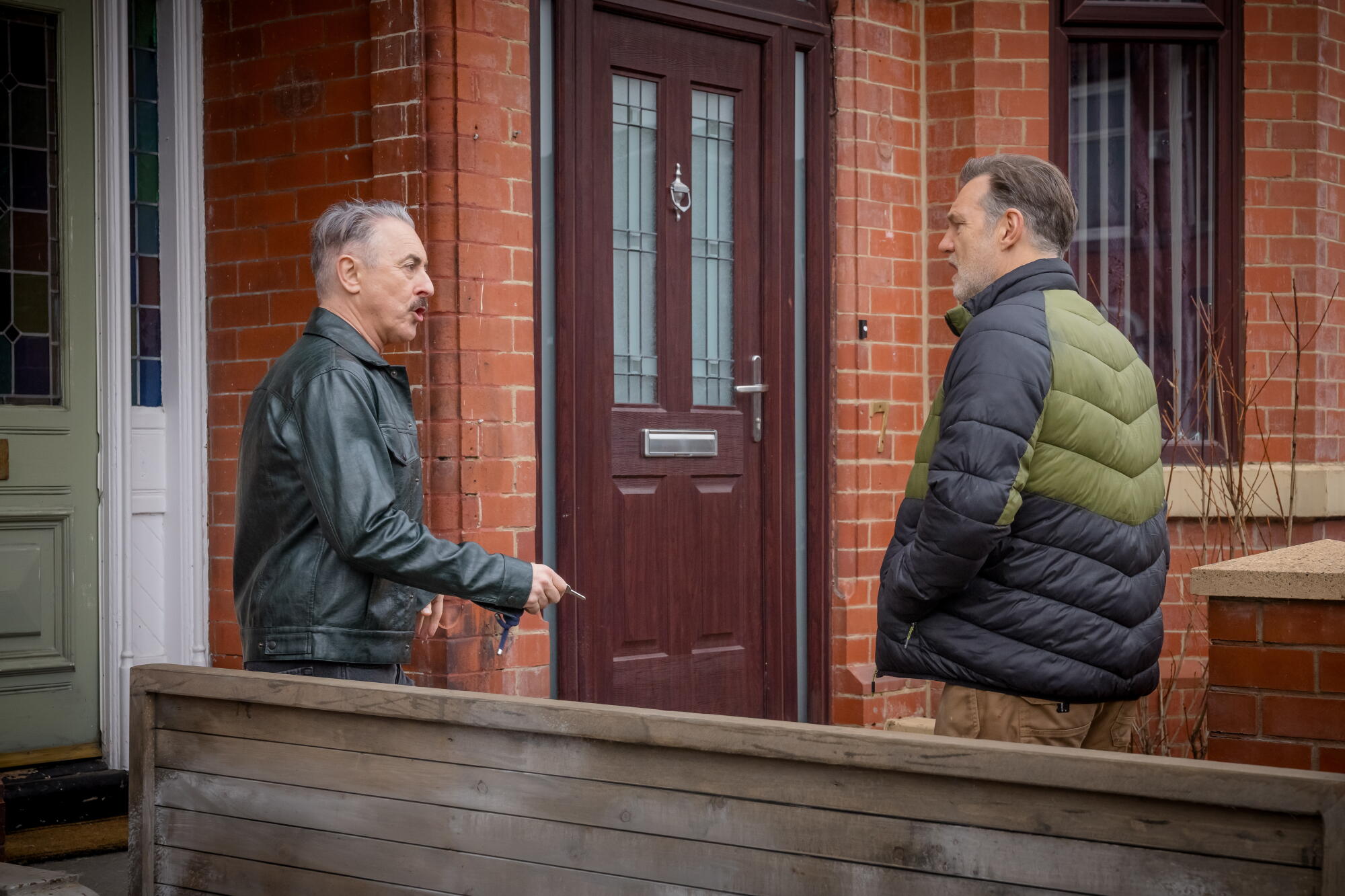
Two men standing near their doorways speaking emphatically.

Alan Cumming and David Morrissey play neighbors whose relationship escalates to violence in “Tip Toe.”

(Ben Blackall / Starz)

Leo’s bar, Spit and Polish, sits on Canal Street in Manchester’s long-established “gay village.” It’s a safe space for his employees and regulars, including Zee (Iz Hesketh), who’s been sleeping hidden in the bar, frightened of new flatmates since coming out as a trans woman, and Melba (Paul Rhys, brilliant), a former drag performer who holds down the end of the bar like Norm from “Cheers” and carries a torch for Leo.

Things will go generally downhill from here, in a narrative of escalating misunderstanding — not in the sense of an innocent mistake, of simply getting the wrong end of the stick (though that’s part of it), but as a contemporary habit of mind, blinkered, closed to facts but open to conspiracies. (Clive, a consumer of social media disinformation, believes that AIDS and COVID are fake); he lives in fear.

Directed by Peter Hoar, it’s a rough watch, yet beautifully wrought and delicately performed, inspiring and depressing, hopeless and hopeful by turns Davies has points to make — hanging your protagonist is not subtle — but his dialogue carries a lot of weight lightly; long conversations ebb and flow and rise and fall like compressed playlets. If there is something schematic about the arc, the characters within it, Clive as much as Leo, are completely human. They stand for something bigger than themselves, but they also stand for themselves.

Davies brought gay life in its infinite variety to television with the 1999 series “Queer as Folk” (also set on Canal Street) and gender fluidity to “Doctor Who,” the series he revived in 2005 and returned to in 2023. (The Tardis is currently in limbo.) His “Cucumber,” about middle-age gay men, and “Banana,” about young LGBTQ+ people, are also set in Manchester, where Davies has lived since the late 1980s. “Tip Toe” has been crafted for an age of surging homophobia and anti-gay violence. “The president of America has given these men permission to attack us,” says Melba, as he sits with Leo late one night by the canal. The series’ dark prophet, he gives it its title.

“It’s a storm, it’s a tide, it’s a great big tsunami. We’re in the middle of it right now … If you’d asked me in 1996 what do you think 2026 will be like, I’d have said ‘glory days’ … But they tricked us didn’t they? They let us all come out, so now we’re standing in he open ready for them to shoot us down. I used to walk into a room and just go, ‘Ta-da!’ Now I tip toe, just in case.”
Source link

‘No role for UNRWA in Gaza’: Does the Board of Peace toe Israeli lines? | Explainer News

The United States-led Board of Peace (BoP) has said the United Nations agency for Palestinian refugees (UNRWA) will have no role in Gaza – echoing a longstanding Israeli demand to sideline the organisation considered a lifeline for millions of Palestinians.

The board, which has been tasked with overseeing the “ceasefire” and Gaza’s reconstruction, said on Friday it would work only with partners it deems reliable and who it believes can meet the needs of Gaza’s population – a standard it says UNRWA does not meet.

Recommended Stories

list of 3 itemsend of list

The move comes as the BoP unveiled a multibillion-dollar plan on Wednesday aimed at beginning Gaza’s reconstruction, nearly a year after a so-called “ceasefire” came into effect in the devastated Palestinian territory.

The plan, presented on the sidelines of the UN General Assembly (UNGA), comes as key elements of the “ceasefire” remain stalled, including the withdrawal of Israeli forces and the disarmament of Hamas.

UNRWA was established in 1949 to cater to tens of thousands of Palestinians displaced from their homes by Jewish militias from areas that currently form part of Israel.

BoP’s stance on UNRWA comes as Israel’s genocide in the coastal enclave continues, with Palestinians facing nonstop attacks, severe restrictions on humanitarian aid and stalled reconstruction plans.

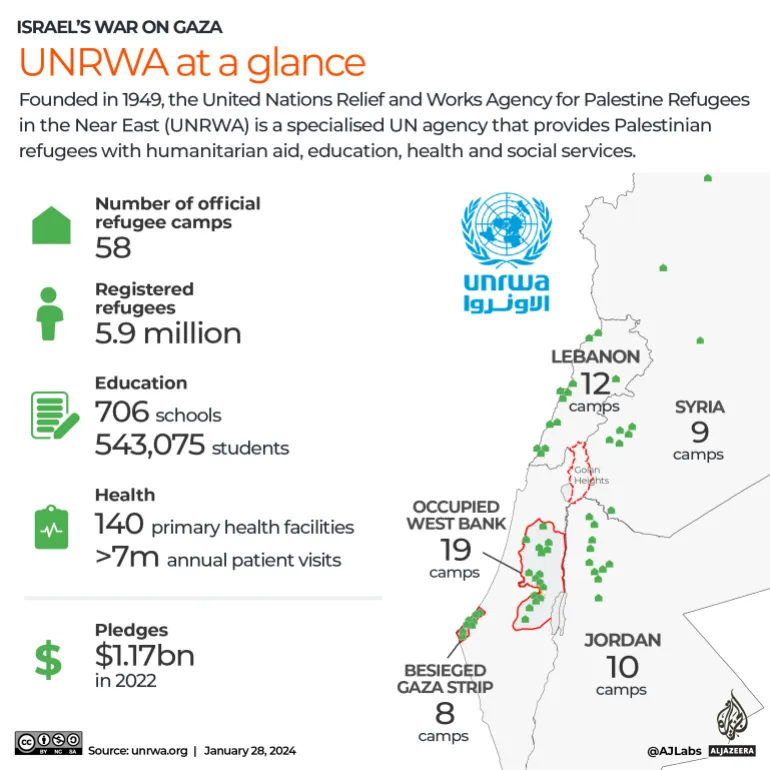
So what has BoP said about UNRWA, and does it keep toeing the Israeli line on the future of Gaza?UNRWA at a glance

What did the Board of Peace say?

The BoP unveiled a 66-project reconstruction blueprint on the sidelines of the UNGA, with $2.4bn proposed for projects aimed at beginning Gaza’s recovery.

UNRWA was left off the list of UN agencies the board identified as partners.

“The Board of Peace’s policy as it relates to UNRWA’s involvement in Gaza is unchanged,” the BoP said in a post on X on Friday.

“We will only work with trusted partners who will deliver for the people of Gaza and contribute to a deradicalised Strip. UNRWA fails on those litmus tests.”

However, a BoP official, speaking to The Associated Press news agency on condition of anonymity, confirmed that board members had met UNRWA officials several times.

The official said the agency’s programmes could continue if they served Gaza’s residents well, but maintained that “UNRWA’s days are over”.

The BoP, which US President Donald Trump launched earlier this year, was conceived to oversee the rebuilding of Gaza after nearly three years of Israel’s genocidal war on the Strip.

What has UNRWA said?

In an indirect response, UNRWA acting Commissioner-General Christian Saunders said on Friday in Gaza, “UNRWA remains an institution of considerable humanitarian and strategic value, with capabilities and expertise that are difficult to replicate today.”

“To disregard these capabilities at a moment of such profound need is neither logical nor responsible,” Saunders said in a statement.

Former UNRWA chief Philippe Lazzarini on Thursday warned that removing the agency would have a “devastating” effect on Palestinians.

“They want to get rid of the agency, but on the other hand they know that if you get completely rid of the agency today, it might have a further … devastating impact on the population,” Lazzarini told AP on Friday.

In a separate statement on X, Lazzarini said, “grandiose plans are what the Board of Peace does best”, noting widespread suffering across Gaza amid Israel’s ongoing genocide.

The agency has about 11,000 Palestinian employees in Gaza and remains heavily involved in healthcare, education, water and sanitation services. Its exclusion is particularly significant given the scale of displacement and the continuing restrictions on aid entering Gaza.

UNRWA has for decades provided aid and education services to Palestinians in Gaza, occupied East Jerusalem and the West Bank as well as Jordan, Syria and Lebanon – the neighbouring countries where the Palestinian refugees have been living.

Palestinians see the agency as safeguarding their right of return to their homeland, while Israel wants it dismantled.

Palestinians receive aid distributed by UNRWA, in Nusairat refugee camp, Gaza
Palestinians receive aid distributed by UNRWA, in Nusairat refugee camp, Gaza [File: Abdel Kareem Hana/AP photo]

What has been Hamas’ response?

Hamas accused the BoP of adopting Israel’s position.

Spokesperson Hazem Qassem on Saturday called the decision to exclude UNRWA “a complete alignment with the Zionist [Israeli] position”, saying it was aimed at ending the agency’s operations, preventing it from delivering aid and undermining Palestinian refugees’ right of return.

Qassem said it was “strange for the peace council to adopt this hostile stance towards UNRWA while simultaneously failing to provide aid to Gaza or compel the occupation to abide by the ceasefire agreement and halt the daily killings of Palestinians in the Strip”.

Does the Board of Peace toe the Israeli line?

Experts say the workings and demands of the BoP align closely with Israel’s vision of the Gaza Strip and the Palestinians.

UNRWA

Israel has for years sought to remove UNRWA from Gaza, accusing the agency of being infiltrated by Hamas.

The International Court of Justice, in an advisory opinion in October, said allegations that “a significant part of UNRWA’s employees are ‘members of Hamas … or other terrorist factions’” had not been substantiated.

The BoP’s position strengthens the Israeli efforts to dismantle the UN agency.

Hamas disarmament

Hamas and other Palestinian factions agreed in July to a roadmap under which weapons would be surrendered in stages as Israeli forces gradually withdrew. The two processes were explicitly linked.

But following an August meeting between Nickolay Mladenov, the BoP’s director-general, and Israeli Prime Minister Benjamin Netanyahu, the board said Israeli forces would not withdraw beyond the “Yellow Line” until Hamas’s decommissioning was complete, including “light weapons, heavy weapons, and the tunnels alike”.

Hamas maintains that it will not implement its obligations unless Israel fulfils its own.

Israel currently occupies more than 60 percent of Gaza while most of the territory’s 2.3 million people remain displaced.

Reconstruction

Article 17 of the BoP plan calls for “temporary reconstruction” beginning in areas designated free of Hamas control, including humanitarian compounds for unarmed civilians.

The proposed system would direct reconstruction, aid and shelter towards areas outside Hamas’s control while Israeli forces remain behind the so-called “Yellow Line”.

However, Israel has refused to allow the Palestinian technocratic committee into Gaza, open crossings or begin reconstruction until Hamas is completely disarmed.

After unveiling the reconstruction plan on the sidelines of the UNGA, BoP high representative Mladenov said once again the proposed plan depends on Hamas’s disarmament.

Displaced Palestinians live in a school run by UNRWA on Monday, June 23, 2025. Hundreds of UNRWA schools were destroyed or damaged in Israeli attacks
Displaced Palestinians live in a school run by UNRWA on Monday, June 23, 2025. Hundreds of UNRWA schools were destroyed or damaged in Israeli attacks [File: Jehad Alshrafi/AP Photo]

What is the situation in Gaza?

Almost a year after the October 2025 ceasefire, reconstruction has yet to begin on any meaningful scale and Israeli forces continue to occupy large parts of the Strip.

At least 1,451 Palestinians have been killed and 4,953 wounded in Israeli attacks since the “ceasefire” began in October 2025, according to Gaza’s Ministry of Health.

The healthcare system is on the verge of “total collapse”, the ministry said last week, while shortages of fuel, medical supplies and spare parts have disrupted hospitals, water and sanitation services.

The scale of destruction is also immense. More than half of Gaza’s hospitals and clinics remain nonfunctional, less than 1.5 percent of cropland is accessible and undamaged, and reconstruction needs have reached an estimated $71.5bn.

Nearly 84 percent of Gaza’s population – more than 1.76 million people – are living in displacement sites or damaged and inadequate shelters, the UN has said.

FILE - Palestinian children who fled with their parents from their houses in the Palestinian refugee camp of Ein el-Hilweh, gather in the backyard of an UNRWA school, in Sidon, Lebanon, Sept. 12, 2023. (AP Photo/Mohammed Zaatari, File)
Palestinian children gather in the backyard of an UNRWA school in Sidon, Lebanon, on September 12, 2023 [File: Mohammed Zaatari/AP Photo]

Source link