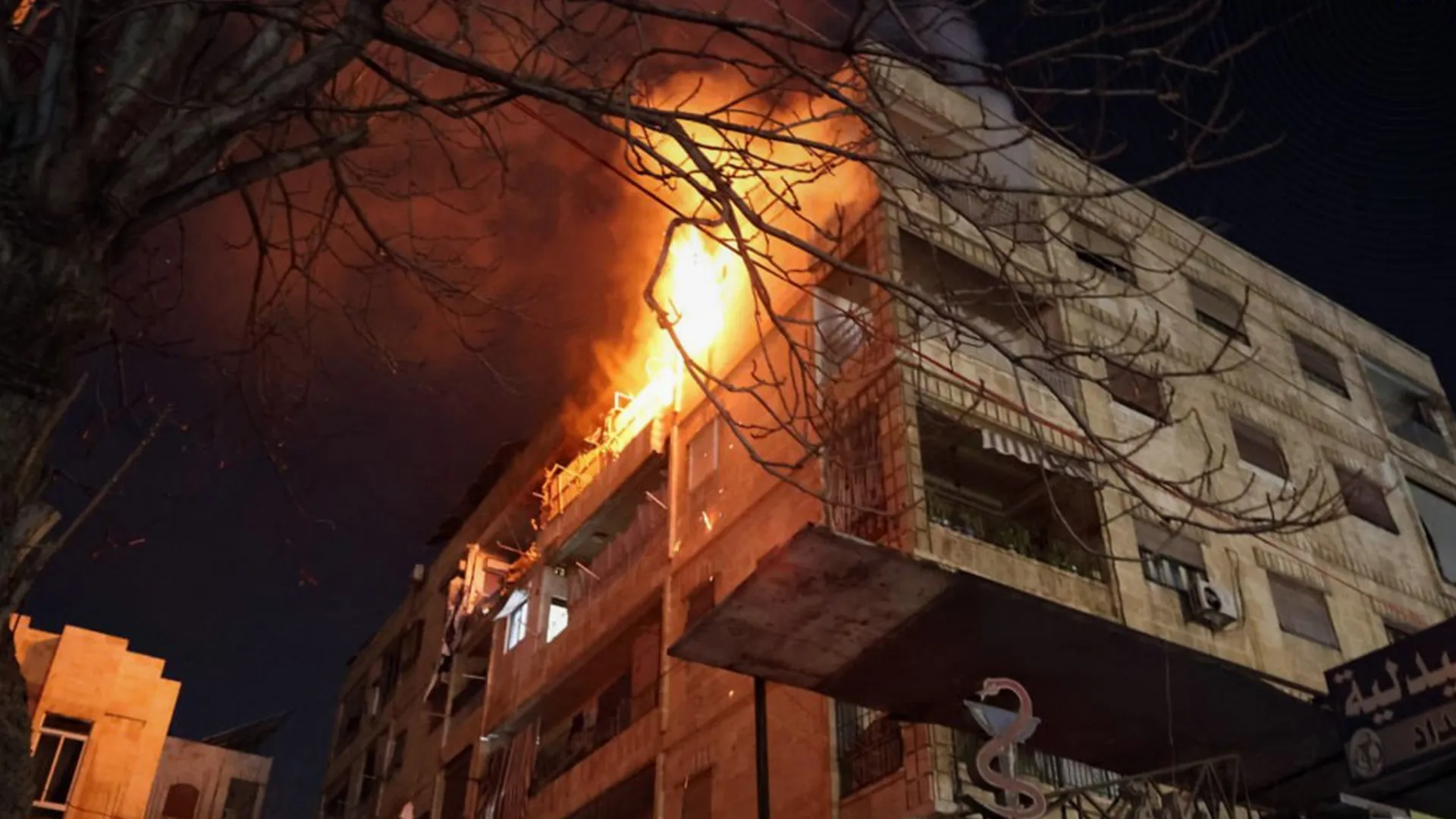
Commercial premises among buildings facing demolition as military incursions intensify near Qalandiya and Kafr Aqab.
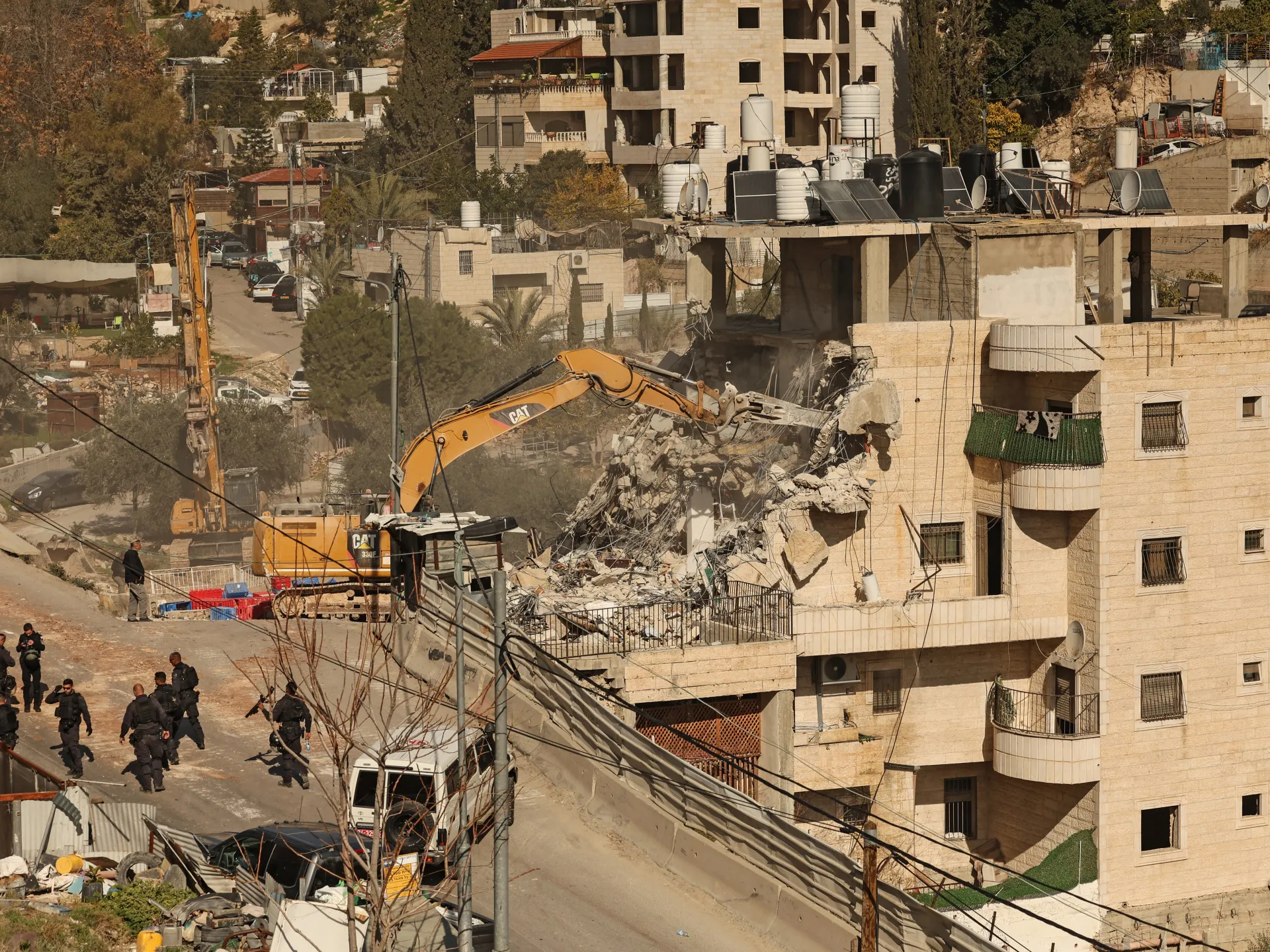
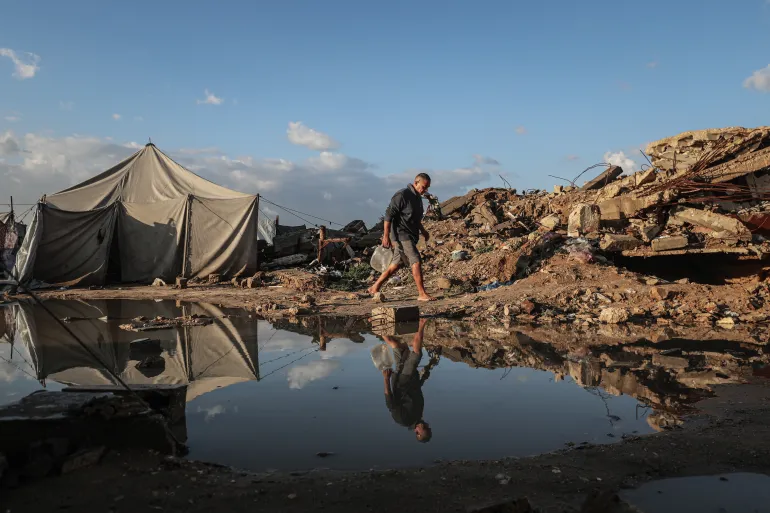
Israeli forces have begun demolishing shops in the vicinity of the Qalandiya refugee camp, north of occupied East Jerusalem, as part of a wider military incursion across several Palestinian neighbourhoods, witnesses and medical officials say.
The raids, which began early on Tuesday, have extended into the nearby town of Kafr Aqab, where Israeli troops deployed in large numbers, carried out house searches and forcibly evicted residents from their homes, according to local media reports.
Recommended Stories
list of 3 itemsend of list
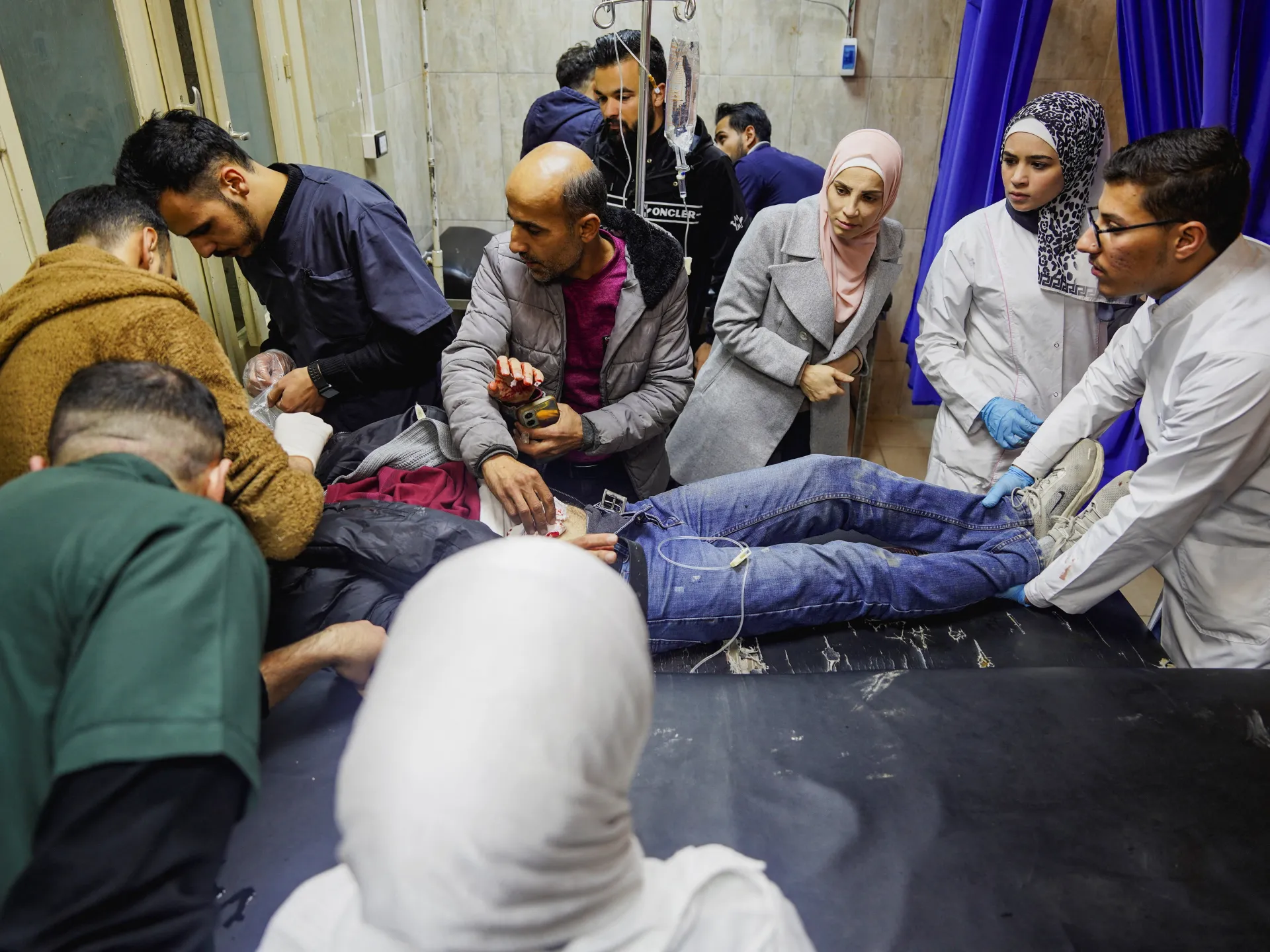
The Palestine Red Crescent Society said its medical teams treated at least three people injured during the raids in Qalandiya and Kafr Aqab. The injuries included a bullet wound to the thigh, wounds caused by shrapnel from live ammunition, and injuries resulting from physical assault.
The Jerusalem governorate reported that at least three Palestinians were injured by Israeli forces’ gunfire, in addition to dozens of cases of suffocation caused by the firing of tear gas and stun grenades, the Palestinian Wafa news agency reported.
Several Palestinians were detained during the large-scale incursion that was also accompanied by the deployment of military vehicles and bulldozers.
Among those arrested are Anan Mohammed Taha and his father, Mohammed Taha, residents of the Qalandiya refugee camp, Wafa said.
‘Intimidation’ and ‘anxiety’
Residents said Israeli forces ordered several families to evacuate their homes, with at least three houses converted into temporary military outposts in Kafr Aqab. Homeowners were reportedly told the operation would continue until at least Wednesday morning.
Israeli forces also stormed the youth club inside the Qalandiya refugee camp and turned the facility into a military base, according to Al Jazeera Arabic’s correspondent.
Journalists covering the operation were also targeted, including Al Jazeera Arabic reporters, with Israeli forces firing stun grenades and tear gas canisters in their direction during the raid in Kafr Aqab.
According to the Jerusalem governorate authorities, stun grenades were also fired directly towards students in the area as they were returning home from school, while private surveillance cameras were seized.
Al Jazeera’s Nida Ibrahim, reporting from Kafr Aqab, said Israeli forces are continuing to “intimidate” Palestinians.
“They have raided Palestinian stores, Palestinian shops, and they’ve destroyed some of the plaques, some of the advertisement billboards that were here”, in an attempt to further cripple the Palestinian economy, Ibrahim said.
“This is part of the anxiety that Palestinians live through day in and day out as these Israeli raids continue on a daily basis,” she added.
Israeli incursions across the West Bank average “60 raids per day”, Ibrahim said.
In addition to the demolitions, Israeli forces confiscated goods from commercial shops in the Qalandiya refugee camp, Kafr Aqab and parts of northern Jerusalem, citing alleged unpaid municipal taxes.
Most Palestinians living in these areas hold Jerusalem residency identification cards. Residents say they are subject to high municipal taxes while receiving few basic services.
Separately, confrontations were also reported in the town of Beit Furik, east of Nablus in the occupied West Bank, after Israeli forces stormed the area.
Israel Katz says military units will be established inside the Palestinian enclave, in contravention of the truce agreement.
Published On 23 Dec 202523 Dec 2025
Share
Israeli Defence Minister Israel Katz has said the Israeli military will never fully withdraw from the Gaza Strip and that an army unit will be established inside the Palestinian enclave.
Speaking on Tuesday, Katz said Israeli forces would remain deployed throughout Gaza, despite a United States-backed peace plan signed by Israel and Hamas in October that calls for a full Israeli military withdrawal and rules out the re-establishment of Israeli civilian settlements in the territory.
Recommended Stories
list of 4 itemsend of list
“We are located deep inside Gaza, and we will never leave all of Gaza,” Katz said. “We are there to protect.”
“In due course, we will establish Nahal [an Israeli infantry brigade] outposts in northern Gaza in place of the settlements that were uprooted,” Katz added, according to Israeli media.
Hours later, he issued a statement in English to the Reuters news agency, saying Nahal units would be stationed in Gaza “only for security reasons”. The Israeli media reported that US officials were displeased with Katz’s initial comments and demanded clarification.
Nahal units are military formations that combine civilian service with army enlistment and have historically played a role in the creation of Israeli communities.
Katz was speaking at a ceremony in the occupied West Bank marking the approval of 1,200 housing units in the illegal Israeli settlement of Beit El.
Addressing settlement expansion in the West Bank, Katz said: “Netanyahu’s government is a settlements government … it strives for action. If we can get sovereignty, we will bring about sovereignty. We are in the practical sovereignty era.”
“There are opportunities here that haven’t been here for a long time,” he added.
Israel is expected to head into an election year in 2026, with illegal settlement expansion a key political issue. Far-right and ultranationalist members of Prime Minister Benjamin Netanyahu’s coalition have repeatedly said they intend to reoccupy Gaza and expand illegal settlements in the West Bank.
Under international law, all Israeli settlements in the occupied West Bank are illegal. The transfer of an occupying power’s civilian population into occupied territory is considered a war crime under the Rome Statute of the International Criminal Court.
Meanwhile, violence by Israeli forces and settlers has continued across the West Bank, while killings continue in Gaza despite the ceasefire. Palestinian officials say more than 1,100 Palestinians have been killed, about 11,000 wounded and more than 21,000 arrested.
The Palestinian Ministry of Health said that since a ceasefire began on October 11, at least 406 Palestinians have been killed and 1,118 injured. Since the start of Israel’s war on October 7, 2023, the ministry said, 70,942 Palestinians have been killed and 171,195 wounded.
This remarkable house has stayed standing through many major events, even surviving the Great Fire of London, despite huge areas of the city being destroyed, and attempts to have it demolished
The house has remained standing through many historic events(Image: In Pictures via Getty Images)
London’s most intriguing landmarks often lie hidden in plain sight, tucked away down side streets. A prime example of this lies down the street of Cloth Fair.
This narrow road near Smithfield Market in the City of London, owes its name to its medieval past as a hub for merchants. Today, instead of bustling scenes of street trading, it’s mostly residential and offers a tranquil retreat from the city’s hustle and bustle.
Yet, one building stands out due to its historical significance. 41-42 Cloth Fair, built between 1597 and 1614, holds the distinction of being London’s oldest surviving house. But what truly sets this four-bedroom townhouse apart is its resilience through various tumultuous periods in history, including its survival of the Great Fire of London.
The Great Fire of London obliterated over 70,000 homes, leaving this townhouse amidst a sea of ruined properties. However, a tall brick wall encircling the property shielded it from the devastating flames, reports the Express.
But this wasn’t the first time the house had dodged disaster. During the Second English Civil War, when many city properties were razed, the house remained unscathed. Unfortunately, its builder, Henry Rich, wasn’t as fortunate. A Royalist, Rich was apprehended, tried, and ultimately beheaded within the grounds of the Palace of Westminster.
The property’s first occupant was William Chapman, who transformed the ground floor into an ale house. Over the centuries, the building has served various purposes, from a wool drapers to a tobacconist, and then a cutlery factory until the 1920s when it was sold.
Since then, it has functioned as a private dwelling and continues to be a home today. The 1920s nearly witnessed the demolition of 41-42 Cloth Fair. In 1929, there were proposals to raze the house along with numerous other historic buildings as part of a plan to improve sanitation in city housing.
Doubts were also raised about its structural integrity, and it was marked as dangerous. But remarkably, the house was spared from demolition and even survived the Blitz unscathed, while 1.7 million buildings across London were damaged and many historical landmarks were lost forever.
In 1995, new owners acquired the property, carried out extensive renovations, and won a City Heritage Award a few years later. One particularly noteworthy historical feature is a collection of signatures etched into the lead windows using a diamond pen.
These autographs belong to several high-profile individuals who have visited the house over the years, including Winston Churchill, the Queen Mother, John Betjeman, and J. B. Priestley.
The house’s age, coupled with its location near a medieval priory, has even sparked rumours of skeletons entombed deep within its foundations.
Whether there’s any truth to these rumours or not, it seems these souls can rest undisturbed under the watchful protection of this seemingly indestructible house.
Have a story you want to share? Email us at webtravel@reachplc.com
Police arrest three people outside insurer of Israeli arms maker Elbit, including Thunberg for holding placard.
British police have arrested Swedish activist Greta Thunberg and two other people at a pro-Palestine protest in central London, according to campaign group Defend Our Juries.
The group said Thunberg was arrested on Tuesday at the Prisoners for Palestine protest held in the heart of London’s Square Mile financial district outside the offices of Aspen Insurance, which provides coverage for Israeli defence contractor Elbit Systems.
Recommended Stories
list of 3 itemsend of list
The group said Thunberg had arrived after the protest began, and it shared video footage of the activist holding a sign reading, “I support the Palestine Action prisoners. I oppose genocide.” Thunberg has called Israel’s war in Gaza a genocide and has twice joined flotilla campaigns to try to break Israel’s siege of Gaza.
The City of London Police, which polices the financial district, confirmed that a 22-year-old woman, a description corresponding to Thunberg, was arrested for displaying a placard “in support of a proscribed organisation (in this case Palestine Action) contrary to Section 13 of the Terrorism Act 2000”.
This is the latest protest in solidarity with activists from the Palestine Action group, six of whom are currently on hunger strike in British prisons with two now hospitalised. The direct action group has been proscribed as a “terrorist organisation” by the United Kingdom’s government.
Defend Our Juries said Tuesday’s protest was held to draw attention to Aspen Insurance’s “complicity in genocide” and to express solidarity with prisoners affiliated with Palestine Action.
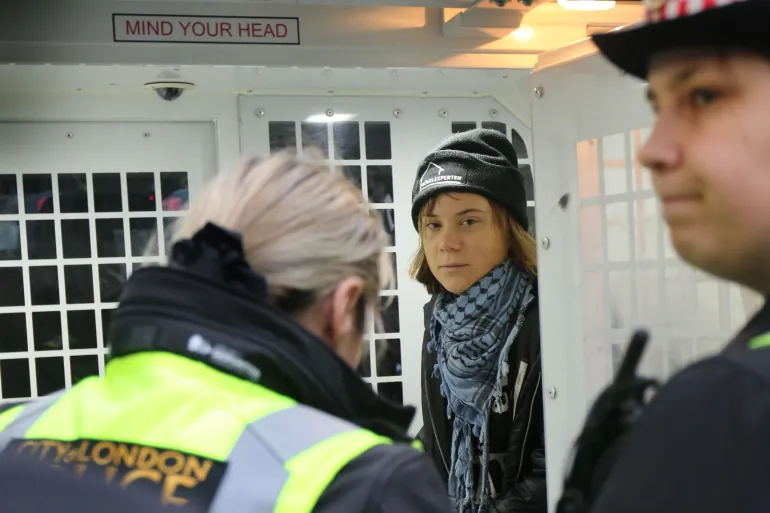
Thunberg is seen after her arrest for holding a placard expressing support for Palestinian Action prisoners and condemnation of Israel’s genocide [Handout/Defend Our Juries]
Two others, a man and a woman, were also arrested at the protest although they had “glued themselves nearby”, according to the City of London Police, which described damage with “hammers and red paint” to “a building on Fenchurch Street”, where the offices of Aspen Insurance are located.
Defend Our Juries confirmed the damage, saying in a news release that two activists “covered the front of the building with symbolic blood-red paint, using re-purposed fire extinguishers” before attaching themselves to the front of the building in the aim of “drawing attention to Aspen’s complicity in Genocide, disrupting their business, and closing down the building”.
The group said Aspen Insurance, a global insurer and reinsurer, was targeted because of its affiliation with Elbit Systems UK, a subsidiary of Elbit Systems, which is Israel’s largest arms producer. It describes its drones as “the backbone” of the Israeli military.
Palestine Action protesters had targeted one of the UK subsidiary’s operations in Bristol last year. Among their five key demands, the group’s hunger strikers want the manufacturer, which has several UK factories, to be shut down.
Defend Our Juries said in its news release that Deputy Prime Minister and Justice Minister David Lammy has “refused to speak to legal representatives of the hunger-strikers, or their families”.
A few days earlier, Thunberg had voiced solidarity with the hunger strikers on Instagram, saying: “It is up to the state to intervene, and put an end to this by meeting these reasonable demands that pave the way for the freedom of all those who choose to use their rights trying to stop a genocide, something the British state has failed to do themselves.”
A Palestine Action spokesperson said in relation to her arrest that it was not clear whether police had “made another one of their mistakes in interpreting the crazy ban on Palestine Action” or whether they had “turned anyone expressing support for prisoners locked up beyond the legal time limit for taking action to stop a genocide into alleged terrorists”.
London, United Kingdom – Lawyers of imprisoned hunger-striking activists linked to the protest group Palestine Action have put the British government on notice as the justice secretary refuses to meet them.
Imran Khan & Partners, which represents the collective, wrote a pre-claim letter to the government on Monday, warning that they would seek a High Court case should officials fail to respond by Tuesday afternoon.
Recommended Stories
list of 4 itemsend of list
Eight activists, aged between 20 and 31, have participated in a rolling strike that began on November 2. There are rising fears that one or more of them could soon die in jail.
In recent days, their relatives and loved ones have told Al Jazeera of their deteriorating health and repeated hospital admissions.
Their lawyers have long called for a meeting with Justice Secretary David Lammy to discuss welfare and prison conditions, believing such an intervention could be life-saving.
But the government has so far refused, saying hunger strikes are not an unusual phenomenon in prisons and that policies to provide adequate medical care to anyone refusing food are being followed.
“Our clients’ food refusal constitutes the largest co-ordinated hunger strike in British history since 1981,” the lawyers wrote, referring to the Irish Republican inmates led by Bobby Sands. Sands and nine others died of starvation, one on day 46 of the protest.
“As of today’s date, [the current] strike has lasted up to 51 days, nearly two months, and poses a significant risk to their life with each passing day,” the lawyers wrote.
The detainees are being held in five prisons over their alleged involvement in break-ins at the United Kingdom’s subsidiary of the Israeli defence firm Elbit Systems in Bristol and a Royal Air Force base in Oxfordshire. They deny the charges against them, such as burglary and violent disorder.
Amu Gib, Heba Muraisi, Teuta Hoxha and Kamran Ahmed are on day 52, 51, 45 and 44 of their protests, respectively. Lewie Chiaramello, who is diabetic and refuses food every other day, began his protest 30 days ago.
Qesser Zuhrah, Jon Cink and Umer Khalid have ended their strike.
All eight will have spent more than a year in prison before their trials take place, well beyond the UK’s usual six-month pre-trial detention limit.
The hunger strikers’ five demands include immediate bail, the right to a fair trial and the de-proscription of Palestine Action, which accuses the UK government of complicity in Israel’s war crimes in Gaza. The UK government banned Palestine Action in July, branding it a “terror” group, a label that applies to groups such as ISIL (ISIS). The protesters have called for an end to alleged censorship in prison, accusing authorities of withholding mail, calls and books. They are also urging that all Elbit sites be closed.
‘Engage with each one’
Leading human rights barrister Michael Mansfield has backed calls for the government to intervene.
“It’s a simple proposition, engage with each one,” he told Al Jazeera. “That’s your job [as government], that’s what you’re there for. You are safeguarding people’s health, welfare and life.”
In a letter addressed to Lammy, he wrote, “Fundamental human rights in the United Kingdom are being destroyed in this quagmire of disinterest and populist politics, the most important being the presumption of innocence and the right to a fair trial by means of preparation and due process.
“There has to be an equality of arms which can hardly be achieved when a defendant is held in oppressive and lengthy periods of remand.”
Families of the prisoners have alleged mistreatment in prison, saying some detainees have been verbally abused and left without care in dangerous health conditions. The Ministry of Justice has denied these accusations and says it cannot comment on individual cases.
“Government takes action when it chooses to,” Mansfield wrote. “There could be no more appropriate time than now with the life-endangering protest by the hunger strikers. The delay is grotesque in some cases, up to two years with trial dates being set in 2027.”
Nida Jafri, a friend of hunger striker Amu Gib, plans to deliver Mansfield’s letter – and one of her own – in hand to the Ministry of Justice on Tuesday.
“These people are on remand – not convicted, still awaiting full legal process,” reads Jafri’s letter. “They are weak, in pain, and visibly wasting away. The absence of adequate medical observation or humane treatment under prison or hospital care is not only unacceptable; it breaches fundamental rights to health, dignity, and life.”
The protest was in support of Palestine Action prisoners on hunger strike
Greta Thunberg has been arrested at a demonstration in support of the Palestine Action protesters who are on hunger strike in prison, according to the Prisoners for Palestine protest group.
The 22-year-old activist was detained in the City of London after attending the scene of the early-morning demonstration on Fenchurch Street.
In a video shared by the group, she could be seen holding a sign reading “I support the Palestine Action prisoners” and “I oppose genocide”.
City of London Police said a 22-year-old woman was arrested for displaying a placard in support of a proscribed organisation, in this case Palestine Action, contrary to Section 13 of the Terrorism Act 2000.
The force said officers were called to the area at about 07:00 GMT after hammers and red paint were used to damage a building.
A man and a woman were also arrested on suspicion of criminal damage after they “glued themselves nearby”, police said. Specialist officers worked to release them before taking them into custody.
PA Media
Greta Thunberg was arrested on Fenchurch Street in the City of London
The Prisoners for Palestine protest group said it staged the demonstration outside the offices of Aspen Insurance, which it claimed provides services to Israeli-linked defence firm Elbit Systems.
Ms Thunberg, who first came to prominence as a child climate activist, has been involved in several demonstrations in support of the Palestinian cause.
Weekly insights and analysis on the latest developments in military technology, strategy, and foreign policy.
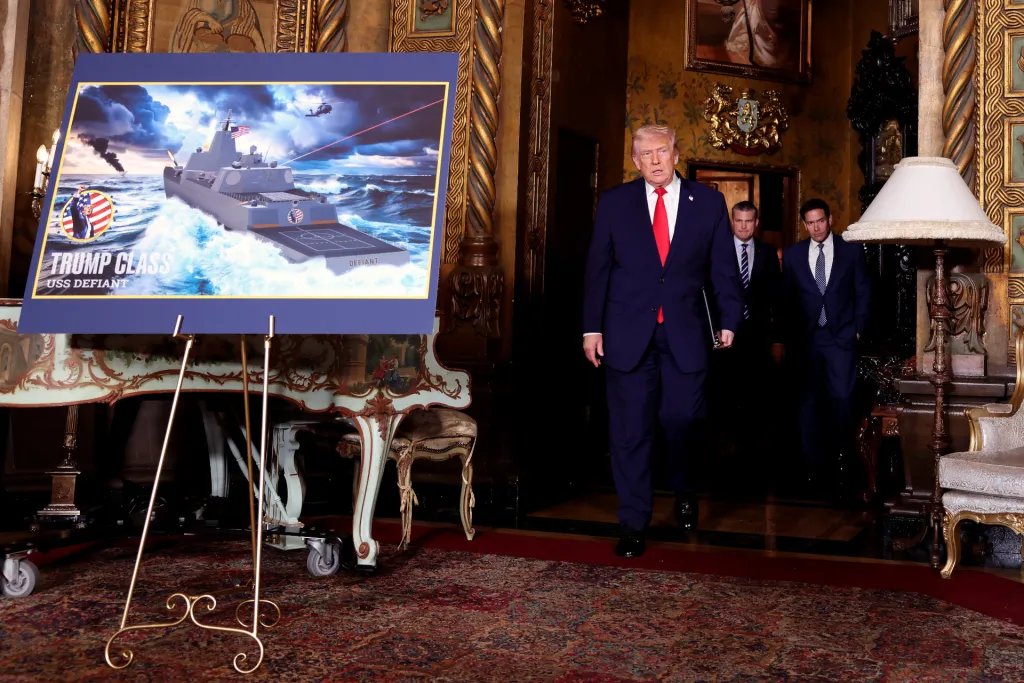
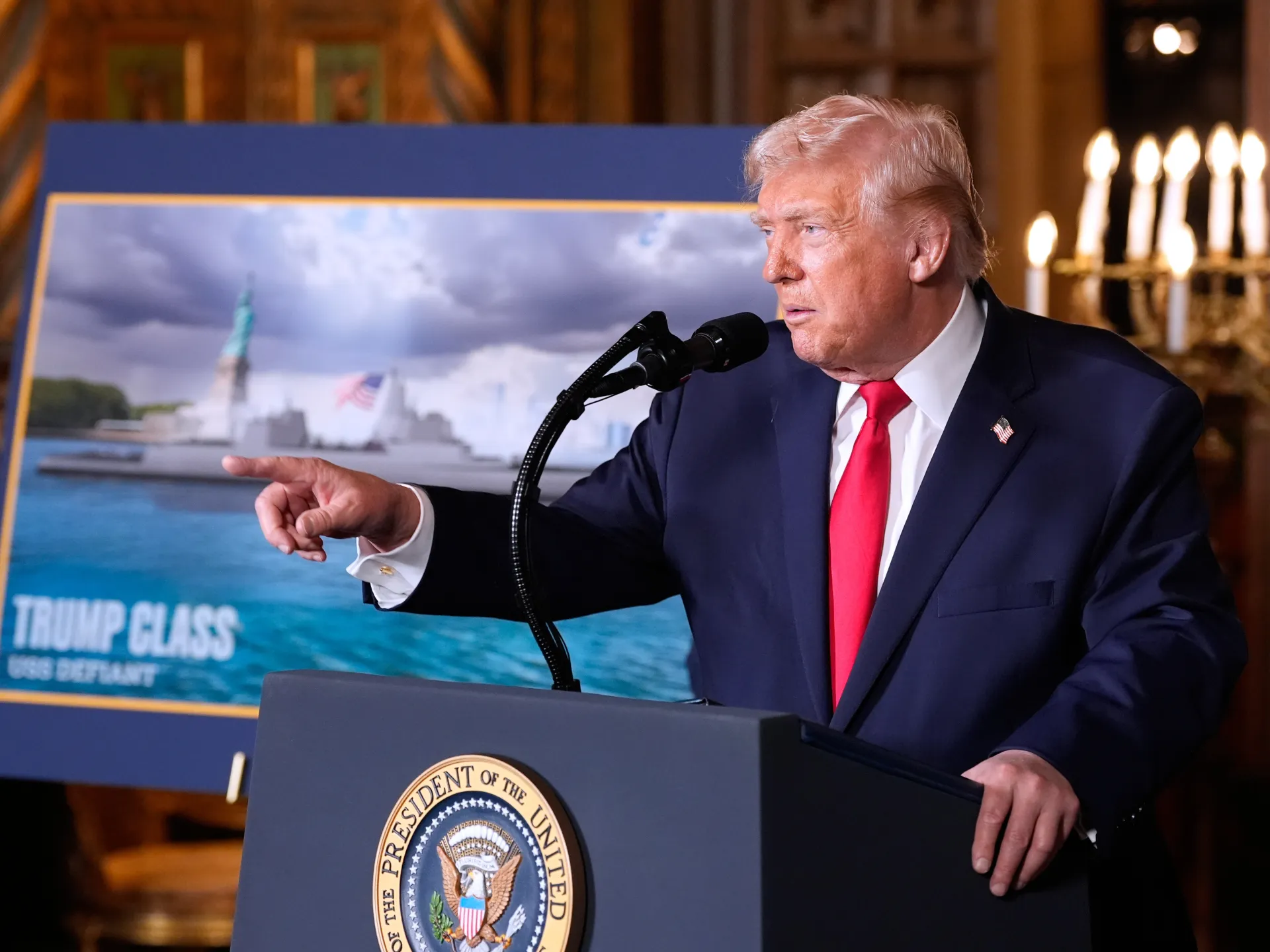
President Donald Trump has rolled out plans for new Trump class large surface combatants for the U.S. Navy. These are to be armed with a wide array of missiles, including nuclear-armed and hypersonic types, as well as electromagnetic railguns, laser directed energy weapons, and more. Trump says the goal now is to build at least two of these vessels, the first of which will be named USS Defiant, but that the fleet size could grow to 10 hulls or more. The 30,000-to-40,000-ton displacement ships are the centerpiece of a larger naval shipbuilding initiative called the Golden Fleet.
Trump, flanked by Secretary of War Pete Hegseth, Secretary of State and acting National Security Advisor Marco Rubio, and Secretary of the Navy John Phelan, unveiled the Trump class at his Mar-a-Lago estate in Palm Beach, Florida. The vessels are currently being referred to as “battleships,” a term historically applied to large warships with gun-centric armament and heavily armored hulls. The Navy decommissioned its last true battleships, the World War II-era Iowa class USS Missouri and USS Wisconsin, between 1990 and 1992. By which time they had been heavily upgraded. TWZhad highlighted the possibility of the Navy pursuing a warship in the general vein of the design shown today after the president had first teased this plan back in September.
President Donald Trump at Mar-a-Lago just before unveiling the Trump class warship plan. Tasos Katopodis/Getty Images
“From [President] Theodore Roosevelt, [and] the Great White Fleet … to the legendary [Iowa class] USS Missouri, whose massive guns helped win World War II, America’s battleships have always been unmistakable symbols of national power,” Trump said. The Trump class “will be the flagships of the American naval fleet, and there has never been anything built like them.”
All four of the Iowa class battleships that were built seen sailing together. USN
“American strength is back on the world stage, and the announcement of the Golden Fleet, anchored by new battleships, the biggest and most lethal ever, … marks a generational commitment to American sea power across the entire department,” Secretary Hegseth said. “New and better ships will provide that deterrent today and for generations to come.”
“We’re going to make battle groups great again,” Secretary Phelan added. “The USS Defiant battleship will inspire awe and reverence for the American flag whenever it pulls into a foreign port. It will be a source of pride for every American.”
“As we forge the future of our Navy’s Fleet, we need a larger surface combatant and the Trump class Battleships meet that requirement,” Chief of Naval Operations Adm. Daryl Caudle also said in a separate Navy press release. “We will ensure continuous improvement, intellectually honest assessments about the requirement to effectively deter and win in the 2030s and beyond, and disciplined execution resulting in a Fleet unparalleled in lethality, adaptability and strength.”
If all goes to plan, “when a conflict arises, you [the president] are going to ask not one, but two questions, where are the carriers and where are the battleships,” Phelan said today.
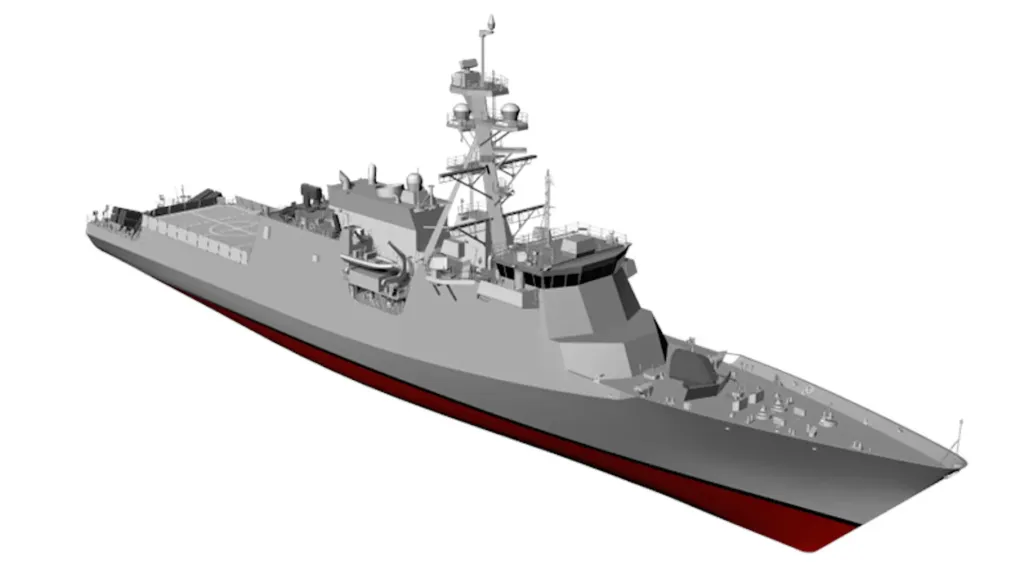
A rendering of a Trump class warship as seen from the side. White House/USN
Otherwise, the salient details about the Trump class shared today at Mar-a-Lago, as well as in the Navy’s release, are as follows:
30,000 to 40,000 displacement (the Iowa class battleships had displacements of around 57,540 tons with a full load).
Renderings displayed at the event at Mar-a-Lago show a design with three large Vertical Launch System (VLS) arrays, two at the bow end and one at the stern.
One of the renderings, seen below, depicts the ship firing what looks to be an IRCPS missile, a Tomahawk cruise missile, and a member of the Standard Missile family.
This appears to be the first time a class of Navy ships has been named after a sitting U.S. president. The Navy has often drawn criticism in the past for naming ships after living individuals, in general. It is unusual for the lead ship in a class of U.S. Navy vessels not to bear the name of that class (USS Defiant here instead of something like USS Trump or USS Donald J. Trump), as well.
Major questions about the plans for the Trump class do remain, including when the USS Defiant might be launched, let alone enter service. What these ships might cost to produce, as well as operate and maintain, is another important open question.
Despite the comments at Mar-a-Lago today, the unveiling of the Trump class is still likely to prompt much new analysis and general discussion about the expected utility of these ships, including from TWZ. We already did a deep dive into the feasibility, as well as the operational relevance, of Trump’s “battleship” proposal after his remarks in September. As we noted at the time, a concept along the lines of what was shown today offers a compromise of sorts that could help justify its complexity and cost. Similar ‘arsenal ship’ concepts for the Navy have been put forward on several occasions over the past few decades. This includes a proposal from Huntington Ingalls Industries in the early 2010s for a derivative of the San Antonio class amphibious warfare ship with 288 VLS cells and otherwise optimized for the ballistic missile defense mission.
Artwork from the Defense Advanced Research Projects Agency showing a notional arsenal ship dating back all the way to the 1990s. DARPAA rendering of the proposed San Antonio class-derived ballistic missile defense ship. HII/MDA
At the same time, what capabilities the Trump class might truly be able to bring to bear will be dependent on a host of factors, especially if they are only ever fielded in relatively smaller numbers. And regardless of how capable any warship is, it can only ever be in one place at one time, which is more often than not in port.
On the other hand, there are concerning VLS cell gaps that are fast approaching on the horizon. The service is set to retire the last of its Ticonderoga class cruisers, each one of which has 122 VLS cells, at the end of the decade. The Navy will also need to make up for the impending loss of the huge missile launch capacity offered by its four Ohio class nuclear guided missile submarines, which are also set to be decommissioned before 2030. The Trump class will clearly feature a massive set of VLS arrays that could help offset some of this deficit.
The general length of time it takes to design and produce large warships creates additional uncertainty for any naval shipbuilding endeavor, as well. Since the end of the Cold War, the Navy has seen a number of major warship programs be severely truncated, or outright cancelled, for a variety of reasons. As one prime example, the service originally planned to acquire 32 Zumwalt class stealth destroyers before slashing that number to just three and drastically watering-down their capabilities. The Trump administration also just recently axed the Constellation class frigate program, which had turned into a major boondoggle, as you can read more about here.
The Trump class “battleship” announcement notably comes on the same day the Navy confirmed to TWZ that the first of its future FF(X) frigates will be delivered with the glaring omission of a VLS and are clearly meant to be produced as cheaply and quickly as possible. At least the first ships will have the same armament of the much-derided Littoral Combat Ship.
All this will prompt major debate about how the Navy is using its pool of resources that it constantly says is too small to meet its future obligations. Investing so much in a small number of hulls while stripping out capabilities of those ships that will be built in larger numbers will surely be a hot topic on Capitol Hill in the months to come.
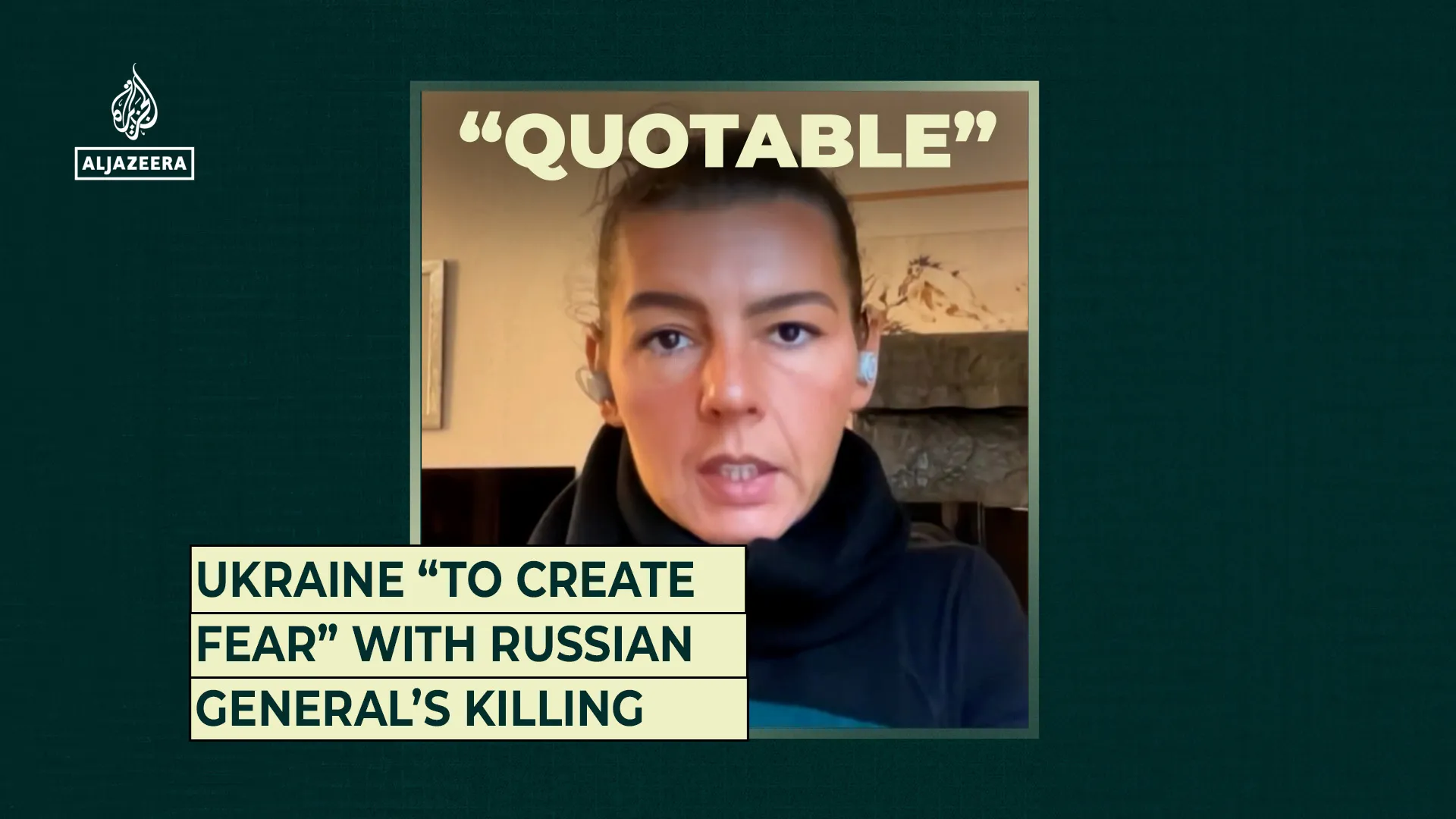
“This [killing in Moscow] is a mode of warfare which would be referred to as, quote-unquote, irregular.”
The killing of a top Russian general is a “direct message” to senior Russian military leaders from Ukraine, says Marina Miron, of King’s College London.
Kyiv, Ukraine – Have you been on a plane during severe turbulence, fearing that the shaking aircraft is about to fall apart and tumble down? Brief moments of weightlessness stop your breath, perhaps you whisper prayers and remember everyone you love.
That’s the feeling you get during a Russian air raid in Kyiv, Ukraine, and there have been more than 1,800 of them since Russia’s full-scale invasion began in 2022.
Recommended Stories
list of 4 itemsend of list
These days, they are bigger, scarier and longer than ever, because each one involves hundreds of drones and dozens of missiles.
They begin after dark and sometimes last in waves until dawn. Whooshing missiles tear up the night sky in two. Drones buzz like horror movie chainsaws or giant mosquitoes out of childhood flu nightmares.
What’s really harrowing is to hear two or three drones at once – I sardonically call it “stereo” and “Dolby surround” – while the arrhythmia of bass drum-like air defence explosions coincides with your heartbeat.
Each boom and thud chokes your body with adrenaline, and some shake your house, but after a couple of hours, your brain gives up, and you fall asleep processing the booms into nightmares.
And in the morning, you fall awake – feeling hungover and disoriented – and read about the consequences. You’re glad when no one is killed, and still sad because several people are usually wounded, and several apartment buildings are damaged.
People walk near a petrol-run generator, used to generate electricity for a medical clinic during a power blackout, after critical civil infrastructure was hit by Russian missile and drone attacks in Kyiv, Ukraine, October 10, 2025 [Gleb Garanich/Reuters]
Sometimes, I think about the people who operate the drones and launch the missiles. How they come back to their families after the night shift, what they tell their children and, most importantly, themselves.
But I prefer the memory of a crowd of high school graduates who walked past my house in June, at dawn, after their prom night that coincided with an especially long and loud air raid.
Their laughter and happiness about the sunrise, the clouds of blossoming trees around them, the rugs of flowers and grass under their feet, and the future ahead of them made them sound immortal. It was a sound that defied Russian President Vladimir Putin.
In recent months, blackouts have been the most inevitable part of each air raid. It feels as though keeping millions awake and horrified during the raids is only part of Moscow’s strategy of terrorising Ukraine.
Moscow’s logic appears simple: if you do not want to surrender, you will freeze. It methodically destroys power stations, transmission and central heating lines to keep millions without electricity, light and heat.
And then there are “planned outages”. There are usually three a day, lasting between two and eight hours.
You can hear an outage because even the sounds in your ears barely register, such as the fridge’s purring or the flow of hot water in the heating system, are gone. You can see an outage because the neighbourhood lights go out, making the stars in the night sky closer and brighter.
How to survive darkness
What saves you from darkness and disconnection is gadgets.
Apart from smartphones with energy-saving modes, wi-fi hotspots and flashlights, there are laptops, tablets, wireless speakers and vacuum cleaners running on batteries.
There are also inexpensive rechargeable lamps – I have 10 of them. Three are pint-sized and bright enough for my mother to read. Three more are motion-activated, which means she can safely use the bathroom any time, and the cat is perpetually amazed.
There is a cap lamp that makes me look like a miner and helps me cook or find something in the basement, and two tiny lamps that can be stuck into a power bank and just glow in a corner.
And there is a Christmas garland in the kitchen that makes each outage feel festive.
But the most important device, the symbolic hearth of my powerless house, is a $1,200, 20kg (40lbs) battery that can keep us warm and energised for up to 12 hours.
I live on the outskirts of Kyiv in a remodelled summer house that has its own pump and a natural gas-powered heating system. Both need electricity, along with the two 50-litre (13-gallon) water heaters.
But boiling water and microwaving meals is too energy-consuming, so we stick to frying pans and an old-fashioned whistling kettle that scares the cat.
And when the power is back on, there is no room for procrastination.
You need to recharge all the lamps and devices, start a washing machine, wash dishes, and go out for groceries without risking your life while crossing the road with the traffic lights off.
The electricity’s comeback may be deceptive – sometimes, it’s too weak. I recently tried to microwave a bowl of soup, twice, but it remained cold.
And for extreme emergencies, I have a gasoline-fuelled generator. It’s loud, shaky and stinky, and you need an entire canister of gas worth $30 for it to keep it going all night.
But such generators keep Ukraine running.
You can see them next to shops, offices and apartment buildings. Some are chained to trees or walls to prevent theft, and some are too huge and heavy to be carried away.
During a recent music festival celebrating Ukrainian composers, a giant diesel generator powered the concert hall.
My internet provider turns them on seconds after an outage begins, so I am online no matter what.
You also need to be prepared when you go out.
After covering the 2008 Russian war in Georgia, I used to drive everyone around me mad with my I-have-to-be-ready-for-any-emergency obsession.
Now, all of Ukraine feels the same obsession.
The phone has to be fully charged. There has to be a power bank in my backpack – along with a basic first aid kit, a lighter (I don’t smoke), extra batteries for the Dictaphone, pens and a pencil to take notes in subzero temperatures, when ballpen ink freezes.
A couple of months ago, I used the lighter at Kyiv’s Independence Square, dotted with hundreds of tiny Ukrainian flags next to photos of fallen soldiers.
I helped a man with a toddler light a tiny candle that he wanted to place next to the photo of his younger brother.
“He’s the toddler’s father,” the man said, and all I could utter was “God rest his soul” as I walked away, hiding tears and putting the lighter back.
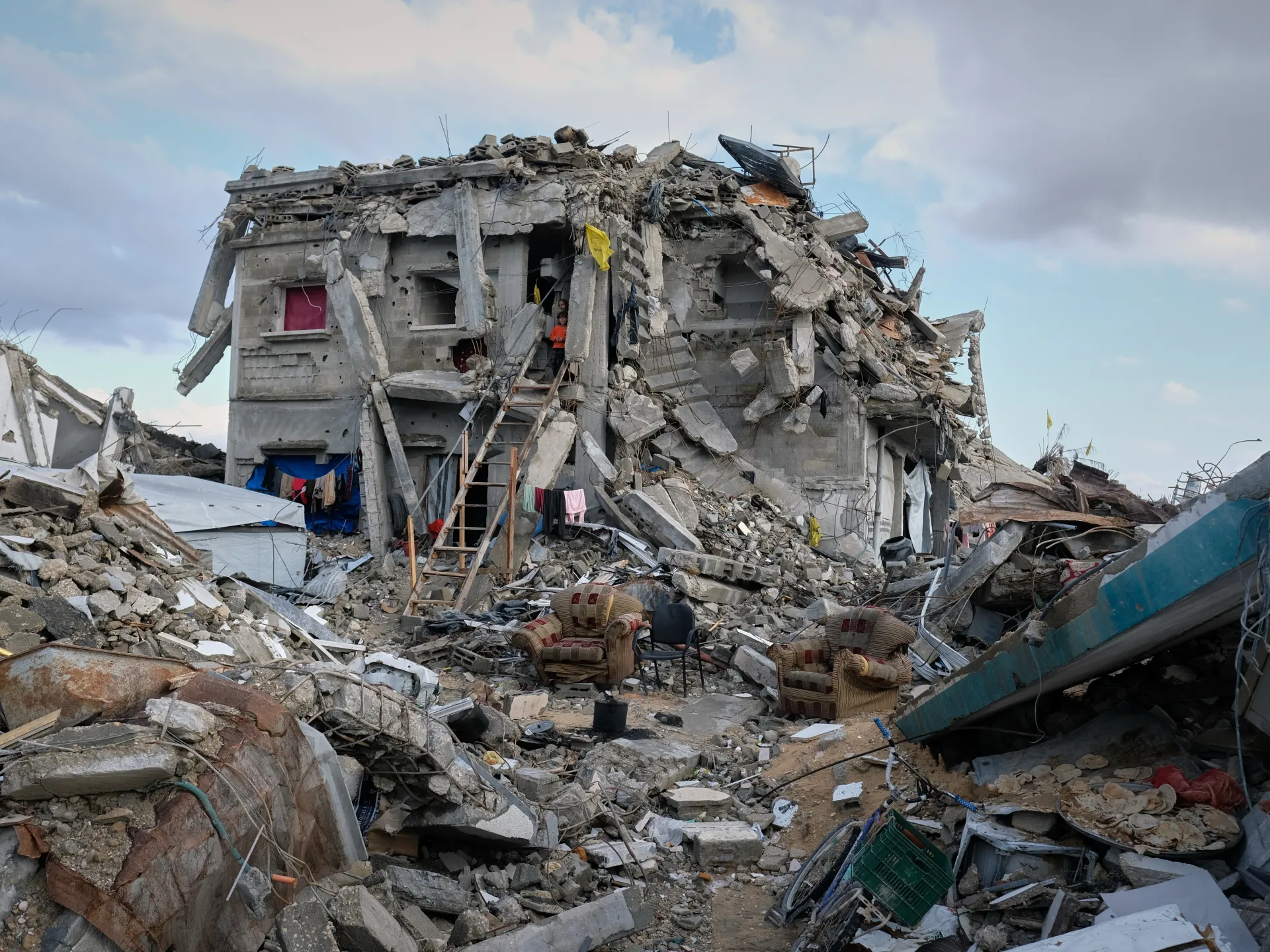
The Halawa family’s building still stands two storeys above the rubble in Gaza City, a rare survivor after two years of nonstop Israeli air attacks that levelled buildings across the besieged Palestinian enclave.
One section has collapsed, with bent metal rods protruding from where a roof once existed. The family built a narrow set of creaking wooden steps to access their home, though these makeshift stairs threaten to give way at any moment. Yet amid the destruction, it remains home.
Israel’s genocidal war on Gaza has killed more than 70,000 Palestinians, destroyed or damaged more than 70 percent of the buildings, and displaced most of the territory’s 2.3 million residents.
In October, Israel reached an agreement to cease fire, but its attacks have not stopped. It has killed more than 400 Palestinians since then, in violation of the truce agreement. It has also not allowed the full entry of aid.
Reconstruction has not begun and is projected to take years, as Israel has kept total control over what goes in and comes out of the enclave. This means families like the Halawas are struggling to rebuild their lives.
The family abandoned their home three months after the war began on October 7, 2023. They returned during the fragile calm established by the truce. Like many others, this family of seven found living in their damaged residence preferable to tent life, particularly as winter rains flooded tent shelters over the past weeks.
In one damaged room, Amani Halawa brewed coffee in a small tin over a fire while thin rays of light filtered through concrete fragments. Amani, her husband Mohammed, and their children have made repairs using concrete scraps, hanging backpacks from exposed metal rods and arranging pots and pans across the kitchen floor.
The home’s walls feature a painted tree and messages to family members separated by the conflict.
Throughout damaged apartments in Gaza City, daily life persists, even as families lie awake fearing their walls might collapse. Health officials report that at least 11 people died from building collapses in a single week in December.
In her home, Sahar Taroush swept dust from carpets placed over rubble. Her daughter Bisan’s face glowed in the light of a computer screen as she watched a movie beside gaping holes in the wall.
On another building’s cracked wall, a family displayed a torn photo of their grandfather on horseback from his time serving in the Palestinian Authority’s security forces during the 1990s. Nearby, a man reclined on a bed precariously balanced on a damaged balcony, scrolling through his phone above the devastated al-Karama neighbourhood.
US President Donald Trump warned Nicolas Maduro to ‘not play tough’ and to step down on Monday, while the Venezuelan leader said Trump should focus on the issues in his own country. Trump told reporters the US will keep 1.9 million barrels of oil that were seized near Venezuela in December.
Mohamed Salah puts Liverpool controversy behind him with dramatic winner against Zimbabwe in their AFCON opener.
Published On 23 Dec 202523 Dec 2025
Share
Mohamed Salah snatched a dramatic stoppage-time winner as Egypt came from behind to beat Zimbabwe 2-1 in their first fixture at the Africa Cup of Nations (AFCON) finals in Morocco on Monday.
Egypt’s captain, starting his first game after four successive matches on the bench at Liverpool, fired home a left-footed effort in the 91st minute to earn the seven-time champions a late victory after Zimbabwe had stunned them by going ahead in the first half.
Recommended Stories
list of 3 itemsend of list
Egypt laid an early siege to Zimbabwe’s goal, but it was the underdogs who netted first through Prince Dube in the 20th minute.
It was left to Egypt’s Premier League contingent of Omar Marmoush, who equalised in the 64th minute, and talisman Salah to see them to a last-gasp victory.
Salah had come into the tournament in Morocco under the spotlight following a fiery outburst after being dropped by the Premier League champions, and struggled to find his rhythm for most of the match at the Grande Stade d’Agadir. When it counted, however, he swept home the winner to see Egypt join South Africa, who beat Angola 2-1 earlier in Marrakesh, at the top of Group B.
It was as much as Egypt deserved, breaking a run of six successive draws over the last two editions of the Cup of Nations.
They had four good chances in the opening 10 minutes as they put Zimbabwe under intense pressure but fell behind when Emmanuel Jalai fed the ball inside for Dube, who turned in possession and placed his effort into the bottom left corner.
It could have been 2-0 as Daniel Msendami’s pace set up a scrambled chance for Washington Navaya that Egypt goalkeeper Mohamed El Shenawy managed to gather before it could be bundled over the line.
Salah, centre, puts Egypt ahead 2-1 in stoppage time [Stringer/Anadolu via Getty Images]
Marmoush sole effect
Marmoush equalised in the 64th minute, picking up a long pass on the left wing before cutting inside and firing home with his right foot from an acute angle for a superb solo goal.
“We created many chances without being able to score early, but in the end everything went well,” Marmoush said.
“We kept a good mindset and finished the match strongly. We will learn from everything that happened in tonight’s game.”
Substitute Ahmed Zizo should have headed home at the back post from Mohamed Hamdy’s inviting cross but put his effort wide, and missed again four minutes from the end when Salah teed him up with a good chance.
It was left to Salah to secure the three points, holding off his marker to bring the ball under control before steering it home for his first goal since early last month.
In the next set of Group B fixtures, Egypt meet South Africa in Agadir on Boxing Day while Zimbabwe and Angola clash on Friday in Marrakesh.
At least two people killed in clashes in northern city of Aleppo during Turkish FM Fidan’s visit to Syria.
By News Agencies and Reuters
Published On 23 Dec 202523 Dec 2025
Share
Syrian government forces and the Kurdish-led Syrian Democratic Forces agreed to stop fighting in the northern city of Aleppo, after a wave of attacks left at least two civilians dead.
Syria’s state news agency SANA cited the defence ministry as saying that the army’s general command issued an order to stop targeting the SDF’s fighters after the deadly clashes erupted during a visit by Turkish Foreign Minister Hakan Fidan.
Recommended Stories
list of 3 itemsend of list
Fidan, whose country views the SDF, which controls swathes of northeastern Syria, as a ‘terrorist’ organisation, said on Monday that the SDF appeared to have no intention of honouring its pledge to integrate into the state’s armed forces by an agreed year-end deadline.
Following the SANA report on Monday evening, the SDF said in a later statement that it had issued instructions to stop responding to attacks by Syrian government forces following de-escalation contacts.
These are the key developments from day 1,398 of Russia’s war on Ukraine.
Published On 23 Dec 202523 Dec 2025
Share
Here is where things stand on Tuesday, December 23:
Fighting
A car bomb killed Russian Lieutenant General Fanil Sarvarov in southern Moscow, the third such killing of a senior Russian military officer in just more than a year. Russian investors pointed the finger at Ukraine. Kyiv has not commented on the incident.
Russian forces struck Ukraine’s Black Sea port of Odesa late on Monday, damaging port facilities and a ship in the second such attack on the region in less than 24 hours, according to Ukrainian officials.
Ukrainian Deputy Prime Minister Oleksii Kuleba said on the Telegram app that the latest attack on Odesa is part of Russia’s attempt “to disrupt maritime logistics by launching systematic attacks on port and energy infrastructure”.
Kuleba said the attack also caused damage to energy infrastructure, disrupting electricity supply to more than 120,000 customers in the Odesa region. One person was hurt in the attack, the Ministry of Internal Affairs said.
Ukrainian President Volodymyr Zelenskyy confirmed media reports that residents of Hrabovske village, straddling the border with Russia in Ukraine’s Sumy region and home to 52 people, were taken by Russian troops. Zelenskyy said that 13 Ukrainian servicemen were among those taken.
Ukraine’s military said it hit a Tamanneftegaz oil terminal in Russia’s Krasnodar region in an overnight attack, causing explosions and a fire. The Ukrainian General Staff said the oil terminal was part of Russia’s energy infrastructure that supported the financing and logistics of Russian troops fighting in Ukraine.
A Ukrainian drone attack also damaged two vessels in the same region. All crew on the ships at the Volna terminal have been safely evacuated, according to regional authorities.
Russia’s Ministry of Defence said it had captured Vilcha village in Ukraine’s eastern Kharkiv region. The claim could not be immediately verified.
Politics and diplomacy
US President Donald Trump said that talks to end the war in Ukraine are going “OK”, amid questions about their progress, with Moscow and Kyiv still far apart on some key matters.
Zelenskyy, meanwhile, described the negotiations in Miami as “very close to a real result”. He also told a gathering of Ukrainian diplomats that the peace process “all looks quite worthy”, even as he conceded that “not everything is ideal with this, but the plan is there”.
Separately, in his nightly video address to the nation, Zelenskyy said the key issue in the talks was to determine whether the US was able to “get a response from Russia; real readiness on the part of that country to focus on something other than aggression”. He said that continued pressure on the Kremlin was vital to reduce Moscow’s capacity to wage war.
The Kremlin said talks between Russia and the US in Miami on ways to resolve the conflict in Ukraine should not be seen as a breakthrough. Kremlin spokesman Dmitry Peskov told the Izvestia news outlet that the discussions were expected to continue in a “meticulous” expert-level format.
Peskov also questioned the reliability of the sources cited in a Reuters news agency report, which said that the US intelligence community believes Putin wants to seize all of Ukraine and reclaim parts of Europe that belonged to the former Soviet bloc. Peskov told reporters in Moscow that if the report was accurate, then the US’s intelligence conclusions were wrong.
Russian Deputy Foreign Minister Sergey Ryabkov declared that Moscow is ready to confirm in a legal agreement that it has no intention of attacking either the European Union or the US-led NATO military alliance, the state RIA news agency reported.
Military aid
The Czech Republic’s National Security Council will debate the future of a Czech-led, Western-financed scheme organising artillery ammunition supplies for Ukraine on January 7, Prime Minister Andrej Babis said. The scheme also brings together foreign donors, including Germany, Denmark and the Netherlands.
Regional security
Swedish customs released the Russian ship Adler, which it boarded over the weekend to perform an inspection, with marine tracking data showing the vessel was on the move again. Swedish customs declined to say what cargo the Adler had been carrying. The Adler is under EU sanctions, while the vessel and its owners, M Leasing LLC, are both subject to US sanctions, suspected of involvement in weapons transport.
A top Amazon executive has said the US technology giant has blocked more than 1,800 job applications from suspected North Korean agents.
North Koreans tried to apply for remote working IT jobs using stolen or fake identities, Amazon’s chief security officer Stephen Schmidt said in a LinkedIn post.
“Their objective is typically straightforward: get hired, get paid, and funnel wages back to fund the regime’s weapons programs,” he said, adding that this trend is likely to be happening at scale across the industry, especially in the US.
Authorities in the US and South Korea have warned about Pyongyang’s operatives carrying out online scams.
Amazon has seen a nearly one-third increase in job applications from North Koreans in the past year, said Mr Schmidt in his post.
He said the operatives typically work with people managing “laptop farms” – referring to computers based in the US that are run remotely from outside of the country.
The firm used a combination of artificial intelligence (AI) tools and verification by its staff to screen job applications, he said.
The strategies used by such fraudsters have become more sophisticated, Mr Schmidt said.
Bad actors are hijacking dormant LinkedIn accounts using leaked credentials to gain verification. They target genuine software engineers to appear credible, he said, urging firms to report suspicious job applications to the authorities.
Mr Schmidt warned employers to look out for indicators of fraudulent North Korean job applications, including incorrectly formatted phone numbers and mismatched education histories.
They used stolen or forged identities of Americans to help North Korean nationals get jobs in the US, said the Department of Justice (DOJ).
It also indicted US brokers who had helped secure jobs for the North Korean operatives.
In July, a woman from Arizona was sentenced to more than eight years in jail for running a laptop farm to help North Korean IT workers secure remote jobs at more than 300 US companies.
The DOJ said the scheme generated more than $17m (£12.6m) in illicit gains for her and Pyongyang.
As Washington intensifies its political, economic, and military attacks against Venezuela, opposition to imperialism is also growing inside the United States—particularly among working-class and immigrant communities who experience the costs of imperialism directly. From cuts to social programs and housing insecurity to mass deportations and ICE raids, many are drawing connections between repression at home and US intervention abroad.
Elizabeth Blaney is a key figure in the Los Angeles tenant movement, a co-founder and co-director of Unión de Vecinos and part of the broader Los Angeles Tenants Union (LATU). With decades of experience organizing in Boyle Heights against displacement and gentrification, Blaney has also been deeply involved in international solidarity with Venezuela.
This conversation took place in the context of her participation in the recent People’s Assembly for Peace and Sovereignty held in Caracas. In it, she reflects on grassroots opposition to war and how the Bolivarian Revolution has helped radicalize housing struggles in the Los Angeles tenant movement.
How are organized working-class communities reacting to the latest imperialist military escalation against Venezuela?
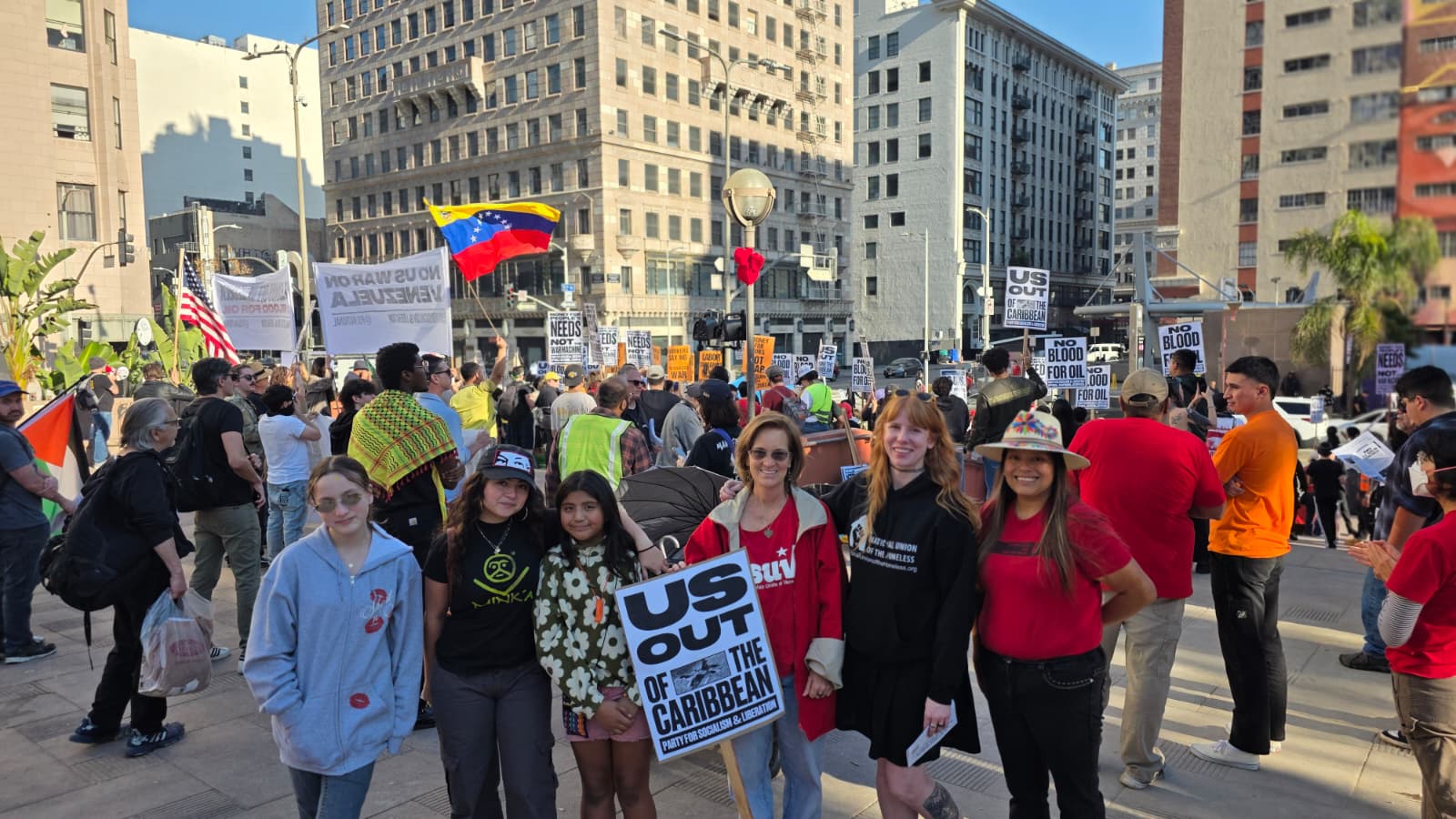
Among the working-class base we organize with, there is absolutely no support for the war against Venezuela. In East Los Angeles, where I’m from—and in Los Angeles more broadly—the population is majority Latino, African American, and Asian. Most people in our communities are immigrants. Many come from countries that have experienced violence as a direct result of US intervention. Because of that, they understand the situation and recognize the real motivations behind what the US government is doing here in Venezuela. There is strong opposition to war and a clear demand for the United States to get out of the Caribbean.
People also understand that war funding comes directly at their expense. We’ve lost school programs, social services, and benefits. Starting in January, many people will lose Medicaid support. There is a widespread understanding that public resources are being redirected to fund wars. So, beyond solidarity or morality, there is also a concrete economic reason that people oppose war…. They know that they are already paying the price.
This has translated into organization. People want to learn more and get involved in the growing anti-war movement, and our leadership has participated in solidarity protests across Los Angeles. The ongoing ICE raids have also deepened understanding of what is happening to Venezuela: witnessing family members, friends, and neighbors abducted by ICE has generated fear, but also a growing disposition to resist.
Many people now understand that retreating into fear only strengthens the state. They also recognize that the same violence the US government deploys against them is being used against the people of Venezuela and Palestine. This has led to a broad rejection of imperialist aggression—people overwhelmingly oppose the imperialist military buildup in the Caribbean and the Israeli genocide, which is funded and enabled by the United States.
You participated in the recent “People’s Assembly for Peace and Sovereignty” [December 9-11] in Caracas. Getting to it was not easy, since most airlines stopped flying to Venezuela after Trump closed the airspace. Despite these obstacles, the Assembly took place and was a huge success. What can you tell us about it?
Hundreds of people were stranded in airports or had their flights canceled at the last minute because of Trump’s illegal attempt to control Venezuelan airspace. As a result, many delegates who were scheduled to attend didn’t make it.
Despite this, the conference went forward, with between 600 and 800 delegates from around the world present. In that sense, it was a success. Some people traveled through five or six countries just to get here. That level of commitment shows how deeply people oppose US aggression and support the call for peace!
Politically, what stood out most was how clearly delegates connected US aggression against Venezuela to its global impact. People discussed how sanctions and seizures—such as the illegal confiscation of oil tankers bound for Cuba and other countries—directly affect energy access and economic stability elsewhere. This makes it clear that what’s happening in Venezuela is an international issue.
There were also discussions about how war funding drains resources from working people in the United States and promotes speculation in financial and housing markets globally. One session focused specifically on housing, examining how imperialist war drives up rents and housing prices, worsening conditions for tenants worldwide.
Beyond peace, the Assembly’s debates emphasized people’s sovereignty and who has the right to control resources. The conclusion was clear—those resources belong to the Venezuelan people. If they are stolen from Venezuela, nothing prevents similar theft elsewhere.
The Peace Assembly helped develop a shared understanding of how to defend Venezuela’s sovereignty while preparing for what comes next globally. Now the analysis has to go back to our communities.
Members of the Unión de Vecinos in an LA concentration against the US military deployment in the Caribbean. (Unión de Vecinos)
You’ve said on other occasions that the Bolivarian Process, despite being demonized by the media establishment, has helped radicalize housing struggles in Los Angeles. How has that experience shaped your organization?
I’m part of the Unión de Vecinos, the East Side chapter of the Los Angeles Tenants Union. We’ve been engaged in internationalist solidarity work for many years. We first came to Venezuela in 2019 and have returned several times since, not only to oppose sanctions but to strengthen the tenant movement in Los Angeles and to be fellow travelers in the march toward socialism.
In July 2023, we organized a brigade of about 25 tenant organizers from across California. For many participants, it was a transformative experience. What people in the United States often don’t grasp is that in Venezuela, there is a real socialist project. Of course, it is not perfect and has contradictions, but it is a true emancipatory project with tangible advances. Housing rights, free university education, and free healthcare already exist here in ways they do not in the US.
Seeing this reality firsthand shifted how our organizers think. It made it clear that socialism is not just an abstract demand but something that can be built in practice. Over the past two years and across our 15 chapters, this experience has fueled profound debates about what it means to build a socialist project in Los Angeles.
We don’t see ourselves as just a housing movement. It is about tenants’ ability to survive, remain in their neighborhoods, and collectively shape their communities. This broader vision was strongly influenced by what we learned in Venezuela. Following a process of internal debates, the LA Tenants Union collectively declared itself a socialist organization in August. That decision would not have been possible without the internationalist exchange with Venezuela.
Another crucial lesson has been learning about participatory democracy. In the United States, democracy is reduced to voting every few years or speaking at meetings with no real power. In Venezuela, democracy is practiced as an ongoing process through communal assemblies and popular consultations. For our organizers, seeing Venezuela’s communal assemblies, which are the communes’ highest decision-making body—with “voceros” [spokespeople] accountable to them—has been especially influential. We are strengthening that model across our chapters.
This work goes beyond visits. We’ve built ongoing relationships with Venezuelan movements like the Movimiento de Pobladores, the Movimiento de Inquilinos, and the Simón Bolívar Institute through regular exchanges and political education initiatives. Reciprocal solidarity is central to our political formation and our ability to challenge dominant narratives in the United States.
At a recent event in El Panal Commune, the Simón Bolívar Institute launched the “Solidarity Committee with the Peoples of the US.” What does this initiative represent for grassroots movements in your context?
Solidarity requires sustained commitment and concrete action. This initiative creates a space where analysis and action converge in a spirit of reciprocal solidarity. At the launch, around ten or eleven organizations from the United States were present, all rooted in working-class communities, in addition to El Panal communards and spokespeople from the Instituto Simón Bolívar. That matters, because this isn’t just about organizations—it’s about the people they represent and organize.
The initiative strengthens our responsibility as organizers and working-class people in the US to fight fascism at home, while opposing imperialism abroad. It also demonstrates that we are not fighting alone. Through this work, we will also be deepening ties with movements in Mexico, Honduras, and Argentina, where people are facing similar crises, particularly around housing. Bringing these struggles together strengthens all of us.
Finally, how have the current ICE raids reshaped the political landscape inside the United States, and how do people connect this repression to US imperialist aggression abroad?
The raids and kidnappings being carried out by the US government against immigrants are a turning point. In practice, the Supreme Court has legalized racism, allowing federal agents to detain people based on skin color, language, or where they gather for work, without due process.
This has sparked resistance well beyond traditional activist circles. While working-class communities have always resisted, many people who were never politically active before are now organizing. Neighborhoods are forming patrols, blocking streets, warning residents, and physically slowing ICE operations.
This has opened space for deeper political conversations. People are increasingly connecting what is happening in their neighborhoods to US aggression abroad. They are asking: if the government can do this here—deporting people, including Venezuelans, or sending migrants to third countries—what stops it from escalating further against countries like Venezuela?
As a result, international solidarity no longer feels distant or abstract. More people are recognizing the shared enemy and taking action in solidarity with Venezuela. That political awakening is one of the most significant developments of the present moment.
United States President Donald Trump has issued a new warning to Nicolas Maduro, saying “it would be smart” for the Venezuelan leader to leave power, as Washington escalates a pressure campaign against Caracas.
The warning on Monday came as Russia pledged “full support” for Maduro’s government, and China condemned the US’s seizure of two oil tankers off the coast of Venezuela.
Recommended Stories
list of 4 itemsend of list
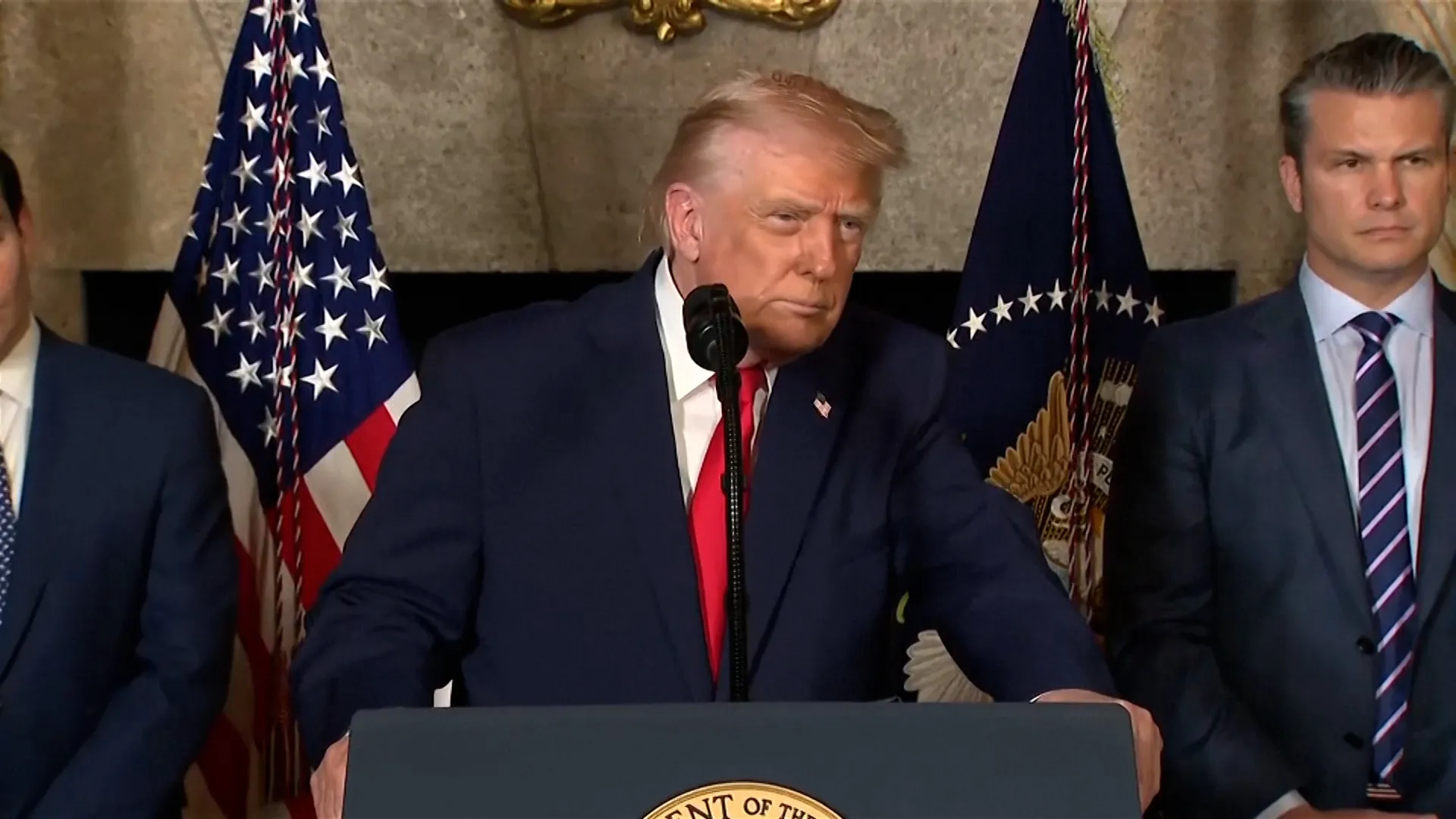
Trump, speaking at his Mar-a-Lago resort in Florida alongside his top national security aides, Secretary of State Marco Rubio and Secretary of Defense Pete Hegseth, suggested that he remains ready to further escalate his four-month pressure campaign.
When asked if the goal was to force Maduro from power, Trump told reporters: “Well, I think it probably would… That’s up to him what he wants to do. I think it’d be smart for him to do that. But again, we’re gonna find out.”
“If he wants to do something, if he plays tough, it’ll be the last time he’s ever able to play tough,” he added.
Trump levied his latest threat as the US coastguard continued for a second day to chase a third oil tanker that it described as part of a “dark fleet” that Venezuela uses to evade US sanctions.
“It’s moving along, and we’ll end up getting it,” Trump said.
The US president also promised to keep the ships and the nearly 4 million barrels of Venezuelan oil the coastguard has seized so far.
“Maybe we’ll sell it. Maybe we’ll keep it. Maybe we will use it in the strategic reserves,” he said. “We’re keeping it. We’re keeping the ships also.”
Maduro fires back
Trump’s campaign against Venezuela’s vital oil sector comes amid a large US military buildup in the region with a stated mission of combating drug trafficking, as well as more than two dozen strikes on alleged drug trafficking vessels in the Pacific Ocean and Caribbean Sea near the South American nation.
Critics have questioned the legality of the attacks, which have killed more than 100 people.
Venezuela denies any involvement in drug trafficking and insists that Washington is seeking to overthrow Maduro to seize the country’s oil reserves, which are the world’s largest.
It has condemned the US’s vessel seizures as acts of “international piracy”.
Maduro fired back at Trump hours after the latest warning, saying the US president would be “better off” if he focused on his own country’s problems rather than threatening Caracas.
“He would be better off in his own country on economic and social issues, and he would be better off in the world if he took care of his country’s affairs,” Maduro said in a speech broadcast on public television.
The exchange of words came on the eve of a United Nations Security Council meeting on Tuesday to discuss the growing crisis.
Russia’s Minister of Foreign Affairs Sergey Lavrov, in a phone call with his Venezuelan counterpart, Yvan Gil, slammed the US’s actions and expressed support for Caracas.
“The ministers expressed their deep concern over the escalation of Washington’s actions in the Caribbean Sea, which could have serious consequences for the region and threaten international shipping,” the Russian Ministry of Foreign Affairs said in a statement.
“The Russian side reaffirmed its full support for and solidarity with the Venezuelan leadership and people in the current context,” it added.
US blockade
China also condemned the US’s latest moves as a “serious violation of international law”.
“China opposes any actions that violate the purposes and principles of the United Nations Charter and infringe upon the sovereignty and security of other countries,” said Lin Jian, a spokesperson for the Chinese Foreign Ministry.
“Venezuela has the right to develop independently and engage in a mutually beneficial cooperation with other nations. China understands and supports Venezuela’s stance in safeguarding its legitimate rights and interests,” he added.
Last week, Rubio brushed aside Moscow’s stated support for Caracas.
Washington, he said, was “not concerned about an escalation with Russia with regards to Venezuela” as “they have their hands full in Ukraine”.
US-Russia relations have soured in recent weeks as Trump has voiced frustration with Moscow over the lack of a resolution on the war in Ukraine
Gil, on Monday, also read a letter on state television, signed by Maduro and addressed to UN member nations, warning that the US blockade “will affect the supply of oil and energy” globally.
“Venezuela reaffirms its vocation for peace, but also declares with absolute clarity that it is prepared to defend its sovereignty, its territorial integrity and its resources in accordance with international law,” he said.
“However, we responsibly warn that these aggressions will not only impact Venezuela. The blockade and piracy against Venezuelan energy trade will affect oil and energy supply, increase instability in international markets, and hit the economies of Latin America, the Caribbean, and the world, especially in the most vulnerable countries.”
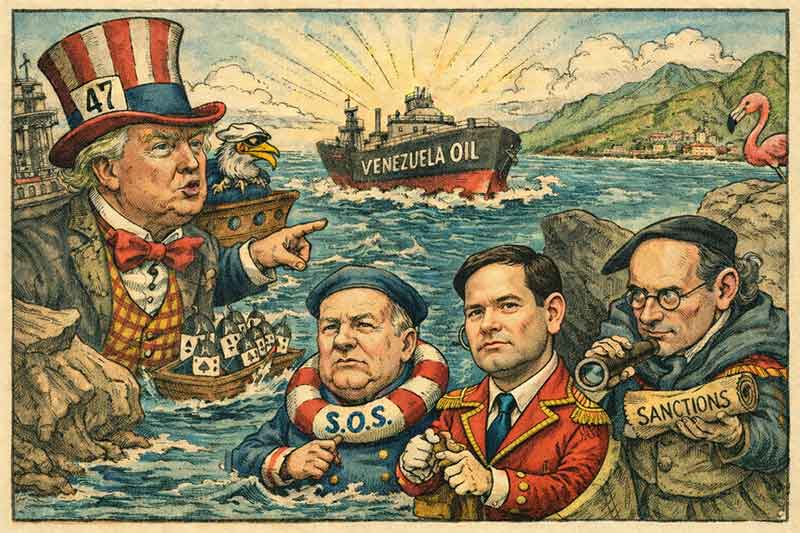
The Trump administration has shifted from a “narcoterrorism” campaign to economic coercive measures. (Countercurrents)
In our Donald-in-Wonderland world, the US is at war with Venezuela while still grasping for a public rationale. The horrific human toll is real – over a 100,000 fatalities from illegal sanctions and over a hundred from more recent “kinetic strikes.” Yet the officially stated justification for the US empire’s escalating offensive remains elusive.
The empire once spun its domination as “democracy promotion.” Accordingly, State Department stenographers such as The Washington Post framed the US-backed coup in Venezuela – which temporarily overthrew President Hugo Chávez – as an attempt to “restore a legitimate democracy.” The ink had barely dried on The New York Timeseditorial of April 13, 2002 – which legitimized that imperial “democratic” restoration – before the Venezuelan people spontaneously rose up and reinstated their elected president.
When the America Firsters captured the White House, Washington’s worn-out excuse of the “responsibility to protect,” so beloved by the Democrats, was banished from the realm along with any pretense of altruism. Not that the hegemon’s actions were ever driven by anything other than self-interest. The differences between the two wings of the imperial bird have always been more rhetorical than substantive.
Confronted by Venezuela’s continued resistance, the new Trump administration retained the policy of regime change but switched the pretext to narcotics interdiction. The Caribbean was cast as a battlefield in a renewed “war on drugs.” Yet with Trump’s pardon of convicted narco-trafficker and former Honduran President Juan Orlando Hernández – among many other contradictions – the alibi was wearing thin.
Venezuelan oil tankers blockaded
The ever-mercurial US president flipped the narrative on December 16, announcing on Truth Social that the US would blockade Venezuelan oil tankers. He justified this straight-up act of war with the striking claim that Venezuela had stolen “our oil, our land, and other assets.”
For the record, Venezuela had nationalized its petroleum industry half a century ago. Foreign companies were compensated.
This presidential social media post followed an earlier one, issued two weeks prior, ordering the airspace above and surrounding Venezuela “closed in its entirety.” The US had also seized an oil tanker departing Venezuela, struck several alleged drug boats, and continued to build up naval forces in the region.
In response to the maritime threat, President Nicolás Maduro ordered the Venezuelan Navy to escort the tankers. The Pentagon was reportedly caught by surprise. China, Mexico, Brazil, BRICS, Turkey, along with international civil society, condemned the escalation. Russia warned the US not to make a “fatal mistake.”
The New York Times reported a “backfire” of nationalist resistance to US aggression among the opposition in Venezuela. Popular demonstrations in support of Venezuela erupted throughout the Americas in Argentina, Panama, Ecuador, Peru, Mexico, Brazil, Colombia, Honduras, and the US.
Trump’s phrasing about Venezuela’s resources is not incidental. It reveals an assumption that precedes and structures the policy itself: that Venezuelan sovereignty is conditional, subordinate to US claims, and revocable whenever it conflicts with Yankee economic or strategic interests. This marks a shift in emphasis, not in substance; drugs have receded from center stage, replaced by oil as the explicit casus belli.
The change is revealing. When Trump speaks of “our” oil and land, he collapses the distinction between corporate access, geopolitical leverage, and national entitlement. Venezuelan resources are no longer considered merely mismanaged or criminally exploited; they are portrayed as property wrongfully withheld from its rightful owner.
The day after his Truth Social post, Trump’s “most pointless prime-time presidential address ever delivered in American history” (in the words of rightwing blogger Matt Walsh) did not even mention the war on Venezuela. Earlier that same day, however, two House resolutions narrowly failed that would have restrained Trump from continuing strikes on small boats and from exercising war powers without congressional approval.
Speaking against the restraining resolutions, Rep. María Elvira Salazar – the equivalent of Lewis Carroll’s Red Queen and one of the far-right self-described “Crazy Cubans” in Congress – hailed the 1983 Grenada and 1989 Panama invasions as models. She approvingly noted both were perpetrated without congressional authorization and suggested Venezuela should be treated in the same way.
The votes showed that nearly half of Congress is critical – compared to 70% of the general public – but their failure also allows Trump to claim that Congress reviewed his warlike actions and effectively granted him a mandate to continue.
Non-international armed conflict
In this Trumpian Wonderland, a naval blockade with combat troops rappelling from helicopters to seize ships becomes merely a “non-international armed conflict” not involving an actual country. The enemy is not even an actual flesh and blood entity but a tactic – narco-terrorism.
Trump posted: “Venezuelan Regime has been designated a FOREIGN TERRORIST ORGANIZATION.” Yet FTOs are non-state actors lacking sovereign immunities conferred by either treaties or UN membership. Such terrorist labels are not descriptive instruments but strategic ones, designed to foreclose alternatives short of war.
In a feat of rhetorical alchemy, the White House designated fentanyl a “weapon of mass destruction.” Trump accused Venezuela of flooding the US with the deadly synthetic narcotic, when his own Drug Enforcement Administration says the source is Mexico. This recalls a previous disastrous regime-change operation in Iraq, also predicated on lies about WMDs.
Like the Cheshire Cat, presidential chief of staff Susie Wiles emerges as the closest to a reliable narrator in a “we’re all mad here” regime. She reportedly said Trump “wants to keep on blowing boats up until Maduro cries uncle,” openly acknowledging that US policy has always been about imperial domination.
The oil is a bonus for the hegemon. But even if Venezuela were resource-poor like Cuba and Nicaragua, it still would be targeted for exercising independent sovereignty.
Seen in that light, Trump’s claim that Venezuela stole “our” oil and land is less an error than a confession. It articulates a worldview in which US power defines legitimacy and resources located elsewhere are treated as imperial property by default. The blockade is not an aberration; it is the logical extension of a twisted belief that sovereignty belongs to whoever is strong enough to seize it. Trump is, in effect, demanding reparations for imperialists for the hardship of living in a world where other countries insist their resources belong to them.
Weekly insights and analysis on the latest developments in military technology, strategy, and foreign policy.
The U.S. Navy has confirmed to TWZ that the armament package for its first “flight” of its new FF(X) frigates will not include a built-in Vertical Launch System (VLS). There had been widespread questions about whether the ships would include a VLS array after renderings were released with no such feature readily apparent.
A lack of any type of VLS on the FF(X) design is a glaring omission that can only raise questions about the operational utility and flexibility of the ships. At the same time, the new frigates will be able to carry modular payloads, including containerized missile launchers, on their sterns. The Navy also has an explicit plan to employ the FF(X)s as “motherships” for uncrewed surface vessels (USV), likely offering a distributed arsenal, as well as additional sensors, for the frigates to leverage during operations.
One of the renderings the Navy released last week of the FF(X) design. USN via USNI News
I have directed a new Frigate class as part of @POTUS Golden Fleet. Built on a proven American design, in American shipyards, with an American supply chain, this effort is focused on one outcome: delivering combat power to the Fleet fast. pic.twitter.com/ovnASiHYaF
“The initial flight of FF(X) will have a 57mm gun, 2 x 30mm guns, a Mk 49 Rolling Airframe Missile [launcher], various countermeasures, and a flight deck from which to launch helicopters and unmanned systems. Aft of the flight deck, there will be a flexible weapons system, which can accommodate containerized payloads (Counter-UAS, other missiles),” a Navy spokesperson told TWZ today. “Much like the successful DDG-51 [Arleigh Burke class destroyer] program, we are building this in flights. The frigate will be upgraded over successive flights to evolve and has the space reservations needed to improve capability over time.”
“The goal is to get [FF(X)] hulls in the water ASAP,” another Navy official told TWZ. “Minimal design changes will be incorporated into the first flight so that we can get hulls into the water as soon as possible.”
“The [FF(X)] design changes are in the process of being finalized and we are confident that our extensive experience and collaboration with the U.S. Navy will lead to a successful approval process,” a HII spokesperson also told us. “Specific and targeted changes will be implemented to meet unique mission requirements. The process will be similar to a baseline upgrade on the DDG program, which has been successfully used to introduce new capabilities multiple times over the class’ history. Design work is ongoing and we understand the Navy’s intent is to minimize changes in order to expedite procurement.”
One of the US Coast Guard’s existing Legend class National Security Cutters. USCG
As we mentioned in our initial reporting on FF(X), the size of the Mk 41 VLS array on the previously planned Constellation class frigates was a hot topic of debate. Questions had been raised whether the 32-cell VLSs on those ships would be sufficient to meet their expected operational taskings, as you can read about more in this past TWZ feature.
A rendering of a Constellation class frigate. USN
Overall, the Mk 41 VLS requirement was central to the FFG(X) program that led to the Constellation class design. This was viewed as a key element of righting the wrongs of the Navy’s chronically underperforming Littoral Combat Ship (LCS) program. The Independence class and Freedom class LCSs both lack a VLS array. In addition, it’s worth remembering here that HII’s losing FFG(X) bid was notably a Patrol Frigate concept derived from the National Security Cutter that featured a VLS. The company had also pitched other VLS-equipped Patrol Frigate variations to the Navy before then, as seen in the video below.
Patrol Frigate Variants – Information Video
Integrating a VLS into future flights of FF(X) frigates is certainly an option, but one that could be complex and costly if the design is not configured to accommodate one to begin with. AsTWZ previously highlighted, the FF(X) configuration, as it has been seen so far, has a significantly redesigned main superstructure compared to the Coast Guard’s Legend class and previous Patrol Frigate concepts. This includes a prominent ‘shelf’ that extends forward into the space on the bow utilized for VLSs on previously seen Patriot Frigate configurations. With what we know now, that extension seems more likely to be utilized in the future as a mounting place for some type of point defense system, possibly even a laser directed energy weapon. It’s possible it could be adapted to accommodate a small VLS array in the future, as well. The lack of an integrated VLS could explain the lack of a more advanced radar in the renderings of the FF(X) that have been shown so far.
A rendering showing the FF(X) design from the top down with the ‘shelf’ extending forward of the main superstructure clearly visible. USN capture
Installing missile launchers on the FF(X)’s fantail would give the ships a boost in firepower in the absence of an integrated VLS array. Renderings so far have shown what look to be launchers for up to 16 Naval Strike Missiles (NSM) installed in that position. NSM is an anti-ship cruise missile with secondary land-attack capability that the Navy has already integrated onto a portion of its LCSs and at least one Arleigh Burke class destroyer, and that the Marine Corps is fielding now in a ground-based configuration. There also looks to be space there for a least one containerized Mk 70 Payload Delivery Systems (PDS), another capability the Navy is already acquiring. Each Mk 70 contains a four-cell launcher derived from the Mk 41 VLS, and similarly capable of firing a variety of weapons, including SM-6 multi-purpose missiles and Tomahawk land-attack cruise missiles. FF(X)s could also leverage sensors on larger crewed warships for targeting purposes when operating as part of a surface action group.
An SM-6 missile seen being fired from a Mk 70 containerized launcher mounted on the stern flight deck of a US Navy Independence class LCS. USN
“The FF(X) will be designed to command groups of unmanned vessels, acting as a sort of ‘mothership,’ providing the commander tailored force packages based upon the weapons and sensors fielded on those unmanned craft,” a Navy spokesperson also told TWZ today.
In this way, an FF(X) could still call upon a deeper and more flexible array of weapon options without having to have a VLS integrated directly onto the ship. The uncrewed platforms would also be able to operate across a much broader area than any single crewed frigate and present a different risk calculus for operating in higher-risk environments. All of this would expand the overall reach of the combined force and present targeting challenges for opponents. But there are also substantial development and operational risks with this kind of arrangement. As it sits, this kind of autonomous vessel and manned vessel teaming is still in development. Operationally, leaving the ship without, or with very limited, area defense capability is at odds with many future threat scenarios.
The Navy is already separately pursuing a family of larger uncrewed surface vessels (USV) able to carry an array of containerized payloads to bolster the capability and operational capacity of its crewed surface fleets as part of a program called Modular Surface Attack Craft (MASC), which you can read more about here.
Even with all this in mind, the lack of a VLS still raises significant questions about the FF(X) plans, especially about the ability of the ships to operate more independently. This has been a key issue for the Navy’s existing LCS fleets, and one that the Constellation class was supposed to help address.
The USS Freedom, seen at the rear, sails alongside the USS Independence. USN The USS Freedom, at rear, sails alongside the USS Independence, in the foreground. The lead ships in both of their classes of Littoral Combat Ships (LCS), these vessels were both been decommissioned in 2021. USN
Omitting a VLS capable of at least employing Evolved Sea Sparrow Missiles (ESSM) imposes particular limitations on the ship’s ability to defend itself against aerial threats. Navy experiences during recent operations in and around the Red Sea have served to put a notable spotlight on the ever-growing dangers posed by anti-ship missiles and drones, which would be far more severe in any future high-end fight in the Pacific. All of this also means FF(X)s will not be able to provide area defense for convoy operations without a modular containerized payload, and that would only offer a very limited supply of munitions compared to a highly efficient VLS array.
The Navy is also clearly focused on just trying to get more hulls into service as quickly as it reasonably can. The service has major operational demands for more surface warships, in general, and now has an additional gap to fill following the collapse of the Constellation class program. The goal is for the FF(X) to be launched in 2028.
“We will start as soon as a funding contract and material are available,” the HII spokesperson told TWZ today. “We are confident in our ability to launch the first ship into the water in 2028, then conduct final outfitting, systems activation, and testing before delivering to the Fleet.”
HII also plans to leverage materials already acquired under the Coast Guard’s Legend class National Security Cutter program to help accelerate work on the first FF(X) hull. The current timeline for that ship to enter operational service remains unknown.
Overall, just how aggressively the Navy is moving to get these new frigates into the fleet as fast and cheaply as possible is now clear with today’s news. While expanded variants in the future with VLS arrays and more exquisite combat systems seem like a real possibility, when it comes to installed armament, America’s next frigate is set to be just as lightly armed as the LCS that came before it.
Rea said he was on the dole at the time, his manager had just left him and he had been banned from driving.
His then-girlfriend Joan (who he met when they were both 16 and went on to marry) had to pick him up in London in her mini and drive him home.
That’s what inspired the song, which was written in 1978, 10 years before it was released as a single in 1988.
Asked about what he thinks of when he hears the song, the singer joked about how it bought him “that lovely little holiday in the Maldives”.
The song has since been covered by artists including Engelbert Humperdinck and Stacey Solomon.
Rea was good friends with Mortimer and in 1997 they recorded Let’s Dance for Middlesbrough Football Club’s FA Cup Final.
On Monday evening, Mortimer posted on X: “So so sad. A lovely brilliant funny giant of a bloke. Oh Man… RIP Chris… Boro legend forever. Love to family and friends.”
But alongside the singer-songwriter’s success, he had suffered with various bouts of ill-health over the years.
He had his pancreas removed a few years after being diagnosed with pancreatic cancer at the age of just 33 in 1994, which meant he developed type 1 diabetes. He later had a stroke in 2016.
Rea (centre) appeared on Mortimer & Whitehouse: Gone Christmas Fishing in 2020
“None of my heroes were rock stars. I arrived in Hollywood for the Grammy Awards once and thought I was going to bump in to people who mattered, like Ry Cooder or Randy Newman. But I was surrounded by pop stars.”
He added: “The celeb thing has gone totally wrong in the sense that everyone has tried to top each other. They don’t put the work in.”
Speaking of his wife in the same interview, he said: “Our golden moment is each morning when there is an elbow fight over whose turn it is to make the coffee.
“Then there are the large mugs of fresh coffee, BBC Breakfast news or Sky and we gaze out of the window over the countryside for an hour and we are still 16. We are lucky to still have that feeling.”
Rea was born in 1951 in Middlesbrough to an Italian father and Irish mother, and had six siblings. He began his working life helping out with his family’s ice-cream business.
“To be Irish Italian in a coffee bar in Middlesbrough – I started my life as an outsider,” he later said.
Getty Images
Once he found the guitar, he soon began playing in various bands and released his debut album Whatever Happened To Benny Santini? in 1978.
His commercial breakthrough came in the 1980s, as two of his studio albums – The Road To Hell (1989) and Auberge (1991) – went to number one in the UK.
He returned to his blues roots in his later years while facing his health challenges.
After his stroke nine years ago, he recovered to launch a new album, Road Songs For Lovers, in 2017.
He took the album on the road at the end of that year but had to cancel a number of shows after he collapsed mid-song while performing at the New Theatre in Oxford.
Rea released a new album in October 2025, titled The Christmas Album, featuring a remaster of Driving Home For Christmas as well as other festive tracks.
Paying tribute to Rea following his death, journalist Tony Parsons described him as a “top man” and “hugely underrated songwriter”.
TV personality Lizzie Cundy, who appeared in the music video for a 2009 version of Driving Home For Christmas, said that she was “so sad” to hear the musician had died.
“I loved every minute and was an honour to work with him and be in his iconic music video,” she said. “He will always be an inspiration and legend to me.”
Andy McDonald, Labour MP for Middlesbrough and Thornaby East, said he was “very saddened” to hear the news of Rea’s death.
In a post on X, he said: “Chris, a most cherished son of Middlesbrough, will live on through his wonderful music. My sincere condolences to his family.”
Rea and his wife Joan shared two daughters, Josephine and Julia. He credited his family with helping him to cope after his ill health.
“It’s music and family with me. I’m only one of four, that’s how I am,” Rea once said. “I’m 25% of a unit. It’s always been that way and we like it that way. In between that there’s music.”
Deadly attack comes as Gaza government media office says Israel violated ceasefire 875 times since it began in October.
Israeli forces have killed at least two Palestinians in the Gaza Strip as Israel continues to violate a ceasefire agreement and block desperately needed humanitarian aid to the war-ravaged coastal enclave.
The Palestinian news agency Wafa reported on Monday that two people were killed after Israeli troops opened fire in the Shujayea neighbourhood of eastern Gaza City.
Recommended Stories
list of 3 itemsend of list
Their deaths bring the total number of Palestinians reported killed in Gaza over the past 24 hours to at least 12, including eight whose bodies were recovered from the rubble in the territory.
The Gaza City attack is the latest in hundreds of Israeli violations of a United States-brokered ceasefire between Israel and Hamas, which came into effect on October 10.
Gaza’s Government Media Office on Monday condemned Israel’s “serious and systematic violations” of the truce, noting that the Israeli authorities had breached the ceasefire 875 times since it came into force.
That includes continued Israeli air and artillery attacks, unlawful demolitions of Palestinian homes and other civilian infrastructure, and at least 265 incidents of Israeli troops shooting Palestinian civilians, the office said in a statement.
At least 411 Palestinians have been killed and 1,112 others wounded in Israeli attacks on Gaza since the ceasefire began, it added.
Worsening shelter conditions
Meanwhile, hundreds of thousands of Palestinian families displaced by Israel’s genocidal war on Gaza continue to grapple with a lack of humanitarian supplies, including adequate food, medicine and shelter.
As the occupying power in Gaza, Israel has an obligation under international law to provide for the needs of Palestinians there.
But the United Nations and other humanitarian groups say it has systematically failed to allow unimpeded deliveries of aid into Gaza.
The situation has been worsened by a series of winter storms that have pummelled the Strip in recent weeks, with rights groups saying Israel’s refusal to allow tents, blankets and other supplies into Gaza is part of its genocidal policy and threatening Palestinian lives.
On Monday, the Gaza Government Media Office said that only 17,819 trucks entered the territory out of the 43,800 that were supposed to be allowed in since the ceasefire came into effect in October.
That amounts to an average of just 244 trucks per day – far below the 600 trucks that Israel agreed to allow into Gaza daily under the ceasefire agreement, the office said.
On Monday, a spokesperson for UN chief Antonio Guterres reiterated the call “for the lifting of all restrictions of the entry of aid into Gaza, including shelter material”.
“Over the past 24 hours, and despite the ceasefire, we have continued to receive reports of air strikes, shelling and gunfire in all five governorates of Gaza. This has resulted in reported casualties and disruptions to humanitarian operations,” Stephane Dujarric said.
He said that the UN’s humanitarian partners are working to address the significant shelter needs, particularly for displaced families living in unsafe conditions.
“Our partners continue to work to improve access to dignified shelter for approximately 1.3 million people in Gaza in the past week, about 3,500 families affected by storms are living in flood prone areas,” he said.
Dujarric said that aid deliveries have included tents, bedding sets, mattresses and blankets, as well as winter clothing for children, but the needs remain overwhelming.
Palestinians struggle with flooding after heavy rain hits the Bureij refugee camp in Gaza City [File: Moiz Salhi/Anadolu]
The appeals come a day after the Palestinian Ministry of Health in Gaza said that a lack of drugs and other healthcare supplies was making it difficult to provide care to patients.
Nearly all of Gaza’s hospitals and healthcare facilities were attacked during Israel’s two-year bombardment of the territory, damaging at least 125 facilities, including 34 hospitals.
The Israeli army has killed at least 70,937 Palestinians in Gaza, mostly women and children, and injured 171,192 others since its genocidal war began in October 2023.
At least two people have been killed in clashes in Aleppo between Syrian government forces and the Kurdish-led Syrian Democratic Forces (SDF) that control the country’s northeast. Syrian President Ahmed al-Sharaa signed a deal in March with the SDF to integrate the group into the country’s state institutions by the end of this year.