today

B-21 Raider Future Insights From Global Strike Command’s Top General

The B-21 Raider stealth bomber is one of the Air Force’s most ambitious weapons programs, designed to carry out deep-penetrating nuclear and conventional strikes over heavily defended skies and other missions its predecessor, the B-2, was never envisioned as doing. As the head of the U.S. Air Force Global Strike Command (AFGSC), one of Gen. Stephen L. Davis’s main tasks is guiding the development of the Raider, of which 100 are currently slated for procurement and that number could grow substantially larger in the coming years.

In his first interview since taking command on Nov. 4, 2025, from Gen. Thomas Bussiere, Davis offered The War Zone exclusive insights about the B-21 and what it can bring to the table in a future high-end fight. As the leader of AFGSC, Davis also oversees B-1B Lancer, B-2A Spirit, and B-52 Stratofortress strategic bombers and all U.S. Air Force intercontinental ballistic missiles (ICBMs). During his Monday morning conversation with us, Davis talked about a host of other topics beyond just the Raider, including the future of the E-4C “Doomsday Plane,” the way forward for the troubled Sentinel ICBM program, and challenges posed by China and Russia.

You can read the first part of our interview here.

Some of the questions and answers have been lightly edited for clarity.

Air Force Gen. Stephen L. Davis, commander of U.S. Air Force Global Strike Command. (USAF)

Q: What capabilities will the B-21 have by the time it achieves initial operating capability (IOC), and what will come later?

A: Right now, I’m focused on delivering the initial capability. And unfortunately, I can’t talk too much about the capabilities of the bomber. They are significant, and they are impressive. From the command’s perspective, we’re concentrating on getting everything in place up at Ellsworth Air Force Base in South Dakota to bed down that capability. Really, it’s the acquisition community that’s still delivering that plane, and I’m certainly interested in that, but I’m probably more focused on the bed down and getting those things right.

Q: Can you provide an update on the Raider’s Initial Operating Capability (IOC)?

A: As for IOC, we are thinking of it in an OPSEC framework. We are not building prototypes, and the infrastructure to support the B-21 is on time. The program remains a benchmark of acquisition and has validated the value of the digital engineering that went into it from the beginning; I can tell you that the penetrating global strike platform we are building and will get with the Raider is amazing.

Q:  Will the B-21 still be optionally manned?

A: That’s a future capability for the aircraft. Right now, we’re planning for the manned implementation of that aircraft and getting the crews ready to be at Ellsworth when the plane arrives.

We now have our first look at the U.S. Air Force's two flying B-21 Raider stealth bombers together at Edwards Air Force Base.
The two flying B-21s at Edwards Air Force Base. (USAF)

Q: What roles will the B-21 be capable of executing beyond the standard deep strike mission set of the B-2? Will they be able to defend themselves kinetically from air threats as well as ground threats?

A:  I really don’t want to talk about those specific attributes of the B-21 because some of those are classified. What I can say is that it will continue to build on the capabilities of the B-2. As you know, in the environment and the places where it might operate, those people are improving their defenses, and likewise, we have to improve the capabilities so we can deliver for the president and the nation a penetrating bomber. Clearly, with a nuclear mission, there are places that we’re going to have to go to deliver nuclear weapons, if ever called upon by the president of the United States, and that’s something that I have to provide to the Department of War and to the president.

Q: We have heard so much about the Long-Range Strike family of systems, but so far, we only know of two members of that family, the B-21 and the Long-Range Stand-Off Weapon (LRSO). What other types of systems make up this family and when will we be able to meet them in the future? 

An Air Force illustration of the Long-Range Stand-Off Weapon. (USAF)

A: Well, once again, you hit me on all the classified aspects of the program. I would say any platform operating today is in a family of systems that’s connected to other things within the Department of the Air Force, and the Department of War, and that’ll continue to be the case of the B-21. And, as a matter of fact, we’re going to extend those, and it will be more connected than the B-2 in order to do its penetrating global strike mission. I think one thing you could add to family systems is the F-47 6th-generation fighter. You know, it’s going to be paired with the F-47 under certain circumstances. So we certainly consider that new 6th-generation stealth fighter as part of the family of systems that might be employed with the B-21.

Q: Any update on that program?

A: Nothing other than I believe it still remains on track. I was recently out of St. Louis, and they got a chance to take a look at the work that they were doing out there. As you know, Air Force Gen. Dale White has just been announced as the Direct Reporting Portfolio Manager for Critical Major Weapon Systems, leading the F-47 and the B-21 programs, so that will create some integration there as well. I know Dale. He’s a very talented acquirer, so I think that bodes well for both those programs.

President Donald Trump has brought up the possibility of changing the designation of the U.S. Air Force's F-47 sixth-generation stealth fighter if the program gets to a point where "I don't like it."
The future F-47 6th-generation stealth fighter will be paired with the B-21 under certain circumstances. (USAF illustration) USAF

Q: How will unmanned systems, specifically aerial drones, be paired with the future bomber force? What capabilities are you looking at in this regard? 

A: In terms of what we might incorporate into both the B-21 and the B-52 in future environments, we’re going to take every bit of information we get on board that aircraft to improve situational awareness. So I’m agnostic on where that comes from, whether that’s overhead capabilities, whether that’s remotely piloted capabilities, or UASs. Our plan is to integrate as much information as we can of that platform.

Q: Will B-21s be able to control collaborative combat aircraft (CCAs) or longer-range drones? What about the B-52J?

A YFQ-42A CCA in flight during testing. (GA-ASI)

A: In terms of CCAs, I think where the Air Force is right now is that they’re building those to be incorporated into the F-47 primarily in fighter aircraft. That’s the first step. It’s certainly possible in the future that they might become part of that family of systems. When you think about long-range strike, when we’re doing [continental U.S.] CONUS-based missions, it really would limit the ability to use some of those platforms as they don’t quite have the extended flight envelopes that the B-21 and the B-52 have.

Q: And with the B-52, as far as working with CCAs, is that still to be determined?

A: I would say yes. I would think that the B-21 would be the more logical partner for that. But once again, we have to deliver that capability that the Air Force does and integrate with fighters. That’s the first step. Assuming that goes well. I think we’ll look at the next steps.

The B-21 Raider was unveiled to the public at a ceremony Dec. 2, 2022 in Palmdale, Calif. The B-21 is a product of partnerships with industry, the Department of Defense, and Congress. The program is designed to deliver on our enduring commitment to provide flexible strike options for coalition operations that defend us against common threats. (U.S. Air Force photo)
The B-21 Raider was unveiled to the public at a ceremony Dec. 2, 2022 in Palmdale, Calif. (U.S. Air Force photo) 94th Airlift Wing

Q: What will it take to pierce China’s A2AD [anti-access/area denial] umbrella? What capabilities do you need to do the job, from a [ground moving GMTI/AMTI target indicator/air moving target indicator] space layer to drones to accompany B-21s? What is your vision?

A: We have a requirement to be able to do that day-to-day for the president. We have to be able to penetrate adversary air defenses and deliver capabilities as directed. And we’ll continue to do that, taking all the information we can get and integrating it into the B-21. Obviously, one of the great things about the B-21 is that it’s going to be much more capable. It will have more sensors. It will have more inputs to it that will make it even stronger and more capable as a penetrating bomber.

Q: What role will your bombers play in taking down the Chinese Navy?

A: That’s an operational plan. I really can’t talk much about it, other than to say that long-range strike contributes to every important mission set that we have in the Department of War. Obviously, one of the attributes of the modern force is the variety of weapons they can carry, and the number and types of targets they can attack. I think in any major confrontation that the U.S. would find itself in, you’re going to find your bomber forces are bringing those skill sets to bear.

The first pre-production B-21 Raider seen from below during its first flight in November 2023. (Andrew Kanei) The first pre-production B-21 Raider seen from below during its first flight in November 2023. Andrew Kanei

Q: What makes the move to put a single pilot onboard the B-21, along with a weapon systems officer (WSO) instead of two pilots, possible, and why is that the right call? 

A: In terms of the crew complement for the B-21, that’s an ongoing discussion within the Department of the Air Force. No final decision has been made. Frankly, we had the same discussion on the B-2 on how it would be manned. And ultimately, they went with two pilots, in part because of the cost of the platform and the number they were producing. Actually, at the time, it was a requirement to have navigator or WSO experience to be a B-2 pilot. We went away from that over time, but that was one of the initial requirements. With B-21 pilots, it’s a different plane, as it has a number of different capabilities. So we think that the right thing to do is look carefully at that crew complement and decide how to best make that the most capable combat platform we can.

A B-21 Raider conducts flight testing, which includes ground testing, taxiing, and flying operations, at Edwards Air Force Base, California. The B-21 will interoperate with our allies and partners to deliver on our enduring commitment to provide flexible strike options for coalition operations that defend us against common threats. (Courtesy photo)
A B-21 Raider conducts flight testing at Edwards Air Force Base, California. (Courtesy photo/USAF) Giancarlo Casem

Q: Will the B-21 have creature comforts that the B-2 doesn’t have to help the crew out during long missions?

A: I think the B-21 is going to be largely like the B-2 in how it supports the crews. There’s enough room for crew members to go on rest status. There’s a place to go to the bathroom, obviously, and to prepare food. All those things will exist in the B-21.

Contact the author: howard@thewarzone.com
Howard is a Senior Staff Writer for The War Zone, and a former Senior Managing Editor for Military Times. Prior to this, he covered military affairs for the Tampa Bay Times as a Senior Writer. Howard’s work has appeared in various publications including Yahoo News, RealClearDefense, and Air Force Times.


Tyler’s passion is the study of military technology, strategy, and foreign policy and he has fostered a dominant voice on those topics in the defense media space. He was the creator of the hugely popular defense site Foxtrot Alpha before developing The War Zone.


Source link

China pitches itself as a reliable partner as Trump alienates US allies | International Trade News

China is showcasing itself as a solid business and trading partner to traditional allies of the United States and others who have been alienated by President Donald Trump’s politics, and some of them appear ready for a reset.

Since the start of 2026, Chinese President Xi Jinping has received South Korean President Lee Jae Myung, Canadian Prime Minister Mark Carney, Finnish Prime Minister Petteri Orpo and Irish leader Micheal Martin.

Recommended Stories

list of 4 itemsend of list

This week, United Kingdom Prime Minister Keir Starmer is on a three-day visit to Beijing, while German Chancellor Friedrich Merz is expected to visit China for the first time in late February.

Among these visitors, five are treaty allies of the US, but all have been hit over the past year by the Trump administration’s “reciprocal” trade tariffs, as well as additional duties on key exports like steel, aluminium, autos and auto parts.

Canada, Finland, Germany and the UK found themselves in a NATO standoff with Trump this month over his desire to annex Greenland and threats that he would impose additional tariffs on eight European countries he said were standing in his way, including the UK and Finland. Trump has since backed down from this threat.

China’s renewed sales pitch

While China has long sought to present itself as a viable alternative to the post-war US-led international order, its sales pitch took on renewed energy at the World Economic Forum‘s (WEF) annual summit in Davos, Switzerland, earlier this month.

As Trump told world leaders that the US had become “the hottest country, anywhere in the world” thanks to surging investment and tariff revenues, and Europe would “do much better” to follow the US lead, Chinese Vice Premier Li Hefeng’s speech emphasised China’s ongoing support for multilateralism and free trade.

“While economic globalisation is not perfect and may cause some problems, we cannot completely reject it and retreat to self-imposed isolation,” Li said.

“The right approach should be, and can only be, to find solutions together through dialogue.”

Li also criticised the “unilateral acts and trade deals of certain countries” – a reference to Trump’s trade war – that “clearly violate the fundamental principles and principles of the [World Trade Organization] and severely impact the global economic and trade order”.

Li also told the WEF that “every country is entitled to defend its legitimate rights and interests”, a point that could be understood to apply as much to China’s claims over places like Taiwan as to Denmark’s dominion over Greenland.

“In many ways, China has chosen to cast itself in the role of a stable and responsible global actor in the midst of the disruption that we are seeing from the US. Reiterating its support for the United Nations system and global rules has often been quite enough to bolster China’s standing, especially among countries of the Global South,” Bjorn Cappelin, an analyst at the Swedish National China Centre, told Al Jazeera.

The West is listening

John Gong, a professor of economics at the University of International Business and Economics in Beijing, told Al Jazeera that the recent series of trips by European leaders to China shows that the Global North is listening, too. Other notable signs include the UK’s approval of a Chinese “mega embassy” in London, Gong said, and progress in a years-long trade dispute over Chinese exports of electric vehicles (EVs) to Europe.

Starmer is also expected to pursue more trade and investment deals with Beijing this week, according to UK media.

“A series of events happening in Europe seems to suggest an adjustment of Europe’s China policy – for the better, of course – against the backdrop of what is emanating from Washington against Europe,” Gong told Al Jazeera.

The shifting diplomatic calculations are also clear in Canada, which has shown a renewed willingness to deepen economic ties with China after several spats with Trump over the past year.

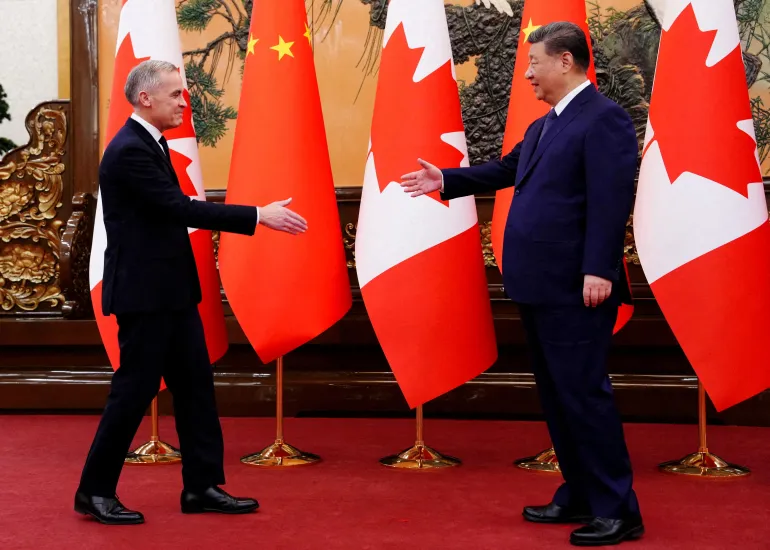
Carney’s is the first visit to Beijing by a Canadian prime minister since Justin Trudeau went in 2017, and he came away with a deal that saw Beijing agree to ease tariffs on Canadian agricultural exports and Ottawa to ease tariffs on Chinese EVs.

Trump lashed out at news of the deal, threatening 100 percent trade tariffs on Canada if the deal goes ahead.

In a statement last weekend on his Truth Social platform, Trump wrote that Carney was “sorely mistaken” if he thought Canada could become a “‘Drop Off Port’ for China to send goods and products into the United States”.

The meeting between Carney and Xi this month also thawed years of frosty relations after Canada arrested Huawei executive Meng Wanzhou in late 2018 at the behest of the US. Beijing subsequently arrested two Canadians in a move that was widely seen as retaliation. They were released in 2021 after Meng reached a deferred agreement with prosecutors in New York.

In Davos, Carney told world leaders that there had been a “rupture in the world order” in a clear reference to Trump, followed by remarks this week to the Canadian House of Commons that “almost nothing was normal now” in the US, according to the CBC.

Carney also said this week in a call with Trump that Ottawa should continue to diversify its trade deals with countries beyond the US, although it had no plans in place yet for a free-trade agreement with China.

Carney Beijing
Canadian PM Carney, left, meets President Xi in Beijing, China, on January 16, 2026 [Sean Kilpatrick/Pool via Reuters]

Filling the void

Hanscom Smith, a former US diplomat and senior fellow at Yale’s Jackson School of International Affairs, told Al Jazeera that Beijing’s appeal could be tempered by other factors, however.

“When the United States becomes more transactional, that creates a vacuum, and it’s not clear the extent to which China or Russia, or any other power, is going to be able to fill the void. It’s not necessarily a zero-sum game,” he told Al Jazeera. “Many countries want to have a good relationship with both the United States and China, and don’t want to choose.”

One glaring concern with China, despite its offer of more reliable business dealings, is its massive global trade surplus, which surged to $1.2 trillion last year.

Much of this was gained in the fallout from Trump’s trade war as China’s manufacturers – facing a slew of tariffs from the US and declining demand at home – expanded their supply chains into places like Southeast Asia and found new markets beyond the US.

China’s record trade surplus has alarmed some European leaders, such as French President Emmanuel Macron, who, in Davos, called for more foreign direct investment from China but not its “massive excess capacities and distortive practices” in the form of export dumping.

Li tried to address such concerns head-on in his Davos speech. “We never seek trade surplus; on top of being the world’s factory, we hope to be the world’s market too. However, in many cases, when China wants to buy, others don’t want to sell. Trade issues often become security hurdles,” he said.

Source link

Israeli plans for Rafah ‘camp’ in Gaza slammed as continuation of genocide | Israel-Palestine conflict News

While diplomatic circles welcome the recovery of the last Israeli captive’s remains in Gaza and the imminent partial reopening of the enclave’s Rafah border crossing with Egypt, a quieter, darker reality is taking shape on the ground.

According to comments by retired Israeli General Amir Avivi, who still advises the military, Israel has cleared land in Rafah, an area in the southern Gaza Strip that it had already flattened in more than two years of its genocidal war, to construct an enormous facility to entrench its military control and presence in Gaza for the long term.

Speaking to the Reuters news agency on Tuesday, Avivi described the project as a “big, organised camp” capable of holding hundreds of thousands of people, stating it would be equipped with “ID checks, including facial recognition”, to track every Palestinian entering or leaving.

Corroborating Avivi’s claims, exclusive analysis by Al Jazeera’s Digital Investigations Team confirms that ground preparations for this project are already well under way.

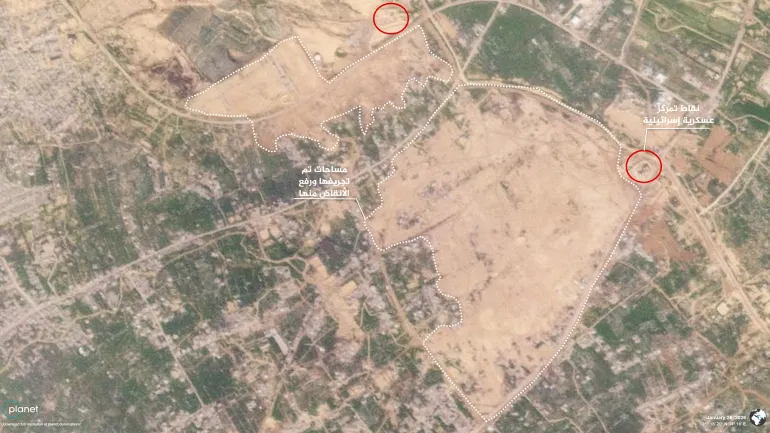
Satellite imagery captured from December 2 through Monday reveals extensive clearing operations in western Rafah. The analysis identifies an area of about 1.3sq km (half a square mile) that has undergone systematic levelling.

According to the investigation, the operations went beyond mere debris removal and involved the flattening of land previously devastated by Israeli air strikes.

The cleared zone is located adjacent to two Israeli military posts, suggesting the new camp will be under direct and immediate military supervision. The satellite evidence aligns with reports that the facility is to act as a controlled “holding pen” rather than a humanitarian shelter.

Recent satellite images reveal that Israel has been conducting rubble removal operations in the south of the Gaza Strip, especially in western Rafah. This has occurred between December 2, 2025 and January 26, 2026.
Recent satellite images reveal that Israel has been conducting rubble removal operations in the south of the Gaza Strip, especially in western Rafah. This has occurred between December 2, 2025 and January 26, 2026. [Planet Labs PBC]

The trap of return

To analysts in Gaza, no humanitarian intent is behind this projected high-tech infrastructure, which they say is in fact a trap for Palestinians.

“What they are building is, in reality, a human-sorting mechanism reminiscent of Nazi-era selection points,” Wissam Afifa, a Gaza-based political analyst, told Al Jazeera. “It is a tool for racial filtering and a continuation of the genocide by other means.”

The reopening of the Rafah crossing, tentatively scheduled for Thursday, according to The Jerusalem Post, comes with strict Israeli conditions. Prime Minister Benjamin Netanyahu has insisted on full “security control”.

For Palestinians hoping to return to Gaza, this means submitting to what Afifa describes as “human sorting stations”.

“This mechanism is designed to deter return,” Afifa said. “Palestinians will face interrogation, humiliation and the risk of arrest at these Israeli-run checkpoints just to go home.”

By leveraging facial recognition technology confirmed by Avivi, Israel is creating a high-risk ordeal for returnees, he said. Afifa argued it will force many Palestinians to choose exile over the risk of the “sorting station”, serving Israel’s longstanding goal of depopulating the Strip.

INTERACTIVE - Gaza map Israel’s withdrawal in Trump’s 20-point plan yellow line map-1760017243
(Al Jazeera)

Permanent occupation within the ‘yellow line’

The Rafah camp is just one piece of a larger puzzle. Israel in effect occupies all of Gaza with a physical military presence in 58 percent of the Gaza Strip. Its forces directly occupy an area within the “yellow line”, a self-proclaimed Israeli military buffer zone established by an October ceasefire.

“We are witnessing the re-engineering of Gaza’s geography and demography,” Afifa said. “About 70 percent of the Strip is now under direct Israeli military management.”

This assessment of a permanent foothold is reinforced by Netanyahu’s own remarks to the Knesset on Monday. By declaring that “the next phase is demilitarisation”, or disarming Hamas, rather than reconstruction, Netanyahu signalled that the military occupation has no end date.

“The talk of ‘reconstruction’ starting in Rafah under Israeli security specifications suggests they are building a permanent security infrastructure, not a sovereign Palestinian state,” Afifa added.

A ‘show’ of peace

For the more than two million Palestinians in Gaza, the hope that the return of the last Israeli captive would bring relief has turned into frustration.

“There is a deep sense of betrayal,” Afifa said. “The world celebrated the release of one Israeli body as a triumph while two million Palestinians remain hostages in their own land.”

Afifa warned that the international silence regarding these “sorting stations” risks normalising them. If the Rafah model succeeds, it would transform Gaza from a besieged territory into a high-tech prison where the simple act of travel becomes a tool of subjugation, he said.

“Israel is behaving as if it is staying forever,” Afifa concluded. “And the world is watching the show of peace while the prison walls are being reinforced.”

Source link

Troubled Sentinel ICBM Program Still Being Restructured Nearly Two Years After Cost Breach

The U.S. Air Force general who oversees America’s intercontinental ballistic missile (ICBM) force sees a long future ahead for the new LGM-35A Sentinel after it eventually enters service. At the same time, he has acknowledged challenges surrounding the Sentinel program, which is still being restructured nearly two years after huge cost overruns triggered a full review. Northrop Grumman, the prime contractor for the missile, says it is now working with the Air Force to try to re-accelerate the program, which is now years, if not decades, behind schedule.

Air Force Gen. Stephen Davis, head of Air Force Global Strike Command (AFGSC), recently discussed Sentinel, as well as the existing Minuteman III ICBMs the new missile is set to replace, among other topics, with TWZ‘s Howard Altman. This was Davis’ first interview since taking command of AFGSC in November.

Today, there are 400 Minuteman IIIs loaded in silos spread across five states. The Air Force’s goal is to replace them, one-for-one, with new Sentinels. In 2020, the Air Force declared Northrop Grumman as the winner of the Ground Based Strategic Deterrent (GBSD) competition that led to Sentinel.

An infared picture of a Minuteman III missile during a test launch. USAF An infrared image of an LGM-30G Minuteman III ICBM taken during a routine test launch. USAF

“Sentinel is probably the biggest program going on in the Department of War right now, certainly in the Department of the Air Force,” Davis said. “Sentinel brings some important new capabilities that we actually have to deliver for the warfighter, for USSTRATCOM [U.S. Strategic Command].”

Much about the new LGM-35A is classified. The Air Force and Northrop Grumman have talked broadly in the past about it offering greater range and improved accuracy, as well as reliability and sustainability benefits, over the aging Minuteman IIIs. The stated plan is for each Sentinel to carry a single W87-1 nuclear warhead inside a Mk 21A re-entry vehicle, but that loading may change in the future, as you can read more about here.

Enabling Peace Through Deterrence


Gen. Davis also called attention to the benefits that are expected to come from Sentinel’s use of open-architecture systems and a supporting infrastructure that is more digital in nature. In general, open architectures, especially software-defined ones, are intended to make it easier to integrate new and improved capabilities and functionality down the line.

“I think Sentinel is going to be a bit easier with some of the things we’re designing into the program, the digital infrastructure, the open architecture,” Davis said. “I think it will make it easier to upgrade and keep that missile relevant. I don’t have any worries about being able to do that in the future.”

The Minuteman III, also known by the designation LGM-30G, first entered operational service in 1970. The missiles, as well as their supporting infrastructure, have received incremental upgrades since then. The design is an evolution of the earlier Minuteman I and II types that entered service in the 1960s. The Air Force did field a newer ICBM, the LGM-118 Peacekeeper, in the 1980s, but withdrew the last of those missiles from service in 2005 as a result of U.S.-Russian arms control agreements. 

LGM-118 MX Peacekeeper ICBM


“We have the challenge of continuing to sustain Minuteman III until we can get Sentinel up online,” Davis said. “We’ve continued to modernize that to keep it relevant. It will continue to sustain it until Sentinel comes on.”

The original program timeline for the Sentinel called for it to begin entering service in 2029. The Minuteman III would continue to serve into 2036 as the Air Force transitioned fully to the new missile.

What the current timeline for Sentinel is now is unknown. In 2024, delays and cost overruns triggered a formal legal requirement for a review of the program, referred to as a Nunn-McCurdy breach, as you can read more about here. This, in turn, prompted an effort to restructure the program that was expected to take 18 to 24 months. At that time, the Pentagon’s Office of Cost Assessment and Program Evaluation (CAPE) projected the total acquisition costs could soar to approximately $140.9 billion, an 81 percent increase over the original estimates, even with the restructuring.

Even then, it had begun to emerge that the bulk of the issues with the Sentinel program were tied to the ground-based infrastructure rather than the missile itself. It has since become clear that the Air Force did not have a full understanding of the magnitude of the physical construction that would be required. This has been compounded by the determination that reusing existing Minuteman III silos is no longer viable, and that entirely new silos will have to be built.

A rendering of a future Sentinel launch facility, including the silo, which dates back at least to 2023. As can be seen, this had already pointed to the need for significant new construction and a limited ability to reuse existing Minuteman III infrastructure. Northrop Grumman

The understanding that it would be possible to reuse substantial parts of the existing Minuteman III infrastructure factored heavily into the original basing plan for Sentinel. The Air Force had considered and rejected a wide range of alternatives, including launchers positioned at the bottom of lakes or in tunnels.

With the Nunn-McCurdy breach, the timeline for replacing Minuteman III has fallen into limbo, at least publicly. Last September, the Government Accountability Office (GAO), a Congressional watchdog, released a report saying the Air Force was considering options for extending the service life of Minuteman III out as far as 2050.

A Minuteman III missile in its silo. USAF

During a quarterly earnings call today, Northrop Grumman CEO Kathy Warden discussed Sentinel and said that the restructuring effort is still underway, creating continued timeline uncertainty.

“We are in the middle of supporting the U.S. Air Force as they restructure the Sentinel Program,” Warden said. “Coming out of that, they will firm [up] a schedule that both locks in new time ranges for milestone B [entry into the engineering and manufacturing development phase], initial operating capability, final operating capability.”

“I don’t want to get ahead of the Air Force in talking about that, but certainly, as I have shared, and the Air Force has, as well, we are working to accelerate the timelines that were published coming out of the Nunn-McCurdy breach two years ago,” she continued. “So that is the goal, and we’re making good progress to identifying options to do so. We still believe that the program will be in development for several years and not transitioning into production until later in the decade, and that production will very much be guided by the milestone achievement during development.”

Another rendering of the future LGM-35A Sentinel ICBM. Northrop Grumman An artist’s conception of a future LGM-35A Sentinel ICBM. Northrop Grumman

Overall, the Air Force and Pentagon leadership continue to view the Sentinel program as a top national security imperative. The announcement of the GBSD effort to replace Minuteman III and the selection of Northrop Grumman’s design had prompted new discussions about the utility of the ground-based leg of America’s nuclear triad. As it stands now, the primary purpose of America’s silo-based ICBMs is to act as a ‘warhead sponge’ that would force any opponent to expend substantial resources on trying to neutralize it in a future nuclear exchange. It also stands as the fastest nuclear response option in the Pentagon’s strategic portfolio. A the same time, the deterioration in the security situation around the globe, with China drastically expanding its nuclear arsenal and Russia at war with its neighbor in Europe, among other proliferation and strategic weapons development concerns, have bolstered the case for Sentinel and nuclear modernization as a whole.

As AFGSC’s Gen. Davis has now told us, the hope is also that the benefits the Sentinels will bring when they finally do enter service will ensure they remain on guard for decades to come.

Contact the author: joe@twz.com

Joseph has been a member of The War Zone team since early 2017. Prior to that, he was an Associate Editor at War Is Boring, and his byline has appeared in other publications, including Small Arms Review, Small Arms Defense Journal, Reuters, We Are the Mighty, and Task & Purpose.


Howard is a Senior Staff Writer for The War Zone, and a former Senior Managing Editor for Military Times. Prior to this, he covered military affairs for the Tampa Bay Times as a Senior Writer. Howard’s work has appeared in various publications including Yahoo News, RealClearDefense, and Air Force Times.


Source link

NASA WB-57F Canberra Jet Makes Fiery Belly-Landing In Houston (Updated)

One of NASA’s high-flying WB-57F research aircraft went skidding down the runway on its belly at Ellington Airport in Houston, Texas, earlier today.

The incident occurred at around 11:30 AM local time, according to KHOU, a local CBS affiliate in Houston. KHOU has shared video footage showing the two-seat WB-57F spraying sparks and smoke after making contact with the runway. Additional footage shows the pilot exiting the plane with the help of first responders on the ground.

Plane appears to land without gears at Ellington Airport in Houston


NASA plane makes belly landing at Ellington Field, video shows


“Today, a mechanical issue with one of NASA’s WB-57s resulted in a gear-up landing at Ellington Field. Response to the incident is ongoing, and all crew are safe at this time,” NASA’s official account on X wrote in response to KHOU‘s report. “As with any incident, a thorough investigation will be conducted by NASA into the cause. NASA will transparently update the public as we gather more information.”

Today, a mechanical issue with one of NASA’s WB-57s resulted in a gear-up landing at Ellington Field. Response to the incident is ongoing, and all crew are safe at this time. As with any incident, a thorough investigation will be conducted by NASA into the cause. NASA will…

— NASA (@NASA) January 27, 2026

KHOU also reported that Ellington’s runway 17R–35L was closed as efforts were made to move the stricken WB-57F.

All three of NASA’s WB-57Fs are based at the Johnson Space Center, also located in Houston. The aircraft are well known for their high-altitude capabilities, and can fly as high as 63,000 feet depending on how they are configured. They can carry different sensors and other systems in modular payload bays under the fuselage, as well as in their noses and underwing pods. Though roughly similar in some respects, the WB-57F should not be confused with the U.S. Air Force’s higher-flying U-2s. NASA also operates a pair of ER-2 aircraft, which are modified U-2s.

The WB-57Fs, originally developed for the U.S. Air Force during the Cold War as high-flying intelligence-gathering platforms, are now used for various scientific research purposes. The jets have also been used to support various U.S. military operational and test and evaluation-type missions. One of them was notably called upon to help in the response to weeks of still unexplained drone incursions over Langley Air Force Base in Virginia in December 2023, which TWZ was first to report. Many aerial videos of space launches that we see are taken by the WB-57Fs, as well.

A stock picture of a NASA WB-57F. NASA

Overall, NASA’s WB-57Fs are the definition of an extremely low-density, high-demand asset, and what long-term impacts today’s belly landing may have on the future of the fleet remain be seen.

Update: 4:20 PM EST —

The Federal Aviation Administration (FAA) has now provided TWZ with the following statement:

“A Martin WB-57 landed with its gear up at Ellington Airport in Houston around 11:25 a.m. local time on Tuesday, Jan. 27. Two people were on board. The FAA will investigate.”

Howard Altman contributed to this story.

Contact the author: joe@twz.com

Joseph has been a member of The War Zone team since early 2017. Prior to that, he was an Associate Editor at War Is Boring, and his byline has appeared in other publications, including Small Arms Review, Small Arms Defense Journal, Reuters, We Are the Mighty, and Task & Purpose.


Source link

Nelly Korda: Lack of mixed indoor league in TGL ‘an unbelievable miss’ says world number two

World number two Nelly Korda has called the lack of a mixed gender indoor virtual league “an unbelievable miss” following the launch of a women’s competition backed by Tiger Woods and Rory McIlroy.

The WTGL will be held in the same Florida venue as the men’s TGL, which is currently midway through its second season.

Some of the world’s best female golfers will compete in a season of team matchplay in the SoFi Center in Palm Beach Gardens, but Korda suggested not combining the men and women’s events was a missed opportunity.

“I have mixed feelings on it, and I’m surprised no other girls have spoken out about it,” she said.

“It’s a huge and unbelievable miss that we’re not playing alongside the men.

“There’s no greater way to grow the game, and it would have been revolutionary. It would have been the first time, I think, that men and women are on the same playing field, playing for the same exact amount of money.

“But I also think it’s great that we are getting this opportunity, so that’s my mixed feelings.”

The indoor golf set-up features teams of players hitting shots at a five-storey-high simulator screen before moving to a short-game area with bunkers and a green that can rotate 360 degrees, creating hole-to-hole variations.

Asked about the prospect of a mixed-gender event, Mike McCarley, a former TV executive who founded the TGL alongside McIlroy and Woods said the idea had been discussed.

“I think that is something that’s interesting to us and is interesting to the LPGA and is interesting to a lot of the players we’re talking to,” said McCarley.

“Right now, we’re really focused on building (the TGL) out and providing, frankly, a nice stage and really nice platform to showcase the players and their personalities.”

Korda, 27, is yet to commit to entering the event, saying she is “still weighing out the time commitment” required to play in the tournament.

World number one Jeeno Thitikul and British golfers Charley Hull and Lottie Woad are among the players confirmed to compete.

Atlanta Drive beat New York GC 4-3 to win the first TGL title last year, with a prize pot of £10.39m being split between the two finalists.

This season’s competition, external began on 28 December, with a best-of-three final set to start on 23 March.

The start date and prize pot for the women’s competition is yet to be announced, beyond it being scheduled to take place in winter 2026-27.

Source link

South Korea’s former first lady sentenced to jail term in bribery case | Corruption News

Kim Keon Hee’s husband, Yoon Suk Yeol, is potentially facing the death penalty over his role in declaring martial law in 2024 while president.

A South Korean court has sentenced former First Lady Kim Keon Hee to one year and eight months in prison after finding her guilty of accepting bribes from the Unification Church, according to South Korea’s official Yonhap news agency.

The Seoul Central District Court on Wednesday cleared Kim, the wife of disgraced ex-President Yoon Suk Yeol, of additional charges of stock price manipulation and violating the political funds act.

Recommended Stories

list of 4 itemsend of list

Kim was accused of receiving bribes and lavish gifts from businesses and politicians, as well as the Unification Church, totalling at least $200,000.

The prosecution team had also indicted Unification Church leader Han Hak-ja, now on ‌trial, after the religious group was suspected of giving Kim valuables, including two Chanel handbags and a diamond necklace, as part ‌of its efforts to win influence with the president’s wife.

Prosecutors in December said Kim had “stood above the law” and colluded with the religious sect to undermine “the constitutionally mandated separation of religion and state”.

SEOUL, SOUTH KOREA - AUGUST 06: South Korean former first lady Kim Keon Hee arrives at the Special Prosecutor's Office on August 06, 2025 in Seoul, South Korea. Former first lady Kim Keon Hee is set to appear before a special counsel Wednesday to be questioned about her alleged involvement in stock manipulation schemes, election meddling and other allegations. (Photo by Chung Sung-Jun/Getty Images)
South Korean former First Lady Kim Keon Hee, centre, arrives at the Special Prosecutor’s Office in August 2025 in Seoul, South Korea [File: Chung Sung-Jun/Getty Images]

Prosecutor Min Joong-ki also said South Korea’s institutions were “severely undermined by abuses of power” committed by Kim.

The former first lady had denied all the charges, claiming the allegations against her were “deeply unjust” in her final testimony last month.

But she has also apologised for “causing trouble despite being a person of no importance”.

“When I consider my role and the responsibilities entrusted to me, it seems clear that I have made many mistakes,” she said in December.

Kim’s husband, the country’s former President Yoon, was ousted from office last year and has been sentenced to five years in prison for actions related to his short and disastrous declaration of martial law in December 2024.

Yoon could still be facing the death penalty in a separate case.

In 2023, hidden camera footage appeared to show Kim accepting a $2,200 luxury handbag in what was later dubbed the “Dior bag scandal”, further dragging down then-President Yoon’s already dismal approval ratings.

The scandal contributed to a stinging defeat for Yoon’s party in general elections in April 2024, as it failed to win back a parliamentary majority.

Yoon vetoed three opposition-backed bills to investigate allegations against Kim, including the Dior bag case, with the last veto in November 2024.

A week later, he declared martial law.

Kim’s sentencing comes days after former Prime Minister Han Duck-soo was sentenced to 23 years in prison – eight years longer than prosecutors demanded – for aiding and abetting Yoon’s suspension of civilian rule.

Source link

Trump promises to ‘de-escalate’ Minnesota crisis after Alex Pretti shooting | Donald Trump News

US president says he still has confidence in Homeland Security Secretary Kristi Noem amid calls for her resignation.

US President Donald Trump said his administration intends to “de-escalate” the spiralling crisis in the state of Minnesota after federal agents killed two United States citizens, including intensive care nurse Alex Pretti, who was shot by two Border Patrol officers over the weekend.

“I don’t think it’s a pullback. It’s a little bit of a change,” President Trump told Fox News on Tuesday.

Recommended Stories

list of 4 itemsend of list

“We’re going to de-escalate a little bit,” Trump said, referring to a sweeping federal immigration crackdown in Minneapolis that has led to weeks of protests, the killing of Pretti and Renee Good, and a standoff between state and federal officials.

Top Trump officials, including Department of Homeland Security Secretary Kristi Noem, are under fire from Democrats and a growing number of Republicans over how they responded to Pretti’s shooting.

Pretti was filming Border Patrol officers with his phone when he was shot and killed on Saturday.

He was also a licensed gun owner with a permit to carry a weapon in public, which he was wearing at the time of the shooting and which appears to have been confiscated by officers before he was killed.

Trump told Fox News that he still had confidence in Noem despite calls for her resignation.

Noem, who oversees both Immigration and Customs Enforcement (ICE) and Customs and Border Protection (CBP), responded to the killing by accusing Pretti of engaging in “domestic terrorism” and suggested the ICU nurse had brandished his weapon at Border Patrol agents during an altercation.

Noem’s remarks preceded any investigation findings and broke with the longstanding protocols of how US officials discuss a civilian shooting by law enforcement. Her characterisation of events also conflicted with preliminary video evidence showing that Pretti did not take out his weapon at any time while he was tackled and later shot and killed by officers.

A CBP official informed Congress on Tuesday that two federal officers fired shots during the killing of Pretti.

According to a notice sent to Congress, officers tried to take Pretti into custody and he resisted, leading to a struggle. During the struggle, a Border Patrol agent yelled, “He’s got a gun!” multiple times, the official said in the notice, according to The Associated Press news agency.

A Border Patrol officer and a CBP officer each fired Glock pistols, the notice said.

Investigators from CBP’s Office of Professional Responsibility conducted the analysis based on a review of body-worn camera footage and agency documentation, the notice said. US law requires the agency to inform relevant congressional committees about deaths in CBP custody within 72 hours.

Source link

Canada Accelerates Armor Plans To Contend With Growing Threats

As the Canadian military assesses how it would best deal with a potential invasion from Russia, Ottawa is pushing ahead with plans to significantly bolster its armored forces. On the wish-list are more than 250 armored fighting vehicles (AFVs), as well as an upgrade for the Canadian Armed Forces’ existing Leopard 2 main battle tanks (MBTs).

These plans were outlined by representatives of the Canadian Armed Forces speaking at Defense IQ’s International Armored Vehicles conference in England last week, their comments later published by Shephard’s Defense Insight. Events of this kind are typically conducted under Chatham House rules, meaning that information can be freely shared with the public, but the identity of the speakers cannot be disclosed.

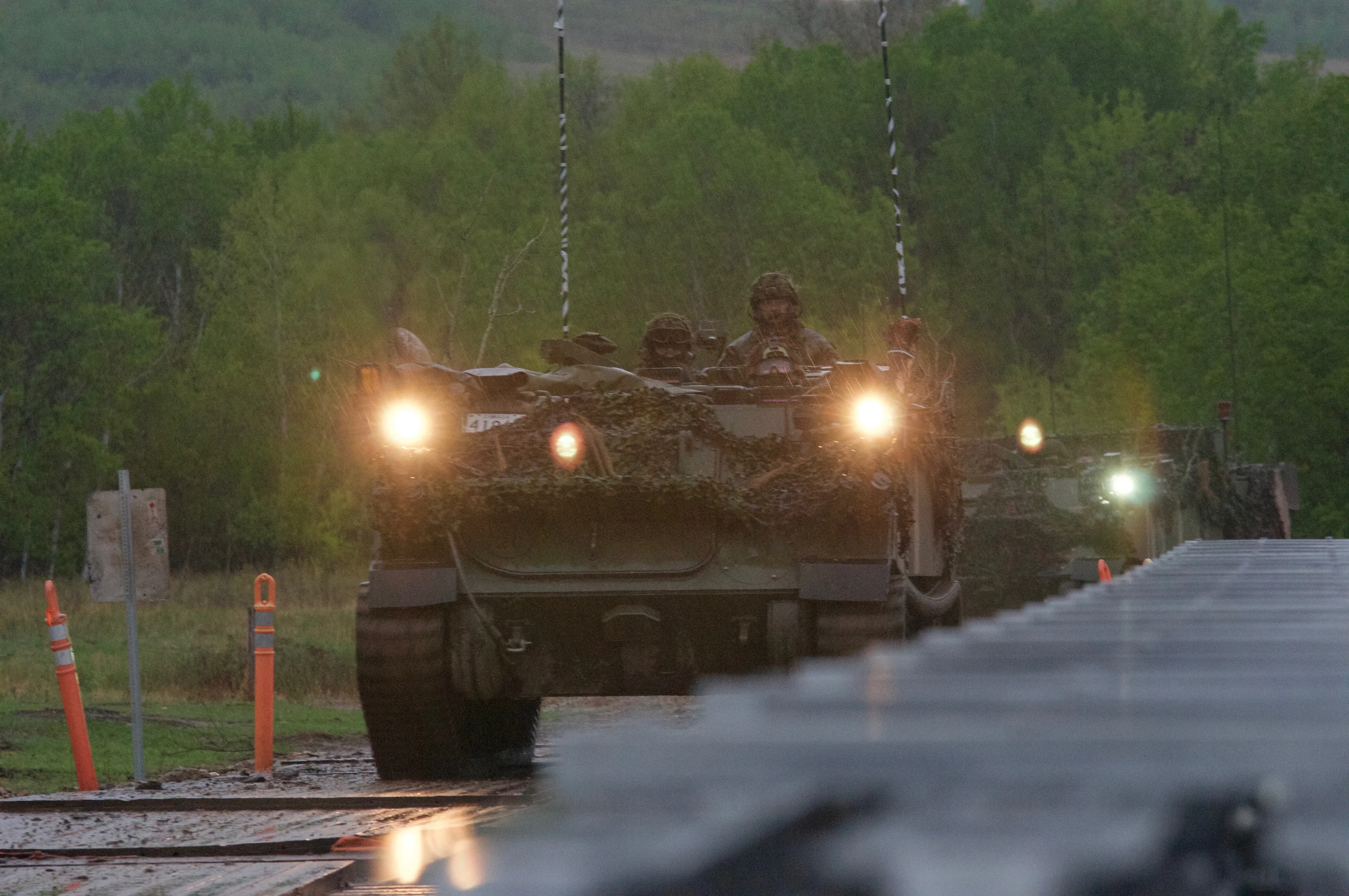
Canadian soldiers of the 2nd Canadian Mechanized Brigade Group move a tracked light armored vehicle (TLAV) conducts a convoy operation as part of Exercise Maple Resolve 17 at Camp Wainwright, Alberta, Canada on May 14, 2017. Exercise Maple Resolve 17 is the Canadian Army’s largest training event of the year involving approximately 40,000 Canadian soldiers, 1,000 U.S. Soldiers and servicemembers from Britain, Australia, New Zealand and France, held May 14 to 29.
Canadian soldiers of the 2nd Canadian Mechanized Brigade Group conduct a Tracked Light Armored Vehicle (TLAV) convoy operation as part of Exercise Maple Resolve 17 at Camp Wainwright, Alberta, Canada, in May 2017. The TLAV is currently the standard Canadian tracked AFV. U.S. Department of Defense Staff Sgt. Brad Miller

Canada already had a plan in place to introduce new AFVs, although the timeline for this has been brought forward. At one point, the new vehicles were expected to be inducted in 2035, but, in a reflection of the new urgency for defense modernization, they are now required to be fielded between 2029 and 2031.

A Leopard 2A4 Main Battle Tank from the Lord Strathcona’s Horse (Royal Canadian) Battle Group conducts a simulated attack during the Combat Team Commander’s Course at 3rd Canadian Division Support Base Garrison Wainwright, Alberta on October 16, 2021. Photo By: Sailor First Class Camden Scott, Directorate of Army Public Affairs 20211005LFC0027D016
A Leopard 2A4 tank from the Lord Strathcona’s Horse (Royal Canadian) Battle Group conducts a simulated attack during the Combat Team Commander’s Course at 3rd Canadian Division Support Base Garrison Wainwright, Alberta, in October 2021. Sailor First Class Camden Scott, Canadian Directorate of Army Public Affairs Sailor First Class Camden Scott

This also appears to be the first time that the number of new AFVs has been officially pitched at 250.

The AFVs are required for the Canadian Army’s armored cavalry forces, specifically the two new medium cavalry (MEDCAV) battalions that are planned to be fielded by the future Maneuver Division.

The vehicles will require both a high level of tactical mobility as well as STANAG Level 6 blast protection, officials say. Level 6 constitutes protection against, for example, 30mm automatic cannonfire, or the detonation of a 15mm artillery shell at 10 meters (33 feet).

According to Shephard, the AFVs are also needed in a highly modular configuration, allowing the fleet to be equipped with cannons and/or mortars for direct fire, as well as for launching loitering munitions. Other versions will be configured as munitions carriers or for command and control (C2) operations.

In the past, three vehicles had been identified as meeting the AFV requirement: the Anglo-Swedish BAE Systems CV90, the South Korean Hanwha Redback, and the German Rheinmetall Lynx. Potentially, many other types could also be considered.

A Swedish Army CV9040. Linus Ehn/Swedish Armed Forces
A Hanwha AS21 Redback (left) and Rheinmetall Lynx KF41 (right), during evaluation trials in Australia. Australian Department of Defense

It’s not clear to what degree the new AFVs might be expected to have special modifications for the region in which they will chiefly operate. It is notable that Russia is well-trained for fighting in northern latitudes and is introducing a variety of weapons systems that are optimized for this kind of environment. In contrast, meanwhile, the U.S. Army is only slowly returning to more robust preparations for warfare in Arctic conditions.

Russian troops test a Chaborz M-3 combat buggy modified for Arctic operations. Russian Ministry of Defense screencap

Currently, the Canadian Army’s tracked AFV fleet is dominated by variants of the Tracked Light Armored Vehicle (TLAV), which is a derivative of the Cold War-era M113. The service also operates more modern wheeled AFVs, including the Bison (a Canadian version of the LAV II used by the U.S. Marine Corps), the improved LAV 6.0, and the Coyote (a version of the Bison configured for battlefield reconnaissance).

TO GO WITH Afghanistan-Canada-unrest-water FOCUS by Mike Patterson In a picture taken on July 10, 2010 a soldier from a reconnaissance squadron of the 1st Royal Canadian Regiment Battle Group keeps watch from a light armoured vehicle (LAV) at an observation post in the Panjwayi district of Kandahar province. Watching for Taliban insurgents attempting to plant roadside bombs in the district, the troops warn local farmers not to work close to the road in case they are mistaken for militants. AFP PHOTO/MIKE PATTERSON (Photo credit should read MIKE PATTERSON/AFP via Getty Images)
A Light Armored Vheilce (LAV) from a reconnaissance squadron of the 1st Royal Canadian Regiment Battle Group in Kandahar province, Afghanistan, in July 2010. MIKE PATTERSON/AFP via Getty Images MIKE PATTERSON

A tracked AFV will ensure the MEDCAV battalions have the requisite off-road mobility and ability to negotiate challenging obstacles, especially vital in the Canadian North. Tracked vehicles are also better able to keep pace with tanks.

As for the Canadian Army’s MBT fleet, this is also slated for an upgrade.

Under the Heavy Direct Fire Modernization (HDFM) project, Ottawa wants to bring its current fleet of German-made Leopard 2A6 MBTs to a new standard, known as Leopard 2A6M, by 2033.

Overall, the country now has a force of 103 Leopard 2A4, 2A4M, and 2A6M vehicles, which are being supported under a contract awarded in 2024. The last of these vehicles is expected to be withdrawn from operational service in 2035. Meanwhile, the oldest Leopard 2A4 versions are only used for training. Canada also donated eight Leopard 2s to Ukraine in 2023.

HDFM replaces most of the remaining analog systems in the Leopard 2A6M fleet and modernizes existing systems, including the optics and fire-control system. The result brings the 2A6M in line with the more advanced Leopard 2A4M fleet.

Canadian Army – Leopard 2A4M CAN Main Battle Tanks Live Firing + On The Move [720p]


The HDFM upgrade is only a stopgap, however, before Canada selects a new MBT. At the International Armored Vehicles conference, officials confirmed that Canada plans to “identify and begin procurement” of a new MBT by 2030. It’s also envisaged that, before the last of the Leopard 2s are retired, these older tanks and the new MBT will serve together within additional armored battalions and companies. The Canadian Forces want these units to be operational by 2037.

“The force design may require additional armored or armored cavalry battalions, but it is just too early at this point to say how many,” one source stated at the conference, as reported by Shephard.

This is part of a wider rethinking of the military, with the aim of having a warfighting concept for 2040.

“We recognize that the army we have is not the army we need, and we are taking the necessary funded steps to bridge that gap,” the source continued. “We are changing our structure, we are modernizing our fleet, we are growing our armored capability. We are no longer just talking about the future; we are actively building it.”

Against this force-structure planning and decisions over new fighting vehicles, Canada is increasingly looking at the kinds of land warfare scenarios it might face in the future.

Earlier this month, TWZ spoke to the operational commander for the Canadian North American Aerospace Defense Command (NORAD) about how the Royal Canadian Air Force is looking to counter the growing threats China and Russia pose to the High North.

North American Aerospace Defense Command CF-18s and F-16s fly in formation in support of Operation NOBLE DEFENDER over Alaska in August 2023. U.S. Air Force photo/Airman 1st Class Ricardo Sandoval

Simply put, the vast swaths of the Arctic are increasingly of both strategic and economic interest for all the major global powers, and this has been underscored by the growing intensity of Russian and Chinese military and civilian maritime activity in the region.

These same potential threats are also driving a reconfiguration of the Canadian Army.

Remarkably, however, the Canadian Armed Forces are reportedly also now looking at how they would respond to a hypothetical U.S. military invasion of Canada. Officials have stressed that they don’t think it is likely that U.S. President Donald Trump would order an invasion of Canada, and that the war-gamed scenarios were entirely conceptual in nature.

Interestingly, these concepts reportedly involve the Canadian Armed Forces adopting asymmetric tactics, “similar to those employed against Russia and later U.S.-led forces in Afghanistan,” according to two senior Canadian government officials, who spoke to The Globe and Mail on condition of anonymity.

The same newspaper suggests that this war-gaming is the first time in a century that the Canadian Armed Forces have looked at a hypothetical American assault on the country, which is not only a founding member of NATO but also, under NORAD, a close partner with the U.S. military in continental air defense. Canada is expected to be part of the Trump administration’s forthcoming Golden Dome missile defense system.

Undoubtedly, however, relations between Canada and the United States have cooled dramatically in recent years.

While officials in the Trump administration have hammered home their goal of U.S. regional dominance as an overarching geostrategic objective, the president himself has made threats to annex Canada. Last year, Trump said that the border between the two countries was no more than an “artificially drawn line” and one that might be redrawn using force and persuasion.

Last week, Trump posted an altered image on his social media account that placed the American flag over Canada, Greenland, and Venezuela.

We need Greenland from the standpoint of national security, and Denmark is not going to be able to do it,” Trump told reporters earlier this month.

The ongoing Greenland issue, which has led to considerable consternation in Europe, has also now drawn in Canada.

Reports emerged last week that Canada was considering sending a small contingent of troops to Greenland. Here they would conduct maneuvers alongside eight European countries, part of a military exercise that is seen as a show of solidarity for Denmark, of which the self-ruling island is a territory.

Danish soldiers conduct a military exercise at the docks Nuuk, Greenland. US president Donald Trump has backed down on his threat to impose tariffs on the UK and other Nato allies who opposed his ambitions to annex Greenland. Picture date: Monday January 26, 2026. (Photo by Ben Birchall/PA Images via Getty Images)
Danish soldiers conduct a military exercise at the docks in Nuuk, Greenland, on January 26, 2026. Photo by Ben Birchall/PA Images via Getty Images Ben Birchall – PA Images

Last week, Trump posted on Truth Social that Canada was opposed to having the Golden Dome over Greenland “even though The Golden Dome would protect Canada. Instead, they voted in favor of doing business with China, who will ‘eat them up’ within the first year!”

Clearly, no one within the Canadian Armed Forces expects to be taking up arms — whether using AFVs or guerrilla tactics — against a U.S. invasion.

However, it is very telling how such a ‘what if?’ is apparently now being considered at a theoretical level. This kind of thinking, as well as the renewed impetus to acquire new and modernized armored fighting vehicles and tanks, underscores just how shifting strategic priorities across the High North are being felt by all of the countries within the region, with Canada no exception.

Contact the author: thomas@thewarzone.com

Thomas is a defense writer and editor with over 20 years of experience covering military aerospace topics and conflicts. He’s written a number of books, edited many more, and has contributed to many of the world’s leading aviation publications. Before joining The War Zone in 2020, he was the editor of AirForces Monthly.


Source link

UPS says it will shed 30,000 jobs in major cost-cutting drive | Business and Economy

Package-delivery giant targets savings of $3bn in 2026 amid push to slash deliveries for Amazon.

United Parcel Service, one of the world’s largest package-delivery companies, has announced plans to slash up to 30,000 jobs amid a push to cut costs and boost profits.

UPS, based in the US state of Georgia, will make the cuts as part of efforts to achieve savings of $3bn in 2026, UPS chief financial officer Brian ⁠Dykes said on an earnings call on Tuesday.

Recommended Stories

list of 4 itemsend of list

Dykes said the job cuts, part of plans to reduce UPS’s reliance on deliveries for its largest customer, Amazon, would be achieved through attrition and voluntary buyouts.

“We expect to offer a second voluntary separation programme for full-time drivers,” Dykes said.

UPS will also shut 24 buildings in the first half of the year and evaluate other buildings for closure in the second half, Dykes said.

He said the savings would be on top of $3.5bn in savings achieved in 2025 through cost-cutting measures, including the elimination of 26.9 million labour hours and the closure of 93 buildings.

Sean O’Brien, president of the Teamsters union, slammed the job cuts in a statement posted on social media.

“Corporate vultures giggled about giving their disrespectful driver buyout program another shot,” O’Brien said.

“Reminder: Teamsters overwhelmingly rejected UPS’s insulting payoff last year. We still know our worth. Drivers still endure violent winters and brutal heat to make UPS its billions. UPS must honor our contract and reward our members.”

UPS announced last year that it would reduce shipments for Amazon by half as part of plans to focus on a smaller volume of more lucrative deliveries.

The firm’s reported revenues of $24.5bn for the final three months of 2025, taking earnings for the year to $88.7bn, and projected revenues in 2026 are expected to hit $89.7bn.

UPS shares were largely unmoved on Tuesday, closing 0.22 percent higher.

Source link

Storm Chandra brings flooding and travel disruption with rain and wind warnings across UK

Helen Willetts,BBC Weatherand

Kathryn Armstrong

Watch: Stranded cars and rough seas as Storm Chandra hits UK

Parts of the UK are under weather warnings as Storm Chandra brings strong winds and flooding across the country.

Poor weather could impact journeys across England, Scotland and Wales until Friday, National Rail warned, as road closures and rail, ferry, and flight cancellations cause widespread travel disruptions.

As of Tuesday night, there were 97 flood warnings, where flooding was expected, and 260 flood alerts, where it was possible, across England.

A major incident was declared in Somerset where some 50 properties were hit by flooding.

In Wales, there were three flood warnings and 16 flood alerts in place, with eight flood warnings and eight flood alerts in place across Scotland.

Charles McQuillan/Getty Images Cars drive through heavy floods on the roads in Northern Ireland. There are several cars and lorries driving through deep water. They hae their headlights on as the light is lowCharles McQuillan/Getty Images

Motorists contended with heavy flooding near Belfast International airport

Yellow warnings for wind, rain and snow remain in force across parts of England, Scotland and Wales, while an amber warning for wind is in place in the north and east of Northern Ireland, including Belfast.

Clearer skies and freezing temperatures on Tuesday night also raise the fresh risk of icy patches on sodden roads and pathways, the Met Office warned, with much of the UK placed under yellow warnings for ice hazards on Wednesday morning.

The third named storm of the year comes days after Storm Ingrid caused widespread damage and disruption over the weekend.

Schools closed in some parts of England and Northern Ireland, and thousands of properties were without power as winds gusted up to around 80mph.

Rain in parts of south-west England is falling on already saturated ground, making flooding more likely.

Firefighters in Devon and Somerset said they had rescued people from 25 vehicles that were stuck in floodwater on Tuesday morning.

In Somerset, Council leader Bill Revans said heavy rainfall had caused “widespread disruption” and warned people to avoid travelling if possible.

Honiton and Sidmouth MP Richard Foord said there were reports of around 20 flooded properties across Devon and Cornwall – a figure expected to increase as river levels peak.

Oliver Kimber in Lostwithiel, Cornwall, said the lane he lives on was inundated with water.

“There was so much water and it was so fast that it just had nowhere else to go, and it was pushing it back up through the drains,” he told BBC Radio Cornwall.

The heavy rain saw several locations – including Katesbridge in Northern Ireland, Mountbatten in Plymouth and Hurn in Dorset – set new January daily rainfall records.

PA Media/Devon and Somerset Fire and Rescue Service A car and a van are submerged in flood watersPA Media/Devon and Somerset Fire and Rescue Service

The town of Axminster was among those in Devon to experience flooding

A severe flood warning, indicating a danger to life, was issued in Upper Frome, Dorchester, while another severe warning ended earlier on Tuesday in Ottery St Mary, Devon – where the Environment Agency said the River Otter had reached its highest recorded level.

“At the moment, it’s a raging torrent,” Jackie Blackford, whose house overlooks the river, told BBC Radio Devon. “It is horrendous – I’ve never seen anything like it.”

Sections of several roads in Dorset, Somerset and eastern Devon have been closed due to flooding and fallen trees.

Local police have asked people not to travel in Exeter, as well as east and mid-Devon, due to increasing reports of flooding. More than 40 schools have either fully or partially closed across the county.

Watch: Latest weather forecast as Storm Chandra brings rain and wind to UK

The Met Office says further downpours are expected for the south-west on Thursday, which may lead to more flooding and transport disruption.

Some schools in the West Midlands were closed due to flooding, and flood warnings are also in place for parts of Yorkshire.

Rain is forecast overnight into Wednesday in south-east England, while the Met Office is warning of travel disruption due to rain and snow across a swathe of northern England, as well as in the Pennines and south-western Scotland, where the wind mixed with rain and snow could create blizzard-like conditions.

Up to 5cm of snow is predicted, while as much as 20cm could accumulate on higher ground. A section of the A66 between Bowes in County Durham and Brough in Cumbria has already been shut because of the snow.

Flooding is expected around the River Monnow at Forge Road, Osbaston, as well as at a number of locations along the Afon Lwyd. Gwent Police earlier said the A40 was flooded between Abergavenny and Raglan.

PA Media A yellow plough clears a road blanketed in snow in Middleton-in-Teesdale, County Durham. Snow is falling around it on trees and hedges which line the narrow road.PA Media

A plough clears snow in Middleton-in-Teesdale, County Durham

PA Media A fallen tree blocks Hall Lane in Houghton-le-SpringPA Media

A fallen tree blocked a lane in Houghton-le-Spring, Sunderland

Strong winds are still a hazard for several areas, particularly south-western parts of Scotland, England and Wales.

In Northern Ireland, more than 10,000 properties were without power and more than 300 schools were closed on Tuesday. Peak wind gusts reached 80mph at Orlock Head on the Ards Peninsula.

Several domestic flights to and from Belfast Airport were cancelled, while Scottish regional airline Loganair cancelled at least 12 flights on Tuesday.

Ferry services between Belfast and Liverpool were also cancelled, and several scheduled services from Belfast and Larne were disrupted.

Outside the UK, the Electricity Supply Board (ESB) in the Republic of Ireland said around 20,000 homes, farms and businesses were without power.

Storm Chandra is the third major storm to hit the UK in January, arriving shortly after Ingrid and Goretti – the latter of which was described by the Met Office as among the most impactful to hit Cornwall and the Isles of Scilly in 30-35 years.

Additional reporting by Chloe Gibson and Christine Butler

Source link

New EA-37B Compass Call Electronic Warfare Jet Makes Maiden Voyage To Europe

Despite rampant speculation that it would eventually head to the Middle East amid growing tensions with Iran, an EA-37B Compass Call’s arrival in Germany yesterday had nothing to do with current events, according to the U.S. Air Force. The specialized electronic warfare (EW) jet made its first trip to Europe to show off its capabilities as the U.S. Air Force transitions from the EC-130 Compass Call turboprop aircraft.

“The aircraft is also slated to visit Spangdahlem Air Base in Germany and RAF Mildenhall, England, marking the platform’s introduction to Airmen, units and NATO Allies in the U.S. Air Forces in Europe area of responsibility,” U.S. Air Forces in Europe-Air Force Africa (USAFE) stated in a release. “The roadshow’s inclusion of multiple installations and units highlights the aircraft’s flexibility to integrate into various mission sets and teams, serving as a key node for joint and coalition operations.”

Turkish Air Force Airmen receive a tour of a U.S. Air Force EA-37B Compass Call aircraft, assigned to the 55th Electronic Combat Group, Davis-Monthan Air Force Base, Arizona, at Ramstein Air Base, Germany, Jan. 26, 2026. The aircraft is also slated to visit Spangdahlem AB, Germany, and RAF Mildenhall, England, marking the platform’s introduction to Airmen, units and NATO Allies in the U.S. Air Forces in Europe area of responsibility. (U.S. Air Force photo by Senior Airman Edgar Grimaldo)
Turkish Air Force airmen receive a tour of a U.S. Air Force EA-37B Compass Call aircraft, assigned to the 55th Electronic Combat Group, Davis-Monthan Air Force Base, Arizona, at Ramstein Air Base, Germany, Jan. 26, 2026. (U.S. Air Force photo by Senior Airman Edgar Grimaldo) Senior Airman Edgar Grimaldo
Royal Norwegian Air Force airmen receive a tour of a U.S. Air Force EA-37B Compass Call assigned to the 55th Electronic Combat Group, Davis-Monthan Air Force Base, Arizona, at Ramstein Air Base, Germany, Jan. 26, 2026. The EA-37B visited Ramstein as part of a road show to familiarize Airmen, units and NATO Allies in the U.S. Air Forces in Europe area of responsibility with the new platform and its capabilities. (U.S. Air Force photo by Senior Airman Edgar Grimaldo)
Royal Norwegian Air Force airmen receive a tour of a U.S. Air Force EA-37B Compass Call assigned to the 55th Electronic Combat Group, Davis-Monthan Air Force Base, Arizona, at Ramstein Air Base, Germany, Jan. 26, 2026. (U.S. Air Force photo by Senior Airman Edgar Grimaldo) Senior Airman Edgar Grimaldo
Military personnel assigned to Ramstein Air Base, Germany, receive a tour of an EA-37B Compass Call aircraft assigned to the 55th Electronic Combat Group, Davis-Monthan Air Force Base, Arizona, during its first stop in the European theater for a scheduled road show, Jan. 26, 2026. The roadshow’s inclusion of multiple installations and units highlights the EA-37B’s potential to integrate into various mission sets and teams, serving as a key node for joint and coalition operations. (U.S. Air Force photo by Senior Airman Edgar Grimaldo)
Military personnel assigned to Ramstein Air Base, Germany, receive a tour of an EA-37B Compass Call aircraft assigned to the 55th Electronic Combat Group, Davis-Monthan Air Force Base, Arizona, during its first stop in the European theater for a scheduled road show, Jan. 26, 2026. The roadshow’s inclusion of multiple installations and units highlights the EA-37B’s potential to integrate into various mission sets and teams, serving as a key node for joint and coalition operations. (U.S. Air Force photo by Senior Airman Edgar Grimaldo) Senior Airman Edgar Grimaldo

The Air Force statement about the EA-37B’s visit to Europe follows suppositions made in many posts on X and shows the limits of online speculation based just on tracking data. The conjecture is understandable given the electronic warfare capabilities such a jet could bring to the fight, jamming radars and interfering with Iranian communications and command and control.

👀🇺🇸✈️🇩🇪 The United States has redeployed an EA-37B electronic warfare aircraft, accepted into service in 2024, from Bermuda to Ramstein Air Base. The aircraft’s specific technical characteristics remain highly classified. The move is widely assessed as a preparatory step for a… pic.twitter.com/xQNWXOEhk9

— NSTRIKE (@NSTRIKE1231) January 26, 2026

USAF EA-37B Compass Call is likely en route to the Persian Gulf. This next-generation Airborne Electromagnetic Attack platform is based on the Gulfstream G550 and is designed to execute offensive counter-information warfare and the suppression of enemy air defenses. Its specific… pic.twitter.com/M6ASNDPZp6

— Lokman Karadag 盧克曼 (@DrLokmanKaradag) January 25, 2026

🚨🇺🇸 The U.S. has quietly shifted its newest EA-37B electronic warfare jet from Bermuda to Ramstein Air Base, Germany, a platform that only entered service in 2024.

Analysts see this as groundwork for a possible Middle East deployment.

If deployed, it would be the first real… pic.twitter.com/wVNTy4CeTM

— Defence Index (@Defence_Index) January 26, 2026

The EA-37B, however, is not yet operational, Kris Pierce, spokesman for the 55th Wing at Offutt Air Force Base told The War Zone Tuesday afternoon.

“We are still in training and testing phase,” he said. “We are still trying to figure out the capabilities.”

The new Compass Call is a heavily modified Gulfstream G550 business jet. It leverages the Israeli-developed Conformal Airborne Early Warning (CAEW) configuration, which has large ‘cheek’ fairings on either side of the fuselage, among other distinctive features.

The Air Force is planning to procure 10 of these jets to replace the aging and ever smaller fleet of turboprop EC-130H Compass Call planes, of which only four remain. The 43rd Electronic Combat Squadron flew the first training sortie for the EA-37B on May 2, 2025.

Many of the EA-37B’s mission systems are directly ported over from the EC-130H, which is why the two very different aircraft share the same nickname. Both aircraft are designed to provide critical stand-off jamming support, including against enemy radars and communications systems. They also have a secondary intelligence, surveillance, and reconnaissance (ISR) function given their ability to spot, track, and geolocate various types of emitters.

The EA-37B also offers new capabilities that go beyond what is found on the EC-130H. The Air Force has said in the past that the aircraft’s designation reflects its ability to not only attack, but also destroy certain targets, as you can read more about here.

An EA-37B Compass Call takes its first official flight at Davis-Monthan Air Force Base, Arizona, Aug. 28, 2024. The plane was officially brought to DM and is now an operational asset to installation capabilities. (U.S. Air Force photo by Senior Airman Andrew Garavito)

In addition, the G550-based aircraft can reach higher altitudes than the EC-130H, giving it a better field of view to provide effects across the electromagnetic spectrum (EMS) over longer distances and larger areas. The jet also offers speed, range, and endurance benefits over its turboprop predecessor. 

“One of the most important aspects of success in conflict is information superiority,” said U.S. Air Force Capt. Tyler Laska, 41st Electronic Combat Squadron EA-37B pilot. “Every moment of hesitation that we can implant into an adversary’s decision-making process increases the survivability of our men and women on the leading edge of every domain.” 

The value of Compass Call aircraft was recently highlighted during the recent pressure campaign against Venezuelan dictator Nicolas Maduro. An EC-130H likely played a role in jamming radars and communications to make it harder for Venezuelan forces to respond during Maduro’s eventual capture. E/A-18G Growler jets also played a major role in that effort.

You can see a video of the EC-130 arriving in the Caribbean below.

A video posted to social media yesterday (20 Dec) shows the arrival of a USAF EC-130H at Luis Muñoz Marin International Airport (SJU/TJSJ) in Puerto Rico.

There are only a few EC-130Hs left in USAF inventory.

Credit/permission: pinchito.avgeek (IG). pic.twitter.com/IxqBaKSBtE

— LatAmMilMovements (@LatAmMilMVMTs) December 22, 2025

As we noted in an earlier story: “Previous iterations of the EC-130H-based Compass Call system have proven their value in combat zones on multiple occasions in the past two decades. A contingent of these aircraft was continuously forward-deployed in the Middle East, from where they also supported operations in Afghanistan, between 2001 and 2021. EC-130Hs supported the raid that led to the death of Al Qaeda founder Osama Bin Laden in Pakistan in 2011 and prevented the detonation of an improvised explosive device that might have killed then-Maj. Gen. James Mattis, who later rose to the rank of General and also served as Secretary of Defense under Trump, in Iraq in 2003, among many other exploits, according to a recent story from Air Force Times.”

A U.S. Air Force EC-130H Compass Call electronic warfare plane was seen landing in Puerto Rico.
An EC-130 Compass Call. (U.S. Air Force photo by Master Sgt. Wolfram M. Stumpf) (U.S. Air Force photo by Master Sgt. Wolfram M. Stumpf)

Had the EA-37B that landed at Ramstein been bound for the Middle East as online trackers posited, that would have been a big deal indeed, marking its first foray into potential combat. Still, this tour, following the two last year to Asia, is a first introduction to a large number of U.S. and allied airmen, of an important new airborne EW platform.

Contact the author: howard@thewarzone.com

Howard is a Senior Staff Writer for The War Zone, and a former Senior Managing Editor for Military Times. Prior to this, he covered military affairs for the Tampa Bay Times as a Senior Writer. Howard’s work has appeared in various publications including Yahoo News, RealClearDefense, and Air Force Times.


Source link

China’s Massive PL-17 Air-To-Air Missile Seen Up Close

One of the most enigmatic weapons in the arsenal of the Chinese People’s Liberation Army Air Force (PLAAF), the PL-17 very long-range air-to-air missile, appears to have been shown for the first time at close quarters. The missile has been around for a relatively long time, but next to no official details about it have been released. Meanwhile, the threat that it and other Chinese air-to-air missiles pose has triggered a flurry of weapons development in the United States.

As is often the case with such images, we must note that the photo of the PL-17 appears authentic, but we cannot be certain of that. The date and location of the image are also unclear, but it shows a PL-17 (more accurately, a full-size mock-up of one) on a display stand at a tradeshow or exhibition. A man poses in front of the missile, face censored, while behind the weapon is a board promoting the J-20 stealth fighter.

As it seems, this is indeed the first legit image of the PLAAF’s ULR-AAM PL-17, even if it’s only a model.

However, it would be most interesting to know when this image was taken and where? 🤔 pic.twitter.com/CjPI4rO6sJ

— @Rupprecht_A (@RupprechtDeino) January 27, 2026

We have become accustomed to ‘leaks’ out of China over many years when it comes to new military aircraft designs and their weaponry. Combined with the fact that the PL-17 was first publicly revealed in a blurry photo close to 10 years ago, its appearance at a tradeshow at this point might not be entirely surprising.

For its part, the PLAAF has published official imagery of the PL-17 (albeit showing the missile at a considerable distance, with no real detail visible). The release of the PLAAF photo, seen below, in 2023, was taken as confirmation that the missile was in operational service, or close to it, arming the J-16 Flanker.

The PLAAF image showing a formation of four J-16s with varying configurations of air-to-air missiles. Two of the fighters in question carry four PL-10s, one PL-12, four PL-15s, and one big PL-17. This loadout spans short to very long-range engagement envelopes, with the PL-17 providing unprecedented reach. PLAAF

When the missile first appeared in public, in 2016, it was dubbed PL-XX in the West; subsequently, the PL-20 designation was suggested, but PL-17 is now confirmed, at least based on the new photo. There are reports that the missile received the Western reporting name CH-AA-12 Auger when it entered service.

From the start, the PL-17 was considered to be a very long-range AAM, based on its prodigious size, roughly 20 feet long. For a missile with this reach, key targets are likely high-value, larger assets, including tankers and airborne early warning aircraft.

This 2016 image provided our first look at the PL-17. Chinese internet
Another 2016 image shows the PL-17 in more detail. Chinese internet

In detail, the PL-17 features a dual-pulse rocket motor, while control is provided by four relatively small tail fins and a thrust-vectoring nozzle. Reportedly, the missile has a range of around 250 miles, although that number is dependent on a huge array of factors, and actual range can vary dramatically based on the engagement circumstances. It is thought to have a top speed of at least Mach 4.

Guidance is thought to be achieved through a combination of a two-way datalink and an active electronically scanned array (AESA) seeker, which is said to be highly resistant to electronic countermeasures. There are also reports of a passive anti-radiation seeker to supplement the main seeker. This could be especially useful against airborne early warning and ground moving target indicator (GMTI) radar aircraft.

However, using the PL-17 to its full potential, in terms of range, engagements would likely involve targeting data provided by standoff assets, such as friendly airborne early warning aircraft (a capability set that China has invested heavily into), other aircraft closer to the target, ground and surface-based radar, or even satellites.

In the past, there had been speculation about a possible optical window on the side of the nose of the missile that could indicate an additional infrared seeker, although there is no sign of that in the full-size mock-up version.

So far, the PL-17 has only been seen carried by the J-16, although there has been an assumption that it would be adapted for external carriage on the J-20, too.

A J-20 with eight external missiles, not, in this case, PL-17s. Chinese internet

Certainly, it seems too large to be used to arm the J-10 series or even the J-35, which would seem to raise a big question about its potential export prospects. On the other hand, the missile may well be envisaged as armament for forthcoming Chinese combat aircraft, most notably the J-36 sixth-generation jet, which features extensive internal weapons capacity.

Regardless, the existence of the PL-17, along with other advanced Chinese air-to-air missile developments, has become a very serious issue for the U.S. military. Concerns about China eroding the ‘missile gap’ with the West have driven work on the still highly classified AIM-260 Joint Advanced Tactical Missile, among other long-range air-to-air missile initiatives.

Last year, the U.S. Navy introduced, at least on a limited scale, an air-launched version of the Standard Missile-6 (SM-6) under the AIM-174B designation. The range of this weapon is classified but should be far in excess of that of the AIM-120D Advanced Medium-Range Air-to-Air Missile (AMRAAM), probably at least double and perhaps even triple the range, against large targets. This would imply an ability to hit some types of aerial targets over multiple hundreds of miles.

How The Navy’s New Very Long-Range AIM-174 Will Pierce China’s Anti-Access Bubble


For now, many questions remain about the full capabilities and technical features of the PL-17. Should the new photo be genuine, however, it would confirm that Beijing is willing to expose at least some aspects of the big missile to a broader audience. With that in mind, we might well learn more about this weapon soon.

Contact the author: thomas@thewarzone.com

Thomas is a defense writer and editor with over 20 years of experience covering military aerospace topics and conflicts. He’s written a number of books, edited many more, and has contributed to many of the world’s leading aviation publications. Before joining The War Zone in 2020, he was the editor of AirForces Monthly.


Source link

Mexico vows ‘solidarity’ with Cuba after oil shipment cancellation reports | Oil and Gas News

The president says Mexico’s decision ‘to sell or give oil to Cuba for humanitarian reasons’ was a ‘sovereign’ one.

Mexican President Claudia Sheinbaum says her country will continue to show “solidarity” with Cuba after media reports that her government halted a shipment of oil to Havana.

Mexico has in recent years become a top supplier of oil to Cuba, which relies on cut-price oil supplies from its allies to survive a US trade embargo and keep the lights on through a severe energy crisis.

Recommended Stories

list of 3 itemsend of list

Venezuela had been a major supplier of discounted crude to Cuba, but US President Donald Trump said he would halt the shipments after the United States military abducted long-term Venezuelan President Nicolas Maduro this month.

As recently as December, Mexico was still sending oil to Cuba, but several media outlets, including Bloomberg and the Mexican newspaper Reforma, have reported that a shipment planned in January was called off.

Sheinbaum refused to confirm or deny the reports on Tuesday. She told reporters during her regular morning news conference that Mexico’s decision “to sell or give oil to Cuba for humanitarian reasons” was a “sovereign decision”.

“It is determined by [Mexican state oil company] Pemex based on the contracts, or, in any case, by the government, as a humanitarian decision to send it under certain circumstances,” Sheinbaum said.

When asked if Mexico would be resuming oil shipments to Cuba, the president sidestepped the question and said, “In any case, it will be reported”. She also said Mexico would “continue to show solidarity” with Cuba.

The Reuters news agency last week reported that the Mexican government was reviewing whether to keep sending oil to Cuba amid growing concerns within Sheinbaum’s government that continuing the shipments could put the country at odds with the US.

Trump on Tuesday told reporters that “Cuba will be failing very soon”, adding that Venezuela has ‌not ‌recently sent ⁠oil or money ‌to Cuba.

According to shipping data and internal documents from state company PDVSA, Venezuela has not sent crude or fuel to Cuba for about a month.

Last year, Mexico sent approximately 5,000 barrels per day to Cuba. With Venezuela’s shipments now offline, Mexico’s supplies are critical.

Source link

‘It Is Venezuela Today. It Will Be South Africa Tomorrow,’ NUMSA Trade Union Warns

South African trade unions and leftist organizations have expressed solidarity with Venezuela. (NUMSA)

Demanding the release of Venezuela’s President Nicolás Maduro and First Lady Cilia Flores, South Africa’s largest trade union marched to the US consulate in Johannesburg on Saturday, January 24.

“In defending Venezuela, we defend the sovereignty of all nations,” concluded the memorandum read aloud outside the consulate by Irvin Jim, general secretary of the over 460,000 members-strong National Union of Metalworkers of South Africa (NUMSA).

“It is Venezuela today … It will be South Africa tomorrow,” Jim warned in his address to the demonstration. US President Donald Trump, who has bombed parts of Nigeria after concocting a false story about a “Christian Genocide” in the country, has also been spinning tales about a “White Genocide” underway in South Africa.

“This is not a joke,” NUMSA warned in a statement. “Donald Trump can easily use the lie of a White genocide in South Africa to invade South Africa, capture South Africa’s president and transport him to a jail in the US, and declare that he is now in charge of our country and all its natural wealth, whilst controlling all trade and natural wealth … After the US criminal military invasion of Venezuela, it is foolish to ignore” this threat to South Africa.

“There is a madman in the White House”

“There is a madman in the White House. There is a fascist in the White House,” NUMSA’s president, Andrew Chirwa, said in his opening address to the demonstration. “Today, it is Venezuela that was attacked by this international criminal. Tomorrow it is” Cuba, Iran, Nigeria,  South Africa. “All over the world this man” is baying “for blood.”

In parallel, the Trump administration is also attempting to strangle South Africa’s economy, threatening to exclude it from the African Growth and Opportunity Act (AGOA), which provides tariff-free access to the US market, on which the country’s automotive sector is heavily dependent.

“Our members and workers across various sectors are losing jobs” because “he has imposed 30% tariffs against South Africa,” Jim added in his speech.

Stressing the need for “an anti-imperialist front to mobilize the workers” across party and union affiliations, Jim said that NUMSA “will soon be convening a political colloquium”, inviting all progressive political parties. “It is about time to unite the working class … behind a  revolutionary agenda,” as South Africa faces increasing US aggression.  

South Africa punished for taking the genocidal state of Israel to the ICJ

South Africa, the union maintains, “is being punished by Trump for taking the genocidal state of Israel to the International Court of Justice (ICJ).” Reaffirming that “this was the correct position … in defense of the people of Palestine,” NUMSA called on the South African government not to cave in to the pressure by Leo Brent Bozell III, Trump’s new ambassador to South Africa.

At his Senate confirmation hearing, he had stated that if appointed, “I would press South Africa to end proceedings against Israel,” and the ICJ itself to stop what he deemed a “lawfare” against Israel.

“If he continues to insult our national sovereignty … by demanding that South Africa must withdraw its case in the ICJ against Israel,” NUMSA insists, “the South African government must act swiftly, and ensure that he packs his bags and leaves the country.”

The South African government must also “continue to demand the release of Venezuela’s President Nicolás Maduro and Comrade Cilia Flores in all international forums,” added the memorandum, which was also copied to the Minister of International Relations.

Demanding that the football governing body “cancel all World Cup matches in the US this year,” a copy of the memorandum was also sent to the FIFA President.

It further called on the African Union (AU) and the BRICS to urgently convene and formulate a coordinated and collective response to the US imperialist aggression.

“No country is safe from America’s greedy appetite”

Recalling the European leaders defending unipolarity under the cover of “rules-based order” at last year’s G20 summit in South Africa, the US had boycotted Alex Mashilo, spokesperson of the South African Communist Party (SACP) said in his address to the protest: “Little did they know that just after a few weeks, that unipolar power will turn against them and demand Greenland.”

Under “the mad Trump administration”, NUMSA emphasized in its statement, “no country is safe from America’s greedy appetite”.

​The US has now even “become extremely dangerous to itself” and “its citizens”, with Trump “brutalizing the American people daily” using “his personal ‘Gestapo’ police commonly known as ICE.”  ​

Expressing “solidarity with American citizens who are being brutalized by ICE,” NUMSA insisted, “This is a moment when all people of the world, including well-meaning US citizens and all South Africans, must unite” against imperialism.

Source: People’s Dispatch

Source link

Ex-Nigeria oil minister in bribery trial spent £2m at Harrods, court hears

Steve SwannSouthwark Crown Court

Getty Images Diezani Alison-Madueke arrives at Southwark Crown Court on 26 January. She is looking at the camera, and wearing a blue scarf and brown hatGetty Images

Diezani Alison-Madueke was Nigeria’s minister of petroleum resources from 2010 to 2015

More than £2m was spent at Harrods on behalf of a then-Nigerian oil minister accused of accepting bribes from industry figures interested in government contracts, a court in London has heard.

Diezani Alison-Madueke, 65, is alleged to have been provided with “a life of luxury in the United Kingdom”, including the use of multimillion-pound properties, a chauffeur driven car, travel by private jet, and £100,000 in cash.

Other benefits she allegedly received included £4.6m spent on refurbishing properties in London and Buckinghamshire, the trial at Southwark Crown Court was told.

She denies five counts of accepting bribes and a charge of conspiracy to commit bribery.

Alison-Madueke was minister of petroleum resources between 2010 and 2015 under then-President Goodluck Jonathan.

Jurors were told that over £2m was spent on behalf of Alison-Madueke at Harrods using the payment cards of Nigerian businessman Kolawole Aluko and the debit card of his company Tenka Limited.

The defendant had her own personal shopper at the store, only available to Harrods Rewards Black Tier members who must spend over £10,000 a year, the court heard.

Jurors were also told she lived some of the time in the UK where she was provided with a housekeeper, nanny, gardener and window cleaner.

The salaries and other running costs were paid for by the owners of energy companies who had lucrative contracts with the state-owned Nigerian National Petroleum Corporation, the court was told.

“This case is about bribery in relation to the oil and gas industry in Nigeria during the period 2011 to 2015,” said Alexandra Healy KC, prosecuting.

“During that time those who were interested in the award and retention of lucrative oil and gas contracts with the state-owned Nigerian National Petroleum Corporation or its subsidiaries the Nigerian Petroleum Development Company and the Pipelines Product Marketing Company, provided significant financial or other advantages to Alison-Madueke.”

Healy added: “It might seem strange to be dealing here in the UK with a case that concerns bribery in relation to the Nigerian oil and gas industry.

“We live in a global society. Bribery and corruption undermine the proper functioning of the global market.

“There is an important public interest in ensuring that conduct in our country does not further corruption in another country.”

PA Media A street view of Harrods PA Media

The court heard Alison-Madueke had her own personal shopper at Harrods

Jurors were also shown photographs inside a property called The Falls in Gerrard’s Cross, Buckinghamshire, which was bought in 2010 by Nigerian businessman Olajide Omokore, owner of a company called Atlantic Energy.

From late 2011 Alison-Madueke allegedly had exclusive use of the house which has a cinema room. The court heard she stayed there three or four times over two years, and spent six weeks at the property writing a book about the president of Nigeria.

She was assisted by a chef and the driver of car whose role included dropping off shopping for Alison-Madueke, whom he knew as “HM” – short for honourable minister.

It was said that this, along with £300,000 worth of refurbishment, was paid for by Tenka Limited. The court was told Aluko also had contracts with state-owned entities that were in the process of securing new oil contracts.

The court heard that between May 2011 and January 2014, £500,000 was also paid in rent for two flats in a block in central London where Alison-Madueke and her mother lived.

Records seized at the Tenka offices in Nigeria show the company settled the bill, it was claimed.

Alison-Madueke sat in the dock besides oil industry executive Olatimbo Ayinde, 54, who is charged with one count of bribery relating to Alison-Madueke and a separate count of bribery of a foreign public official.

Alison-Madueke’s brother, former archbishop Doye Agama, 69, is charged with conspiracy to commit bribery and joined the trial by video link for medical reasons.

Ayinde and Agama also deny the charges against them.

The trial – expected to last about 12 weeks – continues.

Oil plays a significant role in Nigeria’s economy, but the population at large has not seen the benefits.

It is one of the 13 members of the Organisation of Petroleum Exporting Countries (Opec), set up to deal with the worldwide supply of oil and its price.

Source link

Iran president tells Saudi crown prince that US threats cause instability | News

Iranian President Masoud Pezeshkian emphasised that regional instability ‘benefits no one’ during the call.

Iranian President Masoud Pezeshkian has held a phone call with Saudi Crown Prince Mohammed bin Salman after a United States aircraft carrier arrived in the region amid growing fears of a new conflict with Israel or the US.

The US has indicated in recent weeks that it is considering an attack against Iran in response to Tehran’s crackdown on protesters, which left thousands of people dead, and US President Donald Trump has sent the USS Abraham Lincoln aircraft carrier to the region.

Recommended Stories

list of 3 itemsend of list

Pezeshkian hit out at US “threats” in the call with the Saudi leader on Tuesday, saying they were “aimed at disrupting the security of the region and will achieve nothing other than instability”.

“The president pointed to recent pressures and hostilities against Iran, including economic pressure and external interference, stating that such actions had failed to undermine the resilience and awareness of the Iranian people,” according to a statement from Pezeshkian’s office on Tuesday.

The statement said that Prince Mohammed “welcomed the dialogue and reaffirmed Saudi Arabia’s commitment to regional stability, security, and development”.

“He emphasised the importance of solidarity among Islamic countries and stated that Riyadh rejects any form of aggression or escalation against Iran,” it said, adding that he had expressed Riyadh’s readiness to establish “peace and security across the region”.

The call between the two leaders comes after Trump repeatedly threatened to attack Iran during a deadly crackdown on antigovernment protests this month. Last week, he dispatched an “armada” towards Iran but said he hoped he would not have to use it.

Amid growing fears of a new war, a commander from Iran’s Islamic Revolutionary Guard Corps (IRGC) on Tuesday issued a warning to Iran’s neighbours.

“Neighbouring countries are our friends, but if their soil, sky, or waters are used against Iran, they will be considered hostile,” Mohammad Akbarzadeh, political deputy of the IRGC naval forces, was quoted as saying by the Fars news agency.

Israel carried out a wave of attacks on Iran last June, targeting several senior military officials and nuclear scientists, as well as nuclear facilities. The US then joined the 12-day war to bombard three nuclear sites in Iran.

The war came on the eve of a round of planned negotiations between the US and Iran over Tehran’s nuclear programme.

Since the conflict, Trump has reiterated demands that Iran dismantle its nuclear programme and halt uranium enrichment, but talks have not resumed.

On Monday, a US official said that Washington was “open for business” for  Iran.

“I think they know the terms,” the official told reporters when asked about talks with Iran. “They’re aware of the terms.”

Ali Vaez, director of the Iran Project at the International Crisis Group, told Al Jazeera that the odds of Iran surrendering to the US’s demands are “near zero”.

Iran’s leaders believe “compromise under pressure doesn’t alleviate it but rather invites more”, Vaez said.

But while the US builds up its presence in the region, Iran has warned that it would retaliate if an attack is launched.

Iran’s Foreign Ministry spokesperson warned on Tuesday that the consequences of a strike on Iran could affect the region as a whole.

Esmaeil Baghaei told reporters, “Regional countries fully know that any security breach in the region will not affect Iran only. The lack of security is contagious.”

Source link

British Army officer dies after incident during fire training

BBC Breaking NewsBBC

A 25-year-old British Army officer has died following an incident during live fire training, the Ministry of Defence (MoD) has confirmed.

Capt Philip Gilbert Muldowney died on Sunday after the incident at an army training site in Northumberland.

He served as a fire support team commander in the 4th Regiment Royal Artillery.

The MoD said its thoughts were with Capt Muldowney’s loved ones as it confirmed his death on Tuesday.

This breaking news story is being updated and more details will be published shortly. Please refresh the page for the fullest version.

You can receive Breaking News on a smartphone or tablet via the BBC News App. You can also follow @BBCBreaking on X to get the latest alerts.

Source link

Trump’s JPMorgan Chase lawsuit revives debanking concerns in US | Banks News

United States President Donald Trump’s $5bn lawsuit against JPMorgan Chase resurfaces his accusations of debanking – the act of removing a person or organisation’s access to financial services.

The complaint, filed in a Florida court on Thursday, alleges that the bank singled him out for political reasons and closed several of his accounts following the attack on the US Capitol on January 6, 2021, which was perpetrated by his supporters.

Recommended Stories

list of 4 itemsend of list

“JPMC does not close accounts for political or religious reasons. We do close accounts because they create legal or regulatory risk for the company. We regret having to do so, but often rules and regulatory expectations lead us to do so,” the bank said in a statement.

While the lawsuit was filed in his personal capacity, the concept of debanking has long been in the crosshairs of the Trump White House.

Late last year, the White House launched a high-profile effort targeting the nation’s largest financial institutions, accusing them of closing accounts based on political bias. Within days, Trump signed an executive order restricting banks from denying accounts on those grounds.

Trump has long framed “debanking” as a systemic effort targeting conservatives. But evidence for this claim is limited.

A Reuters news agency review of more than 8,000 complaints to the Consumer Financial Protection Bureau (CFPB) found only 35 related to political or religious reasons, let alone targeting Christians or conservatives specifically.

The push by banks centres on the use of “reputational risk” as a standard that allows them to weigh the social or political fallout of doing business with a client.

Critics say this practice makes banks arbiters of morality – freezing, withholding, or closing accounts based not on financial considerations but on social and geopolitical concerns. This approach has pulled financial institutions into the middle of cultural and geopolitical debates.

While often cast as a partisan issue, data show that Trump’s core base, evangelical Christians, are not the ones typically targeted by debanking efforts.

A report from the Institute for Social Policy and Understanding (ISPU), a research organisation that looks at the experience of the US Muslim community, found that 27 percent of Muslim Americans and 14 percent of Jewish Americans have faced trouble banking, compared with negligible rates among Christian denominations, especially with Trump’s core base, evangelicals, at 8 percent.

Overall, 93 percent of Muslim Americans reported experiencing trouble with banking access. In one situation involving Citibank, the New York Chapter of the Council on American Islamic Relations (CAIR) accused the financial institution of not opening the account of a Muslim woman because of her husband, whom she wanted to nominate as a beneficiary and who is a Palestinian Muslim. CAIR did not release the name of the woman at the centre of the complaint.

“It [debanking] is a huge barrier for actually Muslims fulfilling philanthropic goals,” Erum Ikramullah, a senior research project manager at the ISPU, told Al Jazeera.

“It’s a huge barrier for the actual Muslim-based, Muslim-led organisations who are managing relief both domestically and overseas.”

Between October 2023 and May 2024, at least 30 US nonprofits providing humanitarian aid to Gaza have had accounts closed.

“Muslim Americans and Armenian Americans have faced de-banking on account of their last names,” Senator Elizabeth Warren, the Democrat from Massachusetts who founded the CFPB in 2013, said in a Senate Banking Committee hearing last year.

But Trump continues to allege that groups like Christians and conservatives are the ones discriminated against.

Among them include the National Committee for Religious Freedom, led by former Republican Senator and Kansas Governor Sam Brownback. Brownback alleges that Chase closed his account on religious grounds, a claim the bank denies.

Regardless, the push to take on the problem of debanking is a rare spot of bipartisanship in Washington, with Trump and Warren both agreeing that banks should change their ways.

Industry turmoil

A US banking regulator said last month that the nine largest US banks put restrictions on industries that it deems risky, but this has been a long-term issue for several industries.

Operation Choke Point, under the administration of former Democratic President Barack Obama, targeted exploitative industries like payday lenders and arms dealers. The initiative pushed banks to consider entire categories of businesses – and the individuals who worked in them – as reputationally risky, even when that view lagged cultural sentiment.

In response, Frank Keating, the then-CEO of the American Banking Association, slammed the move in an op-ed in The Wall Street Journal, saying that the “Justice Department [is] telling bankers to behave like policemen and judges”.

Ultimately, that scrutiny affected people working in several industries over the last decade, most particularly in adult entertainment, cannabis, and cryptocurrency.

Within months of the new guidance from the Obama administration, hundreds of adult performers lost access to banking services from Chase Bank. The ability to keep a bank account persisted for adult performers. In 2022, adult performer Alana Evans penned an op-ed for The Daily Beast describing how Wells Fargo closed her account.

The Free Speech Coalition, an adult industry trade group, found that 63 percent of adult workers have lost access to a bank account because of their work in the legal industry, and nearly 50 percent have been rejected for a loan because of the nature of the profession.

“I think that when I talk to a lot of people about this issue, or when I’ve talked to even legislators about this, they really can’t believe it, because it’s never been anything that they’ve encountered personally. The idea that a bank could shut off your account because they disagreed with the type of work you do is sort of inconceivable to most people,” Mike Stabile, the director of public policy for the Free Speech Coalition, told Al Jazeera.

The cannabis business has faced similar problems. Over the last decade, both laws and public sentiment around marijuana use have drastically changed. Now, more people use marijuana daily than drink alcohol, and recreational use is legal in 24 states as well as Washington, DC.

Yet, legitimate businesses that cater to this growing market share and those who work for them have been subject to debanking.

Kyle Sherman, the CEO and founder of Flowhub, a cannabis payment processing company, testified in front of the Senate Banking Committee last year that his employees are routinely discriminated against in consumer banking. He alleged that one of his employees was denied a mortgage because of what he does for a living, as well as others who have had their personal accounts closed.

While state laws have shifted on marijuana’s stance, federal laws have not kept up, making it harder for banks to navigate the reputational risk.

Trump recently eased pressure on the marijuana industry by reclassifying the substance as Schedule III, which means it is less harmful, but it does not change the legality of sale and interstate commerce on the federal level.

“In some of the states that have recently gone legal with recreational and medical cannabis, the individual entrepreneurs [there] were previously considered outlaws. It is hard for a banker to get over the perception that yesterday, you were an illegal activity, and today, you’re a legal activity,” said Terry Mendez, the CEO of Safe Harbor Financial, a financial services company for the cannabis industry.

There has been a bigger about-face with regard to the cryptocurrency industry. At first, crypto was seen as a safe haven for illicit transactions because the underlying technology allowed for anonymous transfers, making it difficult for banks to determine which transactions were legitimate and legal and which ones were not.

As the industry began to move into the mainstream, the challenges were amplified. Exchanges and startups faced debanking or sudden account closures, and even major platforms like Coinbase struggled to maintain reliable banking partners.

“Historically, banks were kind of more naturally averse to crypto companies, going back to like 2018, to 2020, 2021. Crypto companies would often, when registering for accounts with banks, say that they were software development companies to try and avoid the mention of crypto because of fear of not being able to open a bank account, which, of course, then means it’s harder to make a payroll. It’s hard to take in funds from investors; you can’t pay vendors,” Sid Powell, the CEO of the asset management firm Maple Finance, told Al Jazeera.

That was not helped by the collapse of FTX, the notorious cryptocurrency exchange, pushing banks to pull back from working with the crypto industry.

Sentiment is shifting now. Under Trump, who has embraced crypto, financial regulators last year withdrew guidance that suggested that banks should be careful when working with the crypto industry. Powell says the executive order could help crypto avoid debanking in the future.

“It [the executive order] kind of signals to the FDIC and the OCC that they should act in a more balanced way when it comes to crypto companies and crypto startups, instead of taking a more hostile approach, or the approach of kind of lumping everyone in with the worst of the industry, which tended to happen post-FTX,” Powell added.

Powell was referring to the The Federal Deposit Insurance Corporation, an independent agency created by Congress to maintain stability in the nation’s financial system, and The Office of the Comptroller of the Currency, an independent bureau of the US Department of the Treasury, which charters, regulates, and supervises all national banks, federal savings associations, and federal branches and agencies of foreign banks.

Trump’s personal gripes

Trump has also accused banks of not doing business with him, the primary driver of his interest in the debanking issue.

Banks can generally refuse to create accounts for potential customers who could be deemed as high risk.

“The president’s companies have filed [for] bankruptcy repeatedly. There have been years of reporting about financial institutions’ concerns with suspicious financial activity, and the president was found civilly liable for inflating the value of his assets that served as collateral for loans from financial institutions,” Graham Steele, an academic fellow at the Rock Center for Corporate Governance at Stanford University, told Al Jazeera.

Reuters reported last year that banks gauged Trump as a financial risk due to his plethora of legal challenges after his first term, including the suit brought by E Jean Caroll, which found Trump liable for sexual abuse. He has declared bankruptcy six times.

He also defaulted on loans totalling hundreds of millions of dollars several times, including a loan to Deutsche Bank. In 2024, a New York court ruled that the president fraudulently inflated his financial worth by more than $2bn.

“Notwithstanding the fact that the president is an inherently political figure, a financial institution could reasonably rely on any of these concerns, grounded in financial and legal risks, not ‘political’ beliefs, as a basis for declining to do business with a customer,” Steele said.

That did not stop the president from pointing fingers at banking giants, including Bank of America CEO Brian Moynihan.

“I hope you start opening your bank to conservatives, because many conservatives complain that the banks are not allowing them to do business within the bank, and that includes a place called Bank of America,” Trump told the executive during a Q&A session at the World Economic Forum in Davos, Switzerland, last year.

The Trump family also sued Capital One last March. The lawsuit alleged that it debanked The Trump Organisation after Trump incited an insurrection at the US Capitol on January 6, 2021, after spreading misinformation alleging that he won the 2020 presidential election even though he had lost by a significant margin.

Trump debanks ‘liberal’ causes

Trump’s rhetoric on debanking is among his latest attempts to punish entities for political bias, while actively pushing actions that punish those who have viewpoints that oppose his own.

Trump has argued that debanking disproportionately targets conservatives and conservative-leaning businesses like firearms manufacturers. His pressure has moved the needle at Citibank. In June, it lifted its ban on banking services to gun sellers and manufacturers, a policy it put in place in 2018 after the shooting in Marjory Stoneman Douglas High School in Parkland, Florida, that left 17 people dead.

In March, his administration announced it would shut down a set of climate grants under the Greenhouse Gas Reduction Fund – known as the “green bank” – a $20bn programme created through the bipartisan Inflation Reduction Act signed by his predecessor, President Joe Biden, in 2022 to channel financing for climate projects into underinvested regions.

Environment and Protection Agency (EPA) administrator Lee Zeldin justified the decision by citing “misconduct, conflicts of interest, and potential fraud”, allegations he offered without evidence, and forced Citibank, which was holding the fund’s money for nonprofit distribution, to return the funds to the EPA.

The decision faced legal hurdles. But earlier this month, a US court of appeals allowed the Trump administration to continue axing the programme. The 2-1 ruling was decided by two judges appointed by Trump.

Last year, the White House also pressured companies seeking federal contracts to abandon diversity, equity and inclusion (DEI) programmes, which it has long portrayed, without evidence, as undermining merit-based hiring.

Citigroup, historically one of the most vocal supporters of DEI in the financial services sector, scrapped its programme. Citibank holds multiple federal contracts with agencies including the Department of Defense and the Consumer Financial Protection Bureau.

Bank of America and Wells Fargo followed suit in February, scaling back their initiatives as well, as did many other companies.

As part of the Trump administration’s immigration crackdowns, the White House has also pressured banks to cut financial services to immigrants. The administration is doing so by trying to cancel the social security numbers of migrants who have legal status in the US, which would essentially cut them off from access to basic financial services, including bank accounts and credit cards, The New York Times reported.

At the time, Leland Dudek, then the Social Security Administration’s acting commissioner and a Trump administration appointee, said the move to cut access would end their “financial lives”.

“There’s a real telling disconnect. They are saying, on the one hand, we wanna put a thumb on the scale and ensure that conservative groups are included in the financial system, while actively working to push out liberal coded groups by either freezing them out of the bank accounts when they get government grants, or trying to investigate and potentially bring criminal charges against the payment platform that serves liberal groups,” Steele said.

Steele questioned if taking on political bias would actually help communities that do not align with the Trump administration’s stated values and conservative viewpoints.

“I think one of the other concerns here is that a lot of this depends on how the executive order is going to be enforced,” Steele said.

Source link

Navy’s Avenger Class Mine Hunters Have Left The Middle East For Good

Four decommissioned U.S. Navy Avenger class mine countermeasures ships have left Bahrain on what may be their final voyage aboard a larger heavy lift vessel. Avengers had been forward-deployed to the Middle Eastern nation for years, where critical mine countermeasures duties have now passed to Independence class Littoral Combat Ships (LCS).

The public affairs office for U.S. Naval Forces Central Command (NAVCENT) and U.S. 5th Fleet first released pictures of the M/V Seaway Hawk, a contracted semi-submersible heavy lift vessel, carrying the former Avenger class ships USS Devastator, USS Dextrous, USS Gladiator, and USS Sentry last Friday. The Navy released more images and a brief statement yesterday. The date stamps on the pictures show the Avengers were physically loaded onto the Seaway Hawk in Bahrain on January 9.

The M/V Seaway Hawk is seen here partially submerged as a decommissioned Avenger class mine countermeasures ship is moved into position for loading on January 9, 2025. USN
M/V Seaway Hawk seen underway with the four decommissioned Avenger class ships onboard on January 20, 2025. USN

The Navy acquired 14 Avenger class ships between 1987 and 1994. Four of them are still in service, all of which are forward-deployed in Japan, but are also slated for decommissioning in the coming years.

“Decommissioned Avenger class Mine Countermeasures ships were safely moved as part of ongoing U.S. Navy force transition efforts in the region,” per the statement from NAVCENT. “The movement evolution required detailed planning, coordination, and disciplined execution to ensure the safe transport of the decommissioned MCM’s.”

“Mission partners worked together to maintain operational standards, prioritize safety, and ensure accountability throughout each phase of the evolution,” the statement adds. “These efforts support continued fleet readiness and responsible transition of legacy platforms, while sustaining operational momentum and mission effectiveness across the maritime domain.”

Another look at the fully loaded M/V Seaway Hawk as seen from the side. USN

A Navy contracting notice last year said the four decommissioned Avengers would head from Bahrain to Philadelphia, Pennsylvania. Sealift, Inc. subsequently received a contract valued at approximately $7 million for work through February of this year, according to USNI News. In addition, the Navy had said it previously intended to scrap the USS Devastator, USS Dextrous, USS Gladiator, and USS Sentry following their decommissioning. If the ships are due to be broken down, why the decision was made to return them to the United States first is unclear.

A section of the Navy’s Report to Congress on the Annual Long-Range Plan for Construction of Naval Vessels for Fiscal Year 2025, released in 2024, discussing the expected fate of a number of ships post-decommissioning. The four Avengers that had been forward-deployed in Bahrain are all listed as being slated for dismantlement. USN

The USS Devastator was the last of the Avenger class ships in Bahrain to be decommissioned, which was marked by a ceremony last September.

“For more than three decades, USS Devastator, USS Dextrous, USS Gladiator and USS Sentry have been critical to maritime missions around the globe – defending the freedom of navigation, promoting stability and deterring and defeating efforts by adversaries to harm the innocent,” Navy Vice Adm. George Wikoff, then commander of NAVCENT and 5th Fleet, said at that time. “To all, past and present, who have served on [these ships], thank you for standing the watch, being true trailblazers in the fleet and maintaining a constant presence in our area of operations… what a proud legacy you leave in your wake.”

The 224-foot-long and 1,312-ton-displacement Avengers are designed to both hunt for and neutralize moored naval mines, as well as those sitting on the sea floor.

A stock picture of an Avenger class ship during training. USN

Each of the ships is equipped with a mine-hunting sonar and surface search radar. Each Avenger can deploy towed minesweeping gear that can mimic the acoustic and magnetic signatures of warships, causing certain types of mines to detonate prematurely. They also have remotely-operated underwater vehicles capable of cutting mooring lines and otherwise interacting with underwater objects to help with rendering mines safe, as well as finding and categorizing them in the first place.

The crew of the Avenger class mine countermeasures ship USS Chief deploy a remotely operated vehicle during an exercise in the Pacific. USN

The ships themselves have fiberglass-coated wooden hulls to reduce their own vulnerability, particularly to mines that detect targets by their magnetic signature.

The Navy has long intended to replace the Avenger class ships with LCSs configured for the mine countermeasures duties. However, delays with the LCS mine countermeasures and other mission packages, or “modules,” as well as other persistent issues with both subclasses of those ships, repeatedly delayed those plans. The LCS program had also originally envisioned it being possible to readily reconfigure the ships for different mission sets by swapping out modules. However, the Navy is now deploying LCSs in largely fixed configurations. As it stands now, the LCS mine countermeasures configuration includes towed mine-hunting sonar for the ships, Common Unmanned Surface Vehicles (CUSV) with mine-sweeping gear, and mine detection and neutralization systems carried by embarked MH-60 Sea Hawk helicopters.

CUSV®


Airborne Laser Mine Detection System (ALMDS) Video


The Navy only fielded its first two operational mine countermeasures modules, installed on the Independence class LCSs USS Santa Barbara and USS Canberra, last year. Canberra arrived in Bahrain in May 2025. At that time, Santa Barbara, as well as the Independence class USS Tulsa and another ship to be named, were slated to comprise the inaugural rotational deployment of mine countermeasures-configured LCSs in the region. The USS Canberra notably sailed together with the M/V Seaway Hawk for a time after it departed Bahrain with the decommissioned Avengers.

The Independence class LCS USS Canberra, in front, sails together with the M/V Seaway Hawk on January 20, 2025. USN

Questions and criticism about the suitability of metal-hulled LCSs to take on the mine countermeasures mission have come up in the past. Both subclasses of LCS are also much larger than the Avenger class design, which could impose limits on how close they can get to mined or potentially mined areas. LCSs are better able to defend themselves against other threats than the Avengers, but they still have relatively limited firepower, which has been a separate source of criticism for years now. There would still be a significant need for tertiary support to protect LCSs during mine-clearing operations, which are slow and complex, and carry significant risks, even in benign environments.

The continued critical importance of naval mine-clearing capacity in the Middle East is underscored now by a new surge in geopolitical friction between the United States and Iran. The regime in Iran regularly threatens to blockade the highly strategic Strait of Hormuz in response to foreign attacks, especially ones that could present an existential danger to the regime in Tehran. The Strait of Hormuz links the Persian Gulf and the Arabian Sea, and is a huge chokepoint for oil and natural gas exports from the Middle East to other countries globally. Naval mining would be central to any blockade, but Iran’s capacity and willingness to launch such an operation, which would have worldwide ramifications, is an open question. TWZ previously explored this issue in depth following the start of the 12 Day War between Iran and Israel last year.

If the Navy has to launch its own mine-clearing operations in and around the Persian Gulf for any reason going forward, LCSs will be front and center now that the Avenger class ships have left the region.

Contact the author: joe@twz.com

Joseph has been a member of The War Zone team since early 2017. Prior to that, he was an Associate Editor at War Is Boring, and his byline has appeared in other publications, including Small Arms Review, Small Arms Defense Journal, Reuters, We Are the Mighty, and Task & Purpose.
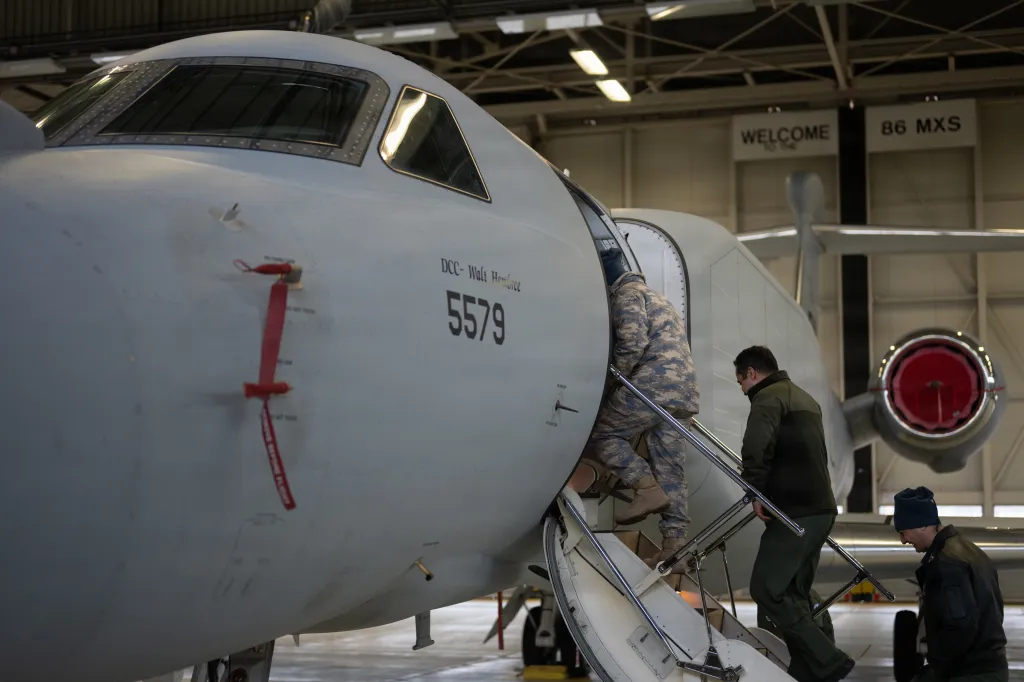

Source link