Thursday

Rain, lightning disrupt opening games of regional playoffs

There was rain, lightning and some comedic reactions for the strange June weather Tuesday that disrupted the opening day of the Southern California regional baseball and softball playoffs.

“Is it raining in June?” asked a stunned El Camino Real baseball player as a downpour fell in Woodland Hills before a Division 2 game against Point Loma. Two fans used artificial turf to shield their heads during a drizzle.

The Division 1 baseball game between Patrick Henry and host Santa Margarita was halted in the fourth inning with Patrick Henry leading 2-0 because of lightning. It will resume Wednesday. The Division 1 softball game between Poway and Ayala was postponed because of rain.

Most games eventually were played and finished.

Point Loma 6, El Camino Real 4: Trailing 6-1 going into the bottom of the seventh inning, the City Section Open Division champions gave Point Loma a scare, scoring three runs and having the bases loaded with two out until Hunter Weller ended the game with a strikeout in a Division 2 opener. Point Loma is the Division I champion from the San Diego Section.

Druw Frost had three hits. A three-run seventh aided by an El Camino Real error helped the Pointers. Phoenix Brant struck out five in 6 1/3 innings. RJ De La Rosa, JJ Saffie and Gavin Farley had RBI singles in the seventh for El Camino Real.

St. John Bosco 2, St. Augustine 1: Jack Champlin picked up the save after strong pitching from Griffin Tagliaferri and Brayden Krakowski. Moise Razo gave the Braves the lead in the third with an RBI double. St. John Bosco will host Villa Park on Thursday in the Division I semifinals.

Villa Park 5, Granite Hills 4: It took nine innings for Villa Park to prevail on the road. Nate Lewis had four hits and three RBIs, including the tiebreaker in the top of the ninth.

Crespi 4, Mater Dei 3: Mikey Martinez hit a three-run home run and Jackson Eisenhauer threw two hits of shutout relief with four strikeouts. Crespi will play the winner of Santa Margarita-Patrick Henry on Thursday.

University City 5, Birmingham 2: The Patriots gave up four runs in the seventh to fall in a Division III opener. University City will play Dos Pueblos, a 10-2 winner over St. Anthony.

Venice 5, Trinity Classical 2: Canon King had a double and triple and Daniel Quiroz added two hits and two RBIs for Venice, which will play at Mt. Carmel on Thursday.

Banning 3, Lemoore 2: The Pilots won their Division IV opener. Angelo Duarte had a walk-off single in the seventh. AJ Herrera had two hits and two RBIs.

Softball

Westlake 5, Rancho Bernardo 3: The Warriors won in Division II and will host Eastlake in the semifinals. Olivia White had a home run.

Legacy 5, Elsinore 4: Isabella Medina had two doubles in the Division III win. Breann Lipold hit two home runs for Elsinore. Legacy will play at St. Bonaventure, a 6-5 win over Southwest EC.

Source link

HBO’s ‘Mountainhead,’ cast enter the 2025 Emmy race

“Mountainhead,” a satirical skewering of tech oligarchs from “Succession” showrunner Jesse Armstrong, arrived this weekend, dropping on the final day of this year’s Emmy eligibility window.

I’m Glenn Whipp, columnist for the Los Angeles Times and host of The Envelope newsletter. While we’re pondering the timeline to upload a human consciousness, let’s consider “Mountainhead” and its Emmy chances.

Newsletter

From the Oscars to the Emmys.

Get the Envelope newsletter for exclusive awards season coverage, behind-the-scenes stories from the Envelope podcast and columnist Glenn Whipp’s must-read analysis.

You may occasionally receive promotional content from the Los Angeles Times.

Another year, another late-breaking HBO movie

Early on in “Mountainhead,” tech bro and Elon Musk stand-in Venis Parish (Cory Michael Smith) uses film history to put the glitches of his company’s latest AI rollout into perspective.

“The first time people saw a movie, everybody ran screaming because they thought they were gonna get hit by a train,” Venis relates, shouting out the Lumiere brothers’ 1895 film, “Arrival of a Train at La Ciotat Station.” “The answer to that was not stop the movies. The answer was: Show more movies. We’re gonna show users as much s— as possible, until everyone realizes nothing’s that f— serious. Nothing means anything, and everything’s funny and cool.”

In the meantime, though, Venis’ social media platform has given users the tools to create deepfakes so realistic they can’t be identified as bogus. Immediately, people all over the world are uploading videos of their enemies committing atrocities, inflaming centuries-old animosities. Reality has collapsed and, with it, global stability.

But for “Mountainhead’s” quartet of tech magnates, played by Smith, Steve Carell, Ramy Youssef and Jason Schwartzman, everything is just fine. As venture capitalist Randall Garrett (Carell) notes, “We have plenty of calories stockpiled. Western countries have strategic commodity reserves, canola oil, lard, frozen orange juice.”

Later, Randall asks: “Are we the Bolsheviks of a new techno world order that starts tonight?”

“Mountainhead” is in many ways scarier than the zombie apocalypse of “The Last of Us” because it feels like its premise is lurking right around the corner. Armstrong came up with the idea for the two-hour movie in November, after immersing himself in podcasts and books about Silicon Valley. He shot it in March, edited it in April and delivered it in May. It captures the DOGE era, specifically in the casual cruelty expressed by its entitled characters.

“Do you believe in other people?” Venis asks Randall. “Eight billion people as real as us?”

Randall’s reply: “Well, obviously not.”

Cory Michael Smith, left, and Steve Carell in "Mountainhead."

Cory Michael Smith, left, and Steve Carell in “Mountainhead.”

(Macall Polay / HBO)

“Mountainhead” aspires more directly to comedy, but because we don’t have a history with these four deplorable men, it’s often difficult to find the humor. “Like ‘Fountainhead’ Mountainhead?” Youssef jokes to Schwartzman about the estate’s title. “Was your interior decorator Ayn Bland?” There’s a procession of put-downs like that. When they’re not roasting each other, they’re trying to boost their own agendas — in the case of the cancer-stricken Randall, it’s the quest to live forever as a disembodied consciousness.

For all its Shakespearean drama, “Succession” was wildly entertaining, more of a comedy than, yes, “The Bear.” Kendall Roy performing the rap “L to the OG” at a party honoring his father’s half-century running Waystar Royco will be the funniest two minutes of television probably forever. But half the fun came from the characters’ reactions to this transcendent moment of cringe. We were deeply invested in this world.

For all their money and power, the “Mountainhead” moguls are, like the Roy children in “Succession,” not serious people. But beyond that, “Mountainhead” doesn’t have much of anything novel to say about its subjects. As good as Smith is at channeling Musk’s alien, empathy-deficient otherness, you can come away with the same level of insight — and entertainment — by spending a few minutes watching Mike Myers on “Saturday Night Live.” I don’t need to watch a movie to know that a guy sitting on a gold toilet isn’t prioritizing anyone’s interests but his own.

“Mountainhead,” as mentioned, arrives on the last day of 2024-25 Emmy eligibility, less by design than from necessity. The paint’s still wet on this film. But this does mark the third straight season that HBO has dropped a TV movie right before the deadline. Last year, it was “The Great Lillian Hall,” starring Jessica Lange as fading Broadway legend. Two years ago, it was the excellent whistleblower thriller “Reality,” featuring a star turn from Sydney Sweeney. Both movies were blanked at the Emmys, though Kathy Bates did manage a Screen Actors Guild Awards nod for “Lillian Hall.”

Did the movies land too late for enough people see them? Perhaps. The late arrival time should mean they’d be fresh in voters’ minds when they fill out their ballots. But you have to be aware of them for that to happen.

Awareness shouldn’t be an issue with “Mountainhead.” Enough people will want to watch the new offering from the creator of “Succession,” and there’s not much else on television vying for attention right now. “Mountainhead” should score a nomination for television movie, even with the category being stronger than usual this year with audience favorites “Rebel Ridge,” the latest “Bridget Jones” movie and Scott Derrickson’s enjoyable, genre-bending “The Gorge” competing.

But actors in these TV movies are at competitive disadvantage as the Emmys lump them together with their counterparts in limited series, performers who are onscreen for a much longer time. This decade, only two TV movie actors have been nominated — Hugh Jackman (“Bad Education”) and Daniel Radcliffe (“Weird: The Al Yankovic Story”). The lead actress category, meanwhile, has been completely dominated by limited series.

Not that there are any women starring in “Mountainhead” because … tech bros. As for the men, Carell, Schwartzman, Smith and Youssef are very good at conveying delusional arrogance. I despised each and every one of their characters. If hate-voting were a thing, they’d all be nominated.

Source link

Scripps National Spelling Bee finals air Thursday night

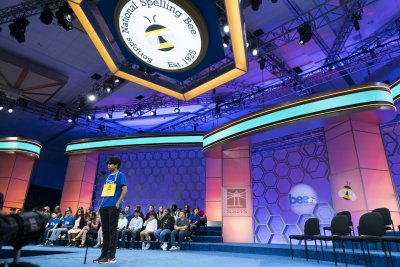
May 29 (UPI) — The final round of the prestigious Scripps National Spelling Bee gets underway at 8 p.m. EDT on Thursday with nine contestants vying for the title.

The event pits 243 spelling champions from every state and the U.S. territories of Puerto Rico, the U.S. Virgin Islands and the Northern Mariana Islands to determine which one earns the Scripps Cup during the spelling competition’s 100th year.

Contestants from Canada, the Bahamas, Germany, Ghana, Kuwait and Nigeria also compete for the title.

National Spelling Bee contestants must not be older than age 15 or have progressed beyond the eighth grade. They advance to the National Spelling Bee by competing in regional competitions.

This year’s nine finalists are between the ages of 11 and 14.

Last year’s runner-up, Faizan Zaki, 13, from Allen, Texas, is among the nine finalists. He lost in a tie-breaking spell-off to last year’s winner, Bruhat Soma.

The winner receives a custom trophy, $52,500 in cash prizes, a commemorative medal and a one-year subscription to reference works from Merriam-Webster and the Encyclopedia Britannica.

All finalists receive at least $2,000, with the second-place finisher winning $25,000.

More than one person can tie for the championship. When two or more contestants tie for the title, each receives the $50,000 grand prize from the National Spelling Bee.

The finals will be aired live on ion, which is available via streaming and many television cable and satellite subscription services.

This year’s National Spelling Bee began on Tuesday, when 60 contestants were eliminated during a preliminary spelling and vocabulary round.

Another 84 spellers were eliminated later on Tuesday after completing a written spelling and vocabulary test.

Three quarterfinal rounds held narrowed the field to 57 semifinalists on Wednesday, and four semifinal rounds produced the nine contestants who qualified for Thursday night’s final round.

The Scripps National Spelling Bee has been held annually since 1925, when nine students competed for the title.

It was suspended from 1943 to 1945 due to World War II and in 2020 due to the COVID-19 pandemic.

The competition has created a historical archive to celebrate the spelling competition’s centennial year.

This year’s competition is its 97th and is being held at the Gaylord National Resort & Convention Center in National Harbor, Md., which has hosted the event since 2011.

Source link

Argentine court declares mistrial in case over death of soccer star Maradona

An Argentine court on Thursday declared a mistrial in the case of seven health professionals accused of negligence in the death of soccer legend Diego Maradona, the latest dramatic twist in a trial that has captivated the nation and the soccer world for more than two months.

The whiplash decision comes after one of the three judges overseeing the trial stepped down over criticism surrounding her participation in a forthcoming documentary about the case.

Her controversial withdrawal compelled the court to either appoint a new judge in her place or to retry the entire case from scratch.

On Thursday, the judges decided the latter, effectively turning the clock back on all proceedings in the case that accuses Maradona’s medical team of failing to provide adequate care for the soccer star in his final days.

The judges ruled there would be a new trial, without specifying when.

Julieta Makintach said that she had “no choice” but to resign from the case Tuesday after the prosecutor showed a teaser-trailer for a documentary, “Divine Justice,” which traces the aftermath of Maradona’s death at the age of 60 to the start of the trailer, clearly featuring Makintach as a main protagonist.

Maradona, who led Argentina to the World Cup title in 1986, died on Nov. 25, 2020, on the outskirts of Buenos Aires, days after undergoing surgery for a hematoma that formed between his skull and brain.

Source link

Cannes: Watch for Jafar Panahi, ‘Sentimental Value’ at Oscars

After reading about these California beaches, can you blame me for thinking about the south of France right about now? And, you know, the movies at Cannes this year were pretty good too. In fact, we might have another best picture Oscar winner from the festival.

I’m Glenn Whipp, columnist for the Los Angeles Times and host of The Envelope newsletter, which is back in your inbox after a springtime sabbatical. Today, I’m looking at the news out of the Cannes Film Festival, wondering if Neon’s publicity team will be getting any rest this coming awards season.

The Cannes-to-Oscars pipeline is flowing

Last year’s Cannes Film Festival gave us a Demi Moore comeback (“The Substance”), an overstuffed, ambitious movie musical that everyone loved until they didn’t (“Emilia Pérez”) and a freewheeling Cinderella story that became the actual Cinderella story of the 2024-25 awards season (“Anora”).

Sean Baker’s “Anora” became just the fourth film to take the festival’s top prize, the Palme d’Or, and then go on to win the Oscar for best picture. But it had been only five years since Bong Joon Ho’s “Parasite” pulled off that feat, so this would seem to be the direction that the academy is going. As the major Hollywood studios have doubled down on IP, indies like A24 and Neon have stepped up, delivering original, daring films that win the hearts of critics, awards voters and, sometimes, moviegoers.

Neon brought “Anora” to Cannes last year, confident that it would make an ideal launching pad. This year, the studio bought films at the festival — among them the taut, tart revenge thriller “It Was Just an Accident,” from dissident Iranian filmmaker Jafar Panahi, and the anarchic political thriller “The Secret Agent” from Brazil’s Kleber Mendonça Filho.

Other men applaud and point to Jafar Panahi, holding the Palme d'Or.

Iranian filmmaker Jafar Panahi holds the Palme d’Or after winning the Cannes Film Festival’s top prize for “It Was Just an Accident.”

(Sameer Al-Doumy / AFP/Getty Images)

“It Was Just an Accident” won the Palme, making it the sixth consecutive time Neon has won the award. Despite being one of the world’s most celebrated and influential filmmakers for movies like “No Bears” and “The White Balloon,” Panahi has never received any recognition at the Oscars. That will change this coming year.

Another movie that might deliver the goods is a title Neon announced at Cannes last year, “Sentimental Value,” an intense family drama that earned a 15-minute standing ovation.

Or was it 17? Or 19? The audience at the Grand Théâtre Lumière might still be standing and applauding; who knows with these Cannes festivalgoers. I’d be long gone, heading to the nearest wine bar. The point is: People love this movie. It won the Grand Prix, Cannes’ second-highest honor.

“Sentimental Value” is a dysfunctional family dramedy focusing on the relationship between a flawed father (the great Stellan Skarsgård) and his actor daughter (Renate Reinsve, extraordinary), two people who are better at their jobs than they are at grappling with their emotions. They’re both sad and lonely, and the film circles a reconciliation, one that’s only possible through their artistic endeavors.

Norwegian director Joachim Trier directed and co-wrote “Sentimental Value,” and it’s his third collaboration with Reinsve, following her debut in the 2011 historical drama “Oslo, August 31st” and the brilliant “The Worst Person in the World,” for which she won Cannes’ best actress prize in 2021. Reinsve somehow failed to make the cut at the Oscars that year, an oversight that will likely be corrected several months from now.

A woman looks over her shoulder, away from a mirror.

Jennifer Lawrence in Lynne Ramsay’s “Die, My Love.”

(Festival de Cannes)

But it’s not just about the prix

Reinsve could well be joined in the category by a past Oscar winner, Jennifer Lawrence, who elicited rave reviews for her turn as a new mother coping with a raft of feelings after giving birth in Lynne Ramsay’s Cannes competition title “Die, My Love.” Critics have mostly been kind to the film, which Mubi bought at the festival for $24 million.

Just don’t label it a postpartum-depression drama, for which Ramsay pointedly chastised reviewers.

“This whole postpartum thing is just bull—,” she told film critic Elvis Mitchell. “It’s not about that. It’s about a relationship breaking down, it’s about love breaking down, and sex breaking down after having a baby. And it’s also about a creative block.”

However you want to read it, “Die, My Love” looks like a comeback for Lawrence, last seen onscreen two years ago, showing her comic chops in the sweetly raunchy “No Hard Feelings.” Lawrence won the lead actress Oscar for the 2012 film “Silver Linings Playbook” and has been nominated three other times — for “Winter’s Bone,” “American Hustle” and “Joy.”

With Ramsay’s movie, which co-stars Robert Pattinson as her husband, Lawrence may well have printed her return ticket to the ceremony, which would be welcome. The Oscars are always more fun when she’s in the room.

More coverage from the festival

Source link

Prep talk: Grant Leary of Crespi is a golfer to watch

Grant Leary of Crespi High has a future as a golfer _ and photographer.

After winning the Southern Section individual title last week with a 66, Leary went on to practice his other fun endeavor — photography. He was shooting photos for the school yearbook at Crespi’s Southern Section Division 1 baseball playoff game.

Asked to set up a photo of himself, he brought out an iron, put one of his unused tees in his mouth and posed with a smile.

Only a junior, Leary won the tournament at Temecula Creek Country Club. He went to the final hole tied. He faced a seven-foot putt for a par but wasn’t aware of its importance.

“I knew it was a very big putt,” he said. “I didn’t know if it was for a tie or the win.”

He didn’t celebrate after making it but later learned it gave him victory.

Golf was the last sport he started playing in eighth grade. His father is a golf instructor.

Next up is the regional state qualifier on Thursday at Los Serranos Golf Course.

This is a daily look at the positive happenings in high school sports. To submit any news, please email [email protected].


Source link

Los Tigres del Norte Way is the newest street in New York City

For nearly six decades, Los Tigres del Norte’s name has been all over the charts, on countless marquees, seven Grammys and, now, one street in New York City.

On Thursday, the historic música Mexicana band showed up to the Sunset Park neighborhood of Brooklyn, surrounded by fans at the grand presentation of the newly minted Los Tigres del Norte Way.

“Starting today, a street in Brooklyn carries the name of Los Tigres del Norte,” the group wrote in an Instagram post Thursday evening. “Thank you for walking with us, today and always.”

The Sinaloense legends’ street sign is located on 5th Avenue and 47th Street in Brooklyn, surrounded by a litany of Latino restaurants.

“We’ve been coming to New York for so many years,” vocalist and accordion player Jorge Hernandez said in a TV interview Wednesday with New York’s Fox 5. “We’ve been able to connect with the community, so that’s why we’ve been selected today to have the street and we are very happy to be honored tomorrow.”

The road naming occurred on the same day as the release of the “La Puerta Negra” artists’ latest five-track EP “La Lotería.” The title track is a sociopolitical corrido that uses the imagery of the popular bingo-like Mexican game to comment on topics like immigration and the past criminality of the current U.S. president.

The band will play its first-ever show at New York’s historic Madison Square Garden on May 24 to wrap up their current East Coast stint before performing June 13 at the Agua Caliente Casino in Rancho Mirage, Calif., and June 15 in Del Mar, Calif.

However, Thursday’s festivities weren’t the first time that the “Jaula de Oro” band was honored with a street-naming ceremony. A strip of W. 26th Street in Chicago is honorarily named after the 12-time Latin Grammy winners. The street runs through the Windy City’s Little Village neighborhood, which is known as the “Mexico of the Midwest” due to upwards of 80% of its residents being of Mexican descent.

Los Tigres del Norte were feted locally in 2014 in the most L.A. way possible — with a star on the Hollywood Walk of Fame.

In June, the group will receive lifetime recognition for its members’ continued immigration advocacy from Monterey County officials ahead of their tour date in Salinas, Calif.


Source link

L.A. City Council approves $14-billion budget, scaling back Bass’ public safety plans

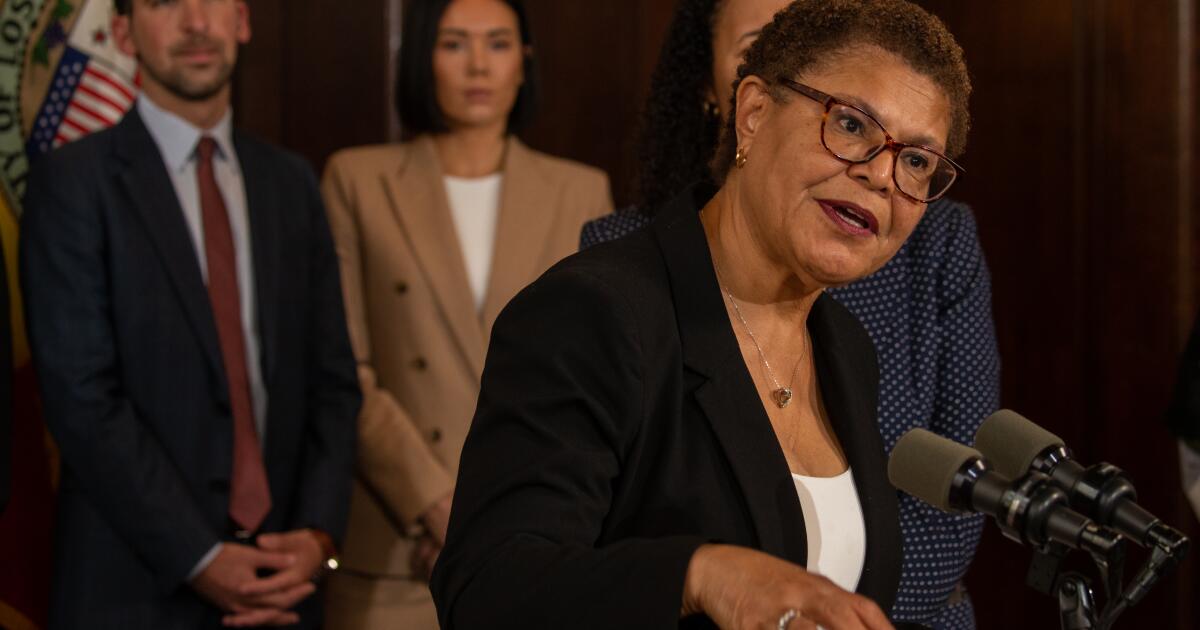
The Los Angeles City Council signed off on a $14-billion spending plan for 2025-26 on Thursday, scaling back Mayor Karen Bass’ public safety initiatives as they attempted to spare 1,000 city workers from layoffs.

Faced with a nearly $1-billion budget shortfall, the council voted 12 to 3 for a plan that would cut funding for recruitment at the Los Angeles Police Department, leaving the agency with fewer officers than at any point since 1995.

The council provided enough money for the LAPD to hire 240 new officers over the coming year, down from the 480 proposed by Bass last month. That reduction would leave the LAPD with about 8,400 officers in June 2026, down from about 8,700 this year and 10,000 in 2020.

The council also scaled back the number of new hires the mayor proposed for the Los Angeles Fire Department in the wake of the wildfire that ravaged huge stretches of Pacific Palisades.

Bass’ budget called for the hiring of 227 additional fire department employees. The council provided funding for the department to expand by an estimated 58 employees.

Three council members — John Lee, Traci Park and Monica Rodriguez — voted against the budget, in large part due to cost-cutting efforts at the two public safety agencies. Park, whose district includes Pacific Palisades, voiced alarm over those and other reductions.

“I just can’t in good conscience vote for a budget that makes our city less safe, less physically sound and even less responsive to our constituents,” she said.

Rodriguez offered a similar message, saying the council should have shifted more money out of Inside Safe, Bass’ signature program to address homelessness. That program, which received a 10% cut, lacks oversight and has been extraordinarily expensive, said Rodriguez, who represents the northeast San Fernando Valley.

“Inside Safe currently spends upwards of $7,000 a month to house a single individual. That’s just room and board and services,” she said. “That doesn’t include all of the other ancillary services that are tapped from our city family in order to make it work, including LAPD overtime, including sanitation services, including the Department of Transportation.”

Councilmember Tim McOsker, who sits on the budget committee, said the fire department would still see an overall increase in funding under the council’s budget. Putting more money into the police and fire departments would mean laying off workers who fix streets, curbs and sidewalks, said McOsker, who represents neighborhoods stretching from Watts south to L.A.’s harbor.

McOsker said it’s still possible that the city could increase funding for LAPD recruitment if the city’s economic picture improves or other savings are identified in the budget. The council authorized the LAPD to ramp up hiring if more money can be found later in the year.

“I would love to put ourselves in a position where we could hire more than 240 officers, and maybe we will. I don’t know. But today we can’t,” McOsker told his colleagues.

Councilmember Ysabel Jurado, who joined the council in December, also defended the budget plan, saying it would help create “a more just, equitable and inclusive Los Angeles.”

“This budget doesn’t fix everything. It doesn’t close every gap. But it does show a willingness to make some structural changes,” she said.

Bass aides did not immediately respond to inquiries about the council’s actions. A second budget vote by the council is required next week before the plan can head to the mayor’s desk for her consideration.

Bass’ spending plan proposed about 1,600 city employee layoffs over the coming year, with deep reductions in agencies that handle trash pickup, streetlight repair and city planning. The decisions made Thursday would reduce the number to around 700, said City Administrative Officer Matt Szabo, who helps prepare the spending plan.

The remaining layoffs could still be avoided if the city’s unions offer financial concessions, said Councilmember Katy Yaroslavsky, who heads the council’s budget committee. For example, she said, civilian city workers could cut costs by taking four to five unpaid furlough days.

“My goal, my fervent goal and hope, is that labor comes to the table and says ‘We’ll take some furloughs, we’ll take some comp time off,’” Yaroslavsky said.

The city entered a full-blown financial crisis earlier this year, driven in large part by rapidly rising legal payouts, weaker than expected tax revenues and scheduled raises for city employees. Those pay increases are expected to consume $250 million over the coming fiscal year.

To bring the city’s budget into balance, council members tapped $29 million in the city’s budget stabilization fund, which was set up to help the city weather periods of slower economic growth. They took steps to collect an extra $20 million in business tax revenue. And they backed a plan to hike the cost of parking tickets, which could generate another $14 million.

At the same time, the council scaled back an array of cuts proposed in Bass’ budget. Over the course of Thursday’s six-hour meeting, the council:

* Restored positions at the Department of Cultural Affairs, averting the closure of the historic Hollyhock House in East Hollywood, protecting its status as a UNESCO World Heritage site.

* Provided the funds to continue operating the Climate Emergency Mobilization Office, which had been threatened with elimination.

* Provided $1 million for Represent LA, which pays for legal defense of residents facing deportation, detention or other immigration proceedings. That funding would have been eliminated under Bass’ original proposal, Councilmember Eunisses Hernandez said.

* Moved $5 million into the animal services department — a move requested by Bass — to ensure that all of the city’s animal shelters remain open.

* Restored funding for streetlight repairs, street resurfacing and removal of “bulky items,” such as mattresses and couches, from sidewalks and alleys.

Even with those changes, the city is still facing the potential for hundreds of layoffs, around a third of them at the LAPD.

Although the council saved the jobs of an estimated 150 civilian workers in that department — many of them specialists, such as workers who handle DNA rape kits — another 250 are still targeted for layoff.

“We took a horrible budget proposal, and we made it into one that is just very bad,” said Councilmember Bob Blumenfield, who represents part of the west San Fernando Valley. “It took a lot of work to do that, but it is better and we did save jobs. But the fundamentals are still very bad.”


Source link

Senate Republicans vow changes to Trump megabill

Landmark legislation that would rewrite the tax code and levy steep cuts to programs providing healthcare and food stamps to the poor passed the House early Thursday, a development that was celebrated by President Trump despite the bill facing an uncertain future among Senate Republicans.

The measure, titled the “One Big Beautiful Bill Act,” would boost funding for border security and the Defense Department, eliminate taxes on tips and overtime, provide a new tax deduction to seniors and renew the 2017 tax cuts passed during the first Trump administration. To pay for those new funding commitments, the bill proposes eliminating green energy tax benefits passed under President Biden, as well as an estimated $1 trillion in cuts to Medicaid and the Supplemental Nutrition Assistance Program.

Even still, the bill would add so much money to the debt that Congress may be forced to execute cuts across the board, including hundreds of billions to Medicare, in a process known as sequestration, according to the nonpartisan Congressional Budget Office.

The House vote fell along party lines. By opposing the bill, the Trump administration said that Democrats were supporting the largest tax increase on middle-class Americans in decades, a reference to the upcoming expiration of Trump’s 2017 tax cuts at the end of the year.

Democrats, on the other hand, have accused Republicans of voting for the deepest cuts to healthcare in modern times. By creating new barriers to Medicaid coverage through the introduction of work hour requirements, as well as increasing premiums under the Affordable Care Act, the CBO and other nonpartisan organizations estimate up to 14 million Americans could lose their insurance coverage.

Those drastic changes to the healthcare landscape have given pause to several Republican senators.

Sen. Susan Collins of Maine has said she is “very wary of cutting Medicaid.” Sen. Josh Hawley of Missouri said he “can’t support” substantial cuts to Medicaid benefits. And after the vote on Thursday, Sen. Roger Marshall of Kansas said that material changes should be expected to the House bill.

“We need to go back through that bill with a fine tooth comb and make it better,” Marshall said in an interview with Newsmax. “I think there’s opportunities in Medicaid to make that bill better, to make sure that we strengthen it, that we preserve it for those who need it most.”

Any Senate rollback of cuts to the Medicaid program could face resistance from the House Freedom Caucus during the reconciliation process. Members of that group, which proclaims a commitment to fiscal conservatism, have called for even deeper cuts to the Medicaid program.

Rep. Andy Harris of Maryland, chair of the House Freedom Caucus, voted “present” early Thursday morning, preserving negotiating leverage as the bill makes its way across Capitol Hill.

“I voted to move the bill along in the process for the president,” Harris wrote on social media. “There is still a lot of work to be done in deficit reduction and ending waste, fraud, and abuse in the Medicaid program.”

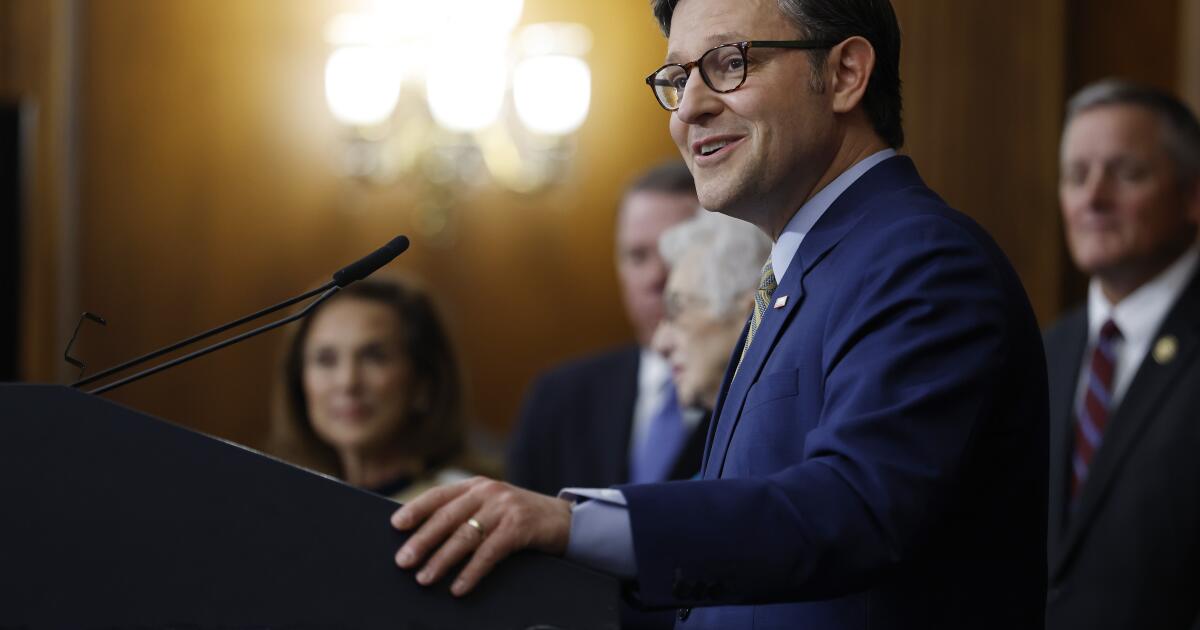
The vote came hours after Trump met with GOP holdouts at the White House. As late as Wednesday afternoon, before meeting with the president, several of those lawmakers were casting doubt on the prospects of the bill’s passage this week, ahead of a Memorial Day deadline set by House Speaker Mike Johnson, a Louisiana Republican.

Republican Sen. Lindsey Graham of South Carolina was dismissive of the Freedom Caucus on Thursday, telling CNN that the cuts they are pushing for would barely make a dent in the national debt.

“You had your chance,” Graham said to the caucus. “Some of these cuts are not real. We’re talking about over a decade — you know, if you do $1.5 trillion, that’s like a percent and a half. So let’s don’t get high on our horse here that we’ve somehow made some major advancement of reducing spending, because we didn’t.”

Sen. Kevin Cramer of North Dakota also mocked the caucus, calling it “rich” for its members to lecture Senate Republicans on fiscal conservatism, “and end up with not that conservative a bill.” The CBO estimates the House legislation would result in a $3.8-trillion increase to the deficit.

If passed, the new work requirements to Medicaid would kick in at the end of 2026, right after the midterm elections. Green energy tax credits would phase out for any project that is not already under construction 60 days after the law comes into force.

The cap on the state and local tax deduction, known as SALT, will increase to $40,000 from $10,000, phasing out for individuals and households making more than $500,000. And while the president campaigned on a promise to eliminate taxes on Social Security, a parliamentary rule precluded Republicans from including a full cut. Instead, the bill proposes an enhanced tax deduction for senior citizens of up to $4,000.

On Truth Social, the president’s social media platform, Trump wrote that the bill is “arguably the most significant piece of Legislation that will ever be signed in the History of our Country!”

“There is no time to waste,” he added. Johnson, the speaker, has set a goal of sending the bill to the president’s desk by Independence Day.

Trump’s press secretary, Karoline Leavitt, said the president’s team was “suiting up” for negotiations with the Senate now that the bill has passed the House. “We will see how it goes,” she said.

“The ‘One Big Beautiful Bill’ is named the ‘One Big Beautiful Bill’ for a reason, because it is a one big beautiful bill that encompasses just about everything this president could want for the American public. It delivers on so many of his core campaign promises. So surely we want to see those campaign promises signed into law,” Leavitt said. “He’s expecting them to get busy on this bill and send it to his desk as soon as possible.”

The two House Republicans who voted against the bill, Thomas Massie of Kentucky and Warren Davidson of Ohio, should face primary challenges for their defiance of the president’s directive, Leavitt added.

“What’s the alternative, I would ask those members of Congress. Did they want to see a tax hike? Did they want to see our country go bankrupt? That’s the alternative by them trying to vote no,” she said. “The president believes that the Republican Party needs to be unified.”

Source link

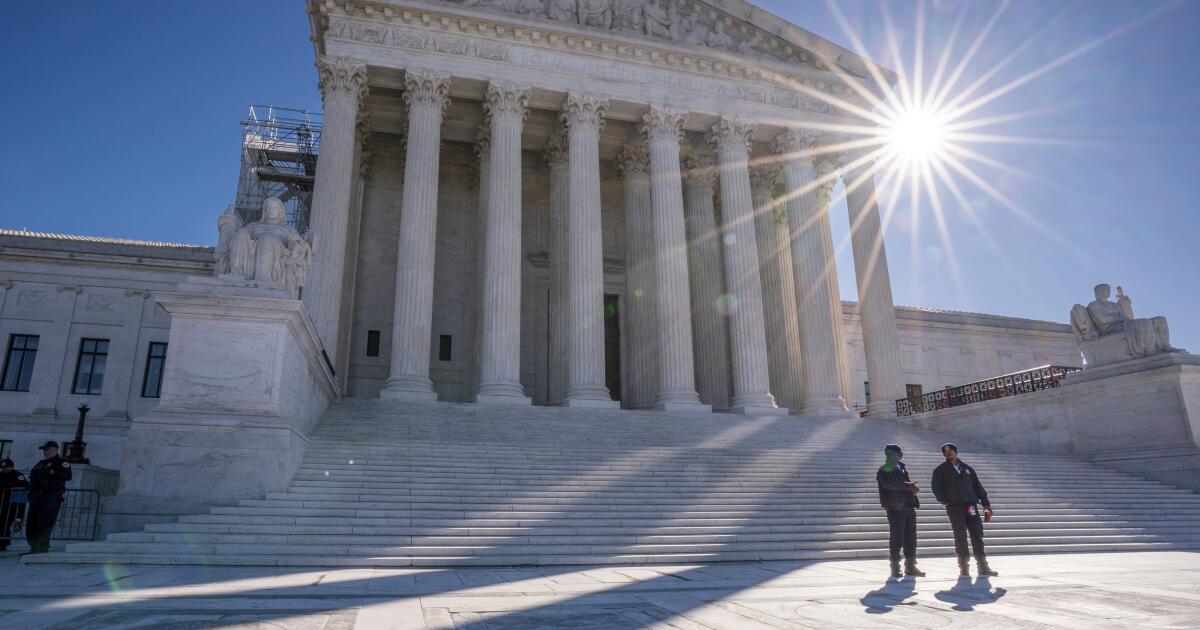
Supreme Court splits 4-4, blocking first religious charter school in Oklahoma

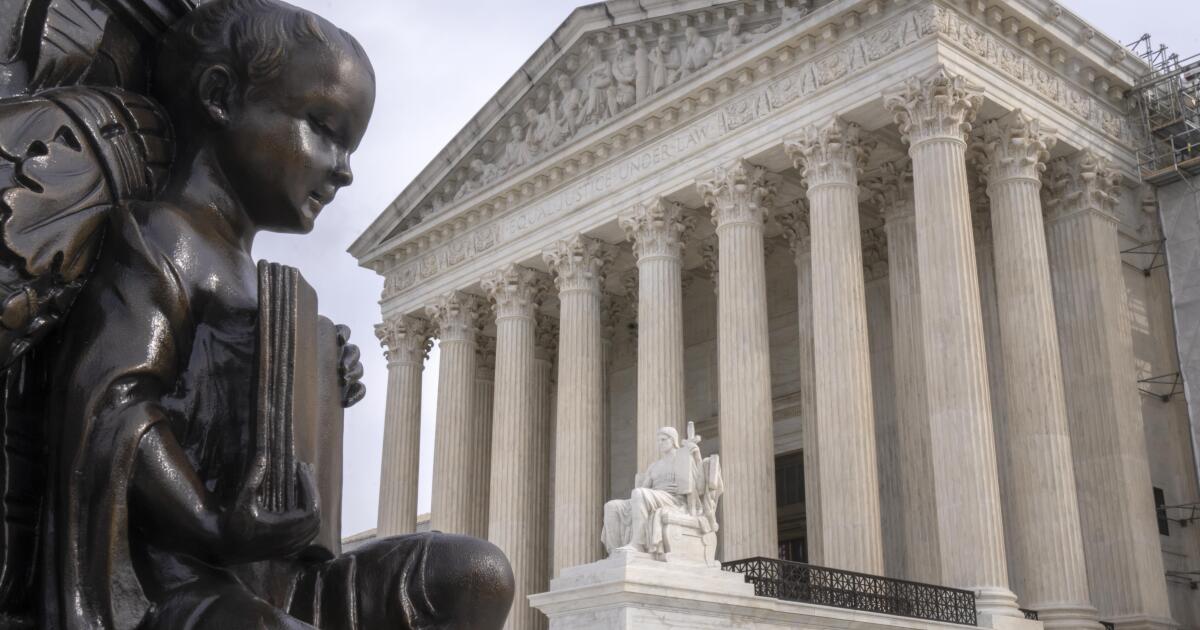
The Supreme Court dealt an unexpected blow Thursday to the conservative drive for religious charter schools.

The justices announced they were split 4-4 in a test case heard last month from Oklahoma, which blocks the new Catholic charter school in the state.

Justice Amy Coney Barrett had announced in advance she would not participate in the decision. A former Notre Dame law professor, she was a close friend of law professor Nicole Garnett, who led the drive for faith-based charter schools.

Chief Justice John G. Roberts sounded uncertain during the oral argument in late April. In the past, he had said states may not discriminate against religious groups, but Oklahoma’s law applied only to public schools, not private ones that were religious.

Defenders of church-state separation had argued that charter schools by law were public, not “sectarian” or religious. They urged the court to uphold the laws as written.

Four other conservative justices had signaled they would vote to allow the religious charter school.

While Thursday’s split decision is a major setback for religious rights advocates, it does not finally settle the issue of religious charter schools. It’s possible, for example, that Justice Barrett may participate in a future case.

This is a breaking news story and will be updated.

Source link

With record Memorial Day weekend travel expected, here’s what to know

Along with vacation necessities such as sunblock and a toothbrush, Southern Californians hoping to get away for Memorial Day weekend will also need to bring a hefty supply of patience to freeways and airports.

A record-breaking number of people across the country are opting to travel rather than stay in for the long weekend— the official kickoff to summer, according to the Automobile Club of Southern California, or AAA.

In Southern California, about 3.6 million are expected hit the road or hop on a plane, the third consecutive year of record-breaking travel for Memorial Day weekend.

“Consumers continue to prioritize travel with family and friends after the pandemic,” Jena Miller, vice president of travel products for AAA, said in a statement.

Most people will be behind the wheel for their weekend getaways, according to AAA. Roughly 2.9 million people in Southern California are expected to hit the road starting Thursday, about 3.6% more than last year.

About 45.1 million people across the country will be traveling for the long weekend and most of them — about 39.4 million — will be driving, AAA estimates.

The automobile club said drivers will also be paying less with car rental costs expected to be about 8% lower than last year, and gas prices about 50 to 60 cents cheaper than last May.

More drivers means more potential gridlock, but the midmorning traveler has a better chance of being rewarded with a speedier commute. Experts say before noon is the best time for people to get on the road this weekend.

“Thursday, May 22 and Friday, May 23 are expected to be the busiest travel day,” Gianella Ghiglino, a spokesperson for AAA, said in a statement. “So if you are leaving those days, you want to make sure you avoid that morning rush hour and you still leave before noon.”

In Southern California, the busiest stretch of freeway is expected to be the 5 Freeway from Los Angeles to Bakersfield, where the typical 90-minute drive could take up to three hours during the worst times, according to AAA.

Vacationers looking to hop on a flight this weekend should be prepared for packed airports.

According to the Federal Aviation Administration, nearly 54,000 flights are scheduled Thursday, the busiest day of air travel for the weekend and one of the busiest days of the year so far at airports across the country.

That increase will come despite the fact that domestic flights cost about 2% more this year compared with 2024, according to AAA.

The Transportation Security Administration is bracing for the rush of travelers. The agency expects to screen about 18 million passengers and crew members between Thursday and Wednesday.

“TSA is ready for the additional passenger volume, and we look forward to welcoming families traveling during this peak period,” Ha McNeill, TSA acting administrator, said in a statement.

Officials are encouraging air passengers to ensure bags are compliant with TSA regulations and to bring a Real ID or other acceptable identification such as a passport.

Source link

Nathan Santa Cruz takes aim at City Section 400 title

Sitting in the Birmingham High bleachers wearing headphones before running the 400 meters at the City Section track and field prelims, 17-year-old senior Nathan Santa Cruz looks like a teenager comfortable and confident. Teammates gravitate to him. Maybe it’s his smile. Or maybe they want to be near someone enjoying each and every day.

A traumatic experience changed his outlook on life in the fall of 2022 when he suffered a brain injury in the opening football game for Venice High and underwent emergency surgery to stop bleeding.

“We don’t know if he’s going to make it,” his mother, Crystal Clark, remembers being told at the hospital.

Nathan Santa Cruz holds up his right ram as he prepares to enter the starting blocks for a 400-meter race.

Nathan Santa Cruz, who survived a brain injury in 2022, goes for a City Section title at 400 meters.

(Craig Weston)

Santa Cruz recovered so well that he played two more years of football, but his real love was using his speed in track. Last season he finished second in the City Section 400. This year, he ran a career-best time of 47.74 seconds at the Arcadia Invitational.

On Thursday, he’ll have a rematch against Justin Hart of Granada Hills in the 400 final. They ran one-two last season.

“I think it’s going to be a real competitive race,” Santa Cruz said. “I’m going to try to come out on top.”

If he doesn’t finish first, he’s already won. He has a track scholarship waiting for him at Cal Poly Pomona, where he plans to study business or criminology. And he has grown up fast because of what happened to him. He’s no normal teenager when you listen to what he believes.

“At the end of the day, it’s God giving you another chance to wake up,” he said. “Make sure I’m better than yesterday. That’s what I do.”

Granada Hills' Justin Hart, the son of former NBA player Jason Hart, is favored in the City 400 and 200.

Granada Hills’ Justin Hart, the son of former NBA player Jason Hart, is favored in the City 400 and 200.

(Craig Weston)

His competitor, Hart, has his own story to tell. He’s the son of Kentucky basketball assistant coach Jason Hart, who spent 10 years in the NBA. An older brother, Jason II, also played basketball but Justin was different.

Justin played lots of sports, including basketball, but when he was 7, he told his father, “I don’t want to do this anymore. I don’t want you to waste your money.”

He wanted to run.

“I didn’t want to be in my dad’s shadow. I wanted to create my own identity in my own sport,” he said.

He won the 400 and was second in the 200 at last year’s City final. He’s going for a sweep on Thursday and is just getting started.

“I think the ceiling is really high,” Granada Hills coach Johnny Wiley said.

He’ll welcome his father and mother in the bleachers cheering loudly.

There really won’t be any losers when Hart and Santa Cruz square off. They come from great families and have learned lessons that will help them succeed for years to come.

Santa Cruz makes it clear he runs to make his mother proud because he’ll never forget a memory from his hospital experience.

“Seeing her cry at the hospital, I knew I had to go make an impact in her life, make it so she didn’t have to pay for her kid to go to college,” he said. “Seeing her smile, that’s why I do it.”

And when days don’t go as well as he might like, Santa Cruz said he has learned, “It’s just the way life goes. I think God gives his toughest battles to his strongest soldiers.”

Source link

Team Bieber says Diddy didn’t do anything — to Justin

Amid all of Casandra Ventura’s troubling testimony this week about life with Sean “Diddy” Combs and his “freak-off” fetish, don’t be troubled thinking about what might have happened between Combs and Justin Bieber, who was launched into the mogul’s circle when he was a teen.

Despite persistent speculation as footage of the two together has surfaced, Team Bieber said Thursday that nothing happened. Move along, nothing to see here.

The speculation comes at a time when Bieber has been worrying fans with photos showing him smoking — a shot posted Thursday had the self-declared former substance abuser sitting with a bong quite obviously in his lap — and “It’s a cult” rumors about the church he has been attending, Churchome in Beverly Hills. (Churchome pastor Judah Smith denies those rumors, by the way.) Bieber’s decision in recent years to sell his catalog for $200 million is said to have been motivated by the pop star allegedly finding himself completely broke despite generating many millions for himself and others while touring.

The new dad’s marriage is rumored to be in trouble as well, though on Friday the Biebs tagged wife Hailey in an Instagram story showing a male lion lovingly caressing a female lion with its nose and teeth.

Combs, of course, is on trial on charges of sex trafficking, racketeering and more. This week in court has seen dramatic testimony from Combs’ former girlfriend Cassie.

But back to Bieber, who was discovered by Scooter Braun in 2008 and quickly signed to a label run by Braun and Usher. Usher was a Combs protégé who was sent by record executive and producer L.A. Reid to live with the mogul in the ’90s and maybe learn a few things. The “Yeah” singer was 15 when he moved to New York. Combs became Usher’s legal guardian.

Reid wrote in his 2016 tell-all memoir “Sing to Me,” via Rolling Stone, “‘Will you take this kid and teach him your swagger?’ I said. ‘Can you just give him some of your flavor?’ And so I sent Usher to New York for what I called the ‘Puffy Flavor Camp.’”

He added, “I was turning him over to the wildest party guy in the country at an age when I still needed to get his mother’s permission, but he went to New York for almost a year. I didn’t know whether I was being irresponsible or having an epiphany.”

Usher would tell Howard Stern in 2016 that he “got a chance to see some things” while living with Combs.

“I went there to see the lifestyle, and I saw it. I don’t know if I could indulge and understand what I was even looking at,” he said on Stern’s show. “I had curiosity of my own. I just didn’t understand it. It was pretty wild. It was crazy.”

Usher said he was mostly focused on making music at the time, no matter what “curious” things might have gone on around him.

So when Bieber and Usher connected, could a Combs meet be far behind?

Sean Combs hollers with his arm around a shirtless Justin Bieber next to Rick Ross

Sean “Diddy” Combs, from left, Justin Bieber and Rick Ross at a Ciroc vodka party in Atlanta in early 2014, when Bieber was 19.

(Prince Williams / FilmMagic via Getty Images)

Combs and the “Baby” singer made news with an interview on Jimmy Kimmel’s show after the “Justin Bieber’s 48 Hrs with Diddy” video was posted on YouTube in November 2009.

In the video, Combs showed Bieber a silver Lamborghini and told him, “The keys is yours, you know, when you hit 16.” That was after Bieber pitched driving it right away with Combs in the passenger seat, because he had his permit. After staring at the kid for a moment, Combs simply said, “No.” Then he promised him the mansion when he turned 18. Combs didn’t have legal guardianship of Bieber like he did with Usher, he said, but they would be together for the next 48 hours.

“He knows better than to talk about the things that he’s done with big brother Puff on national television,” Combs said later in the Kimmel interview, adding, “Everything ain’t for everybody.” That was after he described Bieber as “a little brother” and “one of the greatest kids you could ever know” who could always call up and ask him for industry advice.

The two would continue to cross paths, including at parties for Combs’ vodka Ciroc, a brand the embattled mogul cut ties with in January 2024.

Bieber’s camp released a statement Thursday asserting that nothing untoward ever happened between the two.

“Although Justin is not among Sean Combs’ victims, there are individuals who were genuinely harmed by him,” a spokesperson for Bieber told TMZ. “Shifting focus away from this reality detracts from the justice these victims rightfully deserve.”

The Times was unable to reach a Bieber representative Friday.


Source link

Contributor: Lower-court judges have no business setting the law of the land

On Thursday, the Supreme Court heard oral arguments in the case of Trump vs. CASA Inc. Though the case arises out of President Trump’s January executive order on birthright citizenship and the 14th Amendment, Thursday’s oral argument had very little to do with whether everyone born in the U.S. is automatically a U.S. citizen. Instead, the argument mostly focused on a procedural legal issue that is just as important: whether lower-court federal judges possess the legitimate power to issue nationwide injunctions to bring laws or executive orders to a halt beyond their districts.

There is a very straightforward answer to this question: No, they don’t. And it is imperative for American constitutionalism and republican sef-governance that the justices clearly affirm that.

Let’s start with the text. Article III of the Constitution establishes the “judicial Power” of the United States, which University of Chicago Law School professor Will Baude argued in a 2008 law review article “is the power to issue binding judgments and to settle legal disputes within the court’s jurisdiction.” If the federal courts can bind certain parties, the crucial question is: Who is bound by a federal court issuing an injunction?

In our system of governance, it is only the named parties to a given lawsuit that can truly be bound by a lower court’s judgment. As the brilliant then-Stanford Law School professor Jonathan Mitchell put it in an influential 2018 law review article, an “injunction is nothing more than a judicially imposed non-enforcement policy” that “forbids the named defendants to enforce the statute” — or executive order — “while the court’s order remains in place.” Fundamentally, as Samuel L. Bray observed in another significant 2017 law review article, a federal court’s injunction binds only “the defendant’s conduct … with respect to the plaintiff.” If other courts in other districts face a similar case, those judges might consider their peer’s decision and follow it, but they are not strictly required to do so. (For truly nationwide legal issues, the proper recourse is filing a class-action lawsuit, as authorized by Rule 23 of the Federal Rules of Civil Procedure.)

One need not be a legal scholar to understand this commonsense point.

Americans are a self-governing people; it is we the people, according to the Constitution’s Preamble, who are sovereign in the United States. And while the judiciary serves as an important check on congressional or executive overreach in specific cases or controversies that come before it (as Article III puts it), there is no broader ability for lower-court judges to decide the law of the land by striking down a law or order for all of the American people.

As President Lincoln warned in his first inaugural address: “The candid citizen must confess that if the policy of the government upon vital questions affecting the whole people is to be irrevocably fixed by” the judiciary, “the instant they are made in ordinary litigation between parties in personal actions, the people will have ceased to be their own rulers.”

Simply put, the patriots of 1776 did not rebel against the tyranny of King George III only to subject themselves, many generations later, to the black-robed tyranny of today. They fought for the ability to live freely and self-govern, and to thereby control their own fates and destinies. Judicial supremacy and the concomitant misguided practice of nationwide injunctions necessarily deprive a free people of the ability to do exactly that.

It is true that Chief Justice John Marshall’s landmark 1803 ruling in Marbury vs. Madison established that “it is emphatically the province and duty of the judicial department to say what the law is.” But it is also true, as Marshall noted in the less frequently quoted sentence directly following that assertion: “Those who apply the rule to particular cases, must of necessity expound and interpret that rule.” Note the all-important qualifier of “apply the rule to particular cases.” Marbury is often erroneously invoked to support judicial supremacy, but the modest case- and litigant-specific judicial review that Marshall established has nothing to do with the modern judicial supremacy and nationwide injunctions that proliferate today. It is that fallacious conception of judicial supremacy that was argued Thursday at the Supreme Court.

Chief Justice John G. Roberts Jr., one of the swing votes in CASA, is not always known for judicial modesty. On the contrary, in clumsily attempting to defend his institution’s integrity, he has at times indulged in unvarnished judicial supremacist rhetoric and presided over an unjustifiable arrogation of power to what Alexander Hamilton, in the Federalist No. 78, referred to as the “least dangerous” of the three branches.

If Roberts and his fellow centrist justices — namely, Brett Kavanaugh and Amy Coney Barrett — have any sense of prudence, they must join their more stalwart originalist colleagues in holding that nationwide injunctions offend the very core of our constitutional order. Such a ruling would not merely be a win for Trump; it would be a win for the Constitution and for self-governance itself.

Josh Hammer’s latest book is “Israel and Civilization: The Fate of the Jewish Nation and the Destiny of the West.” This article was produced in collaboration with Creators Syndicate. @josh_hammer

Insights

L.A. Times Insights delivers AI-generated analysis on Voices content to offer all points of view. Insights does not appear on any news articles.

Viewpoint
This article generally aligns with a Right point of view. Learn more about this AI-generated analysis
Perspectives

The following AI-generated content is powered by Perplexity. The Los Angeles Times editorial staff does not create or edit the content.

Ideas expressed in the piece

  • The article argues that lower-court judges lack constitutional authority to issue nationwide injunctions, emphasizing that such injunctions exceed the judiciary’s role as defined by Article III. It asserts that injunctions should bind only named parties in a lawsuit, not the entire population, to preserve self-governance[1][2][3].
  • Citing legal scholars like Will Baude and Jonathan Mitchell, the author contends that nationwide injunctions distort the judicial process by allowing plaintiffs to “venue shop” for favorable rulings, effectively enabling a single judge to dictate policy for all Americans. This undermines the principle that courts resolve disputes between specific parties, not set broad legal precedent[1][2][3].
  • The piece invokes historical precedents, including President Lincoln’s warnings about judicial overreach and Chief Justice Marshall’s Marbury v. Madison, to argue that judicial review should apply narrowly to individual cases. It frames nationwide injunctions as a modern departure from the Founders’ vision of a limited judiciary[1][3].

Different views on the topic

  • During oral arguments, New Jersey Solicitor General Jeremy Feigenbaum argued that nationwide injunctions should remain permissible in specific circumstances, such as cases involving constitutional rights or systemic federal policies, to prevent inconsistent enforcement across jurisdictions[3].
  • Advocates for retaining injunctions highlight their role in checking executive overreach, particularly in high-stakes cases like challenges to Trump’s birthright citizenship order. They argue that without this tool, harmful policies could remain in effect for years while litigation proceeds in multiple courts[4][3].
  • Legal scholars and some justices have raised concerns that banning nationwide injunctions entirely could create regulatory chaos, citing examples like the FTC’s non-compete ban and environmental rules, where injunctions provided temporary uniformity while courts resolve conflicting rulings[3][4].

Source link

Chris Brown arrested for alleged tequila bottle attack

Chris Brown is facing the music for allegedly smashing a tequila bottle over a music producer’s head at a London nightclub two years ago. The R&B star was arrested in connection to the incident early Thursday, The Times has confirmed.

The Metropolitan Police force said in a Thursday statement that it arrested a 36-year-old man shortly after 2 a.m. in a hotel in Manchester, England, “on suspicion of grievous bodily harm. “ The controversial “Under the Influence” singer, 36, remains in custody. Brown was arrested for his alleged involvement in a February 2023 “incident at a venue in Hanover Square,” the statement said.

Though police did not provide additional details — including the nature of the incident or the venue — the charge echoes allegations music producer Amadou “Abe” Diaw raised against Brown in a civil lawsuit filed in October 2023. Detectives for the Central West Area Basic Command Unit have launched an investigation, the statement added.

A representative for the Grammy winner did not immediately respond to The Times’ request for comment Thursday.

Brown was arrested more than two years after he allegedly “brutally assaulted” Diaw by “beating him over the head” with a bottle of Don Julio 1942 Tequila at the TAPE nighclub in London, according to the lawsuit reviewed by The Times. The complaint, filed in Los Angeles County Superior Court, accuses Brown of assault and battery and intentional infliction of emotional distress. The co-defendants include Live Nation, Sony, RCA Records, and another musician, among others.

In the 13-page complaint, Diaw claims he and a friend entered the nightclub and noticed Brown and the other artist “approaching them in a seemingly friendly manner.” The encounter took a turn when Brown allegedly began beating Diaw “on top of the head” with the tequila bottle, striking the top left side of his head three times, the lawsuit said. Diaw claims Brown — whose music career has been marred by numerous allegations of assault (he notably pleaded guilty to assaulting ex-girlfriend Rihanna) — “inflicted severe and lasting injuries” by smashing his head with the bottle and “continued to ruthlessly stomp on” him as he lay unconscious on the nightclub floor following the bottle attack. The other artist who was with Brown also allegedly kicked Diaw in the stomach and legs.

Nightclub staff intervened and brought Diaw out of the venue. Diaw was hospitalized “with lacerations on his head and torn ligaments on his leg,” according to the suit. He continues to suffer “double vision and significant pain in his legs” and needs continued treatment and therapy.

The bottle attack was captured by nightclub surveillance cameras and Metropolitan Police obtained the footage, the complaint said. Diaw also accuses Brown and the other co-defendants of engaging in “defamatory conduct by spreading false rumors about” his clients and claiming he “is a thief in an effort to sabotage professional relationships.”

Diaw seeks an unspecified amount in damages exceeding $25,000 including medical expenses, loss of earnings and other relief deemed appropriate by the court. The next hearing in the case is set for May 30. A jury trial is also set to begin in June 2026, according to a legal database.

Ryan J. Daneshrad, an attorney for Diaw, said in a statement shared with The Times on Thursday: “We can confirm that Chris Brown was involved in an incident with our client, and the injuries sustained are serious.

“We are pursuing all legal remedies to hold him accountable,” Daneshrad added. “At this time, we will let the facts speak for themselves through the proper legal channels.”

Brown’s arrest precedes the kickoff of his Breezy Bowl 20th anniversary tour in June. The performer will launch his slate of live performances on June 8 in Amsterdam. He is set to perform three shows in Manchester on June 15, 16 and 24.

After the European leg of his tour, Brown will come stateside beginning July 30 when he will perform in Miami. The stadium tour will come to Los Angeles at SoFi Stadium on Sept. 13 and 14.


Source link