thune

Senate Republicans reject war powers resolution after Trump berates them at Capitol meeting

Senate Republicans who were berated by President Trump over opposition to his war in Iran held a late-night vote Wednesday to try to appease him, rejecting a war powers resolution a day after a similar measure passed.

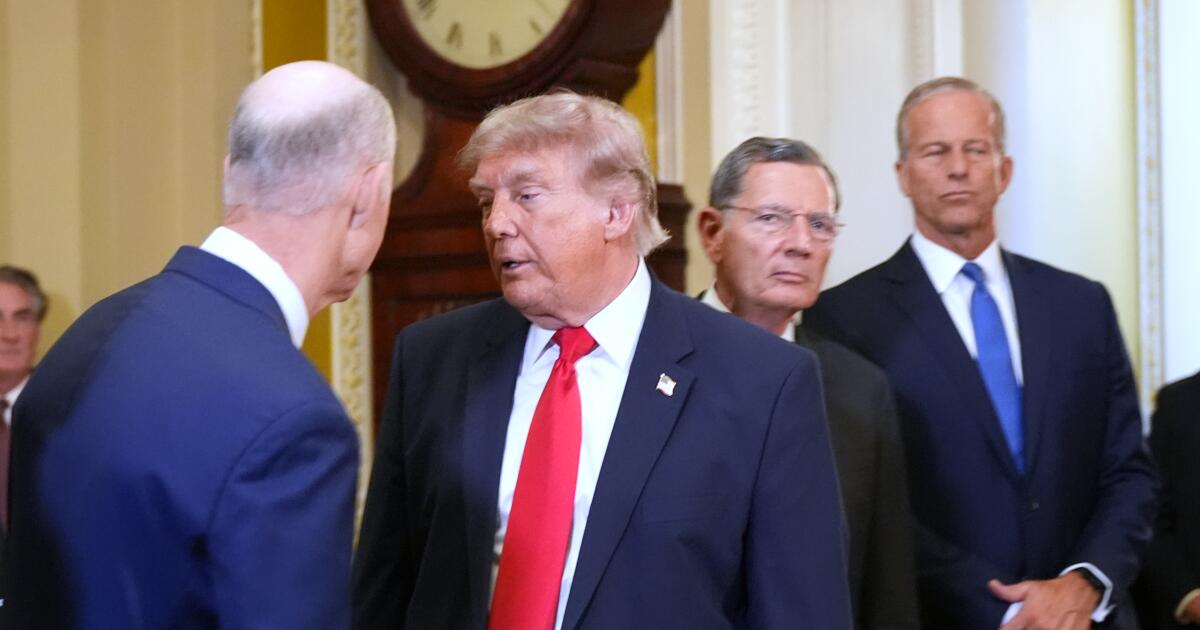
Trump harangued GOP senators face to face earlier in the day for allowing a vote to block his war in Iran on Tuesday, further escalating a feud that has diverted GOP efforts to focus on election-year affordability issues and brought much of the chamber’s business to a halt. He exchanged particularly harsh words with Louisiana Sen. Bill Cassidy, one of four Republicans who had voted with Democrats on the measure.

Hours later, though, Cassidy was invited to receive a personal briefing on the war at the White House from Vice President JD Vance and envoy Steve Witkoff. Cassidy then returned to the Capitol to vote against a separate but nearly identical war powers resolution.

“I want to thank Vice President Vance and Special Envoy Witkoff for the thorough briefing this afternoon on Iran. I appreciate the quick invitation to the White House to address many of my concerns,” said Cassidy, who lost reelection last month after Trump endorsed his opponent, in a post on X.

Kentucky Sen. Rand Paul, a Republican who has repeatedly voted with Democrats to halt the war, voted present this time “to give the President more space and leverage to negotiate a lasting peace,” he said on X. The measure failed 47-50-1 just before midnight on Wednesday, and the Senate then left town for a two-week recess.

It’s unclear whether the move will be enough to appease Trump, who had called the Republicans “losers” for voting against his war and had called Cassidy a “lunatic” at the lunch after their tense exchange. But the vote was a clear signal to the president from Republican senators who still want to placate him, despite increasing tensions in recent weeks and his decision Wednesday morning to reverse himself and delay signing a housing bill that received overwhelming bipartisan support.

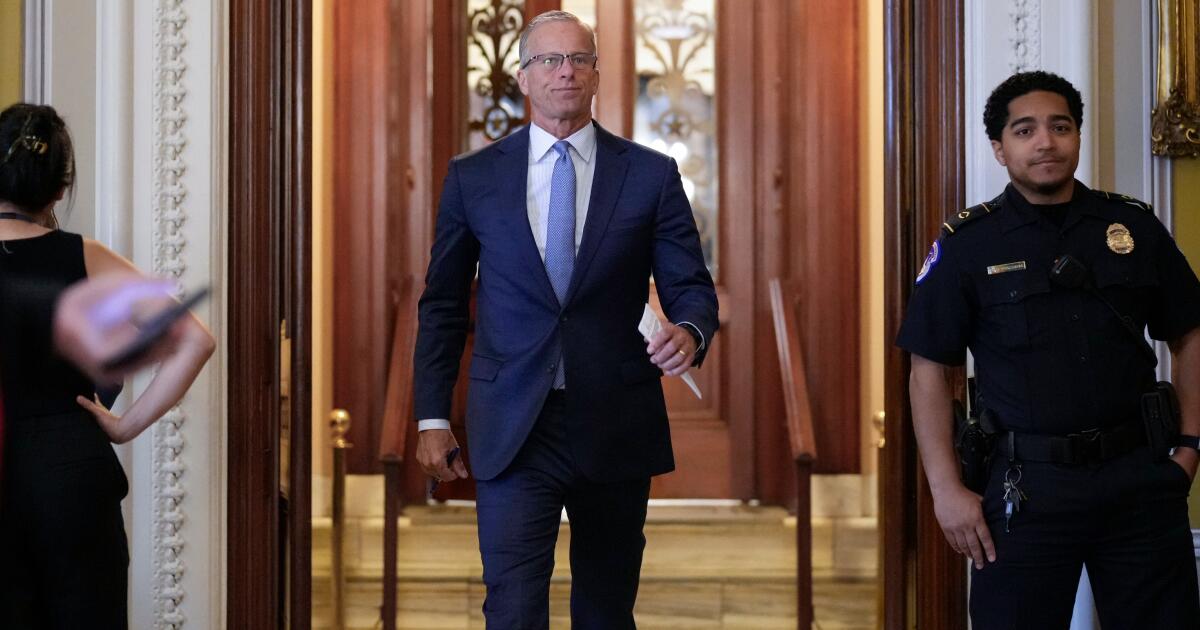
Senate Majority Leader John Thune, R-S.D., and a small group of his Senate GOP colleagues called Trump after the vote. Thune told reporters that the president was “pleased with the outcome.”

Trump later thanked Thune in a social media post and noted that Cassidy and Paul had switched their votes. “This vote puts Iran on notice!” he wrote.

The war powers measure blocked by the Senate on Wednesday was on a separate track from the nearly identical resolution adopted on Tuesday, which had also been passed by the House. Both votes were largely symbolic, and the measures do not carry the full force of law.

Cassidy had sharp words for Trump

Invited by Florida Sen. Rick Scott to speak at a GOP luncheon in the Capitol, Trump had signaled ahead of time that he would use the closed-door meeting to push senators to pass his proof-of-citizenship voting bill. But the conversation was more focused on Tuesday’s vote on war powers.

Most Republicans stayed quiet. But Cassidy stood up and defended his vote.

“I stood and said, ‘You have not told the American people what’s going on,’” Cassidy told reporters after the meeting. “This was supposed to last four weeks, it’s lasted four months. Our original objectives have not been achieved.”

The two men “went back and forth,” Cassidy said, and he “matched his tone and volume.” Cassidy said that he eventually de-escalated, but he did not want to be bullied.

“I am voting for war powers until I get a briefing,” he said afterward.

Trump repeatedly told Cassidy to sit down, according to a person familiar with the private meeting who was not authorized to discuss it. At one point, the president called the senator a “lunatic.”

Publicly, Trump said afterward that they had “a really great meeting.” But he hinted at the discord.

“We like everyone in the room,” Trump told reporters on his way out. “I don’t like a few people, but that’s OK.”

The luncheon capped weeks of friction between Trump and Senate Republicans and added a new layer of frustration as Tuesday’s vote was the first time the Senate had adopted a war powers resolution on the Iran war. Trump made clear he was in no mood to compromise before it even started, calling off a scheduled signing ceremony on a housing bill that passed both chambers overwhelmingly this week and that GOP lawmakers were touting as an election-year achievement.

Trump reverses on housing bill

Republican senators were eager for a conciliatory meeting with the president after escalating tensions in recent weeks. But Trump upended their plans when he declared on social media just beforehand that he wouldn’t sign the legislation until they send him the SAVE America Act, his bill to require proof of citizenship for all voters.

North Carolina Sen. Thom Tillis said he doesn’t know why Trump is holding the housing bill “hostage” for the voting bill that “will never pass in this Congress.”

“It makes no sense to me,” Tillis said as he walked into the luncheon.

Thune said the housing legislation, which aims to lower costs, is “an affordability issue,” and that ”eventually I hope he finds a way to sign it.”

It’s unclear if Trump might veto the legislation or if the late Wednesday night vote will change his outlook. But by rejecting a public bill signing, Republicans worry that Trump is indicating a level of indifference to voters’ affordability concerns heading into November’s midterm elections.

Trump and Senate Republicans have been at odds

Trump’s move on the housing bill is his latest reversal after weeks of being at odds with Senate Republicans.

Trump has blocked the Senate from confirming one of his own nominees, asked them to fund parts of his White House ballroom project despite opposition and forced them to defend the Iran war even as they question the strategy and endgame.

Trump has also helped whittle down his own support in the Senate after endorsing primary challengers to two GOP incumbents who were previously reliable votes for his agenda — Cassidy and Texas Sen. John Cornyn. Both men have become more critical of Trump since losing reelection.

“If we’re going to win the midterm elections, we need to get on the same page,” Cornyn said ahead of the meeting. “We’re not on the same page now, and that I think is dangerous.”

Trump pushes Thune on SAVE America Act

Trump has pressed Republicans for months to kill the Senate filibuster and focus on the proof-of-citizenship voting bill, even though Thune has repeatedly told him that neither has the votes.

While Thune remains popular in his conference and cordial with the president, he has spent much of his time lately telling Trump what he doesn’t want to hear. Thune said Tuesday that while Trump and some in their conference want to see the voting bill pass, “it’s just not realistic.”

Thune devoted weeks of floor time to the voting bill earlier this year and has said he supports it. But he has repeatedly said there aren’t enough votes to scrap the filibuster that triggers a 60-vote threshold to pass most bills in the 53-47 Senate. And Democrats are uniformly opposed to the bill.

“I think people at some point have to come to grips with that,” Thune said.

Jalonick, Sloan, Cappelletti and Mascaro write for the Associated Press. AP writers Josh Boak and Kevin Freking contributed to this report.

Source link

Friction between Trump and Republican senators is growing before the pivotal midterm elections

The relationship between President Trump and Senate Republicans neared a breaking point this week as he upended their efforts to speedily confirm one of his own nominees and said he would not sign the renewal of a key surveillance law unless they agree to new terms.

Trump’s overnight social media post Wednesday that he was delaying Jay Clayton’s nomination to become national intelligence director, just hours before the U.S. attorney’s confirmation hearing, further strained relations between the Senate and White House that have been worsening for weeks. Later that day, some Republican senators who have been hesitant to challenge the president directly on the Iran war were blunt in their criticism of his deal to end it.

“This is the worst foreign policy blunder in decades,” Sen. Bill Cassidy (R-La.) said in a post on X.

The open tensions are an almost complete reversal from a year ago when Senate Republicans worked closely with Trump on a complicated effort to push through his massive package of spending and tax cuts.

At the time, criticism of the president was almost nonexistent among Republicans on Capitol Hill, and they planned to highlight passage of that bill in the midterms. But as the November election draws closer and Republicans are trying to defend their majorities, Trump is instead needling Congress with his demands and reversals, driving several Republican senators to disparage his actions publicly for the first time.

“I think somebody’s not dialing the president into the complexities of what he’s done here,” Sen. Thom Tillis (R-N.C.) said Wednesday after Clayton’s confirmation was postponed. “I mean, my God.”

The slow unraveling of what once seemed like an airtight alliance between the executive and legislative branches in a Republican-led Washington extends to their policy priorities.

Trump appears to have lost interest in most of the GOP agenda and has become almost singularly focused on his voting legislation to require proof of citizenship, which has almost no chance of passing. At the same time, he has asked members of Congress to fund parts of his White House ballroom project, allow a temporary intelligence director that none of them likes and cede their powers on the Iran war.

The growing rift has brought much of the Senate’s business to a halt and put Republicans who are up for reelection this year on the defensive. It has also put pressure on Senate Majority Leader John Thune, who has been upfront with Trump about what he can and cannot do in the Senate.

Trump pressures Thune on voting bill

Trump has pressured Thune (R-S.D.) relentlessly to scrap the filibuster and pass the strict proof-of-citizenship legislation, called the SAVE America Act. Thune has told Trump publicly and privately that the votes are not there for either step. Still, Trump has kept up the push.

In a social media post Thursday, Trump said he would be “the last Republican president” if the voting bill does not pass.

“Senate Majority Leader John Thune, and the Republican Senate, must not let this ‘carnage’ happen,” Trump said. “They will go down on the wrong side of History, as will all Republicans who just stood by and watched.”

Nonetheless, Trump has yet to go after the well-liked Republican leader on a personal basis, as he often did with Thune’s predecessor, Sen. Mitch McConnell (R-Ky.). Trump once called McConnell a “ dour, sullen, and unsmiling political hack.”

Trump and Thune talk frequently, even as Thune is sometimes giving the president news he does not want to hear. As Trump pushed for the voting bill, Thune scheduled weeks of floor time to consider it, an effort to make clear that the Senate was supportive, even if the votes are lacking.

Missouri Sen. Eric Schmitt, one of the president’s closest allies in the Senate, said he has never heard Trump say anything negative about Thune.

“It’s a difficult position,” Schmitt said of Thune’s role in the Senate. “I think they have a good working relationship.”

One of Thune’s closest allies, Republican Sen. Mike Rounds of South Dakota, said the even-keeled leader is the “right person at the right time.”

“In the Capitol today, he is the stable force,” Rounds said. “In Washington, D.C., today, he is the stable force.”

No signs of revolt among Senate GOP

There were no signs of a revolt within the GOP conference, for now, despite Trump’s pressure.

Thune “has managed it better than anyone else could manage it,” said Cassidy, who has become a more frequent Trump critic since a primary loss to a Trump-backed challenger.

Criticism of Trump has at times surfaced even among his closest Senate allies, especially with his proposed $1.776-billion settlement fund for his political allies and his pick for acting intelligence director, Bill Pulte, who has no known intelligence experience.

But the rift with Trump has also stoked some new internal tensions.

Several Republican senators criticized Sen. Mike Lee (R-Utah), who has waged an online campaign to eliminate the filibuster and pass the SAVE America Act, in a private conference lunch this week for stoking dissension within the party in an election year.

Unbowed, Lee has kept up his social media campaign, including a post Friday on X in which he said that giving up because Republicans lack the votes is a “recipe for failure.”

Texas Sen. John Cornyn, one of those who spoke out at the meeting, replied that it is Lee’s job to find the votes, “if you can.”

“Can’t just complain about others,” Cornyn posted. “Prove us wrong.”

Trump’s dwindling number of allies

Some Senate Republicans have made clear they have no plans to separate themselves from Trump.

As several of his colleagues criticized Trump’s agreement with Iran this week, first-term Sen. Bernie Moreno (R-Ohio) aggressively defended it on social media.

“Let’s get the Nobel Peace Prize ready!” Moreno posted on X.

But Trump has far fewer of those Senate allies than he did when they narrowly passed the tax and spending cuts legislation a year ago. That is in part because he has picked off some of the most loyal Republican votes himself.

Cassidy and Cornyn lost in primaries last month after Trump endorsed their opponents. Tillis announced he was not running for reelection last year after Trump repeatedly criticized him on social media.

Now all three have become frequent critics.

Shortly after his election loss, Cornyn posted on social media a fable about a frog and a scorpion. The scorpion asks the frog to carry it across a river, according to the fable, and then stings the frog in the middle of the river, “dooming them both.”

“The dying frog asks the scorpion why it stung despite knowing the consequence,” Cornyn’s post read. “To which the scorpion replies: ‘I am sorry, but I couldn’t help myself. It’s my character.’ ”

Jalonick writes for the Associated Press.

Source link

Thune: Senate may vote next week on ICE, Border Patrol funding

April 14 (UPI) — A budget resolution to fund federal immigration enforcement could hit the Senate floor by next week, Senate Majority Leader John Thune said Tuesday, as Republicans seek to bypass Democratic demands for reforms to Immigration and Customs Enforcement and Border Patrol.

Federal funding for Immigration and Customs Enforcement and Border Patrol lapsed on Feb. 14 after Republicans agreed with the Democrats to remove the Department of Homeland Security from a larger spending package and avert a government shutdown.

Neither agency has been funded through regular DHS appropriations since, though they continue operating through other, emergency funding.

Democrats began demanding reforms to the federal immigration enforcement agencies before agreeing to restore funding after two U.S. citizens were killed by federal immigration officers amid President Donald Trump‘s aggressive immigration crackdown.

Amid a stalemate in negotiations, Republicans are considering passing three years of funding for the agencies through a complicated legislative mechanism called a budget reconciliation bill that permits certain spending legislation to pass with a simple majority rather than 60 votes, Thune told reporters Tuesday in the Capitol.

“Republicans are going to stand with our Border Patrol, with our law enforcement agencies and we’re going to ensure that they are funded, not only today but well into the future,” Thune, R-S.D., said.

Sen. Lindsey Graham, R-S.C., is preparing the resolution to fund the agencies that will be followed by the reconciliation bill “to ensure the job gets done,” he said.

Democrats have blocked funding for ICE and Border Patrol until reforms — including requiring judicial warrants and banning officers from wearing masks — are made, but the reconciliation bill tactic could ensure funding without any votes from Democratic lawmakers.

The same tactic was used last year to pass Trump’s sweeping spending and tax cut bill, which provided $75 billion for ICE.

“All of the things that the Democrats made this about, which was supposed to be about reforms to the way that ICE and Border Patrol operate — they get none of that,” Thune said.

“And now, we’re going to fund those agencies for three years into the future. The only thing the Democrats got out of this was they now own the issue of open borders and defund law enforcement.”

Republicans hold a narrow 53-47 majority in the Senate, with two independents caucusing with the Democrats, as well as a 218-213 majority in the House.

The Senate has twice passed bipartisan bills to fund DHS aside from ICE and Border Patrol, which the House has balked at. Democrats blame the Trump administration’s influence on the lower chamber.

“Republicans are dragging the Senate through a partisan circus just to avoid basic accountability for ICE and Border Patrol,” Senate Minority Leader Chuck Schumer told reporters at the Capitol during a separate press conference on Tuesday.

He said Democrats will continue to push for immigration enforcement reforms.

“So, the pattern, unfortunately, with this administration is clearer and clearer,” the veteran New York Democrat said. “Chaos abroad — the war; chaos at home with not funding DHS with reforms. A failed war overseas, a manufactured crisis here in Washington — in both cases Republicans aren’t leading, they are following orders.”

Source link