throat

Ram Charan: China Has the World by Its Throat

How China’s $7.4T trade strategy impacts global supply chains—and steps CFOs must take now to regain control.

This article appears in the July/August issue of Global Finance Magazine.

Ram Charan is an adviser to CEOs and boards who built his reputation advising CEOs and boards inside some of the world’s largest companies. In his new book, China’s 90% Model: China Has America by the Throat: Here’s How to Fight Back and WIN, he turns that lens on the trade war reshaping global supply chains.

In this Global Salon conversation, he lays out how Beijing uses cheap exports to flood markets and squeeze out rivals — and what CFOs need to do, in the boardroom and beyond, to respond.

Global Finance: Your book lays out the scale of China’s trade surplus and cash reserves. Can you walk us through what you believe are the actual numbers?

Ram Charan: China has earned over time $7.4 trillion in hard cash [e.g., dollars, yen, euros] and 2,250 tons of gold. It is now earning hard cash at a rate of $1.5 trillion a year. My forecast is $1.8 trillion. If nothing is done, in five years China will have an additional $10 trillion in cash in dollars, yen, euros, South Korean won, and other currencies of countries that trade with them. 

Negotiations between President Trump and President Xi Jinping have taken place. They have now stopped because President Xi has clearly declared, “If you do this, I will supply the supply chain. If you don’t do this, I will stop supplying the supply chain.” He’s done the same thing with India.

GF: The Indian rupee is down about 10% against the U.S. dollar compared to a year ago. What does India’s currency situation tell us about the mechanics of the risk from China?  

Charan: Nobody knows the outcome of that crisis [the currency and trade deficit spiral] like the Indian currency going to hell, and trade deficits, which are increasing [India’s bilateral trade deficit with China grew from about $44 billion in 2020 to roughly $100 billion in 2025]. If you call 10 business people of reasonably sized companies in India, now they understand it. 

The reason? The currency. They’re taking action. Your business model has got to change. You better make cash flow [a priority]. If nothing is done, your currency will decline, as it has in India. Your balance of payments will decline, and that is a real cycle.

GF: If a CFO agrees with you on the China threat, what three things should they do in the next 12 months, and what should they avoid?

Charan: First, be defensive. Analyze your country. Which imports are coming from China? If nothing is stopped, what will it do to your country’s currency and balance of payments? A country’s currency is directly relevant to the CFO. 

Second, the CFO should look at which industries are totally dependent on China. If the industry stops, what happens to the country’s GDP? What happens to the value chain? Because almost all value chains, in some way, are interconnected. The CFO has to allocate cash for defensive purposes.

Third, the CFO should substitute China [products] if they can. But the cost of every single thing non-Chinese is very high. How would this change the market? How would they sell, and how would they price? I recommended they start a war room, every morning, see what’s changed, what’s the pattern, who’s driving it, and what are the signals.

GF: What about going on the offense?

Charan: On the offensive side, identify the gaps the Chinese are not filling, including which countries and segments, and where the opportunities lie. The best thing I’ve learned is to think 20 years out. Just think: What will humans need 20 years out? 

For example, there’s the Adani Group in India. The [founder] predicted that India would need ports 25 years ago. Now he’s the largest private port developer and operator in India. Look for those opportunities. You don’t spend your money on a 20-year basis, but you learn how to get there. Get three or four people on the payroll to investigate and look at the technologies.

A company is not competing with a company in China. A company is competing against President Xi Jinping of China, so it has to pull together as an industry. Go to the government. Stop fighting alone. India is doing this actively. Europe is struggling; they don’t have an answer yet.

GF: What is China’s impact on the European auto industry? 

Charan: Europe is at a major crossroads. Europe doesn’t have a strategy. Germany’s auto giants spent decades helping build China’s car industry; now, they are outcompeted and heavily dependent on China. Volkswagen is already moving into defense, so that single indicator shows they know the Chinese are coming. The destruction of the auto industry is a major blow to Germany, including parts suppliers and chemical and energy suppliers. They don’t yet know how to deal with it. I would say one option for them: get a hold of Trump and combine three or four countries just for the auto industry.

GF: Do you see boards and CFOs as locked into short-termism by their fiduciary duty to shareholders, even when the long-term strategic risk is larger?

Charan: There are exceptions, but it’s a fact. I sit in the boardrooms. The market drives short-termism. But the more important point is they are unaware that China is attacking their industry. There is no manufacturing industry in the world that is unaffected by China’s strategy, directly or indirectly.

GF: You’ve said there are tools to wage a financial war with China. How fast can these be implemented, and how confident are you?

Charan: Saudi Arabia probably could fight, because China depends on oil. The Saudis have control of the price of oil. Small countries can’t fight alone. America alone cannot fight. It has to be coordinated. There are tools for a financial war with China. If Brussels and Washington can work together, Chinese power will be reduced.

GF: How can finance leaders fund next-generation industries where China is ahead?

Charan: In a crisis, you have to have good execution and a dedicated team. We did that in World War II. This is an economic war, and people don’t realize it, so each company is doing its own thing. 

You select the industries, assign full-time people. We must have a department of manufacturing and technology, which I’ve recommended to President Trump, in the U.S., in Europe, in Japan, in South Korea, and in Israel. People have to understand that the cost and the price China charges for products is absolutely not real. It is based on [the fact] that you incur losses internally and earn a trillion dollars in hard cash. Therefore, your profit is on a national basis. It is not on an industry basis.

GF: Beyond solar panels, batteries, and rare earths, what should CFOs be watching in supply chains that they’re not?

Charan: First, most important, are the ingredients that go into the chemical industry, APIs [active pharmaceutical ingredients]. Then, in biology, they take the molecules, they have very fast testing, build it, and now begin to come in at a tenth of the price. 

I have gone to DuPont and other companies to see what China needs from us and what they’re buying. But they know our people are not doing the detailed work. The people who are advising Donald Trump are economists. You need chemical engineers and biological engineers. You need the R&D people in Washington to deal with this. Economists and consultants cannot do it.

GF: Isn’t China under great strain, due to the challenging job market for young workers, the housing collapse, and extremely thin profit margins?

Charan: President Xi has said many times: austerity, austerity, austerity. I believe he correctly realized the real estate booms and busts were created by the central bank. So he’s letting it cool for a long time, because his concern is the threat to the Chinese Communist Party from inside China. He’s very clear about it; that is, that going forward, it may take a loss, a lower GDP.

The rural areas are not in great shape. President Xi is taking that calculated risk. But selecting industries, giving them money, and creating hyperscale: That is the real model. Civil control is total; students are under full control. 

GF: Twenty years out, will AI and robotics change the manufacturing equation for finance and operations leaders?

Charan: If you don’t have industry, you are nobody, [even if] you use AI, robotics, and automation. Any country that says it will go without manufacturing, I guarantee, will not be a democratic country and probably won’t survive.

GF: What practical tools can finance leaders use to act on what you’ve described?

Charan: Figure out the whole supply chain’s vulnerabilities, put an industry coalition together, and then try to get to your government and say: Here is the gap. If we don’t fill this gap against China, this industry will go away.

Weld Royal is a contributing writer based in the U.S.

Source link

Fever star Caitlin Clark will play tonight against the Sparks

Caitlin Clark will be in the lineup when the Indiana Fever face the Sparks at Crypto.com Arena after a week-plus of discourse around the star player.

Clark, who has had season-long back problems, did not play on Sunday in Las Vegas. Fever coach Stephanie White said Clark would play on Wednesday against the Sparks.

Earlier in the day, a dozen Republican lawmakers announced they sent a letter to WNBA commissioner Cathy Engelbert arguing the league has failed to adequately protect Clark from physical play.

“Unfortunately, what they too often witness is not simply aggressive competition, but repeated acts of unnecessary physical hostility and violence,” the lawmakers wrote. “Clark has been hip-checked, poked in the eye, and struck in the throat during games. These incidents go far beyond routine physical play, yet the WNBA and its officiating have too often failed to address these unacceptable incidents and hold players accountable.”

When asked about the letter after their shootaround in Los Angeles on Wednesday morning, White stepped aside for team spokesperson Jackie Maynard to read a statement:

“Our organization, nor Caitlin, have had any interaction with anyone in the congressional group and were unaware of their letter. We have been clear in our public comments and in our ongoing dialogue with the league about the priority of player safety. Our players and our fans know where we stand on these issues and continue to stick up for our team and a standard of excellence across the league.”

Alyssa Thomas was given a flagrant foul 2 penalty, fined $1,000 and suspended one game at the start of July for pushing her right fist into Clark’s throat when they both fell on the court during the Mercury’s 111-109 win on June 24 in Indianapolis.

It was originally not called a foul, and a still image of Thomas’ hand in Clark’s throat went viral on social media and stirred up discourse among those in and out of the basketball world.

In the aftermath, Thomas said she got several online attacks, some of which are “threatening our lives.”

White denounced “unacceptable” online behavior from fans last week, and Clark followed up by saying, “I don’t want anyone to ever experience that.”

The letter was led by Texas congressman August Pfluger, chairman of the Republican Study Committee.

“As Commissioner, you have an obligation to ensure that every player competes in a safe and professional environment, both on and off the court, free from violence, discrimination, or retaliation,” the lawmakers wrote. “If discrimination or retaliation is occurring and creating a hostile work environment, we support any appropriate investigation by the Department of Justice, the Department of Labor, or the Equal Employment Opportunity Commission. If true, such conduct could constitute violations of federal civil rights laws.”

The letter finished with three questions for Engelbert, which it demanded the commissioner respond to by July 24. What is your review mechanism for physical hostility and violence on the court? How will you hold players accountable for overly aggressive actions on the court, including towards Caitlin Clark? What steps are you taking to protect WNBA players from online harassment and off-the-court threats?

Conservative commentator Riley Gaines posted the letter and her support of it on social media, which showed signatures from Iowa lawmaker Zach Nunn and Indiana representatives Marlin Stutzman and Victoria Spartz.

White said that Clark would not play on Thursday night in Phoenix, rotating her with star center Aliyah Boston to manage both of their workloads on the team’s first set of back-to-back games.

Source link

WNBA: Alyssa Thomas suspended one game for fist into Cailtin Clark’s throat | Basketball

Both players were on the floor when Thomas pushed her fist into Clark’s throat before getting up and stepping over her.

Phoenix Mercury star guard Alyssa Thomas has been given a flagrant foul 2 by the WNBA office and suspended one game for “recklessly making contact with her fist to the throat area” of Indiana Fever star guard Caitlin Clark during Wednesday’s game between the teams.

The incident occurred with 6:52 left in the second quarter of the Mercury’s 111-109 triumph over host Indiana. No foul was called.

Thomas will serve the suspension Saturday when the Phoenix visit the Toronto Tempo.

Jun 24, 2026; Indianapolis, Indiana, USA; Phoenix Mercury forward Alyssa Thomas (25) shoots the ball while Indiana Fever guard Caitlin Clark (22) defends in the first half at Gainbridge Fieldhouse. Mandatory Credit: Trevor Ruszkowski-Imagn Images
Phoenix Mercury forward Alyssa Thomas (25) shoots the ball while Indiana Fever guard Caitlin Clark (22) defends in the first half at Gainbridge Fieldhouse. [Trevor Ruszkowski-Imagn Images/Reuters]

The WNBA office said it has the option to review games and “classify as flagrant any foul not called as such during a game.”

In this instance, Clark drove into the lane and fell on her side following contact with Phoenix defender Lexi Held. In the ensuing scramble for the ball, Thomas pushed her fist into Clark’s throat before getting up and stepping over Clark.

Fever coach Stephanie White was upset after the contest that Thomas wasn’t called for a foul.

“Number one, you’ve got to call it. It’s absolutely egregious and utterly disrespectful,” White said.

The teams also had played a testy contest two nights earlier in which a combined six technical fouls were called during Indiana’s 86-77 victory.

Thomas, 34, is a six-time All-Star. She is in her second season with the Mercury after playing 11 campaigns with the Connecticut Sun.

Thomas is averaging 14.7 points, 8.4 assists and 6.6 rebounds in 18 games this season.

Clark exited Wednesday’s game with 5:15 left in the third quarter due to back issues.

Clark, 24, is averaging a career-high 21.2 points, 8.2 assists and 4.0 rebounds through 17 games this season. She’s a two-time All-Star.

The Fever host the Los Angeles Sparks on Saturday.

Source link

On This Day, May 31: Mark Felt reveals ID as Watergate figure ‘Deep Throat’

On this date in history:

In 1790, President George Washington signed a bill creating the first U.S. copyright law.

In 1859, construction concluded and bells rang out for the first time from London’s Big Ben clock tower.

In 1889, a flood in Johnstown, Pa., left more than 2,200 people dead.

In 1902, Britain and South Africa signed a peace treaty ending the Boer War.

In 1916, the Battle of Verdun passed the 100-day mark. It would continue for another 200 days, amassing a casualty list of an estimated 800,000 soldiers dead, injured or missing.

In 1921, the Tulsa race massacre was set off when a mob of White residents attacked the Black residents and businesses in the Greenwood District. The total number of those killed in the violence is unknown, with an Oklahoma commission established in 2001 estimating between 75 to 100 people dead. The number of displaced Black residents was far greater.

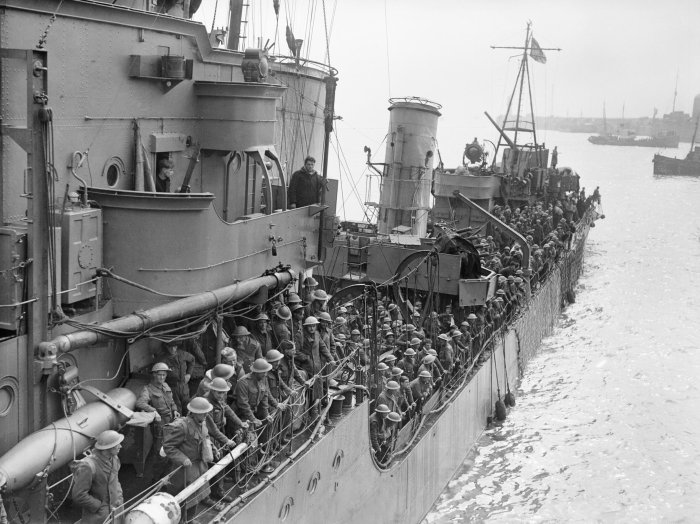
In 1940, a thick fog hanging over the English Channel prevented the German Luftwaffe from flying missions against evacuating Allied troops from Dunkirk.

Troops evacuated from Dunkirk on a destroyer about to berth at Dover, England, on May 31, 1940. File Photo courtesy of the Imperial War Museum

In 1985, seven federally insured banks in Arkansas, Minnesota, Nebraska and Oregon were closed by the Federal Deposit Insurance Corp. It was a single-day record for closings since the FDIC was founded in 1934.

In 1996, Israeli voters elected opposition Likud Party leader Benjamin Netanyahu as prime minister.

In 2003, Eric Robert Rudolph, the long-sought fugitive in the 1996 Atlanta Olympics bombing and attacks on abortion clinics and a gay nightclub, was arrested while rummaging through a dumpster in North Carolina. Rudolph, whose bombings killed two people and injured many others, was sentenced to four life terms in prison.

In 2005, Mark Felt admitted that, while No. 2 man in the FBI, he was “Deep Throat,” the shadowy contact whose help to Washington Post reporters Bob Woodward and Carl Bernstein on the 1972 Watergate break-in led to U.S. President Richard Nixon’s resignation.

File Photo by Alexis C. Glenn/UPI

In 2012, John Edwards of North Carolina, former U.S. senator and presidential candidate, was acquitted on a charge of taking illegal campaign contributions, and a judge declared a mistrial on five other charges against him.

In 2014, U.S. Army Sgt. Bowe Bergdahl, 28, captured in Afghanistan nearly five years earlier, was released by the Taliban in exchange for five detainees held at the Guantanamo Bay detention camp in Cuba. In March 2015, the Army announced that Bergdahl had been charged with desertion.

In 2019, a shooting a a Virginia Beach, Va., municipal center left 12 victims and the shooter — a disgruntled former employee — dead.

In 2021, China announced plans to allow couples to have a third child, scrapping its controversial two-child policy amid a slumping birth rate and aging population.

File Photo by Stephen Shaver/UPI

Source link