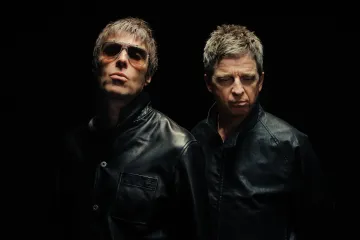
‘It’s not going back to our roots… it’s figuring out what they always were,’ say Nothing But Thieves
NOTHING But Thieves have spent the past decade playing arenas and huge festivals around the world.
But it’s been coming home to play to smaller crowds that’s reminded them just how far they’ve come.
On Saturday, the Essex band played three gigs in three countries to celebrate the forthcoming release of their fifth studio album, Stray Dogs.
“Sweaty and close enough to see everybody’s faces,” is how frontman Conor Mason described the final gig of the day at Camden’s Underworld following earlier gigs in Netherlands and Belgium.
“In London, there was nowhere to hide. You can feel every flaw, every moment of tension.
“The whole day was about letting a little chaos back in and seeing what survives when we take it back to the bigger rooms.”


The whirlwind day followed the band’s homecoming show at Chinnerys in Southend earlier in the month, which reminded the five-piece of the journey they have been on.
“When you see that in your home town, it’s quite bizarre,” says Mason. “It makes you appreciate how far we’ve come.”
For guitarist Joe Langridge-Brown, it led to a moment of reflection outside the venue, right on Southend’s seafront. “I was just looking out at the estuary at one point, thinking, ‘This is f***ing mental’,” he says.
I meet Mason and Langridge-Brown in their East London local where they are enjoying a quiet day at home before the new album is released.
Taking a sip from his pint, Langridge-Brown says that whenever they started working on previous albums, they always asked each each other what Nothing But Thieves actually sound like.
But on this new album, the band deliberately tried to capture their live sound rather than making a record and then figuring out how to play it live.
Guitarist/lyricist Langridge-Brown says: “Every record, we’ve always been trying to reinvent ourselves.
“But I feel like we’ve answered the question — I know what we are in 2026.
“I feel like now we’ve done it with this album. It’s like a foundational reset.
“In a way, it’s not going back to roots. It’s figuring out what they always were.”
That confidence extended to the studio, with guitarist and keyboardist Dom Craik taking the lead on production while the band retained creative control.
“Dom produced the record, but we controlled the record,” says Langridge-Brown.
“If you’ve written a record that is meant to sum up how you sound live, no one knows how we sound better than we do at this point.”
With Stray Dogs, Mason and Langridge-Brown said they also wanted to rebel against the short attention spans of their fans.
Mason says: “You’re told all the time by your label and just by the world that if you don’t make something within the first five seconds that someone’s going to love, they’ll move on to the next thing.
“We’ve made something specifically quite slow in moments and intentionally long-form.
“If people want to get it, they have to sit and really listen to it.
“That’s how you listen to albums. Like the first time you listen to [Pink Floyd’s] The Dark Side Of The Moon, it was from start to finish.”
“Not that it’s as good as that record,” interjects Langridge-Brown. “I just want to get that clear for everyone.
“I don’t want people to only listen to a song for five seconds — it’s our job to try and buck this trend.”
He continues: “This is definitely the best quality of work we’ve created. There’s a lot of attention to detail on this record.
“When you listen to it, it runs as a Nothing But Thieves show — the track list is a set list. We’ve taken crowd noise from our own shows and put it within the record.”
That attention to detail was also important for the album’s lyrics, with the band turning their focus closer to home rather than looking at the wider world.
“Moral Panic and Dead Club City were both very outward-looking,” Langridge-Brown says.
“With Moral Panic, I was basically studying Twitter and seeing this moral panic, this fear and anxiety spread.
“Then Dead Club City was almost the continuation of it, looking to the future.
“So this was, like, ‘OK, let’s not look outwards for now. Let’s look inwards and see what’s in our world and what we’ve created’ — on a bit more of a personal level.”
The first song written for the album was the intense, heavy-guitar title track.
“Stray Dogs was the first song and the lyrics were great,” he continues. “We were like, ‘This feels right. This feels like where we’re heading’.”
Elsewhere on the album, the band push that experimentation in different directions. On Baby Kool (Evelyn), they deliberately throw different sounds together.
“It’s got a glam verse and then it goes into this really grungy Sonic Youth chorus,” says Langridge-Brown.
“Those two worlds don’t naturally mix, but sometimes that’s where the magic is.”
Other standouts include the cinematic Death In The Backseat, the experimental #5 (Dehumanised) and the emotionally vulnerable If You Don’t Have Someone To Love.
AI.Jesus tackles their unease about artificial intelligence and what it could mean for humanity and creativity.
While Testosterone turns its attention to masculinity, with one of its lyrics inspired by a drunken comment Langridge-Brown overheard at a wedding.
Mason says: “I don’t think we are able to be fully macho, and I wouldn’t want to be.”
A Different Kind Of Happiness brings the record to a close, completing an album deliberately structured like a live show, with Stray Dogs opening the “set” and A Different Kind of Happiness as the finale.
The album was also the first to be written in one focused period rather than while on tour.
“We wrote the whole record in the building across the road and we’d have a drink in here after work,” says Mason. Langridge-Brown adds: “This record was very different in that we wrote it in a five-month period once all the touring was finished. We’d never done that before.
“It was always written on the road before — on the back of a tour bus or in between tours.
“But the touring got so huge and so extensive that we just couldn’t give it the time it needed.
“We’ve written about pack mentality in a negative way before, so I’d say this was probably more about community and the pack in a positive light.
“I think Stray Dogs really sums up what we do and who we are — our world, our crew and the fans. We have our own lives and when we meet up, we make a load of noise together.”
The band’s relationship with their fans comes with a huge sense of responsibility on stage.
“People pay a lot of good money to come and see us,” says Mason.
“If we’re not up to scratch, we make sure we are. It’s important.”
For the singer, this means taking care of his voice, which is central to the band’s sound.
He says: “Early on, I used to go out all the time with the boys and I just ruined my voice.
“A producer gave me a slap on the wrist so now, on tour, I treat myself like an athlete. I look after my body and get as much sleep as I can.
“I’m also classically trained so I look after my voice on stage for that hour-and-a-half.”
“He sounds amazing,” Langridge-Brown adds. “On that last tour, he sounded the best he has in years, which is great.
“The central thread running through all our music is Conor’s voice. As a writer, it’s amazing to have that to write for.”
Despite the success of their previous albums — Dead Club City gave them their first No1 in 2023 — chart positions have never dictated what Nothing But Thieves write.
“We never went out to chase a No1 record,” says Langridge-Brown. And Mason adds: “It wasn’t an intention and it wasn’t that commercial. We just write what we want to write.”
In February, Nothing But Thieves will head out on their biggest ever UK arena tour, returning to The O2 six years after their first headline show at the venue.
“The next day, we were, like, ‘What now?’,” says Mason. “I just want to wake up to my job every day in my life and be, like, ‘This is awesome’.
“There’s a lot of people that don’t get to do this so I feel very privileged.” And with five albums now behind them, the band have enough material to be more creative with their live set, building different moods throughout a show.
Stray Dogs also reflects a band increasingly secure in who they are.
That growing sense of self has been personal for Mason, who says that his thirties have changed his outlook on life.
“I had my 30th birthday and it was almost like the next day, I said to myself, ‘It’s time to grow up now’.
“I want to live my life with real gratitude for what I have and presence for what I have.
“I want to just be who I am as a man here and now and enjoy this.
“That was a really big shift for me.”
The band members all grew up together and while things have changed over the years, their friendship has remained a constant.
“We’re constantly evolving,” says Mason.
Langridge-Brown adds: “If you look at the lyrics throughout our career, change is mentioned a lot. It’s just something that we’re drawn to.
“There can be a bit of an identity crisis, but we are grounded as a band because we were mates first.
“And with success you don’t want to lose that.” Mason adds: “You hear a lot of horror stories about bands who break up almost every album, and it’s just, like, ‘How the hell do they function?’.
“The personal relationships and the working relationships were so, so integral to keep alive and to nurture, and that’s been a real foundation for us.”
That closeness continues away from the band. Four of the five still live within roughly a mile of each other and they still socialise regularly.
“You need to come off tour and have some time to yourself,” says Mason.
“But we still meet for gigs, trips to the pub, football and Wimbledon,” adds Langridge-Brown
“We went and watched Queens Of The Stone Age together the other day and our wives and partners are friends as well.
“It’s still quite tight-knit in that way.”
As our chat comes to an end, it’s clear that enduring friendship has kept the band together, but it hasn’t dulled their ambition.
“Stray Dogs is definitely the best album we’ve made, but I don’t think we’ve made our classic album yet,” says Langridge-Brown.
“That’s kind of the aim still — there’s more in the tank.”
Mason agrees: “I’m really excited to further press this process. We’re not done yet.”