The former British Army member harboured ‘extreme right-wing’ views and was ordering explosives components, say police.
Published On 14 Oct 202614 Oct 2026
A British court has handed a former army chef a nearly four-year jail term for possessing weapons for “terrorist purposes”.
Mark Broadhurst, 28, was given the sentence on Wednesday at Sheffield Crown Court in England, two years after police uncovered online messages in which he expressed racist views and an intention to sell homemade firearms to right-wing groups.
Recommended Stories
list of 3 itemsend of list
Police found a stockpile of weapons at Broadhurst’s home address when they took him into custody in September 2024, including knives and crossbows, black powder, ammunition, air pistols and what officials described as “an improvised homemade cannon”.
The former British Army member was also found to be part of an online chat group with three other men who last year were jailed for planning to carry out a “terrorist” attack at mosques or synagogues as part of what they believed to be a coming “race war”.
Frank Ferguson, head of the special crime division of the UK’s public prosecution agency, the Crown Prosecution Service (CPS), said Broadhurst was “clearly interested in violence and developing weapons that had the ability to cause untold harm to innocent people”.
Detective Chief Superintendent James Dunkerley, who heads “counterterror” policing in the northeastern region, said Broadhurst was found to be harbouring an “extreme right-wing mindset” and was “proactively ordering components to make explosives”.
Broadhurst pleaded guilty to firearm possession and possessing an explosive under suspicious circumstances, but denied they were for “terrorism” purposes. A judge, however, ruled that Broadhurst’s offences were connected to “terrorism”.
His conviction comes against a backdrop of rising racial tensions and hate crimes in the UK, with marginalised communities increasingly targeted.
British police in July arrested 12 people in connection with an “extreme right-wing terrorism threat” targeting an Islamic gathering in eastern England.
Six months earlier, UK prosecutors said they were handling the highest number of hate crime cases referred by police in its history.
Thousands of people have taken to the streets of Rio de Janeiro in a student-led protest against presidential candidate Flavio Bolsonaro and the growing influence of Brazil’s far right.
The march happened on Wednesday, just days after far-right Senator Flavio Bolsonaro, the son of former President Jair Bolsonaro, earned the most votes in the first round of the country’s presidential race.
Bolsonaro won 47 percent, ahead of his closest rival, incumbent left-wing President Luiz Inacio Lula da Silva, who gained 45 percent support.
Since neither candidate surpassed the 50 percent threshold, they will face each other in a run-off on October 25.
The results have triggered fears that Brazil could become the latest Latin American country to see its presidency switch from left to right.
Protesters marched through downtown Rio carrying signs reading “Never again Bolsonaro” and “No to the father, no to the son”. Others held banners reading “Dictatorship never again” and “Get out Bolsonaro”.
“I’m here because I believe in democracy. Because I’m scared,” said Alice Carneiro, 25, an administrator in maritime shipping who participated in the protests. She explained that, under a far-right government, she feared a backlash against her wife, who is transgender.
Jair Bolsonaro, the former president, led the country from 2019 to 2023. But his single-term tenure was marked by a series of controversies related to his far-right policies.
He voiced support for Brazil’s past military dictatorship, which was responsible for the disappearance and murder of hundreds of perceived dissidents. He also spread unfounded claims about the accuracy of Brazil’s election system, leading to a court ruling that barred him from holding office for eight years.
Currently, the former president is serving a 27-year sentence after being convicted of plotting to overturn his 2022 election defeat. After Lula’s inauguration in 2023, Bolsonaro’s supporters stormed government buildings in the capital, reportedly hoping to trigger a military uprising.
Critics have framed Jair Bolsonaro’s actions as a threat to Brazil’s democracy.
But Senator Flavio Bolsonaro has received his father’s endorsement, and he has backed amnesty for his father, a prospect that has raised concerns among protesters.
“I find this rise of the far right and the rise of Bolsonarism in Brazil very, very sad,” said Emmanuel Araujo, 19, who is preparing for university entrance exams.
“Lula might not be my preferred candidate,” Araujo added, “but amid this barbarism, we have to choose between someone we can keep criticising and someone who might take away our right to speak.”
Latest polls suggest Lula’s lead over Bolsonaro is narrowing, with neither candidate likely to win outright on Sunday.
Published On 4 Oct 20264 Oct 2026
Brazilian President Luiz Inacio Lula da Silva and right-wing Senator Flavio Bolsonaro have wrapped up their election campaigns, each voicing confidence in victory ahead of Sunday’s tightly contested first-round presidential vote.
Lula, 80, closed his re-election bid on Saturday with a march through Sao Paulo, Brazil’s economic powerhouse, drawing what his campaign called a record crowd for a closing rally.
Recommended Stories
list of 3 itemsend of list
“Tomorrow, we’re going to win the elections in the first round,” he told supporters, describing Sunday’s vote as a choice between “democracy and barbarism” and promising to “defeat the far right”.
He has also framed the election as a test of Brazil’s sovereignty, warning against “meddling” by Washington.
Bolsonaro led a motorcycle caravan through towns in Sao Paulo state, echoing the campaign style of his father, before rallying later in Rio de Janeiro. “I am convinced that everything is in place for us to win this election in the first round,” he said.
The 45-year-old is the son of former President Jair Bolsonaro, a close ally of US President Donald Trump. The former leader, 71, is serving a 27-year prison sentence for attempting to overturn his 2022 election loss to Lula.
The younger Bolsonaro was photographed at his rally holding a portrait of his father.
Trump has not formally endorsed Bolsonaro but has said he is watching the election “very closely”, a level of US interest that has become a flashpoint in the campaign.
Lula’s supporters have seized on it as evidence Washington is trying to meddle in the elections, while some Bolsonaro supporters, frustrated by the cost of living, say they would welcome US pressure if it helped force change at home.
Polls released on Saturday suggested Lula was still ahead but his lead was narrowing, with neither candidate likely to win outright on Sunday. Such a result would send the race to a run-off on October 25 between the two frontrunners, a contest polls suggest would also be close.
It is a far tighter race than Lula’s last victory in 2022, when he beat the elder Bolsonaro by less than two percentage points.
Meanwhile, the Bolsonaro campaign has faced scrutiny over a film-funding scandal. Flavio Bolsonaro is under investigation over financing for Dark Horse, a biopic about his father, bankrolled by a jailed banker tied to one of Brazil’s biggest financial scandals.
Brazil’s Supreme Court authorised federal police in April to investigate whether Flavio Bolsonaro made defamatory statements about Lula.
Bolsonaro has pledged to seek his father’s release from prison if elected, and has echoed his father’s unsubstantiated claims questioning the reliability of Brazil’s electronic voting system, which analysts say could be laying the groundwork to contest the result if he loses.
Beyond the presidency, Brazil’s nearly 160 million registered voters will also choose lawmakers, governors and senators on Sunday.
Stuttgart, Germany – Minutes after the results of the first exit polls flashed across German screens, Chancellor Friedrich Merz of the conservative Christian Democratic Union (CDU) declared in a televised statement at the party’s headquarters that he was going nowhere.
“It’s a disaster,” he said of the state elections in Mecklenburg-Western Pomerania on September 20. “What needs to be done now requires backbone, steadfastness and patience. I will muster them – as party chairman of the CDU and, above all, as chancellor of our country.”
Recommended Stories
list of 4 itemsend of list
But pressure on Merz is mounting.
On Thursday, a survey by Germany’s public broadcaster ARD found that only one in 10 respondents were satisfied or very satisfied with his work. That is the lowest figure for any chancellor since the survey began in 1997.
His party crashed out of the state parliament in Mecklenburg-Western Pomerania, failing to clear the 5 percent threshold needed to win seats – the first time this has happened since the Federal Republic of Germany was founded in 1949. The far-right Alternative for Germany (AfD) came first with more than a third of the vote.
On the same day in Berlin’s state elections, the CDU suffered another major setback. It came second after The Left party, which won 25.7 percent of the vote. The Left now hopes to form a government in the capital although it will need coalition partners.
Just two weeks earlier, the CDU suffered another blow. The AfD won the state elections in Saxony-Anhalt, receiving more than 40 percent of the vote, compared with 17 percent for the CDU.
No obvious successor
Merz could face a revolt within his own party, but removing him as chancellor would be considerably harder.
Under Germany’s Constitution, the Bundestag can replace a chancellor only by simultaneously electing a successor with an absolute majority.
Wolfgang Schroeder, a professor of political science at the University of Kassel, told Al Jazeera: “The CDU is in a situation where it can’t really get any further with Merz, but it also doesn’t know how things would work without him. There is no attractive replacement, so there is no alternative.”
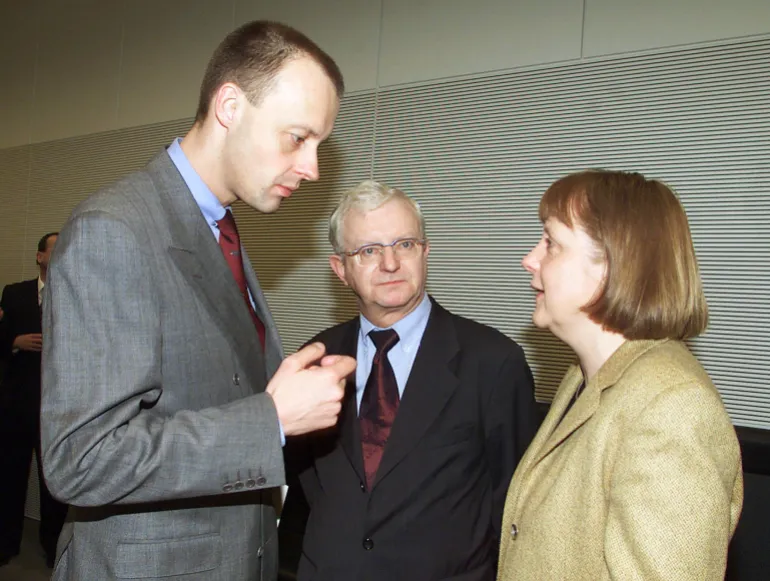
A former chairman of the BlackRock investment company’s German supervisory board, Merz had long harboured ambitions of becoming chancellor but was sidelined by then-Chancellor and -CDU leader Angela Merkel in the early 2000s. He staged an unexpected comeback, finally taking office in May 2025.
Then-designated German Christian Democratic Party (CDU) parliamentary floor leader, Friedrich Merz (left) is pictured with then-party secretary general Angela Merkel (right). In the centre is lawmaker Rudolf Seiters before a meeting of the CDU parliamentary group in the Berlin Reichstag, February 18, 2000 [Reuters]
At the helm, Merz has drawn criticism for remarks about the country’s “Stadtbild” (cityscape), widely interpreted as a suggestion that there were too many refugees and migrants on the streets. The debate has resurfaced in recent days with prominent CDU figures returning to the issue after the party’s poor election results.
The AfD’s surge is but one factor behind the decline of Germany’s long-dominant conservative party, which has produced six chancellors in its history.
The CDU and its Bavarian sister party, the Christian Social Union, govern Germany in coalition with the Social Democratic Party (SPD). The government is struggling amid the rising cost of living, deindustrialisation, crumbling infrastructure and a housing crisis in major cities.
Nils Diederich, a professor emeritus of political science at the Free University of Berlin and a former SPD member in the Bundestag, said Merz has failed to make a good impression but argued he is not the main reason for the CDU’s poor results.
“Overall, I see the coalition itself as the main problem,” he said. “The Social Democrats have worn themselves out in the coalition. They have lost their sense of direction and are putting the brakes on reforms. That, in turn, is dragging the CDU down with them.”
Schroeder told Al Jazeera: “It’s possible that the crisis surrounding the chancellor could develop into a fundamental crisis for the CDU and from there into a crisis for the coalition.”
The reform dilemma
In July, the German government announced a package of 34 measures, including reforms to pensions, taxation, bureaucracy and the labour market. Merz originally intended to push through his repeatedly promised reforms by the end of the year.
But the state elections have put the coalition parties under greater pressure to stake out their own positions.
To ease the burden on people in need of long-term care and to plug multibillion-euro deficits, the SPD is calling for a cap on care costs and for people with private health insurance to share the costs. The CDU firmly rejects both proposals on legal and financial grounds.
State premiers from both major parties and the SPD leadership want to retain the option of retiring without a pension reduction after 45 years of contributions, which they see as a reward for a lifetime of work. The conservative bloc’s business wing, however, insists that the provision be phased out.
Finance Minister Lars Klingbeil of the SPD is planning new revenue measures to consolidate the budget but faces fierce resistance from CDU state premiers and conservative legislators determined to block any tax increases.
Schroeder warned that the coming months could be difficult.
“The CDU is caught in a dilemma. If Merz continues down the path of reforms that place a burden on society, the likelihood of cooperative governance with the SPD will diminish further. If he goes along with the course the SPD is proposing, pressure within the party will increase.”
Diederich said: “If the reforms fall through, then either Merz or the Social Democrats would have to act and let the coalition collapse.”
The next major election test will come in North Rhine-Westphalia, Germany’s most populous state, where voters elect a new parliament in April.
Siegfried Muresan’s loss of the confidence motion increases the prospect for snap elections.
Published On 30 Sep 202630 Sep 2026
Romania’s pro-European Prime Minister-designate Siegfried Muresan has failed to win a parliamentary vote of confidence, prolonging a political crisis seen as a boost for the rising far right.
Muresan, a liberal European Parliament member who was the latest of three designated prime ministers, secured only 182 votes out of the 233 required to secure the confidence motion on Wednesday, according to the official count.
Recommended Stories
list of 3 itemsend of list
The far-right Alliance for the Union of Romanians (AUR) largely boycotted the vote.
The 45-year-old had proposed what he described as a “reform-oriented” governing programme under his centre-right National Liberal Party (PNL), which teamed up with the Save Romania Union party, or USR, and the small ethnic Hungarian UDMR party.
President Nicusor Dan said he would nominate a new prime minister candidate on Monday afternoon, after holding talks with the leaders of the parliamentary parties, to avoid snap elections.
Siegfried Muresan addresses delegates of the Romanian Parliament prior to a vote at the parliament in Bucharest, Romania, on September 30, 2026 [AFP]
Romania saw the collapse of a pro-European coalition government in May, when governing social democrats, together with the opposition far right, ousted liberal Prime Minister Ilie Bolojan in a no-confidence motion at that time.
The far right, which comprises about a third of Parliament, threatened to impeach the president if he does not call early elections once the conditions are met.
Romania, a member of the EU and NATO that borders Ukraine, has not held snap elections since the fall of communism in 1989.
Political analyst Cristian Pirvulescu told the AFP news agency that snap elections would lead to another fragmented Parliament, but with an emboldened far right.
“Early elections mean that, from the moment they are called, it would take four months before a new government could be formed,” Pirvulescu told AFP. “Due to political instability, Romania finds itself in a very complicated economic situation. Four months is already a very long time.”
The country of 19 million has been struggling for months with the highest public deficit and inflation in the European Union.
Supporters of Romania’s far-right politician and former presidential candidate Calin Georgescu, not in picture, cheer as he leaves the Court of Appeal in Bucharest on September 28, 2026, following a new hearing in the case in which he and other defendants are accused of actions against Romania’s constitutional order [AFP]



![Supporters of Romania’s far-right politician and former presidential candidate Calin Georgescu, not in picture, cheer as he leaves the Court of Appeal in Bucharest on September 28, 2026, following a new hearing in the case in which he and other defendants are accused of actions against Romania’s constitutional order [AFP]](https://i0.wp.com/www.aljazeera.com/wp-content/uploads/2026/09/afp_6abd16ba6649-1790777018.jpg?w=640&ssl=1)