The Euro

Ryanair rule change could see you charged extra at airport

Ryanair recently changed one of its rules

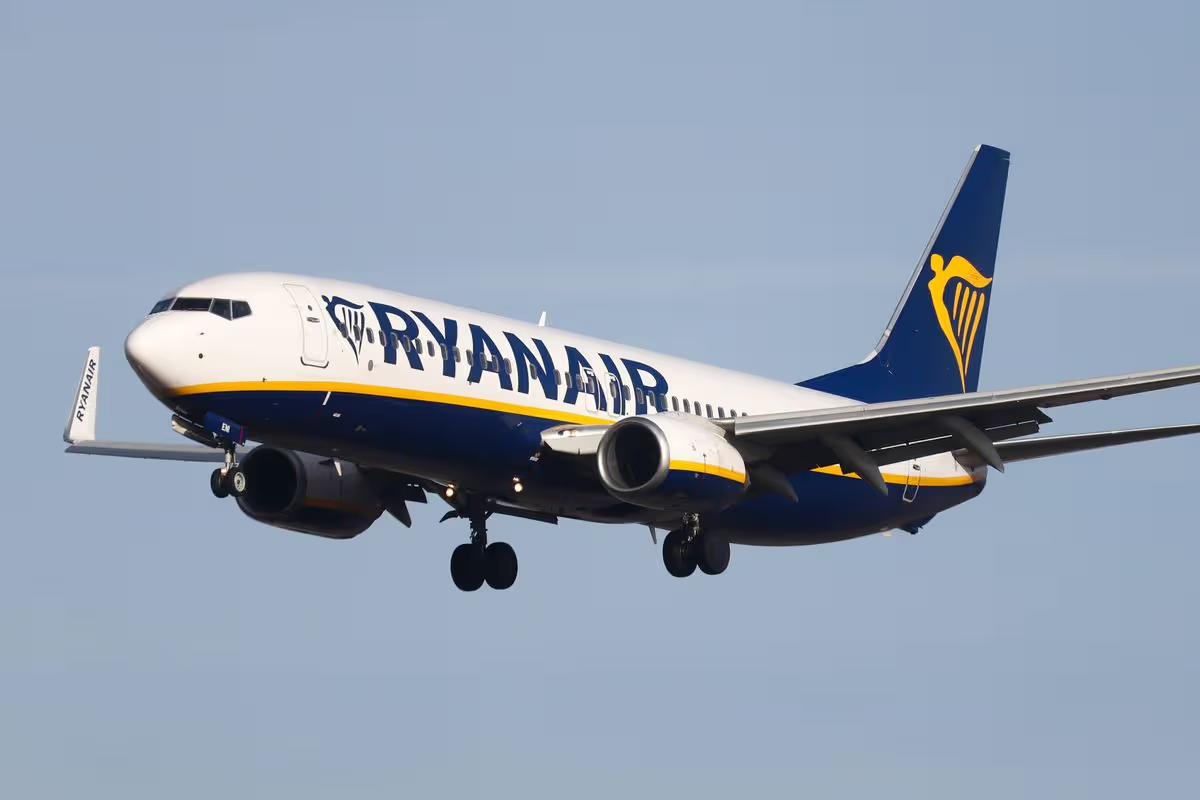
A Ryanair rule change could see some holidaymakers charged around £55 extra at the airport. The budget airline is well known for its no-frills approach, regularly slapping on extra fees for things like luggage and choosing your seat in advance.

Currently, passengers travelling on standard tickets are only allowed one small personal item as hand luggage without incurring any additional costs. Should that item be larger than the permitted dimensions, it will need to go into the aircraft hold, at an extra charge.

While plenty of travellers are well aware of this policy, there is another Ryanair requirement that could leave you out of pocket. Anyone flying with Ryanair must check in online. Passengers can then store their boarding pass on a mobile phone or tablet.

In November 2025, Ryanair has moved to “100% digital boarding passes via its app, eliminating paper passes to reduce costs, improve service, streamline rebooking, and save 300 tonnes of paper annually”. Online check-in opens 60 days before departure for those who have bought allocated seats, or 24 hours beforehand for passengers happy to accept a free seat assignment.

Regardless of seating preferences, the online check-in window shuts two hours before the scheduled departure time. Once online check-in has been completed, boarding passes are issued, and passengers are required to save a digital copy. Failing to check in online will land you with an airport check-in fee of £55, or the euro equivalent.

To sidestep this charge, make sure you have a valid boarding pass in hand before setting off for the airport, reports Chronicle Live. For those travelling without a smartphone or tablet, Ryanair will issue a free boarding pass, so long as online check-in has been completed before arriving at the airport.

Ryanair said it will send passengers a reminder to check in online shortly before their scheduled departure.

Source link

UK holidaymakers face new problem if heading abroad in 2026 ‘it could get worse’

Current events are causing all sorts of problems, according to a currency exchange expert

Brits heading abroad this summer are being given a new warning.

Towards the close of last week, Sterling dropped to a three-week low against the Euro and a five-week low against the US Dollar, spelling trouble for Britons travelling overseas. The decline, according to a foreign exchange expert, stems from two key factors.

Tony Redondo, founder of Newquay-based Cosmos Currency Exchange, explained: “Firstly, markets are worried that Britain is heading towards a period of political instability. Secondly, they are worried about how the UK economy will cope with an expected rise in inflation.

“Though inflation fell to 2.8% today, it is expected to rise, potentially sharply, in the months ahead as the impact of rising oil prices due to the conflict in the Middle East hits the UK economy in full. If markets believe higher inflation makes UK gilts a not–so-safe bet, that will apply further downward pressure on Sterling.”

Tony noted the weakened Pound was hammering holidaymakers venturing abroad, as their money was now “plummeting” in value against currencies like the Euro and Dollar – a situation that “could get worse in the weeks and months ahead”.

However, he highlighted that a struggling domestic economy and Sterling’s persistent fragility was prompting an increasing number of businesses to fundamentally reconsider how and where they sell their services.

Tony added: “If they’re anything, the UK’s businesses are resilient and proving they can adapt. During 2026 to date, we’ve seen a sharp rise in UK businesses moving away from difficult domestic conditions and looking for customers overseas.

“Rather than having all their eggs in one UK economic basket, a growing percentage of UK firms are now marketing and selling their products and services online to customers in Europe, America, Canada, Australia and even Singapore and Hong Kong.

“If there’s one silver lining to the weak UK economy, it’s that many traditionally domestic UK small businesses have become international ones, as they cast their nets ever wider in search of customers and profit.

“The ability to ply your trade internationally has never been easier and it can massively boost a company’s bottom line.”

Source link

Spain’s tourism boss issues warning for Brits ahead of summer

Holidaymakers planning a trip to Spain who haven’t yet booked their flights are being warned to do so know amid speculation that escalating oil prices could soon drive up the costs

A Spanish tourist boss has warned that Brits who haven’t yet booked their summer holidays should book flights as soon as possible to avoid “price fluctuations”.

Jordi Hereu, Spain’s Industry and Tourism Minister, made the comments to Spanish news outlet Expansion yesterday (April 27), warning that growth in the tourist industry could be dampened by rises in the cost of flights. Last year, Spain welcomed 97 million tourists through its borders, and was expected to hit the 100 million mark this year.

He said: “What ⁠we’re recommending is that ‌people buy their tickets now because it’s true that (airlines) are currently using kerosene that was purchased some time ‌ago, and therefore there’s an element of ‌price fluctuations involved.”

“It’s already clear that prices have risen and this could affect demand.” he added. He went on to reassure holidaymakers that authorities were looking at ways to prevent fuel shortages as the busy summer season looms.

READ MORE: Passport holders urged to act as issue could see them ‘turned away at airports’READ MORE: TUI issues Tuesday April 28 update for passengers with holidays to Europe booked

But Mr Hereu also warned: “If the countries ‌that send tourists to Spain had problems, we would have them too.”

Many airlines have been foreced to cancel flights this spring and summer due to the rising cost of jet fuel as supplies run law, as a consequence of the closure of the Strait of Hormuz following the Israeli and US attack on Iran.

Keir Starmer said the UK was doing “everything we can” to reopen the Strait, although the UK PM warned: “I don’t want anybody to think that, once the Strait is open, that that’s the end of the damage. It will go on longer than that.”

He went on to tell Sky News: “I can see that, if there’s more impact, people might change their habits… where they go on holiday this year, what they’re buying in the supermarket, that sort of thing.”

Corneel Koster, Virgin Atlantic’s chief executive, told the Telegraph: “I was looking at improving our financial results by a really significant chunk. And then this happens. We have never seen jet fuel at these levels, with prices more than doubling. The industry cannot absorb increases like this.”

In recent weeks, the cost of a barrel of jet fuel has increased from £63 to as high as £148 amid the conflict in the Middle East. The cost of fuel accounts for around a quarter or more of operating expenses for airlines, meaning it can have a big impact on profits.

According to reports by the BBC, the lowest-priced economy tickets currently cost 24% more on average than this time last year. In response, airlines have asked for measures such as a cut or suspension to Air Passenger Duty to be put in place to balance out the costs for consumers.

READ MORE: UK tourists face risk of new airline strikes in European country 1.3m visit a yearREAD MORE: ‘I cried every day in England so moved 10,000 miles away – now my salary’s doubled’

A number of airlines have already cut services, such as Lufthansa, which has axed 20,000 European short-haul flights, which it claims will save around 40,000 metric tons of jet fuel. The German airline will offer customers options, including refunding fares or booking them on alternative flights with other airlines.

Have a story you want to share? Email us at webtravel@reachplc.com

Source link