Martin Lewis tells OVO E.ON Octopus EDF customers ‘make sure you do it’ – The Mirror
Need to know
All you need to know as personal finance expert reacted to ‘£427’ warning about major change coming as fuel situation gets worse
07:08, 23 Sep 2026Updated 07:08, 23 Sep 2026
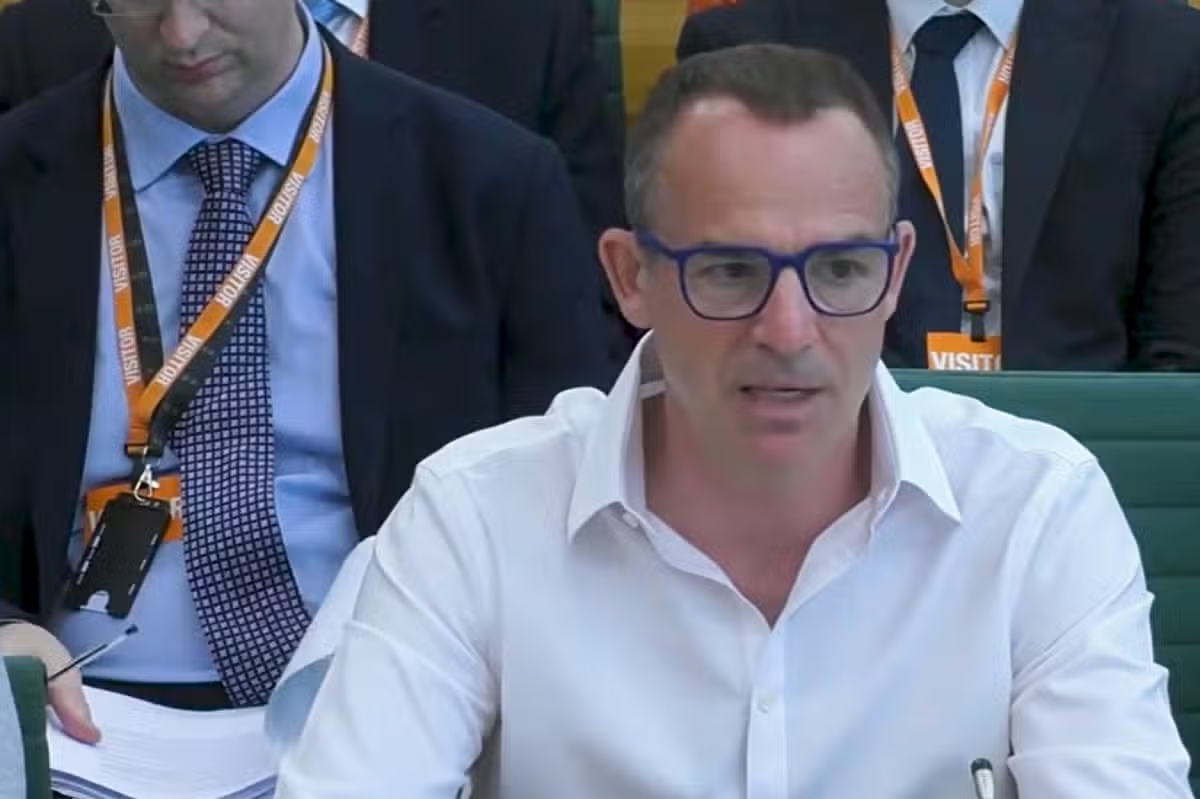
Martin Lewis gave advice to anyone not on a fixed rate or coming up to the end date(Image: Parliament TV)
Energy bills need to know: 25% surge forecast for January amid US-Iran tensions
Energy bills are set to soar by 25% in January, adding an extra £427 to household costs and pushing the price cap to £2,150.
The dramatic increase is being blamed on Donald Trump’s escalating conflict with Iran, which has driven up wholesale gas and electricity prices across the economy. Bloomberg Economics forecasts predict the bitter blow will hit millions of families already struggling with the cost of living crisis.
Personal finance expert Martin Lewis has urged customers of major suppliers including British Gas, Octopus Energy and ScottishPower to take immediate action. He warned that fixed tariffs could offer protection, saying: “I cannot say fixing if you’re on the price cap will definitely save you, but it is absolutely the risk-averse thing to do.”
The cheapest fixed deals currently available include Sainsbury’s Energy at £1,646 per year and Outfox Energy at £1,676. If predictions prove accurate, these tariffs could save households roughly £500 annually compared to the January price cap.
However, energy expert Sabrina Hoque from Uswitch.com cautioned that fixed deals lock customers in for 24 months. She warned they “may look far less competitive in a year if the US-Iran conflict de-escalates.”
Martin Lewis advised consumers to use whole-of-market comparison sites to find the best deals available. He predicted energy prices will remain high, stating: “It’s definitely going to rise. It’s probably going to rise quite substantially.”
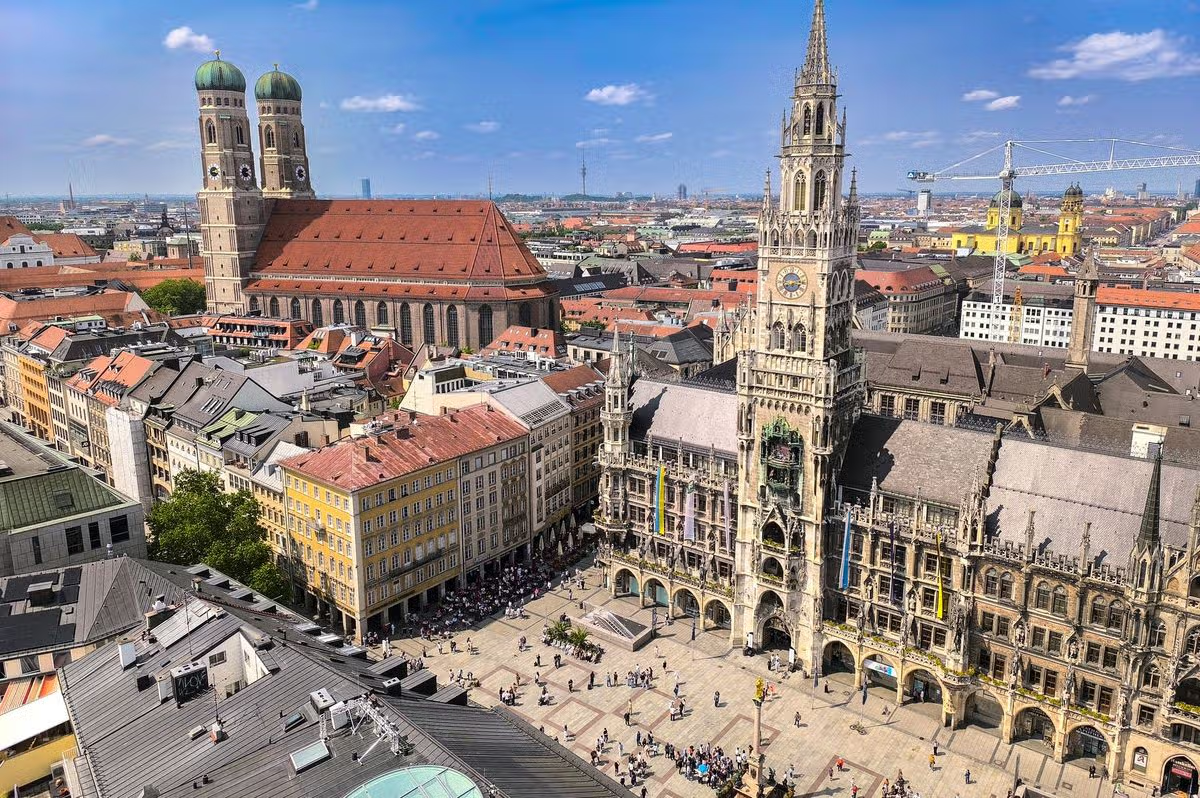
Germany has the largest GDP in Europe(Image: Getty)
When you think about wealthy countries, places like Dubai, China and the US might spring to mind. However, Europe has its fair share of rich countries too. The wealthiest of all has been revealed in new data this year, and it’s not Luxembourg or Sweden.
According to figures from the World Population review, Germany is Europe’s wealthiest country when judged by gross domestic product (GDP). Germany has a GDP of $5.45trillion (£4.026T).
What is GDP?
GDP is a way to measure a country’s productivity and prosperity. The GDP of a country is the total monetary value of all goods and services which that country produced within its borders over a year.
To calculate it, economists take the spending of everyday consumers, the investment of businesses in the country, and government spending and net exports to figure out the final calculation.
If GDP is rising year on year, it’s a good sign that the country is doing well financially. If it is consistently lowering, it’s a sign of an incoming recession.
Is it accurate?
GDP is not a very accurate indicator of the prosperity of a country’s people. It does not indicate how the wealth is distributed, nor the happiness or individual wealth of people.
These flaws are why GDP is often calculated alongside other metrics such as the Human Development Index, which measures the economy as well as life expectancy and education to get a better idea of how a country is functioning.
There’s also the Inclusive Wealth Index, which measures the “savings account” of a country by looking at infrastructure, natural resources and workforce alongside its finances.
How does the UK compare?
According to the most recent data, the UK is in second place with a GDP of $4.23trillion (£3.148T).
France is in third place with $3.17trillion (£2.654T), Italy fourth with $2.42trillion (£2.021T), and Russia fifth with $2.21trillion (£1.962T).
In the case of Germany’s GDP, it is larger than two other European nations combined. Portugal has $380.6billion (£281.0B), and Greece has $307.6billion (£227.1B).