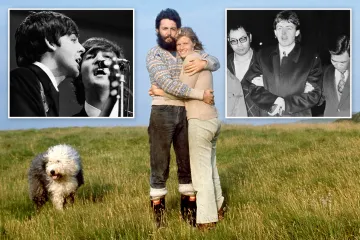
“LINDA looks so beautiful, so cool,” says Paul McCartney.
He’s just been watching a film about the decade of his life after The Beatles broke up — and it is filled with images of his much-missed first wife.
Sign up for the Showbiz newsletter
Thank you!
Paul McCartney, Linda and their dog Martha in ScotlandCredit: �1970 Paul McCartney under exclusive licence to MPL Archive LLP.Photographer: Linda McCartPaul with fellow Beatle John Lennon in 1965Credit: Getty
“The Linda stuff was very emotional,” he admits at the Man On The Run launch event in London.
“Linda, the kids, me and John [Lennon] — all these memories. It’s like my life flashing in front of me.”
Macca is talking to an intimate gathering that includes his daughter Stella, son James, superfan Noel Gallagher and the actor who will play him in a forthcoming biopic, Paul Mescal. Oh, and me.
He continues: “Seeing me and Linda interacting is special because, you know, she’s not here.
“So is seeing the kids when they were little, because they’re not little any more. They’ve got kids of their own now.”
The film stirs memories of forming his own band, Wings, with Linda in 1971, prompting this from McCartney: “We tried to follow The Beatles — it’s mad!”
It also brings into sharp focus his relationship with Lennon, which broke down in the wake of The Beatles split but, as we see, they reconciled shortly before John’s death.
Directed by Oscar-winning Morgan Neville, Man On The Run is a masterpiece of documentary storytelling.
Rich in source material, partly because Linda was a professional photographer who also shot home movies, it is raw, heartfelt, funny, poignant and, crucially, not remotely sugar-coated.
Before the screening starts, Sir Paul, looking fit and well for his 83 years, strolls on to the stage and quips: “I just want to say thank you to Morgan for keeping in all the embarrassing moments that I asked him to take out.”
Paul is arrested and led away in handcuffs in Japan in 1980Credit: GettyPaul in a photograph taken by Linda
But let’s get back to the big question: How DO you follow The Beatles?
It was a conundrum that weighed heavily on McCartney as the Swinging Sixties drew to a close.
As he puts it himself in the movie, the first thing he did was “escape” and then he had to learn how “to grow up”.
He had married American Linda Eastman in March, 1969, at Marylebone Town Hall, London, and soon afterwards adopted her daughter Heather from a previous marriage.
The announcement came amid acrimony over the band’s crooked business manager Allen Klein, favoured at the time by John and the others but later described by Paul as “a sort of demon”.
It was all over for the band of four likely lads from Liverpool who changed popular culture for ever.
“John broke up The Beatles,” Macca affirms in Man On The Run. “But I got the rap. And that’s a bit of a weight to bear.”
Around the same time as Lennon’s bombshell, in late 1969, there were rumours across the US and around the world that “Beatle Paul may be dead”.
There’s a hilarious moment in the film when his younger brother Mike is asked whether it’s true.
“It’s a hoax, it’s a con,” he exclaims, before being asked when was the last time he saw his brother.
Macca with Wings’ DennyCredit: DawbellPaul on stage with his wife Linda as Wings perform in London in 1976Credit: Getty
Mike replies: “The last time? It was his funeral, I think!”
It turned out that McCartney had the perfect bolthole, in an archetypal middle of nowhere, to hide away and reset his life.
In 1966, he had bought High Park Farm, a 183-acre sheep farm on the Mull of Kintyre (yes, that explains the song) in Argyllshire, only reached via a “long and winding” track.
With its corrugated iron roof and general state of dilapidation, it was, as someone in the film points out, the sort of place a poor farm labourer might baulk at accepting.
But, as the Sixties ebbed to a close, Paul, Linda, their daughters, Heather and baby Mary, plus their Old English Sheepdog Martha decamped to the Scottish wilds.
In the movie, McCartney suggests, “We got up there to escape”, and ponders whether he would write “another note of music” before confessing to drowning himself in one wee dram of Scotch after another.
But, with the responsibility of supporting a young family on his shoulders, he realised that “it was a question of HAVING to grow up”.
At the Man On The Run launch, McCartney reflects: “With The Beatles, we were just lads. Everyone, all our management, used to call us ‘the boys’.
“Then I got married and then there was a baby [Mary] on the way.
“I had to grow up. I thought, ‘We can’t just be these ‘boys’ any more’. It was time to think about stuff.
“Even though the film is kind of madcap and you see all our insane decisions, in the background there were some sensible decisions, too.”
He remembers how Linda was his guiding light through those years.
The Beatles on Top Of The Pops in 1966Credit: GettyDaughter Mary joins Paul and pipers on set Mull Of Kintyre videoCredit: �1977 MPL Communications LtdWings say cheers at the farm’s Rude Studio in 1971Credit: MPL Archive LLP/Linda_McCartney
“If there was an idea that was a little bit crazy, I’d say, ‘Should I do that? Could I do that?’ She’d say, ‘It’s allowed’. It was a brilliant philosophy in life.”
Director Neville picks up on this theme: “I looked into the questions Paul was trying to ask of himself, questions that I felt were universal.
“How do you deal with your own legacy and the expectations people have of you? How do you balance your career with your family?
“In Paul’s case, he made them one and the same. And that, I thought, was completely inspirational.”
Though Kintyre provided a necessary respite from the dazzling glare of publicity, Macca has never been far away from making music. It’s in his blood.
In 1970, he released his debut solo album, simply titled McCartney, with its intimate DIY aesthetic and featuring at least two songs with his beloved partner in mind — The Lovely Linda and Maybe I’m Amazed.
Rehearsals for their debut album Wild Life took place at Macca’s converted barn in Scotland, dubbed Rude Studio.
It felt to him as if he was starting over, at the bottom of the pile.
“It was so impossible to do something like that,” he says today.
“Just go back to square one, show up at a university, don’t book hotels, take the dogs in a van. For some reason, we thought it was a great idea!”
If Wings took time to take flight, everything changed in 1973 when they released third album Band On The Run, loaded with classic tunes such as the title track, Jet and Let Me Roll It.
Paul poses with film director Morgan NevilleCredit: Prime Video
Recorded in extraordinary circumstances at EMI’s studio in Lagos, Nigeria, not far from where Paul and Linda were mugged at knifepoint, it paved the way for stadium-sized shows in America.
Without the McCartneys’ sojourn to Scotland, there would have been no Mull Of Kintyre, which, at the time of its release in 1977, became the biggest selling single of all time.
A “love song” to that remote idyll, it featured Great Highland bagpipes played so passionately by the local Campbeltown Pipe Band.
Yet, interwoven with stories of Wings’ upward trajectory, there are musings on McCartney’s strained relationship with Lennon during the Seventies.
We’re reminded of John’s caustic song How Do You Sleep?, directed at Paul with its line, “The only thing you done was yesterday”.
And there’s his old buddy left thinking, “Aside from Yesterday, what about Eleanor Rigby, Lady Madonna, Hey Jude, Let It Be and the rest?”
Macca says: “As it shows in the film, I knew John from a very early age — we were just a couple of rock and roll fans.
“We enjoyed hanging out together and we started writing little songs round at my place.
“My dad had a pipe in his drawer. So we thought we’d smoke it. We couldn’t find any tobacco so we smoked tea! We had all those memories in common.
“Then we went through the whole trajectory of The Beatles. But John was always just that guy to me, even when he was being really mean and I was having to take it.
“At the same time, it was like, ‘Yeah, it’s just John, he does that’. He’d always done that — so that made it a little bit easier.
“But I loved him, you know. I loved all the guys in The Beatles.
Man On The Run is on Amazon Prime Video from Friday, when a soundtrack album is outCredit: Dawbell
“I try and think of how else it could have been, but with just me, John, George and Ringo, it was a magic grouping. And we did OK!”
Near the end of Man On The Run, you see McCartney being confronted by camera crews about the shocking death of Lennon, who had been shot the day before outside the Dakota Building apartment he shared with partner Yoko Ono in New York.
Macca was criticised at the time for a rather cool, unemotional response — but one look in his eyes reveals his utter devastation.
As for the aforementioned “embarrassing moments” on display in the film, they are what make it so refreshing and endearing.
Hence you see McCartney singing Mary Had A Little Lamb wearing a red clown’s nose with Wings guitarist Henry McCullough looking as if he wants the earth to swallow him.
There’s a moustachioed Paul in a baggy pink suit performing the cabaret-style Gotta Sing Gotta Dance, complete with dancing girls, for his 1973 variety show.
And what about him getting busted by Japanese cops in 1980 for having 219g of cannabis in his luggage, spending nine days in custody before being booted out of the country?
McCartney was supposed to be embarking on a Wings tour of Japan but, as it turned out, they never played together again.
He says: “So many bits are embarrassing. The look on Henry McCullough’s face! He’s not happy.
“I was thinking, ‘Maybe we could cut those bits, the dance routine, cool out my image’.
“But Morgan said, ‘No, let me keep them in. You’ll see all that stuff but because you overcame it all and found yourself, you won in the end’.”
Finally, McCartney takes a long hard look at himself — at the person “growing up” in Man On The Run and the man he is today.
He says: “You start to see yourself, not just in the mirror, but to realise what your character is like.
“It’s natural for me to be enthusiastic so I don’t always see pitfalls, With me, it’s, “Nah, nah, just do it’.”
Sir Paul McCartney has been opening up about his career and personal life as a new documentary about him nears release, and a biopic about The Beatles begins filming
Sir Paul McCartney(Image: Medios y Media/Getty Images)
Musician Sir Paul McCartney has made a heartbreaking admission about his time in the spotlight. For around six decades, Paul McCartney has been beloved worldwide thanks to his work as part of The Beatles, as a solo artist, and with his former band, Wings.
Reflecting on his career in an interview with director Morgan Neville Paul, 83, spoke about how he feels when criticised by people.
Making the comments in a new documentary about the musician called Man On The Run, Sir Paul talked about how he bought into some of the criticism.
He remarked: “Whenever I hear someone damning Paul McCartney, I tend to agree with them. So when everyone was saying I broke up the Beatles and I was just overbearing and all of that, I kind of bought into it.”
This isn’t the only time Sir Paul has become emotional when talking about the documentary, as he admitted he felt “emotional” upon seeing his late wife Linda McCartney in the programme.
Linda, who died in 1998, shared four children with Sir Paul including Heather, 63, who was adopted, Mary, 56, Stella, 53, and James, 48.
At a screening of the documentary at London’s Ham Yard Hotel, Sir Paul said the film triggered some powerful memories of Linda, who Sir Paul said helped him deal with the tumultuous time he faced following the break up of The Beatles.
He said: “Seeing me and Linda interacting is very special because, you know, she is not here anymore. Me and Linda, the kids. The music. Me and John [Lennon].
“These memories, it is like a life flashing in front of you. There are so many cool things. Even though there are some embarrassing moments, I come out of it thinking, ‘Yeah, I’m OK’.
“All the stuff with the kids and Linda is lovely to see. Obviously it’s emotional because she looks so beautiful. She’s so cool.”
Sir Paul also has another daughter, 23-year-old Beatrice, with his second wife Heather Mills, who he was married to between 2002 and 2008 when their divorce was finalised.
Sir Paul is currently married to Nancy Shevell, with the pair tying the knot in 2011.
The documentary is set to be released on February 27 as filming continues on four individual biopics about each member of the Beatles, in which Paul Mescal, 30, will play Sir Paul. The films will be directed by Sir Sam Mendes.
★★★★★ Man on the Run, a documentary directed by Academy Award winner Morgan Neville, chronicles Paul McCartney’s post-Beatles solo career with previously unseen footage
19:13, 19 Feb 2026Updated 19:21, 19 Feb 2026
Paul McCartney attends the UK Special Screening of Prime Video’s ‘Paul McCartney – Man on The Run(Image: Prime Video)
Sir Paul McCartney gave director Morgan Neville a blank piece of paper and told him ‘no notes’ after watching documentary Man on the Run for the first time.
Ahead of it being unleashed to fans next week, The Beatles legend has found a few more words to describe the two-hour film calling it ‘madcap’, ’embarrassing’ at times and often ‘overwhelming’ to watch, “But I come out of it thinking, ‘Yeah I’m OK,” says Paul at a very special screening.
The room of family, friends and rock royalty certainly agree. Paul Weller, Noel Gallagher and Sharon Osbourne are among those turning out to the film’s UK debut on a rainy night in Soho. Actor Paul Mescal, who is playing the mop-topped musician at the peak of Beatles-mania in a brand new four part film release, is also in attendance at the Ham Yard hotel.
While Mescal could be seen to be doing his homework, this brand new documentary from Academy Award winner Neville focuses on Paul’s life as he navigates the demise of the Fab Four and the ascension of Wings in its wake.
So what do you do when you quit the biggest band the world has ever seen? If you’re Paul McCartney you start another one.
Paul admits his boundless enthusiasm has led him into trouble at times, but turning a group of musicians practising at a remote farmhouse into a credible 70s rock band makes a gripping plotline for this joyous documentary showcasing a fascinating upheaval in his life, alongside a great love of his life.
Much of the never before seen clips that tell Paul’s story in intimate and raw detail are are thanks to his late wife Linda.
‘Next to a presidential library, Paul McCartney has the best personal archives,’ Neville was told of his subject before they set to work. “It also helped that Paul married a photographer because Linda takes pictures of everything and there are so many home movies too,” the grateful filmmaker says at a Q+A following the screening. “I thought I lost it all,” Paul says. “You know this was the 60s and 70s, you’d have a lot of break ins, you didn’t really bother locking your door too much. Fans would come in and nick a load of stuff. It was how it was. I kind of automatically just thought it’s all gone, but the kids at my office were fantastic. They looked in every little storage unit and every little drawer and they found it all and logged it. There’s amazing stuff there.”
For Paul, the most special memories he sees on screen are the moments of him and late wife Linda together.
“Seeing me and Linda interacting is very special because you know she’s not here anymore. It’s me and Linda, the kids. The music. Me and John. These memories it’s like a life flashing in front of you. There are so many cool things. All the stuff with the kids and Linda is lovely to see. Obviously it’s emotional because she looks so beautiful. She’s so cool.”
Daughter Stella who is in the theatre gives an approving cheer from her seat. “So that comes over,” notes Paul. “You know and the kids aren’t little anymore and they have kids of their own now.”
Paul married New York photographer Linda in March 1969, in a quiet civil ceremony at Marylebone Register Office in London with Ringo Starr among a select group of guests. Less than a year later, after a decade together the four Beatles went their separate ways – which for Paul was straight to a remote 183 acre farm on the Kintyre Peninsula in Scotland.
Talking on camera, a now 83-year-old Paul says all he wanted to do after the Beatles finished was ‘grow up’. Months into setting up his young family into chaotic country living, the call to create music couldn’t be ignored even from his rural retreat.
First came debut album McCartney, followed up months later by 1971’s Ram as he formed a double act with Linda.
“What am I doing singing with Paul McCartney?” Linda asks in the early home footage, admitting she can’t sing and could play only one note on the keyboard. “It’s a start,” Paul replies.
Ram was released just as Paul launched legal action to dissolve the Beatles’ partnership. It was poorly received. Undeterred, Paul set about forming a larger group this time recruiting Denny Laine, a friend from his time in 60s rock group the Moody Blues to join him and Linda. The trio took on more members, naming themselves Wings as they recorded experimental new material and set off to play in the type of tiny venues that had become a distant memory for superstar Paul.
“We’d show up at universities, not bother to book hotels, just take the kids and dogs in a van and for some reason we thought that was a great idea,” says Paul.
But at the start the enthusiasm was not reciprocated. The band were initially received as a ‘dud’ from fans and critics, with even Paul’s collaborator Lennon mocking his music.
After an early mauling from the industry who had once revered him, it was a slow road to success before Wings’ live shows developed into must-see tours and they produced some of the biggest selling singles and albums of the decade, including number one hit Mull Of Kintyre, Jet, Silly Love Songs and Live And Let Die, the theme to the 1973 James Bond film of the same title.
Paul said Linda’s responses to his boundless energy continues to inspire him today. “Anything crazy I would say, ‘Should I do that? Could I do that?’ And she’d say ‘Yeah, it’s allowed!’ It’s a great philosophy to have.”
The film is not just a family portrait, but also an insight into Paul’s complicated relationship with Lennon. Paul admits he felt he was punished most for the demise of the band and even bought into the blame himself.
“I thought that’s the kind of bastard I am, it leaves you in this kind of no man’s land, but the truth, John had come in one day and said he was leaving The Beatles, he said, ‘it’s kind of exciting, it’s like telling someone you want a divorce’.”
The film also sees Paul reflect on John’s ‘diss track’ about him following their break-up, How Do You Sleep?, which featured on 1971’s Imagine album with the Plastic Ono Band.
“The only thing you did was Yesterday (one of the song’s lyrics), was apparently (former Beatles manager) Allen Klein’s suggestion, but (at) the back of my mind I was thinking, ‘but all I ever did was Yesterday, Let It Be, The Long And Winding Road, Eleanor Rigby, Lady Madonna, f*** you, John,” says Paul. “How do I sleep at night? Well, actually, quite well, but you’ve got to remember, I’d known John since he was a teenager, and that’s kind of what I loved about John. He’s a crazy son of a bitch, he’s a lovely, lovely, crazy guy.”
Paul says one of his ‘greatest blessings’ is that he got to reconcile with John before his death in December 1980. Their children recall the last meeting of the two families in John’s New York City apartment, as ‘one big reunion’.
Stella and sister Mary also recall hearing the fateful moment Paul got the call that his best friend was gone. Stella says she heard a wave of commotion before seeing her dad rush out of their home and out onto the farm alone. The famous ‘Drag, isn’t it?’ clip of Paul reacting publicly to John’s death is shown in the film with Sean Ono Lennon defending the response as coming from a place of pure shock and grief, far from the Paul he recognised.
Reflecting on the period of life captured in the archive film, photo and audio recordings, Paul says: “It’s a heck of a story. It would be nice if people took away the fact that in my craziness and my enthusiasm, we stuck with it and we made it work. There’s something brave about that. It didn’t have to work out, you know, but it did.”
Giving their verdict immediately after the London premiere are two men who know exactly what it’s like to launch a solo career in the shadow of an iconic British band. Noel Gallagher and Paul Weller spoke to the Mirror following the screening. Weller hailed the movie as ‘fantastic.’ “It’s great to see that period of time ,the early 70s again, on screen like that.” Lifelong Beatles fan Gallagher called the project ‘amazing’ as the theatre lights came up.
Sharon Osbourne, who also posed for photos with Paul ahead of the screening, said she could see a movie of late husband Ozzy’s life being depicted on screen one day and was moved to tears by the film at several points. “It was incredible… very emotional. Especially the family moments with Linda. It was beautiful.”
*Paul McCartney Man On The Run airs on Prime Video on February 27*
After a newspaper ranked the city bottom in a list of Britain’s best cities, Fiona Whitty went to check it out to see if some of the criticism it receives it fair
Fiona and Rosie enjoyed a lot of what Southampton has to offer(Image: Supplied)
Southampton is many things to many people. Now Britain’s biggest cruise port, it’s where the Titanic set off from on its doomed maiden voyage. It boasts a thriving student community, with all the cool bars and fun places that an unending stream of young people brings.
And it has some of the UK’s best-preserved city walls, which remind you of the strategic importance the city once held. And on the arts front, it’s home to the largest theatre in the south outside of London, with a bumper programme of West End offshoots.
But sadly, not everyone thinks it has much to offer. The Daily Telegraph recently gave it just 1/10 in a ranking of the UK’s 20 biggest cities, placing it last. After spending a weekend there with my 20-year-old daughter Rosie, I think they’ve got it badly wrong.
The city is buzzing…with cocktails, culture and cuisine for starters. Rosie and I kicked off with a cocktail masterclass at 1932, a classy bar that’s ‘hidden’ behind unmarked doors and accessed via a buzzer, giving it a speakeasy feel.
Do you have a story to share? Email webtravel@reachplc.com
Once a bank that opened in – yes, you guessed it – 1932, it’s decked out in sleek art deco-style with golden statue lamps and lattice patterns. Drawing on its heritage, its imaginative bespoke brews, designed by bar manager and mixologist extraordinaire Amy, all have a financial theme.
To begin with, Amy invited us behind the bar to whip up a Cash Money – a creamy mix of rum, coconut, mango and passionfruit jiggled together à la Tom Cruise in a traditional cocktail shaker. Next up was a Platinum Card, created to emulate rhubarb-flavoured Squashies with vodka, rhubarb and banana liquors – this time stirred together and drizzled over ice. Blank Cheque, meanwhile, with gin, Campari, and Lillet Blanc aperitif, had a tantalising hint of Aperol about it.
Rosie and I loved the novelty of mixing behind the bar and the cocktails tasted divine – unique yet perfectly formed. A cocktail masterclass costs £40 with 1932.bar.
Afterwards, we headed to Hokkaido, a hip Japanese restaurant that’s popular with everyone from young couples to families to groups of friends. There we were transported to the Land Of The Rising Sun with a hearty feast that included prawn tempura, fried tofu and chicken, vegetable gyoza and a variety of sushi that tasted every bit as amazing as it looked.
With the city spread out along the Channel and enormous cruise ships often in dock, you can’t escape Southampton’s 1,000-year-old maritime heritage. Not only was it the starting point for The Titanic’s stricken voyage in 1912, it’s also where The Mayflower ferried the Pilgrims over to America nearly 300 years earlier.
On the Titanic front, a brilliant exhibition at the SeaCity Museum offers an absorbing account of how the disaster unfolded, killing around 1,500 of the 2,200-plus passengers and crew on board. A mock courtroom, recounting parts of the British Inquiry that followed, is particularly fascinating as you get to hear the real-life words of witnesses being quizzed and of the judge’s verdicts. Entry costs £14, but book in advance for a 10% discount.
The Titanic Trail, which starts outside, leads you around memorials and points of interest – like The Grapes pub, where several seamen lingered too long before departure and were refused entry to the ship, thus saving their lives. Strolling around we saw Southampton’s old city walls, built to help defend the key port after a surprise attack by French soldiers and Genoese mercenaries nearly 700 years ago. You can discover more at an exhibition at God’s House Tower – once a city entry point and now a museum and art gallery – while the onsite café with excellent coffee and delightful apple buns is perfect for a breather. General entry is free, but the exhibition costs £5.
Southampton is easy to get to, with half-hourly trains from London Waterloo taking just 75 minutes with South Western Railway. Our base was voco Southampton, a stylish IHG hotel on the waterfront. Our sixth-floor twin room offered views across the city’s cruise terminal, where ships docked and car ferries unloaded.
But the real highlights were the super-friendly staff…and the fabulous Atlantic Gate restaurant. With banks of windows flanking the sea, the restaurant has a chilled yet stylish ambience and a stand-out seafood-heavy menu. Over a couple of voco’s superb cocktails – the champagne spritz with rum and coconut was a particular hit – we tucked in to fish soup with whole mussels and prawns, fried mixed seafood and a monkfish, prawn and coconut curry, all simply delicious.
Massive theatre fans, Rosie and I often watch a show when we’re away because tickets are generally cheaper than at home in London, while performances remain just as exciting and professional. The Mayflower – a real Southampton stalwart and, London aside, the south’s biggest – didn’t disappoint.
Dating back to 1928 and now grade-II listed, it’s hosted greats like The Beatles, Queen and the Rolling Stones and still oozes warmth and charm with original chandeliers, sleek cornicing and ornate boxes. Today it attracts the UK’s top comedians, ballet troupes, opera stars, and West End-standard touring productions like Matilda and Six.
A sister theatre nearby, MAST Mayflower Studios, offers yet more. Southampton ticked our boxes for history and culture – and food. The Real Greek, tucked into the side of Westquay shopping centre, was the perfect sassy lunch spot. Thanks to small plate favourites like hummus, tzatziki, Greek salad, and courgette fritters alongside tender grilled aubergine in a smoky tomato sauce and a pork gyros, we enjoyed a smack of summer – helped, no doubt, by the gorgeous Greek sangria with white wine and vermouth.
For our final port of call, we retreated to a batting cage… for the UK’s first interactive baseball experience. 1st Base has given baseball a social makeover, allowing friends or families to bat against each other in a safe and fun game bar environment.
You take it in turns to enter a cage and hit the balls propelled from a machine, while computer technology measures your strike rate and speed. As novices, Rosie and I started slowly but soon picked up the knack and loved the competitive yet relaxed feel to it. Elsewhere, shuffleboard, table tennis, and electronic basketball provided a change of pace – as did the pizza and drinks that are available alongside the action (tip: the dark ‘n’ stormy rum cocktails are out of this world).
No curveballs here – as far as I’m concerned, Southampton has all the bases covered.
GET THERE
A return from London Waterloo to Southampton costs from £44 with South Western Railway. For discounts on food, theatre, and attractions when you travel on their network, check out swr-rewards.com.
BOOK IT
B&B for two in a twin or double room at the voco Southampton starts at £115 per night. See vocohotels.com/southampton.
Liverpool’s L1 postcode has been crowned one of the UK’s coolest areas – from street art to buzzing nightlife, here’s what makes it special
I lived in one of the UK’s ‘coolest postcodes’(Image: Dave Porter / 500px via Getty Images)
Every year, cities, towns and villages from right across Britain battle it out to claim a spot on the coveted “cool” list. Experts assess everything from culinary offerings to community spirit and outdoor access before crowning the top 10 “coolest postcodes” spanning England, Wales, Scotland and Northern Ireland.
This year, the Times has championed Liverpool – specifically the L1 postcode, which I proudly called home for four years.
The publication dubbed it the ultimate destination for “modern-day mop tops” pointing to Hollywood A-listers Paul Mescal and Barry Keoghan, who’ve been soaking up the city’s atmosphere whilst shooting their Beatles biopic.
The Times wrote: “This L1 pocket neatly edges into the vibey Baltic Triangle, a historical area that’s now an engine room of converted warehouses, food markets and venues such as Camp and Furnace – which has hosted everyone from Mogwai to Martha Wainwright – as well as grassroots spaces like Arts Bar Baltic, a creative hub café-bar hybrid.”
Having lived slap-bang in the middle of the Baltic Triangle between 2018 and 2022, I can vouch for its magnetic pull.
Come the weekend, the area bursts into life as revellers from across Liverpool and beyond descend upon its buzzing bars, nightclubs, cafés and artistic haunts.
There’s never a dull moment – something exciting is always happening. The neighbourhood boasts four key attractions that are rapidly putting it on the map for visitors from beyond the city, reports the Express.
Street art
Every corner of the area showcases vibrant artwork that transforms urban spaces into living galleries. From tributes to the Beatles to the famous Liver bird wings, and an entire skatepark serving as a canvas for constantly evolving designs, the Baltic Triangle bursts with colour.
Visitors can stroll through what feels like an open-air exhibition of artistic expression.
Food
Hunger isn’t an option in Liverpool, particularly not in the Baltic Triangle. Central to the area is the Baltic Market, a sprawling food hall offering everything from burritos to pizza and Thai cuisine.
With vendors rotating regularly, there’s always something fresh to discover.
Nightlife
While the district buzzes during daylight hours, it truly comes alive after dark. Industrial warehouses transform into massive entertainment venues, hosting everything from DJ sets to live performances, and famously gave birth to Bongo’s Bingo.
There’s genuinely something to suit all tastes, whether it’s the Irish pub Punch Tarmey’s, Boxpark, Camp and Furnace, or neighbourhood brewery Love Lane.
Creativity
Simply passing through the Baltic Triangle can spark inspiration, thanks to the wealth of cultural happenings. The yearly Sound City music festival takes over its spaces, whilst Arts Bar Baltic regularly stages Books In Bars sessions where bibliophiles can find their next page-turner.
For those needing an energy boost, 92 Degrees Coffee and Ditto Coffee are available, alongside workspaces and conference facilities at Baltic Creative for productive sessions.