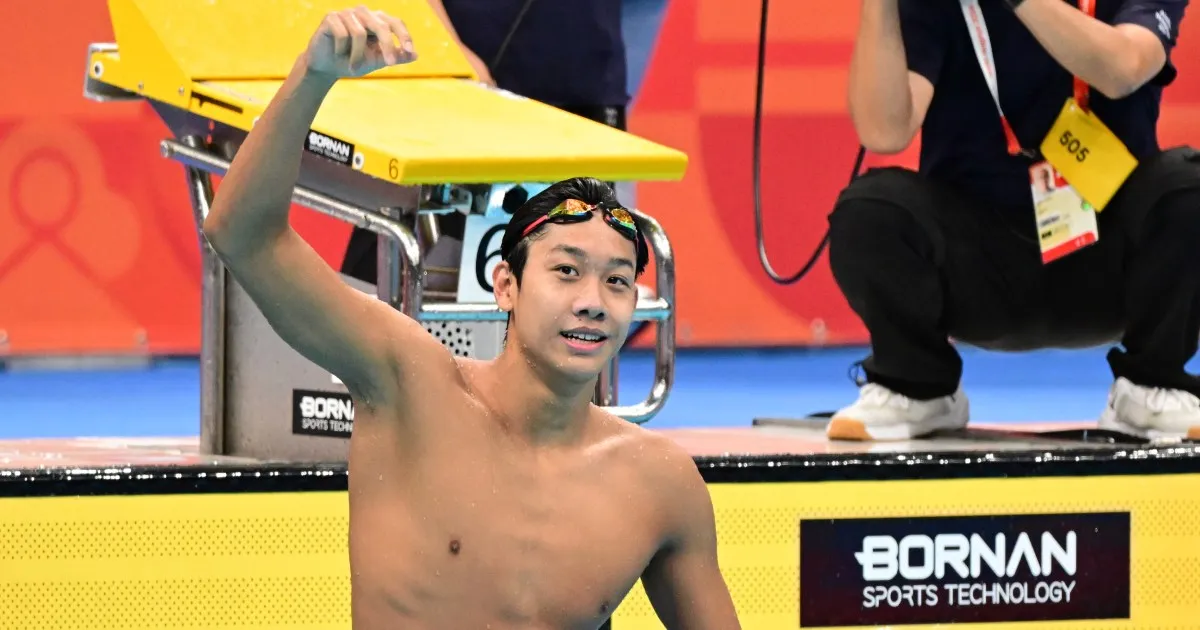
Towering teenager Zhang Zhanshuo became the first swimmer in history to win seven golds at a single Asian Games, while on the track, Thai sprinter Puripol Boonson powered to victory in the 100m.
China’s Zhang, 19, scorched to the men’s 400m freestyle title in the pool in Tokyo on Friday in a Games-record three minutes and 41.28 seconds.
He sat on the lane divider after the race and slowly counted off on his fingers all seven medals he had won.
Zhang also won individual golds in the 200m, 800m and 1,500m freestyle events, as well as three relays.
He said, after wrapping up a scintillating campaign, that it had been the “perfect week”.
“I think the most important thing is to stay grounded and focused, because the Asian Games are not my ultimate goal,” said Zhang, who stands 198cm (six feet, six inches).
With the Los Angeles Olympics less than two years away, China won 30 of the 42 golds in the pool this week.
Their 13-year-old phenomenon Yu Zidi was the undoubted superstar, taking home three individual golds and all in Games-record times.
Not to be outdone, Japan’s 17-year-old Shin Ohashi shattered the men’s 200m breaststroke world record on Thursday.
Swimming, equestrian and diving are taking place in Tokyo, but the city of Nagoya and the wider Aichi prefecture are the main Games host.
The men’s and women’s 100m sprints, the blue riband events in track and field, took place in front of rows of empty seats in Nagoya.
China’s Chen Yujie streaked to a comfortable victory in the women’s final in a Games-record 11.06 seconds.
The men’s was won by 20-year-old Puripol, who burst out of the pack in the final quarter of the race to win in 9.90 seconds, breaking his Games record from earlier in the evening.
It was Thailand’s first men’s 100m gold medal since Suchart Jairsuraparp on home soil at the 1978 Bangkok Games.
‘Today was a miracle for me’
On the last evening of gymnastics, Carlos Yulo won the men’s vault for his second gold of the Games.
The double Olympic champion won floor gold on Thursday to complete his collection of major titles.
“I can’t believe it,” the Filipino said.
“In this whole Asian Games, I felt really stressed, but at the same time, I enjoyed what I did today. I really did my part.
“Today was really a miracle for me.”
There’s little time to celebrate, however, with the world championships next month.
South Korea edged China 85-80 in the semifinals of the women’s basketball, and will face hosts Japan for gold.
China had their giant centre Zhang Ziyu, 19, but it was not enough.
Zhang Ziyu stands 223cm (seven feet, four inches) and scored 22 points.
“She was tough to guard,” said South Korea’s Kang Lee-seul.
“We couldn’t defend her, but we focused on fast breaks and shooting more three-pointers.”
North Korea’s women were again in record-setting form on the weightlifting dais.
Oh Kwang Ok set three world records on her way to women’s 57kg bodyweight class gold.
Oh lifted 104kg in the snatch and 134kg in the clean and jerk for a 238kg total – all world records to add to the two golds North Korea’s women won in the 49kg and 53kg classes this week.
North Korea has won four gold medals and two silvers in the six weightlifting events contested so far.
SINGAPORE: Thailand accused Cambodia on Tuesday of “playing the role of a victim” in a dispute over maritime resources, as the Southeast Asian neighbours brought their long-standing feud before international mediators.
The hearing at the Singapore outpost of the Permanent Court of Arbitration (PCA) comes after the countries fought two rounds of deadly border clashes last year.
In May this year, Thailand unilaterally pulled out of a framework agreement with Cambodia that aimed to resolve overlapping maritime border claims, but denied any link to their land dispute.
Cambodia subsequently initiated a UN-backed conciliation process at the PCA, saying it hoped to return to constructive negotiations.
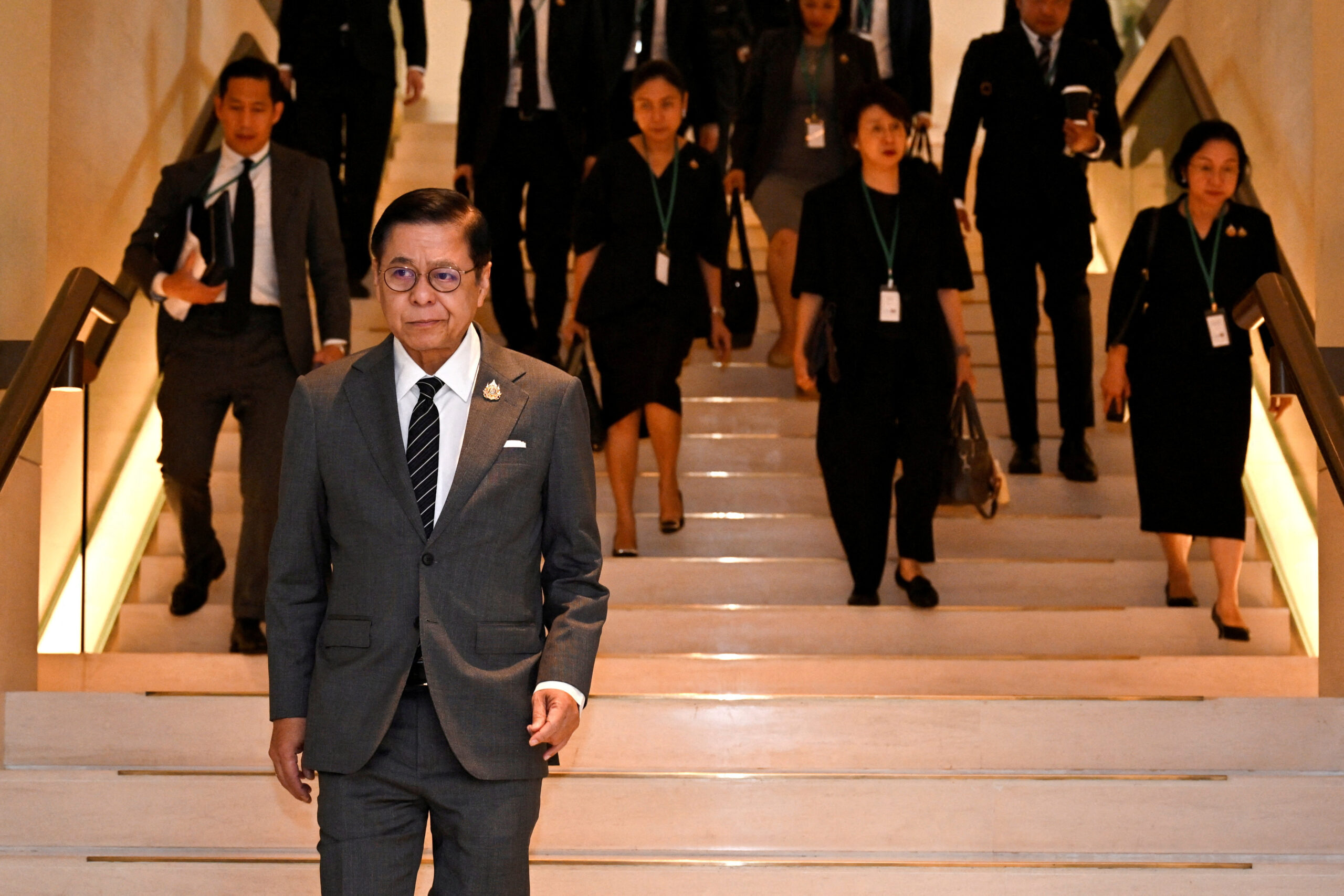
Opening Bangkok’s case before a five-member panel of international legal experts, Foreign Minister Sihasak Phuangketkeow said Cambodia sought to “vilify Thailand through false narratives, distortion of facts, and unfounded accusations… including at international forums”.
“It does this by playing the role of a victim with a sense of self-righteousness aimed at claiming the moral high ground,” he said.
Last year’s clashes left dozens of people dead and displaced more than a million before a truce was agreed.
Thailand has said it withdrew from the framework agreement, called “MoU 44”, because “no progress had been made” in implementing it. Prime Minister Anutin Charnvirakul denied the move was linked to the fighting.
The 2001 memorandum of understanding covers a resource-rich maritime territory of around 27,000 square kilometres (10,500 square miles) to which both Cambodia and Thailand lay claim.
Cambodia said last week that it had resorted to conciliation “after Thailand unilaterally terminated the agreed bilateral framework” through which the two nations had “negotiated their overlapping maritime claims for more than two decades”.
Prime Minister Hun Manet said in June that the move was also to “protect Cambodia’s sovereignty and maritime rights in accordance with international law”.
Foreign Minister Prak Sokhonn told the PCA panel on Tuesday that Phnom Penh saw the process “as a means to rebuild trust, not as a form of escalation”.
Cambodia’s goal was to agree with Thailand on a “single, all-purpose maritime boundary”, or alternatively agree to jointly develop and equitably share resources until a boundary is drawn, he said.
“Cambodia sincerely hopes that Thailand will engage constructively in this process.”
Sihasak said Thailand was also seeking maritime delimitation and to rebuild trust.
Set up in 1899, the PCA is the world’s oldest intergovernmental dispute-resolution body and resolves disputes between countries and private parties by referring to contracts, special agreements and various treaties, such as the UN Convention on the Law of the Sea.
The PCA office in Singapore is the Hague-based court’s first in Asia.
The commission’s recommendations are not binding and will take about a year to be decided.
Foreign Office has updated its travel advice for all UK nationals heading to Thailand
12:06, 08 Sep 2026Updated 12:14, 08 Sep 2026
Around a million Brits head to Thailand every year(Image: Thitikarn Paothongthai via Getty Images)
The Foreign, Commonwealth and Development Office (FCDO) has updated its travel guidance for all UK nationals travelling to Thailand.
The south-east Asian country is enormously popular with Brits and other tourists alike, largely owing to its vibrant culture, cuisine, warm weather, and breath-taking beaches and islands. Approximately a million travellers make their way to Thailand from the UK each year. In a fresh new issued on Tuesday, September 8, the FCDO confirmed that a significant travel rule for Thailand is set to change.
The latest guidance refers to tighter restrictions on visa-free stays coming into force from September 15, 2026. This represents a departure from the previous rules, which allowed visa-free stays of up to 60 days for tourism, business engagements, and urgent work, with the option to extend for a further 30 days.
Those intending to work, study, retire, or settle in Thailand must obtain the relevant visa prior to travelling. If you entered Thailand before September 15, you will generally be permitted to remain for the duration granted upon arrival.
The updated guidance highlights that British nationals have been refused entry for failing to demonstrate sufficient funds or proof of return travel. Border authorities may request evidence of at least 10,000 Thai baht per person (or 20,000 Thai baht per family), as well as confirmation of onward travel.
The FCDO has also revised its safety guidance concerning Thailand’s rainy season. While the general timeframe remains May to October for the majority of the country, and November to March for Koh Samui and south-east Thailand, the updated advice notes that “weather patterns have become increasingly unpredictable and periods of intense rainfall can occur across Thailand.”
It continues: “Heavy rainfall can cause flash flooding, landslides and disruption to transport, particularly in northern, north-eastern and mountainous areas. Conditions can change rapidly and may result in road closures and local travel disruption. Lakes, caves and waterfalls are particularly at risk of dangerous flash flooding.”
Holidaymakers are urged to heed local authority guidance and keep a close eye on the Thai Meteorological Department for weather warnings.
Asia Gardens Hotel & Thai Spa is actually just outside of BenidormCredit: TripAdvisorGuests have said they feel like they’re in ThailandCredit: TripAdvisor
It was named Spain‘s Leading Hotel in the World Travel Awards in 2024.
The tropical grounds have 3,000 Asian plant species, including a 200-year-old bonsai tree as well as other bonsai and palm trees.
The hotel has a total of seven swimming pools, four of which are heated, and all are surrounded by jungle.
The Caras de Angkor pool is an adults-only Balinese style pool, while another is the Zen pool which has hydromassage.
Thailandis known for its massages and the hotel has its very own Thai spa on-site too.
Treatments include various types of massages, foot reflexology and beauty pamper sessions.
There are nine restaurants too, ranging from Asian cuisine at Koh Samui as well as a range of Mediterranean options and a poolside snack bar.
It has seven swimming pools, four of which are heatedCredit: TripAdvisor
The hotel has its own fitness centre, tennis, volleyball and padelcourts as well as football field.
Hotel staff can even advise guests on the best running routes in the area.
One visitor wrote on Tripadvisor: “Incredible place, not only for its design, floral decoration, gardens, atmosphere… but once you set foot in the lobby, you could perfectly believe you are anywhere in Asia.”
Another described it as: “A taste of heaven amongst beautiful gardens a feeling of being whisked away toThailand without the long haul flight!!!“
The hotel offers massages and beauty treatmentsCredit: TripAdvisorSome suites have outdoor terraces and hot tubsCredit: TripAdvisor
Rooms range from Bali-style Deluxe to Deluxe Suites which have huge outdoor terraces with a Jacuzzi.
Room rates start from around £240 per night, but can increase to around £400 during peak season.
The most luxe room is the Presidential Suite which has its own lounge, kitchenette, outdoor terrace with sea views and a hot tub.
It also comes with 24-hour room service and guests can enjoy private in-room breakfasts.
Asia Gardens Hotel & Thai Spa, a Royal Hideaway Hotel can be booked with On the Beach – a seven-night stay for two adults in September 2026 starts from £840pp.
This includes return flights to Alicante and a stay in a Deluxe Room.
A stay with TUI in November starts from £985pp – which also includes bed & breakfast and return flights to London Stansted.
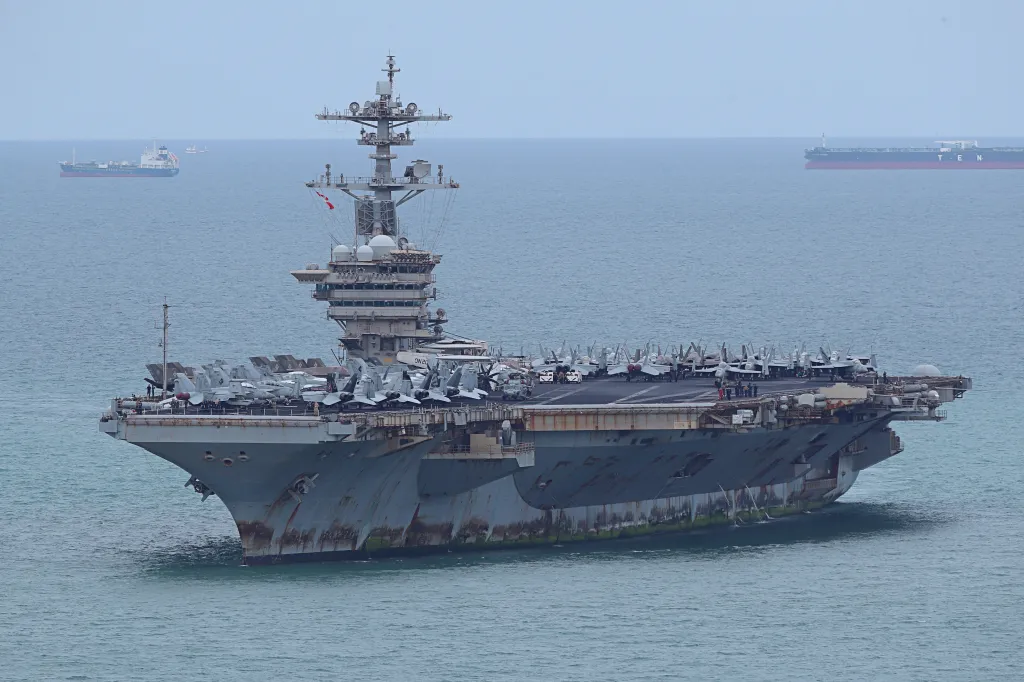
Video emerged on social media of local workers cleaning the carrier. Two of them can be seen on a scaffolding platform, dressed in silver-colored protective clothing, yellow helmets, face shields and black boots, spraying the side of the big ship. You can see that most of the rust, as well as all of the green swath of algae, was removed from the section where they are working.
The camera also pans across the ship, showing the extent of the work still needed.
Those recent viral rust photos/footage of the USS Abraham Lincoln (CVN-72) in Thailand overstated the story.
Yes, the hull looked rough in pictures, but the ship itself was never in question, that’s the part the headlines skipped.
It is unclear whether this work had already been scheduled as part of routine maintenance or whether it had been ordered after images of the ship emerged showing its rough condition. The ship was a huge focus of attention even before it got to Thailand.
Interest in the Lincoln flared up anew after it arrived in Thailand due to its condition, as well as intense curiosity about how the crew would fare in a Thai port call after being at sea for so long.
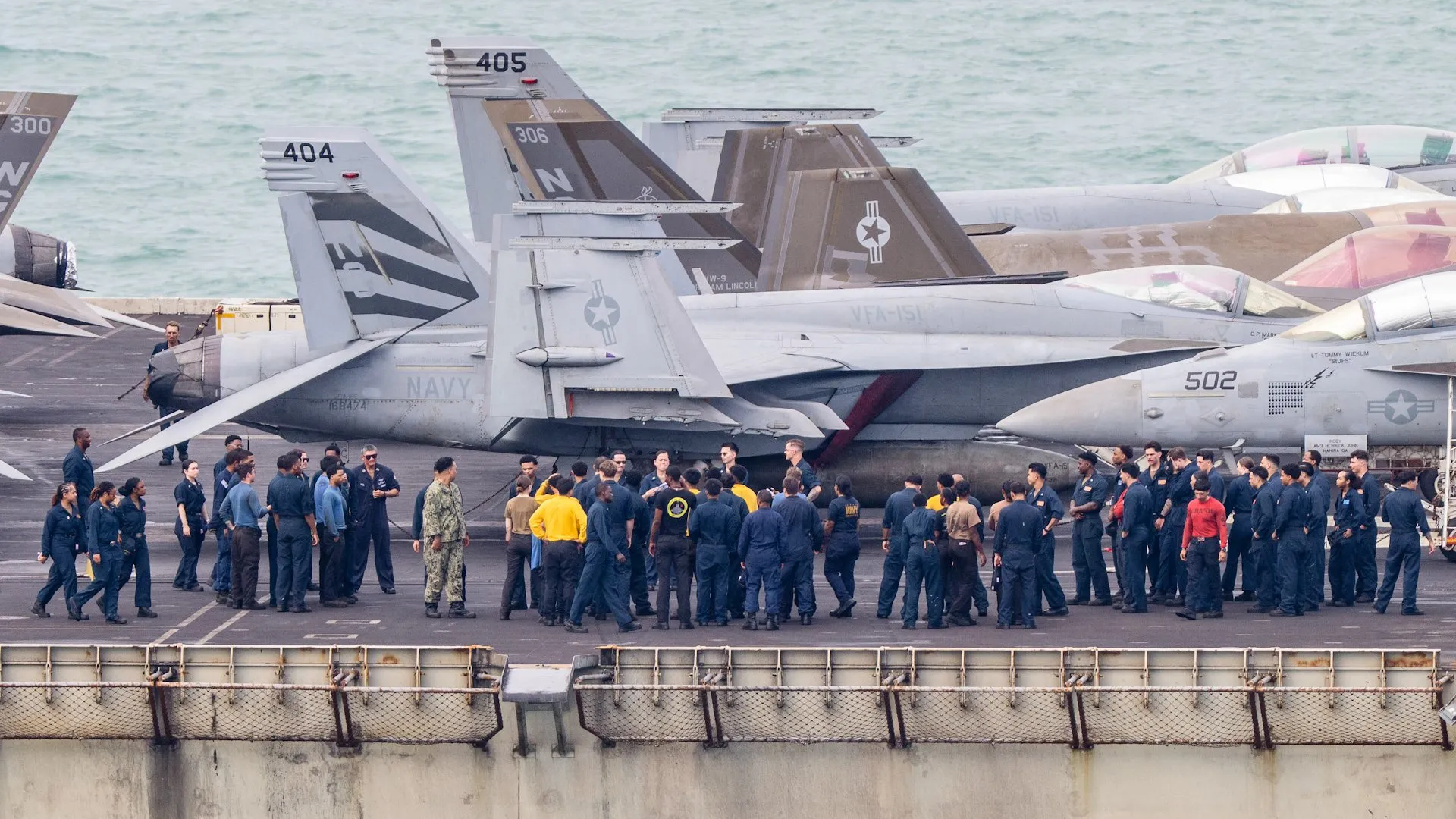
The USS Abraham Lincoln (CVN-72) aircraft carrier arrives at Laem Chabang Port on Sept. 2, 2026 in Si Racha, Thailand. (Photo by Thananuwat Srirasant/Getty Images) Thananuwat Srirasant
“It’s terrible. I think they should be ashamed,” John Phelan told members of Congress at a hearing last year after being shown pictures of a very worn-looking Arleigh Burke class destroyer, the USS Dewey, during a stopover in Singapore. “Would you want to go on that ship?”
One driving factor in the condition of ships like Lincoln is the operational tempo of deployments, a Navy official noted earlier this year.
“We know what to do, but we choose not to do it,” Mark Lattner, director of the Navy’s Ship Integrity and Performance Engineering, Naval Systems Engineering Directorate, said in January during a panel at the Surface Navy Association’s annual symposium that TWZ attended. “And we choose not to do it because there’s always some other problem I’ve got to fix. I don’t have time. Our corrosion can wait. And so we don’t implement the fixes.”
Finding a solution to the Navy’s rust problem became one of Lattner’s main missions in the wake of the fallout from Trump’s late-night texts to Navy officials demanding answers about the condition of theArleighBurke class guided missile destroyer USS Dewey after he saw pictures of it covered in running rust as it pulled into Singapore last year.
A picture of the USS Dewey covered in ‘running rust’ during a recent port visit in Singapore is shown at the confirmation hearing for Secretary of the Navy nominee John Phelan on January 27, 2025. (Senate Armed Services Committee screen capture) Senate Armed Services Committee capture
Port calls offer critical time to fix long-standing issues and resupply the ship of pretty much everything you can think of, from jet fuel to food. So it’s no surprise that the Lincoln would be swarmed with support personnel and supplies while much of her crew enjoys being on land once again for a few days.
It’s unclear how long the clean-up work on the Lincoln will last or how much of it will be finished by the time the ship and crew leave port. Either way, from what we have seen so far, it will look much better leaving Thailand than when it arrived.
A U.S. Navy helicopter lands on the nuclear-powered aircraft carrier USS Abraham Lincoln (CVN-72) while the ship sails to dock at the deep-sea port in Laem Chabang, Chonburi province, Thailand, Wednesday. The Nimitz-class nuclear-powered aircraft carrier with roughly 5,000 sailors and Marines aboard and other vessels from its Carrier Strike Group, is docked with personnel to come ashore in Thailand to rest and recuperate while the warship replenishes supplies after an extended deployment. Photo by Rungroj Yongrit/EPA
Sept. 2 (UPI) — The USS Abraham Lincoln docked in Thailand Wednesday morning, the first break for the sailors aboard since before Thanksgiving.
The 5,000 crew members aboard the nuclear-powered aircraft carrier stepped on land and headed to the beach town of Pattaya, Thailand, to begin their first significant shore leave in nine months.
The ship, based in San Diego, has spent more than 250 consecutive days supporting actions in Venezuela and Iran. The crew has faced issues with morale, plumbing and food supplies. At least one sailor aboard the ship has attempted suicide, and there have been reports of more.
During the Lincoln’s deployment in the Middle East, the U.S. naval base in Bahrain was mostly destroyed at the beginning of the war, making restocking and repairs more challenging.
After public outcry, the Navy replaced the Lincoln with the USS George Washington, allowing the Lincoln to head home.
The Lincoln docked Wednesday at Laem Chabang, north of Pattaya, and crew members traveled by bus into the beach town. Many of them booked hotels for their shore leave, said Pattaya Mayor Poramet Ngampichet.
“It is a well-deserved break for all of the crew, and we really look forward to our time here,” said Capt. Daniel J. Keeler, commanding officer of the Lincoln, The New York Times reported.
“It’s good to have you here,” the mayor said, shaking hands with the Captain.
The mayor and other local dignitaries greeted the first arriving sailors at the Hard Rock Hotel in Pattaya. They handed the crew members gifts and welcomed them to the area.
“Our arrival in Laem Chabang provides a well-deserved opportunity for our sailors and Marines to rest and recharge. It also underscores the strong and enduring partnership and alliance between the United States and Thailand,” Rear Adm. Robert E. Loughran, commander of Carrier Strike Group 3, which includes the Lincoln, said in a statement. “What this strike group has accomplished is truly historic. I could not be prouder of the exceptional professionalism and expertise demonstrated by every member of this team during our operations in the U.S. Central Command area of responsibility.”
The statement pointed out that Thailand has been a partner of the United States since the 1833 Treaty of Amity and Commerce, and it’s the only treaty ally in mainland southeast Asia.
Pattaya is just north of U-Tapao, where an airbase hosted U.S. B-52 bombers during the Vietnam War. It also provided a rest and relaxation spot for U.S. servicemembers during the war and since. For this shore leave, local authorities said the military has restricted certain activities, including consuming marijuana, parasailing and jet skiing.
After the weekend in Thailand, the Lincoln is scheduled to leave for San Diego Sunday.
President Donald Trump signs an executive order to rename Lake Ontario as Lake America in the Oval Office of the White House on Thursday. Photo by Al Drago/UPI | License Photo
Thailand’s Pattaya is expecting a business boost as 5,000 US sailors arrive after spending nine months at sea aboard the USS Abraham Lincoln. The carrier supported the US war on Iran, while its record deployment was marked by deteriorating conditions on board.
Under heavy escort, the USS Abraham Lincoln transited the Strait of Malacca and Singapore Strait over the weekend, en route to Thailand for a highly publicized and much-needed liberty port call. Guided-missile cruiser USS Robert Smalls led the three-ship column, with guided-missile destroyer USS Frank E. Petersen Jr. following astern of the supercarrier as she entered the South China Sea. Multiple Thai officials have confirmed the upcoming port visit since it was first reported by USA Today last week, with the flattop expected to pull into port at Laem Chabang in the coming days. Meanwhile, America’s other two deployed carrier groups are in the Middle East enforcing the ongoing blockade as the U.S. and Iran exchange fire for the first time since July.
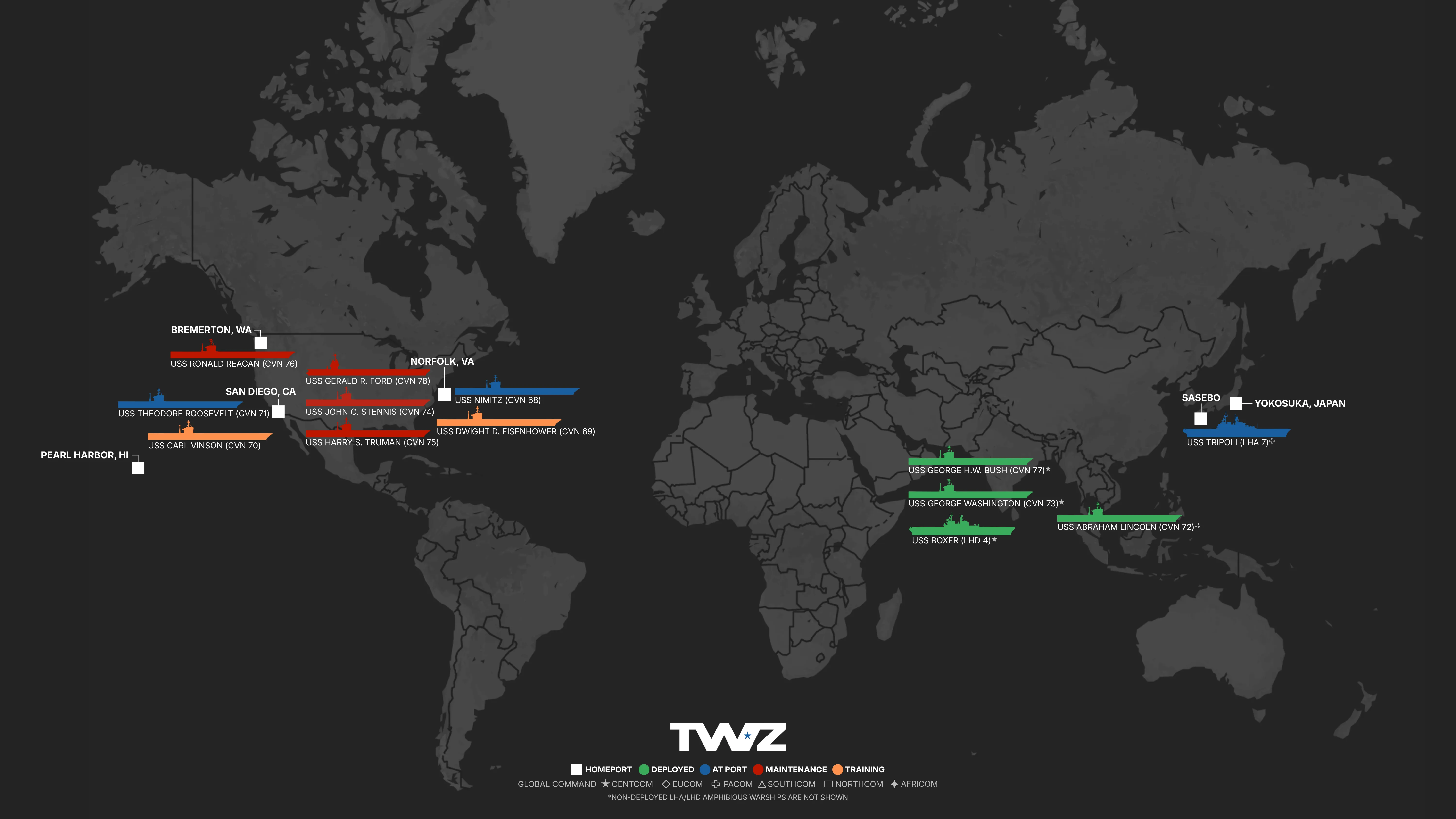
Here’s TWZ’s weekly carrier tracker monitoring America’s flattop fleet, including deployed Carrier Strike Groups (CSG) and Amphibious Ready Groups (ARG), using publicly available open-source information. Check out last week’s report here.
TWZ/IAN ELLIS-JONES (HIGH RESOLUTION)
Lincoln Enters The South China Sea, Again, En Route To Thailand For Liberty
Abraham Lincoln flipped her Automatic Identification System (AIS) transponder on ahead of the transit, broadcasting the flattop’s position publicly for the first time since January 28, 2026, when the CSG made the transit in the opposite direction prior to Operation Epic Fury. Lincoln has now been deployed for 285 days without a liberty call, but that streak is set to end this week.
For friends and family, we anticipate an arrival back home in late September or early October, depending on how long the crew stays in Thailand and whether any other stops are made along the way. When all is said and done, Abraham Lincoln’s deployment will likely become the second-longest in the modern carrier era behind the historic 326 days logged by the USS Gerald R. Ford earlier this year.
Time-lapse of USS Abraham Lincoln transiting the Strait of Malacca. Source: @CVN_72 on X.
While the composition of the Abraham Lincoln CSG has shifted over the nine-plus-month deployment, Frank E. Petersen Jr., a Flight IIA Technology Insertion (TI) Arleigh Burke class destroyer and one of the newest in the fleet, embarked the commander of Integrated Air and Missile Defense (IAMD) throughout the six months of almost nonstop combat operations against Iran. The IAMD commander is responsible for coordinating the detection, response, and interception of inbound aerial threats, and Petersen Jr. is equipped with the world’s foremost integrated naval combat system – the Aegis Combat System Baseline 9 – which delivers quick reaction times, concentrated and networked firepower, and advanced electronic countermeasure capabilities for anti-air warfare.
The unannounced addition of Ticonderoga class cruiser USS Robert Smalls, which has historically served as the IAMD commander for the carriers forward-deployed out of Yokosuka, Japan, adds 122 Vertical Launch System (VLS) cells packed with missiles for protection and firepower. The rationale for the additional Tico cruiser, an iconic class that will be completely retired over the coming years without a comparable replacement, is unclear. TWZ has not received an on-the-record response from the U.S. Central Command (CENTCOM) or U.S. Naval Forces Central Command (NAVCENT) public affairs explaining the redirection.
Robert Smalls was part of the George Washington CSG as recently as August 18, making the northwest-bound Malacca Strait transit with the strike group the week prior, before peeling off to escort the Abraham Lincoln back through.
Guided-missile destroyer USS Frank E. Petersen Jr. transiting the Arabian Sea in June 2026. U.S. Central Command Public AffaUSS Robert Smalls transiting the South China Sea in July 2026. U.S. Navy photo by Petty Officer 3rd Class Nicolas Quezada
U.S. Launches Another Round of Strikes Against Iran Today As Tensions Escalate
Ahead of publication on Tuesday, CENTCOM announced a fresh round of strikes against targets in Iran that began at noon Eastern Time. “The strikes follow recent attempted attacks by the IRGC against commercial shipping in the Strait of Hormuz and against American service members deployed to the region,” the command posted in a statement on social media.
George Washington, which is currently accompanied by a single destroyer, USS Shoup, relieved the Abraham Lincoln in the Middle East earlier this month. Other U.S. 5th Fleet ships are reportedly moving in and out of the CSG, but the situation is fluid and TWZ cannot confirm the current, complete composition of the group. It’s unknown which warship, if any, is currently serving as IAMD commander for the CSG, which chopped into the CENTCOM area of responsibility (AOR) on or around August 19.
Flight ops on the flight deck of USS George Washington in the Middle East. U.S. Naval Forces Central CommanAn F-35C Lightning II, attached to Strike Fighter Squadron (VFA) 147, aboard Washington. Petty Officer 3rd Class Nicolas QuezadaAn MH-60R Seahawk readies for takeoff on the deck of Washington. U.S. Naval Forces Central Comman
Also operating in the Middle East, the four-ship George H.W. Bush CSG is underway at an undisclosed location in the Arabian Sea. Alongside USS George H.W. Bush is Tico cruiser USS Princeton, the IAMD commander, and two Burke destroyers, USS Ross and USS Donald Cook.
The carriers are enforcing the ongoing blockade of Iran – and presumably participating in the latest round of airstrikes – although they are both officially on station to “support maritime security and stability in the Middle East,” according to DVIDS, the military’s content-sharing platform. CENTCOM forces have redirected 84 commercial vessels, disabled three using kinetic force, and boarded another two since the blockade resumed, as of September 1.
USS George H.W. Bush conducts flight ops in U.S. Central Command. U.S. Navy video.
Over the weekend, the United States and Iran traded blows for the first time in over a month. CENTCOM opened the tit-for-tat exchange on Sunday by targeting rocket systems on Larak Island, located in the Strait of Hormuz on the Iranian side of the northern corridor, that are fitted to launch naval mines, after the Islamic Revolutionary Guard Corps (IRGC) was observed making preparations to fire into the contested waterway.
“I can confirm that earlier today U.S. forces struck two Iranian launchers on Larak Island,” Navy Capt. Tim Hawkins, CENTCOM’s spokesman, told TWZ. “Islamic Revolutionary Guard Corps forces were observed preparing to launch rockets with sea mines into the Strait of Hormuz,” he added. The IRGC retaliated by launching a salvo of ballistic missiles at Muwaffaq Salti Air Base, a Jordanian installation the U.S. military operates from. Jordan’s military said it successfully intercepted eight missiles.
The preemptive strikes to prevent Iran from deploying additional mines came just days after CENTCOM commander Adm. Brad Cooper said U.S. forces “successfully cleared” Iranian sea mines from international shipping lanes in the Strait of Hormuz. Commercial traffic through the strait is slowly recovering but still well below pre-war levels.
CENTCOM commander Adm. Brad Cooper provides an update on mine clearing efforts in the Strait of Hormuz. Source: @CENTCOM on X
On the other side of the world, in the United States, three carriers are active: two are underway training while one is in homeport getting ready for an upcoming deployment. USS Dwight D. Eisenhower, which left Norfolk on August 21, transited south in the Atlantic Ocean and was last operating approximately 70 nautical miles off the coast of Florida, well into East Coast Fleet Replacement Squadron (FRS) and Training Command (TRACOM) Carrier Qualifications (CQ). After departing San Diego on August 10, USS Carl Vinson was spotted on satellite imagery off the California coast by ship-tracker MT Anderson, in the process of completing Tailored Ship’s Training Availability (TSTA) and Final Evaluation Period (FEP) training.
USS Theodore Roosevelt, the next carrier slated to deploy from the continental U.S., is pierside at Naval Air Station North Island in San Diego, based on commercial satellite imagery. Speculation is rampant about where Theodore Roosevelt will deploy, but as the Navy has told us many times, “we do not discuss future operations or timelines.”
The balance of America’s carriers (excluding USS Nimitz, which will begin deactivation in 2027) is either in maintenance or scheduled to begin an availability in the future.
The next flattop that will re-enter service, USS Ronald Reagan, is expected to finish a roughly 17-month Docking Planned Incremental Availability (DPIA) soon. “The docking planned incremental availability for Ronald Reagan is on track for its scheduled completion at the end of August 2026,” Catherine Norton, the Public Affairs Officer (PAO) for Puget Sound Naval Shipyard and Intermediate Maintenance Facility, told Stars and Stripes earlier this month. However, the ship has not gotten underway as of publication, even though yesterday was the end of the month, and it appears the DPIA will stretch into September. TWZ reached out to Puget Sound’s PAO but has not received a response yet. For the latest status of the other three carriers in current or upcoming maintenance, marked in red on the map above, check out our recent deep-dive here.
USS Ronald Reagan in Bremerton, Washington, as of August 29, 2026. Source: @BulletOneOneTwo via @WarshipCam on X
Current Big Deck Force Posture At A Glance
Overall carrier force posture is unchanged compared to our previous report on August 24. Three U.S. carriers are deployed (although one is on the tail end of her deployment and heading home to San Diego), one is preparing to deploy in the near term, two are working up in various states of readiness, four are in maintenance, and another, the USS Nimitz, is being used primarily for training before deactivating next year. One amphibious ready group is deployed, one is forward-deployed and at homeport, four are working up or in port, and three are in maintenance.
Note: Positions are general approximations. Non-deployed LHA/LHD amphibious warships are not shown.
But in a matter of weeks, the allowance is being cut in half.
Sign up for the Travel newsletter
Thank you!
Starting September 15, 2026, nationals of 60 countries and territories, including the UK will be allowed to stay visa-free for up to 30 days.
According to officials, the list was revised to “reflect current circumstances, taking into account national security and economic considerations as well as the promotion of tourism”.
Tourists can visit still visit 30 days visa-free for tourism, business engagements, and urgent or ad-hoc work.
Advice on the GOV.UK has a warning for anyone who stays in Thailand longer than the given period – or if you stay without a visa.
It reads: “If you overstay the period of your visa, you will get a fine of 500 Thai baht a day up to a maximum of 20,000 baht. You risk being:
held in detention
deported at your own expense
banned from re-entering Thailand for up to 10 years
“Conditions in detention centres can be harsh.”
Other entry requirements are that your passport has an expiry of at least six months after the date you arrive and have at least one blank page for stamping.
Travellers also need to complete a digital card at least three days before arrival.
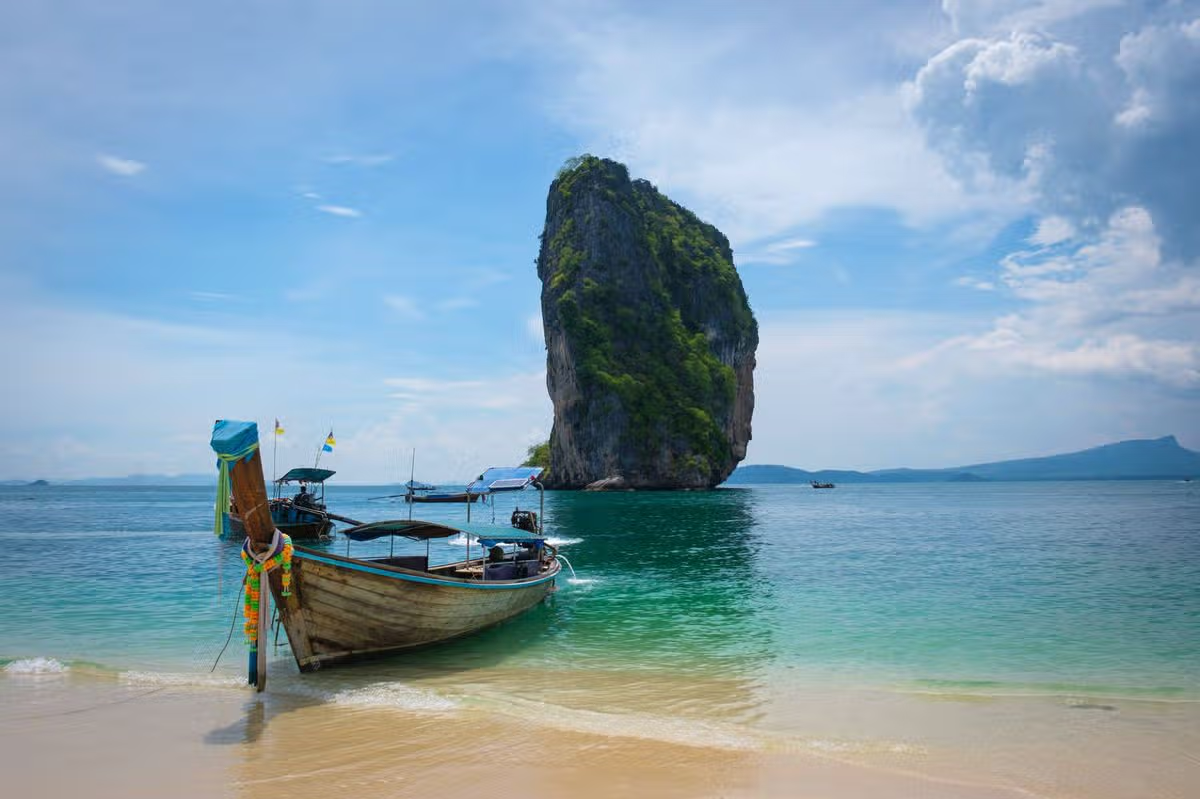
Thailand has beautiful beaches and thousands of islandsCredit: Alamy
I’M walking down the M1 in my flip flops, the trilling of birdsong above me as a cheeky monkey throws fruit skins from the trees.
The only motors on this brick-lined path winding through the jungle of the Rayavadee Resort in Krabi are those powering the sunset chorus.
Stunning Krabi beach where resort is locatedCredit: SuppliedKrabi’s wonderful Rayavadee ResortCredit: Booking.com
And while the bright lights of Thailand’s big cities may mean chaotic tuk tuks, the only traffic jam I see is a family of spectacled langur monkeys running from one tree to another before scampering across the beachfront.
“It’s 5pm, it’s their home time,” a staff member tells me. In the slow lane is the water monitor lizard, lazily crossing the path before slinking into the pond to cool down.
Sign up for the Travel newsletter
Thank you!
This beautiful resort in the heart of Krabi’s Phra Nang Peninsula on the border of the marine national park delivers laid-back luxury with not one but three stunning beaches lapped by the warm waters of the Andaman Sea.
My home off the M1 pathway was a circular, two-storey, dome-roofed wooden pavilion designed to echo the unique rounded cliff rock formations that pepper the surrounding landscapes.
Downstairs, there’s a living room with plush seating and garden views.
Up an open, spiral staircase is the spacious bedroom, with the pavilion’s curved glass windows welcoming the jungle indoors.
Those naughty monkeys are just as keen on the luxury digs — make sure to keep your terrace doors locked otherwise you might have a visitor raiding your minibar.
And as tempting as it would be to simply pull up a lounger on one of the three stunning beaches it sits on — Railay West, Phra Nang and Nam Mao — part of the hotel’s ethos is to get you out there and interacting with the local community.
Kayaking amid the beauty of Klong RootCredit: SuppliedTwo-storey pavilion has plush interior and garden viewsCredit: Booking.com
We set off bright and early in a truly unique transfer — a giant sea tractor to counteract the challenges of the low tide.
I hung on for dear life in the metal carriage contraption the tractor pulls along, before swapping to a longboat for part two of the journey as the savvy captain manoeuvred along narrow channels.
I’d survived, jelly-legged, but not for long.
A short drive away were the waterfalls of Khao Phanom Bencha National Park, a primary filming location for Jurassic World: Rebirth featuring Scarlett Johansson and Jonathan Bailey.
Our guide warned us it was a “bit of a challenge” to get there.
And, just like Thai people have a different definition of “spicy” compared to us Brits, what they call a slight challenge is an understatement.
I clambered up what felt like sheer rock faces, stretching my knees almost to my ears as I attempted to reach the summit. But it was worth it.
The steep path cleared and ahead was a beautiful, crashing waterfall and lagoon surrounded by trees.
The buzzing streets of Bangkok awaitCredit: ShutterstockThe Sun’s Kara Godfrey takes a strollCredit: Kara Godfrey
I threw off my sweat-soaked T-shirt and slid into the pool (water monitor lizard style) to cool off in the 30C heat.
My only disappointment was the lack of Jonathan Bailey in it. No matter.
My afternoon took me to Klong Root, a haven for kayakers.
Paddling through mirror waters, the shade of the mangrove trees was welcome, with the splashing of my oars being the only sound.
This was followed by a local cooking class in the rural community Baan Nong Talay, the pounding of the chilli plant making my eyes water from the heat.
But the delights of the Rayavadee Resort were calling and I made it back in time to grab a table at the most sought-after spot to watch the sunset, The Grotto, nestled on the edge of Phra Nang Beach.
As a riot of bright pink and orange burst across the skyline, my lychee martini went down just as easily as the sun before a meal of freshly grilled steak and Andaman lobster straight off the coals.
After the luxe lifestyle at Rayavadee I was not ready to take on the buzzing streets of Bangkok after our flight there.
Khao Phanom Bencha National Park was a primary filming location for Jurassic World: Rebirth featuring Scarlett Johansson and Jonathan BaileyCredit: AP
GO: THAILAND
GETTING THERE: Eva Air flies daily from Heathrow to Bangkok with fares from £786 return in economy.
The airline was the first in the world to introduce Premium Economy and return fares start from £1,875.
Bang Kachao is just 45 minutes from the centre but couldn’t be a bigger contrast.
This lush green oasis where the Chao Phraya River bends in a sharp U-turn is known as Bangkok’s “Green Lung”.
For just £1 you can rent a bike to cycle along the forest paths — the perfect pause before a whirlwind 24 hours in the most happening city neighbourhoods.
I braved the crowds of Song Wat — named one of the world’s coolest neighbourhoods — for copious amounts of coffee, photobooth snaps and funky souvenirs.
I mooched over to the historical Talat Noi, where honking scooters screeched past while I browsed local street art, devoured tiny coconut pancakes for 20p and Chang beers for £1.80.
I filled my bag with local Thai designer clothes in Siam before a late-night massage for a quarter of the price of in the UK.
My days of relaxation threatening to be forgotten about, the beautiful Park Hyatt welcomed me with air-conditioned arms.
It came in the form of rooftop infinity pools, rooms with just-as-amazing views from the floor-to-ceiling windows, and one of the best breakfast buffets I’ve ever had.
Fresh pork congee, mango sticky rice and Thai tea waffles — I’d be coming back with more weight than just my suitcase.
But after some of the best food, people and sunsets of my life? Who could be Krabi about that . . .
In a few weeks the new route will be whisking holidaymakers away to their dream destination
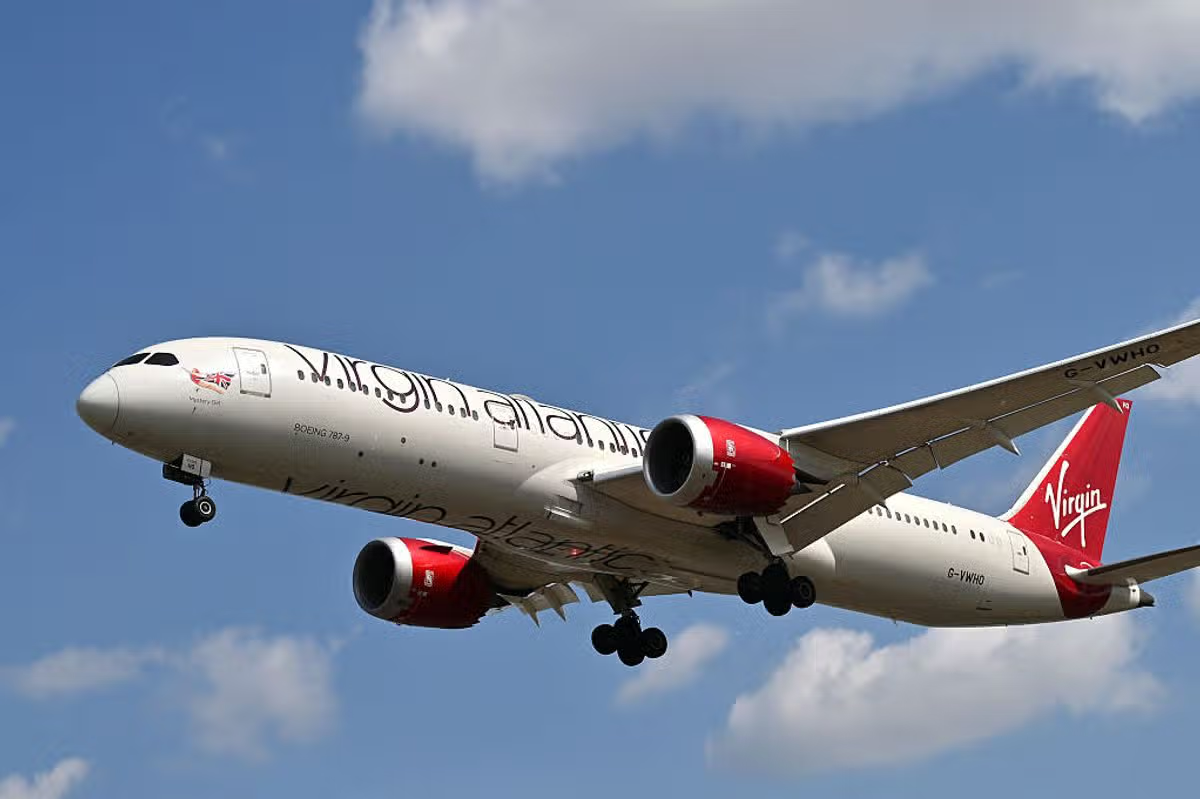
Virgin’s new route will start in October(Image: GETTY)
Virgin Atlantic is opening its newest route, offering travellers a direct 14-hour flight from London Heathrow to the largest island in Thailand. It will become the only direct route between London and Phuket, with most other direct flights to Thailand ending in Bangkok instead.
Phuket is Thailand’s largest island and a popular resort destination famous for its long sandy beaches, jaw-dropping scenery and rich culture. Phuket International Airport itself is a tourist attraction as the runway sits right next to Mai Khao Beach, making for some iconic photographs as beachgoers can watch planes coming in for landing just overhead.
Virgin’s new route is expected to launch on October 18, 2026, after being announced last autumn. The Boeing 787-9 planes hold more than 250 seats and will be taking flight seasonally to Phuket three times a week.
Phuket’s winter season runs from November to February, but even these cooler months can see average daytime highs hitting over 30°C and cooler evenings rarely dipping below 20°C. This is also the dry season for the island, following the heavy summer rains and monsoon season.
The new route adds to the winter sun destinations Virgin offers British travellers, with other hotspots including the Maldives, Dubai, Cape Town and year-round Caribbean options.
Juha Jarvinen, Chief Commercial Officer, Virgin Atlantic, said when the route was announced last year: “We’re thrilled to introduce our new direct service to Phuket, giving our customers a flavour of one of Southeast Asia’s most captivating destinations.
“As well as making the trip more convenient, they can enjoy exploring Thailand’s unique heritage, natural beauty and delicious cuisine. We can’t wait for our customers to experience our trademark hospitality on their next unforgettable journey.”
Virgin has also partnered with Bangkok Airways, allowing travellers to use the new Phuket route and get easy connections over land and sea to Thailand’s other islands, including Bangkok, Koh Samui and Krabi.
The London to Phuket flights will be taking off every Wednesday, Friday and Sunday this winter, with return flights leaving the island on Thursday, Saturday and Monday.
Travellers wanting to head to the Andaman Sea before October 18 are still able to book their holiday with Virgin Atlantic Holidays, but they will be flying on an Emirates plane with a connection in Dubai.
Seats on Virgin’s inaugural Phuket flight are currently priced around £1,300 for a one-way in economy and up to £4,097 for upper class seats.