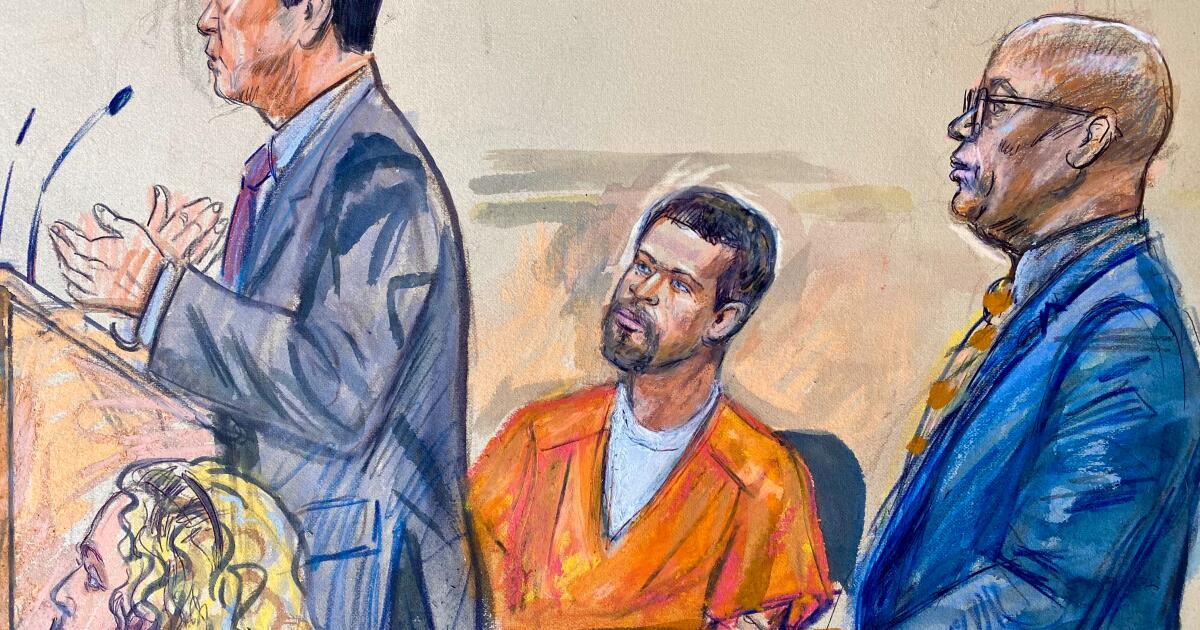
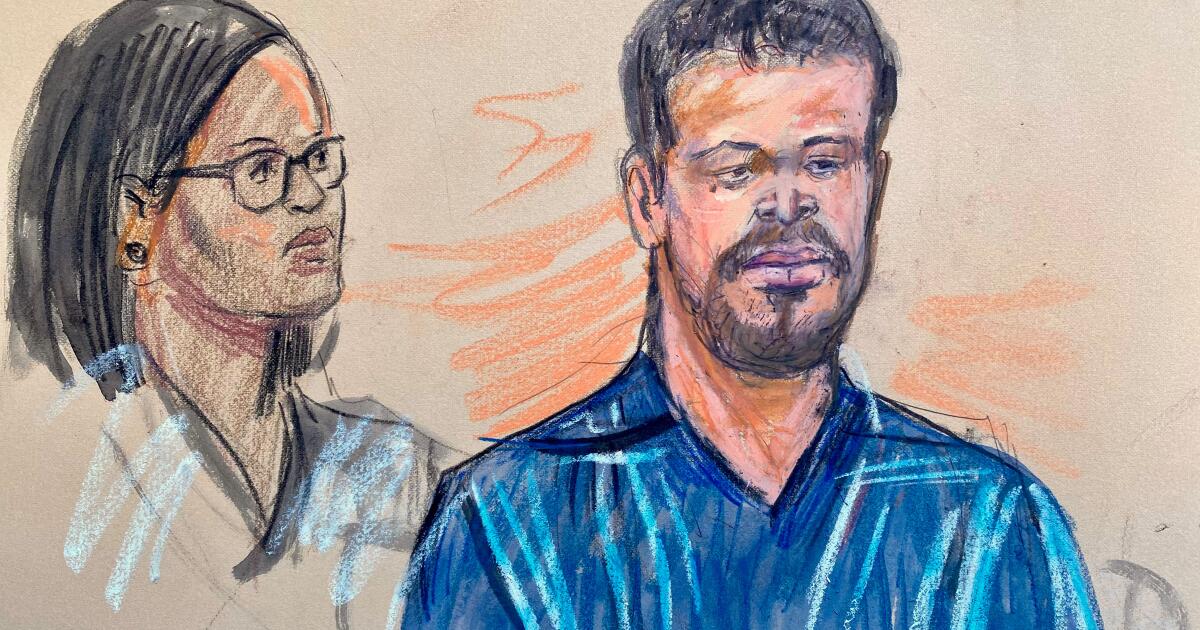
Cole Tomas Allen, the 31-year-old Torrance man charged with trying to kill President Trump at last weekend’s White House Correspondents’ Assn. dinner, will remain in federal jail pending trial.
Allen agreed to his ongoing detention during a brief hearing in federal court in Washington, D.C., on Thursday. “He’s conceding detention at this time,” one of his federal public defenders, Tezira Abe, told Magistrate Judge Moxila Upadhyaya, according to CNBC.
He did not enter a plea during the hearing, according to the Associated Press.
Abe and Allen’s other public defender, Eugene Ohm, had argued in a filing Wednesday for Allen’s pre-trial release, citing his lack of a criminal record, family support and ties to his church, as well as inconsistencies and weaknesses they allege exist in the government’s case against him.
Abe and Ohm did not respond to a request for comment following the hearing.
In addition to trying to kill Trump, a terrorism-related charge that carries a potential life sentence, Allen faces two firearms charges related to his allegedly transporting two guns across state lines as he traveled from California to Washington by Amtrak train, and allegedly discharging one of those firearms — a shotgun — during the incident.
In arguing for Allen’s release in their Wednesday filing, his attorneys not only insisted he was no danger to the community, but questioned the government’s reasoning and evidence for the charges against him.
Allen was captured on a hotel video camera sprinting past U.S. Secret Service agents and into the secured event space a floor above the dinner while armed, according to prosecutors, with the shotgun, a pistol, and various knives. He then fell to the ground and was detained, according to prosecutors.
Trump administration officials who were at the dinner, including Acting Atty. Gen. Todd Blanche and Jeanine Pirro, the U.S. attorney for D.C., charged him swiftly — leaning heavily on an email Allen had sent to family just as he was breaching event security, which Trump and others referred to as a “manifesto” but which was titled an “Apology and Explanation.”
In that document, Allen allegedly wrote that he was targeting top Trump administration officials, with the highest ranking among them receiving top priority. He allegedly wrote that he would “go through” others at the event to get to those officials, but that he was not targeting guests or hotel staff and had chosen buck shot rather than slugs to “minimize casualties” in the room.
The charge of attempting to kill the president hung largely on that document, according to charging documents.
Blanche and Pirro also alleged that Allen had fired a shot during the encounter with Secret Service agents, in which they said a Secret Service agent was shot in the ballistic vest. Prosecutors also alleged in court that Allen had fired his shotgun, noting their recovery of one spent casing, but made no mention of a Secret Service officer being shot in the vest.
That alleged shot served as the basis for the one count of discharging a firearm.
In their filing arguing for Allen’s release, his attorneys questioned the legitimacy of both arguments.
They wrote that the government’s “sole proffered evidence” of Allen’s intent to kill Trump — the “Apology and Explanation” letter — was “far from clear” and never actually mentioned Trump by name.
“The government’s evidence of the charged offense — the attempted assassination of the president — is thus built entirely upon speculation, even under the most generous reading of its theory,” Allen’s attorneys wrote. “While the government may be able to say that the letter expresses an intent to target administration officials, it falls well short of narrowing those officials to President Trump.”
Regarding the one count of discharging a firearm, Allen’s attorneys wrote that the government “has not asserted that Mr. Allen ever fired any of the recovered weapons.” They wrote that the government, “after essentially asserting that Mr. Allen shot a Secret Service Officer in the criminal complaint, has apparently retreated from the theory by not mentioning the alleged officer at all” in its filing arguing for Allen’s ongoing detention.
In the latter document, prosecutors wrote only that an officer had seen Allen fire his shotgun “in the direction of the stairs leading down to the ballroom.” However, they provided little evidence to support that claim, other than that the shotgun held a spent cartridge in its barrel.
“In sum,” Allen’s attorneys wrote, “the government’s entire argument about the nature and circumstances of the offense is based upon inferences drawn about Mr. Allen’s intent that raise more questions than answers.”
Prosecutors, in a separate filing in the case related to evidence gathering, rejected the defense claims.
“The preliminary analysis of the crime scene is consistent with the government’s evidence that your client fired at least one shot from the 12-gauge pump action shotgun in the direction of Officer V.G., and that Officer V.G. fired his service weapon five times,” they wrote. “The government is aware of no evidence thus far collected and analyzed that is inconsistent with the above.”
They wrote that evidence suggests Allen fired his Mossberg 12-gauge pump-action shotgun “at least one time as he ran past the magnetometers on the Terrace Level of the Washington Hilton.”
They wrote that investigators recovered one spent cartridge from the chamber of the shotgun, that the “government’s preliminary ballistics and video analyses show that your client fired his shotgun in the direction of” the Secret Service officer identified only as “V.G.,” and that “at least one fragment was recovered from the crime scene that was physically consistent with a single buckshot pellet.”