“If you intend to come,” USC coach Lindsay Gottlieb said Wednesday at Big Ten media days, “you should probably get your tickets early.”
The success of the two West Coast schools has been a bigger problem for the rest of the Big Ten than Los Angeles basketball fans. In the two years since USC and UCLA left the Pac-12 for the Big Ten, each school has topped the standings once and the Bruins have won the conference tournament twice, going on to the Final Four two years ago and winning the championship last April.
UCLA has some holes to fill this season but is still expected to be top-25 caliber. Watkins returns after missing last season with a torn ACL and will join the country’s top recruiting class to try to help USC return to the nation’s elite and extend the rivals’ dominance over their new league.
“Honestly, for me, I’m just excited to be back and whatever comes with that will come,” Watkins said. “I know the team is excited. We’re preparing for a great season ahead. I’m ecstatic.”
The question that poses for the rest of the conference is whether any of the legacy Big Ten teams can mount a challenge to this newfound tilt from Midwest to West. Iowa and Michigan look like the strongest contenders to break the California grip on the league, but there could be as many as eight other Big Ten teams in the preseason Top 25 poll.
“Our league is stronger and tougher than it has ever been,” Michigan coach Kim Barnes Arico said. “Every night, you’re going to face a top-25 opponent in our league. It’s incredibly, incredibly challenging.”
The Big Ten has been through this before. When Maryland jumped from the ACC in the fall of 2014, the Terrapins claimed at least a share of first place in six of the next seven seasons. Either Ohio State or Indiana topped the standings in the three years prior to the latest expansion, but since then it’s been all UCLA and USC at the top.
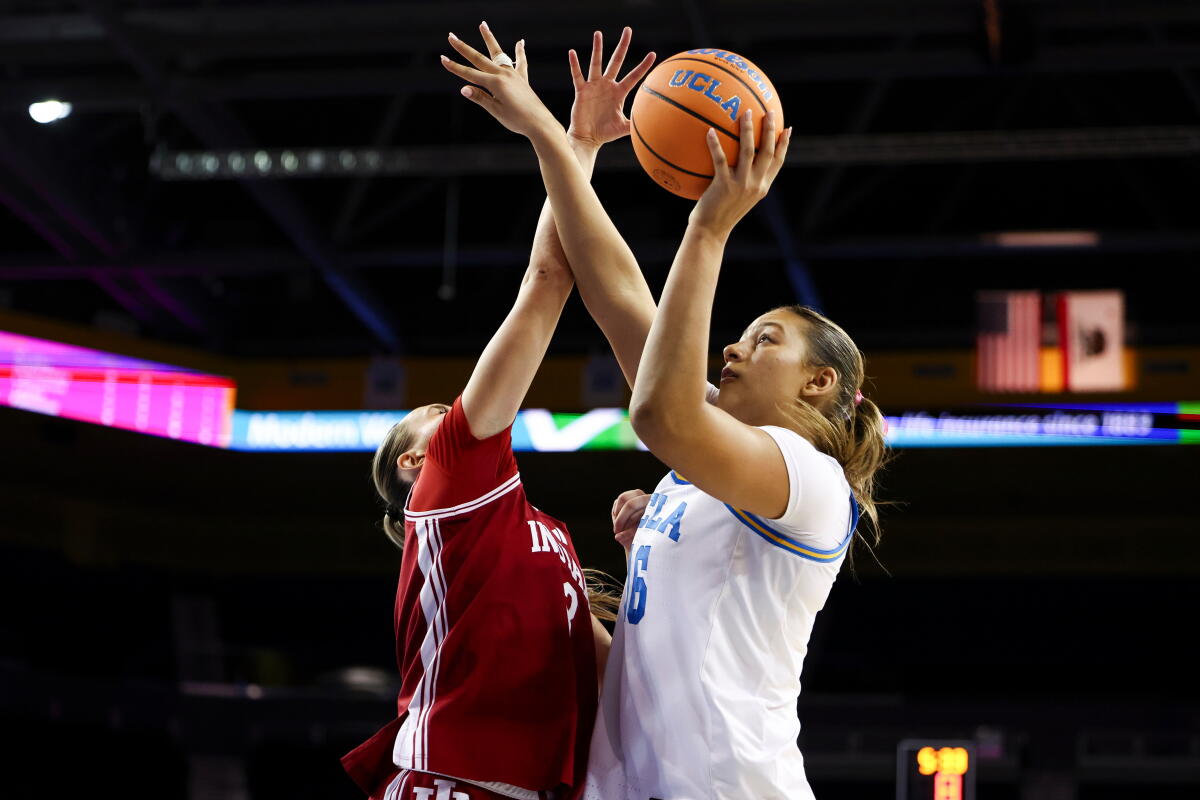
UCLA forward Sienna Betts, right, drives to the basket under pressure from Indiana forward Maya Makalusky on Feb. 15 at Pauley Pavilion.
(Jessie Alcheh / Associated Press)
The Bruins have work to do after accounting for six of the first 18 picks in the WNBA draft, but have five returnees assuming larger roles, including sophomore Sienna Betts and junior Timea Gardiner.
“I think we’re not trying to repeat an outcome, we’re really just trying to repeat a process,” Gardiner said. “Really just giving everything we can to each and every day. We have such an amazing group that is committed to doing that, so we will let the cards fall where they may.”
USC, meanwhile, added the No. 1 and No. 5 recruits in the country and a pair of impact transfers to a Watkins-Jazzy Davidson backcourt after going 18-14 without the preseason Big Ten player of the year. The Trojans have loaded up the roster to make a run at the their first Final Four in 40 years. Gottlieb resisted when asked if she had built a super team, but didn’t exactly deflect the notion, either.
“I’ve never called it that,” Gottlieb said. “We’ve just tried to assemble a team that we think can have championship aspirations. We’ve got a lot of excellent players that are all going to play whatever role they’re asked to the best of their ability. If you do that at the highest level, it becomes a super team.”
Super team or not, the challenge the rest of the Big Ten continues to face has not changed.
“It’s great for our league,” Purdue coach Katie Gearlds said. “Obviously, UCLA winning the championship last year, USC as good as they’re going to be this year having Juju back healthy and the star power that they have, it just elevates and lifts our games and gets more eyeballs on us. I think if you talk to anybody that’s here, we all want to find a way to beat them, but it’s cool that we have them in our league and they are as good as they are.”
DRAMATIC Alaskan landscapes, a medieval city on Spain’s north coast and surf beaches in Morocco are among THE places to visit in 2027, according to Lonely Planet.
The experts’ latest book – Best In Travel 2027 – recommends exploring a treasure trove of places off the beaten track.
Sibenik’s vibrant Old Town and harbourCredit: ShutterstockExplore the height of history at Leon CathedralCredit: Shutterstock
Lisa Minot picks her favourite destinations and experiences from the list.
Sign up for the Travel newsletter
Thank you!
BEST EXPERIENCES
Explore marine treasures on a deep dive in Greece
GO FLIGHTSEEING ALASKA: With just 20 per cent of Alaska accessible by road, taking to the skies in a small plane is one of the best ways to experience its vast wilderness.
DIVE THE AEGEAN: Once heavily restricted to protect underwater antiquities from pillaging, you can now discover Poseidon’s underwater world as new legislation and the opening of underwater archaeological sites allows you to explore marine treasures.
It sank in the 5th century, carrying more than 4,000 wine amphorae (clay jars).
Or visit the Fourni Archipelago, known as the ancient shipwreck capital of the world.
SAIL THE AEOLIAN ISLANDS, ITALY: Island hopping isn’t the reserve of the Greeks.
Sail between these lesser-known islands to discover rugged coastlines, clear waters and Italian traditions.
Set sail from Sicily on the fast ferries that visit all seven islands, but book ahead in summer.
Or join a skippered sailing holiday through UK operators such as Sunsail or Dream Yacht Charter.
EXPLORE KILLARY FJORD, IRELAND: Tucked along Ireland’s Wild Atlantic Way, the Killary Fjord in Co Galway cuts its way ten miles inland towards the village of Leenaun, past steep peaks that change dramatically with the seasons. It’s some of the most dramatic scenery in the country.
BEST PLACES
Take a plane over Alaskan glaciers
SWEDISH RIVIERA: After this year’s heatwaves, travellers may be looking for cooler destinations.
The twin towns of Skanor and Falsterbo are connected by a bridge and home to colourful cottages, gardens and an endless coastline.
SIBENIK, CROATIA: This small but lively Adriatic city has colourful festivals and gastronomic delights from fresh Adriatic seafood to truffle pastas.
Explore a labyrinth of steep stone alleyways, hidden plazas and Venetian-era architecture.
The city sits between the coastal towns of Split and Zadar and there are plenty of low-cost flights into both from the UK.
LEON, SPAIN: Northern Spain is having its moment in 2027.
Known for its many bars offering free tapas, Leon combines centuries of history with a lively contemporary spirit.
When you order a wine, cider or beer, expect a substantial plate of local cured beef, cheese and spicy blood sausage.
RABAT, MOROCCO: Think all the exotic excitement of Marrakech but without the crowds.
Rabat on Morocco’s coast boasts royal palaces, coastal breezes and clean, palm-lined avenues.
The country’s imperial city still has a great Medina — for haggling over leather goods, spices and rugs — as well as miles of wide, sandy beaches.
There are direct flights from Gatwick and Stansted.
PRINCE EDWARD ISLAND, CANADA: Known as Canada’s food island, the country’s smallest province is known for mussels, oysters and roadside lobster rolls served straight off the fishing boats.
Expect lush hills, white sand beaches and red sandstone cliffs dotted with lighthouses.
Author LM Montgomery set her novel Anne Of Green Gables here, and Netflix’s adaptation, Anne With An E, filmed in the province.
THE weather might be about to turn in the UK but in Europe there’s still time to enjoy the sunshine.
So for affordable yet full-of-activity stays, we’ve rounded up 10 best Eurocamp resorts from Croatia to Italy where temperatures are still about 20C in autumn – and stays can be as cheap as £6 per night.
There are plenty of Eurpcamps where temperatures will still be over 20C in autumnCredit: Jaume DevesaEurocamp in Tuscany has six swimming pools and waterslidesCredit: Paul-N. Dubuisson
hu Park Albatros Village, Tuscany, Italy
Tuscany still has temperatures of up to 22C during the autumn, so families can make great use of its six swimming pools, waterslides.
Make sure to try out its treetop adventure course and mini golf too.
Sign up for the Travel newsletter
Thank you!
The new entertainment complex overlooks the beach – it also has a restaurant, pizzeria, ice cream kiosk and there’s a free kids’ club for ages 4-17.
Seven nights from September 28 staying in a Comfort three bedroom holiday home that sleeps up to six guests starts from £236.20 per party – or £35.62pppn.
Holacamp Albufeira has a stretching sandy beach five minutes awayCredit: Unknown
Holacamp Albufeira is perfect for those wanting to blend beach and camping.
As the stretching sandy beach is five-minute drive away and with highs of 22C you can enjoy it well into autumn.
On-site are three swimming pools to splash about in, along with space to sunbathe and don’t forget to try out some watersports or a friendly game of padel.
Alannia Costa Blanca has a beautiful palm-tree lined swimming poolCredit: Jaume Devesa
Just a few hours away in on the Costa Blanca, this Eurocamp has enormous palm-tree lined swimming pools.
There’s also a splash zone for little kids and a spa with sauna and steam room.
When it comes to activities try out tennis, archery, padel tennis, mini golf and there’s a soft play area for the little ones too.
Seven nights from September 28 staying in a Premium two bedroom holiday home that sleeps up to five guests starts from £642.17 per party – or £18.34pppn.
Camping Fabulous Village, Rome, Italy
This Eurocamp is a 30-minute drive outside of central RomeCredit: Paul-N. Dubuisson
When in Rome, head to Camping Fabulous Village – kids will love the swimming pools.
Make sure to head to the on-site restaurant for classic Italian dishes.
The park is a 30-minute drive from Rome too so it’s easy to go sightseeing and book excursions to Ostia Antica, Tivoli, Pompeii and Naples through the parc.
Seven nights from September 28 staying in a Classic two bedroom holiday home that sleeps up to six guests starts from £200.85 per party – or £6.78pppn.
Saint-Aygulf Plage, Riviera, France
For a huge waterplay tower and lots of sports, head to Saint-Aygulf PlageCredit: Eurocamp
Along the French Riviera is this impressive Eurocamp with views across the water. It also has a lagoon-style pool.
The towering waterplay area with tipping buckets and slides actually looks over the Mediterranean Sea.
There are plenty of sporting activities to try out like basketball, volleyball, archery and football – not to mention there’s direct access to the beach where guests can try kayaking and high-octane jet skiing.
Seven nights from September 28 staying in a Comfort two bedroom holiday home that sleeps up to four guests starts from £274.10 per party – or £9.78pppn.
Camping Village Simuni, Dalmatia, Croatia
On the Dalmatian Coast this Eurocamp is by six beaches – one has a huge inflatableCredit: Paul-N. Dubuisson
The Dalmatian Coast can bask in temperatures between 22C and 25C between September and October.
So it’s easy to take advantage of the fact that Camping Village Simuni has access to six beaches – one even has an inflatable obstacle course.
It has four restaurants including Pescaria which serves fresh seafood and Mali Raj where traditional Croatian dishes are cooked right in front of you.
Seven nights from September 28 staying in a Classic three bedroom holiday home that sleeps up to six guests starts from £350 per party – or £8.33pppn.
La Masseria, Puglia, Italy
On the Puglia coastline, La Masseria has an outdoor pool, paddling pool and two JacuzzisCredit: Eurocamp
This Eurocamp is on the Puglia coast – it has a huge swimming complex with an impressive an outdoor pool, paddling pool.
There are also two Jacuzzis, diving boards and the private beach is minutes away on foot.
There are three restaurants on-site and adults can try out wine tours and tastings at the on-parc vineyard.
Seven nights from September 28 staying in a Comfort three bedroom holiday home that sleeps up to six guests starts from £229.30 per party – or £5.45pppn.
El Garrofer, Costa Dorada, Spain
The centre of Barcelona is only a 40-minute drive away from El GarroferCredit: Paul-N. Dubuisson
Described as having an “air of quiet” this resort is much quieter than other Eurocamp sitse.
But it still has swimming pools, waterslides, kids’ clubs and plenty of sport activities to try out.
If you want to see the sights of Barcelona, the city is only a 40-minute drive away so it’s perfect distance for a daytrip.
Seven nights from September 28 staying in a Comfort three bedroom holiday home that sleeps up to five guests starts from £449.95 per party – or £12.85pppn.
Les Dunes, Roussillon, France
Les Dunes has plenty of waterslides and activities throughout autumn for kidsCredit: Paul-N. Dubuisson
This Eurocamp has all you need from a holiday – swimming pools, watersides, restaurants, snack bars all just metres from the beach.
If you visit during September, the parc will be hosting new activities for babies and toddlers.
During October, there will be ‘Day of the Dead’ themed activities like mask-making, games and mini-discos.
Seven nights from September 28 staying in a Classic two bedroom holiday home that sleeps up to four guests starts from £223.23 per party – or £7.97pppn.
Bella Italia, Lake Garda, Italy
If you fancy a visit to Lake Garda had to Eurocamp Bella ItaliaCredit: Paul-N. Dubuisson
On the very tip of Lake Garda is the Bella Italia Eurocamp which has access to the lakeside beach where guests can try out parasailing, para-flying and banana-boat riding.
The resort has four swimming pools with features like waterslides and mushroom fountains.
Not to mention it’s a 10-minute drive away from family-friendly theme park, Gardaland.
Seven nights from September 28, staying in a Classic two bedroom holiday home that sleeps up to six guests starts from £318.07 per party – or £7.57pppn.
UCLA head coach Bob Chesney, offensive coordinator Dean Kennedy and starting quarterback Nico Iamaleava were all in alignment after UCLA’s Week 2 win over San Diego State.
The Bruins’ offense had to get better.
UCLA wasted no time following through on their promises, scoring 21 first-quarter points against Purdue — the most UCLA has scored in the inaugural quarter against a conference opponent since 2016 against Oregon State.
Sign up for UCLA Unlocked
A weekly newsletter offering big game takeaways, recruiting buzz and everything you need to know about UCLA sports — exclusive to L.A. Times subscribers. Free Members receive a partial preview of each edition.
By continuing, you agree to our Terms of Service, which include arbitration and a class action waiver. You agree that we and our third-party vendors may collect and use your information, including through cookies, pixels and similar technologies, for the purposes set forth in our Privacy Policy such as personalizing your experience and ads.
While the Bruins’ offense exploded, their defense imploded, giving up 38 points and 488 yards to the Boilermakers.
But in a homage to “Pac-12 After Dark,” it was only natural that UCLA outpaced Purdue, rumbling to a 52-38 win over the Boilermakers on Saturday night at the Rose Bowl in the Bruins Big Ten opener.
Here are three key takeaways from UCLA’s third win of the season, matching its victory total from last season in just three games.
Running backs are elite
UCLA running back Anthony Woods is hoisted up by offensive lineman Julian Armella after scoring against Purdue at the Rose Bowl on Saturday.
(Ronaldo Bolanos/Los Angeles Times)
UCLA has returned to its roots.
With a rich history of churning out premier tailbacks, including Maurice Jones-Drew, DeShaun Foster and Zach Charbonnet, the Bruin offense has lacked a formidable rushing attack the last few years and finished as the nation’s third-worst ground unit in 2024.
But the Bruins may have struck gold in 2026.
UCLA ranks third in the country in rushing yards, first in rushing scores and fourth in yards per carry. Leading the charge is fifth-year tailback Wayne Knight who has 345 rushing yards and eight touchdowns in just three games — matching the Bruins’ total rushing touchdown mark from last season. Knight finished with his third multi-touchdown game of the season against Purdue, reaching the end zone twice to go alongside 200 all-purpose yards.
Through three games, Knight is exceeding the yardage and touchdown output from Reggie Bush’s 2005 season and Mark Ingram’s 2009 campaign — both of which featured Heisman Trophy wins.
But what makes UCLA’s ground attack so special is that it is a four-headed monster. And the Bruins proved it for the third straight week against the Boilermakers.
All three starting running backs — Knight, fifth-year Anthony Woods and senior Jaivian Thomas — reached the end zone and averaged more than six yards per carry in at least nine rush attempts. And Iamaleava added 55 rushing yards of his own to the 369 total the offense tallied.
After three games of consistent rushing dominance, it is becoming less of a coincidence and more of a pattern — UCLA may have one of the most potent rushing attacks in the country.
And one of its most valuable assets is the ground game’s ability to open up the passing offense.
Iamaleava answers the call
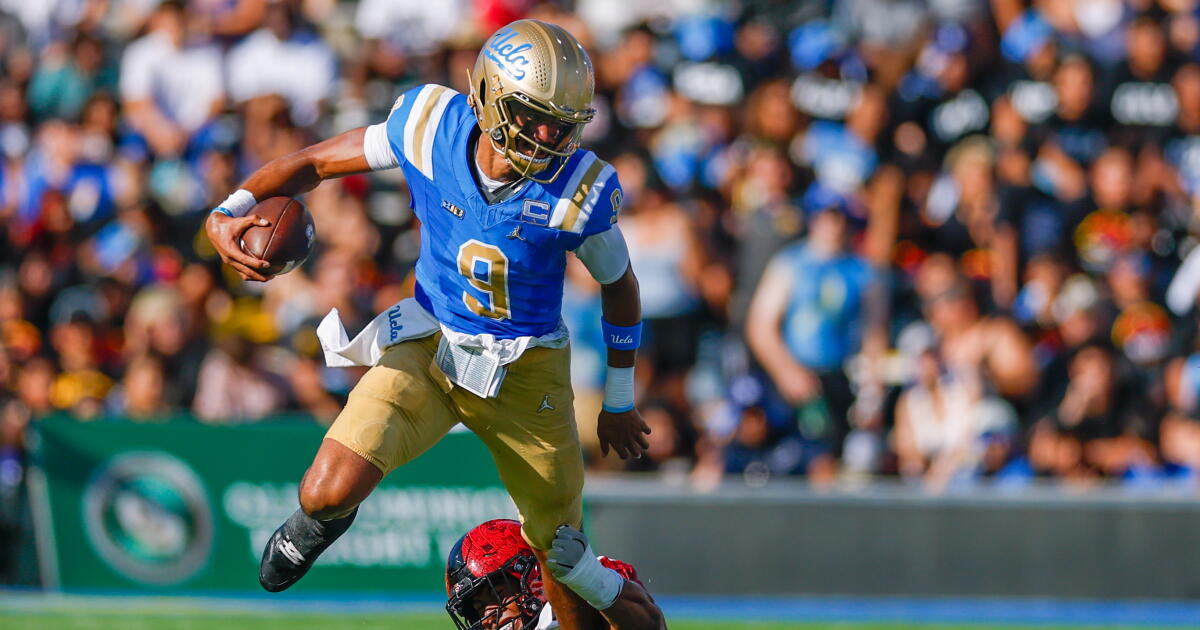
UCLA quarterback Nico Iamaleava hurdles over Purdue defensive back Hudauri Hines during the fourth quarter at the Rose Bowl Saturday.
(Ronaldo Bolanos/Los Angeles Times)
Iamaleava challenged himself to play better after a shaky start to the 2026 season.
After failing to complete a touchdown pass while throwing two red zone interceptions during the first two games, Iamaleava and Chesney knew that the signal caller left plays on the table.
“It’s not his best game, he knows it’s not his best game,” Chesney said after beating San Diego State. “I just think that the grit and the toughness that he played with though when he needed to get a couple first downs that really, really mattered to keep drives alive and put his body on the line and you know peeled himself off that ground and just kept fighting for his teammates, that’s special. But there’s a whole lot we got to do there.”
Iamaleava responded Saturday night, going 19-for-31 through the air for 276 yards and three touchdowns.
Not only did Iamaleava light up the stat sheet, but more important, he also passed the eye test. After looking impatient against San Diego State, consistently leaving the pocket early and failing to let plays develop downfield, he looked like a totally different player Saturday night.
Iamaleava looked poised in the pocket, going through multiple reads and hitting pass catchers across the field in an array of spots and formations. He also protected the ball against a solid Purdue defense.
But what was most impressive from the Bruin signal caller was his resilience and toughness on the field. After taking some bruising hits during the Bruins’ first two games, Iamaleava was fearless on scrambles and designed quarterback runs against Purdue, taking big hits downfield to gain extra yards. He also looked willing to take hits in the pocket to make deep or layered throws.
Although some of the hits led to time off the field — he cut a finger on his throwing hand and later took a crushing hit to his throwing shoulder that left him lying on the turf for some time — he always returned to the game. Chesney said he repeatedly asked Iamaleava whether he was sure he could continue playing and the senior kept insisting on returning to the game once he was cleared by the UCLA medical staff.
“He’s just a straight dog, there really isn’t much to say about that,” Knight said. “He’s battling. He gets hurt and he gets back up. He plays the next play. He’s doing this for his brothers.”
Same defense, different opponent
Purdue quarterback Ryan Browne scrambles out of the pocket while being chased by UCLA players Saturday.
(Ronaldo Bolanos/Los Angeles Times)
Purdue’s offense revealed glaring holes the San Diego State offense could not expose.
Aztec quarterback Jayden Denegal only threw for 45 passing yards against UCLA, consistently missing open receivers downfield that had gained considerable separation on the Bruins’ cornerbacks. And even when he did find them, the receivers were not able to haul in catches.
Boilermakers quarterback Ryan Browne, on the other hand, had no problem picking apart the UCLA secondary. Browne went 19-for-30 for 378 yards and three scores, and while he did throw an interception to cornerback Rodrick Pleasant, it came with less than six minutes remaining when the Bruins were already up two scores.
Purdue’s slot receivers tore through the UCLA secondary, running through multiple layers of coverage. Receivers Asaad Waseem and Xavier Townsend combined for 14 receptions, 311 yards and two touchdowns.
Not only did the Purdue offense score five touchdowns, but the pace at which the team scored illustrated the lack of resistance the Bruins’ secondary gave the Boilermakers. Three of the five touchdown drives took less than two and a half minutes, with the first touchdown coming on one play — courtesy of completely broken coverage.
When asked about the impact of Purdue’s receivers Wednesday, defensive coordinator Colin Hitschler said he would have to wait for the game to answer certain questions.
“When you have 10 personnel and that many receivers that can catch the ball, it can create mismatches, and we play a lot of man, so who’s going to fold first?” Hitschler said. “Are we going to be able to man them up or are we having to play more zone? Those are questions that will play out as the game dictates by who’s winning the one-on-one matchups. It’s the chess match that always happens in any game.”
It was obvious who won the chess match.
Two forced fumbles from linebacker Sammy Omosigho and a formidable run defense that held tailback Fame Ijeboi to 2.8 yards per carry helped mitigate the defense’s problems.
How many games UCLA can win the rest of Big Ten play may rest on the defense’s ability to rebound from a brutal win over Purdue the way the Bruins’ offense did after an ugly win over San Diego State.
Few have felt the transformation quite as deeply as Iamaleava, who was the face of both teams.
“Shoot, it means everything,” Iamaleava said of the team’s 3-0 start. “I think that just speaks to the growth of the team and speaks to Coach Ches, of how he got us to buy into this process and his winning, his winning ways. It feels good to be 3-0, and we’ve got to keep going.”
Women’s soccer scores signature win
The UCLA women’s soccer team has take on grueling schedule, facing off with four teams ranked in the top 25 so far this season.
The No. 21 Bruins (5-3-1, 2-1-0 Big Ten) made the most of their fourth opportunity for a signature win, earning a 1-0 win at No. 5 Ohio State (6-1-1, 2-1-0) on Thursday night. It was the Buckeyes’ first loss this season.
Kara Croone set up Leena Powell for the game winner fired from just outside the box in the 25th minute. UCLA goalkeeper Daphne Nakfoor recorded five saves to maintain the shutout victory.
“Amazing performance for the girls,” UCLA women’s soccer coach Gof Boyoko said. “We needed a solid performance, and they did it. We scored a good goal, we didn’t concede, and we were strong defensively.”
UCLA alum Jordin Canada, who has dealt the ball with expert precision this season, had 11 points and 10 assists for the WNBA-playoff bound Dream.
UCLA alum Gabriela Jaquez, who has enjoyed a strong rookie season with a rebuilding Sky team, finished with 14 points, three rebounds, two steals and one assist. Chicago was eliminated from playoff contention, but Jaquez has been a bright spot for the team all season.
Bruins on deck
Here are all UCLA games scheduled to be played this week across all sports, with all times Pacific:
Monday, Sept. 21
Women’s golf at Canadian Collegiate Invitational, All day
Tuesday, Sept. 22
Women’s golf at Canadian Collegiate Invitational, All day
Do you have a comment or something you’d like to see in a future UCLA newsletter? Email newsletters editor Houston Mitchell at houston.mitchell@latimes.com. To get this newsletter in your inbox, click here.
Sports editor Iliana Limón Romero contributed to this report.
UCLA offensive coordinator Dean Kennedy stressed that his offense needed to come out swinging Saturday against Purdue after going scoreless in the first half against San Diego State last week.
And the Bruins heeded the advice, scoring 21 first-quarter points before pulling away in the second half to take a 52-38 win in their Big Ten opener Saturday night at the Rose Bowl.
UCLA improved to 3-0 and matched its 2025 win total with its first 50-point game against a Power Four program since November 2022. Bob Chesney joined Terry Donahue and Jim Mora as the only coaches to start their UCLA tenures 3-0.
Fifth-year tailback Wayne Knight spearheaded the offensive outburst, rushing for 177 yards and two touchdowns for a Bruins team that had 369 yards and four touchdowns on the ground via an average of 7.7 yards per carry. Knight has eight touchdowns in three games, matching the Bruins’ total output for rushing touchdowns last season.
“The biggest thing for us was to just put it all together. And I think that we stepped up to that challenge — what we did on the ground, in the air,” Knight said. “But the guys up front, no matter who is in there as guys are rotating all the time, whoever is in there is going to put up front. They are working as a team.”
While Chesney made sure to acknowledge his running backs — with all three starters reaching the end zone — he made a point to recognize the man under center, highlighting senior quarterback Nico Iamaleava’s resiliency.
After posting two interceptions to zero passing touchdowns through the first two weeks of the season, Iamaleava completed 19 of 31 passes for 276 yards and three touchdowns while rushing for 55 more. Iamaleava looked much more comfortable and confident in the pocket, despite playing through multiple injuries.
UCLA defensive players celebrate after defensive lineman Sahir West (15) recovers a fumble against Purdue Saturday at the Rose Bowl.
(Ronaldo Bolanos/Los Angeles Times)
“Last week, I told you it wasn’t his greatest game. We watched him go out here today, and I think he was near perfect for a stretch in the beginning of that game, finding all kinds of different receivers and being able to carry the ball himself a little bit,” Chesney said. “And just what a warrior, because he was pretty nicked up out there in moments, and he just wanted to keep fighting.”
Iamaleava found security in senior wideout Semaj Morgan, who hauled in four passes for 72 yards and two touchdowns. In three years at Michigan, Morgan had just four receiving touchdowns. Outside of Morgan, fifth-year wide receiver Leland Smith caught three passes for 59 yards despite playing just one snap across the previous two weeks, potentially giving Iamaleava and Kennedy a big target to look to going forward.
James Madison transfer Landon Ellis, who returned to the field for the first time since going down with a head injury in the beginning of the second half against California, scored his first touchdown as a Bruin. And South Carolina transfer Brian Rowe Jr. caught two passes for 65 yards despite getting targeted eight times, including a deep shot from Iamaleava in the end zone that bounced off his chest.
Although UCLA’s offense turned in 645 yards of total offense, its defense struggled to hold back a Purdue team that lost its 19th consecutive conference game.
UCLA quarterback Nico Iamaleava passes during the first quarter Saturday against Purdue.
(Ronaldo Bolanos / Los Angeles Times)
While the Bruins held Aztec signal caller Jayden Denegal to just 45 passing yards, the secondary found itself facing a different beast in Boilermaker quarterback Ryan Browne, who completed 19 of 30 passes for 378 of Purdue’s 488 total yards, with a touchdown and an interception. Xavier Townsend had 162 yards receiving and two touchdowns.
“I felt like the pressure mounted a little bit and we were not as clean in our technique as we needed to be,” Chesney said. “We can’t put ourselves in panic mode, which might have hit us a little bit throughout today. But when we needed it the most, we were able to get a stop.”
Chesney said the UCLA defense has the personnel and ability to compete with anyone, but penalties and a fake punt that resulted in a first down allowed the Boilermakers to get within one score and added unnecessary pressure.
Fortunately for the UCLA secondary, linebacker Sammy Omosigho put the defense on his back.
Omosigho led the team in tackles with 12, but more important, he had two sacks and two forced fumbles. He has four forced fumbles in three games.
“That’s his third game in a row forcing a fumble. There’s other things he’s going to want to clean up in there too and other schematic things that he can do better,” Chesney said of Omosigho. “But at the same point in time, the one play that stuck out to me was a running back, and it looked like he was going to go and get the edge, and Sam just put out one arm and just crumbled this kid with one arm. The strength he has, the poise he plays with, the toughness he plays with and the strength to be able to execute and finish on those tackles, are things that are pretty impressive.”
UCLA running back Anthony Woods is hoisted up by offensive lineman Julian Armella after scoring a touchdown against Purdue at the Rose Bowl on Saturday.
(Ronaldo Bolanos/Los Angeles Times)
James Madison transfer Sahir West recovered both of Omosigho’s takeaways — the Boilermakers’ first two giveaways this season — and they set up UCLA touchdowns.
While Purdue (1-2) kept up with UCLA for most of the game, its hopes of a comeback ended when senior defensive back Rodrick Pleasant picked off Purdue quarterback Ryan Browne with less than six minutes left.
Despite the Bruins’ difficulty thriving on both sides of the ball during the same game, Chesney said he is confident in his team’s ability to compete going forward.
“We heard the guys on defense saying thanks for getting our back,” Chesney said. “The offense struggled last week, we’re going to need them at some point. The defense is going to need that at some point, and then we’re all going to need the special teams at some point. We haven’t played the perfect complementary game yet, but there’s one in there and I’m looking forward to seeing that day because it exists. There’s fibers in here of a really high level football team.”
While Purdue is not projected to be a Big Ten juggernaut this season, UCLA coach Bob Chesney and his team expect to be challenged during their first game against Big Ten competition on Saturday at the Rose Bowl.
The Boilermakers’ defensive line features five high-impact players that are at least 6-foot-3, and a nose tackle who weighs in at 301 pounds and anchors a defensive front that ranks second in the Big Ten with 17 tackles for loss.
“They’re talented in who they’re as individual players, there are some game-wreckers in there,” Chesney said. “They are as vertical as can be, they jump out of their stances, they’re jumping snap counts and they’re violent. They pose a giant problem, and we are not going to be able to push them around, and we are not going to be able to find ourselves in a spot where they tire. This is going to be a battle on the inside throughout the entire course of that game.”
While UCLA’s ground attack has dominated through the first two games of the season — rushing for 277 yards and six touchdowns against California and 214 yards and four scores against San Diego State — it might be harder for the Bruins’ running backs to have their way against the Purdue defense.
Purdue held both Indiana State‘s and Wake Forest’s starting running backs to less than four yards per carry, and has conceded just two rushing touchdowns to those starters this season.
“There’s some things that I think Purdue does a really good job defensively, in terms of getting off the ball,” said UCLA offensive coordinator Dean Kennedy. “They have got a lot of length. They’re a very, very big team, it will probably be one of the biggest teams we will face, so we have to be prepared for that.”
However, the Boilermakers have struggled to stop quarterbacks on the run — allowing Indiana State’s Elijah Owens and Wake Forest‘s Gio Lopez to combine for 118 rushing yards and two touchdowns — giving Bruins senior quarterback Nico Iamaleava the opportunity to rely on his legs.
While Iamaleava should have wide receivers Landon Ellis and Brian Rowe Jr. back to full strength, fortifying the aerial attack, the signal-caller will be without Mikey Matthews, after the slot receiver went down with a lower-body injury against San Diego State.
“There’s a fine line. Understanding what the coverage is doing, when is it time to take off and go,” Kennedy said. “If you are going through your read, from a clock standpoint, and it’s not there, it’s a great time to take off and go. It’s our job as an offense to create explosives, whether it’s him taking off or it’s him creating a scramble drill. We look at scramble drills, that we have to create explosives, and that’s something we have to do a better job of.”
Defensively, the “Bruin Bullies” will be tasked with stopping running back Fame Ijeboi, who has run for 201 yards and four touchdowns on 5.3 yards per carry this season. Chesney said that Ijeboi has a “Wayne Knight” feeling to him, where he plays low to the ground, displays proficient body balance and leg drive, allowing him to be influential in the passing game and break tackles.
While UCLA has already faced formidable rushers in Cal’s Adam Mohammed and San Diego State’s Lucky Sutton, Ijeboi could be the most impactful yet. And no one knows that more than Bruin defensive coordinator Colin Hitschler, who went to the same high school as the Boilermaker running back.
“It’s been fun to watch his growth, following him through high school, and watching him earn those scholarships and opportunities,” Hitschler said. “Those first two games, he jumped off the tape. He’s got great potential and he’s going to go a long way. We have to do a good job putting a physical shoulder on him and knocking him down because he’ll run through contact and does a great job of finding the edges.”
If Ijeboi is unable to get it going, it will have to be up to Purdue quarterback Ryan Browne to generate offense.
While the signal-caller struggled last season — throwing nine touchdowns with 10 interceptions — Browne has looked like a new player in 2026, passing for 646 yards and four touchdowns.
Browne has benefited from the addition of two premier slot receivers in Florida Atlantic transfer Asaad Waseem and Iowa State transfer Xavier Townsend. They have combined for 25 receptions, 277 yards and one score.
“What makes them unique is there are a lot of them,” Hitschler said. “When you have 10 personnel and that many receivers that can catch the ball, it can create mismatches, and we play a lot of man, so who’s going to fold first?” Hitschler said. “Are we going to be able to man them up or are we having to play more zone? Those are questions that will play out as the game dictates by who’s winning the one-on-one matchups. It’s the chess match that always happens in any game.”
The Bruins’ defense will look to force turnovers, but that is no easy feat as the Boilermakers have yet to turn the ball over this season.