telluride

Inside Telluride’s secret screening: a meta Elizabeth Holmes doc

The Telluride Film Festival has always enjoyed keeping a secret. Tucked away in the Colorado mountains with nary a red carpet or paparazzo in sight, the low-key film festival doesn’t announce its lineup until the day before opening and surprise additions have long been a fixture of the event.

But even by Telluride standards, organizers went to unusual lengths this year to keep their biggest surprise under wraps. They had carved out a prime Sunday evening slot for a world premiere that, fingers crossed, would remain unknown until the audience was seated inside the theater. Festival director Julie Huntsinger offered only a few clues beforehand. The film involved some “very known names,” she told The Times. “Do not miss it. Your jaw will be on the ground for the entire length of the film.”

For three days, trying to crack the mystery became Telluride’s unofficial parlor game. Was it Aaron Sorkin’s “The Social Reckoning”? Denis Villeneuve’s “Dune: Part Three”? Alex Gibney’s Elon Musk documentary “Musk”? By Sunday, the mounting speculation had become fodder for jokes: Introducing his new movie “Club Kid” earlier in the day, writer-director-star Jordan Firstman announced that the evening’s TBA would be a newly restored print of Jerry Seinfeld’s 2007 animated film “Bee Movie.” “Just kidding,” he added. “I love Jerry.”

The festival kept the suspense going right up to showtime. Before entering the Werner Herzog Theatre on Sunday evening, hundreds of moviegoers were required to lock their phones in pouches to prevent spreading the word. Inside, they were warned that security guards equipped with night-vision goggles would be watching for anyone who managed to keep a phone accessible.

Taking the stage, Huntsinger made one last plea for secrecy. “What happens in Telluride stays in Telluride,” she told the crowd, before bringing out Nathan Fielder, the deadpan comic mind behind the reality-bending television shows “Nathan for You,” “The Rehearsal” and “The Curse.”

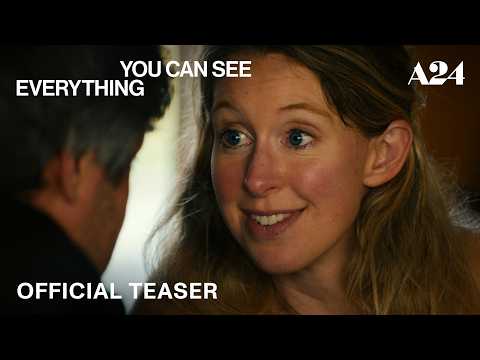
What Telluride had been guarding so carefully was “You Can See Everything,” a nearly three-hour documentary about convicted Theranos founder Elizabeth Holmes, co-directed by Fielder and documentary filmmaker Lance Oppenheim. The film, which A24 will release theatrically in October, had been made largely in secret over three years.

“For those of you who don’t know who we are and are disappointed, I apologize,” Fielder, joined onstage by Oppenheim, told the crowd to laughs. “But hopefully by the end of the film, you’ll be slightly less disappointed.”

The movie begins 34 days before Holmes is due to report to federal prison, with Fielder, Oppenheim and a small crew given extraordinary access to her life with her partner, Billy Evans, and their young children. Holmes and Evans embrace what they call “radical transparency,” opening their home to the cameras in hopes of convincing the filmmakers — and eventually the world — that the public has fundamentally misunderstood her.

But as anyone familiar with Fielder’s reenactment-heavy work can imagine, “You Can See Everything” quickly becomes something far stranger than a conventional documentary. Fielder finds himself drawn from behind the camera into the story, struggling to determine whether Holmes and Evans are being candid with him or manipulating him. From there, the movie takes a series of increasingly surreal turns, including elaborate reenactments involving a Hollywood actress (her arrival is too good to spoil) that further scramble the line between reality and performance.

During a post-screening Q&A moderated by Emma Stone, who co-starred with Fielder in the darkly comic A24 series “The Curse,” Fielder said that his own inability to get a firm grip on what he was witnessing became one of the forces driving the project.

“We’re all smart and we’re really working at the top of our intelligence,” he recalled thinking as he and the crew tried to make sense of their time with Holmes and Evans. “Why can’t we make sense of what’s happening in this house?”

The project began, appropriately enough, with a magic trick.

Oppenheim said he and Fielder were at the Magic Castle in Los Angeles several years ago when a magician asked the audience to name a celebrity. Someone called out Elizabeth Holmes. Afterward, Oppenheim told Fielder he had heard through a friend of a friend that Holmes was looking for someone to document her life.

Fielder had read John Carreyrou’s “Bad Blood,” the bestselling 2018 account of Theranos’ rise and collapse and initially saw little reason to make another documentary about Holmes.

“I thought the story was really fully told,” he told the Telluride crowd. Holmes, however, had largely disappeared from public view, and Fielder was curious about what she might have to say for herself.

Meeting her only deepened that curiosity. Sitting across from Holmes, Fielder said, he found her “sort of honest and charming,” even as his brain was warning him, “No, don’t trust.” That disconnect — between what he knew about Holmes and what he felt in her presence — became central to the movie.

A24 gave Fielder and Oppenheim unusual freedom to pursue the project without any deadline or obligation to turn what they captured into a finished film. If nothing came of it, Fielder recalled being told, “you can just throw everything away.”

Holmes founded Theranos in 2003 and became one of Silicon Valley’s most celebrated young entrepreneurs by claiming the company could perform a wide range of medical tests using only a few drops of blood. The company collapsed after investigations exposed serious problems with its technology and business practices. In 2022, Holmes was convicted on four counts related to defrauding investors and later sentenced to more than 11 years in federal prison.

As shown in “You Can See Everything,” once Holmes reports to federal prison, the filmmakers’ access to her changes dramatically, with Evans — who takes over Holmes’ Twitter feed and assumes power of attorney over her decisions — becoming their main conduit. Fielder said the relationship grew strained as Evans tried to exert greater control over the project. Neither Holmes nor Evans has seen the finished movie.

Fielder is hoping to keep the film’s biggest surprises under wraps. During the Q&A, he told the Telluride audience he hoped future viewers could experience the film without knowing where it was headed. Stone seconded the request.

“You won’t be upsetting me,” Fielder joked. “You’ll be upsetting Oscar-winning actress Emma Stone.”

Fielder said that even after three years immersed in her world, he still doesn’t know quite what to make of Holmes — or how much of what she says can be believed.

“I really am struggling to this day to understand exactly what I experienced in this,” he said. “I don’t quite know what I went through.”

As the crowd filed out of the Herzog, one reaction seemed to recur more than any other: “That was wild.”
Source link

Bill Gates warns of AI risks at Telluride Film Festival

For four days every Labor Day weekend, the Telluride Film Festival turns this tiny mountain town into something of a refuge from the outside world. Tucked into a box canyon and far from the usual machinery of Hollywood, moviegoers spend their days seeing films they may have known little about before arriving and talking about them almost nonstop.

Artificial intelligence, apparently, did not get the memo.

This year, even Telluride’s usually self-contained movie bubble couldn’t keep out the existential anxieties surrounding AI. On Saturday, the festival devoted two events to the subject, beginning with “The Humanity Dilemma,” an hourlong multimedia presentation mixing dire warnings with live music and imagery, and continuing with a panel bluntly titled “AI AI AI,” featuring Microsoft co-founder Bill Gates.

Introducing “The Humanity Dilemma” at the nearly packed Sheridan Opera House, festival executive director Julie Huntsinger acknowledged that Telluride normally steers clear of taking political sides. “We just let the program speak for us,” Huntsinger said.

But on AI, she made an exception.

“We are a very humanist festival — that’s how we identify,” Huntsinger said. “AI is a threat.” While acknowledging potentially beneficial applications, she urged the audience to become more engaged in the debate over its development.

“We all need to be very alert and vigilant and loving and kind and stop this s—,” she said, earning loud whoops of approval from some in the crowd.

AI already occupies an uneasy place in Hollywood, where filmmakers and studios are experimenting with the technology even as actors, writers and other creative workers fight to protect their jobs and likenesses from being exploited or replaced.

For all of Huntsinger’s warnings, Telluride is not treating AI as off-limits. Its program includes “Love, Rendered,” a short documentary directed by Liz Garbus and produced by Darren Aronofsky about an elderly couple confronting the husband’s memory loss. Using AI along with family photographs and stories from loved ones, the filmmakers recreate the moment the couple first met and fell in love 70 years earlier. On Sunday, the film’s creative team is scheduled to discuss the project at an event titled “Filmmaking and Technology With Empathy: AI for Societal Benefit.”

“The Humanity Dilemma” was presented by Tristan Harris and Aza Raskin, co-founders of the Center for Humane Technology, who appeared in the 2020 documentary “The Social Dilemma,” along with artist and researcher Joy Mauthe and violinist Andrei Matorin. Harris and Raskin also appear in this year’s “The AI Doc: Or How I Became an Apocaloptimist.”

The presentation was designed to work on the emotions as well as the intellect. Original songs about humanity’s relationship to AI ran through much of the hour, with Mauthe singing and playing guitar and Matorin on violin, as Harris and Raskin delivered warnings accompanied by images of environmental devastation, poverty and figures in the AI race including Elon Musk, Sam Altman and Larry Ellison.

Their argument was stark: The race to build more powerful AI is moving far faster than governments or the public can keep up. Their deepest fear is that humans could eventually lose control of increasingly capable AI systems altogether.

At the same time, they acknowledged the technology’s potentially transformative benefits.

“AI is confusing because it represents both simultaneous utopia and dystopia,” Raskin said. “Just imagine having to reason about a nuke that could also solve cancer.”

By the end, Harris was calling for a halt to the development of more powerful systems.

“We need to pause frontier AI development and pivot and steer towards a pro-human future,” he said.

The hour concluded with Mauthe leading the audience in a final refrain, singing that the future is “still in our hands.” It was the kind of unabashedly earnest moment that could easily have tipped into awkwardness, but many in the room seemed to embrace it.

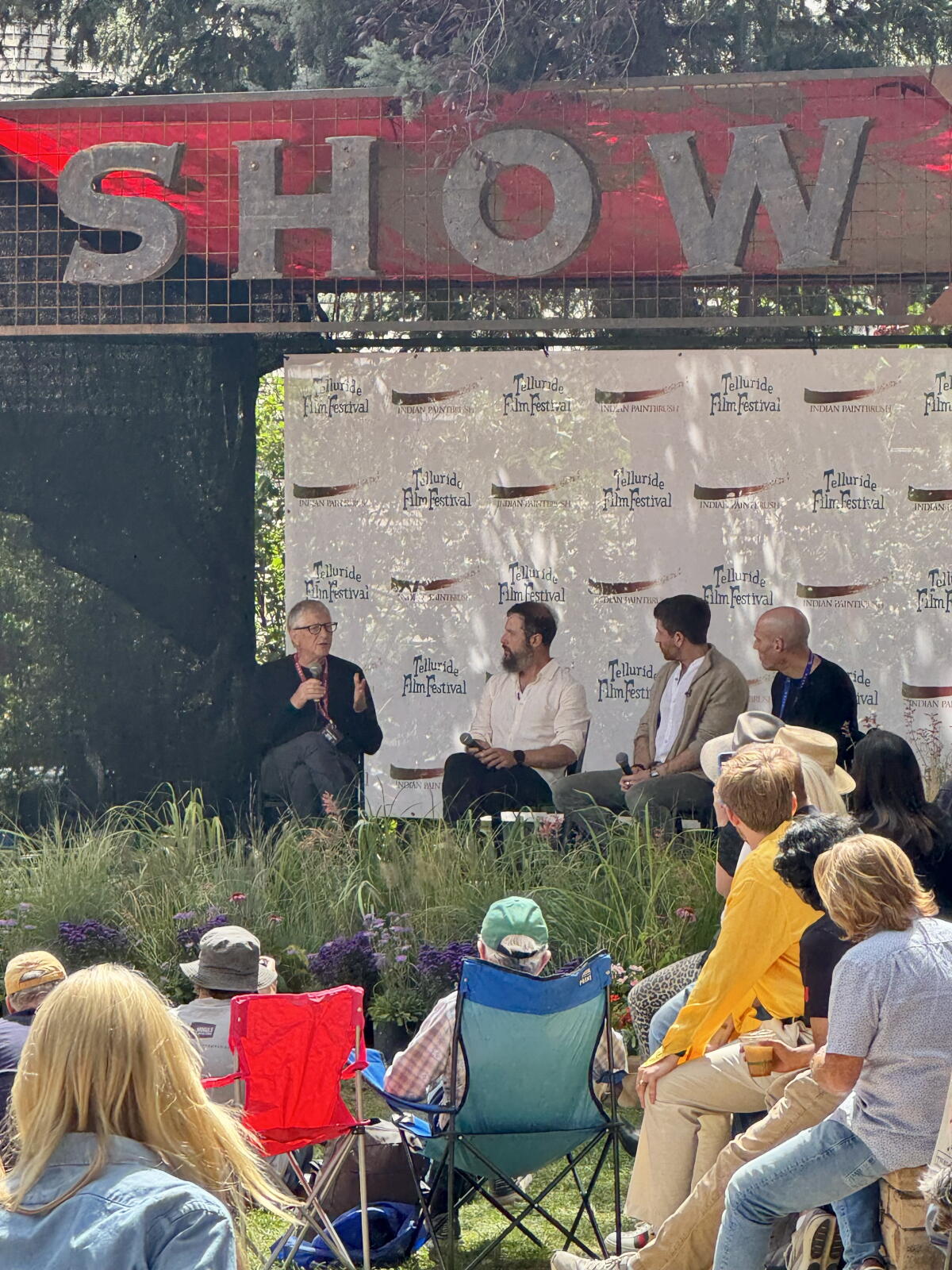
A few hours later, Harris and Raskin returned for “AI AI AI,” held outdoors at the Abel Gance Open Air Cinema in Telluride’s Elks Park, joined by Gates and filmmaker Joshua Oppenheimer, director of the Oscar-nominated documentaries “The Act of Killing” and “The Look of Silence,” who served as a moderator.

Panelists speak at an outdoor event.

From left, Bill Gates, Aza Raskin, Tristan Harris and filmmaker Joshua Oppenheimer discuss the risks and potential benefits of artificial intelligence at the Telluride Film Festival on Saturday.

(Josh Rottenberg)

For Gates, who has spent decades focusing much of his philanthropy and public advocacy on global health and poverty, the rise of AI has forced him to make room for a new priority. In an essay published last week, he warned that the technology was improving faster than he anticipated and called for a new framework to manage its risks.

At Telluride, Gates said he now feels compelled to devote some of the political influence he has long used to advocate for causes such as malnutrition, polio and malaria to raise alarms about AI as well.

“Is this the greatest problem humanity has ever faced?” Gates said. “That is just a fact.”

Gates said his concerns have grown as AI systems have become more capable, particularly at writing computer code, something he has been obsessed with since he was 13.

“The AIs are superhuman, i.e., better than I am at writing code,” Gates said.

He laid out five broad areas of concern: jobs, biotechnology, cyberattacks, psychosocial harms and whether humans will be able to maintain control over the systems they are building.

Oppenheimer said that after spending hours digging into AI risks ahead of the panel, he had come away “absolutely terrified.” He read aloud an answer he had received after asking ChatGPT to estimate the risks if the race toward increasingly powerful AI continued with little regulation.

The chatbot put the chance of “persistent dystopian outcomes for all humanity” at 25% to 40%, a civilization-scale catastrophe at 5% to 15% and human extinction or permanent loss of human control at 5% to 10%.

“That’s what AI thinks,” Oppenheimer said.

Gates stressed AI’s potential upside, citing advances in medicine, education and assistance to farmers in poor countries. But pressed on whether development should be slowed until safety measures catch up, he said he would be open to the idea.

“If there was a credible plan that would cause this to be either slowed down or, you know, even held in stasis for a period of time, I would likely support that,” Gates said.

The difficulty, he said, is that multiple developers in both the U.S. and China are pushing closer to the technological frontier. Still, Gates rejected the argument that competition with China makes meaningful regulation impossible.

“China does not want cyberattacks, bioattacks or loss of control,” Gates said.

The discussion was punctuated by a pair of outbursts from the audience. At one point, as Gates discussed the economic incentives driving AI development, a man shouted that they represented “everything that’s wrong with America” and invoked Jesus Christ. Gates paused before responding dryly: “Anyway, not everything is wrong with America, according to me.”

Gates argued that government and civil society need to move much more quickly.

“This five-year period, in my view, is a very critical period,” he said, adding that responses that take five or six years to get underway could come too late.

Despite the dire warnings, Harris pointed to signs that pressure for safeguards is growing, including calls from AI-industry employees to limit the development of more powerful systems. Just last week, Meta agreed to pay $17 billion to settle claims by 29 states that Facebook and Instagram harmed young users while also agreeing to new child-safety measures on the platforms.

“I just want to leave you with not naive optimism, but momentum,” Harris said.

Near the end, Raskin suggested that President Trump’s well-documented desire to win the Nobel Peace Prize might provide an incentive for him to pursue a U.S.-China pause on more powerful AI systems.

“What’s better than solving one war?” Raskin said. “Saving all of humanity forever from uncontrollable AI.”

Gates, with a wry smile, called the Nobel angle “smart.”

“Whoever really takes the step to solve this AI problem would deserve the Nobel Prize,” he said.

Later that night, the festival would hold an outdoor screening of Stanley Kubrick’s “2001: A Space Odyssey,” featuring HAL 9000, one of cinema’s most famous rogue artificial intelligences.

Gates framed the current stakes in similarly cinematic terms.

“There are these movies where the aliens are coming, and you see unprecedented levels of cooperation between China and the U.S.,” he said. “Well, believe me, the aliens are here.”

Source link

Telluride Film Festival 2026 lineup includes one big mystery

When the 53rd Telluride Film Festival kicks off Friday high in Colorado’s San Juan Mountains, its lineup will span family rupture and sumo wrestling, AIDS and rock stardom, with films touching on astronomy, Rupert Murdoch and extraterrestrial biker gangs — a typically wide-ranging mix for a festival that likes to keep audiences guessing.

For festival director Julie Huntsinger, the films share less a theme than a feeling. “Tenderness is something that I see in a lot of the movies,” she says. “This is a very heartbreaking, tender year.”

Telluride’s intimacy is part of its peculiar power. Smaller and scruffier than the annual film events of Venice, Toronto or New York, the four-day festival has no competition or juried prizes and keeps its lineup secret until the last minute. Celebrities trade red-carpet formality for jeans and flannel, while audiences crisscross town between screenings in a high school auditorium, a Masonic lodge, the county courthouse and half a dozen other spaces pressed into service for the week.

For a festival that can feel this homespun, its awards-season footprint is remarkably large. Last year, five of the 10 eventual best picture Oscar nominees screened there: “Hamnet,” “Bugonia,” “Sentimental Value,” “The Secret Agent” and “Frankenstein.”

This year there are fewer obvious awards heavyweights in the mix, at a time when prestige and independent films have become harder to finance, distribute and sell to audiences. Then again, Telluride has never depended entirely on known quantities; films such as “Slumdog Millionaire” and “Moonlight” arrived with relatively modest expectations and left as major contenders.

“It’s such a quintessential Telluride lineup,” Huntsinger says of this year’s eclectic program. “They kind of always feel that way because they’re so handmade.”

Among the more than 40 films in Telluride’s main program are new works from major directors such as Martin McDonagh, Werner Herzog, Mike Leigh, Danny Boyle and Paweł Pawlikowski. This year’s Silver Medallion tributes — the festival’s signature career honorees — will go to filmmaker Andrew Haigh and actors Sandra Hüller and John Malkovich, who will make his first trip to Telluride.

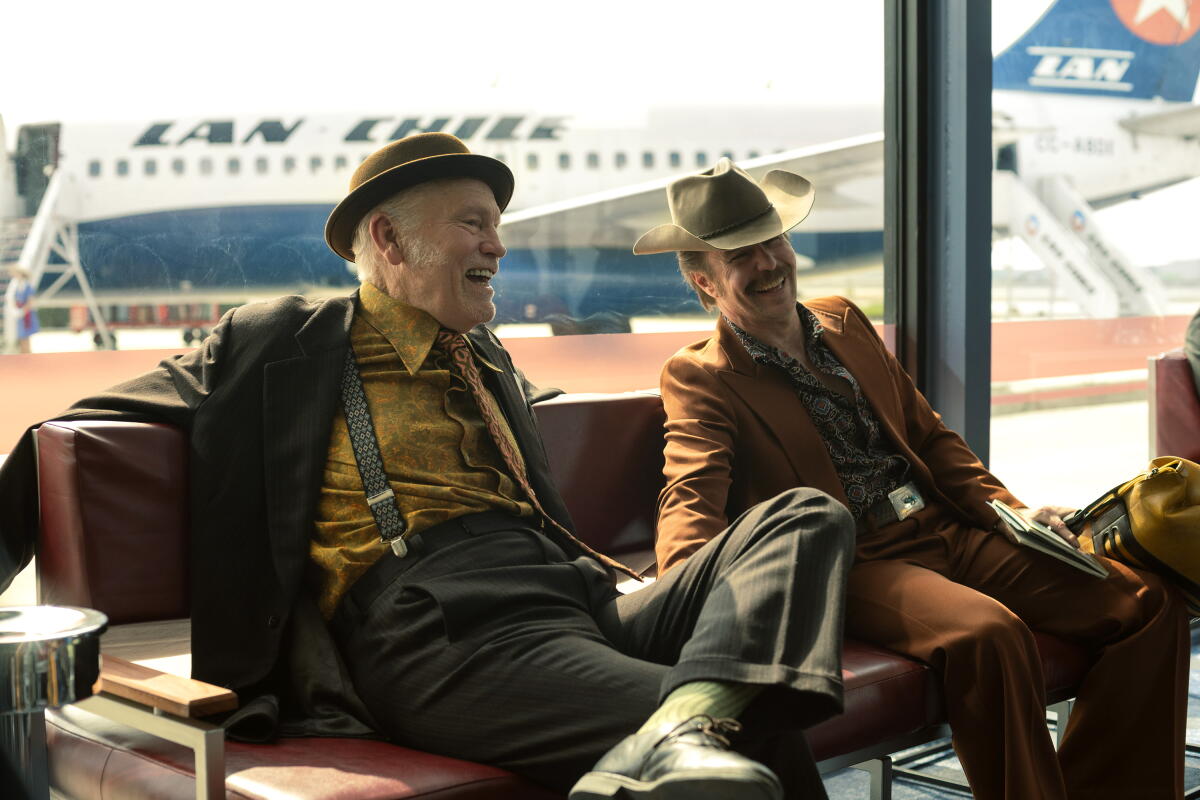
Two men in fedoras wait in an airport for a flight.

John Malkovich and Sam Rockwell in Martin McDonagh’s “Wild Horse Nine”

(Diego Araya Corvalan / Searchlight Pictures)

Haigh, whose films include “All of Us Strangers,” “Lean on Pete” and “45 Years,” returns with “A Long Winter,” adapted from a Colm Tóibín novella and relocated from the Pyrenees to the American Rockies in the 1950s. Ebon Moss-Bachrach, Caitríona Balfe, Kit Connor and Fred Hechinger star as members of a struggling family that begins to unravel after the mother disappears.

Huntsinger calls Haigh deeply humanist. “I don’t know how Andrew is so skilled at getting these performances but that is truly his gift,” she says.

Malkovich comes to Telluride with the dark comedy “Wild Horse Nine,” the latest from McDonagh, writer-director of “The Banshees of Inisherin” and “In Bruges.” Malkovich and Sam Rockwell play veteran CIA operatives who, after helping destabilize Salvador Allende’s government in 1973 Chile, head to Easter Island on a more personal assignment.

“It’s my favorite thing that McDonagh has ever done,” Huntsinger says. “He’s quite incisive. It is a timely film. And Malkovich is extraordinary.”

Hüller returns after a breakout 2023 Telluride, where she brought both “Anatomy of a Fall” and “The Zone of Interest.” She has another two films in the lineup this year: Markus Schleinzer’s “Rose,” in which she plays a woman passing as a male soldier during Europe’s Thirty Years’ War, and Pawlikowski’s “Fatherland” as Erika Mann on a journey back to postwar Germany with her father, the author and Hitler critic Thomas Mann.

Huntsinger seems as taken with Hüller herself as with her artistry — “so much intelligence and compassion for human beings,” she says.

A daughter and father sit at a bar.

Sandra Hüller and Hanns Zischler in the movie “Fatherland.”

(Agata Grzybowska / Mubi)

Elsewhere, Ira Sachs’ “The Man I Love,” starring Rami Malek, Tom Sturridge and this year’s guest director Rebecca Hall, looks back at New York’s queer creative community during the AIDS crisis. In Simon Stone’s “Elsinore,” Andrew Scott plays “Chariots of Fire” star Ian Charleson, who took on the role of Hamlet at the National Theatre while dying of AIDS. Scott’s performance is already generating early awards-season attention.

Huntsinger hopes audiences won’t overlook Arthur Harari’s “The Unknown,” an uncanny body-swapping drama starring Léa Seydoux that uses its genre premise to explore questions of identity and selfhood. “It is really dense and obtuse but I think it is rewarding and I hope people take up the challenge,” she says.

Telluride has long emphasized nonfiction and this year is no exception. Among the higher-profile entries are “Pete Townshend: Behind Blue Eyes,” a portrait of the Who guitarist and songwriter, and Nanette Burstein’s “Carl Sagan: We Are Made of Star Stuff,” about the astronomer and science communicator. The slate also includes Bryan Fogel’s endurance-sports documentary “The Row”; Pegah Ahangarani’s Iran-focused “Rehearsals for a Revolution”; and Mark Cousins’ 16-hour “The Story of Documentary Film.”

“Everest: The Other Side,” from filmmakers Jimmy Chin and Elizabeth Chai Vasarhelyi, follows mountaineers Hilaree Nelson and Jim Morrison as they prepare to climb Everest’s north face and attempt an unprecedented ski descent. Chin and Vasarhelyi won an Oscar for 2018’s “Free Solo,” their nerve-shredding chronicle of Alex Honnold’s ropeless ascent up El Capitan.

Huntsinger calls the new film “an even more complex, emotional, deep and profound examination of what we call the call of the wild.” After seeing it, she says, she ran into Chin and blurted out, “I’m so glad you’re alive.”

The looming subject of artificial intelligence will also get its own moment in Telluride. A conversation called “The Humanity Dilemma” will examine what the festival calls the “species-level event” of AI’s rise and whether an AI-dominated future is inevitable. “I’m very worried about AI,” Huntsinger says.

For all the films Telluride has announced, the one that might generate the most chatter is still under wraps.

While Telluride routinely reserves “TBA” slots for popular repeat screenings, it has occasionally used them to spring an unannounced title on audiences — as it did last year with “Frankenstein.” This year it has set aside a prime Sunday night slot for just such a surprise: a world premiere involving, Huntsinger says, some “very known names.”

“Do not miss it,” she teases. “You just won’t see this one coming and your jaw will be on the ground for the entire length of the film.” Beyond that, Huntsinger falls back on the festival’s unofficial motto: “Underpromise, overdeliver.”

Inevitably, there will be guessing. One possibility is “The Social Reckoning,” a follow-up to “The Social Network” directed by its Oscar-winning screenwriter Aaron Sorkin. This one’s about Facebook whistleblower Frances Haugen and Wall Street Journal reporter Jeff Horwitz and stars Jeremy Strong, Mikey Madison and Jeremy Allen White. It’s due from Sony on Oct. 9. The film was still undergoing reshoots in mid-July.

Huntsinger volunteers one thing: The mystery film is not Alejandro González Iñárritu’s “Digger,” a gonzo satire starring Tom Cruise, Hüller, Riz Ahmed, John Goodman and Jesse Plemons. She says Iñárritu — whose last film, “Bardo,” had a rocky reception on the 2022 festival circuit — was adamant that the decision wasn’t about avoiding festivals.

“As I understand it, there’s a big twist that he would like audiences to discover as close together as possible,” she says of “Digger,” which premieres in London Sept. 22 before opening Oct. 2.

Two of last year’s biggest Oscar contenders, “Sinners” and “One Battle After Another,” also skipped fall festival launches, raising questions about how essential such festivals — Telluride among them — remain to an awards campaign.

Huntsinger understands why a studio might hesitate to expose a film to scrutiny months before release. “The stain can happen if something gets savaged very far ahead of a release,” she says. “There’s a lot at stake.”

But she isn’t convinced the model is broken. She still believes the smaller, more challenging films Telluride tends to champion have “genuine shots” in the Oscar race.

“Getting selected is the prize,” Huntsinger says.

After all the strategizing and prognosticating, what no one can predict is which films will actually connect once audiences arrive.

“I don’t know what people are going to fall in love with,” Huntsinger says. “People have become like cats rather than dogs. You just never know what they’re going to go for.”

Source link