Tehran

Iran war day 77: Trump, Xi discuss Hormuz as Tehran rallies BRICS | US-Israel war on Iran News

The US and Chinese leaders agreed during talks in Beijing that the Strait of Hormuz should remain open to ensure global energy supplies.

United States President Donald Trump and Chinese President Xi Jinping discussed the Strait of Hormuz during talks in Beijing, with the White House saying Xi agreed the strategic waterway “must remain open to support the free flow of energy” as tensions over the Iran war continue to roil global markets.

Meanwhile, Iran’s Foreign Minister Abbas Araghchi urged fellow BRICS nations at a meeting in New Delhi, India, to condemn the US-Israel war on Iran as a violation of international law, insisting Tehran would “never bow to any pressure”.

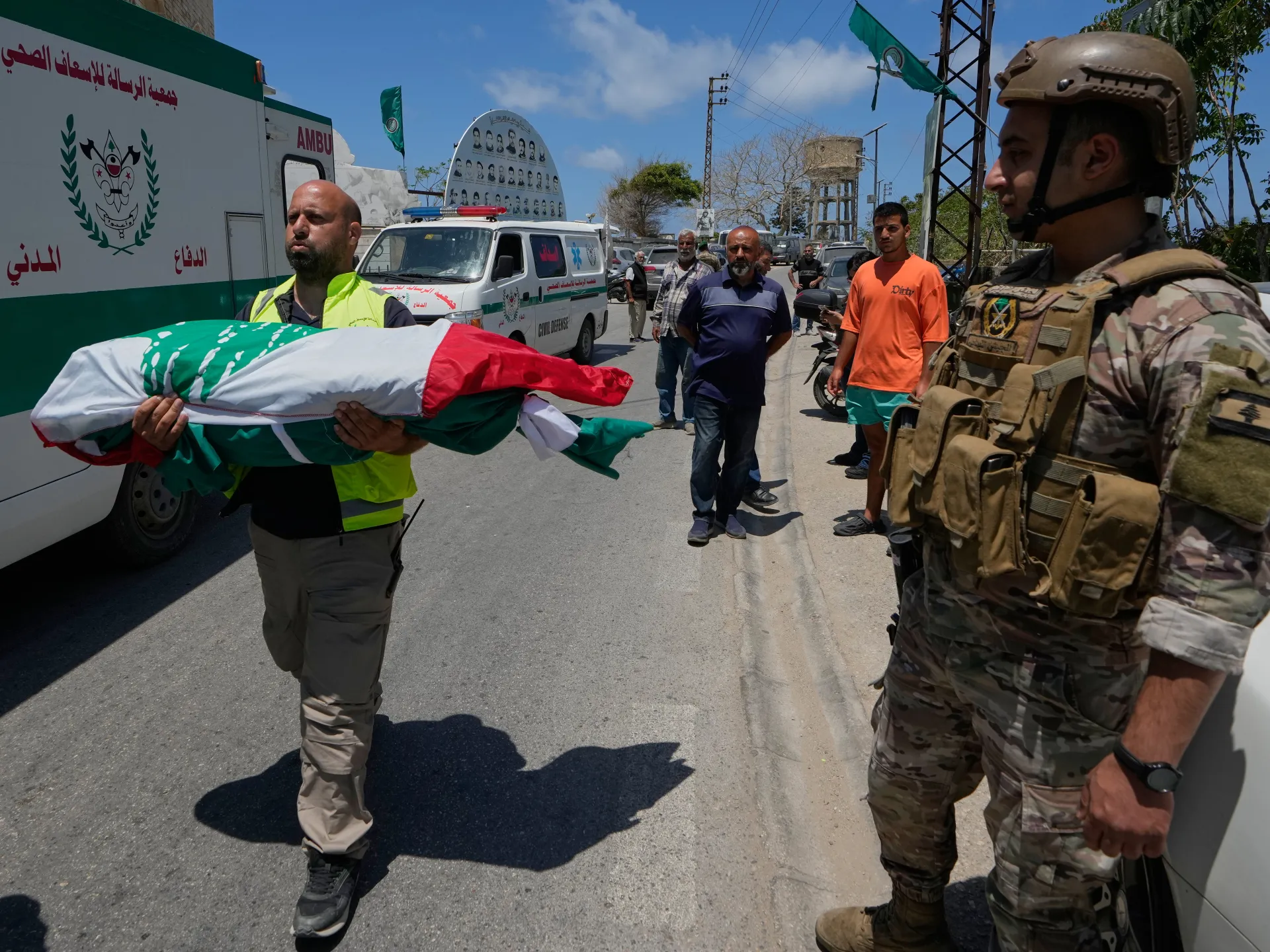
At the same time, a third round of direct talks between Lebanese and Israeli negotiators is under way in Washington, DC, aimed at ending hostilities, even as Israeli attacks continue across towns and villages in southern Lebanon.

Here is what we know:

In Iran

  • Iran urges BRICS to condemn US and Israel: Araghchi told the BRICS+ bloc that Iran was a “victim of illegal expansionism and warmongering” and called on member states to oppose “Western hegemony” by condemning the actions of the US and Israel.
  • Iran accuses UAE over war: Araghchi also accused the United Arab Emirates of playing an active role in the war against Iran, saying during the BRICS summit in India that the UAE was “directly involved in the aggression against my country”.
  • Iran signals new Hormuz strategy: Iranian media reported that more than 30 ships, including some linked to Chinese companies, were allowed to transit the Strait of Hormuz overnight as Tehran signalled the waterway was “open to all commercial ships” that cooperate with Iranian naval forces.

War diplomacy

  • Xi offers help on Hormuz: Trump said Xi Jinping had offered China’s help to open the Strait of Hormuz and pledged not to send military equipment to aid Iran in its war against the US and Israel.
  • Trump-Xi summit held amid ‘promise fatigue’: Analyst Drew Thompson said Washington and Beijing remain deeply distrustful after years of unmet expectations, with both sides accusing the other of breaking promises. He described the summit as “carefully managed” and focused on preventing further deterioration in ties.
  • US says Israel-Lebanon talks ‘positive’: A US official said talks in Washington on Thursday between Israel and Lebanon about an expiring ceasefire were “positive” and will take place as planned for a second day.

In the US

  • Trump wants Iran’s uranium for ‘public relations’: The US president suggested that hunting down Iran’s enriched uranium was primarily for political optics, after Israel demanded it as a goal in the war. “I just feel better if I got it, actually, but it’s – I think, it’s more for public relations than it is for anything else,” Trump told Fox News.
  • Trump says Iran must make deal: In the same interview, Trump told Sean Hannity he was running out of patience to reach a truce with Iran as peace talks have stalled. “I’m not going to be much more patient… They should make a deal. Any sane person would make a deal, but they might be crazy,” Trump said.

In Israel

  • NYT lawsuit: Israel says it will sue The New York Times after the newspaper published an article by columnist Nicholas Kristof detailing rape allegations by Palestinian detainees against Israeli forces. The Israeli Prime Minister’s Office announced the legal move three days after the report, which was based on accounts from 14 male and female Palestinian victims.

In Lebanon and Syria

  • Hezbollah claims attacks on Israeli forces: The group said it launched rockets, drones and artillery attacks on Israeli troops and military vehicles in southern Lebanon, and claimed to have downed Israeli drones.
  • Israel-Lebanon talks face uncertainty: According to Al Jazeera’s Manuel Rapalo, Israel is seeking stronger security guarantees and Hezbollah’s disarmament, while Lebanon wants a permanent ceasefire and Israeli troop withdrawal from the south. Rapalo says Hezbollah’s refusal to commit to any future agreement adds significant uncertainty, although diplomats still view the talks as a breakthrough.
  • Amnesty urges Israel to conduct Syria war crimes probe: The rights group called for investigations into Israeli raids and shelling in southern Syria, which residents say have destroyed homes and farmland and led to detentions. Israel has also seized additional territory beyond the occupied Golan Heights, in violation of the 1974 disengagement agreement.

Source link

Iran’s US-bound World Cup squad given public sendoff in Tehran | World Cup 2026 News

Thousands of people cheered Team Melli as Iran’s World Cup kit was unveiled before the team’s training camp in Turkiye.

Iran hosted a departure rally for its FIFA World Cup squad, witnessed by thousands of fans in Tehran’s Enqelab Square, amid concerns about ⁠the team travelling to the United States to compete.

The players were cheered ⁠by the crowd as they made patriotic statements from a stage on Wednesday.

Iran’s World Cup 2026 kit was also unveiled at the event, following which the team will travel to Turkiye to continue their preparations at a training camp.

“This is the best sendoff in the ⁠last four World Cup campaigns,” Mehdi Taj, president of the Football Federation Islamic Republic of Iran (FFIRI), told state TV.

“The players are with the people, and the crowd stands with the country’s dignity, honour, and strength. Whatever the result, may Iran’s flag be raised there and defended.”

Iran’s participation in the World Cup has been in question since the US and ‌Israel attacked Iran, starting a regional war on February 28.

People gather to attend the farewell ceremony of Iran's national football team ahead of their departure for the 2026 FIFA World Cup, in Tehran on May 13, 2026. The president of the Iranian Football Federation said late May 9 that if Iran dropped out of the World Cup, it would deprive the country of a "major diplomatic asset". World football's governing body FIFA has insisted for weeks that Iran will take part. Iran, who are due to be based in Tucson, Arizona, during the World Cup, face New Zealand, Belgium and Egypt in Group G. The Iranians open their World Cup campaign against New Zealand in Los Angeles on June 15. (Photo by ATTA KENARE / AFP) /
People gather to attend the farewell ceremony of Iran’s national team in Tehran [Atta Kenare/AFP]

An FFIRI delegation, led by Taj, turned back at Toronto’s main airport, citing their treatment by Canadian immigration, and missed a pre-World Cup FIFA gathering in Vancouver. They alleged “unacceptable behaviour of immigration officials” despite holding valid visas.

In 2024, Canada listed Iran’s Islamic Revolutionary Guard Corps as a terrorist organisation, and statements from the Canadian government indicated that Taj was denied entry due to his alleged ties with the IRGC.

The incident triggered fears there may be issues for some of the Iranian delegation getting into the US.

As in Canada, the IRGC is classified as a “terrorist entity” in the US, and Secretary of State Marco Rubio has said no one with ties to ⁠the organisation would be admitted to the country.

Iran has placed responsibility for ⁠getting the players and team officials into the US, where Team Melli are scheduled to play all three World Cup group matches, firmly in the hands of FIFA.

“Nothing has arrived yet regarding the visas. We hope it will definitely ⁠be handled within this timeframe,” Hedayat Mombeini, FFIRI secretary-general, told state TV at the rally.

“FIFA has made promises, and hopefully those promises ⁠will lead to results, and the players will receive their ⁠visas on time.”

Iran ‌will play The Gambia in a World Cup warm-up in Antalya on May 29. Mombeini said the FFIRI was in the process of arranging another friendly for the training camp in Turkiye.

Source link

Crowds gather in Tehran to send off Iran’s World Cup team | World Cup 2026

NewsFeed

Huge crowds gathered in Tehran’s Revolution Square to celebrate and send off Iran’s national football team ahead of the 2026 World Cup. The new jersey of the Iranian national team, which will be worn in the World Cup competitions, was unveiled at the event.

Source link

In war with Iran, China sees a familiar pattern of U.S. mistakes

The Trump administration has repeatedly framed the war in Iran as a quick, winnable fight, vowing to defeat the Islamic Republic “totally and decisively” — incomparable to the “dumb” wars in Iraq and Afghanistan.

But from China’s perspective, the parallels are clear.

“You can blow everything up — destroy it all,” one Chinese official told The Times, describing the Americans, “but you don’t have a strategy.”

President Trump arrives in Beijing this week for talks with a Chinese government that is confident as ever in its ascendance on the world stage, taking stock of its leverage and still baffled the U.S. administration chose yet another costly war in the Middle East.

China has watched as the United States, over seven weeks of fighting an outmatched enemy, has depleted nearly half of its stockpiles of high-end munitions — including its THAAD and Patriot batteries — and fired its Army chief of staff, among other Pentagon leaders, who had warned of critical shortages.

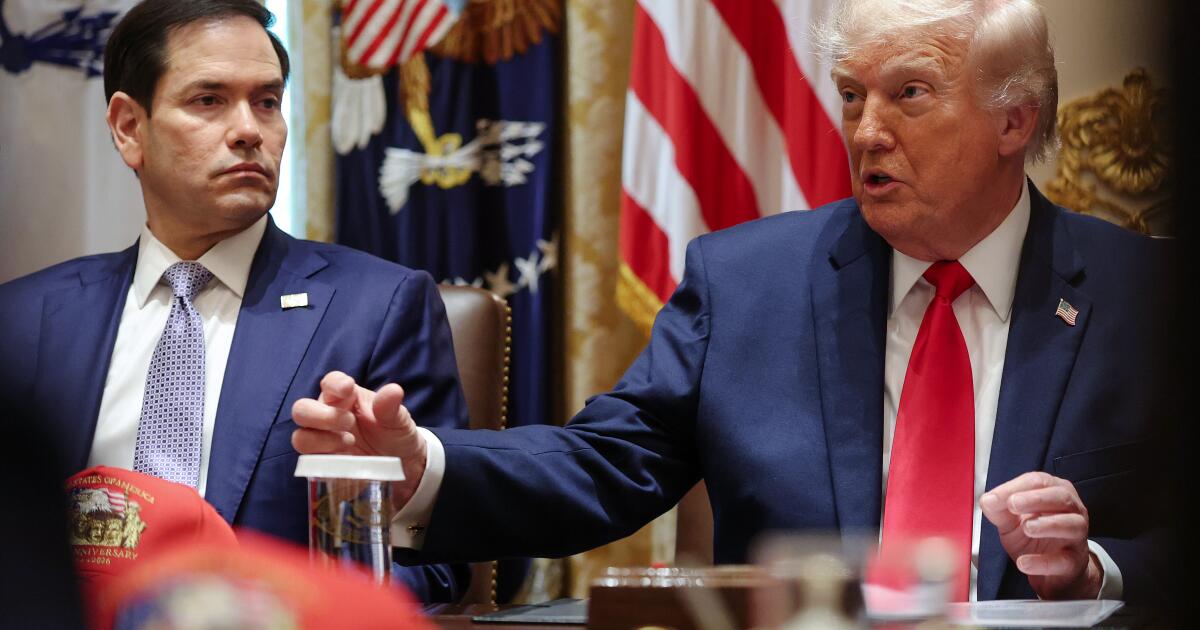
Marco Rubio, Trump’s national security advisor and secretary of State, has said the military operation that started the war known as Operation Epic Fury “is over.”

But the Strait of Hormuz, one of the world’s most vital commercial waterways, remains effectively shuttered. Iranian attacks in the region continue. And talks between Washington and Tehran have failed to reach a diplomatic agreement to bring a definitive end to the conflict.

“The Chinese have high regard for the operational proficiency of U.S. forces, but they recognize that, thus far at least, the Trump administration has not achieved its core objectives in going to war with Iran,” said David Ochmanek, a former deputy assistant secretary of Defense now with the Rand Corp.

The war has given Beijing an opportunity, Ochmanek said, “to double down on the claim they have made for the past year and a half that the [People’s Republic of China], not the U.S., is a force for global stability.”

The war has allowed China to demonstrate some diplomatic prowess. An initial ceasefire reached between the United States and Iran last month was only clinched after Beijing pressured Tehran to agree. And China’s advocacy for an open strait — rejecting Iranian attempts to impose a toll system — while opposing the U.S. war itself has allowed Beijing to maintain leverage with both sides.

It has also inflicted costs. Allies of Beijing noticed when the government did not leap to the defense of Tehran at the start of the war. And China has its own vested interest in a free and open waterway, where nearly 50% of the country’s crude oil imports pass through each day.

Building up to the start of the war and throughout its initial weeks, Washington diverted significant military assets from Asia — where Trump’s own national security strategy says they are needed most — to the Middle East.

The USS Abraham Lincoln was redirected from the South China Sea, along with scores of advanced missile interceptors from South Korea and Japan and nearly the entire U.S. inventory of long-range air-to-surface missiles in the Pacific.

Policy experts at the Pentagon were brought in to discuss a potential invasion of Kharg Island, the jewel of Iran’s oil industry, to draw lessons from planning a defense of Taiwan, according to a Defense official, who was granted anonymity to speak candidly. A Marine expeditionary unit was sent from Okinawa to the region for the potential operation.

Chinese officials and analysts have been candid in their assessments of U.S. hard power, impressed by a military they acknowledge remains the best in the world.

But Beijing sees a persistent flaw in U.S. strategy: the belief that military strength alone can reshape political realities, a view further weakened by the pressures on a democratic government whose public grows impatient with wars that drag on beyond days or weeks.

China’s autocracy is free from accountability to the public — and anyway has confidence that Chinese public opinion would be on its side if it were to launch a major military operation against its main target, Taiwan.

But there are lessons of caution to be learned from the Americans, as well.

Over the last year, the Taiwanese Navy has been practicing the rapid deployment of cheap and domestically produced smart mines for the sea — a potential bulwark against enemy blockades of ports and hostile invasion forces.

It is the type of asymmetric warfare that has so far frustrated the U.S. military in the Strait of Hormuz, protracting a war that Trump vowed would last a month or less.

Taiwan, too, would confront Beijing with political realities that military force cannot erase. Nearly 90% of the Taiwanese people oppose a Chinese takeover, and about 60% say they would resist it at all costs.

“Chinese analysts see two things at once,” said Craig Singleton, senior director of the China program at the Foundation for Defense of Democracies. “They are impressed by U.S. military reach, precision and operational capability, but they also see a familiar pattern of American power struggling to translate battlefield success into a durable political outcome.”

That matters for Taiwan, Singleton said, “because China’s own military modernization has borrowed heavily from the American model, relying heavily on joint operations, high-tech precision strikes, decapitation concepts and information dominance.

“If the world’s most experienced military can still struggle to convert military pressure into political success,” he added, “Beijing has to ask whether the [People’s Liberation Army] could do better in a far more complex Taiwan scenario.”

Source link