taxi

A California lawmaker wants to make it easier for taxis to compete with Uber. But is it too little, too late?

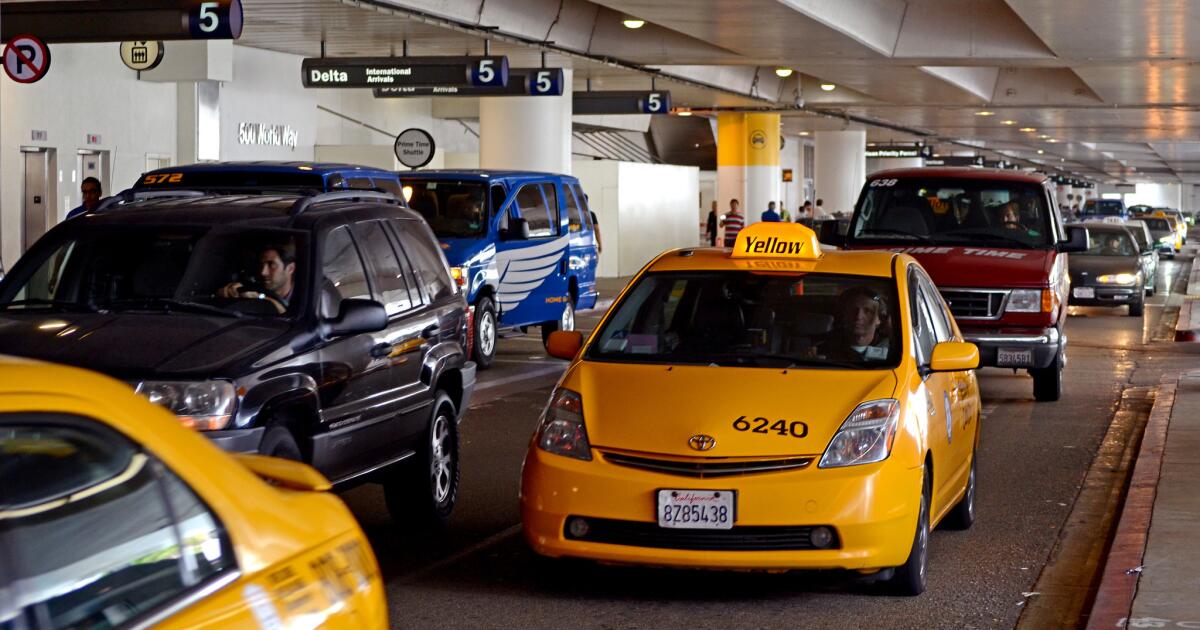
Uber and Lyft continue to expand their dominance in California, and taxi companies are looking to the state Legislature for some relief.

“If communities value taxicabs, then we’re going to have to have a regulatory environment that allows cab companies to thrive,” said William Rouse, general manager of Yellow Cab of Los Angeles. “Right now, that’s just not the case.”

Rouse and others in the taxi industry have turned to Assemblyman Evan Low (D-Campbell) for help. Low has introduced AB 1069, which aims to ease taxi regulations to make the companies more competitive with their ride-hailing rivals.

Under Low’s legislation, which overwhelmingly passed the Assembly last month, taxi regulation would occur regionally rather than city by city. This means, for instance, cabs could pick up passengers in Los Angeles, drop them off in Santa Monica and vice versa without needing multiple permits.

Taxis also could lower or raise their prices — similar to Uber and Lyft’s surge-pricing models — in response to demand, with a maximum price set by each region.

“If we don’t do anything now, they will completely be annihilated,” Low said.

In California, numbers show the extent of the taxi industry’s decline and the ride-hailing boom. Taxi trips dropped nearly 30% in Los Angeles from 2012, right before Uber and Lyft began operating, to 2015. New research from the Brookings Institution shows that the number of ride-hailing drivers doubled in Los Angeles, Sacramento, San Diego and San Jose in 2015.

Uber and Lyft’s business models rely on using public pressure and lobbying to shape and change laws and regulations, said Elizabeth Pollman, a professor at Loyola Law School who has written about how Uber and Lyft have challenged existing state and local rules.

“Their business model wasn’t just to replicate the world we had, but rather to create a new model,” Pollman said.

Uber and Lyft have succeeded at the state Capitol in getting regulations and laws passed to benefit their industry and shooting down those that don’t. Even if Low’s bill passes, major regulatory disparities between ride-hailing companies and taxis will remain.

Taxi drivers still will have to pass fingerprint-based background checks, while Uber and Lyft drivers face less onerous rules. After years of delays, the California Public Utilities Commission, which regulates ride-hailing statewide, is scheduled in the fall to decide whether ride-hailing drivers will need to pass fingerprint checks as well. Neither Uber nor Lyft has taken a position on Low’s bill, but each company has been generally supportive of loosening taxi regulations.

Still, cab companies and transportation experts said the legislation could have clear benefits for the taxi industry. Currently, it costs more than $3,000 a year for taxi permits to operate in four cities — Torrance, Redondo Beach, Hermosa Beach and Manhattan Beach — that stretch roughly six miles along the Los Angeles County coast. In Silicon Valley, similar annual city-by-city fees can run $13,000. Low’s bill aims to wipe away such charges and replace them with a single payment.

The measure would promote greater competition by allowing taxis to grow their own on-demand apps and other dispatch services with fewer restrictions, said Bruce Schaller, a New York-based consultant who monitors both industries.

Schaller said the taxi industry’s problems go beyond regulation, and cabs will need to dramatically improve their service and reduce their fares.

“Why do people use Uber and Lyft?” Schaller said. “It’s because they’re cheap and they show up. That’s it.”

Low’s bill faces many obstacles. Last year, he wrote legislation that would have turned over taxi regulation to the state, but Gov. Jerry Brown vetoed it. The governor’s veto message said he didn’t believe such a major change was warranted. Low’s current bill shifts the burden from cities to counties, but counties don’t want the responsibility.

In a May letter opposing the bill, a representative of the California State Assn. of Counties wrote that counties were ill-equipped to handle taxi regulations without help from cities.

“AB 1069 confuses the relationship between counties and cities by arbitrarily placing the entire burden on the county for taxicab licensure,” the letter said.

Low said he’s open to another entity, such as regional agencies including the Southern California Assn. of Governments in the Los Angeles area, to regulate taxis instead of counties handling them. But he warned that local governments shouldn’t be shortsighted in maintaining strict regulations and high fees that could continue driving taxis out of business.

In that case, Low said, cities “won’t get any of their revenues whatsoever.”

liam.dillon@latimes.com

@dillonliam

ALSO

An overhaul of California’s taxi regulations passes the Legislature

With Uber battle raging, one state lawmaker wants to deregulate the taxi industry
Uber and Lyft are winning at the state Capitol — here’s why

Updates on California politics


Source link

MQ-25 Stingray Has Begun Taxi Tests (Updated)

The initial production representative MQ-25 Stingray tanker drone for the U.S. Navy has completed its first low-speed taxi test. The service has said it is now targeting a first flight for the uncrewed aircraft early this year, after missing a self-imposed deadline to reach that milestone before the end of 2025.

The taxi test took place at Boeing’s facility at MidAmerica Airport, situated outside of St. Louis, Missouri, according to social media posts from the company and Naval Air Systems (NAVAIR). Navy personnel from Air Test and Evaluation Squadron 23 (VX-23) and Air Test and Evaluation Squadron 24 (UX-24), the latter of which is focused specifically on supporting the development of uncrewed aerial systems, participated in the event, per NAVAIR.

The first operational MQ-25A Stingray™ for the @USNavy has successfully completed its first taxi test.

At the push of a button from Air Vehicle Pilots the Stingray autonomously taxied and executed a series of maneuvers to validate its functionality. pic.twitter.com/bNHGKIYsPa

— Boeing Defense (@BoeingDefense) January 30, 2026

Taxing testing, with the drone moving under its own power, is a critical step toward a first flight. When exactly this milestone was achieved is not immediately clear, and TWZ has reached out to NAVAIR and Boeing for more information.

Boeing had previously announced the start of ground testing of the production representative MQ-25 last summer. A flying MQ-25 demonstrator, also known as T1, has been used in flight and ground testing in support of the Stingray program for years now. However, it is a test article that is not fully reflective of the production-standard aircraft.

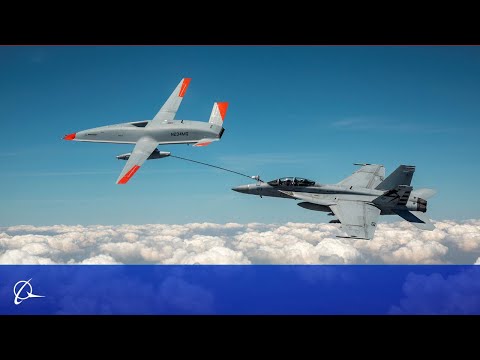
Boeing MQ-25 Becomes First Unmanned Aircraft to Refuel Another Aircraft


Testing MQ-25 Aboard an Aircraft Carrier


The footage released today provides new views of the drone’s exotic top-mounted ‘flush’ air inlet and its engine exhaust inset inside the fuselage, as seen at the top of this story and below. TWZ has drawn particular attention to the inlet in the past, which speaks to the design’s other low observable (stealthy) features, as well as its overall design, despite this not being an explicit focus of the MQ-25 program.

One of the new top-down views of the production representative MQ-25 showing its ‘flush’ inlet. Boeing capture
A view of the drone’s inset exhaust arrangement. Boeing capture

Boeing has previously confirmed to us that the MQ-25’s design was influenced by the company’s submission to the Navy’s abortive Unmanned Carrier Launched Airborne Surveillance and Strike (UCLASS) program. UCLASS envisioned a stealthy carrier-based drone capable of performing kinetic strikes and intelligence, surveillance, and reconnaissance (ISR) missions. Despite significant work toward fielding that capability, including ground-breaking flight testing using a pair of X-47B drones built by Northrop Grumman, the Navy subsequently abandoned the UCLASS plans in favor of an uncrewed tanker. That decision, in turn, led to the MQ-25.

The video also offers a new look at the production representative Stingray configuration’s retractable sensor turret under the nose. Turrets like these typically contain a mixture of electro-optical and infrared cameras, and sometimes also have laser range finders, laser spot markers, and laser designators. In addition to its primary role as a pilotless aerial refueling platform, the Navy says the MQ-25 will have a secondary ISR function. The Stingray’s overall design opens up the possibility that it could take on other missions, including kinetic strike, in the future, as TWZ has previously explored in detail.

A look at the retracted sensor turret on the production-representative MQ-25. A buddy refueling store, which is how the drone will perform its primary tanking mission, is also seen here under the drone’s left wing. Boeing capture

Boeing has otherwise been working in recent years to deliver nine pre-production Stingrays, five of which will be used for fatigue and other static testing work. The Navy plans to eventually acquire a total of 76 Stingrays, and has been most recently targeting 2027 for reaching initial operational capability (IOC) with the type.

#MQ25 on the move!

The first @USNavy MQ-25 Stingray recently moved off the production line to our static test facility. This is the first of nine Stingrays to be put through static, fatigue and flight tests to ensure durability and airworthiness. pic.twitter.com/2UvYoKnK7G

— Boeing Defense (@BoeingDefense) September 14, 2023

The MQ-25 program has been beset by delays and cost growth in recent years. The original goal had been for the initial batch of pre-production Stingrays to be delivered in 2022 and for the type to reach IOC in 2024. Last year, the Navy repeatedly stressed that it was working hard to finally get to first flight before 2026.

“We will fly MQ-25 in ‘25. You can quote me on that,” Vice Adm. Daniel Cheever, Commander of Naval Air Forces, said in January 2025. “We will fly that platform in ‘25 and get that thing on a carrier in ‘26 and start integrating that thing.”

“There’s a lot of confidence in MQ-25 and [20]25. There is a ton of work to get MQ-25 and ’25,” now-retired Navy Vice Adm. Carl Chebi, then head of Naval Air Systems Command (NAVAIR), had also said last April. “70% of the capability that we deliver, [that] industry delivers to us, is late. So we’re pushing hard.”

Needless to say, the first flight schedule subsequently slipped into 2026.

These hurdles aside, Navy officials continue to be outspoken in their support of the MQ-25 program, which they see as offering critical range extension for current and future aircraft embarked on the service’s carriers. The Navy also wants the Stingrays so it can stop flying crewed F/A-18F Super Hornets in the tanker role, which makes up a significant number of their sorties while deployed, helping free up those aircraft for other missions and reducing the wear and tear on those airframes.

An F/A-18F seen carrying a buddy refueling store and underwing drop tanks for tanker duty. USN

The Navy also regularly talks about the MQ-25 being a “pathfinder” for other future carrier-based uncrewed aviation capabilities. As far back as 2021, the service has been talking about a goal to eventually see 60 percent or more of the aircraft in carrier air wings become uncrewed.

Last year, the Navy announced a new surge in efforts to acquire a fleet of carrier-based Collaborative Combat Aircraft (CCA) drones, hiring four companies (Anduril, Boeing, General Atomics, and Northrop Grumman) to develop conceptual designs. Lockheed Martin is also now under contract to the Navy to develop an underlying common control architecture. NAVAIR has now also established a CCA-focused Future Advanced Capability (FAC) program office. The Navy previously entered into a formal agreement with the U.S. Air Force and the U.S. Marine Corps to work together on CCA developments to ensure interoperability, including the ability to seamlessly exchange control of drones during future operations.

In the meantime, beyond just getting the MQ-25 flying, the Navy still has much work to do in integrating the Stingray into routine operations. As noted, critical command and control architectures, along with related tactics, techniques, and procedures, are still being developed.

The Stingrays will also have to be woven into the existing cadence of flight deck operations, including just figuring out how to move them around amid the hustle and bustle of other activity. Carrier decks are very constrained environments physically, and present very different conditions to operate in compared to bases on land. This is true even for crewed aircraft operations, where individuals onboard can provide additional situational awareness. A wearable glove-like system that personnel could use for deck handling was notably used during testing of the X-47B. A different kind of portable control device has been used in testing of the T1 MQ-25 demonstrator in the past, as well. The video released today does not appear to offer any major new insights into how the Navy plans to maneuver the Stingray around on carrier decks.

The glove-like system used during testing of the X-47Bs. USN
A look at a deck control device that has been used in previous testing involving the T1 MQ-25 demonstrator. USN

The Navy has also been developing new force structures and training pipelines to support the MQ-25 program.

With the start of taxi-testing, the MQ-25 is at least now one step closer to its first flight.

Update: 3:12 PM EST —

Boeing and the Navy have now confirmed to TWZ that the first taxi test occurred yesterday.

“The first U.S. Navy MQ-25A Stingray is in the final stages of ground testing and completed its first taxi test yesterday,” a company spokesperson told us in a statement. “Boeing and the Navy will now conduct additional taxi tests and then complete deliberate systems level testing and review and approve the final airworthiness artifacts needed for a flight clearance. Once that’s complete and we have a suitable weather window, the aircraft will fly.”

“The [MQ-25] aircraft is now in the final stages of ground testing and successfully completed its first low-speed taxi test [on] January 29,” Navy Rear Adm. Tony Rossi, Program Executive Officer for Unmanned Aviation and Strike Weapons (PEO U&W), also told TWZ in a statement. “The team is finalizing systems testing and flight clearance, with the first flight planned once certification is complete and weather permits.”

“The MQ-25A Navy–Boeing team continues to make progress toward first flight,” Rossi added. “Over the last several months, the team has completed MQ-25A Stingray structural testing on a static aircraft, conducted initial engine runs, completed its flight-certified software, and commanded the vehicle from the Unmanned Carrier Aviation Mission Control System (UMCS).”

Contact the author: joe@twz.com

Joseph has been a member of The War Zone team since early 2017. Prior to that, he was an Associate Editor at War Is Boring, and his byline has appeared in other publications, including Small Arms Review, Small Arms Defense Journal, Reuters, We Are the Mighty, and Task & Purpose.


Source link

NHTSA probes California Waymo taxi incident that injured a child

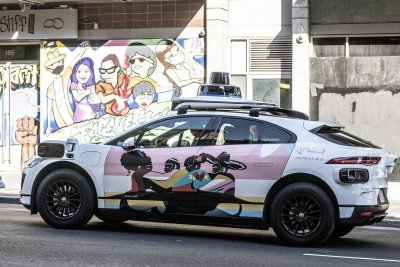
Jan. 29 (UPI) — The National Highway Transportation and Safety Administration is investigating an incident in which an autonomous Waymo taxi struck and injured a child last week in Santa Monica, Calif.

The child was injured Friday after they ran into the street and was struck by an autonomous Waymo taxi about two blocks from an elementary school during its morning drop-off hours, the NHTSA’s Office of Defects said.

“The child ran across the street from behind a double-parked SUV towards the school and was struck by the Waymo AV,” NHTSA officials said in a document on the matter.

The child stood up after being struck and walked to the sidewalk as Waymo officials contacted local authorities to report the incident. The extent of the child’s injuries was not reported.

The autonomous vehicle remained in the spot where the incident occurred and stayed there until police cleared it to leave.

The agency said its Defects Investigation unit will determine if the driverless Waymo taxi “exercised appropriate caution given, among other things, its proximity to the elementary school during drop-off hours and the presence of young pedestrians and other potential vulnerable road users.”

Waymo officials said Wednesday they were committed to improving road safety for passengers and everyone who shares the road. Transparency regarding crashes and other incidents is a component of that commitment to safety, they said.

“Following the event, we voluntarily contacted the National Highway Traffic Safety Administration (NHTSA) that same day. NHTSA has indicated to us that they intend to open an investigation into this incident, and we will cooperate fully with them throughout the process.”

Waymo officials said the unidentified child “suddenly entered the roadway from behind a tall SUV, moving directly into our vehicle’s path.”.

“Our technology immediately detected the individual as soon as they began to emerge from behind the stopped vehicle,” Waymo officials said.

“The Waymo driver braked hard, reducing speed from approximately 17 mph to under 6 mph before contact was made.”

While the autonomous taxi struck the child, Waymo officials said a similar vehicle driven by a human likely would have struck the child at about 14 mph instead of less than 6 mph.

“This event demonstrates the critical value of our safety systems,” Waymo said. “We remain committed to improving road safety where we operate as we continue on our mission to be the world’s most trusted driver.”

Friday’s incident was the second for Waymo during the past week in California.

Another of its vehicles on Sunday struck several parked vehicles while traveling on a one-way street near Dodger Stadium in Los Angeles.

That vehicle was being operated in manual mode by a driver when the crash occurred, and no injuries were reported.

Tech firm Alphabet owns Waymo, as well as Google and other subsidiary companies.

Source link