‘AI helped pick the first thousand targets in Iran’
Source link
‘AI helped pick the first thousand targets in Iran’
Source link

Speaker of the Parliament of Iran Mohammad Bagher Ghalibaf speaks during a news conference in Beirut, Lebanon, on October 12, 2024. File Photo by Wael Hamzeh/EPA
March 29 (UPI) — Iran’s parliament speaker, Mohammad Bagher Ghalibaf, issued a warning Saturday against a possible ground troop invasion as the U.S. military sends more troops to the region.
Ghalibaf made the comments in a message marking 30 days since the start of the war. The United States and Israel began strikes on Iran on Feb. 28 in their efforts to diminish the country’s nuclear weapons program.
Ghalibaf accused the United States of secretly planning a ground invasion of Iran. On Saturday, two U.S. ships arrived in the region carrying 3,500 U.S. service members as well as fighter jets, transport aircraft, amphibious assault vessels and other tactical assets. More troops were expected, U.S. Central Command said.
“The enemy publicly sends messages of negotiation while secretly planning a ground invasion — unaware that our men are waiting for American troops to enter on the ground, ready to unleash devastation upon them and punish their regional allies,” Ghalibaf said, as reported by CNN.
Last week, the Trump administration proposed a 15-point peace plan with Iran. President Donald Trump also ordered a 10-day halt on strikes against Iranian energy sites, though Israel carried out its own attacks on energy sites Friday.
Secretary of State Marco Rubio said Friday that Iran had not responded to the peace proposal.
“The United States speaks of its aspirations, presenting what it failed to achieve in war as a 15-point list to pursue through diplomacy,” Ghalibaf said.
“As long as the Americans seek Iran’s surrender, the answer of your sons remains clear: ‘Far be it from us to accept humiliation.'”
Ghalibaf’s message came in the wake of a Saturday report by The Washington Post that the Defense Department has drawn up plans for a weeks-long ground operation in Iran. Officials told The Post the plan isn’t considered a full-scale ground invasion, but would involve Special Operations forces and infantry troops.
White House press secretary Karoline Leavitt issued a statement in response to the possibility of ground troops in Iran.
“It’s the job of the Pentagon to make preparations in order to give the commander in chief maximum optionality,” she said. “It does not mean the president has made a decision.”
Iran has launched attacks on Israeli and other U.S. allies in the Persian Gulf region, including one Sunday on a military camp in Kuwait, which killed 10 Kuwaiti service members. The army said it detected 14 ballistic missiles and 12 hostile drones in Kuwaiti airspace over the previous 24 hours. Since the start of the war, it has monitored more than 300 ballistic missiles, 2 cruise missiles and more than 600 hostile drones.
Meanwhile, Israeli officials said emergency officials were working on a large fire that broke out at a hazardous materials factory at the Neot Hovav industrial complex, The Guardian reported. The Israeli military blamed “a weapon fragment or interceptor fragment” for the damage and fire.
For years, Beirut’s southern suburb has been spoken about as though it were a world apart: A Hezbollah bastion, a target, a warning, or a battlefield. But in Arabic, the word “dahiyeh” simply means “the suburb”.
The word itself is ordinary. What makes it extraordinary in Lebanon is its history.
list of 4 itemsend of list
When the Lebanese speak of Dahiyeh, they do not mean any suburb of their capital city. They mean southern Beirut in particular – a dense belt of neighbourhoods that grew from villages, fields, informal housing and municipal edges into a major extension of the city.
Dahiyeh – in size nearly as big as municipal Beirut – has been shaped by migration and displacement in the past 50 years. While many moved there in search of work or housing, most of the others were pushed there by wars, political unrest, evictions and a general sense of being neglected by the Lebanese state.

The social geography of Lebanon, which gained independence from French colonisers in 1943, began to be transformed in 1948 when Israel’s establishment saw the expulsion of more than 700,000 Palestinians from their land in what is commonly referred to as the Nakba. After Israel’s further occupation of Palestinian lands in 1967 and the expulsion of Palestinian fighters from Jordan in 1970, southern Lebanon and parts of Beirut became increasingly bound up with the Palestinian national movement.
Dahiyeh’s growth, however, accelerated after 1975, when the Lebanese civil war broke out. People displaced from other parts of Beirut moved south. The subsequent Israeli attacks and invasions in 1978 and 1982 drove more people to the edge of the capital. In that sense, Dahiyeh was not just a destination for “migrants”. It was also a refuge for the uprooted, the poor, and those repeatedly forced to start over.
Studies by scholars such as Mona Harb, professor of urban studies and politics at the American University of Beirut (AUB), show how a common noun – Dahiyeh – gradually evolved into a distinct political space: A stigmatised periphery marked in the Lebanese imagination as Beirut’s “belt of misery” that hardened into a territory with its own social and political significance. Today, it is part of Greater Beirut, woven into the capital geographically, economically and socially, even if the country’s politics may have treated the area as an outlier.
Harb’s work explicitly frames the southern suburb as a politically produced urban territory rather than just a space outside Beirut. To understand how that happened, one has to begin with the making of modern Lebanon.
Under the French Mandate, and later through the political order consolidated at independence in 1943, power in Lebanon was distributed through a sectarian system that heavily favoured the established elites, especially the Maronite Christians, who dominated the presidency and other key positions. The system not only created inequality, but also formalised and reproduced it.
Rural Lebanon, especially the south and the Bekaa Valley, remained underdeveloped and politically neglected for decades. Among those most affected were Lebanon’s Shia community, who were disproportionately concentrated in the poorer agricultural regions and had less access to state investments, infrastructure and patronage than the more privileged urban and mountainous centres. Scholars say it was not simply a temporary developmental gap, but a long history of marginalisation that defined the country’s politics.

Israeli attacks on Palestinian positions inside Lebanon repeatedly hit the surrounding Lebanese communities as well, mainly in the south. For the Shia in southern Lebanon, these attacks sharpened a bitter awareness: They were living on the front lines of a bitter regional conflict, while they were also being denied equal economic rights and meaningful political inclusion in Lebanon itself.
Out of that reality emerged a new form of Shia political mobilisation centred not only on identity, but also on deprivation, dignity and state neglect. That mobilisation found its earliest expression in Harakat al-Mahroumin, the Movement of the Deprived, founded by Imam Musa al-Sadr in the 1970s. Al-Sadr became a towering figure of modern Lebanese Shia politics because he gave social, religious and political forms to grievances building up for decades. That movement later grew an armed wing: Amal.
Al-Sadr’s mysterious disappearance during a 1978 trip to Libya remains unresolved and politically contested to this day. What is not contested is his historical importance. He helped turn the Shia of Lebanon from a neglected rural underclass into an organised political constituency demanding equal rights, representation, and a defining national presence.
The 1982 Israeli invasion of Lebanon changed the Shia political landscape yet again. Israel’s siege of Beirut, the departure of Palestinian icon Yasser Arafat and his Palestine Liberation Organization forces, and Syria’s desire to dominate Lebanon all intensified divisions within Lebanese society.
Amal, which meanwhile had grown closer to Damascus to get weapons, money and political backing, remained a major force. But new Islamist movements emerged from within and around it, shaped by the Israeli occupation, disillusionment with older leaderships, and increasing support from Iran’s Islamic Revolutionary Guard Corps, especially in the Bekaa region.
Over time, these currents crystallised into Hezbollah. The split within the Shia movement was less theological and more about political strategy, defined by questions over aligning more closely with Syria, solidarity with the Palestinians, and general resistance against the Israeli occupation. Differences between Amal and Hezbollah over these questions turned violent in the 1980s, an intra-Shia fighting that Lebanese often recall as “a war among brothers”.
As Hezbollah grew stronger, Dahiyeh became much more than a residential belt. It turned into an urban heartland of a social and political force. Hezbollah built institutions there: Offices, schools, clinics, welfare networks and media infrastructure. Amal also had a presence, but the common shorthand that reduces Dahiyeh to a “Hezbollah stronghold” always conceals more than it reveals.
Today, Dahiyeh hosts a Shia majority, but also has a small minority of Palestinians and other Lebanese communities, including Christians. It bleeds physically into what is known as Greater Beirut, including its Christian and mixed areas. So when the suburb is bombed, it is not some isolated military island that is hit, but a deeply inhabited part of urban Beirut.
That is precisely why Dahiyeh is so central to the Israeli military’s thinking. During the 2006 war, large sections of the southern suburb, especially Haret Hreik, were devastated by Israel. The destruction became so emblematic that Israeli military strategists came up with what came to be known as the Dahiyeh Doctrine: Use of overwhelming force and large-scale destruction of areas associated with an armed group, with the aim of generating deterrence and putting pressure on residents supporting the group. Rights activists and legal scholars say the doctrine violates international humanitarian law, as civilian neighbourhoods and infrastructure do not become legitimate targets simply because an armed group is embedded among the population.
That Israeli pattern, however, has intensified since October 2023, when a genocidal war on Gaza and attacks on Lebanon began. Meanwhile, the killing of Hezbollah leader Hassan Nasrallah in an Israeli strike in late 2024 eroded Dahiyeh’s resistance. That erosion is more visible in the ongoing Israeli attacks on Beirut and southern Lebanon, where more than a million people have registered as displaced since March 2. The old formula – that Dahiyeh was the principal red line and that any strikes there could be deterred by Hezbollah’s threats of retaliatory strikes on several Israeli cities – no longer holds.
Once again, Dahiyeh has become a focal point of the war, with repeated bombardment sending plumes of smoke over a place that many outsiders still describe as a world apart, but which is in fact woven into Beirut’s daily life. Built over decades by the poor, the migrants and the repeatedly uprooted – and shaped by the politics of marginalisation against those whom al‑Sadr once named “the deprived” – Dahiyeh has long served as both a refuge and a front line. Today, it is again being made to carry the costs of a conflict larger than itself.
A relative tells BBC those killed were civilians and not Hezbollah operatives, but the Israel Defence Forces says it was targeting “terrorist infrastructure”.
Source link
March 14 (UPI) — President Donald Trump announced that U.S. forces “totally obliterated” every military target on Iran’s Kharg Island, a key port that exports the vast majority of Iran’s oil.
In a post on Truth Social on Friday evening, Trump described the attack as “one of the most powerful bombing raids in the History of the Middle East.”
He said he directed U.S. Central Command to carry out the bombings after Iran halted ships’ passage through the Straight of Hormuz. About 20% of the world’s crude oil passes through the strait.
“For reasons of decency, I have chosen NOT to wipe out the Oil Infrastructure on the island,” Trump wrote.
“However, should Iran, or anyone else, do anything to interfere with the Free and Safe Passage of Ships through the Strait of Hormuz, I will immediately reconsider this decision.”
Kharg Island is about 15 miles south of the Iranian mainland through which about 90% of the country’s oil exports pass, The Washington Post reported. It’s a critical piece of Iran’s economy and a full attack on the oil infrastructure there could hinder Iran’s ability to pay its military.
Iranian officials said the site was “proceeding normally” after the U.S. attack.
In response to Friday’s bombings on Kharg Island, Iran threatened its own attack on key oil infrastructure in the United Arab Emirates, CNN reported.
Oil has been a key factor in the war in Iran, which began Feb. 28 with surprise U.S. and Israeli airstrikes on dozens of Iranian sites. AAA reported Saturday that the average price of a gallon of gasoline was $3.68 in the United States, up 23% since the start of the war.
This could, in turn, have a dramatic impact on other aspects of the U.S. economy, including food prices, jet fuel and fertilizer.

Attacks on multiple commercial ships in the waters around Iran on Wednesday increased global energy concerns, pushed nations to unleash strategic oil reserves and sparked fresh critiques of the Trump administration’s readiness for a war it started.
As Trump administration and U.S. military officials continued to claim increasing success and advantage in the conflict — and authorities downplayed a reported threat of drone attacks on California — leaders around the world scrambled to respond to the latest attacks and the International Energy Agency’s call for the largest ever release of strategic oil reserves by its members to help stem energy price spikes.
President Trump also faced renewed questions about a deadly strike on an Iranian elementary school at the start of the war, after the New York Times reported Wednesday that a military investigation had determined the U.S. was responsible.
“I don’t know about it,” Trump said when asked about the report.
In an address Wednesday morning, IEA Executive Director Fatih Birol said energy shipments through the Strait of Hormuz had “all but stopped” amid the conflict, driving massive global competition for oil and gas in wealthier countries and fuel rationing in poorer nations.
He said the IEA’s 32 member nations have brought a “sense of urgency and solidarity” to recent discussions on the matter, and had unanimously agreed to “launch the largest ever release of emergency oil stocks in our agency’s history,” making 400 million barrels of oil available.
However, he said the most needed change is the “resumption of traffic through the Strait of Hormuz.”
A vendor pumps petrol from Iranian fuel oil tankers for resale near the Bashmakh border crossing between Iraq and Iran.
(Ozan Kose / AFP/Getty Images)
Several countries, including Germany, Austria and Japan, had already confirmed their plans to release reserves.
The White House did not immediately respond to a request for comment on any U.S. plans to release its strategic reserves, or how much would be released. The U.S. is an IEA member.
Trump told reporters Wednesday that the U.S. has hit Iran “harder than virtually any country in history has been hit,” including by wiping out its naval fleet and eliminating other vessels capable of laying mines, and that he believes oil companies should resume shipments through the strait despite the recent attacks.
U.S. Interior Secretary Doug Burgum backed the idea of releasing oil reserves in a Fox News interview.
“Certainly these are the kinds of moments that these reserves are used for, because what we have here is not a shortage of energy in the world; we’ve got a transit problem, which is temporary,” Burgum said. “When you have a temporary transit problem that we’re resolving militarily and diplomatically — which we can resolve and will resolve — this is the perfect time to think about releasing some of those, to take some pressure off of the global price.”
Burgum said that while Iran is “holding the entire world hostage economically by threatening to close the strait,” Trump has made the consequences of such actions “very clear,” and “there’s a lot of options between ourselves and our allies in the region, including our Arab friends in the region, to make sure that those straits keep open and that energy keeps flowing for the global economy.”
The IEA did not provide details as to the release of the 400 million barrels, part of a broader reserve of some 1.2 billion barrels held by its members. It said the reserves “will be made available to the market over a time frame that is appropriate to the national circumstances of each Member country and will be supplemented by additional emergency measures by some countries.”
The agency said an average of 20 million barrels of crude oil and oil products transited the strait per day in 2025, and that options for bypassing the strait are “limited.”
While some tankers believed linked to Iran were still getting through the Strait of Hormuz, which under normal circumstances carries about 20% of the world’s oil and natural gas, Iranian officials threatened attacks on other vessels — saying they would not allow “even a single liter of oil” tied to the U.S., Israel or their allies through the channel, which connects to the Persian Gulf.
Trump has repeatedly claimed that the U.S. and its powerful Navy would support commercial vessels and ensure the strait remains open to oil shipments, but that has not been the case.
Tankers wait off the Mediterranean coast of southern France on Wednesday.
(Thibaud Moritz / AFP/Getty Images)
The United Kingdom Maritime Trade Operations center, run by the British military, reported at least three ships struck in the region Wednesday — including ships off the United Arab Emirates and a cargo ship that was struck by a projectile in the strait just north of Oman, setting it ablaze.
The Trump administration and the U.S. military, meanwhile, have been pushing out messaging about wiping out Iran’s ability to plant mines in the strait — posting dramatic videos of major strikes on tiny boats on small docks.
Adm. Brad Cooper, the leader of U.S. Central Command, said in a video posted to X on Wednesday morning that “in short, U.S. forces continue delivering devastating combat power against the Iranian regime.”
“I’ve said this before, but it bears repeating: U.S. combat power is building, Iranian combat power is declining,” he said.
The U.S. has struck more than 60 Iranian ships, and just “took out the last of four Soleimani-class warships,” he said. “That’s an entire class of Iranian ships now out of the fight.”
Cooper said Iranian ballistic missile and drone attacks have “dropped drastically” since the start of the war, though “it’s worth pointing out that Iranian forces continue to target innocent civilians in gulf countries, while hiding behind their own people as they launch attacks from highly populated cities in Iran.”
He also addressed the attacks on commercial shipping in the region directly, saying that “for years, the Iranian regime has threatened commercial shipping and U.S. forces in international waters,” and that the U.S. military’s “mission is to end their ability to project power and harass shipping in the Strait of Hormuz.”
Other U.S. leaders called the U.S. war plan — and specifically its approach to protecting the Strait of Hormuz — into question.
In a series of posts to X late Tuesday, which he said followed a two-hour classified briefing on the war, Sen. Chris Murphy (D-Conn.) slammed the administration’s plans as “incoherent and incomplete.”
Murphy wrote that the administration’s goals for the war seemed to be focused primarily on “destroying lots of missiles and boats and drone factories,” and without a clear plan for what to do when Iran — still led by “a hardline regime” — begins rebuilding that infrastructure, other than to continue bombing them. “Which is, of course, endless war,” he wrote.
Murphy also specifically criticized the administration’s plan for the Strait of Hormuz — which he said simply doesn’t exist.
“And on the Strait of Hormuz, they had NO PLAN,” he wrote. “I can’t go into more detail about how Iran gums up the Strait, but suffice it [to] say, right now, they don’t know how to get it safely back open. Which is unforgiveable, because this part of the disaster was 100% foreseeable.”
Ships in the strait remained under threat of various forms of attack Wednesday, as did much of the region as the war raged on.
There was an attack on a U.S. Embassy operations center at Baghdad’s airport, which officials attributed to a drone launched by Iranian proxies based in Iraq. No casualties were reported.
Lebanon’s Health Ministry reported the death toll there — from fighting between Israel and Iranian-backed Hezbollah fighters — had risen to 634 since last week, including 91 children. Another 1,500 people had been wounded, the ministry said.
Iranian authorities have said U.S. and Israeli attacks have killed 1,255 people since Feb. 28. That includes many Iranian leaders, including then-Supreme Leader Ayatollah Ali Khamenei. U.S. officials have said Iranian attacks in the region have killed seven U.S. service members, with another 140 wounded.
CBS News reported Wednesday that dozens of those injuries were sustained by service members in the March 1 Iranian drone attack on a tactical operations center in Kuwait — which is also where six of the seven deaths occurred.
The outlet reported that the attack was more severe than the Trump administration has revealed, with more than 30 military members still in hospitals Tuesday with a range of battle injuries including “brain trauma, shrapnel wounds and burns.”
Threats extended beyond the Middle East, too — including to California, where law enforcement agencies were warned by federal authorities that Iran “allegedly aspired to conduct a surprise attack” on California using drones launched from a vessel off the U.S. coast.
However, sources told The Times that advisory was cautionary and not backed by credible intelligence.
Times staff writer Gavin J. Quinton, in Washington, D.C., contributed to this report.
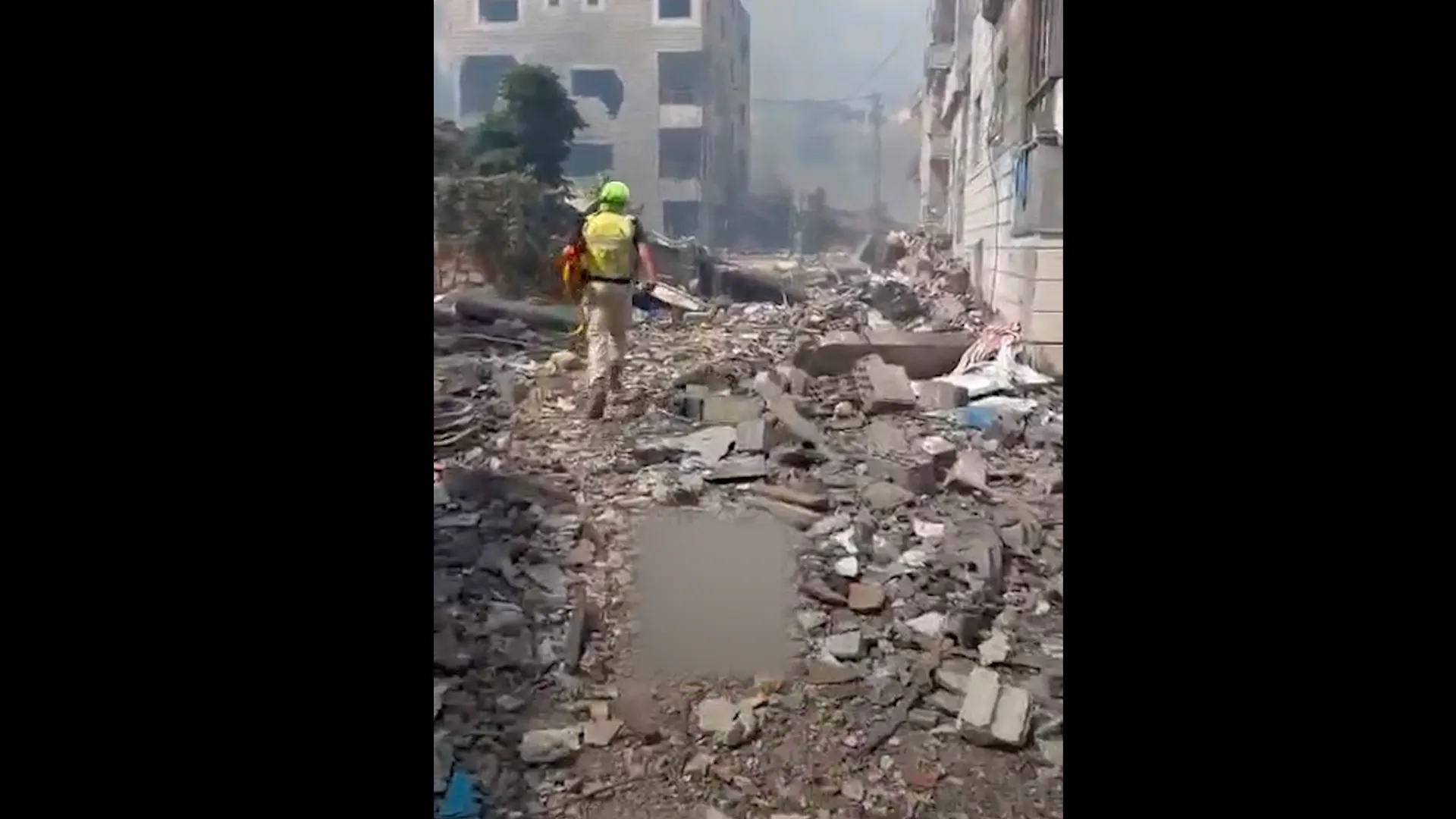
An Israeli air strike has heavily damaged a building in southern Lebanon’s Tyre district.
An Israeli air strike has heavily damaged a building in southern Lebanon’s Tyre district as Israeli forces continue to attack across the area. The army says it is targeting Hezbollah military infrastructure and has warned residents south of the Litani river to leave.
Published On 10 Mar 202610 Mar 2026
Share
WASHINGTON — The Defense Department last week outlined a concise set of military objectives in President Trump’s war against Iran, claiming its ultimate goal is to dismantle Tehran’s ability to project power beyond its borders. Yet it may be targets the Pentagon has largely left unacknowledged that offer the clearest insight yet into Trump’s true intentions.
U.S. military strikes have focused on Iran’s ballistic missile, drone and nuclear programs, as well as its naval assets, according to U.S. Central Command. But strikes have also increasingly targeted Iran’s internal security forces, used by the Islamic Republic to suppress public dissent, according to an analysis from the Institute for the Study of War and the Critical Threats Project shared with The Times.
The strikes have targeted at least 123 headquarters, barracks and local bases operated by Iran’s paramilitary organizations, including the Islamic Revolutionary Guard Corps and its Basij militia. Regional police forces, primarily in the capital region around Tehran and in western Iran, near areas dominated by Kurdish groups hostile to the Iranian government, have also been targeted.
Some of those groups are being armed and supported by the U.S. intelligence community, a U.S. official said, speaking on the condition of anonymity to speak candidly.
Nicholas Carl, with the Critical Threats Project, said the pattern indicates the campaign is already underway to set the conditions for a revolution.
“As we are going after these repressive institutions, we are degrading the ability of the regime to monitor its population, to repress its population,” Carl said. “And so it looks as though the strike campaign may be organized around trying to erode the ability of the regime to repress in those areas.”
Analysts said that strikes against internal forces could be greater than they have measured thus far, noting the difficulty of tracking targets in the war based on publicly available data due to an internet blackout strictly enforced by the Iranian government.
An explosion erupts after strikes near Azadi Tower close to Mehrabad International Airport in Tehran on Saturday.
(Atta Kenare / AFP / Getty Images)
The quieter side of the U.S. campaign suggests a political strategy by the Trump administration that goes beyond simply containing the Iranian government, and may instead aim to lay the groundwork for its overthrow.
Trump and his top aides have been inconsistent in their messaging on their goals for the war, vacillating between calls for regime change and far shorter ambitions, such as an Islamic Republic that remains in power under leadership more acquiescent to the United States.
Before the war began, Trump was presented with an intelligence assessment that large-scale military action was unlikely to topple the Iranian government, two sources familiar with the assessment said. The assessment led analysts at the CIA, the State Department and the Pentagon all to advise the White House against proceeding with the operation. The intelligence analysis was first reported by the Washington Post.
Share via
Greasing the wheels for domestic unrest, for insurgency or revolution could serve other strategic purposes for the Trump administration beyond effecting regime change, adding new sources of pressure on an Islamic Republic that, if still intact by war’s end, would face renewed internal pressures at a moment of historic weakness.
Rob Malley, lead negotiator on the 2015 Iran nuclear deal and special U.S. envoy for Iran under President Biden, said that a sustained U.S. campaign that cripples Iran’s ability to maintain domestic control could mean “the regime collapses, in the sense that it can no longer, genuinely and effectively, govern the entirety of the country.”
“Right now, what Trump is saying suggests an extremely ambitious, extremely long-term, extremely perilous campaign that will only end with Iran’s surrender, and it’s very hard to see Iran surrendering,” Malley said. But the campaign may already be working. “Their communications have certainly been penetrated — they cannot meet without being targeted by Israel or the United States,” he added.
A woman holds a portrait of the late Ayatollah Ali Khamenei at a protest Saturday by medical professionals outside Gandhi Hospital in Tehran, which was damaged in an airstrike earlier this week.
(Majid Saeedi / Getty Images)
“Either the regime stays in place weakened, bloodied, finding it harder to govern a more fragmented, chaotic country,” Malley continued, “or the regime no longer can govern.”
An Israeli official did not deny that internal security forces were being targeted, although the official said that Israel was focused on assassinating Iran’s political and security leadership — “tiers one, two and three,” the official said. The vast majority of the strikes against internal security services thus far have been conducted by the United States.
“Our goal is to weaken the ayatollah regime, to a point where the Iranian people can choose their fate,” the official told The Times. “It’s still not at the point where they can do that, but there is work still to be done.”
By all accounts, the campaign against Iran’s military assets has achieved success. Iranian ballistic missile attacks against Israel and U.S. forces and allies in the region have decreased by 90% after just a week of combat, Defense officials said. Drone strikes have decreased by 83%. Over 30 Iranian vessels, including those used as launching pads for drones and aircraft, have been destroyed — a significant number for Iran’s aged and ill-funded naval fleet.
Trump could simply declare victory based on these results alone, said Elliott Abrams, who served as Trump’s special representative for Iran in 2020.
“They will get weaker as they use up resources and we bomb more and more relevant sites. Already air traffic is starting up again,” Abrams said, noting that commercial flights in the region began resuming this weekend. “So I doubt that the president will need a protracted campaign.”
But that would leave the regime in place, leaving open the possibility of a revanchist Islamic Republic that could reconstitute its military and crack down further on democratic protesters — an outcome that could create political backlash for Trump, Abrams said, after losing U.S. service members in combat.
A woman jogs amid closed shops in south Tel Aviv on Saturday.
(Olympia de Maismont / AFP / Getty Images)
“The outcome remains entirely in doubt — regime collapse after a wave of protests, civil war, a deal that leaves the regime in place behind a new face,” Abrams added. “A real test for Trump would arise if there is a wave of protests as in January, and the regime again starts shooting. Can he do nothing? Unlikely.”
In his initial speech announcing the start of the campaign, Trump addressed the people of Iran, telling them to shelter in their homes until the U.S. bombing campaign concludes.
“When we are finished, take over your government. It will be yours to take. This will be probably your only chance for generations,” the president said. “For many years, you have asked for America’s help. But you never got it. No president was willing to do what I am willing to do tonight. Now you have a president who is giving you what you want. So let’s see how you respond.”
But the president’s message grew muddled over the course of the last week, after he offered conflicting goals in a series of interviews with reporters.
He at once said he was expecting to hand-select the next ayatollah, after assassinating Iran’s longtime supreme leader, Ali Khamenei, in the opening salvo of the war. In other interviews, he said that the joint U.S.-Israeli campaign had killed many of the potential leaders that Washington could have worked with.
On Friday, Trump called for Iran’s “unconditional surrender.” He did not specify whether he was referring to a surrender of Iran’s nuclear program, its ballistic missile program, or on control over the country itself, and in a subsequent interview, said it could simply mean “when Iran no longer has the ability to fight.”
Over the last week, Kurdish leaders have shared accounts of Trump and his top aides reaching out to them and encouraging their involvement in the war, including a ground incursion in western Iran from Iraqi Kurdistan. But the president seems to have placed that effort on hold for the time being. “The war is complicated enough without having — getting the Kurds involved,” he told reporters Saturday aboard Air Force One.
At Central Command headquarters on Thursday, Defense Secretary Pete Hegseth told reporters that Trump maintains his promise to the Iranian people at the outset of the war, that a time will come for an uprising.
Defense Secretary Pete Hegseth addresses the audience as President Trump listens during “The Shield of the Americas Summit“ on Saturday, a gathering with heads of state and government officials from 12 countries in the Americas at the Trump National Doral Golf Club in Doral, Fla.
(Roberto Schmidt / Getty Images)
“No one’s done more than President Trump to reopen the opportunity for those who want a free Iran to do so,” Hegseth said. “Ultimately, it’s common sense, as he said up front, don’t go out and protest while bombs are dropping inside Tehran and elsewhere. There will come a moment where he determines, or they determine, that it’s time to seize that advantage.”
Suzanne Maloney, vice president and director of the foreign policy program at the Brookings Institution and an expert on Iran, said she expects the government to survive the U.S. assault, “still easily able to outgun and outmaneuver any challenges from the streets.”
But a concerted, prolonged campaign could change that assessment.
“Of course, months of full-scale war certainly could also break the system,” Maloney said, adding: “I don’t think the short-term result would be a stable transition to a more liberal system — but rather a collapse of the state itself, and at least for some period of time, a dangerous vacuum of power and order in the heart of the Middle East.”
Explosions shake Tehran as US-Israel attacks intensify, marking eight days of conflict and retaliation from Iran.
Huge explosions have hit several locations across Iran, including the capital, Tehran, as the war that has ignited the Middle East entered its eighth day.
The United States-Israeli attacks sent up clouds of dark smoke in the Iranian capital early on Saturday, and Tehran retaliated by firing missiles at Israel.
list of 4 itemsend of list
The US has warned of a forthcoming bombing campaign that officials said would be the most intense yet in the weeklong conflict, which has already killed at least 1,230 people and is set to cause further casualties daily.
Much of the region has become embroiled in the war, with Tehran not only launching retaliatory strikes on Israel but hitting US assets across the Gulf.
Israel’s military said early on Saturday it had started a “broad-scale wave of strikes” on targets in Tehran.
“Iranians are now waking to day eight since the initiation of the US-Israeli air strikes targeting different facilities and places across the Iranian capital and elsewhere in the country,” said Al Jazeera’s Tohid Asadi, reporting from Tehran.
Continuous attacks have been occurring since midnight, he said.
“According to the latest reports, Mehrabad, which is one of the two main airports in the Iranian capital, was targeted. The nearby area was said to be affected, as well,” said Asadi.
Meanwhile, attacks have been taking place in other cities across the country – targeting not just military areas or political centres, but also residential areas, schools and hospitals, he added.
Amir-Saeid Iravani, Iran’s ambassador to the United Nations, told the UN Security Council on Friday that the US and Israel are bombing civilian areas in his country, stating: “These acts constitute clear war crimes and crimes against humanity.”
The continued fighting comes as US President Donald Trump’s administration approved a new $151m arms sale to Israel after Trump said he would not negotiate with Iran without its “unconditional surrender”.
Iran’s UN ambassador said the country would “take all necessary measures” to defend itself.
Meanwhile, Iran has continued to strike back at Israel.
The Israeli military said early on Saturday that it had detected another round of Iranian missile fire headed towards Israel, and a series of explosions were heard in Tel Aviv following the launches from Iran.
Missiles were also detected heading towards other parts of the country, including southern Israel.
“Since midnight, the Israelis have detected at least five ballistic missile launches coming into Israel from Iran,” said Al Jazeera’s Nida Ibrahim, reporting from Ramallah in the occupied West Bank.
“They have led millions of Israelis into shelters throughout the night, which is something that Israeli analysts say the Iranians are intending to do to put more pressure on the Israeli government – by keeping Israelis in shelters and by keeping these missiles launching coming at different times.”
Multiple Gulf nations, Arab states, as well as Turkiye and Azerbaijan have been caught in the crosshairs of the war.
Iran’s semi-official Fars News Agency has reported that overnight attacks on Bahrain’s capital, Manama, targeted the Financial Harbour Towers commercial complex, the location of the Israeli embassy in the city.
The first week of the United States-Israel war on Iran and Tehran’s retaliatory strikes on nations hosting US forces and assets has engulfed the region and beyond into a broader conflict.
list of 3 itemsend of list
The Reuters news agency reported Friday that an Iranian drone was intercepted and destroyed in the vicinity of the complex.
Multiple Gulf nations, Arab states, as well as Turkiye and Azerbaijan have been caught in the crosshairs of the war.
The Saudi Ministry of Defense on Friday said a cruise missile was intercepted and destroyed to the east of the country’s central al-Kharj governorate. The ministry provided no additional information.
The ministry also said later it had intercepted three drones to the east of the Riyadh region.
Additionally, the Qatari Ministry of Defence announced overnight that its air defence forces successfully intercepted a drone attack targeting the Al Udeid Air Base in Doha that hosts US assets.
Earlier, authorities issued an alert warning that the security threat level had been elevated, requiring people to remain indoors and to stay away from windows and other exposed areas.
Several explosions rang out in Doha on Thursday.
European Union leaders expressed support for Arab countries in the Gulf as Iran continues to launch missile and drone attacks on targets across the region, in response to attacks by the US and Israel.
EU foreign policy chief Kaja Kallas and other European leaders held talks with Gulf Cooperation Council (GCC) officials on Thursday in Brussels, denouncing what they described as “Iran’s inexcusable attacks against the GCC countries”.
Elsewhere n Friday, air defences shot down several drones in the Jordanian city of Irb, according to an Al Jazeera correspondent on the ground.
The Iranian military’s strikes come amid speculation that the US wants Iranian Kurdish groups to join its conflict with Iran.
Source link