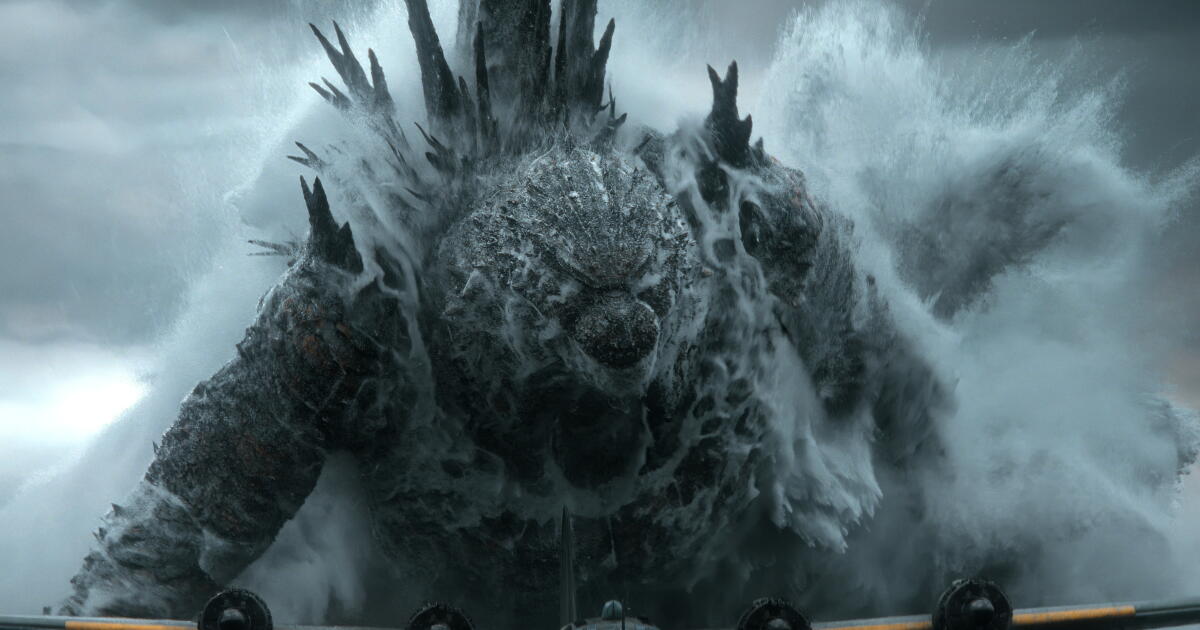
Takashi Yamazaki directs the best monster attacks in the multiplex: “Godzilla Minus Zero,” his follow-up to the 2023 period picture hit “Godzilla Minus One,” opens with a ground-eye view of the decimation of Matsumoto, a midsized mountain town that also happens to be where Yamazaki was born. One local calls its shellacking by winged, dragon-necked Ghidorah a “cruel twist of fate,” moaning that the village was never bombed during World War II. The moralistic film takes no pleasure in destroying Matsumoto; it’s pro-human to a fault. But boy, does the audience shiver with delight watching Ghidorah stomp buildings to rubble while the sound design rattles our seats.
The filmmaker François Truffaut once insisted that it’s impossible to make a truly anti-war film, since its images of combat simply pack too much of a visceral thrill. I’ll add to that: It’s impossible to make an anti-Godzilla film when we’ve all bought tickets to watch the big lizard smash.
Nevertheless, Yamazaki wants to try making a genuinely empathetic disaster movie and he’s earned the right. He’s the rare filmmaker to win his own Oscar for visual effects after Stanley Kubrick did so with “2001: A Space Odyssey.” This decent sequel works very hard to make us feel sad about its mass deaths; the only blood Yamazaki is willing to show is when the injured pack the hospitals. But he’s exponentially better at directing action sequences than he is at emotional ones, and as soon as composer Naoki Satô’s dynamic orchestral score crescendoes up, up, up into Godzilla’s theme music, I couldn’t wait to see the monster explode onto the screen to wreak more havoc.
It’s now 1949 and “Godzilla Minus One’s” core trio is back: reluctant former kamikaze pilot Kōichi Shikishima (Ryunosuke Kamiki) and his family of an orphaned little girl, Akiko (Sae Nagatani), and the woman he’s teamed up with to raise her, Noriko (Minami Hamabe), a prickly urchin who fast pivots to a sweetie pie. Noriko, you may remember, miraculously survived Godzilla’s rampage through Tokyo. This script justifies that lame happy ending with a clever idea about the radiation sickness that results from suffering a blast of the creature’s atomic breath.
The now-married couple are too wan to take up as much of the running time as they do. While they’re meant to be in love, their screen chemistry feels closer to roommates. That would be a bracing statement on their need to cling to their hastily settled home life if Yamazaki was actually making it. Instead, there’s just an awful lot of tears — and young Nagatani is by far the best at sobbing. When the small girl wails, “Something scary is coming again!” the intensity of her terror shatters your heart.
Naval engineer Noda (Hidetaka Yoshioka) also returns with a new promotion to director of the Large-Scale Disaster Response Bureau. There, he welcomes two more scientists: Aoyama (Masami Nagasawa), a plucky meteorologist, and Tanaka (Kanji Murakami), a vengeful biologist who comes with such a compelling backstory that the film would be more interesting if he was the lead. Tanaka also explains his reasoning behind Ghidorah’s name — it’s a Japanese portmanteau of the mythological Greek beasts Hydra and Chimera.
The post-World War II geopolitical landscape is reconstructing itself faster than the Ginza district, which was devastated in the last film and continues to look like a battlefield. The U.S. military has pivoted from fighting against Japan to helping the county fight the kaiju, as long as the Japanese are the ones risking their necks on the front lines. The United States prefers to team with Japan against Russia; Japan, in turn, would rather ally with Godzilla over Ghidorah. However, when the film begins, its characters sincerely think that Godzilla, last seen crumbling to smithereens in the Pacific, is dead. What fun it is to see people realize for the first time that the monster is going to keep coming back.
This is a war film in style and substance, emphasizing the mental exhaustion of a country that cannot handle any more carnage. Kōichi even describes Ghidorah in war terms as “a bomber with guns everywhere and no blind spots” — and that’s before the flying creature sprouts two more heads. One aerial fight is a dazzler with long takes of planes swooping through the clouds accompanied by the teeth-rattling clatter of lightning bolts that crash against your ears like metal trashcan lids. (The muscular cinematography and sound design are, respectively, by Kôzô Shibasaki and Natsuko Inoue.)
Yet a fascinating element of “Godzilla Minus Zero” — as well as director Hideaki Anno’s 2016 “Shin Godzilla” — is how they make a point of featuring saviors who are adamantly dull. The people trying to save the day are never macho or quippy. They wear drab suits and work out of drab offices; the dramatic montages are of people working intently at their desks. When their plans go badly, they take full responsibility. When they succeed, they pause to honor everything sacrificed in the effort, and would find it barbaric if anyone dared to pump their fists.
The focus on shared burdens over individual heroics extends even to the civilians who are forever being told how to stifle their feelings for the common good, whether that’s young Akiko lectured not to hug her adopted daddy in front of other orphans, or, conversely, the parents of a dead child who are asked to cry quieter.
At its core, “Godzilla Minus Zero” drills at the core difference between King Kong and a kaiju: A King Kong movie is about respecting nature while a Godzilla film is about confronting cold and indiscriminate death. Fittingly, the showdown between Godzilla and Ghidorah plays like a ghastly cockfight.
Still, the movie’s tone is so guilt-inducing and grim that when one character insists that there will be time to grieve later, I wanted to blurt out that everyone onscreen has been grieving the whole time. At the risk of sounding monstrous, can we please get back to the smashing?
‘Godzilla Minus Zero’
In Japanese and English, with subtitles
Rated: R, for some violent content/bloody images
Running time: 2 hours, 15 minutes
Playing: Opens Friday, Nov. 6 in wide release