Reporting from Columbus, Ohio — Donald Trump romped to victory Tuesday in Florida, chasing Marco Rubio from the race, but Ohio Gov. John Kasich won his home state, raising hopes for those seeking to stop Trump and settle the presidential contest on the floor of the Republican National Convention.
Trump also won North Carolina and Illinois and was locked in a close fight with Sen. Ted Cruz in Missouri.
“I’m getting ready to rent a covered wagon, we’re going to have a big sail and have the wind blow us to the Rocky Mountains and over the mountains to California,” Kasich said at a jubilant rally outside Cleveland.
That is just the sort of extended nominating fight the GOP establishment sought to avoid by stacking the political calendar with big early contests, capped by Tuesday night’s winner-take-all primaries in Florida and Ohio. California votes on June 7, near the close of the primary season.
Now, many of those same party types see an inconclusive nominating contest as the best and perhaps only chance of thwarting Trump, even if it threatens to shred the GOP in the process.
The setback in Ohio, where Trump campaigned hard, was his most disappointing performance since he finished second to Cruz in February’s Iowa caucuses.
His unhappiness was evident as he addressed reporters at his posh Mar-a-Lago private club in Palm Beach, Fla., and complained about the miseries of running for president.
“Lies, deceit, viciousness. Disgusting reporters. Horrible people,” the Manhattan businessman and reality TV star said. “Some are nice.”
Cruz, speaking with 99% of the Missouri votes counted, once more insisted he was the only candidate who could defeat Trump.
“Starting tomorrow morning, every Republican has a clear choice. Only two campaigns have a plausible path to the nomination — ours and Donald Trump’s,” the Texas senator told supporters in Houston. “Nobody else has any mathematical possibility whatsoever. Only one campaign has beaten Donald Trump over and over again.”
With Trump’s unmatched string of victories, no other candidate is nearly as well positioned to win the nomination ahead of the July convention in Cleveland. He padded his overall delegate lead with Tuesday’s victories, putting him ahead of Cruz and Kasich, who had not won a state before Ohio.
But there were signs Tuesday that not just the establishment but rank-and-file Republicans have yet to rally around the party’s polarizing front-runner.
Nearly 3 in 10 Republican voters across the five states said they would not vote for Trump if he wins the party’s nomination, according to exit poll interviews. Four in 10 said they would consider voting for a third-party candidate if the choice came down to Trump or the Democratic front-runner, Hillary Clinton.
Defections of that magnitude could badly undermine Trump in the general election, and that prospect will probably be stressed by his opponents going forward into next week’s contests in Arizona and Utah.
Rubio spoke to the controversy surrounding the GOP front-runner as he departed the race.
In a Miami concession speech delivered less than half an hour after the polls closed in Florida, the freshman senator congratulated Trump, wagging a finger and shushing members of the audience who booed his kind words.
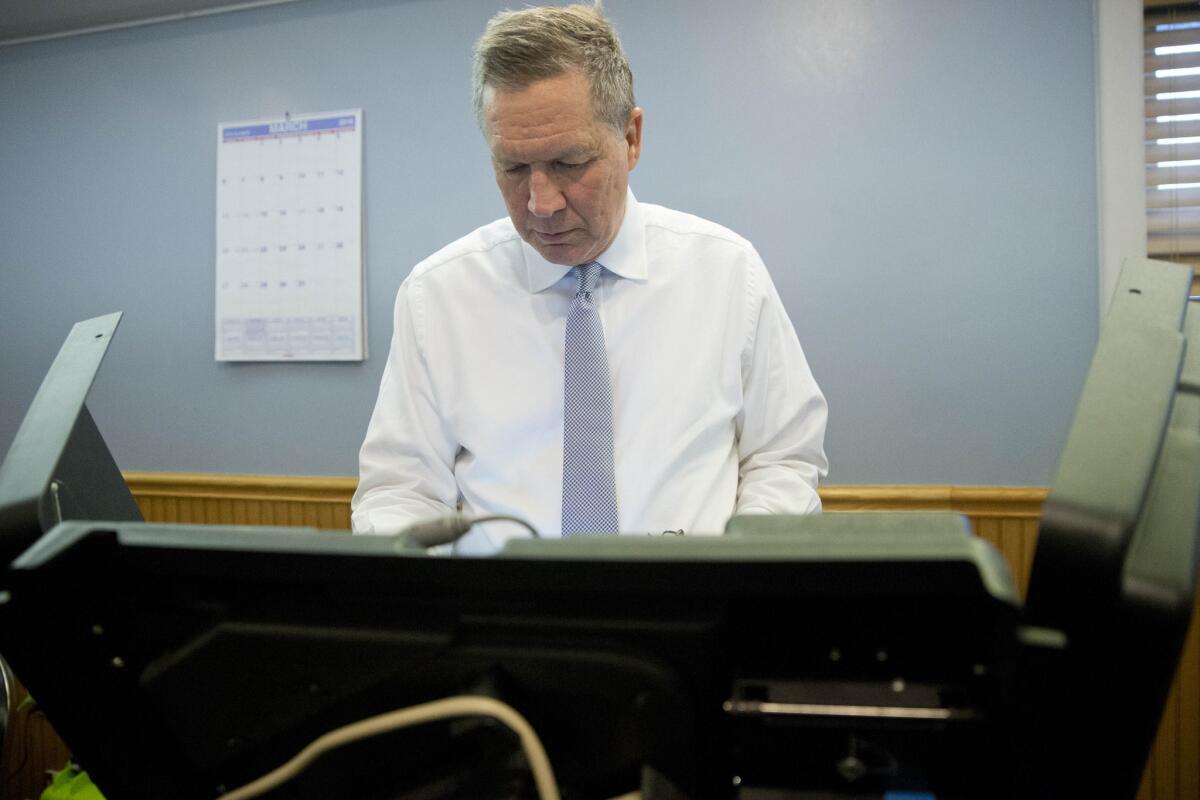
Ohio Gov. John Kasich votes Tuesday in Westerville, Ohio.
(Matt Rourke / Associated Press)
Rubio then devoted the bulk of his lengthy remarks to warn against succumbing to the anger and frustration that have fueled Trump’s improbable rise.
“The politics of resentment against other people will not just leave us a fractured party,” Rubio said, as disconsolate family members stood by onstage. “They’re going to leave us a fractured nation” where people hate each other for their political views.
“Do not give in to the fear,” Rubio said. “Do not give in to the frustration.”
The son of Cuban immigrants and, at age 44, the youngest candidate in the field, Rubio was seen as one of the GOP’s rising stars, with a capacity to broaden the party’s support among millennial voters and the nation’s fast-growing Latino population.
But he failed to win more than a few contests and was never seriously competitive in his home state. Trump captured 99 delegates in Florida’s winner take-all-primary, more than a quarter of those at stake in Tuesday’s balloting.
The victory in winner-take-all Ohio gave Kasich 66 delegates, more than doubling his total but still leaving him well behind Trump. His goal is to build momentum with a series of wins positioning him as the strongest candidate heading into the Cleveland convention even if, as seems inevitable, Kasich is shy of the 1,237 delegates needed to win the nomination outright.
Pennsylvania, where Kasich was born, is the next big target on April 26.
The results Tuesday followed one of the oddest, most contentious weeks in a campaign that has been filled with strange and surreal moments.
The precipitating event was a racially charged near-riot at a Trump rally Friday night in Chicago, which was canceled out of security concerns.
Trump’s opponents quickly seized on the moment and the violent imagery that played around the world to once more challenge his temperament and fitness to be president. They accused him of fomenting the unrest through belligerent remarks that seemed to egg on his audiences into physically confronting dissenters.
Trump denied any responsibility, blaming the violence on what he called professional agitators linked to Democratic hopeful Bernie Sanders. He said the protesters provoked his supporters and were stifling their rights to free speech and assembly.
“I don’t condone violence,” Trump said repeatedly, though he sympathized with backers who chose to “be effective” with protesters in the audience. (Previously he used more pugilistic language.)
Trump said he might even pay the legal fees for a supporter who sucker-punched a demonstrator at a North Carolina rally, drawing widespread condemnation. He won the state anyway.
Indeed, for weeks increasingly desperate Republican opponents have mounted an effort to stop Trump, to seemingly little effect.
More than $10 million in negative ads blazed across the Florida airwaves in just the last week alone, attacking Trump for his ethics, the failings of his business empire and his all-over-the-map political ideology.
Those meant nothing to Mark Owens, who stepped into the Miami Beach sunshine Tuesday and lighted a cigar after casting a ballot for the political neophyte.
“We’ve trusted politicians for 200 years to run our country,” Owens said. “It’s time to give someone else a shot.”
With polls suggesting Florida was firmly in Trump’s grasp, much of the campaign focused on Ohio, another traditional fall battleground.
Trump laid on extra events, including an election-eve rally outside Youngstown in place of a planned Florida appearance, and he turned his attention to attacking Kasich after long ignoring the Ohio governor.
He assailed him for his support as a congressman for the North American Free Trade Agreement, a pact with Canada and Mexico that, Trump said, devastated the state’s economy. He also laid on personal insults in a bid to snatch a victory in Kasich’s home state and clear the governor from the race.
Kasich, whose strategy centered on staying above the salvos flying among other candidates, accused Trump of creating a “toxic” political atmosphere and, wrapping himself in the establishment mantle, spent Monday stumping alongside Mitt Romney, the party’s 2012 nominee.
With Kasich suddenly a factor in the GOP contest, the skirmishing here in Ohio seems a likely preview of what is to come.
While he pledged to take the high road at his victory party Tuesday night, Kasich sent a different message speaking to reporters earlier in the day.
He said, “I will be … forced going forward to talk about some of the deep concerns I have about the way this campaign has been run by some others — by one other in particular.”
Ted Lasso star Cristo Fernández has taken his role as a footballer on the small screen into real life after signing a contract with the US second-tier side El Paso Locomotive FC.
12:17, 13 May 2026Updated 12:17, 13 May 2026
(Image: Apple TV)
Ted Lasso star Cristo Fernández has taken his role as a footballer from fiction to reality after signing a professional contract with the US second-tier side El Paso Locomotive FC.
Announcing the news the club said: “The rumors were true. Welcome to El Paso, Cristo Fernández. El Paso Locomotive FC announced today that it has signed forward Cristo Fernández.”
Cristo is best known by Ted Lasso fans as Dani Rojas, a beloved member of the Richmond team in the hit Apple TV+ show about a British team with a coach with an American football background.
However, many TV fans were unaware that outside of his acting career, the 35 year old has been taking part in football training, training with the Major League Soccer side Chicago Fire’s reserves this year, he also appeared in pre-season matches for the Locomotive before signing with the football club.
The actor played youth football in Mexico while growing up but was forced to quit after a knee injury. After gaining fame in the football based TV show, he is now set to return, saying in a statement that football has been a huge part of his life.
“Football has always been a huge part of my life and identity, and no matter where life has taken me, the dream of competing professionally never truly left my heart,” said Fernandez, who also trialled with the second team of Major League Soccer side Chicago Fire earlier this year.
“I’m incredibly grateful to El Paso Locomotive FC – the club, coaches, staff, and especially my team-mates – for opening the doors and giving me the opportunity to compete from day one.
“This journey back to professional soccer is about believing in yourself, taking risks, and continuing to chase your dreams no matter how unexpected the path may be.
“Maybe I’m just a crazy man with crazy dreams… so being here with the ‘Locos’ actually makes perfect sense.”
El Paso is a newer club, founded in 2018. The group is currently fourth in Group B of the United Soccer League Championship standings. “Cristo is a great addition to our roster, adding another attacking threat to our forward line,” the club’s head coach, Junior Gonzalez, said.
“His passion for the game and leadership qualities for our locker room allow us to continue growing the positive culture we strive for as a club.”
While Cristo is best known for his appearance in Ted Lasso, he has also had several appearances in films and TV shows including; Spider-Man: No Way Home and Sonic The Hedgehog 3. He has also featured in the State Farm commercial “Bundle is Life” alongside Patrick Mahomes.
Five nations get to avoid competing in the Eurovision semi-finals this yearCredit: ReutersThe UK is represented by Look Mum No Computer, who is guaranteed a slot in the Grand Final
Can I vote in the Eurovision semi-final tonight?
In short – no.
Aside from enjoying the show, UK viewers are unable to take part in tonight’s Eurovision semi-final.
This is because we have been drawn into the second semi-final on Thursday May 14, 2026.
Eurovision rules state that you can only vote in the semi-final in which your country is performing.
That means Brits will have to wait until Thursday to vote, when viewers can have their say alongside France and host nation Austria, as well as the 15 competing nations.
How do you vote in the Eurovision semi-final?
UK viewers will be able to vote on Thursday.
Don’t worry, as full instructions will flash up on screen during the BBC broadcast.
The official website explains: “If you’re in a participating country, you can vote by phone or SMS.
“The instructions you will need will be on the screen during the broadcast, and you can also find them atesc.vote.
“Voting opens after the last song has been performed. You can vote up to 10 times, and you’ll have around 18 minutes to do so. Use your power wisely.”
You cannot vote for the UK’s own entry, in line with long-standing Eurovision rules designed to prevent home-nation advantage.
Why does the UK only take part in one semi-final?
The UK is a member of the Eurovision Big Five alongside France, Germany, Italy and Spain, all of whom automatically qualify for the Grand Final.
These nations are are the biggest financial contributors to the European Broadcasting Union (EBU) – the organisation that runsEurovision.
That pre-qualified status means the UK does not have to fight its way through the semi-finals, but is instead allocated to broadcast and vote in one of the two semis.
For 2026, Germany and Italy were drawn into the first semi-final, while the UK and France will join Austria in the second.
Spain has, however, pulled out of the contest entirely in protest of Israel’s participation amid the Gaza war, alongside Iceland, Ireland, the Netherlands and Slovenia.
When are the two Eurovision 2026 semi-finals?
The Eurovision 2026 semi-finals will take place ahead of Saturday’s showpiece, with 30 of the 35 nations battling it out for 20 Grand Final spots.
Both start at 8pm and are live onBBC One and iPlayer, with the first on tonight – Tuesday, May 12 – and the second following on Thursday, May 14.
Rylan and Angela Scanlon will be providing commentary from the Wiener Stadthalle during both semis.
The order for the first semi-final is as follows:
Moldova – Satoshi, Viva, Moldova!
Sweden – Felicia, My System
Croatia – Lelek, Andromeda
Greece – Akylas, Ferto
Portugal – Bandidos do Cante, Rosa
Georgia – Bzikebi, On Replay
Italy (non-competing) – Sal Da Vinci, Per sempre sì
Finland – Linda Lampenius and Pete Parkkonen, Liekinheitin
Montenegro – Tamara Živković, Nova zora
Estonia – Vanilla Ninja, Too Epic to Be True
Israel – Noam Bettan, Michelle
Germany (non-competing) – Sarah Engels, Fire
Belgium – Essyla, Dancing on the Ice
Lithuania – Lion Ceccah, Sólo quiero más
San Marino – Senhit, Superstar (featuring Boy George)
Poland – Alicja, Pray
Serbia – Lavina, Kraj mene
While the schedule for the second semi-final is:
Bulgaria – Dara, Bangaranga
Azerbaijan – JIVA, Just Go
Romania – Alexandra Căpitănescu, Choke Me
Luxembourg – Eva Marija, Mother Nature
Czechia – Daniel Žižka, Crossroads
France (non-competing) – Monroe, Regarde !
Armenia – Simón, Paloma Rumba
Switzerland – Veronica Fusaro, Alice
Cyprus – Antigoni, Jalla
Austria (non-competing) – Cosmó, Tanzschein
Latvia – Atvara, Ēnā
Denmark – Søren Torpegaard Lund, Før vi går hjem
Australia – Delta Goodrem, Eclipse
Ukraine – Leléka, Ridnym
United Kingdom (non-competing) – Look Mum No Computer, Eins, Zwei, Drei
A BAFTA winner broke the fourth wall during the awards’ ceremony to ask BBC bosses if they would cut footage of Gaza: Doctors Under Attack winning the prize for best film about current affairs
22:35, 10 May 2026Updated 22:35, 10 May 2026
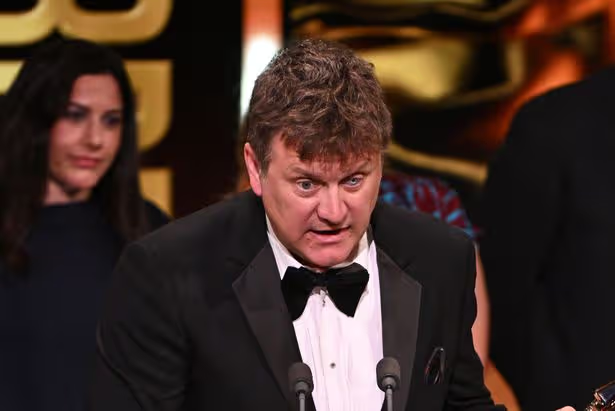
The executive producer of a BAFTA-winning documentary took aim at the BBC during the awards ceremony(Image: Getty Images for BAFTA)
A BAFTA winner took aim at the BBC during the ceremony after a documentary about Gaza triumphed at the prestigious television awards ceremony.
The current affairs film Gaza: Doctors Under Attack picked up a major prize at the BAFTA Television Awards tonight (Sunday, 10 May). But the moment quickly turned political when executive producer Ben De Pear used his acceptance speech to question the broadcaster that originally commissioned the programme.
The one-off documentary, which features testimonies from Palestinian healthcare workers and documents attacks on medical facilities in Gaza, was initially commissioned by the BBC before being shelved over impartiality concerns. It was later broadcast by Channel 4 instead.
When he took to the stage after the film won in the current affairs category, Ben thanked the journalists involved in making the documentary before addressing the BBC directly.
He fired his parting shot, asking: “Finally, just a question for the BBC: given you dropped our film, will you drop us from the Bafta screening later tonight?”
BBC One was responsible for the TV coverage of the BAFTA Awards night, but did not air the ceremony live. The reception of each award was broadcast to the public around two hours after the actual events took place.
Ben was joined on stage by journalist Ramita Navia, who delivered a powerful speech about the findings of the investigation featured in the film.
He shared: ” Israel has killed over 47,000 children and women in Gaza. So far, Israel has bombed and targeted every single one of Gaza’s hospitals.
“It’s killed over 1,700 Palestinian doctors and health care workers. It has imprisoned over 400 in what the UN now calls the medicide. These are the findings of our investigation that the BBC paid for but refused to show.
“But we refuse to be silenced and censored. We thank Channel 4 for showing this film. Right now, there are over 80 Palestinian doctors and healthcare workers being held in detention centres that Israeli human rights groups describe as torture camps. We dedicate this award to them.”
The documentary was originally commissioned over a year ago by the BBC via their independent production company Basement Films.
However, the broadcaster delayed its release while an internal review into a separate Gaza-related programme was carried out. After that review process, the corporation ultimately decided not to air the film.
At the time, the BBC said it had concerns the programme could create “a perception of partiality that would not meet the high standards that the public rightly expect”.
The corporation also confirmed that production on the documentary had been paused while the review was was being conducted. Despite dropping the programme, the BBC said it remained committed to reporting on the conflict.
In a statement previously issued by the BBC, the broadcaster said it was “committed to covering the conflict in Gaza and has produced powerful coverage”.
One member calls for a Presidential Medal of Freedom for a baker who refused to create a wedding cake for a same-sex couple.
Another calls for court interventions by the Department of Justice on behalf of Amish parents fighting New York vaccine requirements and Catholic nuns challenging that state’s requirement that they accommodate hospice patients’ gender identities.
And the chair of the Religious Liberty Commission is calling for a federal hotline with this automated recording: “There is no separation of church and state.”
These are just some of the recommendations that members of the advisory panel formed by President Trump last year want to see included in the commission’s final report.
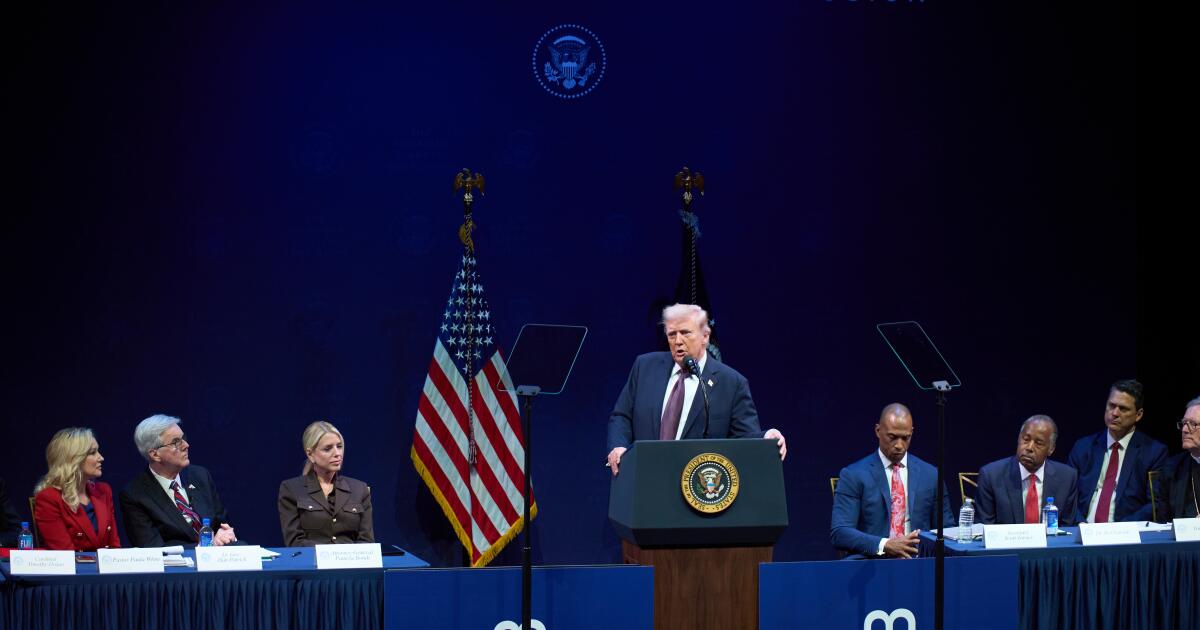
That report is still in the works, but commissioners had an opportunity to describe their wish lists during their most recent meeting in April. There was little dissent as the commissioners, most drawn from Trump’s base of conservative Christian supporters, covered the items they want in the report.
Their ideas reflect the prevailing perspectives on the definition of religious liberty among many conservative Catholic and evangelical activists: increasing avenues for religious expression in public schools, expanding opportunities for faith-based organizations to receive public money, and allowing for religious-based exemptions in areas ranging from labor law to classroom lessons to healthcare mandates.
Such views have also been reflected in Supreme Court decisions issued in recent years by its conservative majority.
Commission’s views criticized
Critics of the commission say it embodies a one-sided perspective of Trump’s supporters and is threatening a well-established constitutional separation of church and state.
A lawsuit by a progressive interreligious coalition argues that the commission fails to comply with federal law requiring advisory panels to feature diverse members and viewpoints.
The lawsuit echoes criticism that most commissioners are conservative Christian clerics and commentators; one is an Orthodox Jewish rabbi. The coalition says members have asserted that America is specifically a Judeo-Christian or Christian nation and notes that most commission meetings took place at the Museum of the Bible in Washington, an institution with Christian leadership.
The Republican administration is asking a federal court to dismiss the lawsuit. The government is citing legal technicalities and contending that the law does not define how a commission should be fairly balanced or whose viewpoints should be represented.
Another entity created by Trump — the Task Force to Eradicate Anti-Christian Bias — issued a report saying Christians faced discrimination under the administration of President Biden in areas such as education, tax law and prosecution of antiabortion protesters. Progressive groups said that report failed to document systemic discrimination, focused on causes favored by conservative Christians and amounted to advocacy rather than an investigation.
In a further interlocking of Trump-related initiatives, several members of the Religious Liberty Commission are scheduled to take part in a May 17 prayer event marking the country’s upcoming 250th birthday. Several also participated in a recent Bible-reading marathon staged largely at the Museum of the Bible.
Harmony and tension
The commission has mostly featured agreement among members, with one dramatic exception. One commissioner, Carrie Prejean Boller, was ousted in February after a contentious hearing on antisemitism.
Commission Chair Dan Patrick said Prejean Boller sought to “hijack” the hearing, in which she had sharp exchanges with witnesses about the definition of antisemitism and defended commentator Candace Owens, denying her record of antisemitic statements. Prejean Boller, a Catholic, contended that she was wrongly ousted for expressing her beliefs.
In other hearings, witnesses described how they defied workplace regulations that they said conflicted with their conservative religious values on gender, abortion, COVID-19 vaccines and more. Some said they were prevented, at least temporarily, from displaying a religious symbol at work or trying to sing a Christian song at a school talent show.
At the hearing devoted to antisemitism, Jewish witnesses spoke of being harassed and threatened at campus pro-Palestinian protests against Israel. The commission has also heard from Hindu, Muslim, Sikh and other witnesses.
Even so, critics said the commission mostly focused on conservative Christian and right-leaning political grievances.
The Rev. Paul Brandeis Raushenbush, president of the progressive Interfaith Alliance, one of the groups suing over the commission’s composition, said the panel’s omissions are as significant as what it focuses on.
He said the commission has failed adequately to address such issues as anti-Muslim efforts in Texas and elsewhere, and also the rise of antisemitism on the right, not just the left.
Separation of church and state
Raushenbush said he is especially worried about the commission chair’s challenging the very notion of church-state separation.
Patrick, a Republican who is the Texas lieutenant governor, repeatedly denounced a concept that is embedded in Supreme Court precedent.
“We need to say there is no separation of church and state,” Patrick said at the April meeting. “That’s a lie.” He suggested printing “a million bumper stickers” to that effect.
No one at the commission meeting disagreed.
Trump made similar comments at a prayer event at the White House in 2025. “They say separation between church and state,” he said. “I said, all right, let’s forget about that for one time.”
While the phrase “separation of church and state” does not appear in the Constitution, 20th century decisions by the Supreme Court cited Thomas Jefferson’s description of the 1st Amendment as creating “a wall of separation between church and state.” The court applied the 1st Amendment’s prohibition of any church “establishment” to the states in addition to the federal government, citing the 14th Amendment’s ban on states denying citizens’ rights.
Courts have since wrestled with how to balance freedom of religion and freedom from government-sponsored religion.
Schools, vaccines and workplaces
Patrick has advocated for prayer and Ten Commandments postings in public schools.
“I don’t have any malice towards anyone that doesn’t believe in any type of faith,” Patrick told fellow commissioners. “That’s fine. That’s what America is about. But these organizations that are pushed by some ideology and pushed by someone’s bank account who wants to remove God from our country? We need to push back.”
On other issues, various commissioners called for requiring schools and workplaces to post notices of the rights of religious expression and exemptions.
Some called for restoring full pay and pension benefits for military service members who were discharged for refusing COVID-19 vaccines.
Bishop Robert Barron of the Catholic Diocese of Winona-Rochester, Minn., called for allowing religious groups such as Catholic Charities to receive federal money without compromising on traditional church teachings about the family.
He also said Catholic immigrants in detention should have humane treatment and access to sacraments and that immigration agents should not disrupt worship services in enforcement actions. The administration last year eliminated a policy against immigration enforcement in sanctuaries, which other religious leaders said should not occur at any time.
Kelly Shackelford, president and chief executive officer of the legal organization First Liberty Institute, called for new requirements that governments pay all legal bills if they lose a religious liberty case. He said many individuals lack the money to challenge the government in court.
“That would be a huge shifting of power in favor of citizens,” he said.