Becerra, Hilton spar over electoral integrity as Trump alleges cheating
As President Trump pushed unfounded allegations that California’s elections are rigged, the security of the ballot box became a major flash point in the state’s 2026 race for governor on Tuesday.
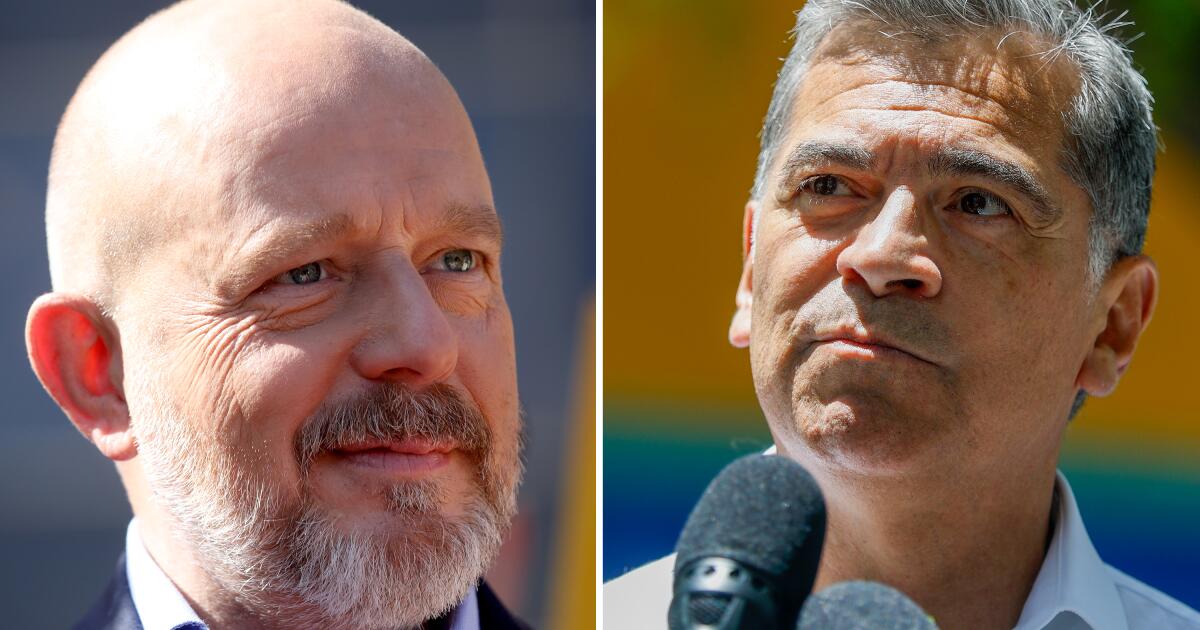
Republican Steve Hilton called for major reforms to how Californians cast ballots and how their votes are tallied, while sidestepping questions about the president’s claims that the state’s elections officials “were cheating.” Democrat Xavier Becerra defended the integrity of the state’s elections and argued that proposed restrictions would disenfranchise many voters.
The men appeared less than 20 miles apart in Southern California one week after a contentious primary election that prompted Trump to repeatedly make unfounded claims about the integrity of California’s slow vote-counting process, allegations triggered as Democrat Nithya Raman was about to overtake Republican Spencer Pratt for second place in the race for Los Angeles mayor.
Hilton, whose endorsement from Trump pushed him to the front of the GOP gubernatorial field, said he has not seen any evidence of impropriety in this month’s election results.
“We’re very, very focused on making sure that everything’s OK,” Hilton told reporters in Norwalk. “We’ve got teams standing by, we’ve got lawyers standing by, very focused on that. We don’t want to let anyone down, we don’t want to let anything slip away, and we’ve seen nothing.”
The two men emerged from a crowded field of candidates in the most unpredictable governor’s race in more than a quarter of a century. While Becerra on Friday nabbed a spot in the June 2 primary and will advance to the November general election, Hilton has not officially been declared a victor by the Associated Press, as of Tuesday afternoon.
Hilton, however, appears on the cusp of clinching the second spot on the ballot. Billionaire Democrat Tom Steyer is in third place in the current ballot tally, and the odds of him overtaking Hilton appear increasingly unlikely.
“I’m very pleased to say that we remain confident that I will make it into the top two and that California will have a real choice for change in November,” Hilton said at a news conference outside the Los Angeles County elections headquarters. “We’re not popping the champagne yet, but we’re very confident.”
Hilton called for electoral reform, including supporting a voter identification requirement that will appear on the November ballot, ending mail ballots being sent to every registered voter, no longer counting ballots that are received after election day — all of which are being pushed by Trump — and increasing resources at county vote counting centers.
“Voter ID [is] not the only thing, but it’s the biggest, quickest, simplest thing we can do to restore faith in the system and to have these elections completed quickly in a way that inspires confidence, and that’s why I hope that Xavier Becerra will join me in campaigning for it, so we can have a united front,” the former Fox News commentator and British political strategist told reporters.
Hilton did not directly address Trump’s unfounded claims of voter fraud in California. However, he noted that Bill Essayli, the first assistant U.S. attorney for the Central District of California, has the full resources of the Department of Justice and has found no proof of wrongdoing.
Essayli said Monday on NewsNation that his office is investigating voter fraud but doesn’t have a case. However, the voter rolls need to be audited, Essayli told host Chris Cuomo.
“That, to me, is the best way to alleviate most of people’s suspicion. We have a system that breeds skepticism and distrust,” Essayli said. “We should have a little transparency and confidence in our system.”
Becerra, a longtime elected official and a former Biden administration Cabinet secretary, questioned whether Hilton could be trusted to protect the state against Trump’s fraud claims.
“That’s who’s endorsing Steve Hilton,” Becerra told reporters at a South Los Angeles food hall, referring to Trump. “That’s who Steve Hilton is aligning himself with.”
Becerra, who was met with cheers of “Si se puede!” from diners, criticized the proposed voter ID ballot measure, arguing that it would create hurdles for many Californians to participate in the democratic electoral process. Led by Republican Assemblymember Carl DeMaio from San Diego and others, the measure would require elections officials to verify that voters are U.S. citizens to be eligible to cast ballots.
“I’m against voter suppression. I’m against anything that would try to limit a Californian’s right to vote,” said Becerra, who formerly served as California’s attorney general.
Told by reporters that Hilton wanted Becerra to campaign for the ballot initiative, Becerra responded, “Come join me here, where the real people are,” gesturing toward the packed food hall.
Becerra acknowledged his concern over the lengthy time that it takes to count votes in California. He suggested one issue is a lack of workers and equipment at county vote-counting centers.
Another problem is that the “votes get backlogged” because so many people wait until the end of the election to cast ballots, he said, likening last-minute voters to shoppers who go to Costco at the end of the day.
“If you wait till 7:00 p.m. when they’re getting ready to close, you’re probably gonna find more people there,” Becerra said.
The attacks on the elections process by Trump and his supporters appear to have a major effect on people’s confidence in the system. For years, Trump has made baseless claims that the 2020 election was stolen from him, which led his supporters to storm the U.S. Capitol as lawmakers were scheduled to certify the election results. Additionally, Trump’s allegations about California’s elections, as well as an upcoming U.S. Supreme Court ruling about ballot tallying, could have a significant effect on the midterm elections that will decide which party controls Congress for the final two years of Trump’s presidency.
A poll released Friday by the Institute of Governmental Studies at UC Berkeley found that 41% of California voters were “not confident” that this year’s elections would be free of federal interference. Although 48% had confidence that there would be no meddling, the concerns expressed were still significant, said political scientist Eric Schickler, co-director of the institute.
Among Democratic registered voters, 79% said they trusted elections officials to provide an accurate vote count. Among Republicans, 55% said they were not confident that would occur, the survey found.