Away with the ferries: exploring Switzerland’s forgotten lake district by boat | Switzerland holidays
The ferry cuts across the waters of Lake Biel, creating soft ripples, as if someone has taken a brushstroke to a blue canvas. To starboard, as we approach St Peter’s Island, are gentle mountains; to port side, lie golden fields. Straight ahead, the isle looks empty and Crusoe-esque.
On the jetty, Max Frey, a boatman, historian and guide, is waiting for me. He’s a man of dates and paperwork and pulls a handful from his satchel as he greets me, thrilled at the prospect of leading a tour; Switzerland’s Jura and Three Lakes region, this idyllic nook on the French border, is often overlooked by visitors.
“Welcome to paradise,” he says, raising his voice above the ferry engine thrum. “That’s how Jean-Jacques Rousseau felt about the island when he came in 1765. He was always running away from places, but spent the happiest days of his life here.”
Beach-fringed St Peter’s Island is now actually a peninsula (in the mid-19th century the level of the surrounding lake was lowered, creating a land bridge to the mainland) but it is still best reached by boat, and is car-free. With golden light falling on the sand and silver zander ghosting through the clear water, it undoubtedly feels heavenly. Rousseau – the philosopher, writer, composer, rebel who spent six weeks on the island in exile – wasn’t the only one to fall under its spell. “Alexandre Dumas and Goethe stayed, too,” says Max, proudly. “So did Joséphine Bonaparte, the first wife of Napoleon. When she arrived, it is said that more than 1,000 boats sailed on to the lake to see her.”
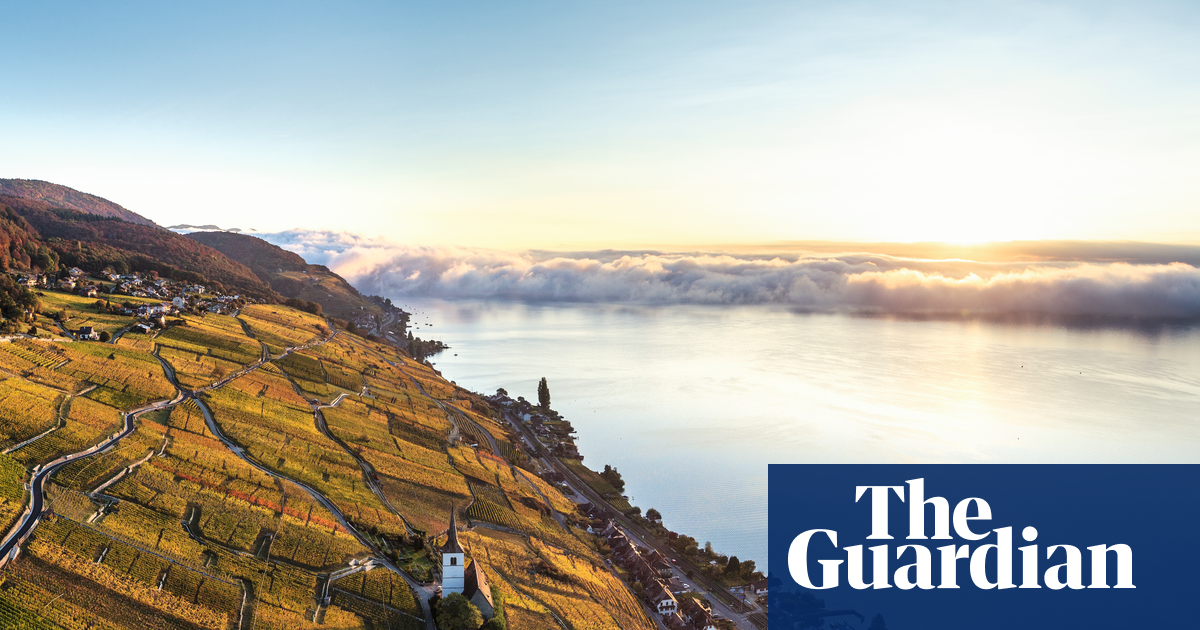
Home to the country’s gentlest summits, the Jura Mountains, and the glacial-blue lakes Biel, Neuchâtel and Murten – linked by the beautiful Zihl and Broye canals – the region is connected by regular ferries (perhaps it could offer an alternative to Greek or Croatian island hopping, only with better cheese). It’s also wine country, the lakesides fringed by tidy vineyards, and small towns such as Ligerz, La Neuveville, Le Landeron and Erlach contain dozens of understated family cellars.
I’m here on a three-day, DIY ferry-hopping trip, travelling from Biel to Murten, hiking, swimming, birding and wine tasting along the way. It’s a wholly different side to the Switzerland I’m used to – low on pomp, lower on price, but high on novelty.
The ferry journey to St Peter’s takes just 15 minutes from the mainland towns of La Neuveville or Ligerz (or 55 minutes from Biel, where I’d arrived from), and Max and I are as good as alone as we explore. Paths slalom through chestnut trees to empty coves. Butterflies flit by. A farmer cycles past to tend to an Angus herd grazing beside swans and reed-bed warblers on the shore. An information panel gives notice that St Peter’s was once home to Romans, then Benedictine monks who, it is said, with free rein on the island lured in the most beautiful girls from around the lake.
We explore the western side on foot, and vineyards take over from forests and sandy coves as we cross to the east. I arrive at my accommodation for the night, Hotel St Petersinsel, housed in a beautiful monastery dating back to 1127, complete with a restaurant courtyard, sarcophagi, Roman-era columns and a museum-piece bedroom where Rousseau slept. As dusk approaches, I dine alone on zander with lemon risotto and summer tomatoes with burrata from nearby Fribourg, paired with local wine.
The next morning, I start the day with a swim by the jetty as a heron flaps overhead. The Three Lakes are full of easily accessible swimming spots and beaches, but I’m alone apart from a family of ducks watching me from the sand. Afterwards, I hop on a ferry to Ligerz, a wine village halfway along Lake Biel’s northern banks on the Franco-German linguistic border.
Ligerz’s name is said to come from an ancient Roman settler, Ligerius, and it turns out to be a village bursting with grapes and bacchanal bliss. Every house seems to have its own vineyard plot leaning towards the shore, which is ideal if it’s lunchtime and a hike around pretty-as-pie St Michael’s Chapel has helped you work up a thirst.
Wine drinking in Switzerland has its challenges. The Swiss keep nearly all they produce and it’s pricey compared with German or Italian wine. But I arrive at Andrey Schafis, a fifth-generation family cellar overlooking the water, where drinkers on the restaurant terrace enjoy chilled lemony chasselas for 15 Swiss francs (£13.50) a bottle, accompanied by charcuterie and cheese. The feeling is less Alpine, more Amalfi.
“Almost everything we make is drunk here,” says Arielle Andrey, uncorking a bottle. We chat over a glass before she dashes off into the wood-beamed cellar to bring out more fresh-baked bread, cheese and wine.
With a spring in my step, I take the village’s Vinifuni – a short, steep funicular through the vineyards – all the way through a cleft in the limestone to the Tessenberg plateau and the petite village of Prêles in the shadow of Chasseral, Jura’s flat-topped mountain. This is a country of preposterously beautiful summits, and although this crest is a gentle one, the view from it is still one of the most dazzling; the fields below look like a gigantic eiderdown of gold and green stitched around three enormous patches of blue.
I follow the lonely path to the highest point through a forest of pine, then stand awhile on its observation deck beneath a 120-metre telecommunications tower that has all the exposed platforms, gantries and satellites of a rocket launch pad.
From here, I zigzag downhill to the village of Nods, as sleepy as it sounds, and then take a bus back to Prêles and the family-run Hôtel de l’Ours Prêles, sitting high above the lake. It isn’t the most celebrated address in the Alps, but it quickly becomes one of my favourites, because of its delightful hosts, Mélanie and Marcello Pigozzo. Marcello cheerfully brings me a cold BLZ beer from nearby Orvin and Mélanie serves an entrecôte steak and profiteroles on the terrace. My meal is soundtracked by bell-rattling cattle in the next-door field.
On my final morning, I take one last boat ride, a three-hour journey from Lake Biel via the Zihr canal to Lake Neuchâtel, and on via the Broye canal to Lake Murten and its lakeside fortress town. The ferry putters past radiant sunflower fields and fruit crops. While the verges are scattered with campsites, cycle paths and bird reserves, including La Grande Cariçaie, the country’s largest marshland, the medieval town of Murten is a time capsule.
Church spires soar, swifts nest in the towers and the battlements can be patrolled, offering a Mary Poppins view of old rooftops and stone chimneys. Beyond the ramparts, beneath a vivid blue sky, vineyards gather on the hazy hills and I watch the ferry depart on its sailing back to Biel. The horn blows. A heron takes flight. A dozing fisher stirs on the jetty. A different Switzerland is out there. You simply need to take the slow boat to find it.
The trip was provided by Jura & Trois Lacs, supported by Switzerland Tourism. St Petersinsel has doubles from £128 B&B and Hôtel de l’Ours Prêles has doubles from £175 B&B. A Swiss Travel Pass for three days covering all public transport, including lake ferries, costs £238