swing state

This millennial illustrates why Iowa is a swing state

As a teenager before he was even allowed to vote, Charlie Comfort organized for then-Sen. Barack Obama in his hometown of Oskaloosa, Iowa.

Now he’s a Republican.

Meet Charlie. He lives in Waterloo.

He’s 23 and this will be his third presidential caucus.

Charlie’s first foray into politics was during the 2008 campaign. He met Obama at the Smokey Row Coffeehouse, one of the most popular stops for candidates in Oskaloosa, on the Fourth of July in 2007.

Obama campaign volunteers. (Handout)

It was Malia Obama’s 9th birthday, and the shop’s staff put the candidate’s daughter’s name up on the marquee inside.

After Obama spoke, Charlie ran home excited and ready to help.

He wasn’t old enough to vote but dedicated hours to organizing his neighbors, teachers and anyone else who would listen. The Obama campaign said Charlie, a high school student, made more phone calls than any other volunteer in town.

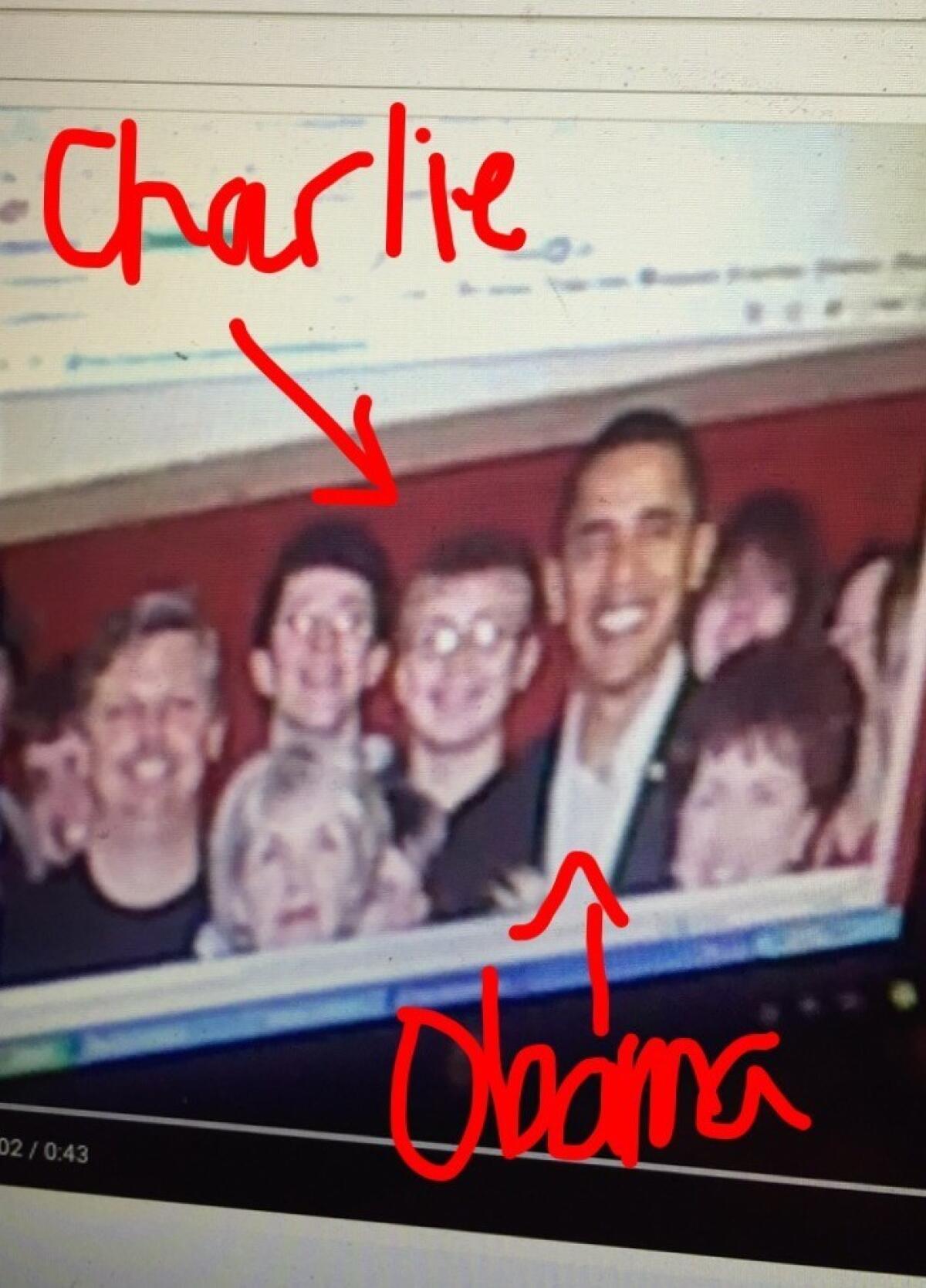
His hard work — at age 15 — earned him a prime spot next to the candidate in this group photo.

The Comfort family was the subject of a front-page story in the Washington Times the morning of the caucus.

Why?

They clearly illustrated the divided nature of the state: Martha Comfort backed Hillary Clinton, Keith Comfort preferred John Edwards and their son was traveling all over the region to put up Obama lawn signs instead of finishing his homework.

Here they are, eight years ago.

Martha Comfort, a legal assistant in town, was working as a Clinton precinct captain. Keith Comfort, a banker, was a little more passive about his support for Edwards, who would ultimately come in second in the caucuses (and later drop out of the race).

Here’s a semi-awkward clip where I tried to get them to pretend they were in a caucus.

SIGN UP for our free Essential Politics newsletter >>

Eight years later, Charlie is a Republican.

Before we get to how that happened, it’s important to note the teenager used the skills he built as a political organizer to run for office himself.

At the age of 19 in October 2011, he became the youngest school board member in Oskaloosa’s history after unseating a 17-year incumbent and getting all his friends to vote.

His interest in education policy had an unintended consequence — he didn’t like that Obama, for whom he’d worked so hard to get to the White House, had not revamped the No Child Left Behind Act as promised. He found himself intrigued by the Republican candidates coming to town in the hopes of winning the Iowa caucuses and challenging Obama in 2012.

In the 2012 Iowa caucuses, he was a Newt Gingrich precinct captain.

But he changed his mind on the way in, and his first caucus vote ultimately went to ex-Sen. Rick Santorum. “I appreciate he spent so much time in Iowa,” Charlie says now.

Once Mitt Romney won the nomination, Charlie set out to help the GOP in the swing state.

That fall, he appeared in a piece by “PBS NewsHour.” (About four minutes into the piece, interviewed at the Smokey Row coffee shop, of course.)

Fast forward four years, and he’s got a tough choice to make.

Charlie has moved from Oskaloosa to Waterloo and is working in marketing. He spent his weekend “chasing the candidates around” because he was undecided as the long campaign for the caucuses comes to a close.

Like most Iowans interested in this quirky process, he’s met many of the hopefuls as they make their way across the state. He even introduced former Florida Gov. Jeb Bush at an event at Smokey Row in October. But that didn’t really help him make up his mind.

“I am disappointed by all the anger, rhetoric and hatred that has been spewed by the party this year,” he says. “I am disappointed that the candidates who would support more moderate values have balked on that to try and get more of a conservative base turning out and I don’t think the Republican platform has been expressed as well as it could.”

Martha and Keith Comfort are still Democrats.

But they also are still split on their preferred candidate.

Keith Comfort gave his first-ever political donation, to Sen. Bernie Sanders. Martha Comfort isn’t working on Clinton’s behalf this time, but she’s still in her corner — probably.

“Now I’m on the fence and I may lean towards Bernie,” she says. “I like what he stands for and I look at Hillary and she really does have the experience but she does have some baggage. But I guess everybody does.”

Then again … “I’m leaning to Hillary because she’s realistic about what she’s promising. She knows what takes place in the office of the president and the process to get things through Congress.”

She says she’ll be resolute in her choice before walking into her neighborhood caucus meeting Monday night: “Nobody is going to persuade me there, even if my husband is across the room.”

As for Charlie, he’s made up his mind.

Iowa caucusgoer Charlie Comfort and presidential hopeful Carly Fiorina

Iowa caucusgoer Charlie Comfort and presidential hopeful Carly Fiorina

Charlie Comfort and Carly Fiorina. (Courtesy of Charlie Comfort)

He didn’t even need the whole weekend.

“This is who I plan to caucus for,” Charlie said Saturday via Facebook Messenger.

It wasn’t intended to have dramatic effect, but the photo didn’t come through for several minutes.

But there he is, smiling next to former Hewlett-Packard Chief Executive Carly Fiorina, considered a long shot in Iowa and nationally.

“She seems genuine, authentic. She has a business background and has experience with policymakers, whether it be domestically or foreign. Ultimately, I think she is in it for the right reasons — to help fix America,” he said.

“I am very impressed with her secretary-to-CEO story. Only in America.”

For more, go to www.latimes.com/politics

ALSO:

Everything you need to know about the Iowa caucuses and why they matter

From west to east, Iowa voters have starkly different realities and fears

How Martin O’Malley could decide who wins the Democratic caucuses in Iowa
Source link

Wisconsin governor’s race deals upset to favored progressive in another key primary

In another major test of how far left Democratic voters in swing states are willing to go, moderate David Crowley narrowly defeated democratic socialist Francesca Hong to become the Democratic nominee for governor of Wisconsin.

The surprise result in Tuesday’s primary — in a closely watched swing state seen as a possible bellwether of Democratic sentiment — came after polls had shown Hong leading the field by double digits. With 95% of the vote counted, Crowley clinched the nomination early Wednesday by just 3,000 votes.

It was the second purple-state race between Democrats in two weeks to have an extremely narrow result, following the slim win by progressive Abdul El-Sayed in the Michigan Senate primary last week. Polling also overestimated progressive performance in that race.

In the November general election, Crowley, the Milwaukee County executive, will face Republican Rep. Tom Tiffany, who was endorsed by President Trump. If Crowley were to defeat Tiffany, he would become the first Black governor in the state’s history.

The race had been closely watched as an example of the national fissure between progressive and establishment Democrats.

“Hong’s candidacy is a sign of the broader trends in the party, with outspoken progressives and socialists emerging in some primaries and having real sway in the party,” said University of Wisconsin-Madison professor Barry Burden. “With Crowley, he has a more conciliatory approach … that probably sits better with the average independent voter or moderate in the state who’s just looking to get some problems addressed.”

Crowley and his backers had undertaken an intense late-July sprint to persuade Democrats to coalesce around him. He suspended his campaign amid low poll numbers, then rejoined the race with less than a month before election day after establishment frontrunner Lt. Gov. Sara Rodriguez dropped out.

“It was fast and furious very late in the campaign to try to build a movement in the party behind Crowley as the establishment candidate who is presumably more likely to win in a general election,” Burden said.

In another upper Midwest contest highlighting the choices confronting Democratic voters, progressive Lt. Gov. Penny Flanagan defeated center-left Rep. Angie Craig. Flanagan will face former television sports reporter Michele Tofoya, a Republican, in November for the seat held by Democratic Sen. Tina Smith, who is retiring.

As Democrats grapple with creating a party identity that will draw swing voters away from President Trump’s Republican Party in November and in 2028, a fierce debate has taken hold between the party’s factions — progressives who argue their approach is the key to the party’s fresh path forward, and moderates who fear that a far-left presidential candidate could cost Democrats the presidency in 2028.

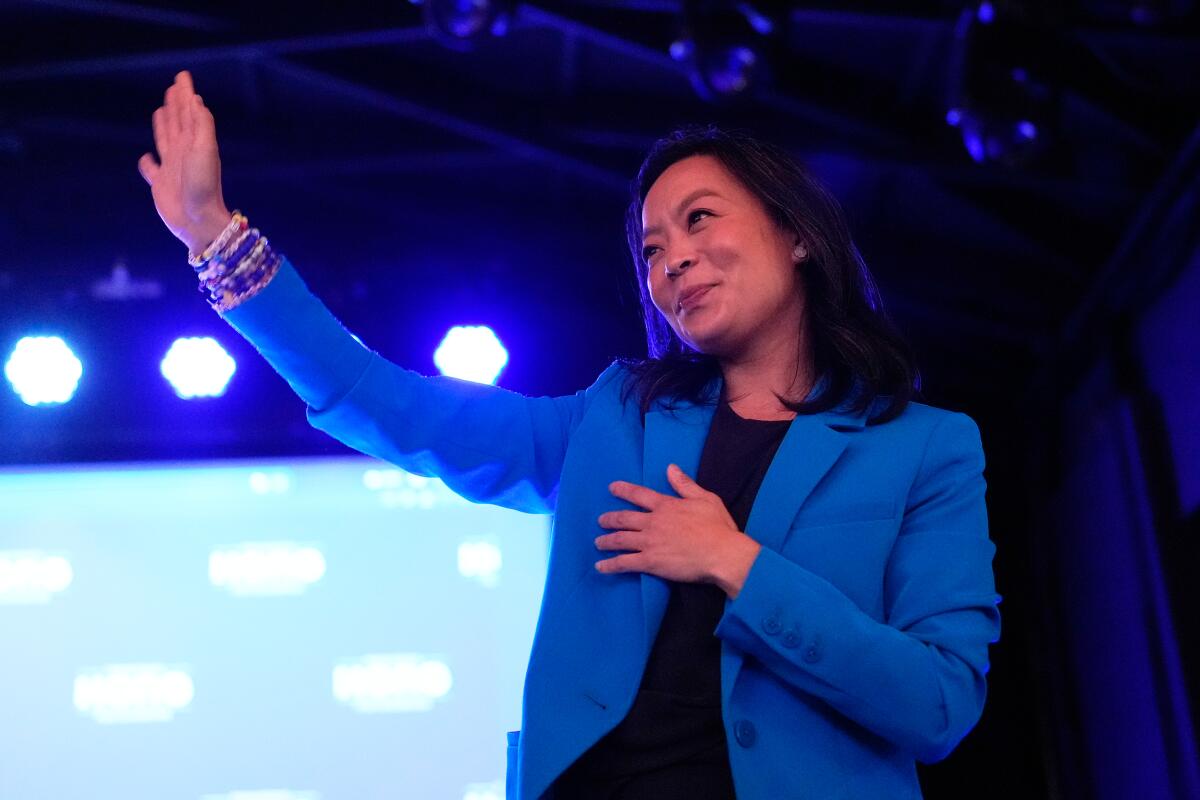
Wisconsin Democratic gubernatorial candidate Francesca Hong waves to supporters on Tuesday night.

Wisconsin Democratic gubernatorial candidate Francesca Hong waves to supporters on Tuesday night.

(Nam Y. Huh / Associated Press)

Progressive candidates so far have fared well in blue strongholds such as Denver, New York and Minnesota this cycle, but they have struggled in Missouri and Wisconsin.

“Democrats of all ilk are winning elections all across the country,” said strategist Hyma Moore on Wednesday on CBS News, “and it’s very specific to what that state or that district needs.”

Moore said Hong’s loss was not “a setback for progressives,” arguing that she was a weaker political candidate than Crowley regardless of her ideology.

In his victory remarks Wednesday morning, Crowley rejected the framing of an intra-party conflict.

“We may not agree on every policy, we may not use the same labels, but we all want safe communities, strong schools, affordable healthcare, good-paying jobs and a brighter future for all of our children,” Crowley said.

Hong, a member of the state Assembly, ran into controversy late in the campaign with resurfaced social media posts in which she called for defunding the police and shared her negative opinions on Thanksgiving. Although she sought to retract or revise many of those comments in televised interviews, moderates and centrists seized on these points to argue against her electability.

“She had a whole smorgasbord of positions that were perfectly designed to repel voters in the middle that Democrats have to win,” said Kate deGruyter of the centrist Democratic group Third Way, which is funneling money into an effort to discredit democratic socialism ahead of the 2028 presidential election.

The race remained exceedingly tight until early Wednesday, when the Associated Press projected Crowley as the winner. In counties where Crowley was expected to dominate, such as Milwaukee, Hong performed better than expected. While Hong won the city of Madison and areas with University of Wisconsin satellite campuses. the margin was too small to push her past Crowley, according to AP election data.

Rep. Ilhan Omar (D-Minn.) and Rep. Ro Khanna (D-Fremont) chose to publicly back Hong, but she was unable to secure key national endorsements from the two most prominent progressives in Congress, Rep. Alexandria Ocasio-Cortez (D-N.Y.) and Sen. Bernie Sanders (I-Vt.).

Hong told her supporters Tuesday night, hours before she conceded, that regardless of the result, progressive politics would have to be reckoned with in Wisconsin’s electoral future.

“We have built something that will change politics forever,” she said. “I am so deeply grateful, to my core, for how hard you have all fought, and for what this fight, our movement, means for all of Wisconsin.”

Times staff writer Justine McDaniel in Washington contributed to this report.

Source link