
Swim

‘Strip Law’ review: A crude courtroom comedy channeling Adult Swim

“Strip Law,” a new cartoon premiering Friday, finds Netflix in an Adult Swim state of mind, which is to say there was no thought of it being made for everybody. (Possibly including some of the people it was made for.) It’s rude, lewd, surreal in a banal sort of way, at times ridiculously violent — that is, the violence is ridiculous.

It was the cast that attracted me: Adam Scott, once more the schlemiel as leading man; Janelle James, sure of her own magnificence, not far from her character on “Abbott Elementary”; and Keith David, whose deep, sonorous voice is almost necessarily one of authority, turned to good or evil or in between as the script demands. James and David, especially, I could listen to for days.

Created by Cullen Crawford, (“The Late Show With Stephen Colbert,” “Star Trek: Lower Decks”), the series is centered on a failing Las Vegas law firm, headed by Scott’s Lincoln Gumb, with James as Sheila Flambé, “a magician and three-year all-county sex champion” he hires as his “co-counsel in charge of spectacle.” Niece Irene (Shannon Gisela), an iron-pumping 16-year-old, works as his investigator; she wears a blindfold labeled “Underage” whenever she’s required to be in a bar. Stephen Root plays his disbarred (later undisbarred — rebarred?) lawyer uncle, Glem Blorchman, the strangest of them all — “It’s 115 degrees out so I put marshmallows in gin,” is something he says as they gather to watch Christmas movies. And David plays Lincoln’s nemesis, Stevie Nichols, the very successful former partner of Lincoln’s late mother, upon whom the son remains perversely fixated.

Much of it is the sort of thing that will work or not work depending on your mood, but generally I prefer the small throwaway jokes to the big gross ones. There are self-reflexive meta gags about “hard-working cartoon writers” and “reappropriating out-of-date catchphrases.” There are many nods to “The Simpsons,” including “frosty chocolate milkshakes” and James L. Brooks’ Gracie Films logo. The final episode, of 10, takes place within the finale of a “Suits”-like legal dramedy. (“It’s against their nature to let something be sweet and fun and airy,” that firm’s bromantic lawyers say of Lincoln’s team. “They have to make it dark and strange and crass.”) And there are left-field references to Cocteau Twins and Bikini Kill, whose “original bass player” Glem claims to be. (“I don’t know what Bikini Kill is,” says Irene. “Neither did I, according to Kathleen Hanna,” says Glem.)

There are various oddball judges (nothing remotely legal happens in a courtroom); “local character” Lunch Meat, who turns up in many roles; a barman, Mr. O’Raviolo, who switches between exaggerated Irish and Italian accents in mid-sentence. Comedian George Wallace plays himself as the mayor of Las Vegas. A Halloween Christmas episode parodies “Miracle on 34th Street”; another takes off on Colton Burpo, the “boy who saw Heaven,” which includes a live-action trailer for a faith-based film featuring Tim Heidecker as a coke-snorting atheistic Lincoln. A virtual reality HR seminar is hosted by “a computerized amalgamation of all five personalities of the Rat Pack,” an immersive Autoverse, in which actors create situations that somehow amount to a driving test. There are the “Nevada-grown” Hot Dates, a sexualized version of the California Raisins; riots occur when the characters are redesigned to be more respectable (“They’re walking away from years of established canon,” laments Lincoln.)

The series felt a little off-putting at first, as if it were straining for effect, but gathered steam as it went on, either because the later episodes are weirder or better written, or because one just gets used to being in that world with those people. There is just enough character in the comedy to create stakes in the narrative; its misfit energy has fueled the screen’s bands of outsiders throughout the years. (“Even when you’re a disaster, you’re a disaster for the right people,” Irene tells Lincoln.) As to the famous fine line between stupid and clever, the stupidity and the cleverness are all but inextricable, and to the point.

The credits declare that the series is “proudly made by real, non-computer human beings,” which is pleasant to know, and in 100 years will still have been the best way to make cartoons, even if by then they are only made by and, for all we know, for machines. The thin-lined drawing style is standard for more or less realistic 21st-century adult TV animation, with perhaps a hint of comics artist Daniel Clowes laid on. But the characters are expressive, and the medium is used to unreal ends, which is, after all, what cartoons are good for.
Source link

‘Swim, soak, switch off’: an off-grid cabin stay in the Scottish Borders | Scotland holidays

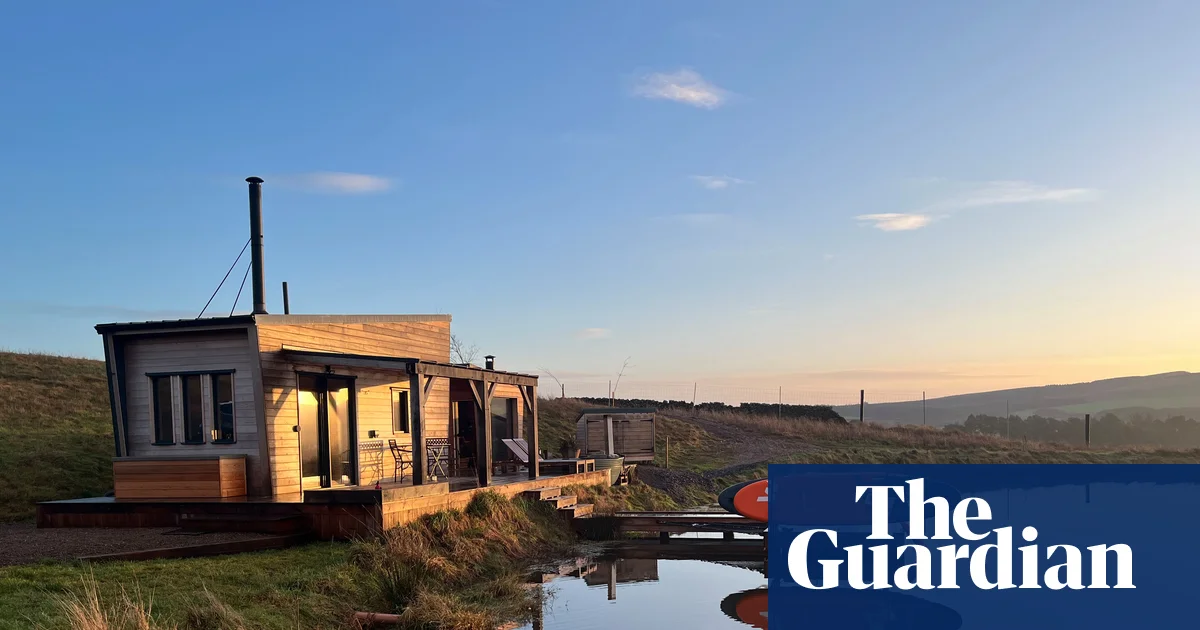
The tiny, off-grid cabin looked almost unreal: made of repurposed oak it stood by a private lochan, with separate cedar sauna, cold outdoor shower, sunken hot tub, and a jetty with two hammocks and a pair of paddleboards. It screamed Finland or Sweden, not a sheep and deer farm in the Scottish Borders. It was the sort of isolated location that would set Ben Fogle’s heart racing in New Lives in the Wild. Two swans bugled my arrival. I felt a little embarrassed that all of it was mine.

Sometimes, we need to escape to a place where the phone coverage is bad enough to make you believe you’re somewhere truly wild. Tiny Home Borders, hidden in rippling foothills 10 miles east of Hawick, is such a place. Last August, owners David and Claire Mactaggart opened a second two-person cabin on their farmland (the first opened in 2022) and I jumped at the chance to stay, swim, soak, and – crucially – switch-off.

Red deer frequent the hills around the cabin. Photograph: Alba Images/Alamy

That first night, on the windblown deck a metre above the lapping water, I fired up the outdoor wood oven and tried to relax. But there was too much to do. First, I had a sauna. Then, I braved a cold plunge in the lochan and a rewarding soak in the burbling hot tub, with the smell of wood smoke filling my nostrils. A pizza followed beside the cabin’s crackling log burner, and later I stargazed using the cabin’s fabulous telescope.

As farms seek new ways to make money, farm stays and agritourism are, unsurprisingly a growing sector. According to Visit Scotland, the combined value of agritourism and farm retail could reach £250m by 2030, a rise driven by growing consumer interest in sustainable tourism. Fittingly, the country is to host the inaugural Global Agritourism Conference in June, and the big topic of discussion within farming is not only the increasing costs of food production but how to diversify and do so sustainably.

The Mactaggarts built their first tiny hut out of an old bale trailer, as an experiment more than anything else. The dream was to create an eco home away from home, with a mezzanine sleeping space above the lounge and kitchen, and with drama to match the setting below Rubers Law, a mini Ben Nevis on the banks of the River Teviot. Then, quickly, one cabin became two, the second built far out of sight of the other. Plans are afoot for a third cabin in another glen on the farm. And everything is as eco as possible, with hemp insulation, solar panels and batteries, reclaimed wood from the farm – and no wifi.

A 90-minute drive from Edinburgh, the location is a great base for exploring an undervisited part of the country. “The Borders is nothing more than a drive-through for many visitors coming north,” Claire said. “It’s a beautiful area, but it’s one so few know about,” David added.

Hawick’s main street. Photograph: Allan Wright/Alamy

Beside the location, breakfast is one of the delights of a stay. Fresh bread. Salty butter. Homemade marmalade. Farm eggs, when the hens are laying. Coffee on the deck and a set of binoculars provided. On my first morning, the sky shone saltire blue.

Wildlife adds to the picture. Red deer outnumber people in these hills, so with wellies on after breakfast, I headed up the gentle slopes of Rubers Law to look for the Borders’ Big Five: bellowing deer, plus sheep, fox, pheasant and red squirrel.

I passed along a muddy single track where wildflowers and wild garlic starting to sprout below hawthorn. Ahead, I saw two vicar-collared male pheasants, then, farther up the brae, five enormous hind deer that had come down from the cold of the hill. In the distance, where the path ended, I could see ducks, sheep, cattle and horses. It was Old MacDonald Had a Farm sprung to life.

Few parts of the Borders are lovelier than historic Hawick. This town of textile weavers is full of cosy cafes, craft shops and tweed retailers that are perfect for a hit of winter warmth, and the centre is stitched together by four bridges, but also by mills for some of the world’s best-known knitwear manufacturers, including Hawico and Lovat Mill.

Perhaps most striking is Johnstons of Elgin, home to a visitor centre, cafe and showroom designed to showcase the appeal of Borders knitwear. Thanks to Hawick’s longstanding tradition, its cashmere, merino and tweed pieces are now coveted by the biggest names in haute couture: Chanel, Dior, Louis Vuitton and Ralph Lauren.

After lunch at nearby Damascus Drum, a cafe-bookshop decorated with flat-weave rugs, I joined a guided tour of Johnstons of Elgin’s newly extended operation at Eastfield Mill, which opened last August. The mill is labyrinthine and atmospheric, home to hundreds of knitters, needle-workers and machines, all hand-finishing, stitching and whirring. Next to this is a yarn library holding 18 tonnes of kaleidoscopic colour, from gorse yellow to heathery purple.

Mike MacEacheran found plenty to do around the cabin. Photograph: Mike Maceacheran

My last stop was the Borders Distillery in the town’s former hydroelectric plant, a fitting place to finish on a winter’s day. With the rain pouring outside, the sky dark as slate, a glass of blended Scotch at the tour’s end from distiller David Shuttleworth felt like a blessing. The glass smelt of green apples and grass, and I was perfectly able to picture the Borders farms that grow the barley for the spirit’s malt.

“The whisky industry is about storytelling and ours is tied to Hawick’s landscape,” said David. “The Teviot brought us here and all our malt comes from 20 miles around the distillery.” That also translates to a low carbon footprint and a community-driven vision that, combined with a takeaway miniature dram, left me feeling heartened.

Back at the cabin, it was late, and, out there in the darkness, I sat under the deck’s awning in the rain, my glass of whisky drained. What a great wee place Hawick is, I thought. What a place of rural community and inspiration. And hopefully many newcomers will agree with the Mactaggarts – that this is a place that’s been overlooked by too many for too long.

The trip was provided by Visit Scotland and Tiny Home Borders. Tiny Home One sleeps two, from £180 per night B&B (two-night minimum, including pick up if travelling by public transport). Johnstons of Elgin tours cost £15. Borders Distillery tours, £20. For more information on visiting Hawick, see Scotland Starts Here

Source link