S. Korea gov’t revises up 2026 growth outlook to 3 pct on chip supercycle

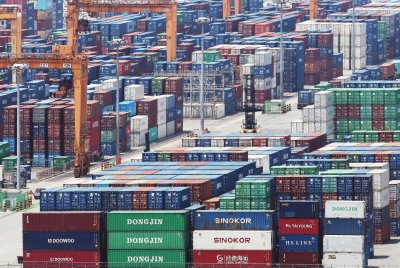
South Korea revised its 2026 growth projection to 3 percent based on strong exports and a semiconductor boom, officials said Tuesday. This July 1 photo shows containers stacked at a port in Pyeongtaek. File Photo by Yonhap
The South Korean government on Tuesday revised up its economic growth projection for 2026 to 3 percent, up 1 percentage point from its previous outlook, citing a semiconductor supercycle and easing uncertainties surrounding the Middle East.
The Ministry of Finance and Economy released its economic policy plan for the second half of 2026, presenting a forecast above the 2.6 percent estimates issued by the International Monetary Fund (IMF), the Organization for Economic Cooperation and Development (OECD) and the Asian Development Bank (ADB).
“This is the first year in which the Lee Jae Myung administration is taking full responsibility for the country’s economic management,” First Vice Finance Minister Lee Hyoung-il said during a press conference held in the central city of Sejong.
“On the back of the government’s prompt response to the Middle East war and robust export performance, the economy is maintaining a stable growth trend,” the first vice finance minister said, adding that the revised 3 percent growth forecast reflects those developments.
Lee said the revised growth forecast, which is significantly higher than those presented by major international institutions, remains achievable because it reflects the latest data.
“I think the outlooks from other organizations were based on data from March and April,” Lee said. “We made our assessment based on the latest data, with the major changes including stronger exports driven by the semiconductor boom. Tensions in the Middle East have eased further since then.”
“We believe such developments will exert downward pressure on consumer prices and inflation, positively affecting both exports and consumption,” he added.
In the report, the finance ministry said the policy vision for the remainder of 2026 is to mark the first year of a major economic leap toward establishing an “irreplaceable Republic of Korea,” referring to South Korea’s official name.
Seoul also unveiled the so-called 3-4-5 vision, under which the country will seek to achieve a potential growth rate of 3 percent, become one of the world’s top four exporters, and raise gross national income (GNI) per capita to US$50,000. The GNI per capita came to US$36,850 in 2025.
The finance ministry said the growth momentum, which began to expand in the second half of 2025, is expected to further accelerate this year on the back of the continuing semiconductor boom, along with policy measures, including an extra budget aimed at shielding the country from the impact of the Middle East war.
The country will also seek to successfully implement three mega projects aimed at fostering the semiconductor, AI data center and physical AI industries, the report said.
South Korea will additionally focus on maintaining an unwavering supply chain based on lessons learned from the Middle East war, including offering tax benefits for the domestic production of strategically important items.
On exports, the finance ministry said South Korea’s outbound shipments are expected to jump a whopping 40 percent on-year in 2026 on the back of the global artificial intelligence (AI) boom.
Non-IT products, such as ships, biohealth and secondary batteries, are also expected to remain robust, it added.
South Korea’s monthly exports reached a record $102.25 billion in June, surpassing the $100 billion mark for the first time after jumping 70.9 percent on-year.
The current account for 2026 was expected to reach a $290 billion surplus, marking a record high, buoyed by the surge in overseas demand and an increase in the number of foreign tourists.
In 2027, however, the current account surplus was expected to narrow to $245 billion following a rise in imports on the back of increasing domestic consumption.
Facility investment for 2026 could expand 5 percent on-year due to the robust performance of semiconductor manufacturing equipment, although growth will be limited by sluggish machinery and petrochemical sectors.
The policy report also projected inflation of 2.6 percent in 2026, up from the previous 2.1 percent estimate, citing the lingering impact of the Middle East war, which led to higher petroleum prices.
Core inflation, which excludes volatile food and energy prices, is expected to remain at around 2 percent.
“In the second half of 2026, as tensions surrounding the Middle East war ease and global crude oil prices decline, consumer price growth is expected to slow,” the ministry said.
“However, uncertainties also linger amid the progress of Middle East war negotiations and weather conditions, which could lead to volatility in energy and agricultural product prices,” it added.
Looking ahead to 2027, the ministry projected annual inflation to reach 2.2 percent despite lower global crude oil prices due to demand-led inflationary pressure.
The government said it will continue to focus on rolling out a post-Middle East war strategy by pursuing stable macroeconomic policies while maintaining a stable supply chain.
“In response to the changing economic environment, we plan to establish a comprehensive response system to maintain market stability across the macroeconomy, financial markets, the foreign exchange market and the real estate market,” the first vice finance minister said. “Based on favorable tax revenue conditions, we will continue active fiscal management.”
Copyright (c) Yonhap News Agency prohibits its content from being redistributed or reprinted without consent, and forbids the content from being learned and used by artificial intelligence systems.