Tottenham’s victory came down to Ho’s brave tactics and his team’s superb execution of them.
After going behind, they pressed City constantly, forcing errors and creating chances. That tenacity won them countless one-on-ones, with City unable or unwilling to play over the press.
After her goal, Shaw was rendered anonymous by the hard work and close marking of centre-backs Toko Koga and Amanda Nilden.
Down the right, Kirsty Hanson dominated Carlotta Wamser, could have been awarded a penalty and provided the low cross for Cathinka Tandberg’s equaliser.
In midfield, Drew Spence pulled all the strings and covered the entire pitch. At 34, she is perhaps playing the best football of her career and deserved her assist for the winner. After Matilda Vinberg put Spurs in front, several players ran to celebrate with Spence.
“When you come into this, you wonder if it will go against you, but the players were outstanding,” said Ho.
“We haven’t won here in so long, so we know it will be a tough game, but I have belief in my team when we are on song. I thought we were outstanding – we worked every blade of grass.”
Spurs are clearly capable of taking the game to anyone in the league and have now scored 28 WSL goals this season, with only Chelsea and London City having more.
In the second half they adapted to City sending on such fluid attacking threats as Mary Fowler, Kerstin Casperij and Beth Mead.
They lifted the gas from the press, applying it more sparingly, and were solid in defence.
It shows that Ho has learned painful lessons from the past – whether from Spurs’ poor record against City, including two five-goal losses in 2025-26, or conceding six to Chelsea and London City back to back in October.
“We have maybe been naive at times and I own that, so we are more reserved,” Ho said of his tactical approach. “It was managing that, and the players’ communication was excellent.”
City were limited to fleeting chances. Jade Rose blasting over after keeper Lize Kop parried a Lauren Hemp free-kick was as close as they came to a second goal, and those were their first shots after a 50-minute drought.
When Spurs got their late chances through the hard work of Vinberg, they could strike for three points.
Vinberg had quite the rollercoaster afternoon. She was initially named on the bench but was promoted to the starting XI 15 minutes before kick-off as Olivia Holdt was suffering stomach cramps.
Perhaps unprepared, she gave away the ball playing out of defence leading to City’s opener. But she grew into the game, scored Spurs’ second goal and set up Jess Naz for the third.
It was a great moment for Naz, on her 100th WSL appearance of a career that has been disrupted by injury.
Spurs are back in Manchester before Christmas, visiting United on 20 December.
There will be real hope of a positive result as they press their way into contention for what would be a historic achievement of a top-three finish.
A sold-out away end helped fill out the 32,000-strong crowd at the Emirates on Sunday as many hoped for an end-to-end encounter.
They were not disappointed as fearless London City showed bravery against an Arsenal side who played with a spark following their 1-1 draw with Barcelona.
The visitors were helped out by Arsenal’s wastefulness – the Gunners had 17 shots and only converted one – but London City caused plenty of problems of their own.
Maestre said after their defeat by Manchester City that their opponents showed more experience and know-how but against Arsenal, his side matured.
They were under pressure early on and fell a goal down thanks to Frida Maanum’s opener but it took just 98 seconds for Izzy Goodwin to equalise for London City.
That killed Arsenal’s momentum and when the pressure increased again from the hosts in the second half, goalkeeper and player of the match Mary Earps stepped up to make crucial saves.
“The performance was there. We had the chances to score and get a better result but Arsenal had chances too. The game was very open,” said Maestre.
“The way we faced and challenged every circumstance in the game shows we are here, and able to play with that mentality in these big games.
“We came here to take risks. Our energy was good. We were brave and weren’t scared about the context or the opponent.
“We tried to play as if we were at home. I always want to feel that my teams are brave and go for the win.”
That bravery showed as Alexia Putellas came close twice with long-range efforts, Goodwin could have been onside when she was played in behind later on.
London City hit the crossbar through substitute Delphine Cascarino and had 14 shots compared to Arsenal’s 17, including four inside the box.
Arsenal are still yet to win at home this season in the WSL but this was still an impressive showing from London City, who came to the Emirates to play.
But while they were willing to take risks, they were smarter than they were against Manchester City, choosing when to press aggressively and when to hold off.
“We tried to match the pace of the ball and not expose ourselves as much to the players that Arsenal have,” added Maestre.
“We were trying to mix the moments we were more clinical in our press. We made some adjustments at half-time and were much better at recognising those.”
Naval Air Systems Command (NAVAIR) is now “conducting market research to determine the industrial base’s existing capability and facility capacity to provide supplemental or secondary Service Life Modification (SLM) turnkey capacity for F/A-18E/F Super Hornet and EA-18G Growler aircraft starting in FY29 [Fiscal Year 2029],” according to a contracting notice put out earlier this week. “To support long-term strike fighter inventory requirements, the Government is evaluating the availability of additional commercial or second-source depot modification repair overhaul (MRO) capacity.”
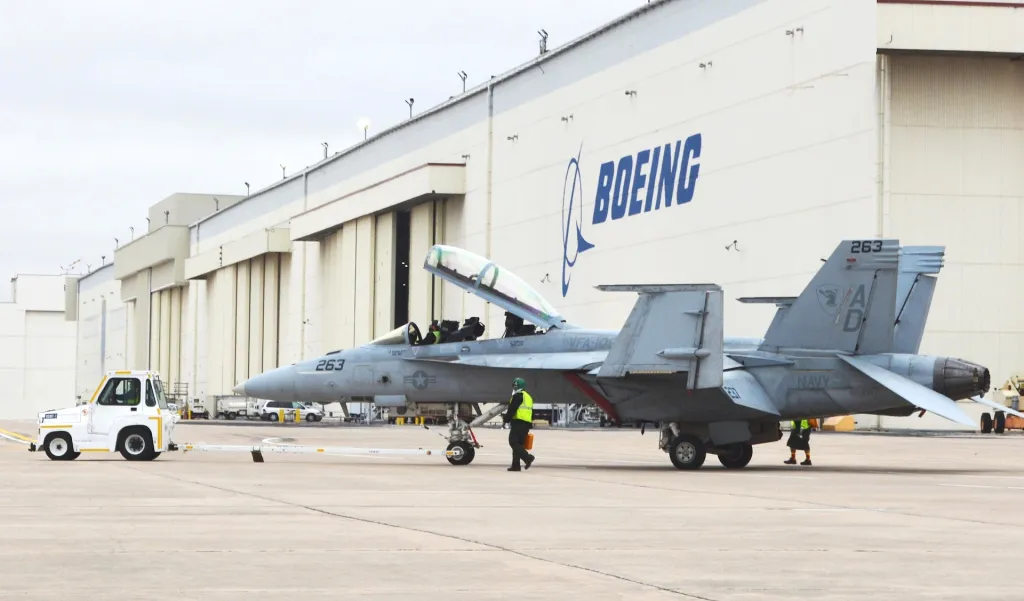
Currently, Boeing performs Service Life Modification (SLM) work on Navy F/A-18E/Fs at facilities in St. Louis, Missouri, and San Antonio, Texas. The Navy has its own Super Hornet SLM line, operated in cooperation with Boeing, at the Fleet Readiness Center Southwest (FRCSW) depot in San Diego, California. Boeing conducts additional F/A-18E/F and EA-18G modification work at various facilities, including an additional site in Jacksonville, Florida.
Workers move a US Navy F/A-18F Super Hornet at Boeing’s facility in San Antonio, Texas. USN
The Navy still plans to put most, if not all, of its F/A-18E/Fs – a total fleet of approximately 550 aircraft at present – through the SLM process, and that work is expected to continue in the mid-2030s. SLM extends the service life of Super Hornets from 6,000 to 10,000 flight hours. The jets also receive Block III upgrades, including new wide-area touchscreen multifunction displays, major boosts in onboard networking capability and computer processing power, and an improved avionics suite.
Overall, “PMA-265 [the F/A-18E/F and EA-18G Program Office] anticipates a maximum SLM induction profile of up to 47 aircraft per year across the industrial base,” according to the recent NAVAIR contracting notice. “Actual aircraft allocation among available sources may vary based on Fleet requirements, aircraft availability, demonstrated performance, schedule, and available capacity.”
It is not immediately clear whether the 47-aircraft-per-year target represents a major increase in expected SLM throughput. Back in 2020, the Navy said its goal was to be inducting 40 Super Hornets into the SLM pipeline annually within three years. There was no indication at that time that this figure included any SLM and/or other upgrade work on its Growlers.
Super Hornets seen going through the SLM process at Boeing’s plant in St. Louis. USN
“Our expansion plans across the St. Louis site triggered the execution of a multi-year strategic plan, requiring the relocation of some work,” Dan Gillian, Vice President and General Manager of Air Dominance at Boeing, had said in a statement accompanying last year’s announcement about plans to move Super Hornet SLM work to other locations. “Given we are already successfully conducting SLM at other locations, this move is logical so we can continue to meet our customers commitments while ensuring we are well poised for future work.”
“Delivering two advanced fighters in parallel was always our plan, and we invested accordingly,” Steve Parker, President and CEO of Boeing Defense, Space & Security, said in a statement after the company won the F/A-XX competition. “We are ready and able to build multiple concurrent future combat aircraft franchise programs.”
A rendering of the Boeing F/A-XX next-generation carrier-based fighter for the US Navy. Boeing
F/A-XX is expected to eventually replace the Navy’s F/A-18E/F and EA-18G fleets, but the first of those next-generation fighters are not expected to begin entering service until some time in the 2030s. As such, Super Hornets and Growlers look set to continue being the primary workhorses of the service’s carrier air wings for years to come.
In turn, ensuring that there are no major disruptions to the SLM process and other upgrades for the F/A-18E/F and EA-18G will continue to be a priority for the Navy, as underscored now by the recent NAVAIR contracting notice. The possibility of the F/A-18E/F fleet receiving additional significant upgrades in the future, particularly to extend their range, has also been raised in the past. The arsenal of munitions available to the Navy’s Super Hornet is also growing substantially. This includes a still-expanding array of longer-range air-to-air missiles, as well as hypersonic Blackbeard air-to-surface missiles.
An F/A-18E Super Hornet carries four AIM-424 Malice very-long-range air-to-air missiles during a test flight. Malice is one of several advanced new weapons the Navy is now adding to the Super Hornet’s arsenal. USN
Just expanding the Super Hornet/Growler SLM/upgrade pipeline could open up interesting new opportunities for companies beyond Boeing. Northrop Grumman, which lost in the F/A-XX competition, has been involved in Super Hornet production in the past as a subcontractor. The Navy might also be interested in tapping new firms, including ones that are already working to expand their defense industrial presence, rather than long-established prime defense contractors.
“We have worked with the Navy for years to improve SLM while growing in San Antonio and FRC Southwest,” Mark Sears, Boeing Fighters Vice President, also said last year. “Delivering multiple fighters and capabilities from multiple locations is what we do, and we will continue that work on the Super Hornets for the life of the fleet.”
NAVAIR’s recent announcement makes clear that the Navy is still very much in the early phases of determining what, if any, new courses of action it ultimately wants to take regarding SLM and other upgrade work for its F/A-18E/F and EA-18G fleets. That being said, new facilities to support those efforts, potentially with new contractors running them, may now be on the horizon
IF THE damp days and dark nights are getting to you, then you could head away for a month in the sun for less than HALF the average UK monthly rent.
The average UK rent costs £1,406 per month, but instead you could head away for just £624 for a month with flights, accommodation, food and drink all included.
With On the Beach you could head away from gloomy UK and spend 28-nights in TunisiaSource: onthebeach.co.ukThe trip would cost £624 per person, working out at £22 per person per daySource: onthebeach.co.uk
That works out at just £22 per day, per person.
The break is with On the Beach for 28 nights at the Skanes Serail Hotel in Monastir, Tunisia.
Sign up for the Travel newsletter
Thank you!
Rooms at the hotel vary, but every room has a balcony which overlooks the garden, pool or sea.
There’s also an indoor pool, a spa, an aquapark and a beachside barbeque area on site.
The resort even has its own private stretch of beach.
When it comes to food and drink, guests can dine at three restaurants, before choosing a tipple at one of the four bars.
If taking kids, there is a kids’ club to keep them occupied as well as live shows.
And for fitness fanatics, there is a climbing gym and tenniscourts as well.
Included in the prices are flights, accommodation, food and drinkSource: onthebeach.co.ukYou’d stay at the Skanes Serail Hotel in Monastir, Tunisia which has its own aquapark and private stretch of beachSource: onthebeach.co.uk
From the hotel, it takes six minutes to drive to Monastir city, where you can explore an Islamic monastery, the medina and a number of souks.
It’s also a 12 minute drive to Sousse, which is the ideal spot for a day trip.
Thanks to the hotel being all inclusive, whilst staying guests can help themselves to the buffet dining as well as local beer, wine and selected spirits.
Food and drink is included as well, with resort being home to four restaurantsSource: onthebeach.co.ukOther things to do at the hotel include tennis, a kids’ club and live showsSource: onthebeach.co.uk
The offer is available on breaks in November, December, January and February.
High temperatures across these months range from 15C to 23C, with November and December being the warmer months of the four.
Caspar Nelson, vice-president of marketing and customer at On the Beach, said: “Twenty quid barely gets a couple a fish-and-chip supper these days.
“On this holiday, it stretches as far as you can take it.
“Brits have had enough of opening bills through their fingers and we would much rather see them opening the curtains to a sea view instead.
“If you’ve got the time, why spend another four weeks dreaming about a getaway when you could be packing for one? Bring your suitcase, leave the high daily prices of the UK behind you and go and live in the sun.”
Super League has said its shareholders have agreed to expand the league from 14 clubs to 15 for the 2027 season.
The league expanded from 12 to 14 teams in time for 2026, allowing Bradford Bulls, York Knights and Toulouse Olympique to join, with Salford Red Devils dropping out after a financially tumultuous 2025 campaign.
It will be the first time the league has operated with 15 clubs, with the top flight running with 12 for much of its existence apart from spells with 14 teams in 2000, from 2009 to 2014 and last season.
Chelsea manager Sonia Bompastor says Lauren James will be out for at least the next few weeks, casting doubt on her availability for England’s World Cup qualifying play-off matches.
The 25-year-old will miss at least the next five matches for the Blues, including Everton’s visit to Stamford Bridge on Saturday and a crucial match against champions Manchester City next weekend.
It also casts doubt on her chances of being available for England’s World Cup qualifying play-off matches against Ukraine in December.
After James came off in distress in the 35th minute of the 6-0 win over Charlton Athletic, Bompastor confirmed the injury: “The only one who will be missing is LJ.
“She had a scan and she has an injury in her hamstring, so we won’t see her until the end of this block.”
There was more positive news for Chelsea, with midfielder Lexi Potter, who made her England debut last month, back after missing the trip to Charlton.
Chelsea, meanwhile, are top of the WSL table having won matches both with and without James this season.
Bompastor added: “Of course we know how good Lauren is for us and for the team.
“Also, my job is to make sure I find solutions when some players are not available and not playing for the team. I think the good thing is that when I looked at some of the statistics from last week, we are a team who are able to score through different players.
“The last game we had against Charlton, a lot of players were involved in scoring again. Also, I think every player on the pitch had a shot on goal.
“Even if it was not always a great one, at least all of the players who were on the pitch had a shot on goal. I think that’s a good thing and, again, my job now is to make sure I find the solutions without LJ on the pitch.”
Earnings Call Insights: Super Micro Computer, Inc. (SMCI) Q1 FY2027
Management View
“Q1 revenue reached $19.9 billion, between the high end of our preannouncement and well ahead of our original outlook of $15 billion,” said (Founder, Chairman of the Board, President & CEO Charles Liang), tying the quarter’s surge to
Seeking Alpha’s Disclaimer:This article was automatically generated by an AI tool based on content available on the Seeking Alpha website, and has not been curated or reviewed by humans. Due to inherent limitations in using AI-based tools, the accuracy, completeness, or timeliness of such articles cannot be guaranteed. This article is intended for informational purposes only. Seeking Alpha does not take account of your objectives or your financial situation and does not offer any personalized investment advice. Seeking Alpha is not a licensed securities dealer, broker or US investment adviser or investment bank.
Average Women’s Super League attendances surged by 192% in the season after the Lionesses’ Euro 2022 triumph, but the speed of the boom has stalled.
Median crowds have risen by just 166 fans, from 3,070 in 2023-24 to 3,236 in 2025-2026, according to a 2026 report from YouGov and architecture firm Populous, external.
Some of the biggest fixtures are now attracting significantly smaller attendances.
Arsenal against Manchester United at Emirates Stadium fell from 46,603 in 2024-25 to 29,853 this season, while Chelsea v Arsenal dropped from 34,302 to 19,349 over the same period.
The Gunners, who averaged 34,000 at the Emirates last season – almost four times the next-highest club, Chelsea, and higher than eight Premier League sides, external – had just 19,546 for their October match against Birmingham City.
There are bright spots, including a sold-out 4,000-ticket Arsenal away allocation at Tottenham for the first time, but the wider trend for some matches is clear.
Manchester United against Manchester City was hosted at Leigh Village in October with a crowd of 5,361. The same fixture was held at Old Trafford in March 2026 with 24,983 fans.
So what is behind the decline? Marketing, scheduling, matchday experience, stadium design, product or something else?
Jay-Z has chosen himself to headline the Super Bowl halftime show.
The 25-time Grammy winner will perform at Inglewood’s SoFi Stadium on Valentine’s Day, Apple Music, the NFL and Roc Nation announced during the Cowboys vs. Eagles “Monday Night Football” matchup.
This caps a banner year for Jay-Z. The rap superstar performed two back-to-back concerts at SoFi Stadium last weekend — part of his “Jay-Z 30” tour celebrating the 30th anniversary of his debut album, “Reasonable Doubt,” and the 25th anniversary of “The Blueprint.” He sold out three nights at New York’s Yankee Stadium in July, followed by stops in London and Paris. He partnered with legendary music producer Rick Rubin on “Jay-Z in 8,” an eight-part documentary about his life and legacy released by HBO last month.
“From Reasonable Doubt to standing on the Super Bowl Halftime stage, this has been a journey,” Jay-Z said in a news release. “Thirty years of music, work and culture on the world’s biggest stage. This run continues to be a dream come true.”
Miley Cyrus, Justin Bieber and Harry Styles were reportedly also in the running, but lost out to the decision-maker himself.
Super Bowl LXI marks the eighth year that Roc Nation, the entertainment behemoth founded by Jay-Z, will produce the halftime show. The Brooklyn rapper has had the ultimate say in who the halftime performer is every year since 2020. In 2019, Roc Nation signed on to consult the NFL on live music entertainment and the social justice initiative Inspire Change, which aims to reduce barriers to opportunity, especially in underserved communities. They extended their deal in 2024 for another five years.
Roc Nation will executive-produce “The Apple Music Super Bowl LXI Halftime Show” and Hamish Hamilton will serve as director.
“For several years, we’ve had the privilege of working closely with Jay-Z and Roc Nation, and I’ve seen the extraordinary impact he has had on the Super Bowl Halftime Show,” NFL Commissioner Roger Goodell said in a news release. “When we first reached an agreement with Roc Nation to produce the show, I had just one request: that Jay-Z take the stage himself one day, whenever the moment felt right to him. I couldn’t be more excited for fans around the world to experience the artistry, creativity and cultural impact he will bring to the Super Bowl stage.”
Jay-Z told Entertainment Tonight in 2024 that it was too soon for him to take on the task.
“I thought it would be selfish to pick myself too early. Maybe one year. Maybe,” he said.
The NFL had approached him years prior about headlining the Super Bowl halftime show, but it came with the stipulation to perform “Run This Town” with Rihanna and Kanye West.
“Of course I would have,” Jay-Z told the New York Times in 2020, “but I said, ‘No, you get me.’ That is not how you go about it, telling someone that they’re going to do the halftime show contingent on who they bring. I said forget it. It was a principle thing.”
Rihanna eventually performed at the 2023 Super Bowl. She may be one of his guest stars come Feb. 14, but he could tap any top artist to perform, considering his label’s deep roster of talent … and the fact that he’s married to Beyoncé. Beyoncé headlined the halftime show in 2013 and made a guest appearance during Coldplay’s Super Bowl 50 set in 2016.
Bad Bunny headlined the show in February, which created an uproar and something of a culture war. “Turning Point USA, the conservative organization founded by the late Charlie Kirk, put together a so-called All-American Halftime Show featuring Kid Rock in an appeal to viewers scandalized by … the Spanish language? Dancing? The idea of fun?” Times music critic Mikael Wood wrote in his review. “For the NFL, the blowback was a calculated risk as the league makes a push to globalize its fan base.”
Before Bad Bunny, performers have included (in reverse chronological order): Kendrick Lamar; Usher; Rihanna; Eminem, Dr. Dre, Snoop Dogg, Kendrick Lamar and Mary J. Blige (all together in 2022); the Weeknd; and Shakira and Jennifer Lopez (also together). Last season’s game drew almost 125 million viewers; this is one of — if not the — biggest stages in music.
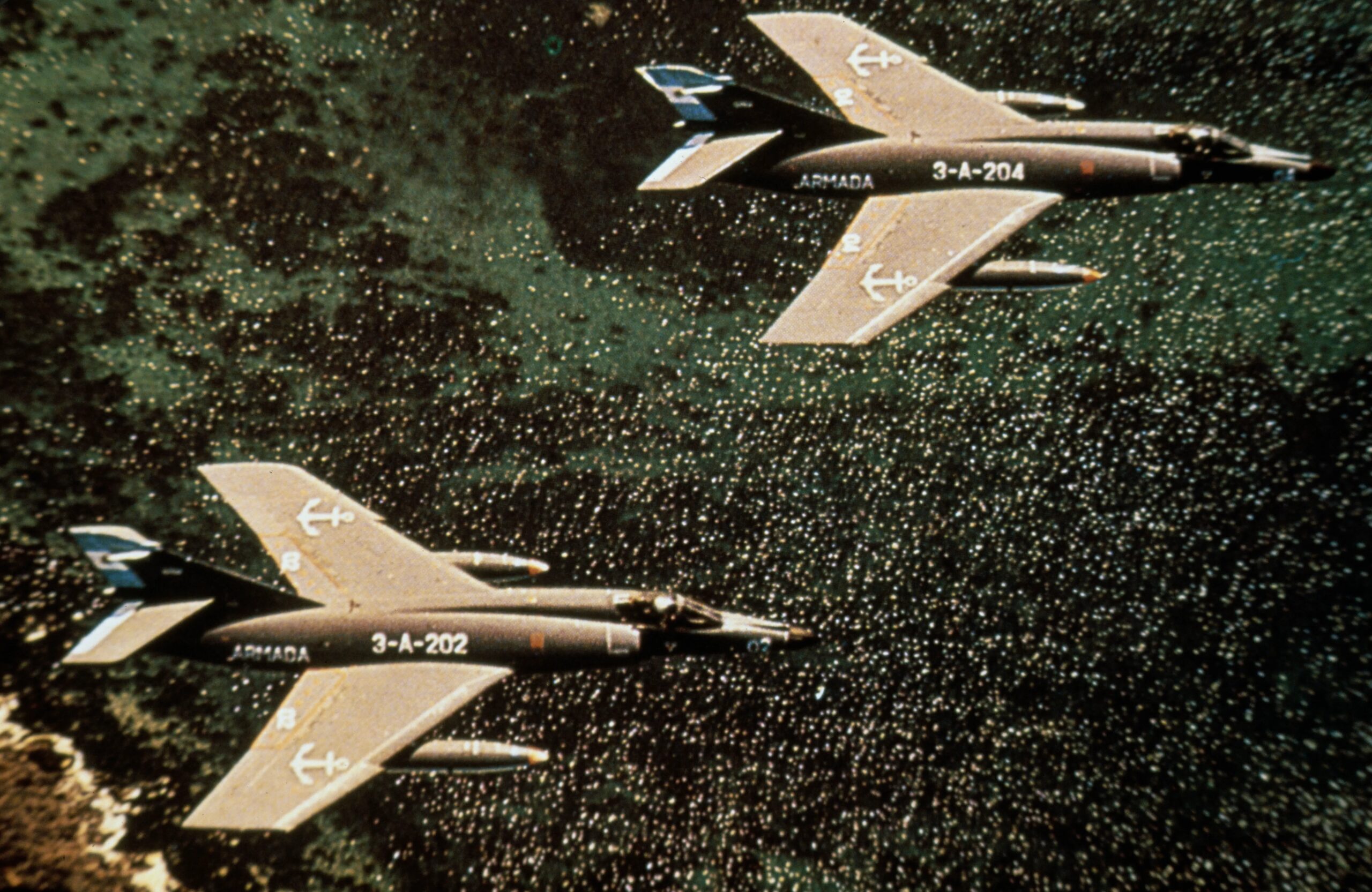
No single Argentine capability shaped British planning during the 1982 South Atlantic conflict more than the pairing of the Dassault Super Étendard strike fighter and its deadly AM39 Exocet anti-ship missile. Against that threat, the British launched a series of special forces operations, all with the same objective: kill the Argentine pilots and destroy their aircraft and missiles before they could be used again. Together, the strike fighter and missile pairing had proven to be the biggest threat to the Royal Navy task force that had been sent to recapture the islands.
Two Super Étendards of the Argentine Navy in flight around the time of the Falklands War in 1982. Photo by UPI/Bettmann Archive/Getty Images
Five Super Étendard aircraft and five AM39 Exocet missiles had been delivered to Argentina before a French embargo took hold. The jets were flown by the Argentine Navy’s 2nd Naval Fighter and Attack Squadron out of Río Grande, on Tierra del Fuego, a region at South America’s southernmost tip, shared by Chile and Argentina. The Super Étendard/Exocet combination had already cost the British the destroyer HMS Sheffield on May 4 and the container ship Atlantic Conveyor on May 25.
A casualty from HMS Sheffield being rushed to the sick bay on board the aircraft carrier HMS Hermes. Crown Copyright
The special forces operations were broken down into four phases — named PLUM DUFF, MIKADO, KETTLEDRUM, and IMPI — the last of which is the least well-documented, and the focus of this article.
PLUM DUFF was the insertion phase and was a reconnaissance mission. On May 16, an RAF Hercules airdropped eight special forces troops onto RFA Fort Austin to form a recce party. On the night of May 17/18, a Sea King HC4, ZA290, lifted off from the aircraft carrier HMS Invincible for a one-way flight to Tierra del Fuego, where the men were to observe Río Grande and report back. The patrol was set down far from the objective and never completed the reconnaissance; the helicopter crew flew on into Chile, where the aircraft was deliberately burnt to try and hide the evidence, while they tried to evade capture.
Commandos being lifted from the decks of HMS Hermes and HMS Invincible to be transferred by Sea King helicopters to other ships while the two aircraft carriers forge ahead to the Falkland Islands from Ascension Island, leaving the marines ready to move at short notice. Photo by Fox Photos/Getty Images
MIKADO was the planned attack phase, and it depended on that missing intelligence. Two Hercules were to air-land up to 70 men of B Squadron, 22 Special Air Service (SAS), directly on Río Grande — the air operation order of May 19 also named Río Gallegos, further up the Argentine coast, as an alternative. The men would destroy the Super Étendards and their Exocets on the ground, kill the pilots, and then withdraw overland into Chile. Commander Task Force 317, at Northwood, accepted from the outset that the mission could well cost both Hercules.
Lieutenant Juan José “Tierno” Rodríguez Mariani in Super Étendard 3-A-203, preparing to take off from Río Grande on May 23, 1982; note the ground power unit still connected. Armada Argentina
The aircrew did not refuse the task, but they were blunt about what it demanded: formation landing by two heavy transports on a possibly heavily defended, icy military runway, with a probable 20-knot tailwind, at night and on passive night-vision goggles in minimum light levels, with intelligence that was inadequate to support any air-land option at all. The RAF planning team recommended an airdrop as the better way to maintain a covert posture, and the Senior Air Staff Officer at Headquarters 38 Group warned the Air Commander to watch for overambitious schemes coming out of the SAS.
The U.K. Ministry of Defense formally cancelled MIKADO on June 4.
KETTLEDRUM was planned as the third of the set. It was aimed at Puerto Deseado, Santa Cruz Province of Argentina, and would have inserted a Special Boat Service party (SBS, the Royal Marines’ special forces unit) from the submarine HMS Onyx — a boat that will reappear before the end of this story.
None of the three was executed as planned.
The Oberon class submarine HMS Onyx on the surface off Ascension Island. HMS Onyx was the only diesel-electric British submarine to serve in the conflict, and its ability to operate silently close inshore enabled it to play an important role. At Ascension Island, Onyx boarded SAS and SBS special forces personnel and supported them during a series of operations. Imperial War Museums via Getty Images
Less well-known is that the cancellation of MIKADO produced a fourth project: Operation IMPI, named after a Zulu fighting force.
Cancelling MIKADO did not mean the wider operation was over. Also on June 4, the U.K. Ministry of Defense tasked CTF 317 to produce a new plan for special forces to destroy the combat effectiveness of the Super Étendards.
CTF 317’s staff went to work on what became IMPI. The planning document, Ops 1/3, is dated June 14 — the day of the Argentine surrender in the islands. In broad terms, the objective was to be attacked by special forces arriving both by air and by sea.
That much has been known, in fragments.
Teniente de Naviro (Lieutenant Commander) Alfredo Astiz signing the Instrument of Surrender on behalf of his Argentine forces at Leith, on the island of South Georgia, on board HMS Plymouth. Crown Copyright
What has not been published until now is the fact that the operation had already been resourced.
At 2240Z on June 12, Maj. Gen. Jeremy Moore, commanding the land forces as CTG 317.1, signalled Rear Admiral Sandy Woodward’s battle group (CTG 317.8), with Admiral Sir John Fieldhouse at Northwood (CTF 317) and Commodore Michael Clapp’s amphibious group (CTG 317.0) as information addressees. The message called for B Squadron, 22 SAS, to be made available for operations as soon as possible: cover was needed against rapid developments of an unfavorable nature in West Falkland (Gran Malvina), and the theatre’s existing special forces assets were fully absorbed supporting the battle for Stanley — and IMPI. Operation IMPI, Moore noted in passing, was by then self-sufficient.
Maj. Gen. Sir Jeremy Moore Mc, Commander, Land Forces Falkland Islands Conflict. Photo by Avalon/Getty Images
Examining two lines of routine signal traffic settles several things at once. Forty-eight hours before the surrender, IMPI was not a staff study but an operation that had been resourced, and that was enough to consume the theatre’s special forces and justify calling a fresh SAS squadron forward. It is also the only contemporary, operational-level reference to IMPI released so far: everything else comes from a narrative written years afterwards.
As that later narrative describes it, the concept behind IMPI was much leaner than MIKADO. Against two Hercules and 70 men, the air element of IMPI rested on a single RAF Hercules.
Overflying Stanley Airfield in November 1983, with two RAF Hercules aircraft present. Getty Images
The aircraft was to fly from Ascension Island, refuel in flight, and then track east of the Falkland Islands and south of Cape Horn before making a low-level approach below Argentine radar cover for a night landing of special forces at the airfields codenamed San Jose and Arco Iris. Other special forces would have been inserted by sea. That air element, as will be seen, is the most questionable part of the entire file.
The routing is worth attention, because it rules out the intuitive picture of a direct run south from Ascension. Instead, the aircraft would have entered from the least-covered and least-expected direction, coming around the bottom of the continent rather than from the northeast.
A schematic map of the planned Operation IMPI. via author
The precise identities of San Jose and Arco Iris are not established in the declassified record.
The most likely reading is that they stand for Río Grande and Río Gallegos — the airfields at which the planned navigation ended, and the two named in MIKADO’s air operation order a month earlier. For a document circulating through restricted channels, encrypting the names of the two targets was an elementary precaution, although it should be noted that an operational order would more commonly have designated them simply as Target One and Target Two.
None of this rules out Chilean participation in other phases of the operation; if anything, it suggests it’s more likely. The narrative survives inside a folder classified Top Secret and restricted to the Chief of the Air Staff, whose declared subject is cooperation with Chile. That setting contrasts with the earlier stage of the planning, when mounting and recovering a special forces insertion from a Chilean airfield was considered and expressly discounted on political grounds — much as the use of an Antarctic strip was discounted after the New Zealand High Commission advised that the Antarctic winter precluded safe trans-polar flight.
The maritime half of IMPI can be traced in the records of those who were there.
Navigational support for the final phase was to come from the nuclear attack submarine HMS Conqueror. On June 9, 1982, Conqueror was off Bahía Camarones, working as an advanced picket and hunting targets of opportunity that ventured outside the 12-nautical-mile limit of Argentine territorial waters, with authority to sink any civilian vessel judged to be running to the Falklands/Malvinas; that same morning the sub had in fact entered Argentine territorial waters trying to locate the Argentine Navy’s Task Group 79.2.
Nuclear attack submarine HMS Conqueror returning to port. via author
That day, Conqueror received preparatory information on IMPI. The sub’s task was to come to periscope depth and act as a radio beacon, giving the Hercules a radio reference against which to refine a navigation that, low and at night, allowed no error. The resulting picture is an odd one: a nuclear submarine deployed on interdiction off the Patagonian coast, turned into a navigation aid for a transport aircraft.
The insertion itself fell to HMS Onyx, the Oberon class diesel-electric boat that had already taken part in Operation KETTLEDRUM and the only conventional submarine Britain deployed to the South Atlantic. On June 14, at 0815Z, lying in San Carlos Water, Onyx embarked a party of 10 men from B Squadron, 22 SAS and the SBS for the mission. The timing matches Moore’s signal of two days earlier almost exactly.
The plan called for the submarine to surface some two nautical miles offshore at night. The troops would close the beach in Gemini inflatables and destroy the objective — aircraft and missiles, if any were there — using anti-tank weapons and demolition charges.
What happened next illustrates the inertia of military machinery. The Argentine surrender in the islands came on that same June 14, hours after the party had gone aboard Onyx. Even so, preparations did not stop at once: on June 15 the embarked troops carried out practice landings from a Gemini. That does not mean IMPI was ever executed — it was not — but it does show that with the strategic outcome already settled, the machine was still rehearsing.
HMS Onyx operating with special forces. via author
The British record closes the matter with administrative dryness: the surrender of the Argentine forces in the Falkland Islands and the cessation of hostile activity by Argentine aircraft resulted in the operation being cancelled.
The air part of the mission is another matter entirely and is where IMPI becomes more uncertain.
The only link between IMPI and an aircraft is a single paragraph in an RAF historical narrative. The folder that holds it was opened on April 18, 1986 — four years after the war — as an eyes-only briefing file for the Chief of the Air Staff, and the pages appear to be a working draft rather than a finished submission, carrying pencil amendments throughout.
Had a Hercules been earmarked, there is no doubt which unit would have provided it. The Special Forces Flight that runs through the whole chapter — five crews, commanded by a squadron leader, exercising regularly with SAS and SBS Sections — appears with its squadron number blanked out, yet the number surfaces a few paragraphs later, where two of its crews are described training on the probe-fitted Hercules C1P. The unit was No. 47 Squadron, RAF, home-based at Lyneham, and it would keep the special forces air support role for decades afterward.
The men who were at Ascension with that detachment, however, say they had nothing to do with it. Reliable sources with direct knowledge of the flight’s activity state that they never saw the codeword at the time, had never heard of the operation until this file surfaced, and consider it inconceivable that a special forces Hercules and crew could have been earmarked for a mission of this kind without the flight — a community of five crews that has stayed in touch ever since — learning of it at some point in the intervening four decades. By June 14, at most one aerial-refueling-qualified special forces crew was at Wideawake.
That skepticism is reinforced by the way the same narrative handles events those crews lived through. Its account of their own work-up does not survive contact with their logbooks.
For example, a practice infiltration into RAF Laarbruch in Germany that the narrative describes as successful had in fact been detected; the Hercules was notionally shot down about two miles out on the approach. The ramp toes (attachable extension plates located at the very end of the rear cargo ramp) it describes as droppable at 20 to 30 knots were never meant to be lowered with the aircraft moving, which would have been unsafe and risked the airframe. There are other anomalies, too.
West Falklands seen from the ramp of an RAF Hercules. Donald Morrison/Getty Images
A document that misstates the squadron’s own exercises is thin evidence on which to place that squadron over Tierra del Fuego.
What is not in question is what the Special Forces Flight could have done, had it been asked.
By mid-May the flight had two crews qualified in air-to-air refueling — one deployed to Ascension, the other held in the United Kingdom to train the others — flying Hercules C1s fitted with probes and, where the task required it, additional fuel tanks in the fuselage. It had rehearsed stream landings and rapid offloads, parachute insertion below radar cover to a pinpoint coastal feature, as well as flying on ANVIS goggles at 250 feet over sea and land. The goggles themselves were fitted to the crews’ helmets by RAE Farnborough specialists in a single day in mid-April. The reach was demonstrated on May 16, when the sortie that dropped the PLUM DUFF party stayed airborne for 24 hours and five minutes, with Victor tankers refueling some 1,800 miles from Ascension. Almost none of it was routine: nearly everything the force did during the conflict was improvised, at speed, in a matter of weeks.
A picture taken on May 24, 1982, at Wideawake Airfield on Ascension Island, showing an RAF Victor tanker prepared for air-to-air refuelling tasks. Photo by AFP
What never had an answer — not for MIKADO, and not for whatever IMPI intended — was the other end of the problem. Putting men ashore deep inside Argentine territory was the solvable half. Getting an aircraft and its passengers out again after a direct action, from a strip in range of the Argentine Air Force, was not.
All of the above is reconstructed from lateral references: the RAF’s narrative in file AIR 20/13036 at the National Archives, unit records, submarine logs, operational signal traffic, and the accounts of participants.
The specific file — the one holding the complete plan with its annexes, the identification of the airfields and the execution sequence — remains closed. It is DEFE 71/980, titled Operation Corporate (Falklands Conflict): Operation IMPI, retained at the National Archives at Kew with no announced opening date. Until it is released, the air element of IMPI cannot be settled either way.
Forty-four years after the conflict, the last British special operation of the war is still, in essence, a document the British state is not prepared to show. That is not a trivial detail: the files touching on cooperation with Chile have consistently been the most reluctantly opened of all.
The folder holding the outline plan for Operation IMPI. National Archives
What remains is an operation of two halves. One of them is solid: a resourced plan, declared self-sufficient on June 12, with a nuclear submarine briefed to act as a beacon, 10 men of the SAS and the SBS embarked in a conventional submarine in San Carlos on the morning of the surrender, and rehearsals continuing the following day. The other half — a lone Hercules coming round Cape Horn to land on a codenamed strip — rests on one paragraph of a flawed staff narrative and is rejected by the only men who could have flown it.
Either way, the obsession is the same.
Between June 4 and June 14, 1982, while the final battle for Port Stanley/Puerto Argentino was being fought and the Argentine land campaign was collapsing, part of the British planning effort was still revolving around five French-built aircraft, their 10 aircrew, and their missiles. That the plan carries the date of the surrender itself, that it was still being rehearsed the following day, and that it remains classified today says a good deal about how far the British were prepared to go to destroy the Super Étendards and their Exocets.
Contact the editor: thomas@thewarzone.com
Mariano Sciaroni holds a master’s degree in Strategy and Geopolitics as well as a postgraduate diploma in Contemporary Military History, both earned at the Argentine Army’s Military Academy. Sciaroni has published five books and numerous articles on military and naval history. He is also an active member of the Argentine Institute of Military History and serves as a sub-lieutenant in the Argentine Army Reserve (Army Aviation Reserve Squadron). You can find out more about his books here.
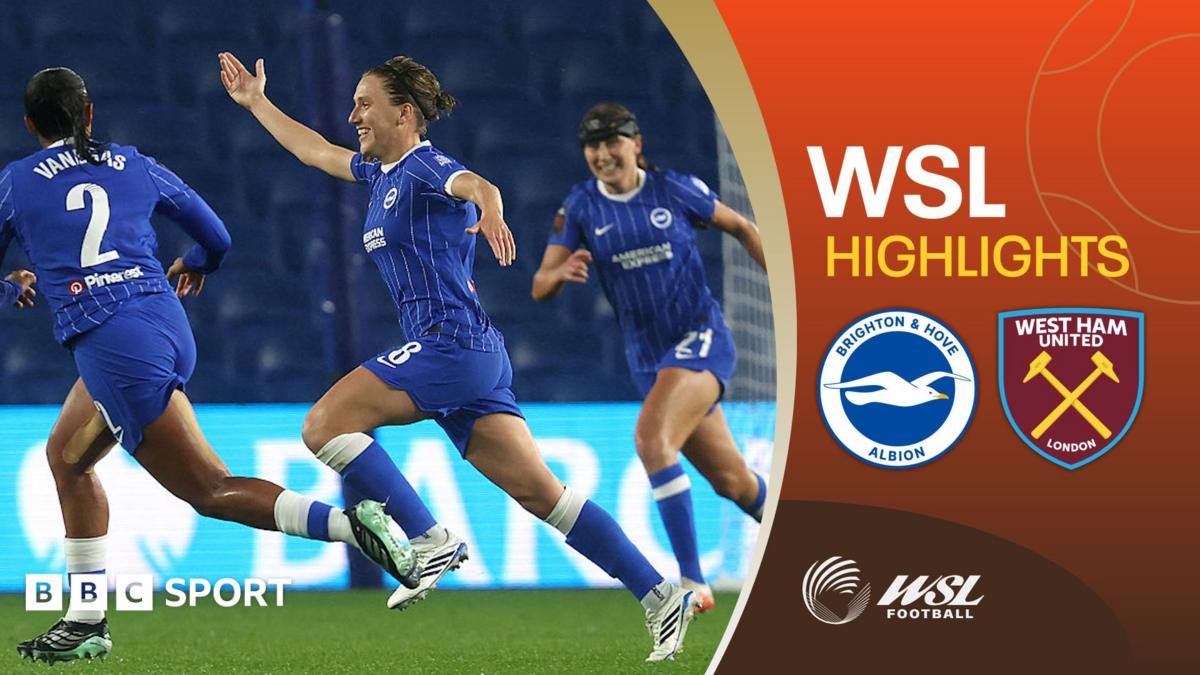
Maisie Symonds scores a “goal of the season” contender to help Brighton beat West Ham 3-0, securing just their second league win of the season in the Women’s Super League.