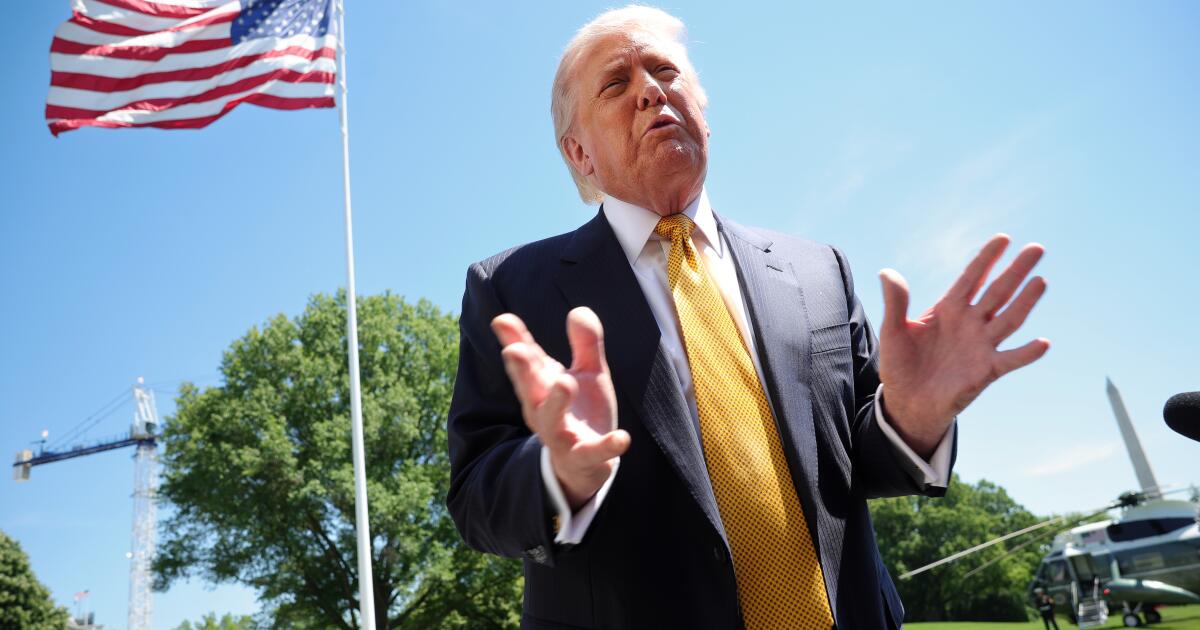
summit

Trump marvels at Chinese power as summit kicks off

An extraordinary display of power and precision along Tiananmen Square greeted President Trump in Beijing on Thursday, kicking off a two-day summit with particularly high stakes for the Americans.

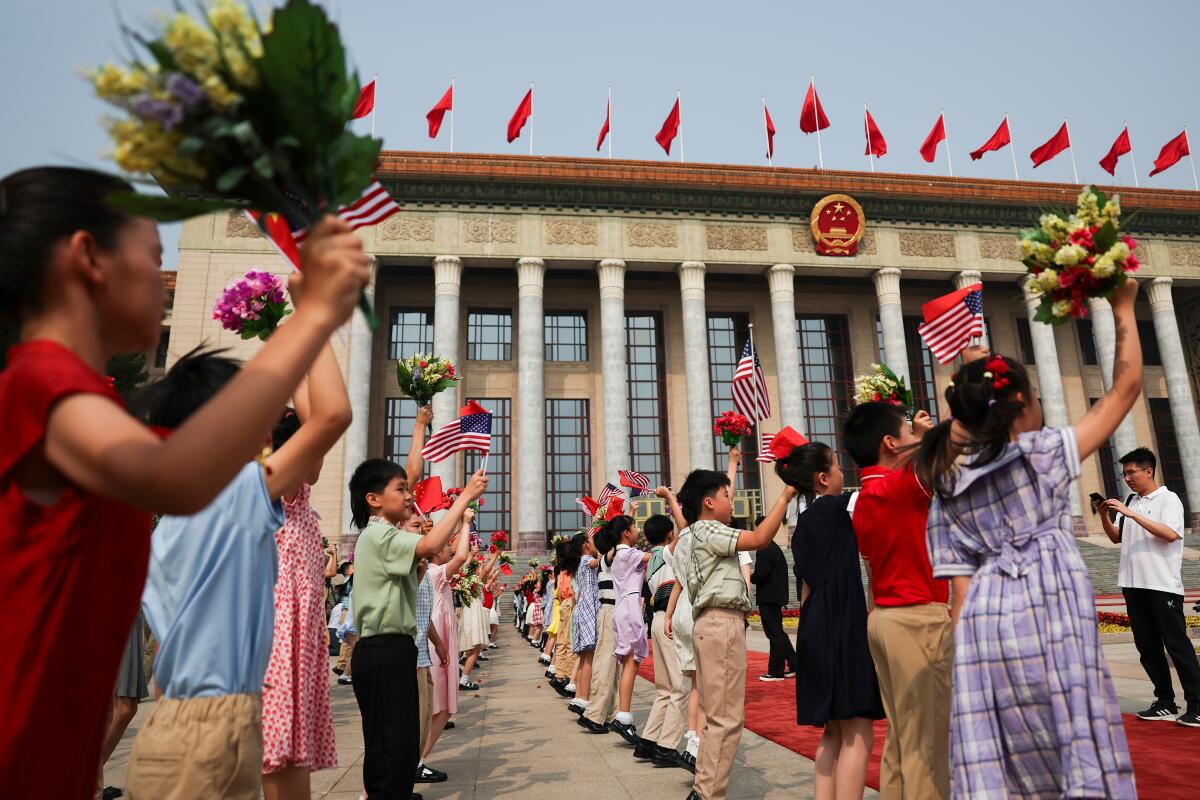
Trump’s meetings with his Chinese counterpart, Xi Jinping, began at the Great Hall of the People moments after a welcome ceremony that seemed to impress the president, featuring a Chinese military honor guard and a greeting from excited school children. American flags waved as “The Star Spangled Banner” rang out on a smoggy day in the heart of the capital.

Children holding Chinese and U.S. flags rehearse before the welcome ceremony for President Trump.

Children holding Chinese and U.S. flags rehearse before the welcome ceremony for President Trump.

(Maxim Shemetov / Associated Press)

Trump reflected on the stakes of his visit at the top of the meeting, telling Xi that the ceremony was an honor “like few I’ve seen before.”

“There are those who say it may be the biggest summit ever,” he said. “I have such respect for China, the job you’ve done.”

Both men struck a conciliatory tone, despite the agenda for the summit featuring some of the thorniest issues facing the two superpowers today, from the U.S. war in Iran to trade relations and the future of Taiwan.

“We’ve gotten along — when there have been difficulties, we’ve worked it out,” Trump added. “We’re going to have a fantastic future together.”

Trump is expected to ask Xi for help reopening the Strait of Hormuz, a vital commercial waterway disrupted by Iran since the start of the war, and for the extension of a truce in the trade war he started at the beginning of his second term.

China, in turn, will ask the Trump administration not to proceed with arms sales to Taiwan, despite their approval by Congress, and for a declaration of opposition to Taiwanese independence. Beijing also seeks access to top-end chips made by American manufacturers.

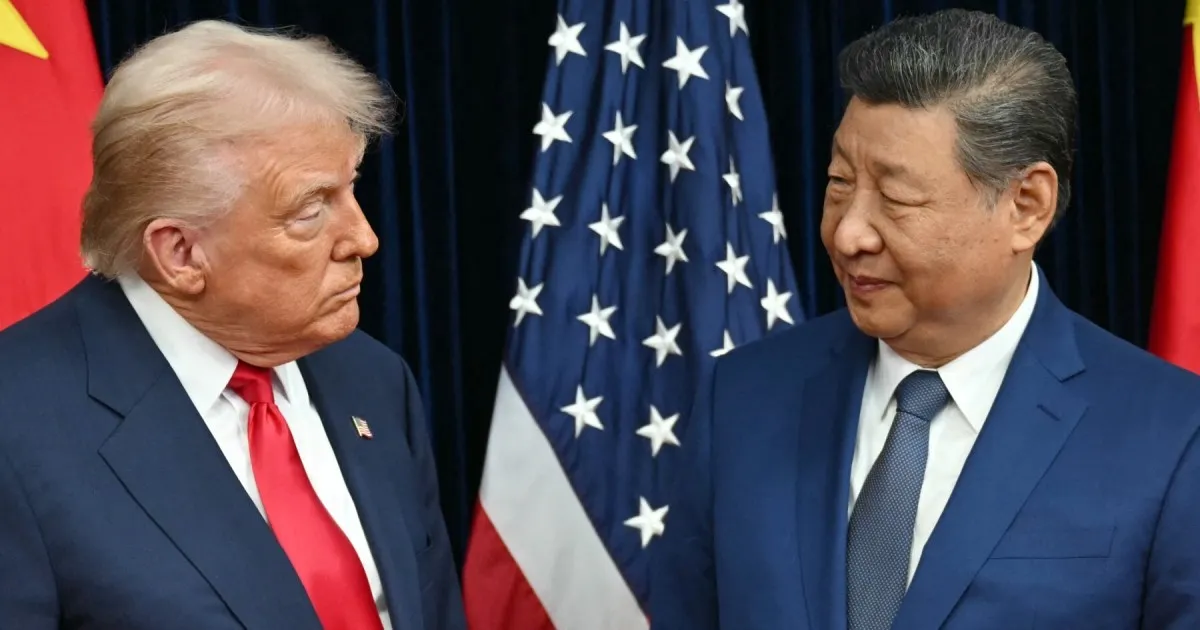
Chinese President Xi Jinping and President Trump shake hands at the Great Hall of the People.

Chinese President Xi Jinping and President Trump shake hands at the Great Hall of the People.

(Kenny Holston / Associated Press)

The agenda exposes the mutual dependence of the two rival superpowers, marked by distrust but driven by a quest for cooperation and stability.

The welcome ceremony outside of the Great Hall kicked off with Xi shaking the hands of Trump’s delegation, including figures such as his political advisor, James Blair, his communications director, Steven Cheung, and his daughter-in-law, Lara Trump.

They were just a few members of a U.S. delegation accompanying Trump filled with curiosities.

Chinese officials were surprised to learn that Pete Hegseth was joining Trump in Beijing this week, marking the first time a president has brought his secretary of defense on an official state visit. It wasn’t immediately clear to the Chinese what his inclusion was meant to convey.

Eric Trump, the president’s son, is here, seeking to leverage the family name for lucrative business deals as Beijing aggressively campaigns against government corruption at home. And First Lady Melania Trump decided to stay at home, an unusual snub of such a high-level event.

A contingent of U.S. business leaders was given little notice to prepare for the trip, including the CEO of Nvidia, who raced to join Trump aboard Air Force One at a refueling stop in Alaksa.

The diplomatic faux pas follow weeks of Chinese frustration over what they see as the Trump administration’s lack of preparation — a perceived display of incompetence that boosts their confidence heading into the negotiations.

Over the course of the visit, Trump is expected to visit the Temple of Heaven, a monument to imperial China and Confucian thought in the center of Beijing. Ahead of Trump’s arrival, an area roughly the size of 400 American football fields was closed in preparation for a stop here.

On Thursday night, local time, Trump will return to the Great Hall of the People for a banquet dinner. Additional meetings are scheduled for Friday morning before Trump departs midday for home.

Source link

Lee meets Bessent, Chinese vice premier ahead of U.S.-China summit

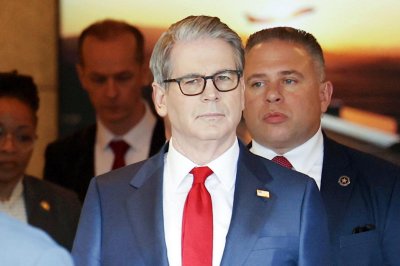
U.S. Treasury Secretary Scott Bessent, seen here arriving at Incheon Airport on Wednesday, met with South Korean President Lee Jae Myung and Chinese Vice Premier He Lifeng on a stop in Seoul ahead of his trip to Beijing for the Trump-Xi summit. Pool Photo by Yonhap

President Lee Jae Myung on Wednesday held back-to-back talks with U.S. Treasury Secretary Scott Bessent and Chinese Vice Premier He Lifeng, and reaffirmed their commitment to cooperation amid global challenges, his office said.

Lee said during his meeting with Bessent at Cheong Wa Dae that South Korea and the United States should further strengthen economic cooperation through close communication so that they can continue the “positive trend” of both countries maintaining stable economies despite increased global uncertainties, according to his spokesperson Kang Yu-jung.

Lee also called for further developing bilateral cooperation in the economic and technological sectors, especially in terms of critical minerals, supply chains and foreign exchange markets, the spokesperson told a press briefing.

While concurring with Lee’s remarks, Bessent credited his leadership for South Korea’s growth and stock market performance under difficult circumstances, such as the Middle East war, she said.

Lee held talks with He earlier in the day and asked him to play an active role in expanding cooperation between South Korea and China in diverse sectors, including the economy, industry, trade and culture.

The vice premier responded that he is pleased the two countries’ bilateral trade increased further this year and conveyed Chinese President Xi Jinping‘s greetings.

Lee recalled his meeting with Xi in January and asked that the vice premier also convey his sincerest greetings, the spokesperson said.

The back-to-back talks came as Bessent and He were in Seoul to coordinate the agenda of Thursday’s high-stakes summit between U.S. President Donald Trump and Xi in Beijing.

Following their meetings with Lee, the two officials met behind closed doors at a VIP lounge at Incheon International Airport, west of Seoul.

The talks were held under tight security, with all access points to the lounge closed, including to the press.

Bessent will later head to Beijing to join Trump on his two-day visit to the country.

Copyright (c) Yonhap News Agency prohibits its content from being redistributed or reprinted without consent, and forbids the content from being learned and used by artificial intelligence systems.

Source link

China Warns US Over Taiwan Arms Sales Ahead of Trump Xi Summit

China renewed its strong opposition to U.S. arms sales to Taiwan ahead of the high profile summit between U.S. President Donald Trump and Chinese President Xi Jinping in Beijing.

Taiwan is expected to be one of the most sensitive issues discussed during the two day meeting, alongside trade disputes, regional security, and the ongoing Iran conflict.

Beijing considers Taiwan part of its territory, while the United States maintains unofficial relations with Taipei and remains legally committed to helping the island defend itself.

China Repeats Opposition to Arms Sales

China’s Taiwan Affairs Office warned Washington against expanding military cooperation with Taiwan and criticized U.S. weapons sales to the island.

Spokesperson Zhang Han described Taiwan as a core Chinese national interest and called on the United States to honor previous commitments under the One China framework.

Beijing argues that Taiwan is an internal Chinese matter and strongly opposes any foreign military involvement with the island.

Record US Weapons Package Raises Tensions

The Trump administration approved an $11 billion weapons package for Taiwan in December, marking the largest U.S. arms sale to the island to date.

Reports have also suggested that another arms package worth around $14 billion could be approved after Trump’s visit to China, though its current status remains unclear.

The United States says such sales are necessary to ensure Taiwan can defend itself against possible military pressure from China.

Taiwan Defence Budget Faces Scrutiny

The issue gained further attention after Taiwan’s opposition controlled parliament approved only part of a proposed $40 billion defense budget requested by President Lai Ching-te.

The approved funding prioritizes purchases of U.S. weapons while reducing spending on some domestic defense programs, including drones.

American officials reportedly expressed disappointment that the budget fell short of what Washington believes Taiwan needs for adequate defense preparedness.

Taiwanese officials fear Beijing could use the reduced spending as leverage during talks with Trump to argue against further U.S. military support for the island.

Taiwan Rejects Beijing Sovereignty Claims

Speaking at the Copenhagen Democracy Summit, Lai described Taiwan as a sovereign and independent nation that would not yield to external pressure.

China quickly rejected those remarks, reiterating that Taiwan has never been and will never become an independent country.

Beijing also repeated warnings that it retains the option of using force to bring Taiwan under its control, although it continues to publicly favor peaceful reunification.

Taiwan’s ruling Democratic Progressive Party responded by emphasizing the island’s democratic system, independent government, and military institutions.

Taiwan Remains Central to US China Rivalry

Taiwan has become one of the most dangerous flashpoints in U.S. China relations, with both powers viewing the issue as tied directly to national credibility and regional influence.

For China, Taiwan represents sovereignty, territorial integrity, and national unity. For the United States, support for Taiwan is linked to maintaining regional stability and reassuring allies in the Indo Pacific.

Analysts warn that increasing military activity, arms sales, and political tensions surrounding Taiwan continue to raise the risk of miscalculation between Washington and Beijing.

Analysis

China’s warning ahead of the Trump Xi summit highlights how deeply the Taiwan issue shapes the broader strategic rivalry between the United States and China.

Despite ongoing diplomatic engagement and trade negotiations, Taiwan remains the most sensitive and potentially explosive issue in the bilateral relationship. Both sides see compromise on Taiwan as politically risky and strategically costly.

The large U.S. arms packages demonstrate Washington’s determination to strengthen Taiwan’s defense capabilities, especially as China rapidly expands its military presence around the island.

At the same time, Taiwan’s internal political debates over defense spending reveal concerns within the island about balancing military preparedness with economic and domestic priorities.

For Beijing, any increase in U.S. military support for Taiwan is viewed as interference in China’s internal affairs and a challenge to its sovereignty claims.

The summit between Trump and Xi may help reduce immediate tensions, but the fundamental disagreement over Taiwan is unlikely to ease. As military capabilities expand and political rhetoric hardens on all sides, Taiwan will remain a central test of whether the United States and China can manage strategic competition without drifting toward confrontation.

With information from Reuters.

Source link

China’s Xi expected to press Trump on Taiwan, tariffs during summit | Donald Trump News

Taipei, Taiwan – Chinese President Xi Jinping is expected to seek concessions on Taiwan and US tariffs when he meets United States President Donald Trump for a high-stakes summit taking place in the shadow of the war on Iran.

Trump will arrive in China on Wednesday evening for a three-day visit that will mark the first trip by a US leader to the country since 2017, when Trump visited in the early days of his first term.

Recommended Stories

list of 4 itemsend of list

Unlike Trump, who is renowned for his mercurial policymaking, Xi is widely seen as predictable in his goals for the summit, particularly as they concern Beijing’s longstanding “core interests” related to national security and territorial integrity.

At the top of that list is Taiwan.

While Taiwan’s government considers itself the head of a de facto sovereign state, Beijing views the island as an inalienable part of its territory.

The US formally cut ties with Taiwan – also known as the Republic of China – decades ago, but is committed to aiding the self-governing democracy’s defence under the 1979 Taiwan Relations Act.

Under the law, Washington has provided Taiwan with billions of dollars in arms and pursued cooperation in areas such as military training and intelligence sharing, which Beijing considers interference in its internal affairs.

The US government officially acknowledges that China views Taiwan as part of its territory, but does not express a stance on whether it agrees.

Washington is also intentionally vague about whether it would intervene to defend Taiwan if China sought to annex it by force.

In a call with US Secretary of State Marco Rubio last month, Chinese Foreign Minister Wang Yi made clear that Taiwan would be raised at the summit, describing the issue as “the biggest risk in the China-US relationship”, according to a Chinese readout of the call.

China’s embassy in Washington, DC, reiterated that message after Trump’s departure for the summit on Tuesday, naming Taiwan as the first of “four red lines” that “must not be challenged”.

While analysts say it is unlikely that the US will change its position on Taiwan due to Chinese pressure, Trump said this week that the summit’s agenda would include US arms sales to the island, raising questions about the future of a stalled multibillion-dollar arms deal.

The US Congress approved the arms package reportedly worth $14bn earlier this year, but the sale still requires Trump’s final approval.

Xi will use his meetings with Trump to “influence and potentially convince Trump to agree to scale back, if not completely suspend, sales to Taiwan,” William Yang, a Taipei-based analyst at the Crisis Group, told Al Jazeera.

If Trump were to make concessions on weapons sales to Taiwan, he would be breaking with a longstanding policy against consulting with Beijing that dates back to former US President Ronald Reagan.

Cancelling or watering down the deal would be a serious blow to Taiwanese President William Lai Ching-te, who is locked in an intense fight with the opposition over defence spending, Yang said.

“They are hoping to first influence Trump’s decision around this issue and potentially create a situation where it will be much harder for [Lai’s] government to request more special defensive spending in the future,” Yang said.

Restoring the US-China framework

Xi is also eager to smooth over US-China relations after a tumultuous 18 months that saw Trump launch a second trade war with the world’s second-largest economy, according to analysts.

The standoff saw each side roll out escalating tit-for-tat tariffs – briefly sending duties well above 100 percent – and other punitive measures, such as export controls, before Washington and Beijing hit pause in May.

During their last meeting in South Korea in October, Xi and Trump agreed to a one-year reprieve in their trade war, while keeping some trade measures in place, including certain tariffs and export controls.

Over the past month, the US has rolled out several rounds of new sanctions targeting Chinese firms, including refiners accused of buying Iranian oil and companies accused of helping Tehran obtain materials to build drones and missiles.

Earlier this month, Beijing issued a “prohibition order” directing firms to disregard the US sanctions on its oil refineries.

“Beijing wants predictability and certainty for the remainder of Trump’s term through January 2029, because Beijing needs to be able to plan its own economic policies,” Feng Chucheng, a founding partner of Beijing-based Hutong Research advisory, told Al Jazeera.

These policy considerations include understanding tariff levels the US will apply to China and its trade partners, Feng said.

Wang Wen, dean of the school for global leadership at Renmin University in Beijing, said China wishes to return to a relationship based on “peaceful coexistence, mutual respect, and win-win cooperation”.

“We hope that this meeting will bring the US policy towards China back to these three principles,” Wang told Al Jazeera.

The stakes are high for Beijing, where the view of Trump has shifted from a “predictable transactional counterpart” to a “more action-oriented and harder-to-restrain opponent,” Hung Pu-Chao, deputy executive director of the Center for Mainland China and Regional Development Research at Taiwan’s Tunghai University, told Al Jazeera.

Restoring the US-China relationship to a stable footing is one way to mitigate these risks, Hung said.

Rather than secure concessions, Hung said, China’s priority is “trying to adjust the current strategic position and negotiating pace that are unfavourable to it, and bring US-China interactions back into a framework that it can better control”.

At the summit, Xi is likely to agree to increase purchases of US agricultural exports and Boeing planes, Feng said, and could also back Trump’s plan to create a “Board of Trade” and a “Board of Investment” to oversee US-China economic ties.

But China is unlikely to make compromises on rare earths – a sector it dominates – unless the US makes major political concessions, Feng said.

Calling for dialogue on the war on Iran

The US-Israel war on Iran will loom large over the summit.

Although not a main player in the conflict, China has been hit by the economic fallout of the war and the shutdown of the Strait of Hormuz, through which one-fifth of global oil and natural gas supplies usually pass.

Beijing has called for negotiations and a comprehensive ceasefire since the start of the conflict, a message Xi is likely to reiterate in his talks with Trump, according to Jodie Wen, a postdoctoral fellow at the Center for International Security and Strategy at Tsinghua University in Beijing.

“Xi will talk about this issue with Donald Trump and say that we all know that the war has a huge impact on the world, on Asian countries and the US, so we must have dialogue,” Wen told Al Jazeera.

Trump said on Tuesday that he does not need China’s “help” resolving the war, though the White House has pressured Beijing to lean on Iran to reopen the strait.

Xi and his top diplomat, Wang, have met more than a dozen global leaders and high-level officials since the start of the war, playing a behind-the-scenes mediating role.

China has had a “comprehensive strategic partnership” with Iran since 2016, and buys more than 80 percent of its oil.

Wen, the postdoctoral fellow at Tsinghua University, said Xi is unlikely to agree to any involvement except as a mediator, which she described as consistent with China’s longstanding approach to global affairs.

“China’s foreign policy principle is non-intervention,” she said. “This is our principle.”

Source link

Trump and Xi to meet in Beijing: The key issues shaping the China summit | Donald Trump News

United States President Donald Trump has departed for Beijing ahead of a high-stakes summit with Chinese President Xi Jinping, after weeks of unsuccessful US efforts to persuade China to help bring Iran back to negotiations and ease tensions around the Strait of Hormuz.

The leaders of the world’s two largest economies are due to meet on Thursday and Friday during Trump’s first visit to China since 2017, with talks expected to focus on trade, Taiwan, artificial intelligence and the war involving Iran.

Recommended Stories

list of 3 itemsend of list

Here is what we know about the upcoming summit and the key issues expected to dominate the agenda.

Why does the Trump-Xi summit matter?

The Trump-Xi summit is a high-level meeting between Trump and Xi Jinping taking place in Beijing as the world’s two largest economies face growing tensions over trade, technology, Taiwan and the Iran war.

The summit is particularly significant because Trump will be the first US leader to visit China in nearly a decade, while the talks also come at a time of heightened geopolitical and economic uncertainty. Originally expected earlier this year, the meeting was delayed by the war on Iran.

Before departing for Beijing, Trump said he and Xi would have a “long talk” about Iran, although he stressed that trade would remain the central focus of the visit.

“Trade remains politically powerful, especially for Trump, because it gives rivalry a language that voters can easily understand,” said Salvador Santino Regilme, associate professor and programme chair of international relations at Leiden University. “Yet the deeper conflict concerns hierarchy, legitimacy and the future architecture of global order.”

Regilme added that both countries remain locked in a relationship shaped by strategic rivalry and deep economic dependence.

“The United States still relies heavily on China’s manufacturing capacity and low-cost production, while China depends on access to US consumers, technology, capital markets and the wider stability of the dollar-centred global economy.”

“This is the paradox of US-China rivalry: each side wants greater autonomy, yet both remain tied to a structure of mutual dependence that neither can easily dismantle without hurting itself,” Regilme added.

What are the biggest issues at the Trump-Xi summit?

Analysts say the US and China are entering the summit with different priorities.

Trump is expected to focus heavily on trade with the aim of securing what he can present as economic wins ahead of November’s midterm elections. Washington has pushed for China to increase purchases of American goods, including Boeing aircraft, beef and soya beans, while also seeking closer investment and trade cooperation.

Beijing, meanwhile, is expected to press the US to ease restrictions on advanced semiconductor exports and roll back measures limiting China’s access to critical chip-making technology. Taiwan is also likely to remain one of the most sensitive and contested issues in the summit.

Trump has also said he plans to raise the case of Jimmy Lai, the jailed Hong Kong media tycoon and pro-democracy figure sentenced earlier this year under Beijing’s national security law.

Beyond bilateral disputes, the two leaders are also expected to discuss the war on Iran, tensions around the Strait of Hormuz and the growing risks linked to artificial intelligence.

The biggest flashpoints include:

Tech vs rare earths

Technology and supply chains are expected to be among the key issues at the summit, as Washington and Beijing remain locked in a widening battle over semiconductors and critical minerals.

The US has tightened restrictions on advanced chips and chip-making equipment going to China, saying the measures are needed to slow Beijing’s military and AI development.

China, meanwhile, controls roughly 90 percent of global rare earth refining, materials essential for semiconductors, electric vehicles, military equipment and electronics, and has responded with tighter export controls on several critical minerals.

Beijing is expected to push for fewer US technology restrictions, while Washington wants China to resume shipments of rare earths and critical minerals after export controls disrupted parts of the American automotive and aerospace sectors.

 Iran war and the Strait of Hormuz

The Iran war is expected to be one of the most closely watched issues at the summit.

Analysts expect Washington to press Beijing to use its influence over Tehran, particularly because China remains the largest buyer of Iranian oil — by far — purchasing more than 80 percent of Iran’s shipped crude exports. US officials have also urged China to support efforts to reopen and secure the Strait of Hormuz, a vital route for global energy supplies.

The conflict has also increased pressure on China’s economy and energy security. About half of China’s crude oil imports come from the Middle East, while disruptions in the Gulf have left commercial shipping vulnerable to attacks and delays.

“I have no doubt that Trump is going to at least try to enlist Xi Jinping to assert some pressure for the Iranians to come back to the table and agree to a settlement,” said Dan Grazier, a senior fellow and director of the National Security Reform programme at the Stimson Center.

Experts say Iran may be one of the few areas where US and Chinese interests overlap, as both countries benefit from stable energy flows through the Gulf.

“Both sides would like to see the strait opened,” said Gregory Poling, director and senior fellow at the Center for Strategic and International Studies (CSIS), but he noted Beijing is unlikely to align itself too closely with Washington’s approach towards Tehran.

While China wants shipping through the Strait of Hormuz restored, Poling argued the diplomatic and strategic pressure created by the disruption is falling far more heavily on Washington.

“It is not China being humiliated in the strait … It’s the US.”

INTERACTIVE - IRGC releases map of control over Strait of Hormuz - May 5, 2026-1777975253

Taiwan: An existential problem

Taiwan is expected to be one of the most sensitive issues, with Beijing repeatedly warning that it remains the biggest source of tension in US-China relations.

China claims the self-ruled island as part of its territory and has increased military pressure on Taiwan in recent years through regular air and naval operations around the island.

Tensions have risen further under Taiwanese President William Lai Ching-te, whom Beijing has sharply criticised because his party views Taiwan as already sovereign.

The US officially recognises the communist mainland as China but is legally committed under the Taiwan Relations Act to support Taiwan’s self-defence, a policy that has long angered China. Washington has approved tens of billions of dollars in military sales to Taiwan over the years, including an $11bn package announced last year, and Trump recently said he discussed the issue with Xi ahead of the summit.

Analysts say Taiwan will be paying close attention to what Trump and Xi say publicly after the summit, especially on defence and arms sales.

“What matters is the precise wording,” Regilme said. “Whether Trump reaffirms support for Taiwan’s defence, whether he sounds ambiguous on arms sales, and whether he gives Xi any rhetorical opening to claim that Washington is restraining Taipei.”

Regilme said Beijing is likely to push for limits on US arms sales and stronger political restrictions on Taiwan, while also discouraging any movement towards formal independence. At the same time, Taipei fears it could become part of a broader geopolitical bargain between Washington and Beijing.

“In great-power politics, small words often carry large consequences, especially for those whose survival depends on the credibility of others,” Regilme added.

Tariffs

Trade is also expected to be a sticking point after years of friction between the US and China over tariffs and economic competition.

The latest trade dispute intensified last year when Trump imposed new tariffs on Chinese goods. China responded with its own tariffs.

At the height of the dispute, tariffs on some goods climbed above 100 percent, prompting concerns about the impact on global trade and supply chains.

The two countries later agreed to temporarily lower tensions through a trade truce reached during talks in South Korea. As part of the deal, China agreed to buy more US agricultural products, including soya beans, while Washington rolled back some tariffs.

What would count as a successful outcome for Trump and Xi?

Analysts say a successful outcome for Trump would likely need to be visible and easy to sell politically at home. That could include Chinese purchases of US goods, movement on tariffs, cooperation on Iran, or progress on rare earth exports.

“Trump’s foreign policy style places enormous value on the public performance of dealmaking, so the optics of success may matter almost as much as the substance,” Regilme said.

For Xi, success would mean preserving stability without appearing to bow to Washington, while securing greater economic predictability and recognition of China as a global power.

“A comprehensive trade deal seems unlikely because the structural sources of rivalry remain unresolved,” Regilme added.

Instead, he said a limited agreement is more likely, potentially involving tariff pauses, purchase commitments, rare earth arrangements or a framework for future negotiations.

“Such an agreement would manage the rivalry temporarily, while leaving untouched the deeper problem: the two economies remain mutually dependent, but their governments increasingly treat that dependency as a strategic danger.”

Source link

Trump’s Tariff Strategy Crumbles Before High-Stakes Xi Summit

Legal defeats at home leave the White House with dwindling leverage as trade talks begin in Beijing.

President Donald Trump heads into this week’s summit with Chinese President Xi Jinping with a major embarrassment back home: the legal foundation of his aggressive tariff strategy is rapidly eroding.

Trump expects to meet Xi in Beijing from May 14 to May 15 to discuss trade, the war in Iran and, possibly, Taiwan. But the meeting comes as federal courts rule against Trump’s sweeping tariff measures, including the 10% global duties and triple-digit levies on Chinese goods that the White House once promoted as a key source of leverage over Beijing.

The rulings, the most recent of which was on May 7, weaken one of Trump’s most aggressive economic weapons just as Washington, D.C., tries to navigate an increasingly fragile geopolitical landscape.

Trump has refused to concede defeat. In March, he defended the tariffs on his social platform, Truth Social. He argued that Section 122 of the Trade Act of 1974 “fully allowed” and “legally tested” the levies. Trump is the first president to invoke Section 122.

Now, his administration is looking to Section 301 of U.S. trade law as a potential path to impose tariffs with fewer legal vulnerabilities.

What’s Section 301?

Section 301 is a provision of the Trade Act of 1974 that empowers the U.S. president to impose tariffs or other penalties on countries accused of unfair trade practices.

But analysts warn that the strategy may also face significant legal and procedural obstacles — worse than Section 122.

“Section 301 tariffs involve a more cumbersome investigatory process before they can be imposed. That is why Trump has preferred other statutes such as [The International Emergency Economic Powers Act] and Section 122, which he attempted to implement by simple executive order,” said Phillip Magness, senior fellow at the Independent Institute.

With Section 122 of IEEPA, the Trump administration sought to revive a long-dormant statutory provision and reinterpret Congress’s definition of “balance of payments” to justify using it against modern trade deficits. If Trump pivots to Section 301 as his next option, his powers are more restricted and must meet more onerous regulatory requirements.

Magness expects this will potentially trigger another wave of lawsuits.

“Trump will attempt to stretch the language of Section 301 as well, in which case there will probably be court challenges to some of his weaker Section 301 findings,” Magness said.

Since April of last year, hundreds of companies have challenged the tariffs in court, including Costco Wholesale Corp., Prada SpA, Staples Inc. and Bumble Bee Foods, along with foreign firms such as BYD Co., Kawasaki Motors and Yokohama Rubber Co.

Iran and Taiwan

The summit also unfolds against a dramatically altered geopolitical backdrop from the leaders’ last meeting in South Korea in October, when both sides agreed to temporarily pause an escalating trade war after China threatened restrictions on rare earth exports.

Since then, Trump has become increasingly consumed by the conflict with Iran — one of China’s closest Middle Eastern allies — a war that has contributed to a global energy crunch and redirected U.S. military resources away from Asia.

The conflict has also strained U.S. munitions stockpiles, fueling speculation among some Chinese analysts about Washington’s ability to defend Taiwan in a prolonged regional confrontation, according to reports from The New York Times.

Source link

Macron and Ruto Strengthen Ties at Nairobi Africa-France Summit

The 2026 Africa France summit in Nairobi marks a significant diplomatic moment in the evolving relationship between Europe and Africa. For the first time, the summit is being held in an African country with no colonial history under France, signaling an intentional shift in symbolism and geopolitical messaging. It is also taking place against a backdrop of deteriorating French influence in parts of West Africa, where countries such as Mali, Burkina Faso, and Niger have sharply reduced engagement with Paris.

The summit reflects a broader attempt to redefine France’s role in Africa under President Emmanuel Macron and to reposition France within a more competitive global environment. At the same time, it highlights Kenya’s growing ambition under President William Ruto to present itself as a continental diplomatic hub and an economic gateway between Africa and global powers.

The convergence of these ambitions has produced a summit agenda focused on innovation, entrepreneurship, climate finance, artificial intelligence, and security cooperation. However, beneath this forward looking framing lies a more complex continuity of historical relationships, economic interests, and strategic recalibration between Africa and Europe.

Macron’s Repositioning of French Africa Policy

The summit reflects the long term evolution of Macron’s Africa strategy, which has sought to move away from traditional post colonial frameworks toward a more diversified and economically oriented engagement model. This approach emphasizes partnerships in innovation, private sector development, and strategic cooperation beyond France’s former colonial sphere.

A central feature of this policy has been an attempt to reduce France’s reliance on its traditional West African alliances while expanding diplomatic and economic ties across the broader African continent. This includes engagement with non Francophone countries and regional institutions, reflecting a recognition that France’s historical influence in West Africa is increasingly contested.

The emphasis on entrepreneurship and innovation, particularly through small business development and technology partnerships, reflects a shift toward a neoliberal development model. This model prioritizes private sector growth, investment facilitation, and startup ecosystems as drivers of economic transformation.

The Nairobi summit continues this trajectory by framing Africa France relations around innovation and growth rather than historical legacy or development aid dependency.

Kenya’s Strategic Diplomatic Positioning

For Kenya, the summit represents an opportunity to consolidate its position as a leading diplomatic and economic actor in Africa. By hosting a major international summit outside the traditional Francophone sphere, Kenya is signaling its ambition to transcend linguistic and colonial regional divisions and present itself as a neutral platform for continental and global engagement.

Under Ruto’s leadership, Kenya has increasingly adopted a development narrative centered on entrepreneurship and economic empowerment. This aligns with the broader summit theme of innovation driven growth and private sector expansion. Kenya’s domestic economic discourse, often framed around the concept of a “hustler economy,” mirrors the emphasis on small business development and market based solutions promoted in France’s external engagement strategy.

The convergence of these narratives allows both countries to present their partnership as forward looking and economically dynamic, rather than historically constrained.

Shared Policy Frameworks and Economic Priorities

A key reason the Nairobi summit bears the imprint of both Macron and Ruto is the overlap in their policy priorities. Both leaders emphasize climate finance, technological innovation, security cooperation, and private sector led development as central pillars of modern governance and international partnership.

This shared framework is particularly visible in discussions around artificial intelligence, climate initiatives, and industrial development. These sectors are presented as areas of mutual benefit, offering opportunities for investment, technological transfer, and economic growth.

However, this alignment is also strategic. It allows both sides to redefine their relationship in terms of future oriented sectors rather than historically sensitive areas such as colonial legacy or aid dependency. By focusing on emerging industries, both France and Kenya seek to establish a partnership narrative that is less politically contentious and more economically aspirational.

Historical Continuities Behind the New Partnership

Despite its modern framing, the France Kenya relationship is rooted in long standing historical interactions dating back to the post independence period. France’s early engagement with Kenya and the wider East African region was partly motivated by its broader strategy to balance British influence in Africa while expanding its own role within European and global institutions.

Kenya, in turn, has historically sought to diversify its international partnerships beyond the Commonwealth framework. Engagement with European economic structures in the early post independence period reflected a desire for greater autonomy in trade and development policy.

The current summit therefore reflects not a break from history, but a continuation of evolving pragmatic cooperation shaped by shifting global power dynamics.

Tensions Beneath Strategic Alignment

Despite the apparent convergence of interests, significant structural tensions remain between France and Kenya in areas such as climate policy, global security, and technological labor markets.

On climate change, both countries acknowledge the urgency of environmental action, but differ in priorities and implementation strategies. Kenya, highly vulnerable to droughts and environmental stress, seeks substantial climate finance and structural adaptation support. France and the broader European Union, however, often balance climate commitments with domestic energy and industrial policy considerations.

Similarly, in the field of artificial intelligence, cooperation masks underlying asymmetries. Much of the data processing and content moderation work that supports global AI systems is conducted in lower wage labor markets, including Kenya. This raises questions about value distribution and economic equity within the emerging digital economy.

In global security, divisions are also evident. Diverging responses to international conflicts, including voting patterns in global institutions, highlight differences in geopolitical alignment between African states and Western partners.

The Geopolitical Logic of the Summit

The Nairobi summit reflects a broader shift in international relations, where traditional post colonial hierarchies are being replaced by more transactional and issue based partnerships. Europe’s search for reliable global partners amid geopolitical uncertainty, combined with Africa’s growing strategic autonomy, is reshaping diplomatic engagement.

For France, Africa represents both an economic opportunity and a strategic necessity in an increasingly multipolar world. For Kenya, engagement with France offers access to investment, technology, and diplomatic visibility within global governance structures.

The summit therefore functions as both a symbolic and practical platform for redefining bilateral relations in a rapidly changing global order.

Analysis

The Nairobi Africa France summit illustrates the transformation of international partnerships from historically anchored relationships into forward looking economic and strategic arrangements. While the rhetoric emphasizes innovation, climate action, and entrepreneurship, the underlying dynamics remain shaped by long standing patterns of influence, economic asymmetry, and geopolitical repositioning.

The convergence between Macron’s and Ruto’s priorities reflects a pragmatic alignment rather than a fully equal partnership. Both sides benefit from framing cooperation in terms of emerging sectors such as artificial intelligence and green development, which carry fewer historical burdens and greater political flexibility.

However, the sustainability of this model depends on whether it can deliver inclusive economic outcomes rather than concentrating benefits among narrow elite and corporate actors. Without broader distribution of gains, the partnership risks reproducing familiar inequalities under a modern technological and developmental narrative.

Ultimately, the summit represents a transitional moment in Africa Europe relations, where historical legacies, contemporary economic interests, and future oriented strategic ambitions intersect in a rapidly evolving global system.

With information from Reuters.

Source link

‘Africa Forward Summit’ Envisions Sustainable, Balanced Partnerships

For decades, France and all of Europe have been key partners, providing diverse development support for Africa. But the time has indeed changed. With the heightening of geopolitical threats and tensions, France struggles to sustain its presence in Africa, targeting to increase its business profile by leveraging the Anglophone community of potential investors in the forthcoming investment conference in Nairobi, the capital of Kenya, located in East Africa. The France-backed and organized conference marks a distinctive commitment to expanding financing across the continent.

According to authentic reports, Kenya and France will co-host the ‘Africa Forward Summit’ in Nairobi on May 11–12, under the theme ‘Africa-France Partnerships for Innovation and Growth,’ marking the first time this summit is held in an English-speaking African country. President Emmanuel Macron and President William Ruto will lead the summit, focusing on economic partnerships, digital innovation, green industrialization, and global financial reform.

Details of the summit are listed as follows:

Significance: The move signals a shift in France’s Africa strategy beyond Francophone regions. It highlights Kenya’s role as a major diplomatic and regional hub.

Key Topics: Discussions will cover sustainable finance, energy transition, health, agriculture, and AI, aiming for an action-oriented approach to economic growth.

Attendees: Over 30 heads of state and 2,000 CEOs/business leaders from France and Africa are expected to attend.

Structure: The event includes high-level state meetings, a business forum to explore investment, and a sports segment.

Objective: To strengthen the Africa-France partnership and reform global financial architecture to ensure better access to capital and signify a new, balanced economic relationship between the two regions.

French corporate executives are also stepping up their engagement in Africa’s innovation economy, eyeing the wide investment landscape through a new ‘Global Gateway Strategy’ with the EU allocating €300 billion ($340 billion), signaling a deepening of financial ties with Africa. Ready-made funds are a contributing capital to support early- and growth-stage startups, which reflects a broader shift in how European investors view long-term business with Africa today. 

While France indicates a long-term potential driven by demographics, digital adoption, and expanding urban markets, African entrepreneurs are increasingly positioning themselves to take advantage, teaming up for development priorities, innovation expertise, financial support, and France’s investment strengths. What is important here is that the May conference would offer insights into the growing appetite for Link-Up Africa and signal the involvement of French financial institutions and the expected roles in supporting economic diversification across Africa’s emerging markets.

Malawian President Lazarus Chakwera has acknowledged the drastic changes, proposing a shift from an aid-driven relationship, at least, to win-win investments that are more purposeful, describing it as a new level kind of partnership. “We are saying economic integration on the continent should be prioritized as much as we have bilateral agreements with external nations outside the continent,” Chakwera said. “We need also to find mutual ways of facilitating the implementation of development projects, progressive ways of trading, and attractive policy approaches with the involvement of European investors in economic sectors in Africa.” 

President William Ruto and French President Emmanuel Macron both acknowledged the strategic pathway with a focus on unlocking Africa’s development potential, driving sustainable industrialization, and targeting economic growth across Africa. Harnessing the untapped resources and utilizing the huge human resources is France’s priority in consolidating the existing bilateral engagement and collaboration.

In a statement, President Ruto underlined the summit reflects a shared commitment to strengthening bilateral ties and deepening multilateral cooperation to advance global goals. Ruto further described the summit as part of the renewal of relations between France and Africa, emphasizing genuine partnerships and shared progress. The agenda will focus on key areas including reform of the international financial architecture, energy transition, green industrialization, the blue economy and connectivity, artificial intelligence, sustainable agriculture, and health. It will spotlight the role of young entrepreneurs, civil society, and international organizations in shaping solutions to pressing global and regional challenges.

In addition, the European Union countries are increasingly strong economic partners for many African countries. It therefore behooves African leaders and business people to necessarily explore available possibilities and windows that have been opened. The EU has unveiled a €300 billion ($340 billion) alternative to China’s Belt and Road Initiative—an investment program the bloc claims will create links, not dependencies.

In an official document, it said the European Commission is broadly examining the following:

– Support AfCFTA implementation and the green transition;

– Improve the trade and investment climate between the EU and Africa;

– Reinforce high-level public-private dialogue;

– Enhance long-term dialogue structures between EU and Africa business associations;

– Unlock new business and investment opportunities, including in the areas of manufacturing and agro-processing as well as regional and continental value chain development.

It is further included in the joint communication of the European Commission (EC) entitled “Toward a Comprehensive Strategy with Africa,” which sets forth what the EU plans with Africa. The Joint EU-Africa Strategy takes into cognizance the most common interests, such as climate change, global security, and the achievement of the United Nations Sustainable Development Goals (SDGs).

Just as China, India, and the United States do, so also France and other European countries are exploring emerging opportunities offered by the African Continental Free Trade Area (AfCFTA), which provides unique and valuable access to an integrated African market of 1.4 billion people. In practical reality, it aims at creating a continental market for goods and services, with free movement of business people and investments in Africa.

Analysts, however, say deepening economic partnership and investment ties between Europe and Africa could rapidly change the landscape in Africa. But challenges significantly remain, particularly the official state bureaucracy combined with infrastructure and security in the continent. France has currently broadened its scope, moving more toward Anglophone African countries and courting them with trade and investment. According to source EU data 2024, aggregate trade was €355 billion between Europe and Africa.

According to Isabelle Herbert-Collet, a customer insights and market expert, a new approach must factor in what she referred to as “local exchange” in the new relationship. “It’s not only about investment; it is about imagining the right products and services and simply facilitating the intercultural exchange,” she said.

Looking ahead, France intends to capitalize on Africa’s most transformative economic sectors and make strategic moves by collaborating, as mutual partnership remains dynamic and adaptable. Despite growing geopolitical tensions, France’s approach and its long-standing ties still offer an alternative partnership model that many African leaders find very appealing. 

The challenge for the future will be to ensure these ties evolve in ways that serve Africa’s development needs while navigating the increasing complexity of global politics. As Africa is indiscriminately open for business, on May 11-12, African and French heads of state and government meet together to chart a new path for innovation, growth, and mutual cooperation. Kenya will hold this investment summit for France to position Africa as a key partner in innovation and economic development while strengthening bilateral ties with France and advancing further Africa’s collective agenda on the international stage.

Source link

Rising Fuel costs overshadowing agenda for ASEAN summit in the Philippines | ASEAN

NewsFeed

ASEAN leaders have begun meeting in the Philippines as residents near the summit venue say their main concerns are soaring fuel prices and living costs. The regional bloc enters what officials describe as a “stress test decade”, facing issues stemming from the Iran conflict since so many member states are heavily reliant on energy from the Gulf.

Source link

U.S.-China summit prospects brighten after official calls

U.S. Secretary of State Marco Rubio meets with Chinese Foreign Minister Wang Yi at the ASEAN Foreign Ministers’ Meeting in Kuala Lumpur, Malaysia, on 2025. Photo by Freddie Everett/U.S. State Department/UPI | License Photo

May 1 (Asia Today) — Senior U.S. and Chinese diplomatic and trade officials held a series of calls ahead of a planned summit between President Donald Trump and Chinese President Xi Jinping, signaling that the meeting is likely to proceed as scheduled.

The summit is planned for May 14-15, after speculation that it could be delayed again because of prolonged tensions in the Middle East.

Chinese Foreign Minister Wang Yi spoke by phone Wednesday with U.S. Secretary of State Marco Rubio, according to China’s Foreign Ministry. The call came as both countries prepare for high-level engagement and seek to manage tensions over trade, Taiwan and regional security.

Wang said leader-level diplomacy has long served as a guide for U.S.-China relations and that bilateral ties have generally remained stable under the strategic direction of Xi and Trump.

He urged both sides to preserve what he called a hard-won period of stability, prepare carefully for major high-level exchanges, expand cooperation and manage differences.

Wang also said Taiwan is China’s core interest and the “biggest risk” in U.S.-China relations, urging Washington to honor its commitments and make what Beijing views as the correct choice.

China’s Foreign Ministry said Rubio described U.S.-China relations as the world’s most important bilateral relationship and said leader-level diplomacy is central to maintaining strategic stability.

The two sides also held economic talks. Chinese Vice Premier He Lifeng spoke by video with U.S. Treasury Secretary Scott Bessent and U.S. Trade Representative Jamieson Greer. Reuters described the trade discussion as “candid and comprehensive,” with both sides raising concerns over trade restrictions and regulatory measures.

The exchanges suggest Washington and Beijing are moving toward holding the summit as planned, despite persistent disputes over Taiwan, trade restrictions and broader strategic competition.

— Reported by Asia Today; translated by UPI

© Asia Today. Unauthorized reproduction or redistribution prohibited.

Original Korean report: https://www.asiatoday.co.kr/kn/view.php?key=20260501010000028

Source link

Ex-President Moon urges N. Korean leader to return to dialogue on summit anniv.

Former President Moon Jae-in speaks during a ceremony at the National Assembly in Seoul on Monday to commemorate the eighth anniversary of the Panmunjom Declaration, signed by the leaders of the two Koreas. Pool Photo by Yonhap

Former President Moon Jae-in on Monday urged North Korean leader Kim Jong-un to resume inter-Korean talks, calling it the “fastest and safest” way to overcome the current deadlock.

Moon made the call during a ceremony held at the National Assembly to commemorate the eighth anniversary of the Panmunjom Declaration, a landmark agreement signed by Moon and Kim during their summit at the truce village of Panmunjom in April 2018.

“I ask you to return to the spirit of the April 27 Panmunjom summit and open the door to dialogue, and to work together with the Lee Jae Myung government to once again build a vision of ‘peace and prosperity on the Korean Peninsula’ and to live as a proud member of the international community,” Moon said. “Inter-Korean dialogue is the fastest and safest breakthrough to overcome the current deadlock.”

Moon also stressed that Pyongyang cannot be ensured “genuine security” by continuing to bolster its military capabilities and opting for isolation.

“Engaging in communication and expanding exchanges with the outside world, instead, is the most effective way to safeguard security,” he added.

On U.S.-North Korea relations, Moon expressed hope that Kim will take the “bold step of sitting down” with U.S. President Donald Trump as Trump earlier voiced his willingness to engage in talks with the North.

“I hope you use the improved inter-Korean ties as a bridge toward dialogue between North Korea and the U.S. as you did eight years ago,” he said.

Moon then urged Trump to demonstrate his decisiveness to help bring back the North to the negotiating table, saying the Korean Peninsula issue is a “key national interest” of the United States that must never be pushed down its list of priorities.

“There is no other way but to seek a diplomatic solution to resolve the North Korean nuclear issue and bring peace to the Korean Peninsula,” he added.

Lee has offered to resume stalled talks with the North since taking office in June last year, but Pyongyang has rebuffed his peace overtures.

Copyright (c) Yonhap News Agency prohibits its content from being redistributed or reprinted without consent, and forbids the content from being learned and used by artificial intelligence systems.

Source link