Summers

Dangerous summers: How heatwaves and wildfires change life across Europe | Weather

Europe’s summers are transforming. What were once considered exceptionally high temperatures, such as the near 40 degrees Celsius (104 degrees Fahrenheit) being experienced in Prague, are becoming the norm.

According to Europe’s Copernicus Climate Change Service, late May and June heatwaves brought daily average temperatures of more than 10C (18F) above the norm in parts of France, the United Kingdom and Spain.

Recommended Stories

list of 4 itemsend of list

Western European temperatures averaged 20.74C (69F) in June, 3.06C (5.4F) above the 1991-2020 average.

With some temperatures climbing well above 40C, prolonged droughts, destructive wildfires and shrinking rivers are no longer freak events but recurring features of European summers.

Scientists have repeatedly warned that climate change would increase the frequency and intensity of extreme weather. Heatwaves now last longer, arrive earlier and affect more countries simultaneously.

The consequences extend beyond uncomfortable temperatures. They are reshaping ecosystems, economies and daily life across much of the continent.

Wildfires: Larger, earlier and more destructive

Extreme heat dries vegetation, turning forests, scrubland and grass into fuel for fires. When strong winds combine with prolonged drought, fires can spread more rapidly and become ever more difficult to control.

Countries across the Mediterranean area – including Spain, Portugal, Greece, Italy and France – have a history of wildfires. But fire season now starts earlier, lasts longer, and affects regions that in the past faced a much lower risk.

The European Union recorded at least 1 million hectares (2.5 million acres) of land burned in the region last year, nearly double the historical average.

Some fires are so intense they generate their own weather systems. Known as pyrocumulonimbus clouds, these towering smoke clouds can produce powerful winds, lightning and embers that ignite new fires several kilometres away, making them even harder to contain.

Beyond the immediate destruction of homes and forests, wildfires damage biodiversity, release dangerous quantities of carbon dioxide and leave landscapes vulnerable to erosion and flooding when heavy rain eventually returns.


Water under pressure

Heatwaves also place enormous strain on Europe’s water resources. Higher temperatures increase evaporation from rivers, lakes and reservoirs while reducing soil moisture. Mountain snowpacks melt earlier in spring, leaving less water available during the hottest months.

Rivers such as the Rhine, Po and Danube have repeatedly experienced unusually low water levels during recent summers. Low rivers disrupt shipping, reduce hydroelectric power generation and can threaten industrial operations that rely on river water for cooling.

Agriculture is often among the hardest hit sectors due to high temperatures. Farmers across Southern and Central Europe are dealing with reduced crop yields, livestock heat stress and greater demand for irrigation at the same time water is becoming scarce.

A study released in May by the European Investment Bank and the European Commission projected that climate change threatens to increase annual European agricultural losses by as much as 66 percent by 2050, threatening the future of food production.

Some regions are already restricting water use during prolonged dry spells, a sign of how climate change is beginning to affect everyday life.

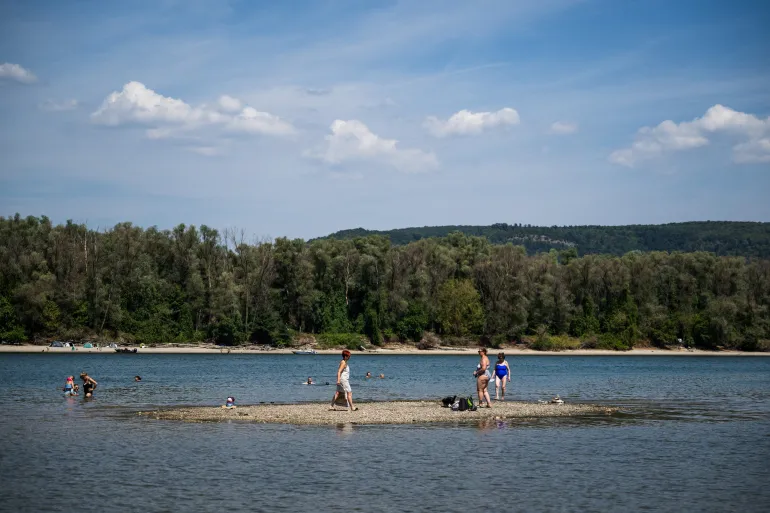
People spend time on a newly exposed island due to the low water level of the Danube River in Kisoroszi, Hungary, August 1, 2026. REUTERS/Marton Monus
People spend time on a newly exposed island due to the low water level of the Danube River in Kisoroszi, Hungary, on August 1, 2026 [Marton Monus/Reuters]


Health hazards, strain on energy systems intensify

Heat is among Europe’s deadliest natural hazards. Unlike floods or storms, the impacts are often less visible but more widespread.

Older people, children and people with existing medical conditions are most at risk. Hospitals see increased admissions linked to dehydration, heatstroke and cardiovascular illness during heatwaves.

Cities are especially vulnerable because concrete and asphalt absorb and retain heat, creating what is known as the urban heat island effect. Night-time temperatures remain high, preventing buildings and people from cooling down.

The growing use of air conditioning offers some protection but creates another challenge.

Electricity demand often surges during heatwaves as millions of people seek relief from the high temperatures. This coincides with a slump in efficiency in power generation as warmer rivers mean that the cooling of thermal and nuclear power stations is more of a challenge.

This creates a growing challenge for Europe’s energy systems as demand rises precisely when supply can become more constrained.

Economic costs escalate

The financial effects from this environmental crisis are mounting. The European Environment Agency estimates that extreme weather has already cost Europe 738 billion euros ($850bn) from 1980 to 2023. At least 162 billion euros ($190bn) of that was in the most recent three-year period.

The agency projected a lack of robust climate action could cost the European economy more than 5.6 trillion euros ($6.4 trillion) by 2050. These costs affect almost all sectors of the economy.

Wildfires destroy homes, tourism infrastructure and businesses. Drought reduces agricultural production while low river levels disrupt trade and manufacturing.

Outdoor workers in construction and agriculture face reduced productivity as extreme heat makes working safely more difficult.

Insurance losses from weather disasters have also risen sharply over recent decades. Three-quarters of Europe’s natural disaster losses are uninsured, according to the European Central Bank.

Meanwhile, governments face growing costs associated with responding to emergencies and rebuilding communities.

Many economists argued that investing in climate resilience today will be significantly cheaper than repeatedly paying the costs of more frequent disasters.

A person walks by an area burnt by fire, in Montfort-sur-Argens, in the Var department, amid worsening drought conditions following a heatwave and water shortages across much of France, August 2, 2026. REUTERS/Florion Goga
An area in Montfort-sur-Argens in the Var department of southern France burned in a wildfire amid worsening drought conditions after a heatwave and water shortages across much of the country [Florion Goga/Reuters]

Adapting as warming accelerates

Climate projections consistently indicate that Europe will continue to warm faster than the global average. Southern Europe is expected to experience hotter and drier summers, increasing the likelihood of severe drought and wildfires.

Even Northern Europe, traditionally associated with milder summers, is expected to experience more intense heatwaves. Cairngorms National Park in the Scottish Highlands recently witnessed wildfires that forced local communities to flee

Communities are already adapting to some extent. Cities are planting more trees to provide shade, redesigning streets to reduce heat, expanding early warning systems and have begun developing cooling centres for vulnerable residents.

Water conservation, improved forest management and more resilient infrastructure are becoming important parts of long-term planning. Agriculture is also changing as farmers experiment with drought-resistant crops, different planting schedules and more efficient irrigation systems.

But scientists stressed that adaptation alone will not be enough. Without significant reductions in greenhouse gas emissions, the conditions that create extreme weather are expected to become more common in the years ahead.

Europe’s recent summers are no longer viewed simply as isolated weather events. They offer a glimpse of what a warmer climate could mean.

The challenge lies in responding to today’s extremes and preparing populations for climates in which intense anomalies become normal.
Source link

Are Europe’s extreme summers the new normal? What the science says | Weather

Temperatures in Europe hit a new high this summer, with hotter early-summer heatwaves triggering illness, deaths and the collapse of infrastructure across the continent.

Transport buckled on Sunday as temperatures hit 40C (104F) across Germany, the Czech Republic and Poland. In France, days averaging 29.8C (85.6F) – spiking to 44C (111.2F) in one town – gave way to storms, leaving an estimated 1,000 excess deaths behind.

Scenes like this may well be the new normal.

Last summer’s heatwave alone caused an estimated 2,300 climate-related deaths in 12 European countries, WWA says.

A study by World Weather Attribution (WWA) has found that intense heat on this level is now tens to hundreds of times more likely than it was in 2003, and was unheard of 50 years ago.

“Heat-related mortality is likely to remain a feature of Europe’s warming climate,” warns Dr Hans Kluge, the World Health Organization (WHO)’s regional director for Europe. Deaths have already risen by an average of 52 per million people annually since the 1990s, he told Al Jazeera – a trend he says shows little sign of reversing on its own.

So what does this mean for the future? Are these temperatures the new normal, and if so, why?

We asked the climate experts:

Is this really the new normal?

Yes, it certainly looks that way. According to WWA, heatwaves were generally about 3.5C cooler in June 1976, and 2C cooler even in 2003.

“Think of it like a race where the starting line has been moved much closer to the finish,” Dr Akshay Deoras of the University of Reading told Al Jazeera. Ultimately, this is down to global warming, he says.

Europe has warmed at roughly twice the global average since the 1980s, according to the European Commission’s climate change service, Copernicus.

Deoras says this amounts to “loading the dice” towards once-rare extremes.

WWA’s modelling goes further: at current emissions rates, an event of the magnitude of this summer’s heatwave is expected to occur every couple of decades – and today’s extremes are effectively a preview of what an ordinary summer could look like by the middle of the century.

Why is this happening in Europe now?

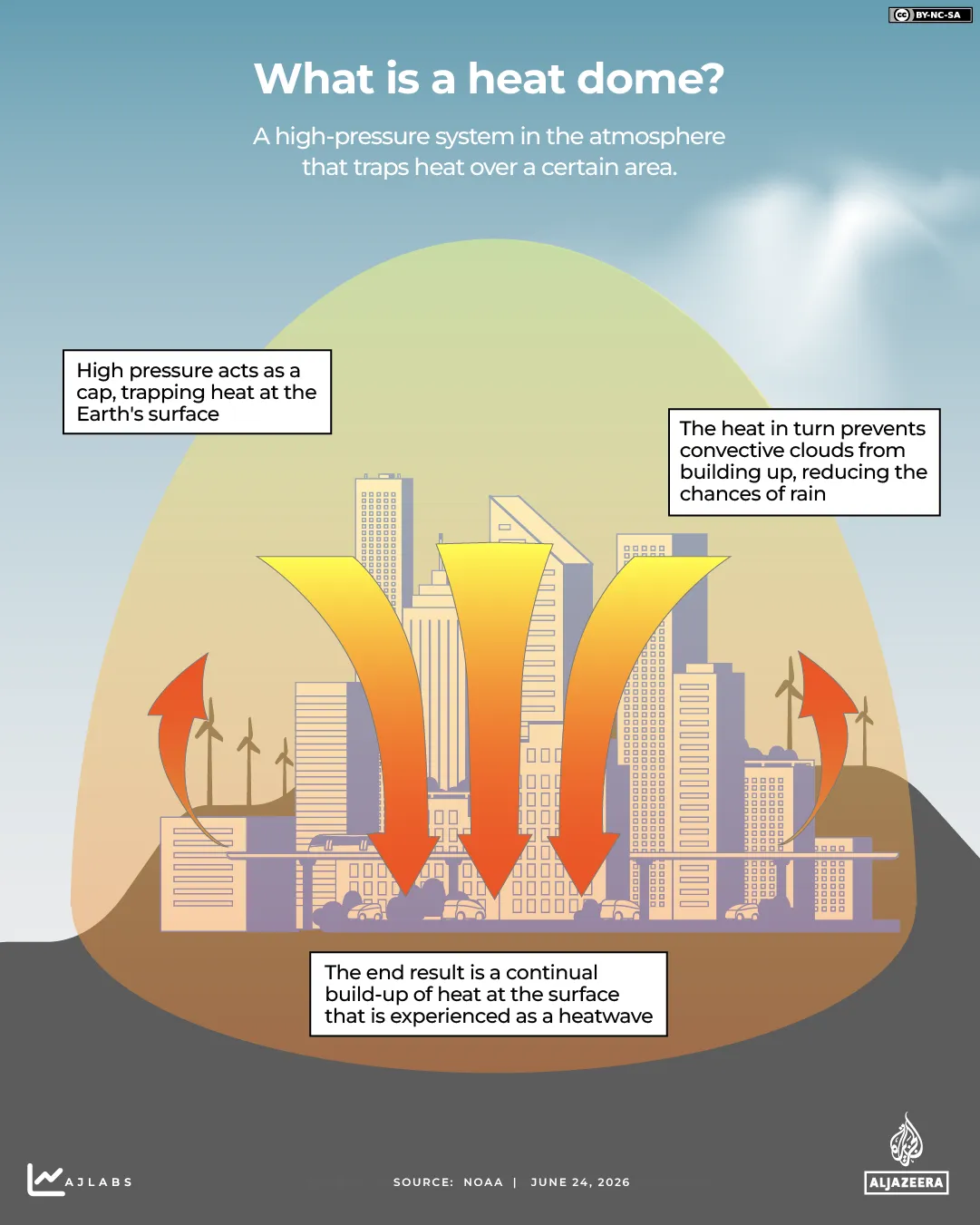
The immediate trigger is a stalled high-pressure system, or a “heat dome”, which traps heat in one concentrated area for days or weeks.

interactive- Heat dome-june24-2026-1782302509

Heat domes aren’t new, but Europe’s already-shifted baseline means the same pattern now produces far hotter outcomes than decades ago, Deoras told Al Jazeera.

Professor Hannah Cloke of the University of Reading told Al Jazeera that’s because the warming behind new, extreme weather patterns comes from emissions released decades ago, and the climate system takes time to respond – so we’re feeling the effects now of pollution from the past.

Copernicus’s European State of the Climate 2025 report confirms this: more than 95 percent of the continent saw above-average annual temperatures last year, alongside record Alpine glacier loss and the highest sea-surface temperatures ever measured in Europe.

And because Europe is warming roughly twice as fast as the rest of the planet, that gap with the global average is projected to keep widening – meaning whatever the world experiences on average in the coming decades, Europe will likely see first, and worse.

Is this trajectory irreversible?

Partly. Some of the damage is permanent. Some of it isn’t – yet.

Take glaciers. Because the effects of pollution from decades ago are cumulative, “some of what we are experiencing this summer is already locked in”, Cloke says.

Alpine glaciers, which feed major European rivers, she says, have already shrunk past the point of recovery, and their contribution to summer river flow is “permanently reduced”.

Not everything is set in stone, however. “Every tonne of emissions avoided changes the odds of what comes next,” Cloke says.

What we do now, therefore, will decide the difference between summers that are simply hard to live with in the future, and summers that become “genuinely beyond our ability to cope with”.

Some resources, like groundwater in northern Europe, can still recover – “but the window to act is narrowing with each dry year”, she says.

What is this doing to human health?

The toll is already severe and likely to worsen.

The Lancet Countdown Europe calculates that there were 62,000 heat-related deaths across the region in 2024 alone, with projections showing a steep further rise by 2050 if we don’t make changes.

Much of the problem, Kluge told Al Jazeera, is architectural and largely unaddressed.

“Most of the housing stock across this region was designed for a colder climate – to retain heat, not shed it,” he said, warning that without large-scale retrofitting, deaths could keep climbing past 2050 regardless of how good warning systems become.

His prescription: treat heat as predictable, not an emergency.

“Governments need to plan for heat the way they plan for winter flu – as a recurring, predictable challenge requiring permanent infrastructure, not a one-off crisis requiring emergency improvisation.” The highest-return step, he added, is identifying who’s most at risk – often older people living alone – and reaching them before a heatwave hits, not after.

What else can be done?

Cloke points to two priorities: early warning systems that reliably reach the people who most need to be protected, and an overhaul of water infrastructure in Europe which has been built for rainfall patterns that no longer exist.

Deoras says emissions also still matter: cutting them won’t eliminate heatwaves, which are “a natural part of the climate system”, but doing so would make them “less intense, less frequent and shorter-lived”.

None of the experts who spoke to Al Jazeera describe this as hopeless.

They do warn that the window of opportunity for addressing the issue is narrowing: infrastructure can still be retrofitted, emissions can still be cut, warning systems can still be improved – if the decisions to do so are made now, rather than after the next heatwave.

What a “normal” European summer looks like in 2050 is still being written, they say.

Source link

New European destination for this summer’s cheapest all-inclusive holidays

FOR cheap all-inclusive holidays, one destination in Europe has just been revealed as most affordable spot for summer this year.

TravelSupermarket has found that one spot along the Bulgarian coastline that’s the ideal for spot families with pretty beaches and hotels with aqua parks.

The Bourgas Area of Bulgaria has been declared the cheapest spot for an all-inclusive break Credit: Alamy
The Black Coast destination has an average price of £553pp during the summer Credit: Alamy

Follow The Sun’s award-winning travel team on Instagram and Tiktok for top holiday tips and inspiration @thesuntravel.

Making a change for 2026, TravelSupermarket has totted up the prices and found that Bulgaria has knocked Tunisia off its perch for cheapest destinations this summer.

A week in the Bourgas Area averages out at just £553per person.

The Bourgas Area is along the Black Sea coast in southeastern Bulgaria – and a few places might be familiar to Brits.

STAYCAY

Our travel experts’ best-kept-secret UK holiday spots for summer – from £37 a night


YES YOU MAY

FREE and cheap family days out and activities across the UK for May half term

The major city of the region is Burgas, but most will recognise the name Sunny Beach.

It’s Bulgaria’s largest holiday resort with almost five miles of golden sandy coast and plenty of nightlife.

On TravelSupermarket, all-inclusive holidays to Sunny Beach in the week beginning June 15 cost as little as £249pp.

In July during the summer holidays, all-inclusive breaks increase to around £529pp.

One favourite spotted by Sun Travel is to the DIT Evrika Beach Club Hotel which is perfect for families with young children.

The hotel has multiple swimming pools and even an aqua park with flumes.

DIT Evrika Beach Club Hotel has got six bars, five restaurants and an aqua park Credit: Jet2holidays

It has six bars, five restaurants and plenty of entertainment throughout the day and during the evening.

A seven-night all-inclusive break for a family of four departing on June 22 costs £562per person.

Other popular spots in the area include the historic town of Sozopol and Nessebar.

Nessebar is known for its history, seaside and charming cobblestone streets.

On the approach is The Windmill of Nessebar, which was built in the 19th century and is a symbol of the town’s rich maritime history.

Here, the average price of an ice cream is £1.20, a family meal is priced around £28, and a three course dinner for two costs just £22.

Thodes, Majorca and Dalaman are all cheaper than they were last summer Credit: Alamy

In a surprise change of events, Tunisia, which was last year’s number one cheapest destination has dropped out of the top 10 entirely.

Meanwhile Rhodes, Majorca and Dalaman are all cheaper than they were last summer, with savings of up to £91 per person.

The pretty island of Menorca takes second place at an average of £588 per person, with Turkey‘s Bodrum Area close behind in third at £591.

Turkey‘s Antalya Area follows in fourth at £604, and Greek favourite Rhodes rounds out the top five at £608 per person.

Here Are The Cheapest All-Inclusive Destinations for Summer 2026…

Here are TravelSupermarket’s cheapest all-inclusive holiday destinations and the average price per person per week…

  1. Bourgas Area, Bulgaria – £553pp per week
  2. Menorca, Spain – £588pp per week
  3. Bodrum Area, Turkey – £591pp per week
  4. Antalya Area, Turkey – £604pp per week
  5. Rhodes, Greece – £608pp per week
  6. Majorca, Spain – £619pp per week
  7. Dalaman Area, Turkey – £620pp per week
  8. Sardinia, Italy – £627pp per week
  9. Agadir, Morocco – £632pp per week
  10. Lanzarote, Spain – £634pp per week

Chris Webber, Head of Holidays and Deals at TravelSupermarket, said: “Bulgaria taking the crown this year is a real moment. The Bourgas Area — home to Sunny Beach and Burgas — has long been one of the most affordable spots on the Black Sea, but seeing it leapfrog Tunisia to top the all-inclusive rankings shows just how much value it’s offering British holidaymakers right now.

“It’s also striking that Tunisia, which held the top two spots last summer, doesn’t make the top 10 this year — a reminder that the cheapest destinations can shift year on year.

“The good news for anyone heading back to old favourites is that Rhodes, Majorca and Dalaman are all still in the top ten, and are noticeably cheaper than they were last summer.”

TravelSupermarket analysed all-inclusive holidays between 1–20 April 2026 for trips departing May–September 2026, across all star ratings, durations and traveller groups.


Source link