WITH a mile-long golden beach and an annual film festival bringing in A-list movie stars – you might think this spot was on the French Riviera.
But actually, this destination is miles away on the northern coast of France – and it’s a place called Deauville.
Sign up for the Travel newsletter
Thank you!
The seaside town of Deauville in Normandy has a sandy beach over a mile longCredit: AlamyIt’s been visited by lots of A-listers thanks to its American film festivalCredit: Alamy
The seaside town is a classic Norman resort with a huge beach, seaside casino and pulls in celebrity visitors every year.
Most of the famous faces will visit during September when it hosts the American Film Festival.
And even when they leave, a piece of them remains as their names are adorned on beach huts called Les Planches – which have become an attraction in themselves.
This year, it will be held between September 4-16.
The town is also known for fashion as designer Coco Chanel opened up her very first boutique there in 1913.
The shop closed in 1939 after the outbreak of World War II but you can still see where it once was at 13 Rue Lucien Barrière.
Another pull to the seaside town is to see its horse racing events.
Deauville has a long history of horse breeding and racing, as it’s home to the Deauville-La Touques Racecourse.
The race track is extremely famous and is considered a world-class venue for horse racing, especially in the summer.
The biggest event which is a held throughout August is the Barrière Deauville Meeting which has Group 1 races.
On the beachfront is the town’s huge Casino Barrière Deauville which has 300 slot machines as well as classic roulette and blackjack tables.
Inside, there’s also a cinema, theatre and a night club.
Deauville is known for its horse racing – and you might see some on the beachCredit: AlamyVilla Strassburger is a beautiful Norman home that’s open to the public for guided toursCredit: Alamy
When the sun shines, a must-do in Deauville is to head to the beach.
Plage de Deauville is around 1.2miles long and is scattered with around 450 multicoloured umbrellas.
While they might look like you’re classic beach parasol, you won’t find these anywhere else as they are actually made in Deauville workshops.
It’s a popular spot amongst tourists and locals with some calling it ‘one of the best beaches in France‘, another called it ‘sensational’.
The beach is also open to horse riders before 10am in the morning and after 7pm in the evening.
There are also 22 beach-front shops and bars, a seawater Olympic swimmingpool, riding school and tennis club all within walking distance.
Dotted around Deauville are the tall Norman villas with half-timbered frames and pitched roofs.
And Villa Strassburger is one of the most beautiful properties in the town and was designed by local Caen architect, Georges Pichereau.
It was built for horse racing enthusiast Baron Henri de Rothschild in 1907, later on in 1975, it was declared a national historic monument.
You can go inside the house in the summer months, but only as part of a guided tour.
You can get to Deauville on the train if you take the Eurostar to Paris – tickets start from £39.
Then take a direct train from Paris Saint Lazare (10 minutes by Metro from Gare du Nord) to Trouville-Deauville which station takes just over two hours.
This particular area is famous for its crepes, so we made it our mission to sample as many as possible — with chocolate, ice cream and seafood.
“The humble lemon-and-sugar will no longer get a look-in at my house on Shrove Tuesday. Given its Channel-front location, the town is also very big on moules — we even spotted a pizza piled high with them.
“Keen to assimilate with the locals, or possibly just excited about using shells as cutlery, even my son tucked into a bowl at one of the town’s best restaurants, Le Central, opposite the fish market.
“I’m also keen to live like a local, so sampled as much of the local wine and Calvados brandy as possible, for shockingly low prices.”
DOH! Homer – no, not the Simpsons character, I mean the ancient Greek poet – must have got it wrong when he penned his classic Odyssey saga some 3,000 years ago.
For legend has it that the tiny Dodecanese island of Lipsi is his fabled Ogygia, where a saucy siren called Kalypso kept Trojan war hero Odysseus a prisoner for seven years.
Sign up for the Travel newsletter
Thank you!
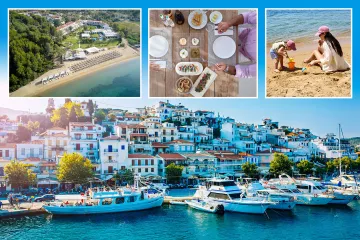
The picturesque harbor of Lipsi island, Dodecanese, Greece is the type of place nobody should ever want to leaveCredit: AlamyThe rural landscape of Lipsi island shows how laid back life on the archipelago really isCredit: Getty
Now, according to Homer, Odysseus was desperate to escape from Ogygia and flee home to his wife Penelope in Ithaca, on the other side of Greece.
But after my week-long stay in Lipsi I can’t imagine anyone wanting to leave this lovely, laid-back island, lapped by the clear blue water of the Aegean Sea.
Especially with the cooling Meltemi breeze ensuring that, although the temperature can hover in the 30s in summer, it never feels oppressively hot.
Certainly Sally Vavoulas, from Tenterden, Kent, has not wished to leave.
She arrived in Lipsi in 2001, fell under its spell — and is still there.
These days she helps run the island’s excellent winery with husband Manolis. But more of that later.
Lipsi is not one island but an archipelago.
Only three of its 24 isles are occupied — and one has just two residents — while most of the 800-strong population are clustered in a sprawling village on the main isle.
Ferries chug into the little harbour every day from Kos and Samos, a two-hour cruise away — and twice a week from Athens, a longer nine-hour voyage.
Berthed alongside them are millionaires’ luxury superyachts, which have sailed from faraway spots such as the Caribbean and the United States.
Winemaker Sally Vavoulas came to Lipsi in 2001 and has never looked backCredit: Supplied
And tied up farther down the jetty are the locals’ tiny but colourful fishing smacks.
Fortunately, though, those huge skyscraper-like cruise ships are banned from Lipsi.
Lining the quay are a cluster of excellent tavernas — such as Pefko, where owner Nikos looks annoyed when I ask which is the best dish on that night’s menu.
“None is best,” he replies sternly, before breaking into a beaming smile and adding: “Everything’s superb.” Hmm, as I soon discover, Nikos isn’t wrong!
Just down the road there’s Kalypso, a restaurant owned by the brother of village mayor Fotis Mangos and named after the aforementioned siren.
Well, if she dished up a delicious sea bass like the one I tucked into, then no wonder Odysseus stayed for seven years.
Fotis, I have been warned, has a habit of suddenly breaking into song.
He doesn’t after joining me for dinner, but plays a YouTube video of him duetting with a Greek rapper on a little ditty called “Come With Me To Lipsi”.
Malcolm visited the apiary in Lipsi, discovering how the honey is infused with thymeCredit: Supplied
Former PE teacher Fotis is justly proud of his “hidden gem” of an island, and would love to see more British holidaymakers venturing there. September, he says, is ideal as the kids are back at school yet the sun is still hot and the sea remains comfortably warm.
Not too many tourists, though, because Fotis doesn’t want to turn the place into another overcrowded Santorini or Kos.
Probably unlikely, because there are no discos or nightclubs blaring out raucous music.
Nor will you find any sunbeds, parasols or pedalos on the tiny beaches scattered around its coves.
A couple do boast tavernas where you can sip a cold beer or the local aniseed-based ouzo over lunch. But most are virtually deserted and often you have them to yourself.
Two other restaurants in the village worth visiting are Manolis Tastes, whose chef was once voted Best in the Mediterranean, and Plateia, where Despina makes ice cream that is to die for.
One morning I take a 50-minute ramble along winding dirt tracks, following colourful hand-painted signs through the hills to Monodendri — which means “One tree”. It’s supposed to be a nudist beach, although none of the three sun-worshippers stretched out on towels are baring all when I arrive. And I don’t, either.
Small shops on the island give it a very authentic feelCredit: Supplied
But it’s an idyllic, peaceful spot where you hear just the gentle waves. Grand feast
I’ve hired a little runabout car from George’s Rentals but rarely use it. Lipsi is only some 16 square kilometres and you can walk to most places.
One day, hiking past lemon and fig trees, grapevines and donkeys, I bump into Dimitri, the island’s cheesemaker.
He doesn’t speak much English and only makes goat cheese — not surprising as there are twice as many goats as people on the island — but he offers me some. It’s delicious, at 13 euros a kilo.
The island is dotted with white, blue-domed churches, most just tiny family chapels with barely room to swing a cat (of which there are many on Lipsi).
One local tells me there are 400 churches, another reckons about 150.
So I ask the island’s priest as he sits sipping coffee outside a taverna. He reckons 57. And as from time to time Fr Georgios is called out to preach in all of them, he should know.
The biggest is Panagia Charou, or the Virgin Mary of Death Church, where a revered but rather strange icon shows her clutching a crucified Christ on the cross.
Every year on August 23, it seems that a bunch of withered lilies left there by a schoolgirl in 1943 miraculously bloom back to life.
The occasion is marked by a grand feast “filled with dancing and singing, eating and drinking, drawing believers from all corners”.
Panagia Charou is the biggest church on the island of Lipsi, one of at least 50Credit: Shutterstock
Out on another walk, I meet Nikiforos, who makes the island’s honey. He doesn’t speak English but happily shows me round his apiary.
Much of the honey is infused with the taste of thyme, which grows all over Lipsi. But, sadly, time isn’t on my side, and the holiday is almost over.
I manage to squeeze in a visit to Sally’s Lipsi Winery, where I taste four of their locally produced tipples.
One, a sweet red wine called Aposperitis, was served by the Greek President to Charles and Camilla during a state banquet in Athens a few years ago.
Sally wants to know which I prefer. So I umm and aah, before suggesting perhaps I should try a second glass of each.
Which is why, on my last night, I’m afraid I ended up rather tipsy in Lipsi.
GO: Lipsi
GETTING THERE: Jet2, Tui, easyJet, British Airways and Ryanair fly to Kos with return fares this September from £106pp, and from there Dodekanisos Seaways operate daily ferries to Lipsi for around £60 return.
STAYING THERE: The delightful Lipsi Blue Boutique Hotel, a ten-minute stroll from the village, boasts wonderful views of sunsets over the Aegean, and yoga sessions on the terrace. Four nights’ B&B costs from £540.
Flying with a red, blue or green suitcase could be a bad idea
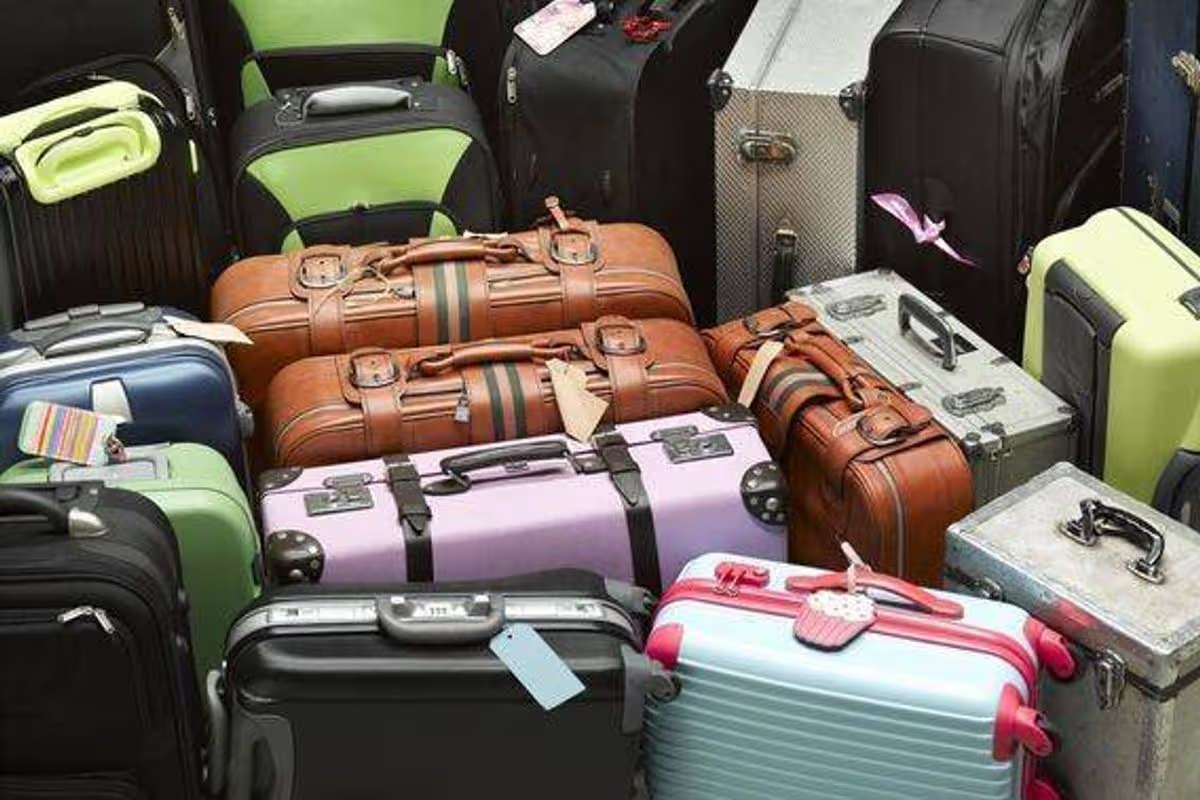
Jet2, Ryanair and easyJet passengers should avoid using ‘colourful suitcase’ (Image: Getty)
Planning and setting off on a getaway is among life’s finest pleasures, but sometimes, events outside your control can occur. Flights might get axed, accommodation double-booked, or in the most serious cases, you could become a target for criminals.
Whilst remaining vigilant is crucial, there are several steps you can take prior to departure to guarantee your possessions and personal items stay safe at the airport and during your travels. Shahzad Ali, security specialist and CEO of Get Licensed, revealed his key tips for safeguarding your luggage while on holiday.
He urged passengers to steer clear of brightly coloured luggage at all costs, as it could draw unwanted attention.
The travel specialist cautioned passengers flying with major carriers this summer, including Jet2, Ryanair, easyJet and TUI, and recommended they choose a black suitcase instead.
He said: “Although a new and colourful suitcase may look more fashionable, it won’t only be attractive to you. It’s best to choose a more common-looking suitcase, and if possible, a worn-out one – as to not stand out from the crowd – and with it, a high-quality padlock,” reports the Express.
“This can make a big difference in keeping your items safe. You can add an identifier, such as a ribbon or sticker, to avoid getting your luggage mistaken for someone else’s whilst still remaining subtle.”
He offered another handy security recommendation: “When packing, organise your items in three categories: extremely valuable (such as documents, credit cards, mobile phones and larger sums of cash), valuable (such as jewellery and other expensive items) and less valuable (such as clothes and self-care products).
“The extremely valuable items that don’t need to be used often at the airport should be placed in a money belt that will stay close to your body at all times until you reach your destination.
“The ones that need to be used at the airport should be placed in a small handbag or fanny pack that will stay in front of you at all times. When they’re not needed any longer, these items should be placed in the money belt. Larger valuables, such as laptops or tablets, can be placed in your carry-on luggage.
“Valuables such as jewellery should be strategically hidden among less valuable items, such as clothes, in your checked luggage.”