Sudans

UN probe finds mass killings, gang rapes by Sudan’s RSF amount to genocide | Sudan war News

A UN Fact-Finding Mission found that the paramilitary’s systematic campaign of violence in Darfur amounted to genocide.

Sudan’s paramilitary Rapid Support Forces (RSF) committed genocide in the western city of el-Fasher, carrying out mass killings, gang rapes and deliberate starvation as part of an intentional policy, a United Nations investigation has found.

The UN Fact-Finding Mission for Sudan released its findings on Wednesday, concluding that the RSF’s systematic campaign of violence against civilians during and after its siege of the capital of North Darfur state amounted to genocide, building on a February report that had already identified hallmarks of the crime.

Recommended Stories

list of 4 itemsend of list

The mission’s chairman warned that the findings have urgent lessons for el-Obeid, another major city now ringed by RSF forces, where the UN human rights chief has warned a “catastrophe” is unfolding.

In Wednesday’s report, survivors in el-Fasher described being raped in rooms where bodies of recently killed ‌civilians, including their own family members, were still lying on the ground.

The report found that the RSF and its allies committed the war crime of starvation by imposing a prolonged siege on the city, impeding relief supplies and shelling food production systems.

The RSF has denied such abuses in more than three years of war with the Sudanese military, saying the accounts have been manufactured by its enemies and making counteraccusations against them.

UN High Commissioner for Human Rights Volker Turk warned last week that ⁠a “catastrophe” was unfolding around el-Obeid, the capital of North Kordofan state in south-central Sudan, and his office had documented patterns of summary executions, abductions, torture and sexual violence in the surrounding region.

For much of Sudan’s civil war, international attention has centred on Khartoum and the Darfur region.

In recent weeks, however, attention has increasingly shifted to el-Obeid as fighting has intensified across the Kordofan region in central Sudan.

Members of the UN Human Rights Council on Monday condemned the violence and set up an urgent inquiry ⁠into reported abuses there.

The United Kingdom and other states have warned of a risk of large-scale atrocities as the RSF have massed forces around el-Obeid, now home to ⁠about half a million people, including more than 83,000 internally ⁠displaced people.

The fact-finding mission had already concluded in its February report that mass killings of non-Arab communities when the RSF captured el-Fasher bore hallmarks of genocide.

Its new report said it found additional evidence that the widespread and systematic ‌pattern of conduct of the RSF, including large-scale killings, mass rapes and deliberate starvation, was part of an intended policy.

“The patterns we documented in el-Fasher – including encirclement, attacks on civilian infrastructure, restrictions on ‌humanitarian ‌access and widespread abuses against civilians – serve as a stark warning,” said Mohamed Chande Othman, the mission’s chairman.

“The international community must heed these lessons and act to prevent further catastrophe,” he added.

Source link

In maps and charts: South Sudan’s 15 years of independence | Interactive News

South Sudan became the world’s newest country in July 2011 after nearly 99 percent of voters chose independence from Sudan.

Fifteen years later, most of the major promises that came with independence remain unfulfilled.

Recommended Stories

list of 4 itemsend of list

South Sudan remains one of the world’s most fragile states.

Oil finances nearly 90 percent of the government’s revenue, but the country remains wracked by deep inequality and violence: 82 percent of the population lives below the poverty line, and political jostling between rival groups has left the young nation in a perpetual state of conflict.

A woman poses with her 3-year-old daughter in their house which is made out of straw, bamboo and plastic sheeting at the Protection of Civilian site (PoC) in Bentiu, South Sudan, on February 15, 2018. Bentiu's Protection of Civilian site was established in January 2014, when 7,000 civilians entered the UNMISS base to seek protection, shortly after the start of the South Sudanese civil war. The camp hosts over 20,000 households and at least 114,250 individuals by IOM. the numbers keep growing every day, as fighting brings more people seeking safety. (Photo by Stefanie GLINSKI / AFP)
A woman poses with her three-year-old daughter in their house which is made out of straw, bamboo and plastic sheeting at the Protection of Civilian site (PoC) in Bentiu, South Sudan, on February 15, 2018 [File: Stefanie Glinski/AFP]

Elections have never been held since independence, millions remain displaced, and the country’s economy depends on pipelines running through Sudan, the very nation it fought to leave.

Interactive_South_Sudan-Maps_July2026_3-04-AT A GLANCE

‘A failed promise’

Jok Madut Jok, 57, a professor and director of graduate studies at Syracuse University, is from Warrap, South Sudan, and still has family in both rural and urban parts of the country.

Jok says he recalls the joy of the time when South Sudan broke away to establish a new beginning. It was a moment of hope. Today, though, he feels as though he has been denied all that was promised at the time.

“South Sudan at the moment is a failed promise,” he says. “South Sudanese who had lived under brutal regimes in Sudan and had been excluded from money and development programmes, and were victims of security operations in the southern part, had hung their hopes on independence.”

Jok says people are now looking towards possibilities of political transitions to hold their government accountable.

Who controls what in South Sudan?

The country is technically governed by a transitional unity government created under the 2018 peace agreement.

But that peace remains fragile.

Violence continues across Jonglei, Upper Nile, Unity and Equatoria states with clashes involving government forces, opposition fighters and other armed groups.

Elections scheduled several times since independence have again been delayed, with the latest vote planned for late 2026.

Interactive_South_Sudan-Maps_July2026_3-03-CONTORL MAP

Main political and armed groups:

Sudan People’s Liberation Movement (SPLM)

The ruling party which led the independence movement.

Sudan People’s Liberation Movement-in-Opposition (SPLM-IO)

Led by Riek Machar, it is part of the unity government. It still maintains armed forces in parts of the country.

South Sudan People’s Defence Forces (SSPDF)

The national army, formerly known as the SPLA, it is loyal to President Salva Kiir.

White Army

A loose network of armed youth, mainly from the Nuer ethnic group.

National Salvation Front (NAS)

It remains active, mainly in Equatoria province. The NAS never fully joined the peace agreement.

A South Sudanese military police officer sits on a pickup truck while monitoring the area as troops belonging to the South Sudanese Unified Forces take part in a deployment ceremony at the Luri Military Training Centre in Juba on November 15, 2023. Hundreds of former rebels and government troops in South Sudan's Unified Forces were deployed at a long-overdue ceremony on November 15, 2023, marking progress for the country's lumbering peace process. (Photo by Peter Louis GUME / AFP)
A South Sudanese military police officer sits on a pickup truck while monitoring the area as troops belonging to the South Sudanese Unified Forces take part in a deployment ceremony at the Luri Military Training Centre in Juba on November 15, 2023 [File: Peter Louis Gume/AFP]

Who runs the government?

Salva Kiir – President since independence.

  • Leader of the governing SPLM.
  • Supported largely by influential sections of the Dinka, South Sudan’s largest ethnic community.
FILE - South Sudan's President Salva Kiir attends the swearing-in ceremony for Kenya's new president William Ruto, at Kasarani stadium in Nairobi, Kenya on Sept. 13, 2022. (AP Photo/Brian Inganga, File)
FILE – South Sudan’s President Salva Kiir attends the swearing-in ceremony for Kenya’s new president William Ruto, at Kasarani stadium in Nairobi, Kenya on September 13, 2022 [File: Brian Inganga/AP]

Riek Machar – Vice President.

  • Leader of SPLM-IO.
  • Historically backed by many Nuer supporters.
  • His rivalry with Kiir triggered the 2013 civil war after political tensions exploded inside the ruling party.
FILE - South Sudan's rebel leader Riek Machar speaks to the media about the situation in South Sudan following a peace agreement the week before with the government in Addis Ababa, Ethiopia, Aug. 31, 2015. (AP Photo/Mulugeta Ayene, File)
South Sudan’s rebel leader Riek Machar speaks to the media about the situation in South Sudan following a peace agreement with the government in Addis Ababa, Ethiopia, August 31, 2015 [File: Mulugeta Ayene/AP]

Independence delivered, violence continued

Between 2011 and  2026, according to data compiled by the United States-headquartered Armed Conflict Location and Event Data (ACLED), there were 13,256 attacks in South Sudan, which means 883 attacks per year on average – or more than two a day.

The majority of the attacks have been led by:

  • Various communal and clan-based armed groups. These constituted 6,168, or just over 46 percent, of all attacks.
  • The armed forces and police, who were responsible for 3,278 attacks.
  • Unidentified armed groups, behind 2,276 attacks.
  • Sudan’s People’s Liberation Movement-in-Opposition, responsible for 900 attacks.
  • National Salvation Front, behind 269 attacksForeign actors, behind 154 attacks.
  • Others, responsible for the remaining 184 attacks.

Jan Pospisil, 52, a researcher at the Austria-based Peace and Conflict Evidence Platform, recently conducted a survey of more than 22,000 respondents in South Sudan.

Of them, 98 percent said they were proud of being South Sudanese. At the same time, more than 52 percent of respondents said in 2023 that they didn’t feel safe speaking up politically, and in 2025, the results were approximately the same.

Hunger persists after 15 years of violence

Hunger is worsening across South Sudan, where an estimated 7.8 million people are facing crisis levels of food insecurity between April and July 2026, about 280,000 more than projected last year, according to the Integrated Food Security Phase Classification.

Of those, about 73,000 people are living in catastrophic conditions, facing starvation, extreme food shortages and a heightened risk of death.

Another 2.5 million are in emergency conditions, while 5.3 million more are struggling to meet daily food needs without exhausting what little they have left.

Interactive_South_Sudan-Maps_July2026_3-HUNGER

The nutrition crisis is worsening alongside this.

An estimated 2.2 million children under five now require treatment for acute malnutrition, an increase of about 90,000 cases since the previous assessment.

Another 1.2 million pregnant and breastfeeding women also need urgent nutritional support.

The crisis is being fuelled by conflict, displacement and repeated shocks that have destroyed livelihoods, disrupted markets and cut communities off from aid.

“My family is living in rural areas, some in the cities but have no access to quality healthcare, no clean drinking water, no road infrastructure,” Jok says. “Even if they were to farm and raise cattle, and create their own livelihoods, they usually are cut off from markets and from basic services that are the responsibility of the state, especially a state that extracts public resources from underneath the people.”

“It’s a feeling that people are totally excluded from the gains of independence,” he added. “It verges on criminal neglect.”

Villagers collect food aid dropped from a plane in gunny bags from a plane onto a drop zone at a village in Ayod county, South Sudan, where World Food Programme (WFP) have just carried out an food drop of grain and supplementary aid on February 6, 2020. The villagers hear the distant roar of jet engines before a cargo plane makes a deafening pass over Mogok, dropping sacks of grain from its hold to the marooned dust bowl below. South Sudan is the last place on earth where food is airdropped, and in Mogok there was little other choice: without the tonnes of grains and cereals, people would have simply perished. (Photo by TONY KARUMBA / AFP)
Villagers collect food aid dropped from a plane in gunny bags at a village in Ayod county, South Sudan, by the World Food Programme (WFP) on February 6, 2020 [File: Tony Karumba/AFP]

Economic inequality

Pospisil says despite the riches of the 150,000 barrels of oil that are extracted, sold and mainly exported every day, broader economic gains are not a reality for most of the public.

In most rankings, South Sudan languishes as the poorest nation in the world.

South Sudan mainly exports crude to China, but also has Chinese and Indian companies invested alongside state-held organisations that own blocks in the oil fields.

INTERACTIVE - South Sudan’s top export destinations- JULY 7, 2026 copy 2-1783585168
(Al Jazeera)


Interactive_South_Sudan-Maps_July2026_3-OIL BLOCKS
(Al Jazeera)
INTERACTIVE - South Sudan’s top export destinations - JULY 7, 2026 copy-1783585207
(Al Jazeera)

Source link

Why el-Obeid matters as Sudan’s war enters a new phase | Sudan war News

More than 11,000 people, including over 5,500 children, have fled escalating fighting around Sudan’s strategic city of el-Obeid over the past two weeks, according to Save the Children, as the United Nations warns that up to 500,000 civilians could be at risk if the violence intensifies. The city has become the latest focal point in a war that has already triggered the world’s largest displacement crisis.

For much of Sudan’s three-year civil war between the Sudanese Armed Forces (SAF) and the paramilitary Rapid Support Forces (RSF), international attention has centred on Khartoum and the Darfur region. In recent weeks, however, attention has increasingly shifted to el-Obeid as fighting has intensified across Kordofan, prompting warnings from UN officials and humanitarian organisations that another acute humanitarian emergency could be unfolding.

Francesco Lanino, deputy country director for Save the Children in Sudan, said the consequences of displacement extend far beyond the loss of housing.

“For children, displacement is far more than the loss of a home,” he said. “It often means losing access to school, healthcare, clean water and the support networks that help them feel safe and protected. Many have already been displaced multiple times, and without urgent action to protect civilians, ensure humanitarian assistance can reach those in need and prevent further violence, thousands of children could be forced to flee while facing increasing risks to their safety, health and wellbeing.”

Why is el-Obeid so important?

El-Obeid, the capital of North Kordofan state, lies about 360km (224 miles) southwest of Khartoum at the intersection of roads linking central Sudan with Darfur and the country’s southern states.

That location has made it one of Sudan’s most important commercial centres and a key logistical hub for both military operations and humanitarian aid.

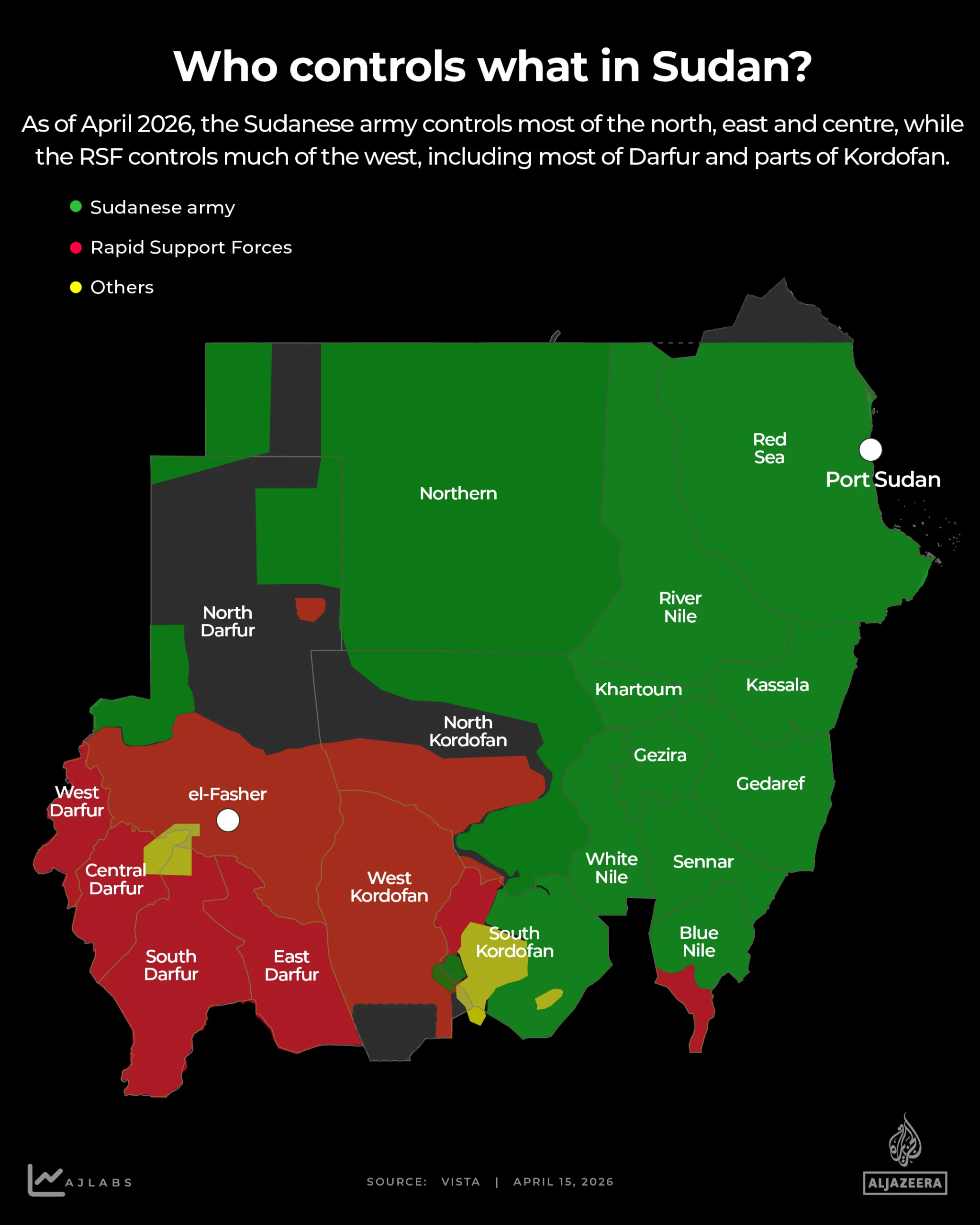
The city has remained under the control of the SAF, making it one of the army’s most important positions in western Sudan. Military analysts say control of el-Obeid helps shape movement along key supply routes connecting central Sudan with Kordofan and Darfur, helping explain why both the SAF and the RSF consider it strategically important.

Why has the fighting intensified now?

The battle for el-Obeid reflects a broader shift in Sudan’s war.

After the SAF regained territory in and around Khartoum earlier this year, fighting increasingly concentrated in western Sudan, particularly across the Kordofan and Darfur regions.

The RSF has expanded military pressure around el-Obeid while the army has reinforced its positions inside the city. UN officials have warned that the growing military build-up raises the risk of a wider assault, although neither side has announced plans for a full-scale offensive.

The conflict has also evolved. Drone warfare has become an increasingly prominent feature of the conflict, targeting military positions as well as infrastructure civilians rely on, including fuel depots, electricity networks and water facilities.

What are civilians experiencing?

Civilians in el-Obeid are facing mounting hardship as the fighting intensifies and essential services come under increasing strain.

Aid agencies and the United Nations say repeated attacks have disrupted electricity and water supplies, contributed to fuel shortages and driven up the prices of food and other essential goods. Damage to water infrastructure, combined with restricted humanitarian access, has also heightened concerns about waterborne diseases, including cholera.

Many of those now fleeing el-Obeid had already been displaced by fighting elsewhere in Sudan, meaning they are being uprooted for a second or even third time. Save the Children says more than half of the people displaced in the latest wave are children, underscoring the disproportionate impact the conflict is having on young people and their families.

Why are the UN and aid agencies so concerned?

The immediate concern extends beyond the fighting itself to the possibility that el-Obeid could become the next city to experience prolonged urban warfare, with civilians trapped between rival forces.

According to the United Nations, up to 500,000 civilians in and around el-Obeid could be at risk if violence escalates. The figure includes longtime residents as well as people who had already sought refuge in the city after fleeing fighting elsewhere in Sudan.

People are transported in the back of a truck, some 30km east of the city of El-Obeid, in Sudan's North Kordofan region, on January 9, 2023. -[ASHRAF SHAZLY / AFP]
People are transported in the back of a truck, some 30km east of the city of el-Obeid, in Sudan’s North Kordofan region [ASHRAF SHAZLY / AFP]

Humanitarian organisations warn that continued hostilities could further restrict the delivery of humanitarian assistance into North Kordofan at a time when many communities already face shortages of food, medicine, fuel and clean water.

The UN has also raised alarm over the growing use of drone strikes, warning that repeated attacks on civilian infrastructure are deepening the humanitarian crisis and making it harder for people to access essential services.

Why are officials comparing el-Obeid and el-Fasher?

Officials increasingly fear el-Obeid could follow the trajectory of el-Fasher, the capital of North Darfur, where months of fighting left civilians trapped, humanitarian access severely restricted and basic services devastated.

The comparison does not mean el-Obeid has reached the same stage. Rather, UN officials say it highlights the risk that the city could follow a similar trajectory if fighting intensifies and civilians cannot safely leave or receive humanitarian assistance.

El-Fasher has become one of the starkest examples of the human cost of Sudan’s war. Since fighting escalated there in 2024, repeated clashes, shelling and attacks on displacement camps have forced hundreds of thousands of people to flee, while hospitals, markets and other civilian infrastructure have been damaged or destroyed. Aid agencies have repeatedly warned that restrictions on humanitarian access have deepened hunger and disease, leaving many residents with little access to food, clean water or healthcare.

UN officials fear a similar pattern could unfold in el-Obeid if military pressure continues to build. The city has become a refuge for people displaced from other parts of Sudan, meaning a major offensive could trap large numbers of civilians while further disrupting aid operations across Kordofan. Preventing another prolonged urban battle, they say, is critical to avoiding an even wider humanitarian crisis.

What could happen next?

The next phase of the conflict will depend on whether the current military pressure around el-Obeid develops into a sustained ground offensive or whether diplomatic efforts succeed in reducing hostilities and improving humanitarian access.

For the Sudanese Armed Forces, holding el-Obeid is important to maintaining its position in North Kordofan and preserving access to western Sudan. For the Rapid Support Forces, increasing pressure on the city could strengthen its military position in the region, although the outcome of any future offensive remains uncertain.

If fighting escalates, aid organisations warn that more families are likely to flee while shortages of food, clean water, fuel and medical supplies deepen. A wider battle could also further disrupt humanitarian operations across Kordofan, a region that serves as an important corridor for assistance to communities affected by the war.

More broadly, the battle for el-Obeid reflects the changing geography of Sudan’s war. As front lines shift away from Khartoum, Kordofan is emerging as one of the conflict’s most consequential theatres, carrying profound implications not only for the military balance but also for hundreds of thousands of civilians caught in the fighting.

As the latest wave of displacement illustrates, the humanitarian consequences are already unfolding. Whether el-Obeid becomes another prolonged urban battleground, or whether sustained international efforts help avert a wider assault, may determine not only the next phase of Sudan’s war but also the fate of hundreds of thousands of civilians caught in its path.

“The signs from el-Obeid are clear and unmistakable: another human rights catastrophe is unfolding in Sudan,” UN High Commissioner for Human Rights Volker Turk warned late last week. “This is not a drill. It is a red alert that needs to land on the desks of heads of state and government around the world.”

Source link

Why Is the UN Investigating Alleged Atrocities in Sudan’s Al Obeid?

Sudan has been engulfed in a devastating civil war since April 2023, when fighting erupted between the Sudanese Armed Forces and the paramilitary Rapid Support Forces (RSF). The conflict has displaced millions of people, triggered one of the world’s worst humanitarian crises and led to widespread allegations of war crimes and crimes against humanity.

Al Obeid, one of Sudan’s largest and most strategically important cities, has become the latest flashpoint as the RSF intensifies military operations around the city. The situation has raised fears of a repeat of the violence witnessed in Al Fashir in North Darfur, where fierce fighting, civilian casualties and widespread reports of abuses drew international condemnation.

Against this backdrop, the United Nations Human Rights Council has moved to increase international scrutiny by launching an urgent inquiry into alleged violations committed during the escalating violence.

Stay ahead of the geopolitical week.

MD Briefing delivers expert analysis across five global fronts — the Indo-Pacific, energy, geoeconomics, European security, and the Middle East — every Monday morning. Free.

The United Nations Human Rights Council on Monday adopted a resolution condemning escalating violence by Sudan’s Rapid Support Forces in Al Obeid and authorising an urgent investigation into alleged human rights abuses committed during the fighting.

The motion, introduced by the United Kingdom with support from 14 other countries, was adopted by consensus, although China distanced itself from the decision over concerns about country specific investigations conducted without the consent of the government concerned.

The inquiry will seek to document alleged violations as international concern grows over the deteriorating humanitarian and security situation in the city.

Diplomats warned that the situation in Al Obeid could mirror previous atrocities reported elsewhere in Sudan.

Britain’s Human Rights Ambassador Eleanor Sanders urged the council to prevent a repeat of the violence seen in Al Fashir, warning that similar patterns of attacks against civilians must not be allowed to recur.

South Africa also backed the resolution, describing the situation as a critical warning and expressing concern that the RSF was employing tactics similar to those previously documented during operations in Darfur.

The mounting international concern reflects fears that the conflict around Al Obeid could rapidly escalate into another large scale humanitarian disaster.

The United Nations High Commissioner for Human Rights recently warned that a catastrophe is unfolding around Al Obeid.

According to the Human Rights Office, investigators have documented reports of summary executions, kidnappings, torture and widespread sexual violence in areas surrounding the city.

The findings add to a growing body of evidence gathered by United Nations agencies and international human rights organisations documenting alleged abuses committed during Sudan’s civil war.

The Rapid Support Forces have consistently rejected previous allegations, arguing that the accusations are politically motivated and making similar allegations against rival forces.

The newly approved investigation is intended to independently gather evidence, establish facts and improve accountability for alleged violations of international humanitarian and human rights law.

Although the Human Rights Council does not possess judicial authority, its investigations often provide evidence used by international courts, sanctions bodies and future accountability mechanisms.

The inquiry may also increase diplomatic pressure on parties to the conflict while drawing greater international attention to the humanitarian crisis unfolding in Sudan.

While the resolution was adopted without a formal vote, China stated that it did not support investigations targeting individual countries without their approval.

Beijing has consistently argued that international human rights mechanisms should respect national sovereignty and avoid what it considers politically selective investigations.

Despite China’s position, the resolution received sufficient backing from council members to proceed.

The investigation signals growing international concern that Sudan’s conflict is entering another dangerous phase marked by escalating violence against civilians.

Independent documentation of alleged abuses could strengthen future efforts to pursue accountability while increasing international pressure for humanitarian access and renewed peace negotiations.

The inquiry also demonstrates the Human Rights Council’s willingness to respond quickly when there are warnings of possible mass atrocities.

United Nations Human Rights Council

Launching an urgent investigation into alleged abuses and monitoring developments in Al Obeid.

Rapid Support Forces

Facing renewed international scrutiny over allegations of serious human rights violations, which the group denies.

Sudanese Armed Forces

Continuing military operations against the RSF while remaining a central party to the conflict.

Civilians in Al Obeid

Confronting increasing risks from escalating fighting, displacement and humanitarian hardship.

Seeking greater accountability, humanitarian access and diplomatic efforts to reduce violence.

China

Maintaining its opposition to country specific human rights investigations conducted without state consent.

The Human Rights Council will begin organising the urgent inquiry, with investigators expected to collect evidence, interview witnesses and monitor developments around Al Obeid.

Meanwhile, international attention will remain focused on whether fighting intensifies around the city and whether diplomatic efforts can prevent another humanitarian catastrophe similar to those witnessed elsewhere in Sudan.

The Human Rights Council’s decision reflects growing concern that events in Al Obeid are following a pattern already witnessed elsewhere in Sudan’s civil war. The repeated references by diplomats to Al Fashir suggest the international community fears another episode of mass civilian suffering before meaningful intervention becomes possible.

The inquiry itself will not stop the fighting, nor does the Human Rights Council possess enforcement powers. Its primary significance lies in documenting evidence that may later support international legal action, targeted sanctions or future accountability mechanisms. Such investigations also serve as an important warning to armed groups that alleged violations are being monitored by the international community.

The decision also highlights the persistent divisions within the United Nations over country specific investigations. China’s decision to distance itself from the resolution reflects a broader debate between protecting state sovereignty and responding rapidly to alleged mass atrocities. Similar disagreements have shaped international responses to conflicts in Myanmar, Syria and other crisis zones.

For Sudan, however, the immediate challenge remains humanitarian rather than diplomatic. Continued fighting around Al Obeid threatens to worsen displacement, restrict humanitarian access and expose more civilians to violence. If the conflict follows the trajectory seen in other parts of the country, the consequences could further deepen what is already one of the world’s largest humanitarian emergencies.

Ultimately, the inquiry represents an effort to ensure that alleged abuses are documented while there is still an opportunity to deter further violations. Whether it contributes to greater accountability or influences the conduct of the conflict will depend largely on developments on the ground and the willingness of the international community to translate its findings into concrete action.

With information from Reuters.

Source link

Sudan’s maternity wards reopen, bringing hope amid post-war struggles | Health

After years of closure due to war, hospitals in the Sudanese capital are welcoming mothers again, despite lingering economic and logistical hurdles.

In the Sudanese city of Omdurman, the maternity hospital, known locally as Al-Dayat or ‘Midwives” in English, has resumed operations after a long closure caused by the war. Mothers are once again arriving at maternity wards, navigating difficult economic and logistical conditions to give birth safely.

Al-Toma Jabara, a mother from East Nile, gave birth to her daughter, Doaa, at the hospital two days ago. She told Al Jazeera that she was unable to conceive during the war years. Fighting between the Sudanese armed forces and the Rapid Support Forces (RSF) separated Jabara from her husband for two years.

She has lived under constant bombardment and clashes in her home, making a normal family life seem impossible. She described Doaa’s arrival as a “new beginning” for her family after years of fear and deprivation.

At Bahri Hospital, Fatima Abdel Rahman, a mother from Al Jazirah state, recounted her exhausting and expensive journey to the capital Khartoum. Her family had to spend a large portion of their income on transportation and temporary accommodation near the facility to monitor her condition post-delivery.

Abdel Rahman noted that medication shortages forced her to buy basic drugs from outside pharmacies at inflated prices, adding to her financial burden. However, she stressed that the functioning maternity ward provided her with a vital sense of safety, sparing her the fear of dying due to lack of medical care – a constant dread she lived with during the war.

Rebuilding the shattered health sector

During the conflict, the closure of specialised maternity hospitals forced many women to undergo unsafe home births or travel long distances, drastically increasing risks for both mothers and infants. An anonymous official from the Khartoum State Ministry of Health confirmed that maternal and infant complications and mortality rates surged during the war due to closures.

The Neonatal Department at Omdurman Maternity Hospital is the largest of its kind in Sudan [Mohammed Mirghani/Al Jazeera]

The official told Al Jazeera that complication rates are now gradually decreasing as services resume. The health ministry has repaired and reopened 15 maternity wards across the capital, including Al-Dayat and the Saudi Hospital. The capital’s hospitals are now recording a significant increase in births, reaching about 7,000 new deliveries per month.

Emad Abdullah, director of the Omdurman Maternity Hospital, noted that it initially received only one or two cases a day upon reopening. Today, that number has climbed to approximately 60 births per day, as services expand to meet growing demand.

The hospital has several vital departments, including a caesarean section, an intensive care unit and a neonatal department equipped with about 140 incubators, making it the largest in Sudan.

Rising costs and logistical nightmares

Maternity costs vary significantly depending on the facility. At government hospitals, a natural birth typically costs about 130,000 Sudanese pounds ($216), while C-sections cost around 400,000 pounds ($666). In private hospitals, the cost of a natural birth shoots up to approximately 500,000 pounds ($813) and C-sections range between 600-800,000 pounds ($999-1,322), depending on the service level.

Despite the reopening of wards in Khartoum, Omdurman and Bahri, large challenges remain with patients from distant regions such as Al Jazirah and Kordofan facing exhausting journeys and exorbitant transport costs.

In the hospitals, there is a shortage of basic medicines and emergency rooms often operate beyond their capacity. In addition, the wartime exodus of doctors and nurses has left a critical gap in qualified staff, while essential medical equipment needs regular maintenance to keep up with demand.

Amira Othman Abdel Majeed, an infection control officer at Bahri Hospital, described the war as the most challenging period for the health sector, marred by severe shortages of supplies, electricity and water. That has imposed psychological pressure on medical staff who feared losing mothers and children during treatment.

However, she said the “liberation of Khartoum” and the resumption of maternity services have dramatically changed the landscape. Staff emerged stronger and more resilient, with the ongoing medical care serving as a prime symbol of the capital’s recovering health sector.

Source link

UN Warns of Human Rights Catastrophe Unfolding in Sudan’s Al-Obeid

Sudan has been engulfed in a devastating civil war since April 2023, when fighting erupted between the Sudanese Armed Forces (SAF), led by Abdel Fattah al-Burhan, and the Rapid Support Forces (RSF), commanded by Mohamed Hamdan Dagalo. The conflict has evolved into one of the world’s worst humanitarian crises, displacing millions, collapsing healthcare and public services, and triggering repeated warnings of famine and ethnic violence.

The latest concern centres on Al-Obeid, the capital of North Kordofan. The city is strategically important because it links central Sudan with the western Darfur region and serves as a major logistical and commercial hub. Control of Al-Obeid would provide whichever side captures it with a crucial military corridor for moving troops and supplies across Sudan.

According to the Office of the United Nations High Commissioner for Human Rights, civilians in the city have endured siege-like conditions for around 18 months, with dwindling food, water and medical supplies, while drone strikes and shelling have intensified.

Stay ahead of the geopolitical week.

MD Briefing delivers expert analysis across five global fronts — the Indo-Pacific, energy, geoeconomics, European security, and the Middle East — every Monday morning. Free.

Why it matters

The warning from UN High Commissioner Volker Türk suggests international concern that Al-Obeid could become another major atrocity site similar to previous battles in Darfur.

Several factors make the situation particularly alarming:

  • Strategic military battle: Both the SAF and RSF view Al-Obeid as critical to controlling supply routes between central and western Sudan.
  • Civilian catastrophe: Thousands of civilians remain trapped as fighting intensifies, with limited humanitarian access and worsening shortages of clean water, food and healthcare.
  • Risk of mass atrocities: Britain requested the emergency UN debate amid fears that an RSF offensive could result in large-scale civilian killings similar to previous episodes documented elsewhere in Sudan.
  • Humanitarian spillover: Further escalation would increase refugee flows into neighbouring countries already struggling to absorb displaced Sudanese populations.

Key stakeholders

Sudanese Armed Forces (SAF)

  • Controls parts of central and eastern Sudan.
  • Seeks to prevent RSF advances into North Kordofan and maintain control over key transport routes.

Rapid Support Forces (RSF)

  • Attempting to expand territorial control after major campaigns elsewhere.
  • Surrounding Al-Obeid could strengthen its position in western and central Sudan.

United Nations

  • The OHCHR is documenting civilian casualties and warning of possible mass atrocities.
  • UN agencies are pushing for humanitarian access before conditions deteriorate further.

United Kingdom

  • Requested the urgent debate at the United Nations Human Rights Council, highlighting growing Western concern over another possible humanitarian disaster.

Humanitarian organisations

  • Aid agencies face increasing difficulties reaching civilians due to insecurity and siege conditions.

Regional countries

  • Neighbours including Chad, South Sudan and Egypt remain vulnerable to additional refugee inflows and regional instability.

Future outlook

The immediate outlook depends on whether the RSF launches a full-scale assault on Al-Obeid or negotiations produce humanitarian access.

Possible scenarios include:

  • Escalation: A major offensive could trigger another urban battle marked by heavy civilian casualties, infrastructure destruction and further displacement.
  • Prolonged siege: Even without a direct assault, continued encirclement could deepen shortages of water, food and medicine, increasing disease and starvation risks.
  • International pressure: The UN and Western governments may increase diplomatic pressure for humanitarian corridors, though previous efforts have had limited success.
  • Limited accountability: Despite mounting documentation of alleged abuses by both sides, meaningful international enforcement remains difficult given the fragmented nature of the conflict.

Volker Türk’s warning reflects growing concern that Sudan’s conflict is entering another dangerous phase rather than improving. Al-Obeid represents more than a humanitarian hotspot—it is a strategic military objective whose capture could reshape the balance of power between the SAF and RSF.

The battle also illustrates a recurring pattern throughout the war: military gains are increasingly achieved through sieges, attacks on civilian infrastructure and restrictions on humanitarian access. These tactics magnify civilian suffering even before major ground offensives begin.

For the international community, the warning underscores a familiar challenge. The UN can document abuses and raise alarms, but translating those warnings into protection for civilians has repeatedly proven difficult. Without stronger diplomatic leverage or sustained international engagement, there is a significant risk that Al-Obeid could become the latest symbol of Sudan’s worsening humanitarian crisis rather than the point at which the conflict’s trajectory changes.

With information from Reuters.

Source link

‘Digging with a needle’: Generals stall peace as Sudan’s el-Obeid burns | Drone Strikes News

Khartoum, Sudan – As drone attacks rain down on el-Obeid and the Rapid Support Forces (RSF) tighten their months-long siege, the capital of North Kordofan has emerged as the latest flashpoint in Sudan’s grinding war of attrition.

Despite mounting international alarm and renewed US diplomatic pressure aimed at securing a nationwide truce, Sudan’s warring generals remain deeply entrenched. Both the Sudanese Armed Forces (SAF) and the RSF appear locked in a pursuit of outright military victory, largely sustained by a continuous flow of foreign weapons.

Through the lens of the escalating crisis in el-Obeid, a grim reality is unfolding: Civilian suffering is increasingly weaponised amid polarised domestic narratives, while geopolitical manoeuvring repeatedly stalls any viable path to peace.

A strategic prize and international alarm

El-Obeid holds immense strategic value. Located 550km (340 miles) southwest of Khartoum, it acts as the primary gateway linking Khartoum to the vast Darfur region. The city is also a major military stronghold, hosting the SAF’s 5th Infantry Division, known as “Al-Hagana”, and has become a refuge for hundreds of thousands of displaced civilians fleeing violence elsewhere.

The looming threat of a full-scale ground invasion has triggered urgent global warnings. Recently, 38 international nongovernmental organisations (NGOs), alongside the UN and countries including Qatar, sounded the alarm over the escalating use of drones and the potential for mass atrocities, warning that el-Obeid could face the same devastation recently seen in el-Fasher.

Yet these warnings have failed to alter the calculus on the ground.

Polarised narratives of a stalled peace

Recent United States diplomatic efforts, led by Massad Boulos, an adviser to US President Donald Trump, have pushed for a comprehensive ceasefire. However, the push for peace has collided with absolute domestic polarisation.

SAF commander Abdel Fattah al-Burhan has firmly rejected unconditional truces, stating that the army will operate with the precision of “digging with a needle” until the RSF is entirely dismantled.

This deadlock reflects a deeply fractured political landscape. Fathi Abu Ammar, a Sudanese academic, told Al Jazeera that the SAF is primarily responsible for the prolonged suffering by obstructing peace initiatives and refusing to establish safe corridors for civilians to leave el-Obeid.

He accused the army of using the city’s residents as “human shields” to garner international sympathy, while arguing that the RSF is fighting to address legitimate historical grievances.

Conversely, Sudanese journalist and political analyst Yousef Abdel Mannan vehemently rejected these claims.

Speaking to Al Jazeera from Sudan, Abdel Mannan accused the RSF of widespread atrocities, including a recent drone attack on a girls’ school in el-Obeid and the systematic killing of thousands of civilians in el-Fasher, including patients inside the Saudi Hospital.

Abdel Mannan dismissed the US-backed truce proposals as inadequate measures that merely “treat the wounds of the conflict while leaving the root cause intact”, arguing that only a comprehensive political settlement, not a temporary ceasefire, can resolve the crisis.

He maintained that civilians in el-Obeid are not being held hostage by the army, but rather prefer to remain in their homes rather than face displacement at the hands of paramilitaries.

Foreign arms and the geopolitical deadlock

Beneath the domestic blame game lies a critical factor sustaining the conflict: Foreign interference.

David Shinn, a former US diplomat and assistant secretary of state for African affairs, noted that despite years of US engagement and sanctions targeting both SAF and RSF leaders, neither side has shown a genuine interest in halting the violence.

“There is a desire from both sides to continue fighting until one side wins,” Shinn told Al Jazeera.

The escalating use of uncrewed aerial vehicles (UAVs) over el-Obeid underscores this external lifeline. “Neither the RSF nor the Sudanese army manufactures drones,” Shinn pointed out, meaning these advanced weapons must be imported.

He highlighted that the warring parties are actively backed by regional powers, pointing to the United Arab Emirates as a backer of the RSF, and Egypt and Saudi Arabia as supporters of the SAF, arguing that the conflict has transformed into a proxy war.

For the siege of el-Obeid to end and a genuine peace process to begin, the geopolitical spigot must be turned off.

Until the international community forces external actors to halt their military support, analysts warn that Sudan will remain hostage to a war its generals believe they can still win.

Source link

Cairo Doubles Down on Sudan’s Army – but Backs a Fading Bet

Egypt’s foreign ministry used carefully calibrated language on Monday to restate a familiar position: unwavering support for Sudan’s “unity, sovereignty and territorial integrity” and for its “national institutions, particularly the Sudanese Armed Forces (SAF).” Framed as a rejection of “parallel entities” seeking to form an alternative government in exile, the statement is another sign that Cairo is tying its Sudan policy ever more tightly to General Abdel Fattah al‑Burhan and the SAF as the country’s civil war grinds into yet another year.

Behind the diplomatic phrasing lies a blunt political choice. Since the outbreak of fighting between the SAF and the Rapid Support Forces (RSF) in April 2023, Egypt has emerged as one of the army’s main regional backers, both politically and—according to multiple reports—quietly in security terms. Egyptian officials insist they are defending Sudanese state institutions against militia fragmentation and external meddling, a message they repeat in multilateral forums and joint communiqués with Burhan’s Transitional Sovereignty Council.

From Cairo, the stakes in Sudan are seen as existential rather than abstract. Egyptian analysts routinely describe the stability of their southern neighbour as a vital national security concern, citing fears of refugee flows, arms smuggling and jihadist safe havens along the porous border. Control of the Nile is an even deeper driver: since the 2019 fall of Omar al‑Bashir, Egypt has intensified security and military coordination with Khartoum to counter Ethiopia’s upstream Grand Ethiopian Renaissance Dam (GERD) and preserve its historic water share.

There is also a clear regime‑security affinity, however misguided that affinity might be. Burhan, a career officer who trained in Cairo and maintains close ties with Egyptian generals, represents a familiar authoritarian model for President Abdel Fattah el‑Sisi, himself a former general who came to power after a coup in 2013. Supporting the SAF fits Egypt’s long‑standing pattern of siding with Sudan’s army “whoever is in charge of it,” and buttresses Cairo’s broader preference for strong central militaries over messy civilian transitions across the region.

Stay ahead of the geopolitical week.

MD Briefing delivers expert analysis across five global fronts — the Indo-Pacific, energy, geoeconomics, European security, and the Middle East — every Monday morning. Free.

Officially, Egypt insists it is not a party to Sudan’s war. Sisi has repeatedly pledged “non‑interference,” and Cairo frames its role as limited to mediation, humanitarian aid, and hosting millions of Sudanese fleeing the conflict. Egyptian troops captured by the RSF at Merowe airbase in April 2023 were described as participants in pre‑scheduled joint exercises, not combat operations, a spin that few international observers bought.

The line between deterrent presence and de facto involvement has become increasingly blurred. Analysts note years of intensifying joint drills, intelligence cooperation and arms ties between the two militaries since 2019. Think‑tanks and regional media have reported unconfirmed Egyptian airstrikes on RSF positions and possible targeting of gold‑mining camps in northern Sudan, amid allegations by RSF leaders that Cairo is providing drones and tactical support to the SAF—claims Egypt denies. The pattern points towards at the very least a protective security umbrella for Burhan’s forces, far beyond the strict neutrality Cairo proclaims.

Yet in Burhan Egypt is backing a very risky partner. By hinging its Sudan strategy almost entirely on the SAF and Burhan’s sovereignty council, Egypt is betting on a man and an institution that look increasingly incapable of reunifying the country. The war has left tens of thousands dead, displaced over 14 million people, and pushed parts of Sudan towards famine, with the army losing and regaining territory in a grinding stalemate against the RSF. Burhan’s own legitimacy is deeply contested: he led the 2021 coup that derailed a fragile civilian‑military power‑sharing agreement, and his government is widely seen by pro‑democracy groups as a continuation of military dominance rather than a path to elections.

Cairo’s categorical rejection of “parallel governments” sounds like a defence of state unity, but in practice it risks delegitimising genuine civilian coalitions seeking to organise outside the SAF‑RSF binary. By equating Sudan’s “national institutions” with the existing military leadership, Egypt narrows the political horizon and sidelines the broad civilian forces that led the 2018–2019 uprising—precisely the actors most likely to provide a sustainable, inclusive settlement. If the SAF continues to fragment on the battlefield or loses further territorial control, Cairo may find that its red lines have locked it into defending a shrinking power centre with dwindling popular backing.

There is also a long‑term reputational cost. Egypt positions itself as a mediator through formats such as the “Quad”, and hosts conferences of Sudanese civil and political actors in Cairo. But as long as its public diplomacy is tethered to explicit promises that it “will not be lax or late in supporting the legitimate Sudanese government” under Burhan, that positioning is scarcely credible. On the contrary, Egypt has decisively and actively allied itself to Sudan’s military junta.

Source link

South Sudan’s Jonglei: Who burned homes and silenced hospitals? | News

Juba, South Sudan – In the days before Lankien was attacked, doctors at the local hospital rushed to evacuate patients. Some were women in labour. Others were being treated for gunshot wounds. By the evening of February 3, just hours after the last patients were carried out, a bomb struck the empty facility, ripping a crater through its warehouse.

Fighting was underway in surrounding areas as South Sudan’s military pressed forward with a counteroffensive aimed at retaking territory seized by opposition armed groups. As the army advanced eastward through Jonglei State, it captured town after town, pushing opposition fighters towards the Ethiopian border.

In the aftermath of the bombing, residents said they were forced to flee into surrounding marshland on the morning of February 7 as mortar fire struck the town. Some eventually returned and described extensive destruction.

The hospital had been looted and burned. Its cold-chain storage unit, used to preserve vaccines, was set on fire. Vehicles were sprayed with bullets and stripped for parts. Solar-powered water systems had been dismantled. The local market was reduced to twisted metal sheets, while homes on the outskirts appeared to have been burned.

“Anything that can support the life of human beings was deliberately destroyed,” said Emmerson Gono, deputy head of mission for Doctors Without Borders, known by its French initials MSF, who visited Lankien in April, adding that this was his assessment based on what he observed.

A counteroffensive across Jonglei

Since the start of what authorities refer to as “Operation Enduring Peace,” satellite imagery analysed by the Centre for Information Resilience (CIR), combined with verified videos, images and witness accounts, indicates widespread destruction across a swathe of Jonglei that has long been a stronghold of opposition groups.

Both the military and opposition forces have been accused of razing villages and attacking civilians in recent months. In this area of Jonglei, which is home to a section of the Nuer ethnic group that officials often cast as hostile to the state, more than a dozen residents who spoke to Al Jazeera said they believed the military was responsible for targeted destruction that experts say has pushed tens of thousands of people towards the brink of famine.

evacuated, and patients were discharged hours before the attack, following increased tensions and after MSF received information about a possible attack against the city. [Courtesy of MSF]
Lankien hospital was evacuated, and patients were discharged hours before the attack, following increased tensions and after MSF received information about a possible attack against the city. [Courtesy of MSF]

In most of the 23 incidents CIR documented between late January and February, civilian structures, including homes, health facilities and markets, appear to have been burned and looted. CIR said the destruction was “likely to be more widespread and potentially part of what it described as a deliberate military strategy”.

“Using satellite imagery, we were able to map how troop movements from west to east followed a path of burning and looting,” said CIR researcher Kiria Borak, stressing that satellite imagery alone cannot determine intent or responsibility.

Some officials and humanitarian actors have attributed the destruction in Jonglei to clashes between government troops and opposition forces. However, residents told Al Jazeera that opposition fighters were not present when their villages were attacked. Those accounts could not be independently verified due to restricted access to the area.

Government officials did not respond to requests for comment on the specific allegations described in this report. In earlier statements, authorities have said military operations are conducted in self-defence and that civilians are not deliberately targeted.

Political backdrop

Violence has escalated since 2025, when opposition leader and first vice president Riek Machar was arrested on charges of subversion, allegations he denies. Machar and President Salva Kiir were once on opposing sides of the country’s 2013–2018 civil war, which killed hundreds of thousands of people before a peace agreement brought them into a fragile unity government.

The implementation of that agreement stalled amid delays in unifying armed forces into a national military and repeated postponements of national elections.

Following Machar’s arrest, the government undertook a campaign of aerial bombardments to beat back a simmering rebellion in rural areas. Machar’s political group declared the peace deal dead and began launching hit-and-run attacks on military positions.

Between December and January, opposition fighters, buoyed by support from local armed youth, seized several military garrisons in Jonglei, prompting the government to announce a counteroffensive on January 28.

Then-army chief Paul Nang ordered forces, drawn from the national army, intelligence units, police and allied militias, according to UN investigators, to retake territory held by opposition groups.

Analysts say the involvement of allied militias operating alongside formal units has complicated the determination of command responsibility.

‘Burning homes’

Five individuals who fled Lankien told Al Jazeera they witnessed events unfold on February 7.

They said government-aligned forces reached the outskirts of the town after fighting in a nearby village. Around late morning, mortar fire struck the town, followed by the arrival of ground forces in armoured vehicles.

Gai Ket, 32, said he had been cutting firewood when explosions began. He rushed back to town to look for his wife and children.

“The first thing I saw was smoke. SSPDF was burning homes,” he said, referring to the national army.

When he reached his house, he found his wife dead, with a severe wound to her chest. Bodies lay scattered across the neighbourhood. “Everything was gone,” he said.

South Sudan
The hospital’s main warehouse was destroyed during the attack, and we lost most of our critical supplies for providing medical care. [Courtesy of MSF]

Another resident, Puoch Duol, said he returned at night to search for his grandmother, who had been too weak to flee. He said he found her body among several others near the ruins of burned homes.

Satellite imagery reviewed by CIR indicates significant destruction in Lankien between February 7 and 9. On February 7, the army announced it was in control of the town.

MSF has said government forces were in control of Lankien in the days after the attack but has not assigned responsibility for the destruction. It said the government is the only party to the conflict with the capability to carry out aerial bombardments.

Government-appointed officials told Al Jazeera that opposition fighters looted the town during their withdrawal. Opposition representatives deny this, saying their forces were not present at the time. Neither account could be independently verified.

A pattern of destruction

Residents described a similar pattern of destruction across towns and villages stretching from the Nile River to the Ethiopian border. Armed men in military-style uniforms arrived in armoured vehicles, often after opposition forces were reported to have withdrawn, according to residents.

Homes and markets were burned, while health facilities and humanitarian compounds were looted. Civilians took refuge in swamps and forests, while those too weak to flee were killed or went missing.

CIR geolocated social media footage from Pathai showing fighters moving among burning structures towards a road leading into the town’s western entrance. The identities of those in the footage could not be independently verified.

Jany, an aid worker based in the town of Walgak, described an attack on February 5.

“We saw smoke everywhere. They were firing guns and burning houses,” he said.

Satellite imagery shows significant structural damage in Walgak between February 3 and 7, shortly after the town changed hands.

Humanitarian sources tracking developments in the area reported that multiple villages in the vicinity of Walgak were burned or destroyed during the same period. These accounts could not be independently verified due to restricted access and ongoing insecurity.

Remote sensing data shows clusters of fire activity across the region during the same period. However, satellite imagery alone cannot determine the cause or responsibility for the fires.

Command rhetoric and discipline

From the start of military operations, remarks by commanders raised concerns over civilian safety.

A video circulated on social media shows Johnson Olony, a deputy army chief who is also head of the Agwelek armed group, telling troops not to spare lives or property during operations. The government later said the remarks did not reflect official policy, and Olony apologised.

In another video, a commander identified as Wal Nyak appears to threaten violence against perceived opposition supporters. “Whether you are a woman or a girl, we will kill you all … We don’t want supporters of Riek Machar here,” he says.

Reports and satellite imagery point to burned villages and mass displacement across Jonglei. [Satellite imagery © Vantor]
Reports and satellite imagery point to burned villages and mass displacement across Jonglei. [Satellite imagery/Vantor]

The authenticity and full context of the footage could not be independently verified.

Humanitarian impact

Aid agencies say the consequences of the destruction reported in the area are severe and likely to last for months or longer.

At least 28 health facilities in Jonglei were damaged or looted this year, according to the UN. Seventy percent are no longer functioning.

The Integrated Phase Classification (IPC), a United Nations-backed analysis body, says there is a risk of famine in multiple counties, while more than 70,000 people are already facing the highest possible severity of hunger.

Nicholas Kerandi of the UN Food and Agriculture Organization said the impacts on food security and public health “are likely to persist through the remainder of the year and potentially beyond”.

Others say the alleged abuses in Jonglei have pushed South Sudan’s already fractured state to breaking point.

“The tribes don’t trust one another, the citizens don’t trust the government, and the government doesn’t trust its citizens,” Ter Manyang Gatwech, a human rights advocate from Jonglei, told Al Jazeera.

“Unless there is a miracle, South Sudan will disintegrate,” he said.

Source link

The making of Sudan’s RSF | Sudan war

NewsFeed

Sudan’s Rapid Support Forces have had a long history of violations, going back to when they were known as the ‘Janjaweed’. Over the past few years, they have been trying to change their image and become influential political actors in Sudan, but will that work? Al Jazeera’s Hala Saadani looks back at the RSF’s history and where they may go from here.

Source link