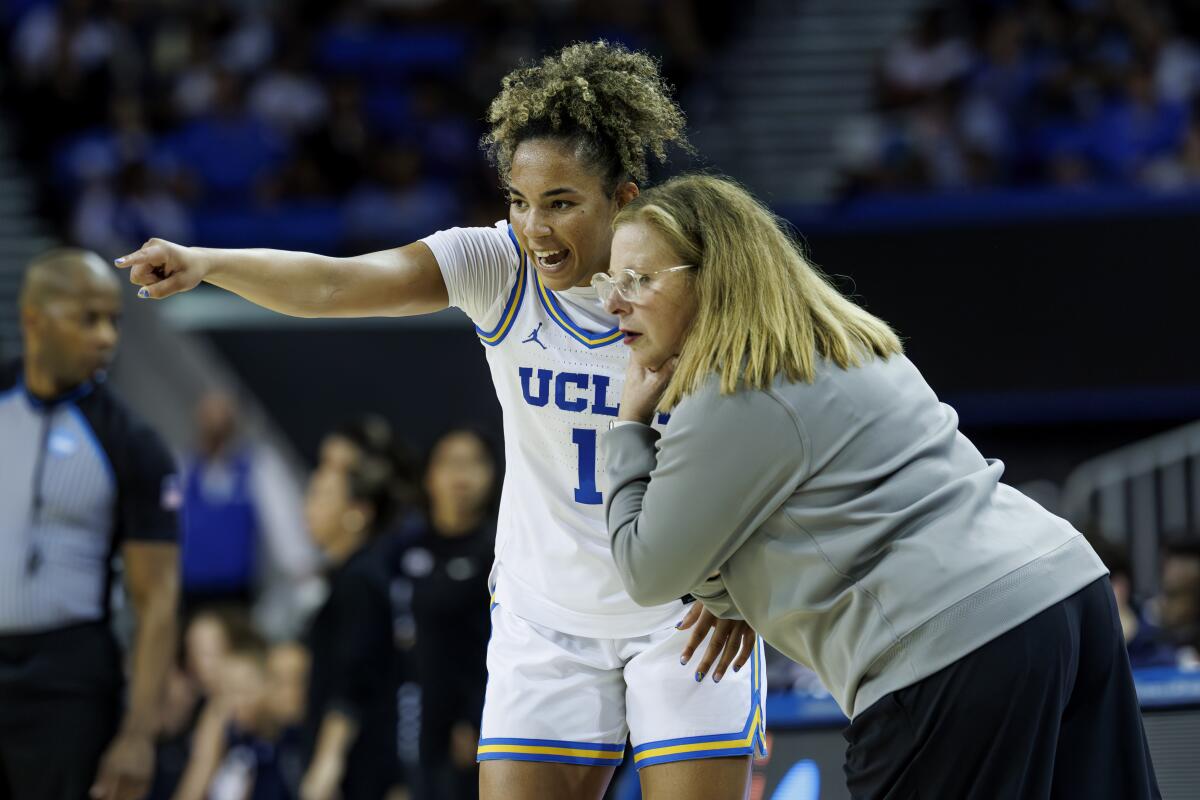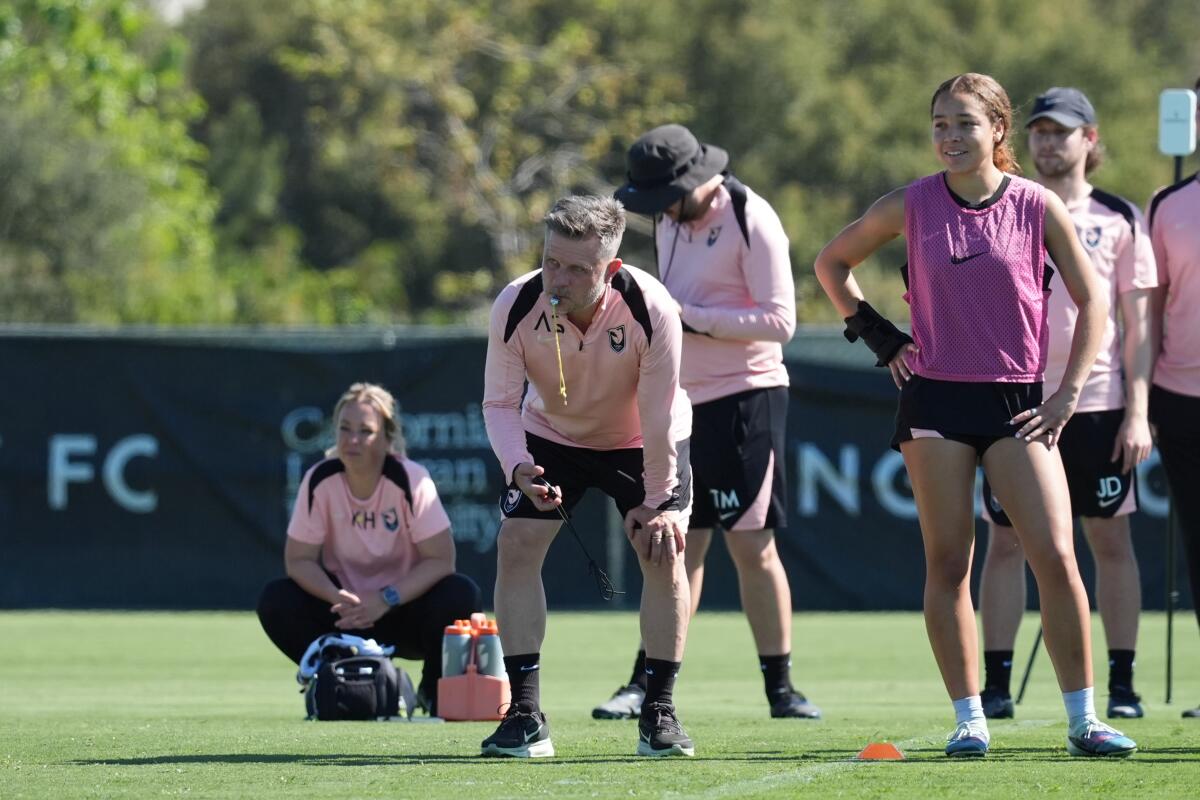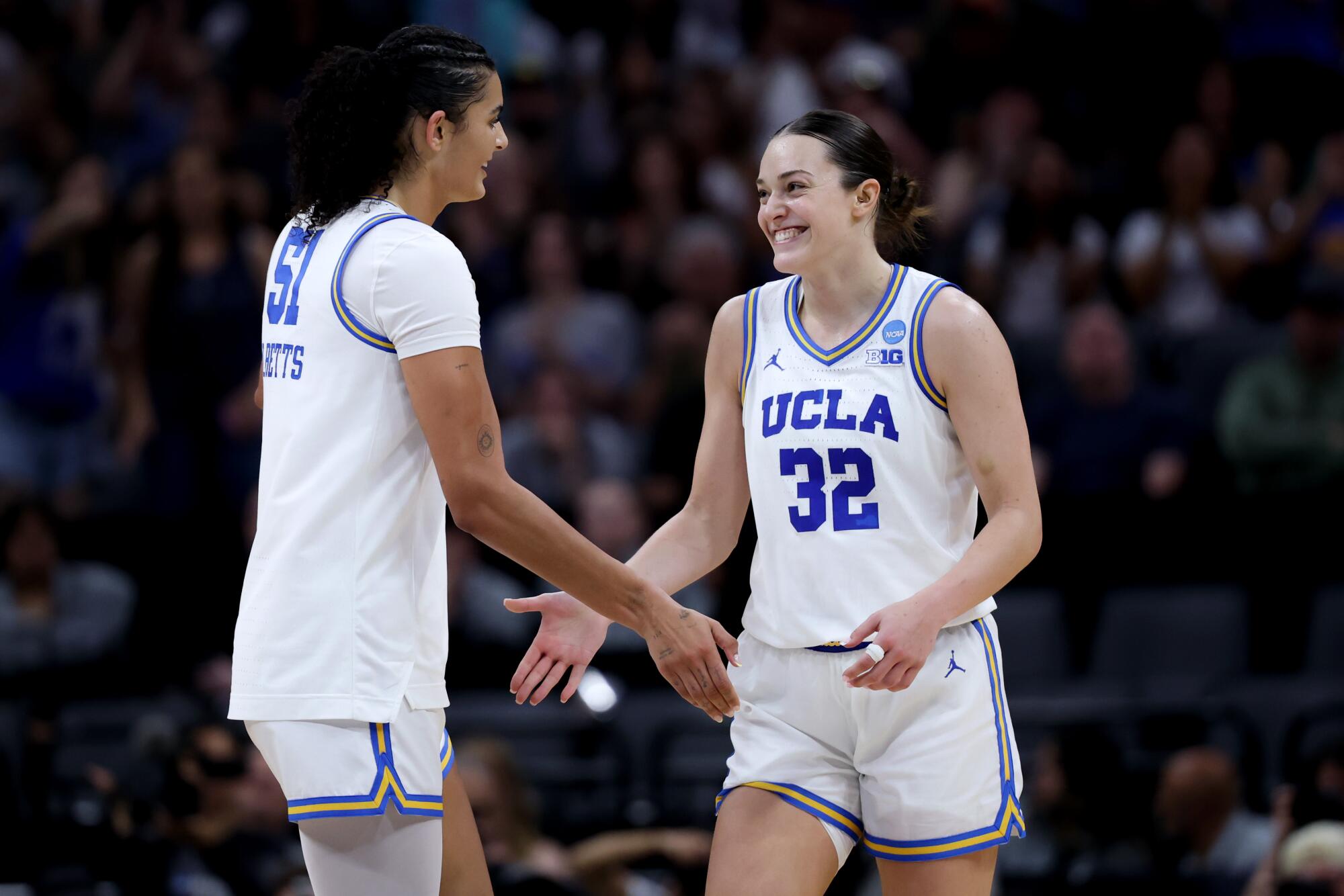
When Julie Uhrman and a fledgling ownership group that would quickly grow to more than 100 announced plans to start a women’s soccer club in the summer of 2020, the goal was to build something unique and different.
And in that she was wildly successful: four years after its founding, Angel City became the most valuable team in the history of women’s professional sports while funneling millions of dollars to community programs throughout Southern California.
What the team hasn’t done is win. And that, Uhrman said, has to change.
“It’s time to win,” said Uhrman, who this month is stepping down as the team’s chief executive to take a new role as principal advisor. “We’re in L.A. We live in a city of champions and we want to be on the same mantle as them. It’s a process but we have the right team in place, on and off the pitch, to accomplish that.”
Angel City will kick off its fifth season Sunday at BMO Stadium against the Chicago Stars. Over its previous four seasons, Angel City lost 12 more games than it won, finished with a winning record only once and made just one playoff appearance. And it has used four coaches, three sporting directors and more than 70 players in its search for success.
“We needed to rip it up and start again,” Straus said.
As a result, more than half the players on the opening day roster weren’t with Angel City at the start of last season. And nine women who started at least a half-dozen games last season aren’t there this year.
“This is Angel City 2.0,” Parsons said. “We’ve gone through a huge amount of staff change. We’ve gone through a huge amount of roster change. And January 2026 has become Year 1.
“Year 5 is Year 1 of building what we believe is a sporting organization that can get to the top and stay at the top.”
That’s probably not what the team’s long-suffering fans wanted to hear. They wanted to hear that this is the year Angel City wins a trophy. But after watching his team finish 11th in the 14-team NWSL in 2025, Parsons said that’s not realistic.
“You don’t go from 11th to being a top-four team. I think you come from 11th and you become a playoff team ,” said Parsons who, as a manager, took a Portland Thorns team with a losing record to an NWSL Shield and a league title in his first two seasons. “Last year was a tough year. Now we’re in a better place. So we’re still on the journey.”
Angel City coach Alexander Straus watches over a practice session at the team’s training facility in Thousand Oaks in February.
(Damian Dovarganes / Associated Press)
So is the league. With the addition of expansion franchises in Denver and Boston, the NWSL entered its 14th season Friday with a record 16 teams, meaning each club will play a record 30 games. The top eight finishers in the table will make the playoffs.
For Angel City, the makeover to 2.0 really launched about six months before Parsons arrived when Disney CEO Bob Iger and his wife, Willow Bay, dean of the USC Annenberg School for Communication and Journalism, became controlling owners of the club and committed $50 million to improving it. Part of that investment paid for the purchase and renovation of a sprawling state-of-the-art training center at Cal Lutheran University and part of it allowed Parsons to come in and tear things up.
When he took over as sporting director last winter, Parsons quickly set about overhauling the roster, leaving Angel City with one of the youngest teams in the NWSL, averaging 25 years of age, this season. Two players are still in their teens and eight others have yet to turn 23.
A year ago, eight players on the roster were 32 or older.
Among the key offseason additions are defender Emily Sams, an Olympic champion with the U.S. national team, and midfielder Ary Borges, a Brazilian international. They will join a core that includes Japanese midfielder Hina Sugita and Zambian striker Prisca Chilufya, who joined the team at the end of last season.
Of the four, only Sugita, a two-time World Cup veteran, is older than 26.
“We’re getting closer to competing for trophies,” Parsons said. “But making [the] playoffs right now is a logical next step. This year is about showing that we’re going in the right direction. But we can’t jump from 11th to one. Those days are over.
“We have overachieved the last 12 months in building a sporting organization, staffing departments and [constructing a] roster. There’s going to be ups and downs this year, like there is every year.”
Goalkeeper Angelina Anderson, entering her fourth season with Angel City, making her one of the team’s longest-tenured players, believes in Parsons’ deliberate approach and is confident the team is about to turn the corner.
“Having that methodical approach is really smart and it gives us kind of an overview of like, we want to win the championship, we feel like we’re in a really good spot, but there are daily, monthly, season-long challenges that we’re going to have to overcome if that’s where we want to get to,” said Anderson, one of three team captains. “It’s actually a very smart way for all of us to manage our expectations.”
Uhrman agrees too but being realistic is hard. When she helped launch Angel City, it was with the vision of building a winning team and nearly six years later, she’s still waiting for that vision to be released.
“Our aspiration is to win the championship. Our goal is to make the playoffs,” she said. “And we feel very comfortable that we can do that. It is a process. We’re realistic about where we are in the process and what we need to do to develop and grow.
“Believing in the fact that it’s a process is comforting because we are being realistic about what we are. But that doesn’t change what we want to accomplish.”
If you’re looking for the most elegant way to wrap up our “little excursion” in Iran, it’s this: President Trump should follow what might politely be called the “declare victory and head for the airport” strategy.
You know the drill: Announce that we’ve set back Iran’s nuclear programs a decade, pounded their navy into submission, and turned the ayatollah into a fine mist. Mission accomplished! Thank you for flying the friendly skies, and please return your seat backs to their full upright and locked position.
Don’t get me wrong. This “cut and run” routine is less than ideal. Trump will have signaled to the world he (we) can’t endure any insurgent resistance, empowered the Islamic Revolutionary Guard Corps to run the country and likely angered Israel in the process.
But his domestic political base will believe he won, and fan service has always been his top political priority.
Besides, once you’ve entered a war without a coherent justification, clearly defined goals or a credible exit strategy, you’re lucky to get out at all. A salutary outcome no longer exists; that ship has already sailed.
Speaking of which, as I write this, we are drifting toward what feels like a point of no return. Mining the Strait of Hormuz, which Iran is now attempting to do, is the ultimate trump card.
Using mines to shut down this narrow shipping lane — which contributes about 20% of the world’s oil supply, not to mention natural gas and fertilizer — could result in a crippled global economy, mass casualties and a situation in which the president can no longer save face while cutting and running.
As retired U.S. Navy Adm. James Stavridis writes, “Iran has been planning a Strait of Hormuz closure operation for decades and probably has more than 5,000 mines; just one hit can severely damage a thin-skinned tanker.”
Yes, once laid, minefields can be cleared. But Stavridis predicts it would take “weeks, if not a month or two” to clear thousands of mines. He warns: “The global economy needs to be prepared for a month or two shutdown.” (Complicating matters is the fact that our dedicated minesweepers were recently decommissioned.)
The Iranians are not idiots. They watch American politics. They understand that Trump’s pressure point isn’t Tehran — it’s the S&P 500. A bad week on Wall Street makes him jumpier than a long-tailed cat in a room full of rocking chairs.
Trump, whatever else you say about him, is a transactional materialist who approaches geopolitics the way a real estate developer approaches zoning disputes: What’s the angle, where’s the leverage, and can everybody just settle already?
Unfortunately, the fellows running Iran are religious zealots who believe — deeply, sincerely and somewhat alarmingly — in something larger than quarterly economic indicators. Their strategic plan appears to consist of two options: survive (which they see as tantamount to victory), or die gloriously while insisting they meant to do that all along.
Which makes their current behavior grimly logical.
The Iranian regime, such as it is, doesn’t have much to lose. But they know exactly what Trump has to lose: His popularity and political legacy are now tied to the price of oil.
Releasing U.S. strategic oil reserves will help to some extent, but this is not a long-term solution. And Iran is betting that when the price at the pump for U.S. consumers starts looking like a luxury car payment, Trump will do what critics like to summarize as TACO — “Trump Always Chickens Out.”
Lots of American political observers agree. And it’s not just moderates or RINOs who are teasing this.
Referring to the U.S. military, former Speaker of the House Newt Gingrich told Larry Kudlow on Fox Business: “They have to keep the Strait of Hormuz open. I don’t care what it costs.”
“If they can’t keep it open,” Gingrich continued, “this war will, in fact, be an American defeat before very long, because the entire world, including the American people, will react to the price of oil if the strait stays closed very long.”
Perhaps the U.S. military can pull off a delicate trick: keep our “armada” in the region, keep the Strait of Hormuz open, clear any mines that are laid and prevent some unlucky tanker from being hit by a mine — or, for that matter, by a drone or missile fired from the Iranian coast. That final risk is why some military analysts believe reopening the strait would require a ground operation.
Imagine that the U.S. manages to thread these needles. Then what?
Total and complete surrender? Regime change? Boots on the ground?
Absent a swift exit (like, tomorrow), we’re left with the two classic options of power politics: a delayed and more ignominious retreat or increased escalation.
And, historically speaking, American presidents are more likely to double down — with tragic results.
Rep. Yoo Yong-won of South Korea’s People Power Party speaks about the performance of the Cheongung-II missile defense system during recent Middle East missile attacks. Photo by Asia Today
March 5 (Asia Today) — A South Korean lawmaker said Wednesday that the country’s Cheongung-II surface-to-air missile system demonstrated high effectiveness in real combat conditions in the Middle East, citing reports of a 96% interception rate during recent missile attacks on the United Arab Emirates.
Rep. Yoo Yong-won of the conservative People Power Party, who serves on the National Assembly’s Defense Committee, said the result showed the strength of South Korea’s defense technology.
“The fact that Cheongung-II achieved an interception rate exceeding 90% in an intense real-world combat environment in the Middle East is a great victory for South Korea’s defense science and technology,” Yoo said.
According to information Yoo said he confirmed with sources familiar with the United Arab Emirates air defense operations, two Cheongung-II missile batteries deployed in the UAE fired more than 60 interceptor missiles during recent attacks.
About 96% of those missiles successfully intercepted their targets, the sources said.
Cheongung-II is a medium-range surface-to-air interceptor missile system developed by South Korea to defend against aircraft and ballistic missile threats.
Yoo said the reported interception rate was notable even compared with leading Western air defense systems.
“A 96% real combat interception rate is a figure that even the U.S. Patriot system would find difficult to achieve,” he said, referring to the Patriot Advanced Capability-3 system widely used in missile defense operations.
The lawmaker said the performance of the Cheongung-II system could strengthen confidence in South Korea’s Korean Air and Missile Defense architecture, which is designed to counter potential missile threats from North Korea.
“The Cheongung-II deployed by the UAE is the same model currently operated by the South Korean military,” Yoo said. “Its success in neutralizing Iranian missile attacks increases the credibility of our missile defense system.”
The remarks come amid escalating tensions in the Middle East following U.S. and Israeli airstrikes on Iran and subsequent missile retaliation across the region.
The United Arab Emirates reportedly used a multi-layered air defense network during the attacks, combining U.S.-made THAAD and Patriot systems with South Korea’s Cheongung-II and Israeli air defense systems including Arrow and Barak-8.
Despite large-scale missile and drone attacks, the UAE is reported to have achieved an overall interception rate exceeding 90%, limiting damage.
Yoo said South Korea’s parliament would support further development and exports of the missile system.
“We will provide strong legislative and policy support so that Cheongung-II, whose performance has been proven in real operations, can expand exports across the Middle East and global defense markets,” he said.
Harrison Ford received a standing ovation Sunday as he accepted the SAG-AFTRA Life Achievement Award.
“It’s a little early isn’t it?” Ford joked, noting that “it’s a little weird to be getting a lifetime achievement award at the half-point of my career.”
The 83-year-old is one of the industry’s highest-grossing actors after catapulting to global stardom with his role as Han Solo in the “Star Wars” franchise, a legacy further cemented by his lead role in “Indiana Jones” movies.
Ford fought back tears, thanking his fellow actors, writers, directors and cast members. He “found a calling. A life in storytelling. An identity in pretending to be other people,” he said.
“While we’re all at different stages of our lives and careers in this room, we all share something fundamental. We share the privilege of working in the world of ideas, of empathy, or imagination,” Ford said. “Because of that privilege, I’ve come to know myself.”
Ford said he was “not an overnight success,” spending the first 15 years of his career jumping between acting and carpentry before landing an acting role.
Ford thanked film producer and casting director Fred Roos and his longtime manager Pat McQueeney, all of whom he said were integral to his success.
“They’re no longer with us, but it feels important that I think of them now. I feel them here tonight. They would be happy for me,” Ford said.
SAG-AFTRA’s recognition on Sunday is one of several lifetime achievement awards bestowed upon the actor over his extensive six-decade career, which is defined by two of Hollywood’s biggest film franchises.
A highlight reel of Ford’s various acting performances played ahead of his accepting the award.
The award was presented by actor Woody Harrelson, who lauded Ford’s varied achievements and called him a “timeless American treasure.”
“There’s too much of me in this tribute to Harrison, but I’m an actor, what do you expect?” Harrelson quipped. The actor first met Ford after following him into a sushi restaurant and the pair “sealed their friendship” over lunch, during which “at one point, we laughed — and I’m not kidding — for three minutes straight,” Harrelson said.
“This is a life achievement award and he has lived a full one,” Harrelson said.
Ford hasn’t shown signs of slowing down in recent years. The actor plays therapist Paul Rhoades in the Apple TV show “Shrinking,” which earned him his first-ever Emmy nomination last year. He also recently starred in the “Yellowstone” prequel “1923” and appeared in his first Marvel movie, “Captain America: Brave New World.”
Ford “thinks working more is the antidote to aging,” Harrelson said. The actor recently reprised his iconic role as a swashbuckling archaeologist in the 2023 sequel “Indiana Jones and the Dial of Destiny.”
Despite Ford’s massive success in the industry, the actor has yet to win a major competitive acting award. The Life Achievement Award is the first that Ford snagged from the guild. He was nominated last year for actor in a comedy series for his role in “Shrinking” but lost to Martin Short for his performance in “Only Murders in the Building.”
Ford said he was “quite humbled” to be honored with the award in a room full of actors, “many of whom are here because they’ve been nominated to receive a prize for their amazing work, while I’m here to receive a prize for being alive.”
“Sometimes we make entertainment. Sometimes we make art. Sometimes we’re lucky and we make them both at the same time,” Ford said.
The awards show’s highest honor is given to performers who foster the “finest ideals of the acting profession.” Ford joins a list of seasoned actors who have received the award, including Jane Fonda, Barbra Streisand, Morgan Freeman and Robert De Niro.
SAG-AFTRA described Ford as “one of cinema’s most enduring leading men” whose performances “have become woven into the fabric of our culture,” in a December release announcing the honor.
Users expect apps to be easy to use and operate smoothly without odd crashes or bugs. However, to reach success and, of course, revenue, having a functional app is not enough. The app, for one, needs to embrace the latest innovations, and the app type must also be in demand. Let’s explore some of the app trends that will persist in 2026, from their functionality to their very purpose.
AI influence on app development and functionality
AI has left almost no industry untouched, and general app development and final functionalities are no exceptions. For one, developers can craft apps in weeks or months with assistance from Claude AI or similar products. However, besides assisting in the actual building of the apps, AI is sure to leave its mark in the following ways:
AI-powered features that let users use AI through the app to achieve their intended results faster. For example, that could include an online shopping app that lets you upload your photo and see how certain outfits would look on your body.
AI will make apps more personalized to users than ever before.
Apps will start to adapt to your behavior and habits even more.
More productivity and online earning apps are appearing
People do achieve things and perform tasks faster, but they do have more temptations to slack off or procrastinate. So, it is evident that productivity-boosting apps will see an even bigger boom than before. After all, we already see developers experimenting with what we expect a productivity app to do. For example, programmers introduce game-like experiences to ensure that you stay on the right, effective path.
Besides boosting productivity, various apps also build work discipline and empower users to earn more on the side. One option is picking up micro jobs online; a variety of apps offer them. Essentially, people use a service like JumpTask to find tasks, such as answering surveys, testing other apps, or browsing promoted social media channels. In exchange for your work, you get paid, and you can pick up tasks as flexibly as you like. Such options are highly useful for students who need to build up their responsibility and ownership of their work slowly.
One-can-do-it-all apps
A regular consumer has dozens of apps installed on their smartphone. However, if they start achieving more goals with a single app, that number will drop naturally. So, developers are going after that: building tools that serve more than one purpose.
For example, an app could have started as an instant messaging app, but now you might even use it as a digital wallet, note-taking software, and a general scheduling tool. Such apps, also called super apps, are only meant to become more popular, and many of the apps you use will integrate additional features to match the market demand.
Online shopping stores should also introduce more personalized and immersive experiences. One innovation that we have already noticed is the use of AI to make highly personal outfit recommendations.
Furthermore, we already see lots of livestream shopping, where sellers directly communicate with their clients and sell their products. Additionally, people can now engage in social commerce, meaning they can purchase items directly on social media platforms (without leaving them).
Lastly, social media apps in general are much more relevant for the consumers’ journeys. After all, millions of people purchase items after watching a TikTok or YouTube video. Furthermore, such promotional content has proven much more effective than any ad because it comes across as more realistic and less polished. For example, brands might believe that using celebrities in their product commercials will increase sales. However, people prefer imagining themselves as the person, and knowing the privileges celebrities have, it is no wonder they have beautiful hair, and this product is likely irrelevant.
Conclusion
Staying up to date with the latest industry news and trends can help you achieve greater success with your app. However, don’t be afraid to experiment with tech, and challenging consumer expectations can also lead to positive results. Yet, if you’re more comfortable with safer approaches, be sure to embrace the latest innovations rather than fight them. After all, refusing to do so could lead to falling behind in the market and to your users dropping your product in favor of a more polished, innovative one.
The men’s team was criticised after several players appeared to laugh when Trump made his comment, but Knight said: “I think there’s a genuine level of support there and respect. That’s being overshadowed by a quick lapse.
“The guys were in a tough spot, so I think it’s a shame this storyline and narrative has kind of blown up and [is] overshadowing that connection and genuine interest in one another and cheering each other on.”
US men’s player Charlie McAvoy subsequently apologised for his team’s response, saying it was “not reflective” of how his side view the women’s squad.
“Certainly sorry for how we responded to it in that moment,” the Boston Bruins player told reporters before an NHL game on Thursday. “Things just happened really quick there.
“If you know the men’s team, and if you know the relationships that we have, the amount of time that we’ve spent with the women’s team and how we’ve supported them, it’s certainly not reflective of how we feel and look at them and their accomplishments.”
Knight, 36, ended her Olympic career with 15 goals, the most by any US male or female player.
She said she hopes the Trump controversy proves to be a “really good learning point, to really focus on how we talk about women, not only in sport but in industry”.
She said: “Women aren’t less than, and their achievements shouldn’t be overshadowed by anything else other than how great they are.”
Welcome to UCLA Unlocked, our weekly newsletter featuring all things Bruins athletics. To sign up to get this newsletter delivered every Monday to your inbox, click here.
The UCLA women’s basketball team is closing in on an undefeated Big Ten season, clinched the outright regular season league title for the first time in school history, is riding a 21-win streak and is ranked No. 2 nationally.
Perhaps most remarkable, the Bruins firmly believe they can be better and have yet to peak as they push to win a national title.
How did UCLA go from being a team that got pushed around by UConn, LSU and South Carolina in the NCAA tournament the last three seasons to a loaded squad no one wants to face in March?
Bruins coach Cori Close solved the riddle by recruiting six senior leaders who accepted they had to continuously sacrifice and push to improve to achieve their goals. They echo their coach’s values, putting each other first in order to succeed.
Sign up for UCLA Unlocked
A weekly newsletter offering big game takeaways, recruiting buzz and everything you need to know about UCLA sports.
“Me and Kiki [Rice] came here in our freshman year and it’s just been amazing to see the program grow since then,” UCLA senior Gabriela Jaquez said. “And I think that’s also a big credit to our coaches and to all the staff at UCLA to really get the fans out there and support us because we really couldn’t do it without them.”
UCLA honored Lauren Betts, Angela Dugalić, Jaquez, Gianna Kneepkens, Charlisse Leger-Walker and Rice during their final regular-season home game Sunday. The group will be back soon to host first- and second-round NCAA tournament games at Pauley Pavilion, but Close wanted them to take the time to celebrate all they had accomplished together.
Betts is in the national player of the year conversation, but the big award is likely to go to another player who carries a heavier workload for their team. Close said the seniors are all projected to be WNBA draft picks, but they have sacrificed better individual statistics and potentially some awards in exchange for a better shot at winning a national championship. She said the selfless approach is rare and should be cherished.
“One of them said the other day, like, ‘I might not ever play on a team like this again,’” Close said of her senior class. “I think the combination of the depth of the relationship, excellence on the court, their love of the work — they love to work and get better together — and their connection off the court.
”… I think these seniors actually do really understand that this is really special. They’ve set a bar for the culture of our program that we will be forever measuring it against.”
Baseball makes a statement
No. 1 UCLA baseball team turned heads with a weekend sweep of No. 7 TCU. The Bruins beat the Horned Frogs 10-2 on Friday, 5-1 on Saturday and 15-5 on Sunday. Roch Cholowsky and Will Gasparino have racked up six home runs apiece during UCLA’s first seven games this season.
Softball keeps rolling
The No. 9 UCLA softball team beat No. 11 Texas A&M 15-7 in five innings on Sunday to cap a 6-0 weekend at the Mary Nutter Collegiate Classic. The Bruins also beat No. 20 Duke and No. 13 South Carolina. Senior Megan Grant delivered a .545 batting average during the weekend with two home runs and nine walks.
Gymnastics knocks out Illini
No. 5 UCLA gymnastics defeated Illinois 197.675-195.475 Sunday in Champaign, Ill.
Jordan Chiles won the all-around (39.650), vault (9.950) and floor exercise (9.975), while Ciena Alipio won balance beam (9.950).
The Bruins host three top 25 programs — Iowa, Ohio State and Maryland — during the Big Fours meet Friday at Pauley Pavilion.
Do you have a comment or something you’d like to see in a future UCLA newsletter? Email newsletters editor Houston Mitchell at houston.mitchell@latimes.com. To get this newsletter in your inbox, click here.
In this episode of The Envelope video podcast, Teyana Taylor describes the “slingshot” of success that’s come with “One Battle After Another” and shares her insights as to why fictional revolutionary Perfidia Beverly Hills does what she does in the film.
Kelvin Washington: Hello, everyone, and welcome back to The Envelope. Kelvin Washington, Yvonne Villarreal, we have Mark Olsen as well. Hopefully you all have been great since the last time I saw you. Everybody been good?
Mark Olsen: Of course.
Washington: Well, I tell you what, there’s a list of folks who’ve been very good because they’ve been nominated for an Oscar. And obviously, you kind of get the usual suspects, if you will. And then you get some surprises out there. Some folks you go, “Whoa!” So I want to start with you. Either of you can jump in on this. Is there someone that maybe surprised you, a film or something that you were just excited about or maybe someone said, “Them again?” or “That film again?”
Olsen: I think it was very exciting that “Sinners” got the most nominations of any film ever with 16 nominations. It was nominated in every category that it was eligible for. To see a movie that has had commercial success and felt like a cultural moment now being recognized somewhere like the Academy Awards, it’s just exciting to see that all coming together and rolling along for that film, regardless of how it turns out at the show.
Villarreal: I was very excited to see Rose Byrne get acknowledged for “If I Had Legs I’d Kick You.” Because I was worried about that movie losing steam after all the raves it got at Sundance [in 2025] and it’s a smaller movie. I wasn’t sure, “Are people going to remember it?” But I just think she’s so great in that film.
I was sort of surprised that Chase Infiniti didn’t get nominated.
Olsen: Because of the nature of the movie, the whole lead/supporting business was tough, and also it being her first movie, it’s a little harder to get that nomination — especially in lead actress, faced with, say, Kate Hudson, someone who’s been in the business for a long time, is much beloved in the industry, has obviously family historical ties to Hollywood. It’s interesting to see even in the nominations this sort of alchemy of like, “a little of this, a little bit of that” as far as who the academy was choosing to recognize.
Washington: You know, I go back to something you said, Mark, when you go to “Sinners.” You mentioned the blockbuster feel of it, getting people’s butts to the theaters, spending money. And also kind of original. We’ve had vampire movies before, but, you know, you get the “Transformer 12’s” and “Expendable 32’s.” I think a lot of folks were excited to see something original that also had commercial success as well.
Another film that had a bunch of success is “One Battle After Another.” You had a chance to speak with a star from that film, who’s been a star in her own right musically, but now into the film world, with Teyana Taylor.
Olsen: That’s right. It’s so exciting. She’s nominated for best supporting actress. This is a long movie, it’s over two and a half hours long. She more or less exits the picture about 30 minutes in. So I think it says something about the strength of her performance that her character kind of hovers over the rest of that movie. You feel her in the movie, even though she’s actually not onscreen. So at the Oscar nominees luncheon recently, we had a chance to sit down with Teyana and she was just so vibrant, so full of energy, really has a great attitude about this moment for herself. I mean, she just recently won a Golden Globe, she hosted “Saturday Night Live.” So much is like happening for her, seemingly right now and she’s just got this real like, taking it all in, very open to it [attitude]. It was really an exciting conversation.
Washington: A culmination of all her hard work. Here is Mark’s conversation with Teyana Taylor.
Teyana Taylor.
(Ian Spanier / For The Times)
Mark Olsen: You were just at the Super Bowl. About a week before that, you were a nominee at the Grammys. About a week before that you hosted “Saturday Night Live.” About a week before that you won a Golden Globe. And you’re here today as an Academy Award nominee. I’m sure I’m leaving some things out. I would say what’s the last year been like for you, but I feel like, what’s the last month or two been like for you? It feels like the rocket ship has really taken off.
Teyana Taylor: Yeah, it’s really taken off. I’m so blessed and I’m so honored and I’m filled with so much gratitude to just see so many prayers get answered all at once, where I’m also OK with one at a time. But it’s all happening, you know? And I’m just beyond blessed. And like we were talking about earlier, just how much fun I’m having with it. I’m really having a good time and I’m taking it all in because life is short and life is so fragile. So I just try and take time to enjoy life and enjoy my blessings and enjoy just being alive and well.
Olsen: Has there been a moment that felt the most surreal, like a “What is happening to me right now” moment?
Taylor: Honestly, all of it, because it reminds me of a slingshot, you know what I’m saying? It’s just like, here’s the way, here’s the way, here’s the way, here’s the way, here’s the work, here’s the prayers, here’s the tears, just here, here, here, here, here. And then whoosh — whatever the ball hit, it knocked down everything at once. And that’s what this feels like. It feels really good because literally everything is happening at the same time. So it’s not like only one moment or only two moments that’s making me feel this way. It’s everything. The small wins, the big wins, the medium wins. Every single win and every single blessing is a big deal to me. You know what I’m saying? Even my Ls. I’m not gonna win everything and I’m not gonna get everything, and some things are not even meant for me. But even those are blessings. It’s preparation for something that is in store for me and something that is meant for me, because all of this is already written. What’s for you is for you and will be for you, because that’s just what’s written. So I have that mindset.
Olsen: You’ve been doing this since you were a teenager, at first as a choreographer and a dancer, a singer, an actor, you’re going to direct your first feature soon. What keeps you moving through all of this, through these different disciplines and pursuits?
Taylor: My babies. My support system. My village. My community. I love to make my people proud. I love to make my peers proud, my family. I just love to make everybody proud and that’s what keeps me going. Even right now, I’m also in culinary school. So it’s just juggling that, but taking out the little moments to just be quiet and cook and feed my people. So it’s a push. It’s understanding it’s a marathon and that it’s not a sprint. It’s a part of the faith walk. And I think that’s what keeps me going, to wake up and feel so blessed, how could I ever complain? How could I ever be like, “Oh, this is too much”? It is everything I’ve ever asked for. I’m never going to complain about answered prayers. What pushes me is just the reassurance from my support system, the reassurance from Father God himself, the reassurance for my babies. They keep me going. That’s who I do it for. I want to create generational wealth. So them babies are my reason. They are my why.
Olsen: To start asking you about “One Battle After Another,” your character, Perfidia Beverly Hills, she’s inspired a lot of conversation and some controversy. For you, was there something about that character that you felt you hadn’t seen on screen before?
Taylor: Yes. Perfidia is complex and she is also misunderstood. This is a woman who has been in survival mode, who has been fetishized, who has been ignored, not seen. We’re seeing this woman deal with that, where in movies we’re used to seeing us women have to be in capes all day and you see this woman rip this cape away and it’s just unapologetically herself — even in her weakness. And even like you said, with the controversy of her sexuality, I think her sexuality is her armor. It is also her power. She’ll give somebody what they want to get what she wants. And literally in the movie, she’s made selfish decisions. But if you think about her spirit and mentally and emotionally as a woman, it felt good to see a woman actually be selfish and put her[self] first, which we never really get to do because we have to be super this, super this, super this. Super mom, super wife, super woman, super chef; everything is always with a super in front of it. And you see this woman not really caring about what people think. Nobody can quiet her. And in this space of, “OK, you’re too loud, quiet down; you stand too tall, have a seat,” Perfidia is all of the things that they can’t make her do. She’s like, “I’m gonna stand tall, I’m gonna use my voice, I’m gonna use whatever I need to use to get what I want.” And she makes decisions that we don’t agree with, but I think one thing we all can agree on is that she’s a badass. And I can always respect anybody that’s unapologetically themselves.
Another thing that I feel like the controversy is proof of is how much of a nonfactor postpartum depression is. Half of the mistakes we see Perfidia make is her dealing with postpartum depression. You see the moment where they say, “Perfida, she’s a runner. She comes from a long line of revolutionaries.” That in itself is a pressure on her to feel like she gotta keep that going. The revolution is instilled in her. It’s a part of her identity. So imagine getting pregnant and you’re feeling like, “Oh, my God, does this slow down the revolution? Am I gonna play house with a person that’s ignoring me?” Nobody is really taking the time to think about what’s happening in her mind. We can’t control how a person handles postpartum depression. We hear her, through the door, cry, and then we see Bob put his ear to the door — and instead of him walking in, he walked away. And then what was the result of that? Her walking away. Even if it had to be walking away from Baby Willa, it’s something that she felt like she needed to do, and that’s what postpartum make you do sometime. And every mother handles postpartrum depression differently. But I think that’s what I love about her character, because you get to see a harsh reality that I know is hard to take in. But when you watch it a few times you understand exactly what’s happening. … I think that’s what makes the letter at the end so important. Because you hear the pain, you hear the hurt, you hear the regret, you hear the accountability, “Do you have love? Are you happy? Will you try and change the world like we did? We failed, but maybe you will not.”
And that’s another thing. This is a story that Paul Thomas Anderson wanted to tell. It was Perfidia’s job to go and anchor this boat and stay there and create the path for Willa to take on these battles, because her past haunted Willa and Bob. That’s a part of Perfidia being supporting — supporting the next steps of what is for Willa. It’s for Willa to go on and to rise. So you see Perfidia in the beginning of the movie, you see her drive this boat, you see her get to the middle of the sea and you see her anchor herself. And from there, we have to continue the story. So I’m happy that the controversy around her can create dialogue like this, can create healthy dialogue or even uncomfortable dialogue. As long as it’s dialogue and we’re conversing and we are speaking and people are speaking from their point of views, I can absolutely respect that.
Olsen: Is that a conversation you expected to have? When you were making the film, were you and Paul, or you and your co-stars talking about the depiction of Black women in the movie? Or have you been surprised that’s been such a talking point now that the movie’s out in the world?
Taylor: Honestly, I’m not surprised of any of the talking. I think one thing that I said before the movie even dropped and we were doing our press junkets, I was always very boisterous about the fact that this movie, period, not just the character, would definitely shake the table, and it would definitely spark, whether it was great debates or — I love conversation and I like when we can converse. Get it off your chest, tell me how you feel. And I’m open to receive that. So I knew that it would shake the table. I also knew that it needed to be done. Postpartum depression is a big thing for me that I feel like it needs more light. It needs light around it. We need more solutions for it. And like I said, you see this person, this woman in survival mode. You see this woman be ignored. You see this woman be fetishized. And is that not the truth? Is that not what happens, especially in this place of a Black woman feeling the least protected? So I’m really happy that Paul put wings on that to be able to spread and fly with that. And like I said, I know it’s probably tough to take in, but that’s what we got to see because everybody is not wearing capes. Everybody is not handling things the way you may handle things, I may handle the things, the way that person or this person may handle things. So we all just got to give grace and take in the film. It’s a story that’s being told.
Olsen: To me, one of the biggest surprises about the movie is considering how cohesive and complete it feels, to learn how improvisatory and collaborative the process of making the movie was. Were you surprised by that? What was it like for you entering into the process of making this movie with Paul?
Taylor: I was shocked at how collaborative it was. And I loved every bit of it because one thing about it is, again, when you are telling a story that someone wrote — he’s been working on this project for 20 years. This is something that I consider to be his baby. And when you’re trusting me to take on a job like this, I don’t ever wanna walk into any set and feel like I’m doing what I want to do. I just want to be of good support. If you tell me, “Hey, let’s find this together,” I’m gonna find it together. If you say, “This is my vision of what that is and this is how I want it to be,” it’s my job to give you that vision of what you want it be, and then add my little sauce on top of it. But to be fully collaborative, I thought it was really dope. We found Perfidia’s layers and we color-coordinated those layers. And I’m really happy that he let me be a part of that.
Olsen: What do you feel you brought to Perfidia or you were able to add to the character?
Taylor: I was able to add a lot. Paul was very, very collaborative. And again, we found her layers, which was the most important, especially with such a complex character. And you know, I just came from “A Thousand and One.” So I came from being another complex character, but this one was complex to a whole other level, where we almost didn’t understand why we never see Perfidia cry. But you see these little moments, like little details, in her face that’s just like, it’s this strength, but the strength — because I also don’t really love the term “strong Black woman” — it’s this strength that you feel like she has to have because the strength is really survival mode. And again, like I said, you hear her crack down and you hear her vulnerable, and nobody stepped through that door. So when you see a strong Black woman, there is no grace, it’s, “Oh, she’s OK, she fine, she got it all figured out.” And then you hear her vulnerable and you still feel like even at her most vulnerable, she got this, she’s strong. And it’s just like, “Step through the door. Step in early. Step in the first time. Hear me the first time, see me [this] time, wipe the first tear away. Would she have walked out that door on Baby Willa and Bob, had he walked through that door when he heard her cry?
Olsen: I’ve heard you a number of times when you’re talking about Paul, you always call him Paul “Let Him Cook” Thomas Anderson. What does that mean?
Taylor: Let him cook! Listen, because he to me is a master chef. And honestly, I’m very, very big on leadership. I respect the person that is a leader. What makes it so dope is because, with being in culinary school, I originally signed up for culinary school, of course, to learn the art of culinary, but to just cook, I love to cook and I wanted to learn the art of that. With being enrolled in culinary school, it’s a lot of writing work and a lot of discussion forums and a lot of quizzes and stuff like that. So you’re not only learning to cook, but you’re learning how to run a business. You’re learning how to navigate your staff, front of house, back of house, in the kitchen. You have to understand it’s a whole system in how you handle people in general. In the kitchen they call it like a “servant leader,” where your leader is in the kitchen with you, they’re cooking with you. They’re your mentor, they are your guidance, but they’re cooking with you. They’re not just pointing, “Do this, do that, boom, boom, boom.” And it’s just, like, his gentle servant leadership is something that I respect so much and something that inspires me as an upcoming movie director on how to handle and navigate my staff.
So it’s like the best of both worlds because I have PTA and then I have culinary school who’s teaching me how to be the best leader. Even in how we handle people, it’s bigger than just the people that work for us or with us. It’s also the people that come into this restaurant. It’s your customers. It’s just the hospitality of it all and the hospitality that he gives, it’s really amazing to see. I’m also a big sports girl. So even in regards to him being our quarterback, you know, he’s not on the side, pointing at what to do. He’s on the field with you. But he has an even bigger job because now he’s trusting that he’s going to throw this ball to you and you’re going to receive that ball. So we’re his receivers, we’re his wide receivers to take it to the touchdown. It’s all about being present. And that’s what I learned in culinary, it’s what I learned in sports, it’s just everything about being a leader as I prepare to lead my village and lead my community. That’s just so important to me. So I always respect people that are in the field with you. I become a warrior for you. You see Paul, you’re running in the battlefield, you look to your left, he’s with you. He’s not on a horse, he’s not on his high horse. He’s in the field with you. Let’s go, we got this! And it just makes you want to you want to go so hard for him. And that’s how I look at it. So I am a student. I am a teammate. I am a soldier. I am a warrior. That’s what I am with people that are great leaders.
Olsen: When you won the Golden Globe, your speech was so moving and you specifically spoke to your “brown sisters and little brown girls” and said that their light does not need permission to shine. Can you talk more about that? What was it that made you want to say that in that moment, specifically talking about this movie?
Taylor: I thought it was a very important moment on a very important stage. I wanted to use my voice and I wanted to use my platform. And in that moment, I had the voice and the platform to say just that. It’s nothing less than that. There’s nothing beyond that. Exactly what I said. We deserve space. What that night showed was that here’s the space. And I appreciated that. I was filled with so much gratitude. That moment hit hard for me because I was that little girl that sat on the floor on a TV watching the other queens onstage accept their awards. Like, “You can do it too, you can do it too.” And I knew that one day when it was my turn, I would tell my little queens, “You can do it too — all the little queens that look like me, you can do it too, you deserve space.” To know that also my daughters were watching as well, it’s everything to me. It’s everything for me to know that they embrace that as well. It’s so important. I’ve gotten so many women come up to me like, “Wow, that speech was just everything.” And that’s what it’s all about. That’s what is all about: to inspire, uplift and remind us that there is space.
Olsen: Before I let you go, you just bring it on red carpets time and time again. And the one thing I like is that you wear these really bold outfits, and it never looks like the clothes are wearing you. Do you have tips for people? What do you do for confident personal style?
Taylor: Honestly, follow your heart. Follow your heart. If you see it and you like it, put it together. You might put it together and be like, “That didn’t work the way I [intended].” Practice. Play in clothes. I love to play in clothes — but also will walk in the store and redress a whole mannequin. I’ll also be like, “I like that tie, I think it should be a little bit tighter.” I dream about certain outfits. I dream of certain moments where I’m like, “Oooh. I already know what I feel like I want my Oscar dress to look like. I already know what I want my Golden Globes dress to look like.” It’s always a vision. Or sometimes you might have a base. You might see something and be like, “I like this, but I feel it could use this.” Add it. If you feel like something can use something, add it. Because before you know it, now you done created your own thing. So don’t hesitate. When I was younger, I used to hesitate and be like, “This looked pretty cool, but now I’m not gonna do it.” And then later on, I see somebody try it, and I’m like, “Oh, I should have just…” Always follow your gut and always follow you heart.