Su57

New Su-57 Weapons Configuration Points To Drone And Cruise Missile Defense Mission

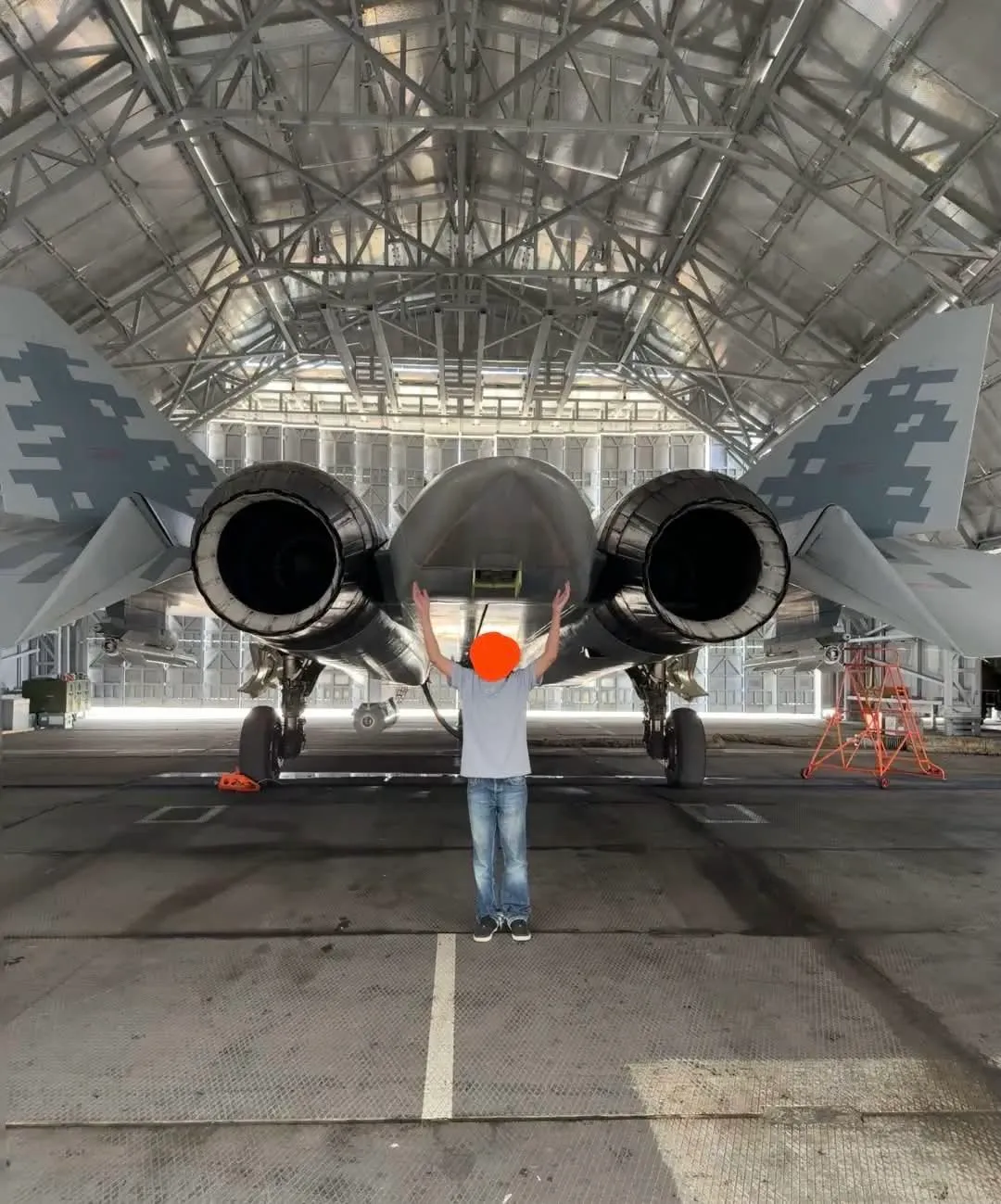
Imagery has recently appeared showing a Russian Sukhoi Su-57 Felon fighter with an unusual external weapons load of short-range air-to-air missiles, as well as what looks like a previously unseen type of targeting pod. While we cannot say for sure, we may just have gotten our first close look at a Su-57 equipped to counter the Ukrainian kamikaze drones and cruise missiles that are now a regular menace to air defenses increasingly deep inside Russia.

Two photos, the original source of which is unclear, show a Su-57 configured with a pair of R-73/R-74 (AA-11 Archer) series short-range air-to-air missiles on pylons under the wings. One of those photos further shows the mysterious targeting pod below the left engine nacelle.

This rear view of a Su-57 reveals the two missiles underwing as well as the targeting pod below the left engine nacelle. via X

Both show a Su-57 seen from the rear inside a large shelter. One photo apparently surfaced on the TikTok social media platform. Somewhat surprisingly, it is one of a pair that also show apparent teenagers posing alongside the Felon — one of them inside the fighter’s cockpit — suggesting some kind of unofficial tour of the base.

The photos have been reposted on Russian social media, with military bloggers identifying them as showing Su-57s configured to hunt and shoot down Ukrainian drones.

A civilian, apparently a teenager, sits in the cockpit of a Su-57. via X

While this certainly seems likely, we should not rule out some other possibilities, including a Felon involved in some kind of weapons trials. On the other hand, it is unusual to see Su-57s, in operational service or otherwise, carrying short-range air-to-air missiles externally. After all, the jet has internal bays specifically for this purpose, something we have described in detail in the past.

A pre-production Su-57. The triangular, canoe-like wing-root weapons bays are visible outboard of the aircraft’s engine intakes. Vitaly Kuzmin

At the very least, this would appear to be a load-out optimized for close-range engagements, of the kind that would be required for hunting Ukrainian long-range one-way attack drones and, increasingly, cruise missiles.

It is also worth noting the large shelter in which the Su-57 is parked. This looks to be of the same type that has been installed at the airfield at Akhtubinsk in the Astrakhan region of the Russian Federation, located more than 350 miles from the front line. In June of 2024, Akhtubinsk was itself hit by Ukrainian drones, which appear to have severely damaged, if not destroyed, a Felon parked in the open.

Russian military bloggers complained bitterly about the lack of protection from drone attacks at Akhtubinsk.

This reflected wider questions about the ability of Russia’s widely dispersed and heavily targeted air defenses to counter Ukrainian drone incursions and the ability to protect its own aircraft. Almost all of these assets, at the start of the conflict, sat in the open without any sort of shelters, let alone hardened ones. This is an area that Russia has since begun to address, even extending this to its long-range bomber fleet.

The Su-57 is very much a prized, ‘silver bullet’ asset of the Russian Aerospace Forces (VKS). But it is also notably well-equipped for countering drones and cruise missiles, as we will come onto later.

The number of production configuration Su-57s in Russia’s inventory is notoriously limited. As of early 2023, there were just around nine series-production Su-57s in Russian service, along with less than a dozen pre-production and prototype aircraft that are not fully equipped for combat operations. The number of production Felons has expanded since then, but not on a grand scale as Russia prioritizes production of fighters like the cheaper and less complex Su-35S Flanker.

The scope of the Su-57’s contribution to Russia’s conflict in Ukraine is hard to quantify.

The U.K. Ministry of Defense has stated that Su-57s have been used in Ukraine since “at least June 2022.”

Prior to that statement, there had been on-and-off claims of the Felon being used to launch standoff strikes, mirroring tactics for other Russian jets involved in similar missions, in which they avoid the highly contested airspace over Ukraine itself.

For this purpose, the Felon can be armed with the Kh-69 stealthy cruise missile, intended to destroy small, hardened targets at distances of over 180 miles. It also carries the Kh-58UShK anti-radiation missile (including in its internal weapons bays) with a maximum range of around 150 miles, depending on launch parameters.

There was also combat testing between the Su-57 and the S-70 UCAV that went terribly wrong.

Meanwhile, the Su-57 has very impressive air-to-air capabilities.

Most impressively, it is armed with the 124-mile-range R-37M (AA-13 Axehead) air-to-air missile, complemented by the R-77-1 (AA-12 Adder) air-to-air missile, with a range of 68 miles, which are also capable of engaging Ukrainian aircraft ‘across the border’ in some scenarios.

Using high-end, fifth-generation, or equivalent fighter jets to tackle hostile drones and cruise missiles would not be unique to Russia. The U.S. military, as well as Israel and the United Kingdom, have called upon their F-35 fleets to deal with lower-end threats like these in the Middle East.

The Su-57 is the only operational Russian fighter available in any kind of meaningful numbers with an active electronically scanned array (AESA) radar.

The N036 radar, which has five separate AESA arrays, is part of a broader, integrated fire-control system that includes the 101KS electro-optical suite, the N036Sh identification friend or foe (IFF) system, and the L402 electronic countermeasures suite.

You can clearly see one of the supplemental side radar apertures below the ‘chine line’ under the aerial refueling probe. Russian Embassy

AESA radars are, in general, much better able to deal with drone and cruise missile threats.

Overall, any kind of AESA radar provides a significant boost to modern combat aircraft. In comparison with traditional mechanically scanned array technology, an AESA can find and track a target at a much greater range, more quickly, and with a greater degree of accuracy. This also applies to smaller threats, including those with limited radar signatures, or flying at very low levels, such as drones and cruise missiles.

The passive 101KS electro-optical suite should also be very useful against the same kinds of threats. It comprises an infrared search-and-track (IRST) sensor ahead of the cockpit, four ultraviolet missile-approach warning sensors, two directional infrared countermeasures turrets, and one imaging infrared sensor for low-level flying. Using the IRST, in particular, for counter-drone and cruise missile work, would reflect U.S. fighters’ employment of podded infrared sensors for the same. These sensors allow for long-range detection of low-radar-signature targets, including drones and cruise missiles. They can work collaboratively with the radar and other sensors to detect, classify, and engage these kinds of hard-to-spot targets at long distances.

The Su-57’s 101KS-V IRST is mounted where it is found traditionally on Russian fighters and is not the best spot for low observability. UAC Russia

Furthermore, unlike previous Russian tactical fighters, the Su-57 has a navigation and targeting pod, the 101KS-N, developed for it from the outset. Again, these kinds of stores have begun to be employed much more widely in efforts to counter drones and cruise missiles.

While targeting pods were first fielded for air-to-ground applications, they can also be used for air-to-air engagement, being highly important for visual ID at range. The laser designator can also be employed to illuminate, or ‘laze,’ a target, although that does not come into play with the Felon, since the aircraft has no laser-guided air-to-air weapons that we know of.

Interestingly, the pod seen in the accompanying image has a different rear end from the standard 101KS-N. It is unclear if it represents a new version of the pod, or even one that is optimized for air-to-air engagements, but that is a possibility. We also should not rule out that this is another type of store entirely, although its position on the nacelle makes that less likely.

Meanwhile, despite claims that Russia is developing laser-guided rockets that can be used for air-to-air engagements, like the U.S. developments of the 70mm Advanced Precision Kill Weapon System II (APKWS II) rocket as a lower-cost way to down drones, there is no evidence that these have yet been fielded. This leaves the R-73/R-74 series short-range air-to-air missiles as the cheapest option for bringing down these kinds of threats.

When the R-73 first emerged in the early 1980s, it soon established itself as a very capable short-range air-to-air missile. Its combination of an all-aspect infrared seeker, high off-boresight capability, thrust-vectoring controls, and the fact it could be cued by the pilot’s helmet-mounted sight was unusual for the time, but is now much more commonplace. It has also been proven as a drone-killer, as seen in the video below, of a Russian MiG-29 Fulcrum shooting down one of Georgia’s Israeli-made Hermes 450 drones over Abkhazia in March 2008.

Russian jet shoots Georgian drone © Reuters thumbnail

Russian jet shoots Georgian drone © Reuters


The successor to the R-73 is the R-74M, which looks almost identical but has a new two-band infrared seeker. This provides an increased seeker range and an expanded off-boresight capability, reducing the possibility of the enemy aircraft escaping it in a tight-turning dogfight.

RVV-MD is the export name used for the Vympel R-74M. The abbreviation denotes “short-range air-to-air missile” in Russian. Rosoboronexport

However, since critical parts of the R-74M were sourced from Ukraine, Russia then moved to the R-74M2, which is optimized for internal carriage by the Su-57. This uses a Russian-made seeker and a rocket motor with increased burn time, for longer range. The weapon can also be fired in lock-on-after-launch mode, which is typically required when launched from an internal bay, the missile beginning its flight under inertial control before achieving an in-flight lock-on.

This sequence may or may not show the launch of an R-74M2 from one of the Su-57’s two small wing-root weapons bays. Russian Ministry of Defense capture

It’s unclear which of these weapons are carried under the wings of the Su-57 in these images. However, with plentiful stocks of older R-73s still available, it would make good sense to carry these externally, since they cannot be accommodated in the internal weapons bays.

Another key counter-drone and cruise missile weapon could be the Su-57’s 30mm single-barrel cannon within the starboard wing root and provided with 150 rounds of ammunition. You can see it in action here. On the other hand, downing slow and low drones with the gun is very challenging from a fighter and can be outright dangerous. The 30mm gun on the Felon also has a notably limited magazine size.

All in all, there is some circumstantial evidence that Su-57s are now being used — whether routinely, or as part of combat trials — for air defense against Ukrainian drones and cruise missiles.

Clearly, this is a growing problem for Russia, underscored very publicly by the large-scale daylight raid on Moscow last month. In what was one of the biggest attacks on the Russian capital in the conflict, multiple Ukrainian drones and cruise missiles hit several locations across the city.

Ukraine is pursuing a relentless campaign that is particularly targeting Russia’s refineries, as well as weapons production sites, and key military facilities.

In response, Russia is calling upon a wide variety of assets to help defend against the drones and cruise missiles.

Although many key assets are deployed closer to the front lines in Ukraine, there is now an array of additional layered air defenses deployed in and around key potential targets. Defensive systems extend from S-400 long-range surface-to-air missile batteries to attack helicopters tasked with gunning down drones in midair. Most prominently, Pantsir short-range air defense batteries have been positioned on rooftops and elevated towers.

Ukraine has demonstrated it can now strike targets over vast expanses of Russian territory. With its ground-based air defenses already stretched extremely thin, robustly protecting a growing landmass from potential strikes with those systems alone just isn’t possible. With Ukraine increasingly using long-range cruise missiles capable of delivering very heavy warheads, the stakes are further increased. Even if fighter aircraft were just focused on defensing key targets from the heavy cruise missile threat, it would make sense as these missiles can do huge amounts of damage and are easier to spot using both infrared and radar sensors.

In addition, we know fighters are part of the overall response equation already. For instance, they have been forward-stationed on alert at the bomber base at Engels for some time now.

These kinds of fighter activities are less visible, and the Russian authorities are unlikely to publicize them much, since the fact they are doing this work paints a less-than-impressive picture of the state of Russian air defenses, and further underlines expanding Ukrainian capabilities. This is especially true of the prized Su-57s, which may well now be involved in these lower-end defensive efforts.

Contact the author: thomas@thewarzone.com

Thomas Newdick is a staff writer at TWZ, where he covers military aviation, defense technology, weapons systems, and international security. Based in Berlin, Germany, he reports on conflicts, military modernization efforts, and emerging aerospace technologies around the world, with a particular interest in airpower and its role in contemporary warfare. His reporting is informed by deep expertise in modern and historical airpower, particularly in Europe, with a focus on military aviation, air campaigns, and aerospace developments across the continent and beyond.


Source link

Russia’s New Two-Seat Su-57 Felon Takes Its First Flight

Newly emerged imagery of the two-seat version of Russia’s Sukhoi Su-57 Felon fighter offers the clearest look yet of the aircraft, which only broke cover over the weekend. The imagery, which was released through official Russian industry channels, shows the dual-seat version of the Su-57 making what was reportedly its first flight at an airfield in Russia. You can get up to date with our previous reporting on the two-seat Su-57D version here.

According to the United Aircraft Corporation (UAC), the first flight of the Su-57D was conducted in the hands of Sergei Bogdan, chief test pilot at the Sukhoi Design Bureau. The flight proceeded as planned in accordance with the flight mission parameters, UAC said.

Russia’s United Aircraft Corporation has flown a two-seat Su-57 prototype for the first time. The variant is designed for pilot training and as a command platform for coordinating manned and unmanned operations. https://t.co/mTtdRvarMo pic.twitter.com/NjPgQzpyTP

— Open Source Intel (@Osint613) May 19, 2026

“Flight tests have begun on the prototype of the Su-57, a fifth-generation two-seater fighter.  This aircraft, developed independently by our aircraft manufacturers, will, in addition to its unique combat characteristics, also possess the capabilities of a combat trainer and a command and control aircraft,” said Denis Manturov, First Deputy Prime Minister of Russia.

“We are continuing our work on improving and expanding the capabilities of our most advanced fifth-generation aircraft complex. I am confident that the two-seater version of the aircraft will significantly contribute to its success in foreign markets,” added Vadim Badeha, CEO of UAC.

Imagery has emerged that appears to show a previously unknown two-seat version of the Sukhoi Su-57 Felon, Russia’s most modern and capable fighter. Provided the available photo is legitimate, and there is nothing obvious to suggest otherwise, at this point, the Russian development would parallel China’s work on a two-seat version of the stealthy J-20.
UAC
UAC

We now have a much better view of the two-seater, which we can compare with the standard single-seat Su-57 already in Russian service. The new aircraft features an elongated cockpit canopy with a steep elevated position for a second crew member behind the pilot. While the definitive role of the new version remains unclear, many observers believe the aircraft represents Sukhoi’s attempt to transform the Felon into a command-and-control platform to operate as part of a future crewed-uncrewed teaming concept, a concept of operations the Felon is already participating in developing.

A good view of the single-seat Su-57 (foreground) and two-seat Su-57D. UAC

The first image emerged through the Fighterbomber Telegram channel, a source closely associated with Russian Aerospace Forces personnel. According to the claims accompanying that first photo, it showed the aircraft during taxi tests, an important stage before any flight trials.

UAC
UAC

The appearance of the twin-seat Su-57D places Russia in a very exclusive club. At present, China is the only other nation publicly associated with a two-seat fifth-generation fighter program through its Chengdu J-20S variant, an aircraft also widely acknowledged to be associated with crewed-uncrewed teaming for the growing family of Chinese uncrewed combat air vehicles (UCAVs) and fighter-like loyal wingman drones.

A composite image that compares the two-seat J-20S with improved single-seat J-20A, and the original single-seat J-20:

The extra crew station could dramatically reduce pilot workload during high-intensity missions involving the control of formations of drones, but also in missions such as electronic warfare and strike coordination. Of course, the aircraft could also be used as a combat trainer.

UAC

The second crew member may eventually direct formations of Sukhoi S-70 Okhotnik-B UCAVs. Russia has already experimented with linking the Okhotnik drone to existing single-seat Su-57 prototypes during previous testing campaigns.

Первый совместный полет БЛА «Охотник» и истребителя Су-57 thumbnail

Первый совместный полет БЛА «Охотник» и истребителя Су-57


The emergence of the aircraft is also intriguing in the context of the abandoned Indo-Russian FGFA program, an effort once intended to create a customized export version of the Su-57 for India. One of New Delhi’s longstanding requests involved a two-seat configuration, but negotiations collapsed years ago amid disagreements over technology transfer, performance concerns, and design priorities. Ironically, the very concept India once sought may now finally be materializing.

UAC

There will be various other changes beyond the cockpit redesign. Accommodating a second seat will likely have required some internal rearrangement involving avionics bays, fuel storage, and mission systems. The changes to the outer mold-line of the jet will also have a negative impact on the aircraft’s low-observability (stealthy) characteristics and performance.

The Su-57 program has long faced a degree of (sometimes unfair) skepticism in the West due to limited production numbers, sanctions pressure, limited combat employment, and persistent questions surrounding the overall level of stealth performance. Nonetheless, Russia continues to push upgrades for the aircraft. In recent years, imagery has also surfaced showing experimental low-observable engine nozzles and revised propulsion systems intended to improve maneuverability and survivability.

UAC

Despite the intrigue surrounding the new imagery, many uncertainties remain. There is still no indication of whether the aircraft is intended primarily for Russian use or export customers, or if the program has any kind of formal Russian state backing. However, a comment on Telegram from Rostec says that the Su-57D “was developed by specialists at UAC on their own initiative.”

The project may be aimed largely at attracting more international buyers for the Su-57, which has so far struggled to find export interest amid intensifying global competition in the stealth fighter market, and Russia’s pariah status since its invasion of Ukraine.

For now, the newly surfaced imagery provides a very interesting glimpse into a previously unknown program. However, the emergence of the two-seat Su-57D at the very least signals a major evolution in Russia’s fighter ambitions.

Contact the author: thomas@thewarzone.com

Thomas is a defense writer and editor with over 20 years of experience covering military aerospace topics and conflicts. He’s written a number of books, edited many more, and has contributed to many of the world’s leading aviation publications. Before joining The War Zone in 2020, he was the editor of AirForces Monthly.


Source link

Two-Seat Variant Of Russia’s Su-57 Felon Fighter Materializes

Imagery has emerged that appears to show a previously unknown two-seat version of the Sukhoi Su-57 Felon, Russia’s most modern and capable fighter. Provided the available photo is legitimate, and there is nothing obvious to suggest otherwise, at this point, the Russian development would parallel China’s work on a two-seat version of the stealthy J-20. While the exact role of China’s two-seat J-20S remains the subject of debate, it is noteworthy that Russia’s use of dual-seat tactical jets is well-established, as is China’s, and that Sukhoi had previously drafted a two-seat Felon specifically for an Indian requirement.

The apparent first publicly available photo of the two-seat Su-57 appeared on the Fighterbomber Telegram channel, which has close ties to the Russian Aerospace Forces. The same account claims that the aircraft is now undergoing taxi trials.

With the unveiling of the two-seat variant of the Su-57- aka the Su-57D (?) – it appears that, following the J-20S (AS), there is now a second 5th-generation aircraft available in a two-seat configuration.

1. pic.twitter.com/JgThpiEdfA

— @Rupprecht_A (@RupprechtDeino) May 17, 2026

The most prominent modification to the aircraft is a redesigned forward fuselage, with a tandem two-seat cockpit that is broadly similar to that on the Su-30 Flanker family and on the two-seat Su-27UB Flanker-C. As on the Su-30, the rear seat is positioned significantly higher than the front one, providing a much better view forward from the rear cockpit.

The background of the photo has been blurred, so the location cannot be identified. Typically, tests of this kind would take place at Zhukovsky, near Moscow, the major hub for Russian experimental aerospace testing.

Russian air force pilots sit in the cockpit of a Russian air force Sukhoi Su-30SM fighter jet before departure on a mission at the Russian Hmeimim military base in Latakia province, in the northwest of Syria, on December 16, 2015. - Russia began its air war in Syria on September 30, conducting air strikes against a range of anti-regime armed groups including US-backed rebels and jihadist groups. Moscow has said it is fighting and other "terrorist groups," but its campaign has come under fire by Western officials who accuse the Kremlin of seeking to prop up Syrian President Bashar al-Assad. (Photo by Paul GYPTEAU / AFP) (Photo by PAUL GYPTEAU/AFP via Getty Images)
Russian pilots sit in the cockpit of a Su-30SM fighter in Syria in 2015. Photo by PAUL GYPTEAU/AFP via Getty Images PAUL GYPTEAU

Some reports suggest that this new version of the Felon is designated Su-57D or Su-57UB, but this remains unconfirmed. In a Russian aerospace context, the suffix D would normally denote long range, while UB signifies a combat trainer.

There have been suggestions that the two-seat Su-57 might have been built using an existing single-seat Felon airframe, namely one of the prototypes, T-50-5R.

With no previous reports that Sukhoi was actively working on a two-seat version of the Su-57, the aircraft’s appearance now is all the more intriguing.

However, back in 2023, details of a patent emerged for a “multifunctional two-seat low-observable tactical aircraft,” with plans published showing a two-seat Su-57. According to Russian media reports, the planned two-seat aircraft is intended for “acting as an airborne command post for network-oriented operations of mixed groups of aircraft.” This is a concept that actually dates all the way back to when the Su-30 was first drafted at the end of the Soviet era. At the same time, the patent points to the utility of such an aircraft for crew training. Regardless, the accompanying illustration looks very similar to the two-seat Felon we see in the image from Fighterbomber.

Federal Service for Intellectual Property

As far as the Russian Aerospace Forces are concerned, only 76 Su-57s (presumed to be single-seaters) are on order. This is a surprisingly low number, with Moscow instead having chosen to invest in the cheaper and well-proven Su-35S and Su-30SM/M2 families of tactical fighters. The Su-57 first appeared, then in T-50 pre-production form, a decade and a half ago.

The idea that Russia might be seeking a combat trainer to help convert pilots to the Su-57 seems very unlikely, especially considering the small number of frontline Felon fighters currently planned. Stealth fighters have dropped the two seat trainer companion concept from the Cold War era. The extreme focus of signature control, high cost of the aircraft, higher levels of automation, as well as enhancements in simulated training over the years, have spurred this.

It may be that Sukhoi is seeking to promote a two-seat combat version of the Su-57 as a direct successor to the twin-seat Su-30SM/M2. These aircraft are widely used by the Russian Aerospace Forces for both long-range air defense and ground attack/strike, two roles for which Russia has long prized having an extra crewmember on board.

Sukhoi T-50 and Sukhoi Su-30MK jet fighters of Russian Air Force fly in formation at MAKS-2013 International Airshow near Zhukovsky, Russia. (Photo by: aviation-images.com/Universal Images Group via Getty Images)
A Su-30MK demonstrator performs alongside a T-50 prototype at the MAKS 2013 International Airshow near Zhukovsky, Russia. aviation-images.com/Universal Images Group via Getty Images aviation-images.com

There is also the fact that the two-seat Su-57 is intended to operate alongside loyal wingman drones, specifically the Sukhoi S-70 Okhotnik-B (Hunter-B) flying-wing uncrewed combat air vehicle (UCAV).

The emergence of crewed-uncrewed teaming will be greatly enabled by a second person acting as a ‘mission commander’ of sorts. In this case, they would occupy the rear seat of the Su-57 and help control uncrewed systems, coordinating tactics with them near the forward edges of the fight. It is in this capacity that the two-seat version of China’s J-20 is widely expected to operate.

A pair of Chinese two-seat J-20S fighters, with serial numbers suggesting assignment to an operational unit. via X

There have already been signs that the Su-57 and S-70 programs are directly linked, including ‘loyal wingmen’ cooperative testing. A two-seat Felon would offer a much more suitable platform for this kind of teaming to be taken further. It is perhaps no coincidence that one of the vertical fins of the two-seat Su-57 carries the silhouette of an apparent S-70.

Первый совместный полет БЛА «Охотник» и истребителя Су-57 thumbnail

Первый совместный полет БЛА «Охотник» и истребителя Су-57


As well as the S-70, the tail marking also appears to show the Sukhoi Su-75 Checkmate fighter, the S-71 stealthy air-launched missile, and some other kind of munition, perhaps generic.

This marking may well suggest that the two-seat fighter is intended to work in conjunction with all of these platforms, to various degrees, forming a new family of Russian air combat systems. This would be in line with a similar kind of tail markings we have seen on single-seat Felons, including the aircraft that was involved during previous cooperative testing with the Okhotnik-B.

Of course, a two-seat Su-57 would potentially be able to provide the Russian Aerospace Forces with a platform that can undertake all these roles: long-range air defense, ground attack/strike, drone controller, and combat trainer.

The two-seat Felon is very likely also being aimed at the export market. There would also be a precedent here, in the shape of India.

Back in 2003, Russia and India signed a letter of intent concerning the joint development of the Prospective Multirole Fighter (PMF), commonly referred to in India as the Fifth-Generation Fighter Aircraft (FGFA).

In 2010, a contract was signed covering the preliminary design of the PMF, to be jointly developed by Sukhoi and Hindustan Aeronautics Limited (HAL) of India on the basis of what was then known as the T-50 — the prototype of the Su-57 Felon.

Notably, the Indian Air Force wanted a two-seat PMF.

It’s not clear how far Sukhoi progressed on a two-seat PMF to meet the Indian requirement, but the result would have looked very much like the two-seat Felon now apparently under test.

This was all academic, however, since India walked away from the PMF in 2018. This followed an embarrassing incident, in which the fifth prototype T-50 caught fire on the runway at Zhukovsky, reportedly in full view of an Indian delegation.

A Russian Sukhoi Su-57 fifth-generation fighter aircraft prepares to take off from the tarmac during Aero India 2025, a military aviation exhibition at the Yelahanka Air Force Station in Bengaluru on February 11, 2025. Air traffic is booming in India, even though only a tiny fraction of its people fly each year, and manufacturers are seeking lucrative deals at the flagship Aero India exhibition from February 10. (Photo by Arun SANKAR / AFP) (Photo by ARUN SANKAR/AFP via Getty Images)
A Su-57 prepares to take off during Aero India 2025 at Yelahanka Air Force Station in Bengaluru. An Indian Air Force Su-30MKI is seen in the foreground. Photo by Arun SANKAR / AFP ARUN SANKAR

Nevertheless, Moscow has continued to push the Su-57 for India, as that country struggles with acquiring new advanced fighters and fielding them in the required numbers.

At the same time, Russia has sought to kickstart the Felon program by finding other export customers for the Su-57E version.

So far, only Algeria has confirmed, via its state-run media, that it has bought the Su-57E, as we discussed at the time. It appears that two aircraft have already been delivered to the North African nation, out of a possible total of 14.

That creepy high pitched tone of Algeria’s Sukhoi Su-57E fighter jets. Algeria is currently the only country in Africa to operate 5th Gen stealth fighters. They have already received two Sukhoi Su‑57 aircraft and plans to acquire an additional 12 units. The Algerian Air Force is… pic.twitter.com/QLLDZNhaco

— Defense News Nigeria (@DefenseNigeria) March 16, 2026

Being able to offer a two-seat Felon could well attract more foreign interest, especially customers that might be looking to acquire members of the Su-30 family, or who might be looking to replace these same aircraft.

One of the first serial-production Su-57s is seen being built in 2020. United Aircraft Corporation

Potentially, Sukhoi might choose to combine the two-seat Felon with the improvements incorporated in the long-promised Su-57M. Also known as the ‘second stage’ Su-57, the Su-57M would be powered by the new AL-51F-1 (izdeliye 30) turbofan engine, replacing the current AL-41F-1, with increased thrust, lighter weight, and lower operating costs, as well as other advanced features. As you can read about here, Sukhoi has also unveiled a new type of thrust-vectoring engine nozzle for the aircraft, intended to improve the low-observable features of the Felon.

Still, adding another seat to the Su-57 will cause an impact on performance. Range could be decreased due to reduced internal fuel load, and the aircraft’s general performance, including speed and turning capabilities, could also suffer. Its radar signature, especially from the critical frontal aspect, will be affected as well. At the same time, the Su-57 is not a very low-observable aircraft, or even close to it. It was designed around a different philosophy than Western fifth-generation fighter aircraft, which took limitations in low-observable technologies and cost into heavy consideration. You can read more about this here.

The absence of Russian interest in buying more Felons has meant the Su-57M program has progressed only very slowly.

Getting more export customers would provide a huge boost to the Su-57 and would also help the Russian military.

Foreign investment is vital to speed the development of the Felon. The same was true in the late 1990s when India’s purchase of the Su-30MKI Flanker essentially secured the development of the multirole version of this fighter, which was only later acquired by Russia. On the other hand, any export customer would be taking a big risk due to the war with Ukraine and its impact on the Russian aerospace and defense industry, as well as its geopolitical standing.

While we await more imagery and details of the latest iteration of the Su-57 Felon, it is certainly noteworthy that a two-seat version of another fifth-generation fighter now appears to have broken cover.

Contact the author: thomas@thewarzone.com

Thomas is a defense writer and editor with over 20 years of experience covering military aerospace topics and conflicts. He’s written a number of books, edited many more, and has contributed to many of the world’s leading aviation publications. Before joining The War Zone in 2020, he was the editor of AirForces Monthly.


Source link