stumping

House Speaker Johnson stumping for CA GOP congressional candidates

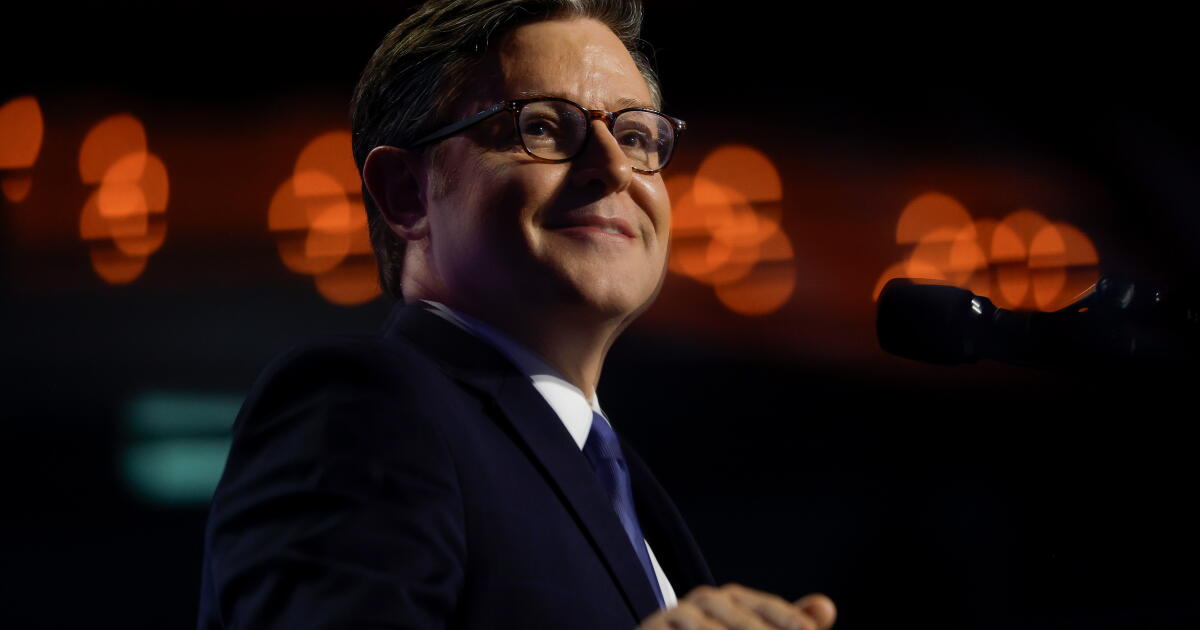
House Speaker Mike Johnson plans to visit California on Wednesday to stump and fundraise for Republican candidates in a state that could determine control of the U.S. House of Representatives during President Trump’s final two years in office.

Johnson (R-La.) plans to visit the Central Valley and the Inland Empire, a sign of the importance of California congressional contests in the November midterm election.

David Wasserman, a congressional forecaster for the nonpartisan Cook Political Report, said that Johnson is attempting to mitigate the aftermath of Proposition 50, the redrawing of California’s congressional districts that voters approved in November in response to Trump’s efforts to tilt districts in his favor elsewhere in the nation, notably Texas.

“If it weren’t for Republican efforts to redraw Texas, Proposition 50 wouldn’t have seen the light of day,” said Wasserman, who predicts Democrats will win control of the House, and said that Republicans would have a better chance at holding more seats if they hadn’t prompted the redistricting fight.

Redrawing congressional districts typically happens once a decade after the U.S. Census, and in California, voters in 2010 decided to hand the power of crafting the state’s districts to an independent commission. After Trump pushed Texas to redraw its congressional boundaries to increase GOP representation in Congress last year, California Democrats responded by persuading voters to reshape its districts to favor Democrats, who already dominate the state’s 52-member congressional delegation.

“California Republicans are on the verge of extinction because of the White House action,” Wasserman said.

In Chowchilla, Johnson is scheduled to hold a fundraiser and a rally in support of former Stockton Mayor Kevin Lincoln, who is trying to topple Rep. Adam Gray (D-Merced) in one of the most competitive congressional races in the nation. He is expected to be joined by Republican National Committee chairman Joe Gruters, California Republican Party Chair Corrin Rankin and Congress members from Texas and Michigan.

He is also holding a get-out-the-vote event in support of Rep. David Valadao (R-Hanford), a longtime Democratic target given the voter makeup of his Central Valley district. Johnson is also holding an evening fundraiser in Riverside for Jim Desmond, a member of the San Diego County Board of Supervisors who is running in the district being vacated by longtime Rep. Darrell Issa (R-Vista).

Issa decided to retire after his congressional district was redrawn because of Proposition 50. He has endorsed Desmond to represent the new district, which spans San Diego and Riverside counties.

The California trip is part of Johnson’s plans to campaign in 22 states in an effort to help Republicans retain control of the House before the Nov. 3 election.

Despite California’s sapphire tilt — registered Democratic voters outnumber Republicans nearly two-to-one — the state’s residents are often the largest donors to politicians on both sides of the aisle. Democrats headed here in coming days include gubernatorial candidates Amy Acton of Ohio, Deb Haaland of New Mexico and Gina Hinojosa of Texas.

Trump sent followers a fundraising appeal Tuesday focused on Democrats’ ability to win control of Congress, which would upend his agenda during his final two years in office.

“I’ve never asked for sympathy. I’ve never asked this country to feel sorry for me. I’ve never asked for anything,” he said in the email. “That changes today. With less than 45 days until midterm elections, the left is ready to put the final nail in my coffin.”

Christian Martinez, a spokesman for the National Republican Congressional Committee, pointed to the pivotal role California will play in determining control of Congress.

“California’s House races will decide whether working families keep fighters like David Valadao, James Gallagher, Kevin Lincoln, and Jim Desmond or get more of the same from Democrats who raised costs, left the border wide open, and made communities less safe,” Martinez said. “Californians are done paying more, waiting longer, and living with less safety so corrupt Sacramento and Washington Democrats can protect their socialist agenda.”

Anna Elsasser, a spokesperson for the Democratic Congressional Campaign Committee, shot back that the policies and beliefs of Desmond, Lincoln and Valadao have deeply harmed California families, including high gas prices and the cost of living.

“That’s why Mike Johnson is swooping in to try and save their fledgling campaigns. Voters won’t forget who sold them out to hand massive tax breaks to billionaires and wealthy corporations by gutting health care and food assistance, championing chaotic tariffs, and refusing to rein in a costly war that has sent gas prices soaring,” she said. “Californians are ready for change, not another two years of Mike Johnson and DC Republicans’ status quo.”
Source link

Trump refers to Black man from racist 1988 campaign ad while stumping in North Carolina

As President Trump tries to convince voters that Democrats have let crime run amok, he’s digging into the country’s political past to cite one of the most controversial campaign advertisements that relied heavily on racist tropes.

During a campaign stop Wednesday in Gastonia, N.C., to stump for Republican U.S. Senate candidate Michael Whatley, Trump resurrected a 1988 George H.W. Bush presidential campaign ad featuring Willie Horton, a Black man convicted of rape and assault after his release through a Massachusetts prison furlough program.

A grainy black-and-white prison photo of Horton was used in the ad targeting then-Massachusetts Gov. Michael Dukakis, who was ahead of Bush in the polls. On Wednesday, Trump evoked the Horton ad in an effort to convince voters Democratic former Gov. Roy Cooper, Whatley’s opponent in the Senate race, is soft on crime.

“Willie Horton was a bad guy, really bad guy,” Trump said, before comparing Dukakis’s release of Horton to the pretrial release of a Black man who faces a murder charge for last year’s killing of a white Ukrainian refugee in Charlotte, N.C.

But Cooper was not the governor when the man was released or when he was later charged with killing the refugee.

“Same thing as this, same as, same exact thing,” the president told the crowd in Gastonia.

It’s the second time Trump has invoked Willie Horton while campaigning for his party. Last month during a speech in Las Vegas, Trump called the Charlotte killing a “Willie Horton — modern day” tragedy.

“After the Willie Horton ad dropped, Bush established a lead in the polls and never looked back,” said Andra Gillespie, a political scientist at Emory University outside Atlanta. “They showed the picture, and you ascribed race onto it. It wasn’t sufficiently condemned as racism.”

A spokeswoman for the Republican National Committee, which organized the Gastonia campaign rally, defended Trump’s reference to Horton.

“Roy Cooper emptied prisons and released thousands of violent monsters onto North Carolina streets,” RNC National Press Secretary Natalie Baldassarre said in a statement to the Associated Press. “The results had deadly consequences, and every Democrat who supports abolishing or defunding the police, paroling criminals, and implementing lax bail policies will have to answer for their dangerous records in November.”

Trump paints North Carolina as a ‘dangerous state’

Wednesday’s rally cited the Aug. 22, 2025, killing of white 23-year-old Iryna Zarutska on a commuter train in Charlotte.

Decarlos Brown Jr., who is Black, faces murder and other charges in Zarutska’s stabbing, which was captured on video. Court records showed that at the time of the attack, Brown had 14 prior cases in Mecklenburg County, including serving five years for robbery with a dangerous weapon. Doctors had diagnosed him with schizophrenia.

Republicans and other influential voices in Trump’s Make America Great Again movement claimed the attack showed how Democratic elected leaders in large cities across the U.S. failed to protect residents, while some conservative commentators suggested Democrats were ignoring an unfounded “black-on-white” crime problem.

“He should have been locked up for many, many years,” Trump said Wednesday of Brown.

“Nobody used to think of North Carolina as a dangerous state, criminally dangerous,” Trump added while blaming Cooper. “It was apple pie, right? Now, it’s one of the most violent, one of the worst in the whole nation.”

According to 2024 FBI crime data, North Carolina ranked 19th for statewide violent-crime rates in a 50-state comparison.

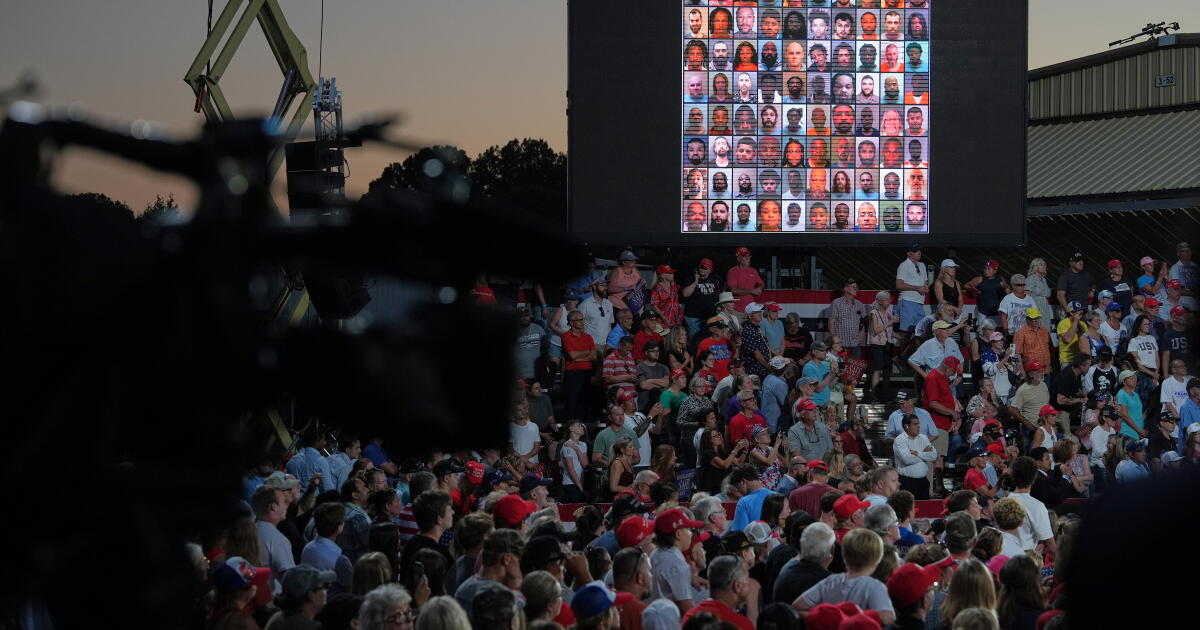
During the Gastonia rally, a mosaic of mug shots was displayed on a large screen for the crowd. Trump claimed Cooper had cut a deal with “radical activists” to release “some of the worst criminals in the nation into North Carolina.”

“He released these people. This is just a small group of them,” the president said, pointing to the mug shots that overwhelmingly featured Black people.

Although it is unclear under what circumstances the people in the mug shots were released, state corrections officials have said Brown was not released early from prison or under Cooper’s COVID-era prisoner-release settlement that Trump referenced.

Before fatally stabbing Zarutska, according to court records, Brown had been on a pretrial release over a misdemeanor offense that was ordered by a magistrate after Cooper left office.

‘Tapping into anger’

Republicans are under pressure to win over swayable voters as the November midterms approach with Democrats pushing to gain control of the House, the Senate, or both. Some political strategists say part of the ploy of adding Horton to the North Carolina Senate campaign is to rile up Trump’s base.

“He’s tapping into the anger to remind Republican voters of what he thinks their first principles are in hopes that will be successful for Republican candidates,” Gillespie said.

“He’s doing this to try and divert attention away from criticism of how he’s governing at the moment,” she added. “Democrats want to make the story of this election Trump’s low approval numbers, the war in Iran, inflation, being preoccupied with things that don’t make a whole lot of sense when there are really serious things going on in the country.”

Dewey Clayton, professor emeritus of political science at the University of Louisville, said Trump and other Republicans may be thinking that what worked before in the 2016 and 2024 elections presumably will work again in this year’s midterms.

“It was very effective,” Clayton said. “You do not necessarily have to look at it as racial, in and of itself, although [race] clearly becomes a component. In 2026, talking about ads going back in the 1980s? I’m sure he had consultants that were basically saying this is tried and true.”

The GOP may need the push in November, Gillespie warns. “I think the motivation by going back to these old strategies is there is real concern about Republican enthusiasm and you might see lower Republican turnout,” she said.

Rhetoric attempts to divert voters’ attention from rising costs

The tactic speaks to desperation by Trump and the Whatley campaign, according to Morgan Jackson, a partner with Nexus Strategies in Raleigh.

“Trump brings up Willie Horton to stoke racial division, something he’s used for the last 10 years,” said Jackson, who is chief strategist for Cooper’s campaign. “It is very clear from the president’s speech last night their only goal is to sow division and hate and lies. Michael Whatley doubles down in support of that effort.”

Jackson also said Trump and Whatley are trying to change the election’s message of “rising inflation and the cost of everything.”

“They want to use inflammatory rhetoric, hate speech and lies to sow division in a chance to win an election,” he said. “By referencing Willie Horton, they are showing their hand very clearly.”

The AP sent an email Thursday seeking comment from Whatley’s Senate campaign.

Williams writes for the Associated Press. Williams reported from Detroit. AP videojournalist Erik Verduzco in Gastonia, N.C., contributed to this report.

Source link