studios

Universal Studios’ ‘Fast & Furious’ coaster is almost ready to ride

Universal Studios Hollywood has begun peeling back the curtain — or opening the garage? — on its new “Fast & Furious”-inspired coaster coming to the park this summer.

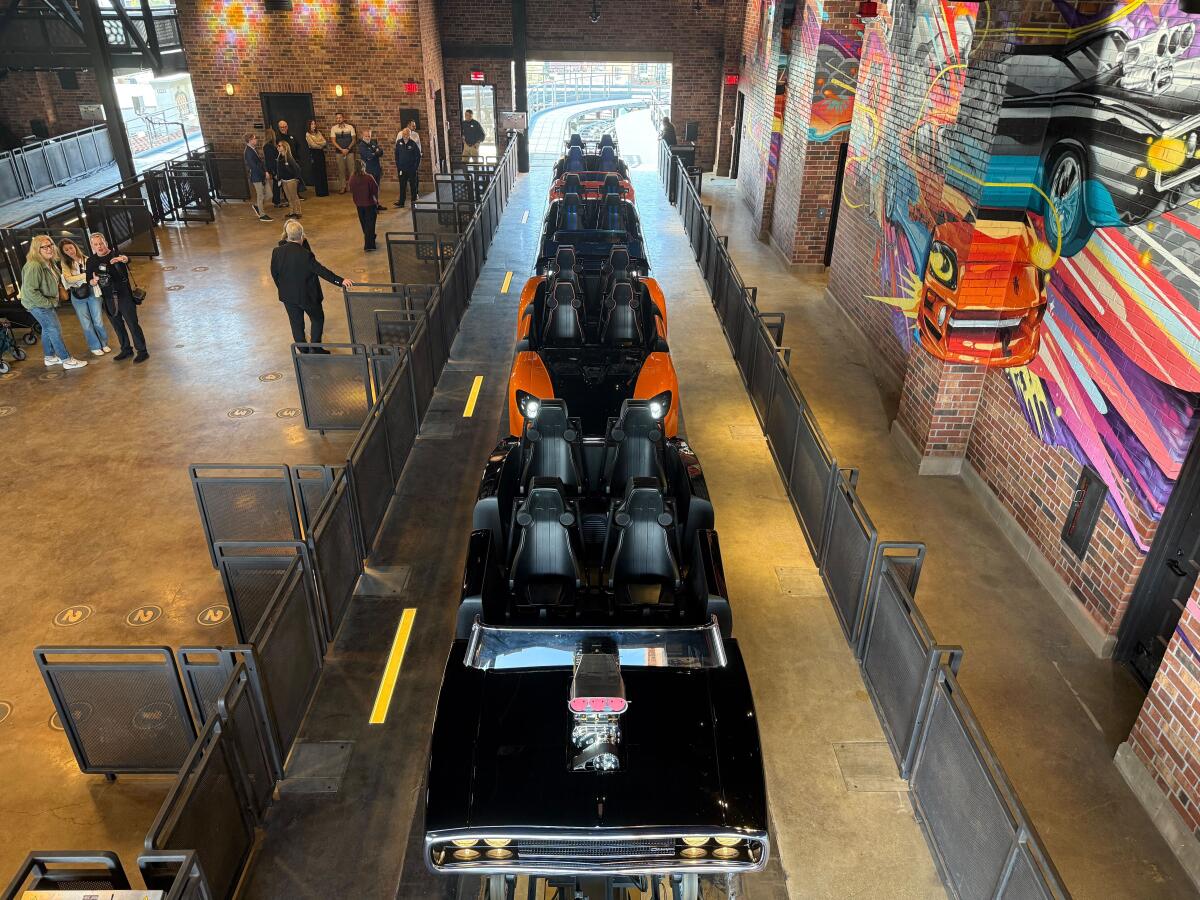
The coaster will feature four heavily detailed miniature cars as ride vehicles. These four-seaters — mimicking a Dodge Charger, Mazda RX-Y, Nissan Skyline GT-R and Toyota Supra, all complete with pull-down lap-bars and working taillights — were unveiled at a media event Wednesday.

But perhaps the most exciting news out of the event is just how meaty of a coaster Fast & Furious: Hollywood Drift looks to be.

A car-themed roller coaster in a warehouse.

Fast & Furious: Hollywood Drift will launch this summer at Universal Studios Hollywood and boast ride vehicles that are miniatures of actual cars. The show building is themed like a warehouse with a vibrant, spray-painted mural.

(Todd Martens / Los Angeles Times)

The attraction, the second outdoor coaster at the park after the more kid-focused “Harry Potter” ride Flight of the Hippogriff, was timed at running about two minutes around the track, which goes over and under the park’s famed hillside escalators. Hollywood Drift will reach a top speed of 72 mph.

While a representative for the company said the coaster is intended to reach that 72-mph milestone at various points on the ride, it’s worth noting that it’s still in testing mode and the final speeds and run-time may change. Still, the fact that Universal has been able to pack such a mighty experience into a tight piece of real estate should be positive news for coaster enthusiasts.

By comparison, the family coaster Flight of the Hippogriff is only about a minute, whereas Disney California Adventure’s Incredicoaster comes in at more than 2 and a half minutes. It’s not uncommon for modern coasters today, due to their increasing emphasis on speed and thrills, to last only about a minute.

A look at the ride vehicles and inside mural in the passenger load area of Fast & Furious: Hollywood Drift.

A look at the ride vehicles and inside mural in the passenger load area of Fast & Furious: Hollywood Drift.

(Todd Martens / Los Angeles Times)

Though packing storytelling into a fast-moving outdoor ride is always a theme park challenge, Universal is doing what it can to make guests feel as if they’re sitting in actual tiny, authentic cars. Check, for instance, the brightly orange Supra, or the black, vintage-style Charger. Each car will be equipped with onboard audio and has unique details, right down to the different placement of the odometers on the dashboard.

One question: Do those odometers actually work and measure speed? A Universal rep declined to answer, but no matter, as most guest will likely be focused on the scenery outside the vehicle, such as the next-door golf course or bird’s-eye views of the park.

An artist rendering of Universal Studios Hollywood's Fast & Furious: Hollywood Drift.

An artist rendering of Universal Studios Hollywood’s Fast & Furious: Hollywood Drift, the park’s first high-speed outdoor coaster.

(Universal Studios Hollywood)

The coasters will board two at a time inside the red brick, warehouse-themed show building, which features spray-painted murals from artist Tristan Eaton. Each coaster train holds four cars. There will be a single rider line for solo guests, and the coaster will boast 360-degree rotation, which is meant to create the sensation of a car drifting. The track is 4,100 feet and will take guests on a hillside journey between the park’s upper and lower lots.

The “Fast & Furious” saga spans 11 films, and will soon be recognized with an exhibit at the Petersen Automotive Museum. “A Fast & Furious Legacy: 25 Years of Automotive Icons” opens March 14 and will feature various movie-used vehicles and stunt cars. Among the cars on display will be an early ‘90s Supra driven by Paul Walker’s character Brian O’Conner, one of the vehicles Universal mimicked for the roller coaster.
Source link

The newest trend in L.A. office space: In-house studios for traveling influencers

For the trendiest tenants in Hollywood office buildings, it’s the latest fad that goes way beyond designer furniture and art: mini studios

To capitalize on the never-ending flow of stars and influencers who come through Los Angeles, a growing number of companies are building bright little corners for content creators to try products and shoot short videos. Athletic apparel maker Puma, Kim Kardashian’s Skims and cheeky cosmetics retailer e.l.f. have spaces specifically designed to give people a place to experience and broadcast about their brands.

Hollywood, which hasn’t historically been home to apparel companies, is now attracting the offices of fashion retailers, says CIM Group, one of the neighborhood’s largest commercial property landlords.

“When we’re touring a space, one of the first items they bring up is, ‘Where can I build a studio?’” said Blake Eckert, who leases CIM offices in L.A.

Their studio offices also serve as marketing centers, with showrooms and meeting spaces where brands can host proprietary events not open to the public.

“For companies where brand visibility is really important, there is a trend of creating spaces that don’t just function as offices,” said real estate broker Nicole Mahalka of CBRE, who puts together entertainment property leases and sales.

Puma’s global entertainment marketing team is based in its new Hollywood offices, which works with such musical celebrity partners as Rihanna, ASAP Rocky, Dua Lipa, Skepta and Rosé, said Allyssa Rapp, head of Puma Studio L.A.

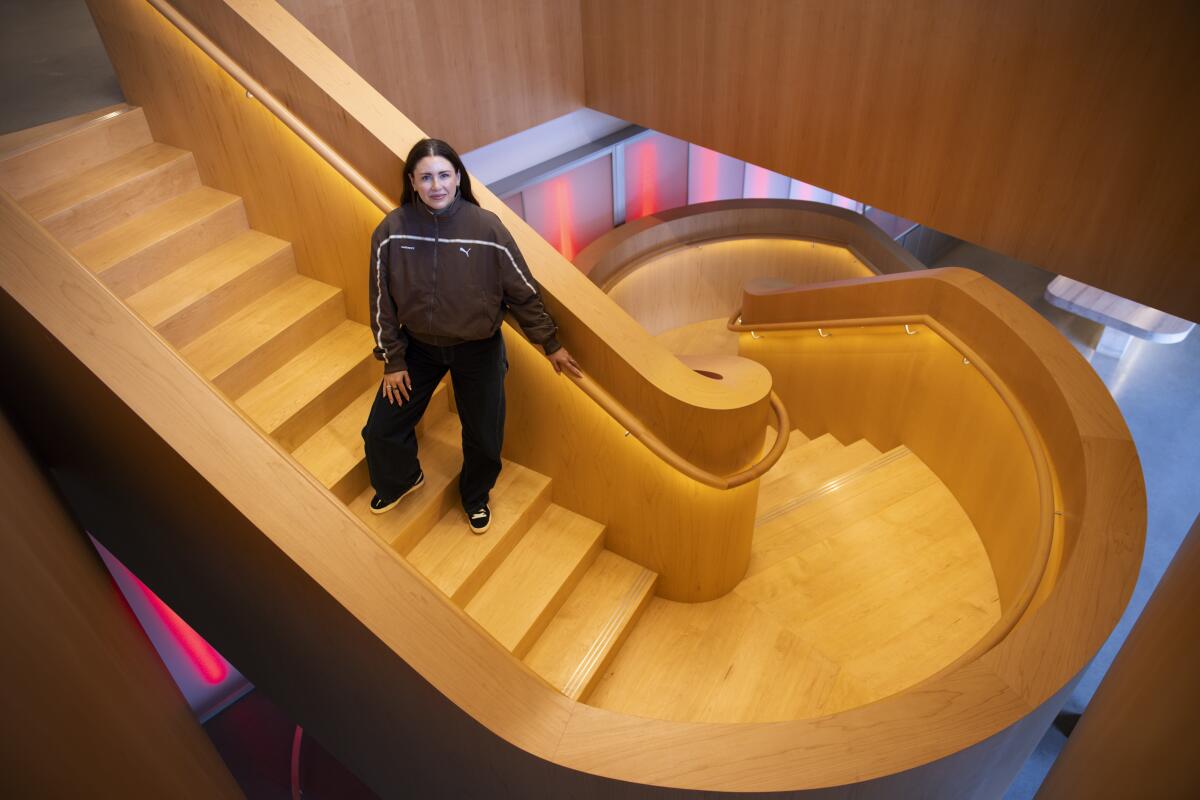
Allyssa Rapp, director of entertainment marketing at Puma, is shown in the Puma Studio L.A.

Allyssa Rapp, director of entertainment marketing at Puma, is shown in the Puma Studio L.A. The company keeps a closet full of Puma products on hand to give VIP guests. Visits to the studio sanctum are by invitation only, though.

(Kayla Bartkowski / Los Angeles Times)

Hollywood is a central location, she said, for meeting with celebrities, stylists and outside designers, most of whom are based in Los Angeles.

The office is a “creation hub,” she said, where influencers can record Puma’s design prototyping lab supported by libraries of materials and equipment used to create Puma apparel. The company, founded in 1948, is known for its emblematic sneakers such as the Speedcat and its lunging feline logo, and makes athletic wear, accessories and equipment.

Puma’s entertainment marketing team also occupies the office and sometimes uses it for exclusive events.

“We use the space as a showroom, as a social space that transforms from a traditional workplace into more of an experiential space,” Rapp said.

Nontraditional uses include content creation, sit-down dinners, product launches, album listening parties and workshops.

“Inviting people into our space and being able to give them high-touch brand experiences is something tangible and important for them,” she said. “The cultural layer is really important for us.”

The company keeps a closet full of Puma products on hand to give VIP guests. Visits to the studio sanctum are by invitation only, though. There’s no retail portal to the exclusive Hollywood offices.

Puma shoes are on display in the Puma Studio L.A.

Puma shoes are on display in the Puma Studio L.A.

(Kayla Bartkowski / Los Angeles Times)

Puma is also positioning its L.A studio as a connection point for major upcoming sporting events coming to Los Angeles, including the World Cup this summer, the 2027 Super Bowl and 2028 Olympics.

In-office studios don’t need to be big to be impactful, Mahalka said. “These are smaller stages, closer to green screen than a massive soundstage.”

Social media is the key driver of content created by most businesses, which may set up small booth-like stages where influencers can hawk hot products while offering discounts to people watching them perform.

Bigger, elevated stages can accommodate multiple performers for extended discussions in front of small audiences, with towering screens behind them to set the mood or illustrate products.

Among the tricked-out offices, she said, is Skims. The company, which is valued at $5 billion, is based in a glass-and-steel office building near the fabled intersection of Hollywood Boulevard and Vine Street.

The fashion retailer declined to comment on the studio uses in its headquarters, but according to architecture firm Odaa, it has open and private offices, meeting rooms, collaboration zones, photo studios, sample libraries, prototype showrooms, an executive lounge and a commissary for 400 people.

Pieces of a shoe sit on a workbench in the Puma Studio L.A.

Pieces of a shoe sit on a workbench in the Puma Studio L.A.

(Kayla Bartkowski / Los Angeles Times)

The brands building studios typically want to find the darkest spot on the premises to put their content creation or podcast spaces, Eckert said, where they can limit outside light and sound. That’s commonly near the center of the office floor, far from windows and close to permanent shear walls that limit sound intrusion.

They also need space for green rooms and restrooms dedicated to the talent.

Spotify recently built a fancy podcast studio in a CIM office building on trendy Sycamore Avenue that is open by invitation-only to video creators in Spotify’s partner program.

“Ambitious shows need spaces that support big ideas,” Bill Simmons, head of talk strategy at Spotify, said in a statement. “These studios give teams room to experiment and keep pushing what’s possible.”

Source link

Mid AI scandal, Hollywood studios threaten ByteDance with legal action

After the fake video of Tom Cruise and Brad Pitt fighting went viral, a surge of AI-generated content from Seedance 2.0 flooded the internet.

Some fans were using the new AI video generator, backed by ByteDance, to refashion the finales for shows like “Game of Thrones” and “Stranger Things.” Others created battle scenes between iconic superheroes like Wolverine and Superman or between a Transformer and Godzilla.

As these Seedance videos amassed millions of views on social media, industry guilds like SAG-AFTRA and the Motion Picture Assn. have criticized the AI platform that was launched last week. Now, many major Hollywood studios are threatening to take legal action against ByteDance, the same Chinese parent that oversees TikTok.

Netflix, Warner Bros. Discovery, Paramount and Disney have all sent individual cease and desist letters, detailing the unauthorized reproduction of each of the studios’ copyrighted intellectual property.

Netflix and Warner Bros. Discovery were the latest studios to send cease and desists letter to ByteDance on Tuesday.

Netflix calls Seedance “a high-speed privacy engine” and says that they “will not stand by and watch ByteDance treat our valued IP as free, public domain clip art,” as stated in the letter. The streamer also cites the illegal use of sets derived from “Squid Game,” costumes from “Bridgerton” and character design from “KPop Demon Hunters.”

Warner Bros. Discovery looks to repurposed content, including characters from the “Harry Potter” and “Lord of the Rings” franchises, as well as superheroes like Batman, as “ blatant infringement” by ByteDance. The studio argues that it’s clear that their AI technology was trained on Warner Bros. copyrighted material “without authorization.”

“But the users are not the ones at the root cause of the infringement; they are merely building on the foundation of infringement already laid by ByteDance as Seedance comes pre-loaded with Warner Bros. Discovery’s copyrighted characters,” wrote the studios’ legal executive vice president Wayne Smith. “That was a deliberate design choice by ByteDance.”

Disney and Paramount were the first of the studios to call out ByteDance, sending their letters last Friday and Saturday. Disney accuses ByteDance of loading its Seedance service “with a pirated library of Disney’s copyrighted characters from Star Wars, Marvel, and other Disney franchises.”

“Over Disney’s well-publicized objections, ByteDance is hijacking Disney’s characters by reproducing, distributing, and creating derivative works featuring those characters. ByteDance’s virtual smash-and-grab of Disney’s IP is willful, pervasive, and totally unacceptable,” Disney’s attorney David Singer wrote, per Axios.

Paramount’s cease and desist letter was reviewed by The Times and makes similar assertions about ByteDance’s unapproved use of copyrighted material.

ByteDance has since pledged to implement more safeguards to protect copyrighted material in response to these letters.

“ByteDance respects intellectual property rights and we have heard the concerns regarding Seedance 2.0,” a company spokesperson said in a statement shared with CNBC. “We are taking steps to strengthen current safeguards as we work to prevent the unauthorized use of intellectual property and likeness by users.”

But with or without the safeguards, Dan Purcell, chief executive of Midnight Labs, an AI-powered company that specializes in IP protection for high-value entertainment, said these letters might be a bit of a delayed reaction from the studios.

“Once synthetic content is generated, it spreads instantly and at a massive scale. By the time lawyers engage, the damage is done,” said Purcell in a statement. “The only path forward is strict licensing, real-time enforcement, and consequences that actually hurt. Reactive letters won’t fix this. The industry needs to move at the speed of AI — not the speed of litigation.”

Source link