
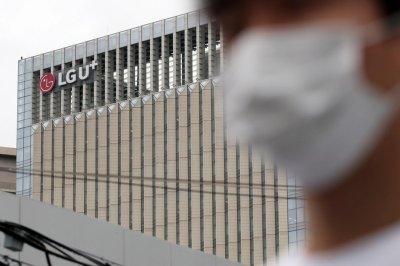

Exterior view of the headquarters of LG Uplus in Seoul, South Korea. LG HelloVision, LG Uplus’s subsidiary is still struggling to revive its mobile virtual network operator business, with subscriber growth and revenue showing little momentum despite broader expansion in South Korea’s budget mobile market. File. Photo by YONHAP / EPA
March 6 (Asia Today) — LG HelloVision is still struggling to revive its mobile virtual network operator business, with subscriber growth and revenue showing little momentum despite broader expansion in South Korea’s budget mobile market.
The company said its budget mobile revenue rose to 156.7 billion won ($118 million) last year from 156.1 billion won ($117 million) a year earlier, an increase of just 0.4%.
The business remains one of LG HelloVision’s key revenue sources, accounting for about 10% of total sales. But its performance has remained largely flat as subscriber growth has slowed.
LG HelloVision said its budget mobile subscriber base, including internet-of-things lines, stood at about 770,000 in the first half of last year, up only about 20,000 from a year earlier.
Industry analysts said the company received limited benefit from increased number-transfer demand that followed last year’s telecommunications hacking incident.
South Korea’s three major wireless carriers responded with aggressive marketing campaigns to attract subscribers, reducing the spillover effect that smaller operators such as LG HelloVision had hoped to capture.
Its parent company, LG Uplus, reported about 21.7 million mobile subscribers last year, up 6.6% from about 20.4 million a year earlier. Mobile service revenue rose to 6.67 trillion won ($5.01 billion) from 6.43 trillion won ($4.83 billion).
One industry official said LG Uplus, which was seen as less affected by the hacking fallout, appeared to absorb a large share of switching demand through aggressive marketing.
Analysts also pointed to LG HelloVision’s cautious approach to new pricing plans and promotions as another reason for the prolonged slump.
The company has faced profitability pressure while growth in its core pay television business has stalled. After posting operating profit in the 40 billion won range in 2023, it has remained in the 10 billion won range over the past two years.
Aside from a new plan introduced late last year that included compensation for financial fraud such as voice phishing, the company has made few notable changes to its budget mobile offerings.
LG HelloVision said it plans to try to revive subscriber growth this year with a new promotion tied to next week’s launch of Samsung Electronics’ Galaxy S26 smartphone series.
Customers who buy a Galaxy S26 device and sign up for one of the company’s plans will receive a 30,000 won ($23) gift certificate. Subscribers to its Coupon Pack plan will also receive additional coupons worth 120,000 won ($90).
The company has also added artificial intelligence features to improve the sign-up process. On its website, users can enter their preferences and receive tailored plan recommendations along with summaries of customer reviews.
Still, analysts say competition with the three major wireless carriers is likely to remain a challenge.
Industry observers expect another round of large smartphone subsidies this year, led in part by KT, which reportedly lost a substantial number of subscribers earlier this year after penalty fees were waived for some customers.
Given the structure of the budget mobile market, analysts said LG HelloVision may need to focus more heavily on low-cost promotional plans and more specialized offerings aimed at specific customer groups.
Travel expert Ash Bhardwaj said people who are still in the country should ‘prepare’
People were advised to ‘prepare’ some essentials (stock image)(Image: Getty)
People affected by the Middle East conflict have been urged to gather a few essential items and keep them “ready to go” amid the ongoing war in Iran. Having these on hand will make sudden changes a lot less scary and chaotic, an expert has claimed.
Speaking on a recent episode of BBC Morning Live, travel expert Ash Bhardwaj said: “One of the best things you can always do is just make sure you have a grab bag. So, if you have to move quickly, you’ve got your essentials with you.”
Although it may look different for everyone, some things will likely be part of anyone’s emergency bag. Ash suggested that packing a ‘grab bag’ in advance could help during any panic that might set in during an emergency.
He said: “[That includes things like] passports, essential medicines and maybe any documents for travel insurance if you’ve got them printed out. If you’ve got kids, a change of underwear, a couple of t-shirts and some snacks.
“If you’ve got babies, and you’re no longer breastfeeding but still feeding them with formula or milk, get enough for 48 to 72 hours. This isn’t to scare you, it’s just so that you have actually thought everything through and it relaxes you.”
Content cannot be displayed without consent
The broadcaster said that people should prepare and “plan for when the worst might happen”. Speaking to hotel staff can help point out emergency exits, procedures, and other important safety measures.
As of March 5, 2026, the Foreign Office advises against all but essential travel to the United Arab Emirates. There are other parts of the Middle East and surrounding areas that have also been listed as completely or partially unsafe for travel – read that latest round-up here.
The current situation in Iran caused tensions to erupt last week, on February 28, when the US and Israel launched extensive strikes. Iran’s Supreme Leader, Ayatollah Ali Khamenei, who had been in power since 1989, was killed during the initial wave of attacks.
In an update from March 5, Dubai’s Emirates Airline has announced it will operate over 100 flights on March 5 and 6 from Dubai. The airline said it will “continue to gradually build back its flying schedule, subject to airspace availability and all operational requirements being met”, adding that “safety is always our top priority”.
WASHINGTON — A crowd gathered at a commuter gate at Reagan National Airport on Friday as fog-laden Washington skies caused an hourlong ground stop that backed up passengers hoping to head out from American Airlines’ Terminal D.
But soon the already densely packed area swelled even more, as word spread across nearby gates that, of the hundreds of air travelers coming and going, only one among them was accompanied by a U.S. Secret Service detail, along with uniformed local police officers: former President Biden.
Biden, who has rarely made public appearances since leaving office last year, sat, like many of his fellow passengers, awaiting a flight that would take him to Columbia, S.C., for an evening event with the South Carolina Democratic Party.
Passengers whispered and gaped in wonder: Why would a man who for a time was leader of the free world be, like they were, at the mercy of airport travel delays, even as he sat ensconced in his security detail?
Maybe for Biden it made more sense than for some other former presidents. Known for years as Amtrak Joe, Biden as a senator prided himself on becoming arguably the nation’s biggest Amtrak fan, regularly taking the train home to Delaware rather than taking up residence in Washington. Now, as a former president, he’s been spotted riding the rails since, taking selfies with and chatting up his fellow passengers.
On Friday, the vibe was about the same, as Biden — seated in the third row of the tiny first class cabin on the commuter jet — boarded the flight ahead of other passengers, along with his detail, members of which were spread throughout the plane.
“God bless you, sir,” one woman said, as she filed past Biden in his window seat, newspaper in his lap.
“Thank you for your service,” a man said, shaking Biden’s hand.
The woman who took the aisle seat next to the former president first set down her coffee on the arm rest they shared, deposited a bag in the overhead compartment, then sat down and realized her seatmate was the nation’s 46th president.
Biden set his hand on her cup to steady it, then met her gaze with a hello as she took her seat.
“I feel like I’m about to cry,” the woman said, as they shook hands and, over the course of the next hour, chatted throughout the flight.
Former presidents and their spouses receive lifelong Secret Service protection under federal law, but there are no provisions guaranteeing the elite levels of private travel that were necessary features of their time in office.
There are two, seemingly irreconcilable, stories of how the Palisades fire became a deadly and destructive behemoth dominating post-fire discourse. One is told by the residents who lived through it, and the other by the government officials who responded to it.
Government officials have routinely argued they had little agency to change the outcome of a colossal fire fanned by intense winds. Palisadians point to a string of government missteps they say clearly led to and exacerbated the disaster.
Officials’ unwillingness to acknowledge any mistakes has only sharpened residents’ focus on them, functionally bringing to a grinding halt any discourse around how the two groups can work to prevent the next disaster.
Instead, residents have been left feeling gaslighted by their own government, while fire officials struggle to navigate the backlash to new fire safety measures.
When officials and residents do talk solutions, the former tend to emphasize personal responsibility — most prominently, Zone Zero, which will require residents to remove flammable materials and plants near their homes — while the latter often push for greater government responsibility: a bolstered fire service and a beefed-up water system.
You’re reading Boiling Point
The L.A. Times climate team gets you up to speed on climate change, energy and the environment. Sign up to get it in your inbox every week.
The Fire Department failed to put out the Lachman fire a week prior. Mayor Karen Bass then left the country during dangerous weather while the deputy mayor for public safety position was vacant after Brian K. Williams, who formerly held the role, was put on leave after allegedly making a bomb threat against City Hall. L.A.’s city Fire Department officials failed to deploy 1,000 firefighters in advance of the fire and did not call for firefighters to work extended hours, while dozens of fire engines were out of commission at the time, waiting for repairs.
An aircraft drops fire retardant on the Palisades fire on Jan. 8, 2025.
However, when government officials — be it the mayor, the fire chief or the governor — describe the fire, they tell a different story:
The day after the fire erupted, Bass placed some of the blame on climate change, which some scientists argue has exacerbated fires in the area by increasing the frequency and intensity of hot, dry and windy conditions. Fire officials stressed that the winds during the first few days of the fires were so strong that there was little even the best-equipped fire service could do and that the fire grew so large that there wasn’t a single fire hydrant system in the world that could handle the demand.
Many residents don’t deny that, under such extreme conditions and after the fire reached a certain scale and ferocity, the destruction became inevitable — and there are many who would just like to move on from January 2025.
However, others remain frustrated that these official versions of the story do not acknowledge the government’s failure to prepare for such conditions and its failure to stop the fire before it passed the threshold of inevitability. Indeed, at times, officials have shied away from these uncomfortable discussions to shield themselves from potential liability.
One telling example: On the one-year anniversary of the fire, residents gathered to voice these frustrations at a protest in the heart of the neighborhood. But when Bass was asked to comment on the event, she dismissed it as an unfit way to commemorate the anniversary and accused organizers of profiting off the disaster.
Survivors gathered in Palisades Village to commemorate the one-year anniversary of the Palisades fire on Jan. 7, 2026.
(Genaro Molina / Los Angeles Times)
This sort of dismissal has essentially forestalled any constructive discussions of climate change, the limits of the fire service and water systems and proposals like Zone Zero, since so many Palisadians now feel like any of that is just a fig leaf for the government’s agency and responsibility, and not a good faith discussion of how to solve the wildfire problem.
The reality is, how climate change is influencing wildfires in Southern California is still a subject of debate among scientists. That doesn’t mean that local leaders need to sit on their hands and wait for consensus. Experts can easily point to a litany of steps that can be taken to better protect residents, regardless of how profound the impact is of global warming on fire risk in the region.
Fire scientists and fire service veterans (who have the pleasure of speaking freely in retirement) argue both personal responsibility and government responsibility play key roles in preventing disasters:
Home hardening and defensible space slow down the dangerous chain reaction in which a wildfire jumps into an urban area and spreads from house to house. It is then the responsibility of a prepared and capable fire service to use that extra time to stop the destruction in its tracks.
The bottom line is that neither the government’s story nor the residents’ story of the Palisades fire is fundamentally wrong. And neither is fully complete.
The conversations around fire preparedness that need to happen next will require both homeowners and government officials to acknowledge they both have real agency and responsibility to shape the outcome of the next fire.
More recent wildfire news
Mayor Karen Bass personally directed the watering down of the city Fire Department’s after-action report on the Palisades fire in an attempt to limit the city’s legal liability, my colleague Alene Tchekmedyian reports. The revelations come after Bass repeatedly denied any involvement in the editing of the report to downplay failures.
Last Thursday, California Atty. Gen. Rob Bonta announced his office had opened a civil rights investigation into the fire preparations and response for the Eaton fire, looking for any potential disparities in the historically Black west Altadena, my colleague Grace Toohey reports. West Altadena received late evacuation alerts, and officials allocated limited firefighting resources to the neighborhood.
Meanwhile, the federal government is hard at work attempting to unify federal firefighting resources within the Department of the Interior — including from the Bureau of Land Management and National Park Service — into one U.S. Wildland Fire Service by the end of the year. The effort does not yet include the federal government’s largest firefighting team in the U.S. Forest Service. Because it is housed under the Department of Agriculture, not the Department of the Interior, merging it into the U.S. Wildland Fire Service would probably require congressional approval.
A few last things in climate news
An investigation from my colleague Hayley Smith found that, as Southern California’s top air pollution authority weighed a proposal to phase out gas-powered appliances, it was inundated with at least 20,000 AI-generated emails opposing the measure. When staff reached out to a subset of people listed as submitters of the comments, only five responded, with three saying they had no knowledge of the letters. The authority ultimately scrapped the proposal.
The National Science Foundation announced last week that a supercomputer in Wyoming used by thousands of scientists to simulate and research the climate would be transferred from a federally funded research institute to an unnamed “third-party operator.” It left scientists shocked and concerned.
The Department of Energy has made new nuclear energy a priority; however, no new commercial-scale nuclear facilities are currently under construction, and it’s unclear how the U.S., which imports most of the uranium used by its current reactors, would fuel any new nuclear power plants. These sorts of technical challenges have vexed nuclear advocates who are fighting against a decades-long stagnation in nuclear development, triggered primarily by safety concerns.
This is the latest edition of Boiling Point, a newsletter about climate change and the environment in the American West. Sign up here to get it in your inbox. And listen to our Boiling Point podcast here.