struggling

Tiny ADU houses young adult children struggling to pay rent in L.A.

When Tina LaMonica and Warren Wellen purchased their South Pasadena Craftsman home in 2001, the one-car garage dated back to 1917, a time when people parked their narrow Ford Model T cars inside garages like this one.

“We bought it for $650,000,” LaMonica says of the house. “Of course, we could never afford to buy it now.”

The couple moved in when their daughters, Sophie and Ruby Wellen, were little, and their tree-lined street was full of families with young kids who rode their scooters throughout the neighborhood.

“We all grew up together and had block parties,” says Sophie, 30. Now, she adds, “There are no new families moving in. No one left. Why would they?”

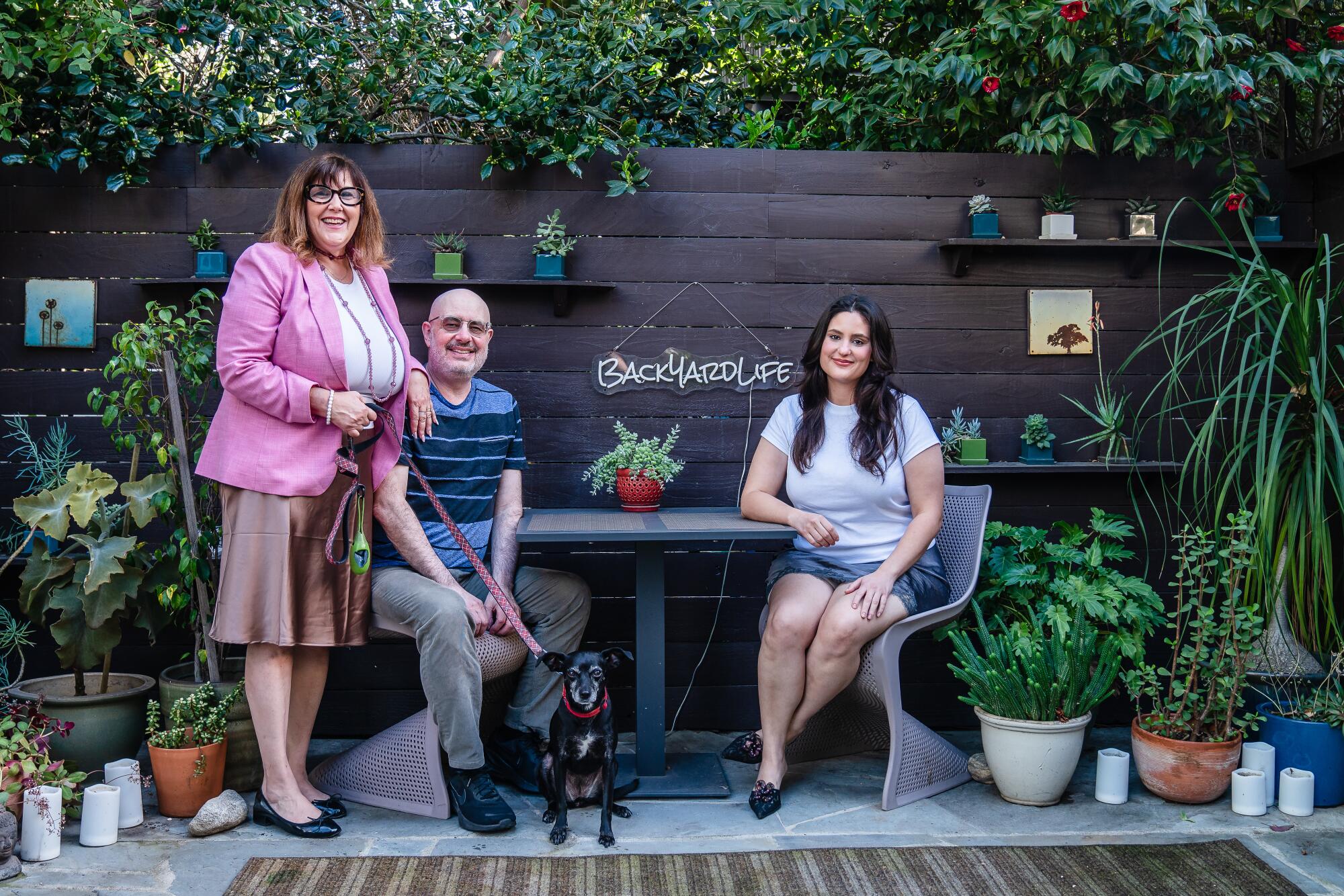
Tina LaMonica, Warren Wellen, their daughter Sophie Wellen and their dog Hazelnut.

Tina LaMonica and Warren Wellen sit on the patio with their daughter, Sophie Wellen, and their dog, Hazelnut, next to the 230-square-foot ADU where Sophie lived for two years. Her younger sister is now living in the ADU.

Music was always a part of their home, Sophie says, thanks to her father, Warren, 65, who is both an attorney and a musician in the alternative rock band Brahms’ Third Racket.

“He plays everything,” Sophie says. “Throughout my entire childhood, he was always making music.”

LaMonica adds, “It can be disruptive.”

So in 2021, the couple pulled together money from different sources, including a line of credit, and turned the garage into a tiny 230-square-foot accessory dwelling unit, or ADU, for Warren to use as a music studio.

“It was intended to be a creative space, not a home,” says LaMonica, 64, who is a commercial real estate broker. “The total cost was around $125,000, including permits, construction and all systems — a significant investment, but one that ended up serving our family in unexpected ways.”

Tina LaMonica and Warren Wellen's South Pasadena garage before it was turned into an ADU.
The garage before, left, during, right, and after, below, construction.

The garage before, left, during, right, and after, below, construction. (Tina LaMonica)

A Craftsman style ADU rests behind a swimming pool.

A few months after using his new music studio, Sophie, who had been in law school at the University of Michigan, moved back to Los Angeles after being away for 10 years.

“She wasn’t working right away, and like many new grads, she had student debt and credit card debt from getting through school,” says LaMonica. “Market rent in the Los Angeles area wasn’t realistic, even with a job offer lined up. So, the studio became her first home. It gave her stability and independence during a major transition.”

Sophie, who describes her relationship with her parents as close, says the ADU was always meant to be temporary and she’s grateful for it.

“At 28, I didn’t know where I wanted to live in L.A.,” she says. “I had only grown up in Pasadena, which is a small community. I felt lucky to be able to live in this little house in the back and explore the city to find the right place for me, instead of rushing to grab the first place I could, like so many of my associates had to do. It was right after the bar exam, and I was really stressed.”

A tiny ADU with black and white tile and white kitchen.

The ADU features a Murphy bed and and a nice-sized kitchenette.

An all-white kitchen in an ADU.

The kitchenette has a compact air fryer-toaster oven from Our Place, and a slim, Classic retro-style refrigerator.

After clerking for a judge in Washington, D.C., Sophie’s boyfriend William Lang moved to Los Angeles and joined her and her dog in the ADU, bringing his two cats with him.

“It was a full house,” Sophie says, laughing. “And yes, they were indoor cats! But we made it work. Finding a rental was hard. I couldn’t really afford a nice apartment in L.A. I had to save up and wait until my boyfriend got here so we had two incomes.”

It’s no surprise they felt at home. Although it’s small, the unit is sunny and bright, with a pitched roof and a big picture window overlooking the lush backyard and swimming pool. (The blinds can be closed for privacy.)

There’s a Murphy bed that turns into a love seat when pulled down, which saves space, and classic black-and-white checkerboard porcelain tile from Mission Tile in South Pasadena that gives the living spaces a surprising sense of fun. The unit also has a bathroom with a shower, a closet and a storage nook above the bathroom.

A desk in an ADU overlooking a backyard.

The ADU has room for a desk, flat-screen TV and comfy chair.

There’s also room for a desk, a flat-screen TV on the wall and a comfortable chair. Not having a dining room isn’t a problem because there’s a welcoming patio just outside the French doors, with two chairs, a couch and a coffee table.

“The backyard was our saving grace,” says Sophie. “Most of the time, William sat at the little table. It was cozy and nice. I got to be near my parents, and they got to know my partner better.”

The ADU has a roomy kitchenette with white cabinets and countertops, a compact air fryer-toaster oven from Our Place, and a slim retro-style refrigerator from Unique. “You can bake, broil and fry with the small Wonder Oven,” LaMonica says. “Ruby uses it all the time.” There’s also a mini-split system for heating and cooling, and if needed, a stackable washer and dryer can be added later.

An outdoor patio in South Pasadena.

A patio area provides another living space steps outside the ADU.

Soon after Sophie moved out, having lived in the back house for two years, her 27-year-old sister Ruby moved in. “She works in Torrance and can’t afford to rent an apartment close to her job,” her mother says. “The ADU gives her a chance to live affordably, stay safe and be near family, while building financial footing on her own terms.”

LaMonica is happy with the ADU, though she wishes they could have added a second floor, which the city of South Pasadena didn’t allow at the time.

She imagines a future in which one of her daughters lives in the main house, and she and her husband live in the ADU. “I think an ADU is a great long-term solution,” she says. “It keeps people from moving out of California. With an ADU, at least you can keep your family on site.”

In some ways, the small ADU is more than just a solution for young people who can’t afford to live in Los Angeles. A 2025 study found that Los Angeles ranked second among the 50 largest U.S. metros for its share of working adults (ages 25 to 40) living with parents.

Backyard homes can also help people connect with their community.

“The nice thing about the ADU is that it can give you a sense of community that’s hard to find right now because people are so isolated,” says Sophie, who now rents a two-bedroom duplex in Hancock Park with Lang for $4,500 a month. “We’re both lawyers at private law firms and doing well, but I still don’t feel like I could have a child right now and give them the life I want. It’s hard to make big life decisions in L.A., especially if you have student debt. It was really nice to have dinner with my parents every once in a while. They didn’t want William and I to leave.”

A tiny bathroom inside an ADU.

The bathroom inside the ADU.

As Southern California gets more crowded and housing costs rise, young people have to look for options different from those their parents had when they were growing up.

LaMonica says she and her husband never thought they would house both daughters in a converted garage. “But in a place like Los Angeles,” she says, “the tiny ADU turned into a flexible and essential lifeline for our family, not just once but twice.”

And maybe one day, Warren will finally get his music studio.
Source link

Sarah Beeny in last-ditch attempt to turn around struggling dating app after it fails to make a single penny in a year

SARAH Beeny is revamping her failing dating app in a last-ditch attempt to turn around its fortunes.

She’s launching the “world’s first” video dating app – and is looking for singletons to find love in a bold new move.

Sarah Beeny is hoping to revive the fortunes of her ailing dating siteCredit: Instagram
Sarah is best known for being a property guruCredit: Channel4

Sarah might have the Midas touch when it comes to flogging houses, but didn’t have quite so much luck wielding Cupid’s bow and arrow.

The telly star and property guru runs a dating website called My Single Friend and it is heavily in debt.

Now she’s revealed that the site will be overhauled.

She said on Instagram: “I have to admit, I’m so excited because I’m going to relaunch My Single Friend as the world’s first video dating app and it’s coming next week and I can’t wait.

PROPERTY BLOW

Sarah Beeny faces having to demolish extension at £3m estate in council row


STAYING STRONG

Sarah Beeny on cancer battle, moment that broke her and how she’s moving on

“But as we are launching completely empty, I’m looking for the first 50 people who would like to be on the app when we launch, so if you have a single friend you’d like to pop on or are single yourself, send me a DM.”

The most recent figures show it didn’t make a penny in a year, plus singletons looking for love have been less than kind in online reviews of the firm.

Books posted on Companies House showed that for 2023 the firm had zero equity and it didn’t pay a penny in Corporation Tax, meaning it didn’t make enough cash on which to be taxed. It also owed £1.5m.

The firm was founded in 2004.

A review on Trustpilot read: “The matches they offer up have nothing to do with my search criteria, I suspect there aren’t many people signed up on my area. Customer service good though.”

Another person added: “Most profiles are inactive. Some profiles appear twice under different IDS The quality of the individuals is questionable… most guys over 50 look like bald spuds and send d**k pics.”

My Single Friend told would-be members: “Our clever two-way matching system can help you find your perfect match; our highly-rated and super-lovely customer service team is on-hand every day.

“Fall in love with love again. We can’t wait to help you take the first step.”

Household name Sarah — who beatbreast cancer in 2023 — shot to fame fronting Property Ladder in 2001 before going on to front a host of property shows on TV.

Sarah has overcome breast cancer, getting the all-clear in 2023Credit: Getty

Source link

Mel Schilling’s ‘heartbroken’ MAFS co-star John Aiken says ‘I’m struggling to breathe’ as he breaks silence on her death

MEL Schilling’s “heartbroken” MAFS co-star John Aiken has admitted he is “struggling to breathe”, as he broke his silence on her death.

The Australian relationship expert, 55, revealed his immense grief after Mel tragically died aged 54 following a brave battle with colon cancer.

MAFS Australia expert John Aiken penned an emotional tribute to Mel Schilling following news of her deathCredit: Instagram
John said he was ‘struggling to breathe’ following his friend’s passingCredit: Instgram
Mel and John appeared on the Aussie MAFS together for ten yearsCredit: Nine

The much-loved dating coach was known for her work on both the Married At First Sight Australia and UK versions of the show.

Today her MAFS Aus co-star John shared a picture of him with his pal from 2016 and one from the recent series, and penned an emotional message which read: “It’s with great sadness and heavy heart that today I lost my dear friend and fellow MAFS expert Mel Schilling.

“I am heartbroken, devastated and finding it hard to breathe.

“It was a privilege and an honour to sit beside her on the MAFS couch and watch her shine. She was warm, supportive and honest, and she deeply cared about all our participants. I had a front row seat to her remarkable skills and she truly believed in the experiment. At her core she loved love.”

Read more on mel shilling

FEARLESS MEL

How Mel Schilling hid cancer hell from legion of fans despite pain off camera


LAST OUTING

Final pictures of late Mel Schilling four months before tragic death

John also talked about their relationship off screen, and the “fun” they would have when the cameras weren’t rolling.

“And when her illness struck she never complained. She kept her challenges to herself and continued to deliver time and time again. She was an inspiration, a fighter, a leader,” the grief stricken star said.

“It’s not fair that my partner in crime is gone. She was one of the good ones. I am unravelling just thinking about it. I wanted to sit on our couch together forever. She knew my rhythms and I knew hers. But it’s simply not to be.

John admitted he was “distraught” that he had to accept she was now gone, and ended the heartfelt message with: “I love you and I miss you gorgeous.. xx”.

Mel and John were incredibly close having worked on MAFS Australia together for ten years, including the latest series which is airing right now on E4.

John said he was ‘heartbroken’ by Mel’s sad deathCredit: Channel 4

Mel’s MAFS UK co-star Charlene Douglas also paid an emotional tribute, where she reflected on their close bond.

Taking to Instagram, she wrote: “I’m both devastated and heartbroken to hear of the passing of my MAFS queen and friend Mel.

“I had the pleasure of spending time with Mel in her last days and will forever treasure the laughter, the memories and love we had for each other.

“Mel’s love for life, jokes and of course dancing will forever stay in my heart. What I wouldn’t give to be dancing to Beyoncé with you right now.

Mel’s MAFS UK co-star Charlene also penned a heartfelt tributeCredit: Channel 4

“Sleep in perfect peace Mel. Love you ♥️”

Mel was previously diagnosed with colon cancer in 2023, which later spread to her lungs and brain.

Her husband Gareth Brisbane announced the heartbreaking news today in an emotional Instagram post.

Alongside touching pictures of Mel, he said: “Melanie Jane Brisbane-Schilling passed away peacefully today, surrounded by love.

“In her final moments, when I thought cancer had taken away her ability to speak, she ushered me closer and whispered a message for Maddie and me that will sustain me for the rest of my life.

“It took all of her remaining strength, and that gesture summed up our wee Melsie perfectly. Even then, her only thought was for Maddie and me.”

He continued: “This is a woman who became a new mum and a TV star at 42 — and nailed both.

Mel’s husband Gareth Brisbane announced the heartbreaking news today in an emotional Instagram postCredit: Instagram

“This is a woman who, through two years of chemotherapy, when she could barely lift her head from the pillow, never complained and never stopped showing courage, grace, compassion and empathy, and never missed a day of filming.

“To most of you, she was Mel Schilling — matriarch of MAFS and queen of reality TV. To Maddie and me, she was our wee Melsie: an incredible mum, role model, and soulmate.”

Channel 4 hailed Mel as a friend who “radiated joy, warmth and optimism”.

Issuing a statement, it said: “Our thoughts and condolences are, first and foremost, with her family and loved ones.

“We’re privileged to be the channel that is home to Mel’s work, which was at the heart of Married At First Sight‘s phenomenal success, both in the UK and Australia.

“It reflected so much about her – her fierce advocacy for other women, her passion for healthy relationships and her mission to unite people in love.

“For many who work for Channel 4, Mel was not just a colleague but a friend, someone who radiated joy, warmth and optimism, who energized every room she walked into, with humour and positivity.

“Everyone who knew her will miss all this about her and much more. We share in the sorrow that we’re sure many viewers will now feel at this terrible loss.”

Mel had been battling colon cancerCredit: Instagram

Source link

‘It’s the Cuban people who are suffering.’ How Cuba is struggling under U.S. oil blockade

Reggaeton boomed in a neighborhood bar in Old Havana on a recent night, when, suddenly, the music stopped and everything went dark.

The customers groaned. Another blackout.

A U.S. blockade on oil shipments to Cuba has plunged the island into its worst energy crisis in modern history. The country’s already cratering economy now teeters on the verge of collapse, with vehicles idled by a lack of gas, hospitals forced to cancel surgeries and millions living without a steady supply of electricity and water.

It is the result of a calculated pressure campaign by President Trump, whose administration is negotiating with Cuba’s leaders over the future of the communist-ruled Caribbean island.

People fed up with rolling blackouts have staged sporadic protests in recent days, banging pots and shouting slogans against the government, rare demonstrations in a country known for repressing dissent.

Some power outages hit isolated areas, but in recent weeks Cuba has experienced three island-wide blackouts. The most recent one struck Saturday night and continued into Sunday.

A food cart on a street at night.

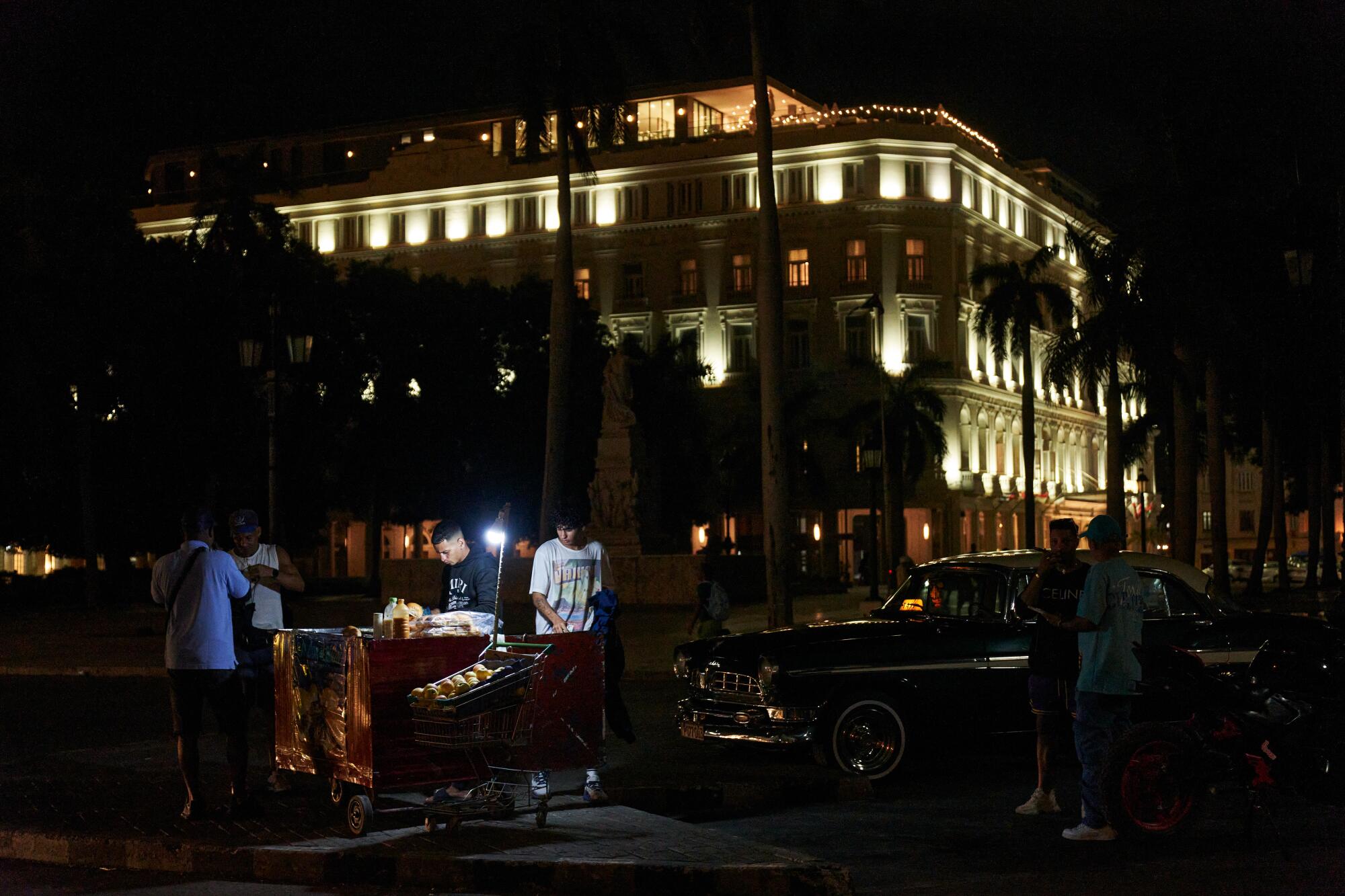
Two men sell food from a cart in front of the Kempinski hotel Friday night in Havana.

As Havana and Washington hash out a possible deal — which is likely to include some form of economic opening, and perhaps limited changes to Cuba’s leadership — many people here say they feel like pawns in a geopolitical game beyond their control.

Some, like those at the bar, who kept drinking in the dark after the power vanished, say they have little choice but to adjust to a life where flushing a toilet, cooking a pot of rice or riding a bus to work is now considered a luxury.

“The U.S. is trying to punish the Cuban government,” said one customer, named Rolando. “But it’s the people who are suffering.”

Cuba’s struggles long predate the oil embargo. For years, Cubans have complained of food shortages, crumbling public services and political repression. Demographers say Cuba is undergoing one of the world’s fastest population declines — a 25% drop in just four years — as birth rates fall and emigration soars.

Cuban President Miguel Díaz-Canel blames “genocidal” economic, financial and trade restrictions imposed by the United States in the decades since Fidel Castro’s army toppled the U.S.-backed dictator Fulgencio Batista in 1959.

1

Young people play dominoes in the streets of Old Havana

2

A woman reacts to her granddaughter at a bar

1. Young people play dominoes in the streets of Old Havana. 2. A woman reacts to her granddaughter at a bar in Old Havana. (Natalia Favre/For The Times)

But many Cubans blame their own leaders for mismanaging the economy — and straying from the ideals of Castro’s revolution. They were raised to believe in an implicit social contract, which maintained that while Cubans might not have luxuries or be allowed all civil liberties, they would always have free education and healthcare, a place to sleep and enough to eat.

“The pact has failed,” said Juan Carlos Albizu-Campos Espiñeira, an economist at the Christian Center for Reflection and Dialogue in Havana.

He faults the government for soaring inflation and a misguided investment strategy that pumped money into the tourism industry while neglecting fundamental sectors like industry and healthcare.

“This is the worst moment in Cuba’s history,” he said. “But things were really bad before this.”

An aerial view of the Vedado neighborhood in Havana.

The Vedado neighborhood in Havana.

Life has long been challenging for Pablo Barrueto, 63, who works mornings at a construction site and now spends afternoons filling plastic jugs from a tap on the street and hauling them up narrow stairwells to neighbors who have been without water for weeks.

His two jobs barely enough cover food for him and his partner, Maribel Estrada, 55, who earns $5 monthly as a security guard at a state-run museum.

The pair, who live in a cramped studio apartment in a crumbling colonial-era building, can’t afford butter or mayonnaise, so breakfast is a piece of plain bread. Barrueto said he often goes to bed hungry. It has been years since he has tasted pork or beef.

“I work so hard,” said Barrueto, who on a recent afternoon was cooking beans in a pair of tattered jeans. “But I don’t see the fruits of my labor.”

Men fill plastic containers with water on a sidewalk.

Pablo Barrueto, center, fills water containers from a public tap after more than 17 days without running water.

Estrada has developed ulcers on her legs, but the doctor who prescribed her antibiotics said she wouldn’t be able to find them on the empty shelves of state-run pharmacies. On the black market, the medication was being sold for more than what Estrada makes in a month.

“If I lived in another country, my legs wouldn’t look like this,” she said, rolling up her pants to show the chronic sores on her calves.

Estrada said she was reaching a point where she would accept anything that would improve her life, even U.S. intervention.

“If things don’t get better, they should just hand over the country to Trump,” she said.

The U.S. has long played a major role in Cuban history, from its involvement in the island’s war of independence from Spain to the heavy hand of American companies in Cuba’s sugar industry. Washington repeatedly backed unpopular leaders who protected U.S. interests, including Batista, whose corrupt and repressive regime sparked support for the Cuban Revolution.

For decades, the island was celebrated by U.S. critics worldwide as a scrappy symbol of anti-imperialism and a utopic experiment in socialism. But in recent years, amid a government crackdown on dissent, some of that support has faded.

A man holds a booklet and cash wrapped in a small plastic bag.

A man holds his ration book and cash while waiting to collect his daily bread in Havana.

The Trump administration’s bellicose new push to dominate Latin America with tariffs and military intervention has scared allies who in the past might have come to Cuba’s rescue.

Mexico, Brazil and Colombia, all led by leftists, have declined to provide emergency fuel shipments in recent months out of fear of angering Trump.

The current crisis was set in motion on Jan. 3, when the U.S. launched a surprise attack on Venezuela, killing 32 Cuban security guards stationed there — in addition to scores of Venezuelan troops and civilians — and capturing President Nicolás Maduro.

As the U.S. seized control of Venezuela’s oil industry, the impacts immediately rocked Cuba, which had long relied on subsidized oil shipments from Maduro’s regime.

Cuba’s leaders say the country has not received a single fuel shipment in three months, debilitating an economy that depends on oil to generate the electricity.

There is little relief in sight.

An employee of a grocery sells vegetables and other goods

An employee of a MIPYME sells vegetables and other goods to a customer Friday in Havana.

A state-owned Russian oil tanker loaded with 750,000 barrels of crude is currently crossing the Atlantic. It’s unclear whether the U.S. will try to stop the ship from reaching Cuba, where the oil, once refined, could provide Havana with energy for several weeks.

At the same time, the “Nuestra América” humanitarian convoy is in the process of delivering more than 20 tons of critical supplies to Cuba, some of which will arrive by boat in the coming days.

David Adler, a general coordinator of Progressive International, a global leftist group that helped organize the flotilla, said he hoped the delivery of medicine, food, baby formula and solar panels would highlight the severity of Trump’s restrictions on Cuba.

“We’re beginning to come to grips with the fact that there will be mothers and children and elderly and sick people who will die simply as a result of this senseless and cruel and criminal policy,” Adler said. “Why are we inflicting such cruel punishment on a country that does not represent any threat to the United States?”

In Cuba, where many fear the prospect of no electricity come summer, with its muggy heat and swarms of disease-carrying mosquitoes, people are getting creative. With virtually no public transport and few drivers able to find — or afford — gas that costs more than $5 a gallon, many people have resumed riding bicycles. Others have fashioned electric-powered scooters into slow-moving taxis.

Four young people stand and sit in a dark street.

Young people talk in the street in central Havana.

One man in the small town of Aguacate made headlines after he modified his 1980 Fiat Polski to run on charcoal, the same fuel many people here are now cooking with.

Camila Hernández, who works at Havana’s airport, had hoped to celebrate her 21st birthday at home with friends, eating and dancing. “It would have been wonderful,” she said.

But it had been weeks without regular electricity in the home she shares with her parents and boyfriend. His family’s home had power — but lacked water.

To avoid yet another night sitting in the darkness, she marked her birthday by strolling to the Paseo del Prado, an iconic boulevard not far from the waterfront cooled by a light sea breeze.

Her boyfriend’s mother, Yusmary Salas, 47, said poor living conditions were testing her patience. “I can’t even go to the bathroom without planning how I will flush the toilet,” she said. She said she is hungry for change, but has no idea what shape it will take.

Trump insists he “can do whatever I want” in Cuba, and recently said he expects to have the “honor” of “taking Cuba in some form.”

A man climbs a steep flight of stairs.

Pablo Barrueto carries a water container up to his home in Old Havana.

Such talk rattles many here who grew up in a country where government buildings still bear the revolutionary motto: “Homeland or death, we will prevail.”

Salas said she hopes that whatever comes next is peaceful, and that Cubans, long a proud people, have their dignity restored. And their power restored, too.

At the darkened bar in Old Havana, workers scrambled to light candles and serve beer that, without refrigeration, would soon go warm. Someone with a battery-powered speaker hit “play” on a song, the 2004 Daddy Yankee hit “Gasolina.”

Dáme más gasolina!” they sang together. “Give me more gasoline!”

Source link