
street lighting

L.A. property owners reject $80 million streetlight funding increase

Los Angeles property owners voted against an increase in an assessment for maintaining streetlights that would have collected an additional $80 million a year, as the city faces a backlog of broken streetlights due to stagnant funding and a rise in vandalism.

The assessment has not changed since 1996. Property owners had until June 2 to submit their votes, which were weighted by the amount of their parcel’s proposed assessment. According to results released Thursday, nearly 80% of the weighted vote went against raising the assessment, which currently generates about $45 million a year.

For the average single-family home, which make up the majority of parcels, the current payment is $58 annually, or about $5 a month, according to Miguel Sangalang, executive director and general manager of the Bureau of Street Lighting. The increase would have brought the average annual bill to $117, or about $10 a month.

The proposed increase would have brought the total amount collected by the assessment to $125 million a year.

In a joint statement Thursday, Mayor Karen Bass, Council President Marqueece Harris-Dawson and City Councilmembers Eunisses Hernandez and Katy Yaroslavsky said that despite the result, the “critical work will continue” to address the broken streetlights that have plunged neighborhoods into darkness across the city.

“Despite this outcome, the City remains committed to improving streetlight reliability, repairing outages faster, and building a sustainable funding path for streetlight operations and maintenance,” the group statement said. “Every Angeleno deserves to feel safe walking their dogs, returning home from work, and parking their cars at night, and the City is committed to delivering the reliable street lighting that makes that a reality.”

The Bureau of Street Lighting owns and operates nearly 225,000 streetlights across the city, which have historically been covered by the assessment. The average repair time for a streetlight was one year, bureau officials said in February.

Without more revenue from the assessment, city officials have been looking for alternative funding. The City Council has said it will finance $65 million for solar-powered streetlights.

Bass recently announced an initiative to repair and replace 60,000 streetlights over the next two years, and several council members have turned to their district’s discretionary funding to fix broken streetlights in their districts.

Hernandez, who chairs the council’s Public Works Committee, said in a statement that the result doesn’t change the fact that the city is trying to maintain a 21st century lighting system with an outdated funding model.

“If this assessment isn’t the path forward, then it’s our responsibility to build one through better leveraging City assets like light poles, exploring new revenue opportunities, and pursuing reforms to outdated state laws like Proposition 218 that make it extraordinarily difficult for cities as large as Los Angeles to maintain basic public infrastructure,” she said.

Broken streetlights have emerged as an issue in the mayoral election, with Councilmember Nithya Raman citing broken lights as an example of how the city “can’t seem to manage the basics.” Raman is facing Bass in a Nov. 2 runoff.

In February, city council members announced a plan to replace streetlights with solar-powered versions, in an attempt to deter copper wire theft. About 1 in 10 streetlights are out of service because of disrepair or copper wire theft, according to the city.

A well-known example is the Sixth Street Bridge, where thieves stole seven miles’ worth of wire.
Source link

To combat copper thefts, L.A. city agency seeks its own armed police

For thieves looking to strip Los Angeles for parts, copper has become a fast-moving currency.

The problem has become so persistent that the Los Angeles Department of Water and Power is now asking for its own armed police force to protect vulnerable utility equipment, street lighting and critical infrastructure, insisting that the department’s contracted and unarmed security guards aren’t cutting it.

“They lack the authority to detain or arrest suspects, intervene in crimes in progress, conduct searches, or carry firearms for enforcement purposes,” according to a May 21 report from the city agency. “Delays hinder timely intervention, reduce investigative effectiveness, and contribute to repeat victimization of LADWP facilities.”

Under DWP’s current “observe and report” security model, an officer who sees someone cutting a fence or stripping copper from a transformer has little authority apart from yelling a warning or making a 911 call, according to the department report.

The proposal asks for 20 to 50 sworn officers to start, hired over a five-year period, along with support staff. If approved, the force would give the agency’s officers the authority to carry a firearm, make arrests and investigate thefts. The plan was scheduled to be discussed Thursday by the City Council.

The push comes as citywide service requests for streetlight repairs have surged over the last several years.

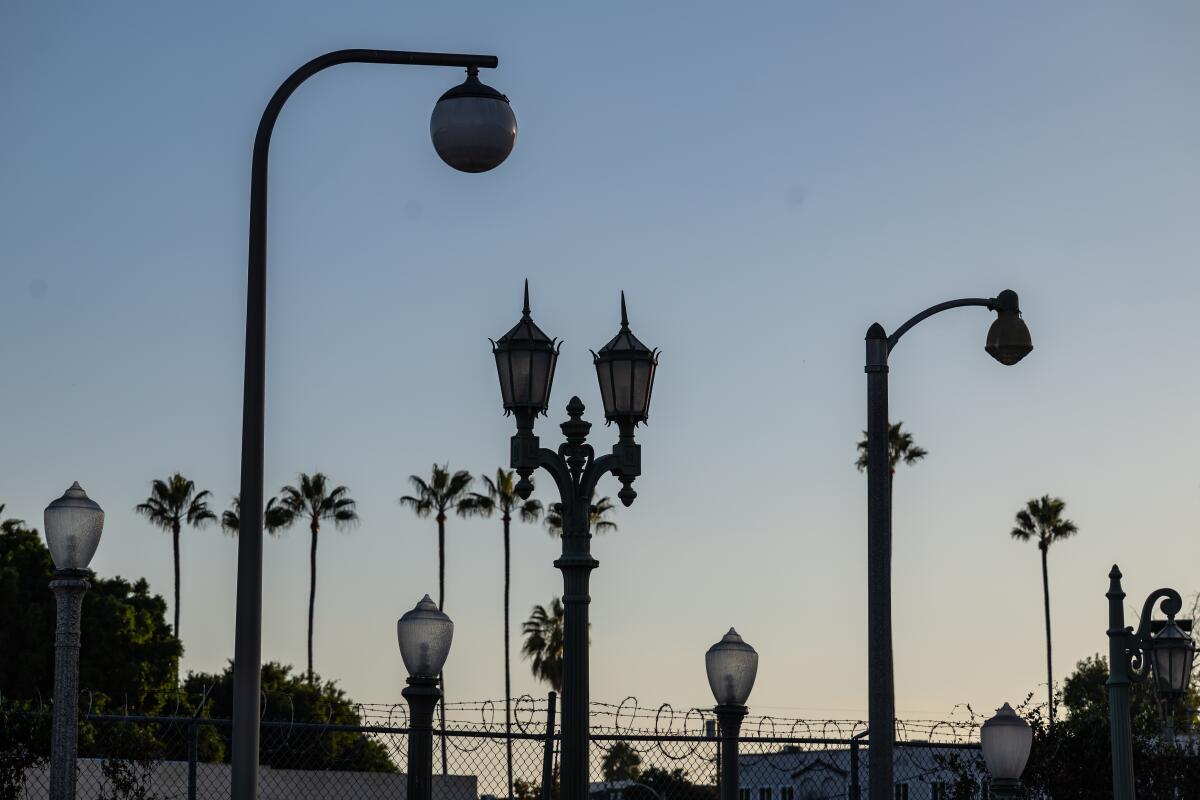
Dark streetlights.

L.A.’s historic streetlights outside the Bureau of Street Lighting near Virgil Avenue and Santa Monica Boulevard.

(Jason Armond/Los Angeles Times)

The city logged 14,328 electronic streetlight service requests in 2018, according to data from the Bureau of Street Lighting. Requests have tripled since then, reaching an all-time high of 46,079 in 2024, the last full year of available data.

Mayor Karen Bass’ office said in March that copper thefts are a leading cause of streetlight outages. Repairs have been backlogged for months.

Prices for the metal are at an all-time high, driven by major supply disruptions in Indonesia and Chile, and soaring demand from artificial intelligence data centers and electric grid infrastructure. Thieves typically exchange the metal for cash at recycling centers, where it can fetch up to $5.30 per pound. The City Council last year approved a program offering up to $5,000 for information in metal and wire theft cases.

Theft losses alone exceed $1 million annually, according to DWP.

Establishing a new police force would require changing the city charter, meaning voters will have a say come the November midterm elections. Authorities will also need to obtain state legislative approval for the plan.

Officials said rolling out the police department would cost $9.7 million over three years, plus up to $6 million annually to pay for staffing. They maintain those costs are less than the $46 million combined DWP spends each year on private security contractors and unarmed staff security.

A metal pole and base, with an opening in the base.

On Hill Street in downtown L.A., streetlights have been targeted by thieves and vandals.

(Jason Armond/Los Angeles Times)

Any cost overflows would be paid for by DWP customers.

Timothy O’Connor, executive director for the Los Angeles Office of Public Accountability, a spending watchdog, said his office is not convinced that the agency could minimize long-term cost creep, or that the new force would offset enough costs to justify the program. The proposed force of a few dozen officers, he said, would be too small to get the job done.

“Theft losses at DWP are real and are increasing. However, eliminating these losses is not enough to offset the proposed costs,” he said. “Furthermore, DWP will be unable to fully eliminate theft given the diffuse nature of the DWP system.”

But O’Connor also said the department is faced with real security risks like those posed by drone attacks or terrorism threats, which he said “appear to justify the proposal at some level.”

In February, a man shot himself after he drove his car through the perimeter fence of a power substation while carrying explosives and several firearms. Dubbing the incident an attempted terrorist attack, officials said the episode could have caused catastrophic infrastructure damage.

David Levitus, executive director of the advocacy group LA Forward, said he was surprised to learn of the proposal so late in Los Angeles’ ongoing charter reform process, which his organization has monitored closely.

“The fact that this is being dumped in late May — what’s the rush?” Levitus said. “I think we really need to be wary of creating new police departments in general, but especially without a clear case and clear constraints and accountability mechanisms.”

Source link