WASHINGTON — Republicans are entering the final month of the midterm campaign increasingly anxious that the $1 billion at their disposal may not be enough to fend off sweeping losses as the party reckons with President Trump’s unpopularity, persistent cost concerns and the fallout from the war in Iran.
The cash advantage, spread out across a half-dozen groups, is driven largely by the Trump-aligned MAGA Inc., which had nearly $416 million in cash on hand at the end of August and began stepping up its spending on critical races in September.
But that money may have come too late, forcing the president’s group to pay much higher rates because of the shrinking availability of air time. Four Republican Senate campaign officials said groups that reserved advertising time last spring paid much lower rates than MAGA Inc. and its affiliated groups.
Instead, by waiting until September, Trump-connected organizations are sometimes paying more than five times what they would have spent if they acted earlier.
A representative of MAGA Inc. familiar with the group’s strategy said its spending has allowed Republicans to keep races more competitive than they would have been otherwise. In some cases, the group has been the only one on the air criticizing Democratic candidates.
The MAGA Inc. representative and the Republican Senate campaign officials spoke on condition of anonymity to discuss internal strategy.
The challenge is acute in places like Texas, where Trump will travel on Wednesday for the second time in a week to stump for Republican Ken Paxton’s Senate campaign. The state hasn’t elected a Democratic senator since 1988, yet MAGA Inc. has spent more than $22 million in the past month, according to the ad tracking firm AdImpact.
Another group, Texas PAC, which is aligned with Senate Majority Leader John Thune, has spent more than $83 million on advertising in the past month, an extraordinary amount to protect what’s normally a safe Republican seat.
One of those advertisements, which featured Paxton’s estranged wife saying she’s supporting the full Republican ticket, aired across the United States last weekend during a football game between the Dallas Cowboys and the Houston Texans.
Candidates are charged a lower advertising rate than outside groups, so the late infusion of super PAC cash has come at a steep price.
MAGA Inc., which is running ads primarily on streaming services, has been charged roughly $894 per airing, according to AdImpact, while Texas PAC has been charged roughly $809 for a mix of broadcast and streaming. That compares with about $290 for Democratic nominee James Talarico’s campaign, also on broadcast and streaming.
Those averages mask some of the more glaring disparities. For example, during a football game last month, Texas PAC was charged $450,000 to air a single spot in the Austin market. Talarico’s campaign paid $50,000 for a spot during the same game in the same market, according to AdImpact.
Elections are a referendum on the power of money
The 2026 campaign is shaping up as a referendum on the power of money in American politics. Democrats freely acknowledge their disadvantage, relying instead on anti-Trump sentiment among voters and targeted messaging on issues like corruption. Some Republicans, meanwhile, are open about the challenge of trying to spend their way out of a tough campaign at this late stage.
Neil Newhouse, a longtime Republican pollster, echoed concerns that his party was deploying its cash too late.
“After the votes are counted, I think we’re going to find the most effective advertising in terms of communicating message and moving voters and poll numbers, the most effective time was advertising that happened well before Labor Day, not after it,” he said. “A million dollars of advertising in October is a drop in the bucket.”
Thune’s group began pulling back in North Carolina last week, a sign of the party’s challenge in the Senate race there. The state’s outgoing Sen. Thom Tillis has been increasingly vocal about his party’s vulnerabilities and recently said that, even with a strong cash advantage, “in the last month, you pretty much have to place your bets.”
“If we have endless resources, then we should spend endlessly in every state,” he said. “Absent endless resources, you’ve got to make data-driven decisions about where you can win.”
The midterms mark the first national election since the Supreme Court in June erased limits on how much political parties can spend in coordination with candidates for Congress and president, injecting even more money into a political system already awash in cash.
Money alone doesn’t translate into victory
There’s plenty of evidence that money alone doesn’t translate into victory.
Democrat Kamala Harris entered the final stretch of the 2024 campaign with significantly more money than Trump but went on to lose every critical swing state and the White House. Elon Musk’s $25 million didn’t lift his preferred candidate to a Wisconsin Supreme Court seat last year. And Tom Steyer didn’t advance to the general election in the California governor’s race despite pumping $216 million of his own money into the campaign.
The $1 billion that Republicans have amassed compares with roughly $579 million held by a comparable collection of major Democratic groups.
Senate Democratic leader Chuck Schumer said his party is facing an “obscene” amount of spending that could swamp them in the midterms.
“We’re never going to have as much money as them,” he said in an interview. “I sum up the election in this sentence: Can a massive Republican advantage in money beat a massive Democratic advantage in better candidates and political climate? I bet it can’t.”
In addition to Texas, Democrats have mounted competitive Senate campaigns in states like Ohio, Maine, Iowa and Michigan. A similar dynamic has emerged in governors’ races from Florida and Georgia to Wisconsin, Ohio and Nevada.
Former President Barack Obama is stepping up his involvement in the midterms and will headline a fundraiser for Senate candidates on Wednesday.
In the House, Democrats are growing so confident they can retake the majority that they’re expanding their targets deeper into traditionally Republican districts in Arkansas and Tennessee. But a lack of money could limit their gains.
“We absolutely need to spend enough to get our message out,” said Rep. Suzan DelBene of Washington, who chairs the Democratic Congressional Campaign Committee. “And district by district, we are.”
Trump turns to his bond with supporters
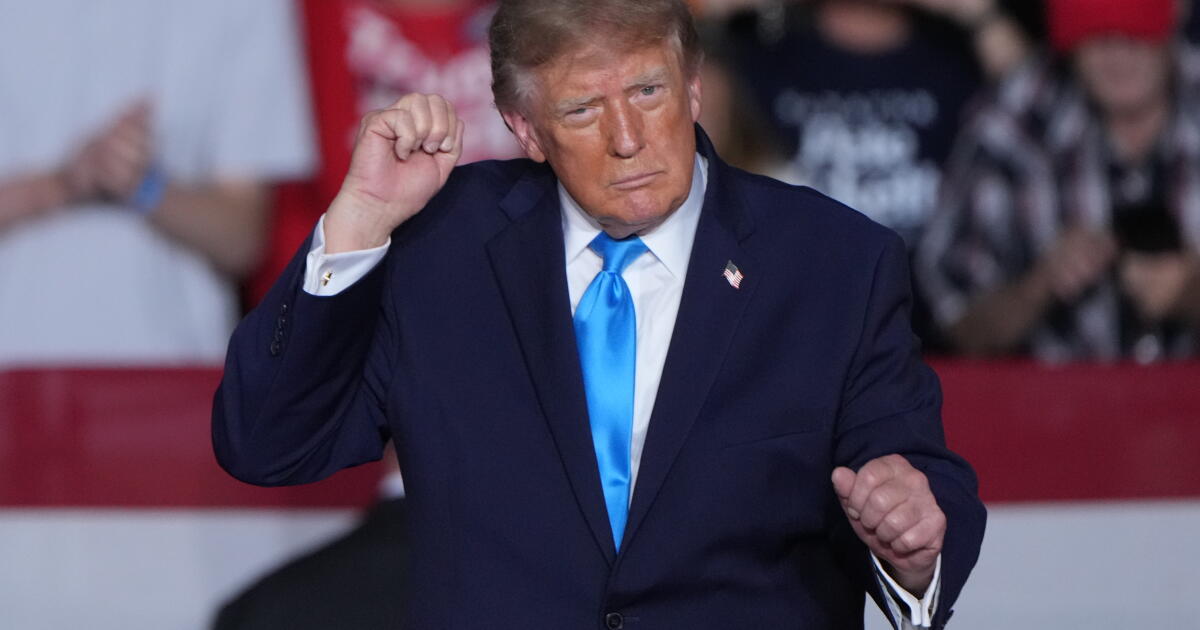
From his earliest days as an unlikely political figure, Trump has consistently overcome expectations. Facing daunting prospects heading into the final weeks of his last midterm, he’s betting he can again outwit political gravity, relying in large part on the deep bond he’s built with supporters.
He has stepped up his campaign rallies in recent weeks, traveling to deep red territory to galvanize the party faithful. At events like the one this past weekend in Vandalia, Ohio, the crowd was enthusiastic and cheered at the lines that have become Trump staples over the years, particularly when he dips into profanity. The high school gymnasium that held the event was packed, though crowds began emptying out about halfway through the 90-minute rally.
In the closing minutes of a speech Monday in Grand Island, Nebraska, the president revived his plea that supporters who have stood so fervently by him pretend as if he is on the ballot one more time.
“In a true way, I am running,” he said. “We have to keep it going.”
Sloan and Beaumont write for the Associated Press. Beaumont reported from Des Moines, Iowa. AP writers Seung Min Kim in Vandalia, Ohio, and Mary Clare Jalonick in Washington contributed to this report.