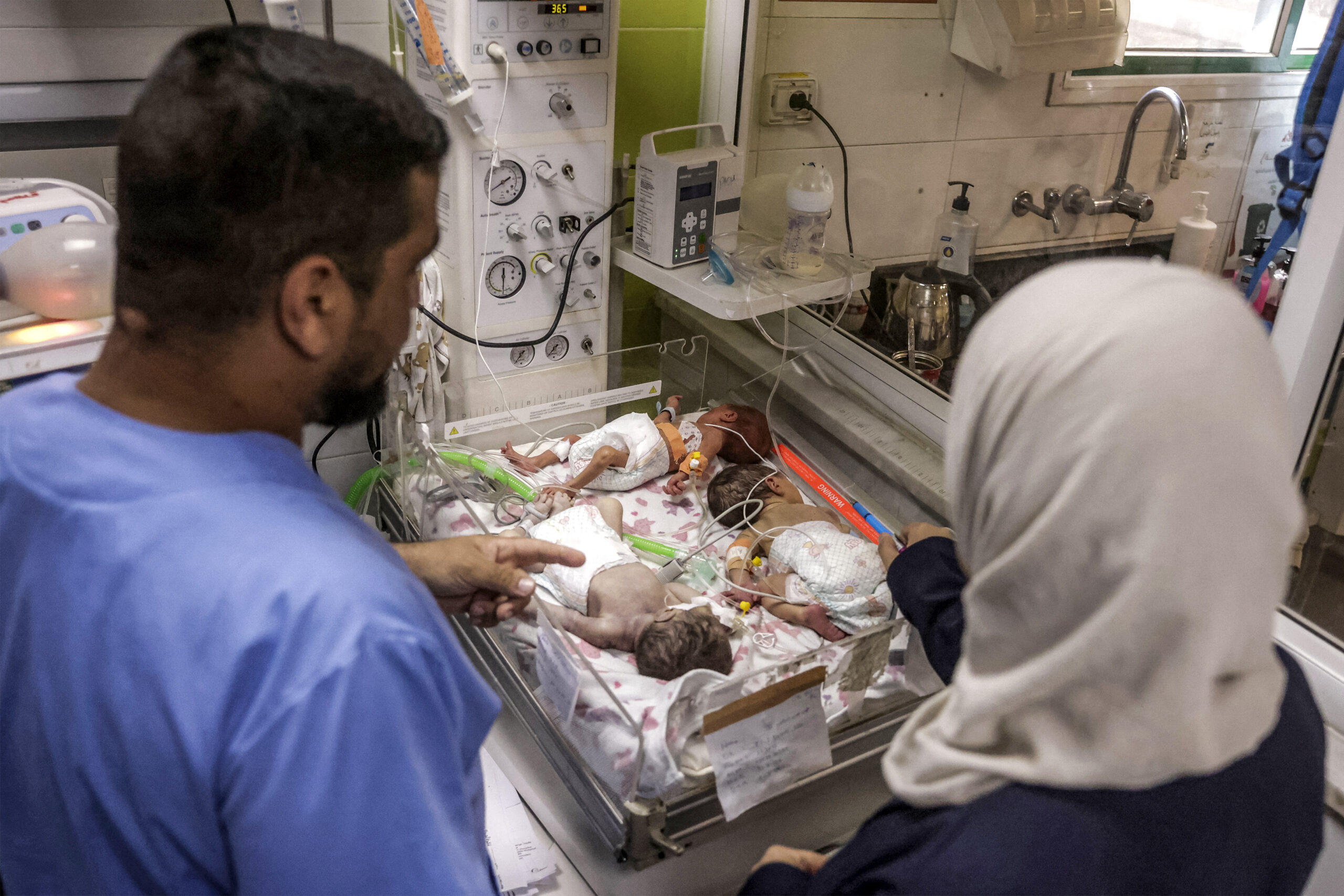
Khan Yunis: As monitors beep and doctors consult near them, two tiny newborns lie silently side-by-side, sharing a single incubator in a southern Gaza hospital running short on space and supplies.
Gaza’s youngest already face an extremely precarious entry into the world, given the dire humanitarian situation in the war-shattered territory that borders Israel and Egypt.
But for babies needing specialist care, such as those born prematurely, the road ahead is even more perilous.
“The situation is dire: there is no oxygen available for them, nor is there any spare incubators in the hospital,” said Hatem Dhahir, head of the neonatal department at Nasser hospital in the southern city of Khan Yunis.
“We’re trying to transfer them to other hospitals, but they’re always full and the situation is very bad. Most of the children need oxygen and are very underweight, and things are going from bad to worse,” he told AFP.
The war between Israel and Hamas has devastated the Palestinian territory’s healthcare system, with many medical facilities rendered completely or partially unusable.
Ongoing Israeli restrictions on goods entering the Gaza Strip mean medical supplies and specialist equipment are also running low.
Dhahir said Nasser hospital had seen a significant increase in the number of premature births in recent months, as well as twins and triplets.
The influx was forcing staff to place two or even three babies in each incubator, he said.
In March, the UN’s humanitarian agency OCHA said that one in three pregnancies in Gaza were high-risk and 70 percent of newborns were premature or underweight.
Incubator sharing significantly increased mortality risks, it said.
‘No room’
Nearly the entirety of Gaza’s population was displaced at least once during the devastating war which started in October 2023.
The fighting flattened swathes of the territory, left hundreds of thousands of people living in tents and temporary shelters and shattered vital infrastructure such as sanitation and access to safe water.
Despite a US-backed ceasefire declared in October 2025, the Israeli military continues to target Palestinians it says are militants.
A UN-mandated inquiry published in June said that severe shortages of food, medical supplies, fuel and the collapse of healthcare services had an enormous impact on maternal health.
“Against this background, rates of miscarriage, stillbirth, low-birthweight infants and congenital defects have increased,” the UN’s Independent International Commission of Inquiry said.
Heart conditions were among three types of congenital defects to have particularly increased, the commission said, citing medical practitioners.
In southern Gaza, Mona Ahmad was accompanying a baby taken to Nasser hospital in late August and diagnosed with a serious congenital defect in which the heart’s two main blood vessels are switched in position.
“We received a final report stating that the baby was suffering from transposed arteries and needed to be transferred, as there was absolutely no treatment available for her here,” Ahmad told AFP.
“The baby spent a full week in the neonatal unit and was discharged because there was no room for her there,” she added.
In a bid to revive Gaza’s neonatal care system, the UN children’s agency UNICEF has scaled up its work to supply medical equipment such as incubators, ventilators and monitors to hospitals.
Including work that began before the ceasefire, UNICEF has supplied 93 incubators to six facilities across the Gaza Strip.
But challenges remain immense and more needs to be done, said Toby Fricker, chief of advocacy and communications for UNICEF Palestine, following a visit to a neonatal intensive care unit in the territory.
For now, “through the pure… resilience of the doctors, of people, things are working,” he said.
Deploying two US carrier strike groups to the Middle East represents a significant concentration of firepower, limiting carrier availability elsewhere. Former head of US Naval Forces Central Command Vice Admiral John Miller told Al Jazeera’s ‘This is America’ it comes at a cost.
Weekly insights and analysis on the latest developments in military technology, strategy, and foreign policy.
The aircraft carrier USS George Washington transited the Arabian Sea today after arriving in the U.S. Central Command (CENTCOM) region yesterday, the command announced via X. The move was designed to relieve the overworked USS Abraham Lincolnand comes as the U.S. continues to maintain a naval blockade of Iranian ports amid ongoing tensions with Tehran. However, the deployment also leaves the U.S. bereft of aircraft carriers in the western Pacific, at least for the moment, highlighting the strain on one of its most important assets for American power projection. Extended deployments across multiple carriers is putting extreme stress on the carrier force and could have major cascading effects as maintenance required to reset these ships after deployments draws on longer than originally planned. At the same time, delays in carrier production could also exacerbate the future availability of the force.
The need to redeploy the Washington from Yokosuka, Japan, where it is based, to the CENTCOM region was sparked by concerns about the condition of the crew of the Lincoln. That carrier reportedly endured grueling conditions amid round-the-clock operations without any liberty port calls since deploying last year. The issue sparked outrage from those worried about the mental and physical health of the sailors and Marines aboard, as well as pushback from U.S. officials who claimed the media was blowing the situation out of proportion.
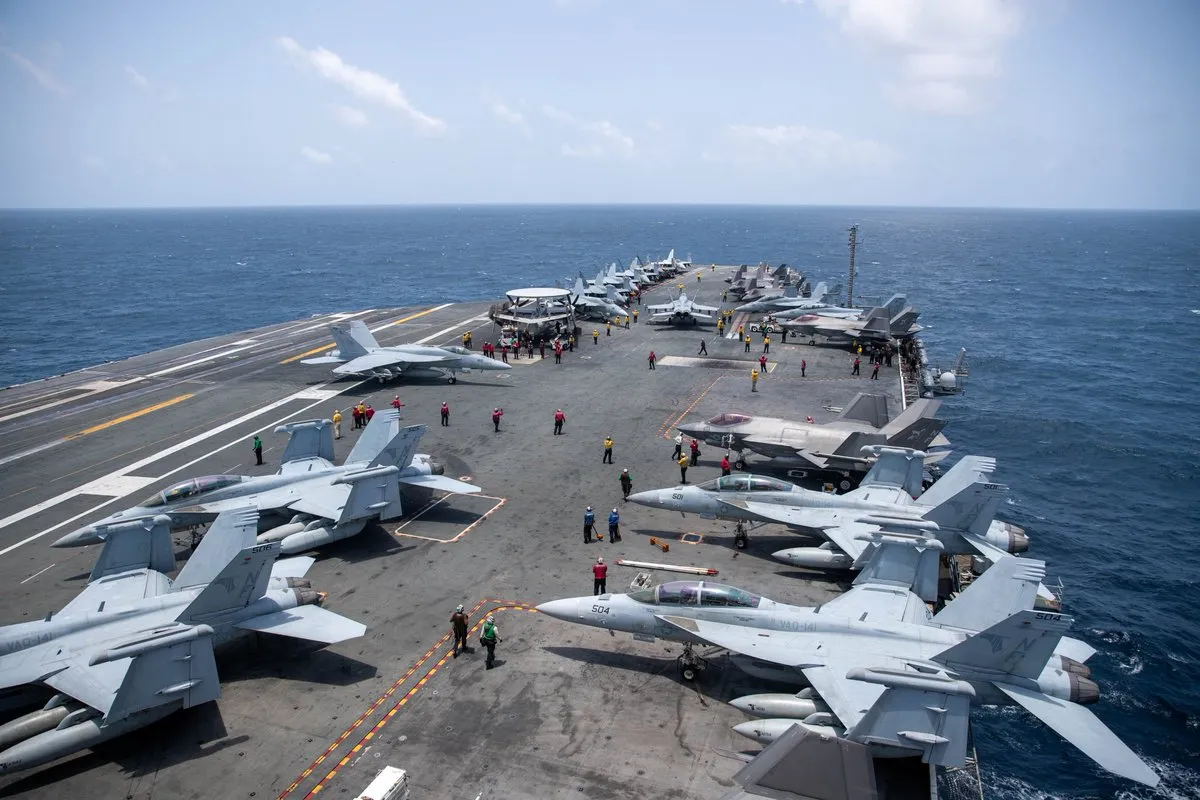
U.S. Sailors work on the flight deck of USS George Washington (CVN 73), Aug. 20, as the aircraft carrier transits the Arabian Sea. The George Washington Carrier Strike Group is operating in Middle East during a scheduled deployment after arriving in the CENTCOM theater yesterday. Source: U.S. Central Command
While the U.S. and Iran have stopped firing at each other, the region remains a tinderbox. Both Washington and Tehran are claiming control over the Strait of Hormuz, and negotiations to end hostilities have broken down.
With the ongoing blockade, as well as CENTCOM’s efforts to move millions of barrels of oil through its preferred southern route close to Oman, there is still a need for the aviation assets provided by carriers and the strike and defensive missile capabilities provided by their escort ships. This is especially true for contingency operations, deterring Iran, and pressuring them to conform to Washington’s demands.
TWZ/IAN ELLIS-JONES
As we noted earlier in this story, all this leaves Adm. Samuel Paparo, the commander of U.S. Pacific Command (PACOM), with no carrier coverage in theater to deter or counter potential PRC or DPRK aggression. Carrier gaps in the Pacific were rare up until 2024, which marked the first time in decades that the U.S. had no flattops in Asia. Though the U.S. military has been largely focused on the Middle East, the PACOM region remains the top concern among many within the national security apparatus, as China is America’s top pacing threat and North Korea remains unpredictable and dangerous. Russian operations in the Pacific are another issue, among a slew of others.
The extended deployment of the Lincoln, and the need to replace it, didn’t just create an issue, albeit temporary, for PACOM. Typical carrier deployments last about six to seven months, a period designed to ensure the ships can maintain readiness and the crews do not get worn out. When that doesn’t happen, it creates a cascading series of problems that affect not just the ships and crews, but the facilities that have scheduled repairs and lined up workers to make them happen.
The bottom line is that the longer these vessels stay out on cruise, the longer they have to stay in on deep maintenance, and past a certain point, the magnitude of this relationship skyrockets. Extra days out can turn into extra weeks in the yard, and so on. With yard facilities at a premium, especially those capable of dealing with a supercarrier, critical schedules can quickly implode, with work stacking up across multiple vessels, resulting in them being sidelined much longer than planned. You can read all about this in our past feature linked here.
For instance, after returning from a historic 11-month deployment, USS Gerald R. Ford transited to Pier 5N at Norfolk Naval Shipyard in July to begin its first post-deployment Planned Incremental Availability (PIA). Ford’s PIA will take longer than initially expected due to the stress from its journey, including a fire the laundry room that raged for more than 30 hours and will require an additional, concurrent availability. This will likely extend its time in dry dock, a situation experienced by the USS Dwight D. Eisenhower after it had an epic deployment. Of note is that the damage to the Ford meant it had to depart the CENTCOM region in March at the height of the war on Iran. That left just one carrier on station, which, ironically, was the Lincoln.
The USS Gerald R. Ford (CVN 78) arrives at the NATO Marathi Pier Complex in Souda Bay, Crete, Greece, during a scheduled port visit on Feb. 23, 2026. (U.S. Navy photo by Mass Communication Specialist 3rd Class Hannah Donahue) Petty Officer 3rd Class Hannah Donahue
There are several other issues being faced by the carrier force as the Navy has had to juggle maintenance schedules to make up for construction delays.
The future Ford class USS John F. Kennedy is not scheduled for delivery until March 2027. JFK just completed Acceptance Trials Aug. 15, following a four-day underway period off the Atlantic Coast. The Navy had originally planned to take delivery of the Kennedy in 2022, but that was delayed until March 2027 “to support completion of Advanced Arresting Gear (AAG) certification and continued Advanced Weapons Elevator (AWE) work,” according to the Navy’s Fiscal Year 2026 budget request. To offset that, the decommissioning of the USS Nimitz was pushed back.
The future USS John F. Kennedy is seen leaving port to begin acceptance sea trials on August 12, 2026. (HII)
As for what carrier capacity is actually available today, four are currently offline or waiting to enter maintenance availabilities.
The USS John C.Stennis moved to complete a Refueling and Complex Overhaul (RCOH) period at Newport News Shipbuilding in Virginia in May 2021. When the contract was awarded to Huntington Ingalls Industries (HII) in February 2021, work was expected to be completed by October 2025, and the downstream effects of the extended delay have rippled across the fleet.
The Nimitz class aircraft carrier USS John C. Stennis (CVN 74) is moved to an outfitting berth in Newport News, Virginia, April 8, 2024. The carrier is in Newport News Shipbuilding conducting refueling and complex overhaul to prepare the ship for the second half of its 50-year service life. (U.S. Navy photo by Mass Communication Specialist 2nd Class Simon Pike) Petty Officer 2nd Class Simon Pike
Nimitz class aircraft carriers typically complete RCOH, a lengthy modernization and maintenance period that includes a nuclear refuel, at the halfway point of their expected 50-year service life. The Navy is rethinking its approach to speed up future such overhauls and cut down on labor requirements, beginning with USS Harry S. Truman.
Truman is pierside in Norfolk, Virginia, waiting to enter RCOH following the Stennis, as only one shipyard on the East Coast is capable of conducting such invasive maintenance.
USS Ronald Reagan is the only carrier on the West Coast that is unavailable to deploy today. It was previously forward-deployed to Yokosuka, Japan, completed a hull swap with USS George Washington in mid-2025 and is currently in dry dock at Puget Sound Naval Shipyard and Intermediate Maintenance Facility in Bremerton, Washington. When the contract for the Drydocking PIA (DPIA) was awarded in 2025, work was expected to be completed by August 2026, and the timeline appears to be on schedule. According to Stars & Stripes, Ronald Reagan is expected to wrap up the 17-month DPIA and return to service by the end of the month.
This leaves three carriers that could be pushed toward the Pacific in an emergency, one of which is largely ready for deployment. The USS Theodore Roosevelt, USS Carl Vinson, and USS Dwight D. Eisenhower, are in various states of readiness and working up in preparation for future deployments. Theodore Roosevelt, which completed COMPTUEX in May before participating in large-scale exercise RIMPAC 2026 over the summer, is expected to deploy in the very near term, and is the most likely to be sent to the Pacific. Also homeported out of San Diego, Carl Vinson pulled out of port on August 10 and is underway training off the West Coast. As of publication. Dwight D. Eisenhower finished a 16-month post-deployment PIA and completed sea trials in April, and most recently returned home on July 27 after conducting an ammo onload with dry cargo/ammo ship USNS Medgar Evers.
TWZ/IAN ELLIS-JONES
Lincoln, as we noted earlier in this piece, is heading home to San Diego after leaving the CENTCOM region, but when it will return to service is unknown. There is an upcoming DPIA scheduled for the carrier, according to Fiscal Year 2027 budget documents, but the timeline is unclear. Based on the history of other lengthy carrier deployments, that could be delayed as well.
So, it’s likely another carrier strike group will be heading toward the West Pacific soon and the gap won’t be a prolonged one, but after multiple prolonged deployments, America’s carrier force may be set up for a larger availability crisis down the line.
Contact the authors: howard@twz.com; ian.ellis-jones@recurrent.io