‘Love Story’ stars see the show as a ‘lens’ on the ‘intensity’ of fame
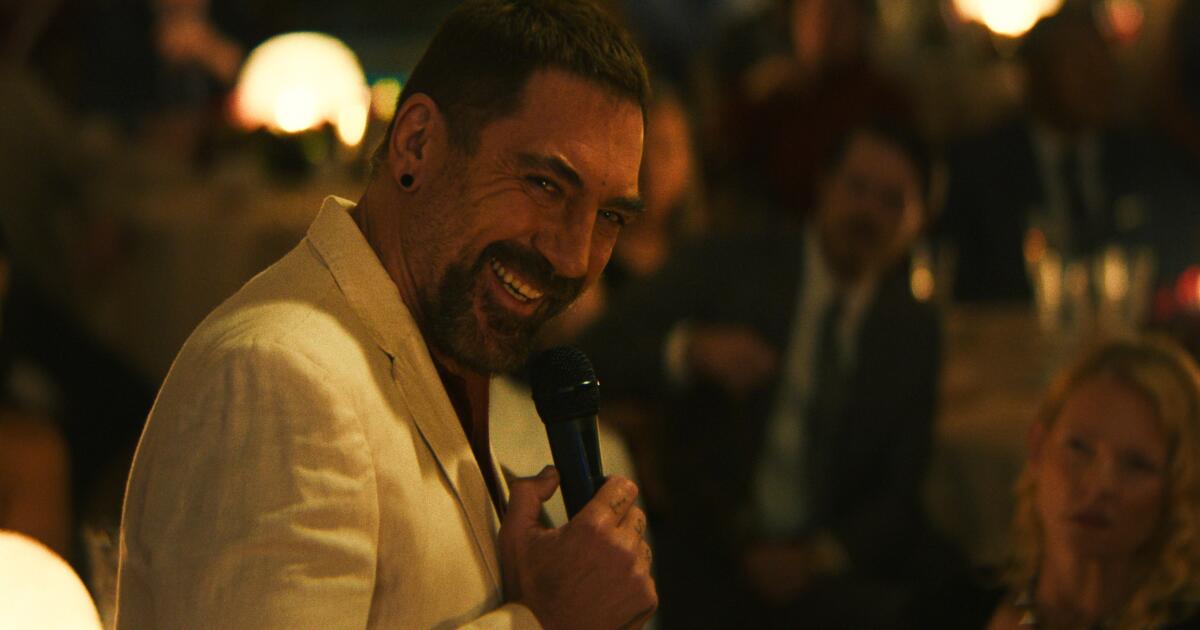
In this week’s episode of The Envelope podcast, “Love Story” stars Paul Anthony Kelly and Sarah Pidgeon open up about inhabiting John F. Kennedy Jr. and Carolyn Bessette — and creating a cultural moment of their own.
Kelvin Washington: Welcome to the next episode of The Envelope, Kelvin Washington alongside Yvonne Villarreal; we got Mark Olsen as usual. And so you, my friend, had a chance to speak with stars of “Love Story” — Ryan Murphy, of course, tackling love with this. So it got me thinking, give me some real-life love stories that you’d like to see portrayed, maybe next season. Some love stories you always found interesting.
Villarreal: This one doesn’t have a tragic ending, and that’s why I want it. And that is Ina and Jeffrey Garten. “Barefoot Contessa”!
Olsen: I didn’t know that there was a great romance in her life.
Villarreal: Mark. You’ve never heard of Jeffrey? You don’t know Ina and Jeffrey. OK, this is why we need it. That man adores Ina and anything that she makes. Chicken, anything. This is a love story I need to see get the full display. I’ve read it in her book, but I need —
Olsen: So like “Julie & Julia.” Julia Child and her husband.
Villarreal: But cuter, sweeter, more adoring.
Washington: Loving the food theme here.
Villarreal: She’ll make anything and he thinks it’s delicious, and she laughs at everything he says, and I just want more of it, and I’m very curious what a Ryan Murphy take on Ina and Jeffrey would be.
Olsen: But see, that’s the thing. A Ryan Murphy take on that would ruin it for you.
Washington: That would be dramatic and spicy. Salacious.
Villarreal: Nothing could ruin it for me.
Washington: You got one?
Villarreal: Yeah, what’s yours?
Olsen: Well, I have two. One is because the sort of the ’90s vibes of “Love Story.” So you would obviously do Kurt Cobain and Courtney Love. And that one would be very exciting and dramatic and very ’90s-ish. But I think for more of a torn-from-the-headlines [version], Taylor Swift and Travis Kelce.
Villarreal: It’s too current.
Olsen: That’s why though.
Villarreal: How about you?
Washington: So I’m gonna stay with your ’90s. Instead of the pop grunge. I’m going to go R&B pop. I’m going to go Bobby and Whitney.
Olsen: I mean, that’s gold right there.
Washington: I’m just saying. You got love, you got fame, you got tragedy. You’ve got stuff that we didn’t know about behind the scenes.
Villarreal: Maybe he could hire us as head writers for each of these seasons and we can all have our say.
Washington: We can all have our own season. So as I mentioned, Yvonne, you had a chance to sit down with Paul Anthony Kelly and Sarah Pidgeon of “Love Story.” How’d that chat go?
Villarreal: They play John F. Kennedy Jr. and Carolyn Bessette, respectively, and it sort of looks at this seven-year tumultuous relationship and what they both endured navigating the spotlight and what that did to them, how they each felt about it. So it was interesting to get the take from Paul and Sarah about how they’re also navigating the spotlight, because I feel like social media fame is quite different than what John and Carolyn were navigating back then. And I was curious to see what it was like for them. So yeah, it was an interesting conversation.
Washington: All right, let’s get into that conversation now.

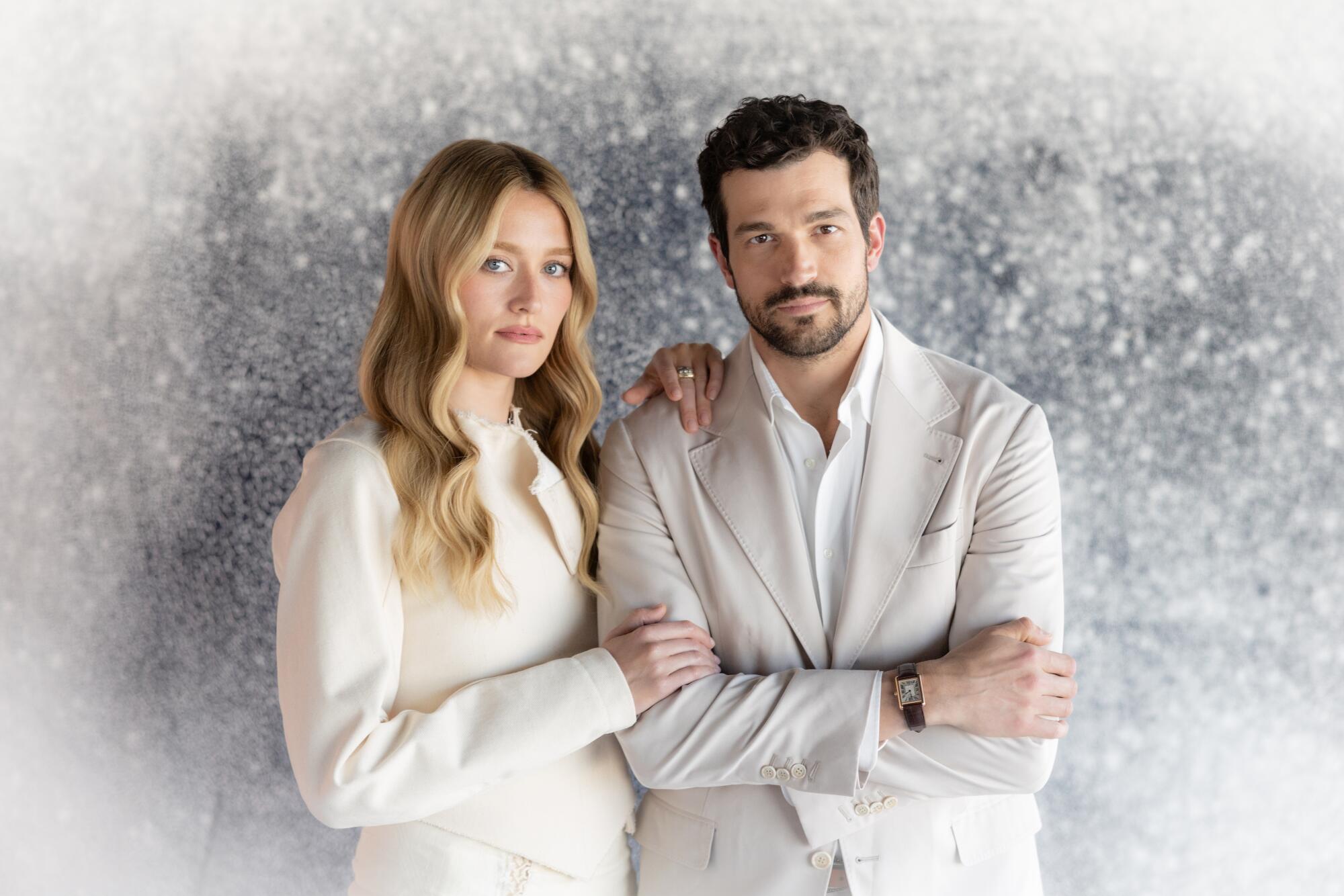
Sarah Pidgeon and Paul Anthony Kelly, the breakout stars of FX’s “Love Story.”
(Jason Armond / Los Angeles Times)
Villarreal: I imagine doing this series has been a sort of singular experience. What do you want to remember about this moment that you’re in?
Kelly: All of it’s so fun, it’s exciting. It’s definitely, for me, a new muscle that I’m learning to use and explore and stretch and flex. And I get to hang out with her a little bit more. It was wonderful.
Pidgeon: I think it’s just really hard to contextualize what this [is] — [to Kelly] I don’t know if you feel this way too — because there hasn’t been a ton of space from even the show having all the episodes come out. I don’t think I totally understand how this fits into the story of my life. I recognize that we’re experiencing something very exciting. And I think I speak for both of us that we feel really grateful and so honored to have taken on these roles and that it’s resonated and has excited people. But being out and about in New York and someone stops you and says, like, “Are you that girl from that show?” … When you’re making something, it can feel so insular. I remember when I started, I had a freak out sort of midway through like, “Oh, this is actually going to come out. It’s not just about the making of it. People will see it.” I had a huge heat rash. [To Kelly] Remember when we were in Hyannis Port? I just haven’t totally had that perspective. It’s just been very full-on in the most exciting, lovely, happy way.
Kelly: It’s all unfolded in succession. There’s been no period of time to really process. I can’t believe I did it, still. It’s out and it’s exactly the same thing … people are like, “Hey, you’re the guy in that thing, right?” I’m like, “Yeah.”
Villarreal: Has it happened in an awkward way?
Kelly: No, no, it’s all been overwhelmingly positive. I guess that’s best-case scenario, but I still try to walk around with a mustache and glasses and a hat and they’re still like, “Hey …!”
Villarreal: You didn’t try to go to the [JFK Jr.] look-alike contest in New York?
Kelly: Oh, my gosh, no.
Pidgeon: He would have won. That wouldn’t have been fair.
Kelly: It’s too many people. I got the show, so I think I already won.
Villarreal: A big theme of the series is exploring the heavy ramifications of fame on privacy. And aside from the great opportunities that come with doing the press or other things that come along with this, what has it been like adjusting your life to this experience?
Pidgeon: That idea was on both of our minds when we were filming. And we were filming in New York, so apart from the scenes and subject material we were exploring, we actually experienced it in real life as well. You have even more characters in a scene when you’re shooting on the streets of Tribeca and people stop and watch. And there was a lot of interest from the public while we were filming. I’ve been marinating on that idea. Maybe not marinating, but meditating. [Or] a little bit of both. Through our characterization of Carolyn and John, I think we felt those extremes. I haven’t felt anywhere close to that. But I don’t know about you [Kelly], but I feel like I’ve been quite busy going different places, coming on podcasts and things like that where my downtime hasn’t really been spent walking the streets so much. It’s been kind of going home and taking a shower and going to sleep.
Kelly: Same. I haven’t really had much time to go out and just be in the public, which I think has been kind of a gift. I recently had a child, so I have no time between the show and being dad. It’s been really great to live within that little privacy bubble I have at the moment. I’m going to New York for the first time in a little while tomorrow.
Villarreal: Has living in their story made you more conscious of what types of boundaries you do want to set?
Kelly: Absolutely. That was a really great gift of the show. And exploring the exponential setting of what privacy means to people, certainly those two individuals. But now I’ve adopted that within my own life, and it’s like, “OK, yeah, I like to be a private person.”
Villarreal: What about you, Sarah?
Pidgeon: So much, at least for Carolyn, was she was constantly battling this sense of how she was being perceived. And I really admire her ability, whether or not she felt the pressure [to do so] — she never spoke on the record and never had to correct the record despite, in my mind, a lot of those allegations being false in the stories about her. That sense of sort of self-possession is quite admirable and, again, this is so new for the both of us. Being able to embody her, that approach and attitude towards it, is something that’s quite interesting to me. And I mean, it definitely has a lot of self-restraint attached to it, so who knows if I possess that as well.
Villarreal: The love story between John and Carolyn, as well as their fateful flight, generated a lot of media attention. And I know you, Sarah, were a toddler, at the time of their deaths; and you, Paul, were a young boy — and you’re a Canadian. What was your image of them in terms of the lore that surrounded them before making the series?
Kelly: Growing up in Canada, I was familiar with who he was. I became even more familiar with them after living in the States for a while. I was a model before, and I had been told I looked like him, so after being told that, you kind of do a little bit of research. Who is this guy? And I was like, “I don’t look anything like JFK.” But then I realized [they meant] JFK Jr. “OK, maybe; yeah, I do look like him a little bit.” So I became more aware of them after that. But growing up, it definitely wasn’t in my cultural zeitgeist, whatever you want to call it.
Pidgeon: I knew that Carolyn worked at Calvin Klein. I knew they were married. I knew their story. I was such a young child when they passed, but they remained so in the cultural conversation because, especially in 1999, they represented such hope in politics. And they’re such a modern couple, sort of breaking the rules of what those norms are, especially coming from such a storied family that has such legacy in the States.
Villarreal: There’s an overwhelming amount of source material from the Kennedy side, but less so on Carolyn. What proved to be most useful to you? What were the things that you turned to to study or figure out who she was?
Pidgeon: That was such a mystery. [I was] taking these still photographs, mainly paparazzi images — and now that I’ve had a few photos taken of myself, you hold yourself differently when you know someone’s taking a photo of you that you also don’t know. That plus videos of her, very few in which she was speaking. And some of the candid photos, mainly from when she was younger. I sort of laid those on top of each other and then used as many books that I could find and interviews that people would give who knew her. But there’s scarcity in terms of that information. That at times felt arresting, but at other times … there’s a lot of freedom in that. And I think that’s what was so interesting about playing this character that is so well known and yet very enigmatic. Finding her walk and thinking about how that changes over the course of nine episodes and six-and-a-half, seven years. How this woman with so much freedom and anonymity — 26 years old, living in New York City, barreling down these streets in the East Village — then changes when she’s the most photographed woman in America. How that perception changes you physically.
Villarreal: Her walk was very striking for me, because I’m like, I can’t move that way.
Pidgeon: Yes you can. You can get a pair of Manolos.
Villarreal: It won’t look as elegant as you, Sarah, but talk to me about finding that walk because, like you said, it shifts from when the onslaught happens. Did you work with a movement coach? Was that all you?
Pidgeon: Julia Crockett is so incredible. There’s not enough hours in the day to sing her praises. We started with a lot of what I just mentioned, the quotes that people said of how she moved. She spoke with her hands. She could be a fast walker — most people who live in New York are. If there was a video of what I was doing in these hotel rooms, they’d think I was absolutely crazy. Rolling around on the floor, isolating different parts of my body, making it as dramatic as possible, and working it into a circle of attention that felt real. And understanding we were both 5-10, which helps. I think tall women carry themselves in a certain way. But understanding that my body is still my body, and our production I don’t think was particularly interested in doing huge physical transformations in terms of prosthetics or things like that. But getting the shoes, walking around in my spare time in New York in heels, which Carolyn does in the show and Sarah Pidgeon does not. That really changes you and it changes how you feel. And just always having that through line of, “What were the touchstones of Carolyn as a young woman, and where did I want her to end up physically?” You can see it through so many different versions in these different photographs — her hair changes, how she dresses changes, the red lip. I [was] always remembering that there was a journey that I was going on: “How can the world close in on her? What does that feel like?” Also, not only putting it into my body first, but feeling it in my body, imagining that. And what are the images that come up? We thought about [her as a] mossy ball; very tactile, just rolling down these hallways in the Roosevelt Hotel in Hollywood.
Villarreal: Paul, you had about three weeks from when you got cast and when production started. And there’s ample stuff to sift through. How did you figure your way out through the noise? What was the thing that really helped you lock in to who he was?
Kelly: He narrates his father’s book, “Profiles in Courage,” and that for me was a great asset. I had to learn how to use my tongue in a different way than I’ve ever spoken before. His speech patterns are different. I worked with a dialect coach. I would listen to that all day, every day — amongst ’90s alt music, some Nine Inch Nails and stuff because that’s what John would do.
Villarreal: Was that what he was into?
Kelly: I think so. One of my favorite photos of him is a candid photo, and he’s wearing a Nine Inch Nails shirt. I’m like, “My guy! Here we go. I can relate.” I watched a lot of his interviews just to see how he kept his cool and composure. He was a very relaxed individual under extreme stress situations. The Larry King interview was a great one; I relied on [it] a lot. I also looked at a lot of images and saw how he moved through the world. I was a model before so I’m pretty good at understanding how my body moves and how to move it; I also worked with Julia pretty briefly, but she gave me some really great tips and I took those throughout the entire duration of filming and just ran with it.
Villarreal: Are you someone that takes bike as your transportation often?
Kelly: Oh yeah. Four wheels moves the body, two wheels moves the soul.
Villarreal: How is it doing it with the suit on?
Kelly: It’s hot.
Pidgeon: Yeah, you did a lot of that in July during a heat wave.
Kelly: Oh, my gosh, when we started filming, the first scene where John is introduced on the bicycle, we shot that on a Sunday and it was like 103 degrees outside and I’m in a ’90s wool suit. It was great … And a hat. And a backpack. There’s a photo where there’s several hands coming at me with fans and spritzer.
Villarreal: How about finding John and Carolyn together? What did that look like for the two of you, figuring out who they were as a couple?
Kelly: I feel like it happened organically. We had like this unspoken bond and trust with each other from the moment we met and it was just like, “OK, we both understand the assignment.” Then we get to step into these shoes and we understand what that was like, I guess, but just going through it together [helped]. It’s also so well written and it is easy to fall into that. It’s very easy to fall in love with this one every day and then fight.
Pidgeon: Oh, you flatter me.
Villarreal: Because you both were so young at the time that they were a couple, were there modern-day couples of your generation that you looked to in terms of how they dealt with the spotlight? Was there someone you were looking to, to help you understand it?
Pidgeon: I think they were pretty singular, especially considering so much of how we view them as a couple was the time in which they existed. I don’t think I can really point to a couple … obviously there’s a comparison with [Princess] Diana, but I can’t really I put my finger on a couple that had the same essence of John and Carolyn, or the same challenges and obstacles of being a couple in public life. [To Kelly] Can you think of anyone?
Kelly: Not really, no.
Pidgeon: It was also that we were coming in on this advent of paparazzi. Obviously coming from such an important family, there was — and I want to speak for you [Kelly] in terms of how you felt about your characterization of JFK Jr. — but there was so much investment in them as a couple because America, and really the world, had watched him grow up. So of course there is this heightened interest in who America’s son marries. And again, that hope that they were this modern couple, one that we’ve never seen before, and what will they become in this new millennium? In terms of finding them together, what was so wonderful about the writing of the show was they were — granted, it happened in about three or four episodes [for the show’s purposes] — but as we were getting to know each other, so were Carolyn and John. They were falling in love with each other and figuring out what that dynamic was and having those misfirings and miscommunications and moments of intensity and questioning. The amount of times I’ve used the word “meta” while talking about the experience of making this show, that sort of mirrored life in a way. I was able to just absolutely give over to Paul and trust him and be excited working with him every single day and be so curious about who John and Carolyn were that day on set. No one better than Paul Anthony Kelly.
Kelly: Oh, you flatter me.
Villarreal: There are a lot of scenes that are stuff that we’ll never know whether they actually happened. But then there are the moments that were played out in tabloids — one of them is the Bryant Park episode. What can you tell me about what that was like shooting on the streets of New York? What do you remember about that experience?
Kelly: What was it, the Nextdoor app called?
Pidgeon: Citizen.
Kelly: The Citizen app. They called it [a] “domestic dispute” … so we were obviously doing our job correctly. It was interesting. Shooting in New York is a very interesting experience because you have all these outliers just watching and gawking. Everyone’s got phones and cameras and what have you. And we’re so in it and doing it and then to have like this blowup argument over and over and again, take after take, angle after angle.
Pidgeon: I wonder if someone reported us just to be like, “Make it stop!”
Kelly: Yeah, exactly. Nobody tried to save you in the moment. Maybe that was them trying to save you [by posting it in the app].
Pidgeon: That was always something to contend with or accept, really, at a certain point. This is an expectation of working in the city. And what I really liked about that scene was that — considering there was such little videography of her, especially because that was a private moment that was unfortunately caught on tape — they both had less inhibitions. I found it [to be] a really amazing exercise as an actor to finally be able to really take something and mimic it exactly and find how the words that Connor [Hines] had written [aligned with it]; it felt like such a great sign when it felt the writing really matched what I physically knew to be true. Because our interest in the story is what happens behind closed doors, as you said. But in those few moments that we did re-create, the real-life [moments], it felt very reassuring as an actor to feel like the words that we were speaking matched the physical footage. I just found it such an exciting way to go about it, to have it really be this outside-in approach. You take this physicality and vocal pattern that I had developed as Carolyn, but then really have some proof for that to be the jumping-off point. I love that we had that scene; we had when they take their first photo after their wedding; we had, in Episode 9, the [Newman’s Own/George Awards] event. Remember that clip that we watched? We’re in the exact same outfits, and I think it’s the Newman’s Own event. I always appreciated those moments. It felt like a different way in to a character that I had really started to get to know at that point.
Villarreal: Whenever I watch something based on a true story or people that were like historical figures, I can’t help but Google to see if something really happened. Is there something you Googled in the process of making the show where you were like, “Did this really happen?”
Pidgeon: There’s a bit of speculation as to how they met. There’s a couple of different stories. Considering this couple was so well known, the fact that there’s still a mystery into how they even met for the first time I think is quite interesting.
Villarreal: I Googled — and I will say I clearly am not the only one that thought this because there was a whole story of it — “Did they really eat KFC chicken?”
Pidgeon: They did.
Kelly: Fine dining.
Pidgeon: You didn’t eat any chicken.
Kelly: Noooo. I got secondhand chicken. That chicken, oh my gosh.
Pidgeon: They did warm it up a bit, but it was pretty cold, you know.
Villarreal: We can’t talk about this show without talking about the wardrobe, the costumes. It’s such a key piece to the storytelling here. Tell me about that collaboration and what the clothes said to you about who Carolyn is and then who John is.
Pidgeon: Yes, clothes are incredibly important to the story and to how most of the public knows and remembers Carolyn. Working with Rudy Mance was so incredible. What he was able to source, while we’re not necessarily sure if they were pieces that Carolyn herself wore, they were the exact pieces of the exact same collection. The very few pieces we weren’t able to source, they were impeccably re-created. Just the attention to detail, I had never really experienced something like that. It was just really watching a master at work, and the rest of our crew as well; not a detail was ever overlooked. The mystery that we really tried to solve in the beginning was: Wow, there’s so many photos of her [from] ’95, ’96 and beyond; there are far fewer photos of what she looked like when she was working at Calvin Klein. And we’re in that space and that time for quite a while. From the photos that we do have of her living in this time in her life, and then how we know she will dress, what are the through lines? What are the pieces she repeats? I don’t think I wore much Prada in the first two, three episodes, which makes sense, because she was just starting out at Calvin Klein. We [had her wear] a lot of Calvin pieces. What was so insightful to playing her was her sartorial choices and her understanding of how, especially since she never spoke on the record, [and] what she can communicate through fashion and how in those initial fittings, even before I really spoke the words of those episodes, how it immediately changed how I held myself as Carolyn was growing and getting older. I keep referencing this quote about Yohji Yamamoto, a designer whom she wore frequently. He liked making the association with his clothing to armor. I just thought that was such a great way into her sort of mental state and how she approached clothing. It was very her, she wore the clothes. That was something that I had to remember, that if I was going to try and embody her, I had [to] feel like I was wearing the clothes because that’s what really stuck out. You always saw her first, despite her wearing some incredibly beautiful clothing. Carolyn was No. 1.
Kelly: John had such great style. Sometimes it was pretty kooky. I also loved that too because it just is such a sense of him. Working with Rudy was a dream. He and his team were incredible. They were able to source so many things. And if they couldn’t find it, it was a direct re-creation, like exact copy of what it was. I remember even just like those shorts with the Knicks logo that he wears playing football. I remember seeing a comment, “John would never wear those.” [Sighs.] “OK, sure.” There’s something about getting into those outfits that it just was this whole other transporting layer of becoming. You hold yourself differently in these things and it just made it feel more real and you’re like, “OK, cool,” and you just live in it and it feels good and you get slouchy and whatever. It was really nice.
Villarreal: How does your style compare? Did they influence your style now?
Kelly: Honestly, it’s a little different, but it’s not that far off. I feel pretty good in a suit. I like to wear suits a lot. I’m the suited heavy metal guy.
Pidgeon: You also have that cool factor about you too. I think there’s something in that with John. He looked great in a suit, he looked great in a tux, but then there was a bit of an edge to him. There was bit of a realness, I think, that you guys share.
Villarreal: Everyone’s trying to emulate it. So many TikToks of people trying to re-create it. Sarah, do you feel like you can never go back to brunette now? Like this is your thing now? You have to stick with it?
Pidgeon: The blond seems to be working. I like being a different hair color. I don’t think I’ll be blond forever. Simply too much time [involved]. It’s so much work. My colorist is amazing — Kari Hill. Cannot sing her praises enough. And Alex Pardoe, who does extensions. It’s been really interesting to find how I [am as a blond] — so much of my time being blond was embodying Carolyn. [Paul and I] would both sleep on the weekends. We wouldn’t do anything while we were shooting. So I didn’t really get a chance to take a walk in this new hair. And when I started dressing again, to go out, I would put on my favorite clothes from when I was brunette. It’s like, “Oh, it just doesn’t hit.” It’s been cool to see how I present and how color theory is crazy. But we’ll see, I guess it depends on how much time I have on my hands.
Villarreal: The series really grapples with the media invasion that swirled around them. What do you say to the critics that feel that a show like this either reignites that craze or contributes to it? What do you want the takeaway of a show like this to be?
Pidgeon: Thinking about one of the first questions you asked — how are we now dealing with with being potentially recognized — I think the intensity of interest in famous people, famous couples, celebrity, actors, musicians, you name it, artists, it’s changed shape, but it has never gone away. Our intention in making this show was, again, what we know about their lived reality, but what can we infer might have happened behind those closed doors. To the general public, [they were] sort of two-dimensional … I knew very little about Carolyn, but I ingested so many photos of her far before this project was ever on my radar. While I recognize this may have contributed to reigniting interest in them, I hope that that interest feels like there’s a more intimate understanding of these people; that they weren’t just figures, that they were people with very full lives, feelings, a profound sense of privacy, intense relation to each other, very, very human. I guess that would be my answer to that. I hope that this is also a bit of a lens or a mirror that, again, if that intensity hasn’t changed, how might we [change it] in the future?