Airmen Under Fire: Stories From Iranian Barrages On U.S. Bases
Air Force Chief of Staff Gen. Kenneth S. Wilsbach offered some new insights on Monday into the challenges faced by airmen during Operation Epic Fury as Iranian missiles and drones rained down on them. His comments came during a keynote speech at the Air & Space Forces Air, Space and Cyber Symposium that TWZ is attending.
“Since becoming the chief, I’ve had the privilege of spending time with airmen throughout CENTCOM [U.S. Central Command],” said Wilsbach, who assumed the position in November. “I have walked flight lines, visited maintenance hangars, and stood inside operations centers where young Americans were managing missions overhead. Let me tell you about a few courageous airmen I met on my recent trip to the Middle East. They told me about their experience on the flight line during an attack.”
Burning Hangar
“As missiles were inbound, airmen sprinted toward bunkers,” the service chief said, without providing details about which base. “Moments later, a missile struck nearby in a hangar, and the aircraft inside burst into flames. The bunker withstood the blast, but the force of the impact damaged the door so badly it wouldn’t open, trapping the airmen inside.”
“Picture the scene,” Wilsbach explained. “Fire was spreading, an aircraft was burning only feet away, their teammates were trapped inside, and they had no way out. Despite the danger, airmen ran toward the flames.”
“A security forces NCO grabbed a pry bar and forced the door open,” he continued. “Calmly communicated with the airmen trapped inside. Seconds later, the ejection seat on the burning aircraft ignited, sending glass and metal fragments through the air. Finally, the door gave way, and the airmen escaped and ran for cover.”
“Wherever I went, I saw airmen with that steely-eyed look of warriors, determined to get the mission done and protect their fellow airmen,” the chief noted. “More than 30,000 airmen deployed in support of Epic Fury to a dozen locations. They served alongside soldiers, sailors, Marines, Guardians, and Coalition partners.”
Launching F-15Es Under Fire
“Operation Epic Fury will be studied for its scale, precision, and speed,” said Wilsbach. “Over 38 days of combat operations, the Joint Force struck more than 13,000 military objectives. Five hundred aircraft executed 10,000 sorties, an average of more than 250 sorties every day. Our airmen accomplished this through 1,200 alarm reds while executing 48 airfield repairs and completing more than 420 reportable explosive ordnance disposal, long lonely walks.”
“That walk is exactly what the name suggests,” Wilsbach proffered. “EOD technician leaving a place of relative safety and approaching a suspected bomb or unexploded munition to render it safe for everyone else.”
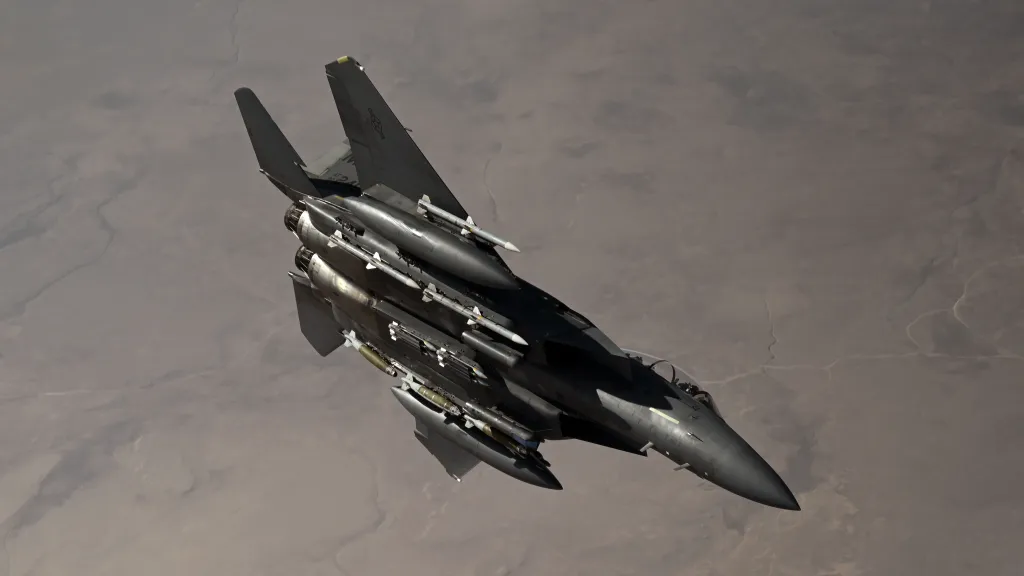
“Behind those numbers were thousands of decisions made by airmen who had to keep the mission moving while the enemy was actively trying to stop them,” Wilsbach stated. “One was Garrett, a staff sergeant F-15E crew chief from East Texas. He joined the Air Force to travel and see the world. We sure allowed him to achieve that goal, but I’m not sure the Middle East was exactly what he had in mind. On the second day of Epic Fury, Garrett was on the flight line launching four Strike Eagles when alarm red sounded. Airmen around him started running for shelter. Garrett’s adrenaline spiked. He knew exactly what that alarm meant. Danger was inbound, but his launch was not complete.”

“A young airman was working with him, and Garrett sent him to the bunker,” the service chief continued. “Garrett stayed. The rest of the team was separated, so he armed the weapons and cleared the jet. Proceed… While everyone else ran for cover, he decided to stay. Garrett understood why those Strike Eagles were in theater. He knew they were one of their best lines of defense, so he stayed until the job was done. Only after the last fighter taxied out, Garrett finally took cover. Later, when someone asked why, his answer was simple: his fellow airmen needed those airplanes in the air.”
Swatting Down Drones Under Fire
“Hundreds of miles away, two senior airmen, Shanae and Nolan, tracked a swarm of enemy drones headed toward their base,” Wilsbach pointed out. “Shanae joined the Air Force to provide for her family. During the opening days of Epic Fury, she found herself protecting another family – the hundreds of airmen depending on her.”
“People sprinted for shelter as alarm red announced an incoming attack, but Shanae and Nolan stayed focused on the screens in front of them because every inbound track could be a weapon aimed at their teammates,” the general said. “Shanae is 27 years old, and Nolan is 21. Think about the responsibility we placed on these two airmen. Hundreds of lives depended on them to identify the threats and employ countermeasures. Every second mattered. The stakes were life and death. Together, Shanae and Nolan achieved more than 10 surface-to-air kills that night, defeating threat after threat before it could reach the airmen they were protecting. There were moments when they were afraid, and most people would be, but courage is not the absence of fear. Courage is overcoming it. They stayed locked on, trusted their training, and did the job everyone around them was counting on.”
Picking Up The Pieces After An Attack
“Peter is a senior airman from New York who spent nine months in the Middle East as an air transportation airman,” Wilsbach said. “With his team, he moved heavy ordnance, prepared missile systems, and downloaded Patriot equipment, while ballistic missiles and attack drones repeatedly target their airfield.”
“One of those attacks became very personal,” the service chief noted. “Enemy fire destroyed Peter’s living quarters and nearly everything he had brought from home. Imagine coming back after a 12-hour shift to find the wreckage of your hooch. The few pieces of home he carried halfway around the world were gone. Peter’s response told me everything I needed to know about him. He said that his possessions could be replaced, but the mission could not.”
Keeping The Reapers Flying
“More than 4,000 dynamic targets had to be found, identified, validated, and engaged,” Wilsbach said. “Remotely piloted aircraft, airborne ISR platforms, cyber operators, space professionals, and countless others turn enormous amounts of data into intelligence commanders could use.”
“Suit is a first lieutenant with a family tradition of excellence,” Wilsbach said of one MQ-9 Reaper pilot. “Both of his grandfathers served in the Army. I’m sure they wanted a better life for their kids, which is why his parents chose the Air Force. Today, Suit flies the MQ-9 and carries his family tradition forward. He also scored a perfect 100 on its physical assessment this year, so apparently excellence runs in the family.”

“MQ-9s flown by pilots like Suit supplied critical ISR and kinetic strike capabilities, launching them from bases within range of enemy fires,” said Wilsbach. “Suit planned and launched an MQ-9 combat sortie during an active attack. While missiles hit the airfield, Suit taxied out and got his Reaper airborne. He handed off control to another crew, then switched to the ground control station to recover a different MQ-9. His crew destroyed a priority target and then turned their sensors back toward their own airfield to inspect the runway for damage and determine whether operations could continue.”
“The MQ-9 was a workhorse for combatant commanders during Epic Fury. It provided real-time intelligence, struck 860 targets, and gave our forces the edge while denying the enemy freedom of movement. Airmen-like Suit made sure this asset stayed in the fight and maximized its impact. The MQ-9 success demonstrates the need for a capable follow-on aircraft that achieves the same effects with greater survivability, adaptability, and at a lower cost.”
Rescuing An F-15E Crew Shot Down Over Iran
“Peaches is an air battle manager from Texas,” the chief stated. “During Epic Fury, she found herself in the middle of a story of her own her family will be telling for generations. Peaches led 134 joint and coalition operators responsible for command and control across a complex battle space. Her team supported operations involving more than 1,000 one-way attack drones and 1,200 enemy ballistic missile threats. Those numbers are difficult to comprehend, but for Peaches, command and control was not a collection of symbols moving across the screen.”
“Every symbol represented something real: an aircraft, a threat, a crew, an airman,” he explained. “It was during this time two of those airmen became isolated inside of Iran. What followed became one of the defining moments of the operation. Over 50 hours, Peaches was one of the many who coordinated the combat search and rescue effort, leading her team to integrate 176 aircraft, fighters, bombers, tankers, intelligence platforms, and Air Force Special Operations Command forces that converged on one objective: bringing those Americans home.”
“Think about the complexity of that problem,” Wilsbach noted. “Aircraft operating at different speeds, altitudes, fuel states, with different sensors, weapons, and responsibilities, while an adversary was actively trying to stop them. Maintenance teams generated additional fighters. Tanker crews extended the range and endurance of the force, intelligence professionals track the threats. AFSOC [Air Force Special Operations Command] airmen brought specialized capabilities need[ed] to reach out to our isolated teammates and get them out. Every one of those airmen was doing something different, yet all were contributing to the same mission.”
“The Dude 44 rescue demonstrates why integration matters,” Wilsbach added. “To someone outside of our profession, committing that much combat power to recover two people might appear extraordinary. To an airman, the reason is simple: we make a promise to one another in our Airman’s Creed. I will never leave an airman behind. If you are isolated, injured, or trapped behind enemy lines, we are coming to get you. The courage and performance displayed during that mission was so impressive that 10 airmen received battlefield promotions. I had the distinct honor of promoting six of those heroes, ranging from staff sergeant to chief master sergeant during a recent trip. Everyone understood that their success depended on someone else doing their job. That is how our air and space forces fight.”
Contact the author: howard@twz.com